Divorce increases the risk of emotional, behavioural, and social maladjustment in children (e.g., Amato, Reference Amato2001; Amato & Cheadle, Reference Amato and Cheadle2008; Kim, Reference Kim2011; Stallman & Sanders, Reference Stallman and Sanders2007). For some children, these effects persist for many years (Kim, Reference Kim2011), even into adulthood (Amato & Sobolewski, Reference Amato and Sobolewski2001; Gilman, Kawachi, Fitzmaurice, & Buka, Reference Gilman, Kawachi, Fitzmaurice and Buka2003). Although there has been debate as to whether divorce continues to have negative impacts on children, given societal shifts in attitudes towards divorce (Thornton & Young-DeMarco, Reference Thornton and Young-DeMarco2001), a recent analysis of population data suggests that this relationship continues (Gähler & Garriga, Reference Gähler and Garriga2013). Although the components of intervention programs that have been designed for divorced parents to promote child adjustment vary, most have focused on aspects of parents’ mental health, conflict between parents, and/or parenting style (Geasler & Blaisure, Reference Geasler and Blaisure1998). In order to develop more effective parenting programs to ameliorate the impact of divorce on children, the parenting mechanisms by which divorce negatively affects children need to be identified. To date, research has largely focused on three key parent-related aspects that influence a child's adjustment following divorce: parental mental health adjustment, parenting style, and conflict between parents. The aim of this study was to examine the relative contributions of these three factors on children's emotional problems, behavioural problems, and social relationships.
Divorce is accompanied by changes in almost all domains of a family's life — emotional, social, residential, and financial. These changes are especially pronounced and stressful for parents, as they have the challenge of needing to be emotionally sensitive and responsive to their child during a time of upheaval, in addition to managing their own emotions and stress. Given this, it is not surprising that parents who are separated or divorced experience lower levels of psychological wellbeing, including elevated symptoms of depression, anxiety, and stress, than married parents (Afifi, Cox, & Enns, Reference Afifi, Cox and Enns2006; Australian Bureau of Statistics [ABS], 2006; Lizardi, Thompson, Keyes, & Hasin, Reference Lizardi, Thompson, Keyes and Hasin2009).
There is a wealth of literature showing that parental mental health influences child behaviour (e.g., Foster et al., Reference Foster, Webster, Weissman, Pilowsky, Wickramaratne, Rush and Kornstein2008; O'Connor, Heron, Golding, Beveridge, & Glover, Reference O'Connor, Heron, Golding, Beveridge and Glover2002), and research indicates that this is also the case for children whose parents are divorced (e.g., Donald, Dower, Correa-Velez, & Jones, Reference Donald, Dower, Correa-Velez and Jones2006; Dube et al., Reference Dube, Anda, Felitti, Chapman, Williamson and Giles2001). Emotional distress in divorced parents has been found to put children at risk of psychological problems beyond the divorce itself (e.g., Lizardi et al., Reference Lizardi, Thompson, Keyes and Hasin2009). A large Norwegian study of adolescents (13–19 years), for example, found that parental divorce and parental distress (a combined measure of depression and anxiety) contributed independently to predicting adolescent depression and anxiety (Storksen, Roysamb, Holmen, & Tambs, Reference Storksen, Roysamb, Holmen and Tambs2006). In looking specifically at the prevalence of adolescents with substantial distress symptoms, rates were lowest among those with non-distressed, non-divorced parents (14%), moderate for youth with a parent who was divorced or distressed (approximately 20%), and highest for youth with a divorced and distressed parent (30%). This indicates that parental distress post-divorce adds to the risk for psychological problems, especially emotional symptoms, in their offspring.
Unfortunately, most of the previous literature surrounding the influence of parental mental health on child adjustment has predominantly focused on parental distress, including depression, anxiety, and stress. Other areas of parental adjustment related to relationship breakdown, such as anger and hostility, have been relatively understudied (Dreman, Spielberger, & Darzi, Reference Dreman, Spielberger and Darzi1998). This is particularly important for parents’ anger, as parental anger is acknowledged as playing an important role in how parents approach the parenting task, such as in reacting to their child's problems (e.g., Sedlar & Hansen, Reference Sedlar and Hansen2001). Thus, a broader conceptualisation of parental adjustment that includes anger is needed if we are to understand how parent and child adjustment relate. There is some evidence that mothers’ state anger, for example, remains heightened even several years post-divorce (Dreman et al., Reference Dreman, Spielberger and Darzi1998) and that this anger is detrimental to their overall adjustment (e.g., self-esteem; Dreman et al., Reference Dreman, Spielberger and Darzi1998; Emery, Reference Emery2011). Furthermore, there is some evidence that parental anger is linked to child behaviour (Dreman & Aldor, Reference Dreman and Aldor1994). As such, both parental distress (an indicator of internalising symptoms) and anger (an indicator of externalising symptoms) were considered as part of parental mental health adjustment in this study.
Another well-documented risk factor for childhood maladjustment is interparental conflict. Conflict between parents is an almost universal experience for parents who divorce as they separate themselves emotionally, financially, and physically from their former partner and attempt to establish a new family life (Stallman & Sanders, Reference Stallman and Sanders2007). Even years after divorce, up to 12% of couples continue to engage in high levels of conflict, unable to resolve anger or hateful feelings (King & Heard, Reference King and Heard1999). Conflict is thought to impair the ability of parents to separate their own needs from those of their children, establish co-parenting arrangements, maintain good parent-child relationships, and be able to renegotiate with their former spouse on an ongoing basis without the need for litigation (Stallman & Sanders, Reference Stallman and Sanders2007). This conflict is thought to account for a large part of the increased risk of psychopathology in children who have divorced parents, as there is strong evidence that conflict negatively impacts on a child's emotional, behavioural, and social adjustment (Amato & Cheadle, Reference Amato and Cheadle2008; Christophersen & Mortweet, Reference Christophersen, Mortweet, Christophersen and Mortweet2003; Garber, Reference Garber2004; O'Connor & Dvorak, Reference O'Connor, Dvorak and Shohov2002; Strohschein, Reference Strohschein2012).
In addition to this direct effect of conflict on children, conflict may also act to undermine the quality of parenting, the affective responsiveness of parents to children, and styles of discipline. For example, conflict may impact on parenting quality by draining parents’ emotional energy and interfering with their ability to respond sensitively to their child (Ruschena, Prior, Sanson, & Smart, Reference Ruschena, Prior, Sanson and Smart2005). Adding to the possible effects of conflict, divorce may also have a more direct impact on disrupting parenting style. For example, during the divorce process and following divorce, parenting practices may be disrupted through decreases in monitoring, positive attention, and emotional availability (Anderson, Lindner, & Bennion, Reference Anderson, Lindner, Bennion, Hetherington and Clingempeel1992; Brody, Neubaum, & Forehand, Reference Brody, Neubaum and Forehand1988; Capaldi & Patterson, Reference Capaldi and Patterson1991; DeGarmo, Forgatch, & Martinez, Reference DeGarmo, Forgatch and Martinez1999; Peterson & Zill, Reference Peterson and Zill1986; Vuchinich, Vuchinich, & Wood, Reference Vuchinich, Vuchinich and Wood1993), as the single parent takes on more paid employment and tasks that were previously shared. To the extent that divorce disrupts parenting quality, consequences for the child's adjustment are likely to be seen.
However, not all research has consistently documented differences in parenting style after divorce. Whereas several longitudinal studies have found increases in inconsistent discipline and reduced affection and emotional availability among divorced versus non-divorced parents (Kasen, Cohen, Brook, & Hartmark, Reference Kasen, Cohen, Brook and Hartmark1996; Lengua & Sandler, Reference Lengua and Sandler2000; Sutherland, Altenhofen, & Biringen, Reference Sutherland, Altenhofen and Biringen2012), others have shown no difference between the parenting styles of divorced and non-divorced parents (Ruschena et al., Reference Ruschena, Prior, Sanson and Smart2005; Strohschein, Reference Strohschein2007). Still, regardless of the extent to which parenting style is negatively affected by divorce, problematic parenting is related to increases in child emotional, behavioural, and social problems in children with divorced parents (e.g., Sutherland et al., Reference Sutherland, Altenhofen and Biringen2012). Thus, it is important to consider the contributions of parenting style to children's adjustment following divorce.
In sum, children of divorced parents are at risk for emotional, behavioural, and social problems, and research on parental factors that are linked to these increased problems indicate that parental mental health, co-parenting conflict, and parenting style are all linked to this increased risk. However, most of the available literature has predominantly examined one or two or these parenting factors on a specific aspect of child outcome (e.g., the impact of parental conflict on youth depression), rather than the possible combined effects across the major domains of children's adjustment. This means that there is little evidence on how parenting style, parental adjustment, and co-parental conflict each contribute unique variance to predicting adverse outcomes for children across the major domains of emotional, behavioural, and social problems following divorce. Furthermore, little research has examined how parental anger, which is an important part of parental adjustment that has implications for parenting, relates to child outcomes in divorced families. Such a study will further our understanding of how divorce affects children, as well as aid in designing effective parenting programs that focus on changing parenting characteristics that are contributing most strongly to the child's adjustment. With this in mind, our study aimed to evaluate how parenting style, parental adjustment (including both distress and anger), and co-parental conflict contribute to the emotional, behavioural, and social adjustment of children.
Method
Participants
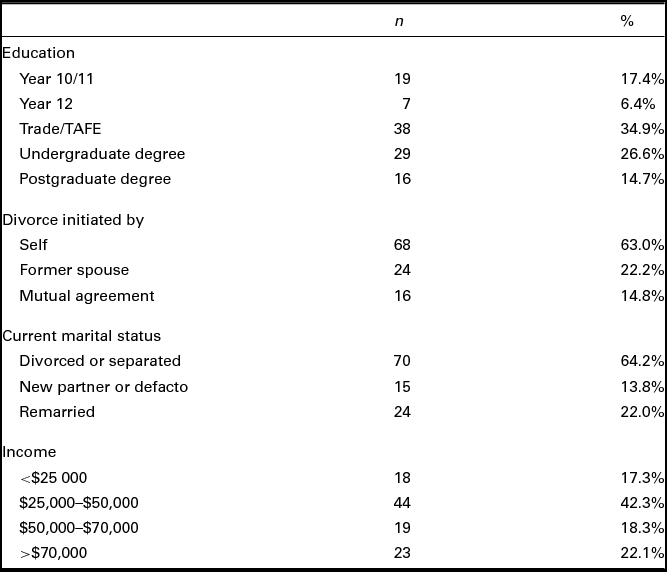
Participants were 109 divorced parents (n = 96 mothers) with a child aged between 4 and 17 years. All parents were biological parents of the child reported on. Parents’ ages ranged from 26 to 57 years, with a mean age of 41.1 years (SD = 6.2). Most parents (86%) listed Australia as their place of birth, 6% the United Kingdom, 3% New Zealand and six participants each listed another country. The majority of participants were living in New South Wales (51.4%), with 16.5% from Western Australia, 13.8% from Queensland, 9.2% from Tasmania, 8.3% from South Australia, and 0.9% from Victoria. The mean time since divorce was 5.2 years (SD = 4.0), with 29% having divorced in the previous 2 years, 33% within 3 to 5 years, 22% within 6 to 10 years and 16% more than 10 years. The average marriage duration of the participants was 11.3 years (SD = 6.4), with an average of 2.3 (SD = 1.2) children from the marriage. At the time of the survey, the average number of children in the current household was 2.4 (SD = 1.0). Parents reported on 67 (62%) boys and 42 (38%) girls. The mean child age was 11.7 years (SD = 3.4). A majority of both fathers (77%) and mothers (75%) were employed. Table 1 shows additional education and income demographic characteristics of parents.
Sociodemographic Characteristics of Parents

Measures
Sociodemographic variables
Sociodemographic variables were assessed using a family background questionnaire that included current marital status, parent age, education level, income, number of hours worked, number of dependent children, time since separation, sex and age of child, and relationship to the child.
Child behaviour
The Strengths and Difficulties Questionnaire (SDQ; Goodman, Reference Goodman1997) is a brief parent-report behavioural screening questionnaire about children aged 4–16 years. It measures both positive and negative behaviours across five domains, generating scores for emotional symptoms, conduct problems, hyperactivity, peer problems, and prosocial behaviour. These can be combined to form three second-order factors — internalising problems (emotional symptoms and peer problems subscales), externalising problems (conduct problems and hyperactivity subscales), and prosocial behaviour (prosocial behaviour subscale). Because these second-order factors are recommended for use with community samples (Goodman, Lamping, & Ploubidis, Reference Goodman, Lamping and Ploubidis2010) and were germaine to our research questions, we used these scores in our study. The SDQ second-order factors have good reliability and validity (Goodman et al., Reference Goodman, Lamping and Ploubidis2010) and had adequate internal consistency in this sample (α = .76 for internalising problems, α = .72 for externalising problems, and α = .82 for prosocial behaviour).
Parenting style
The Parenting Scale (PS; Arnold, O'Leary, Wolff, & Acker, Reference Arnold, O'Leary, Wolff and Acker1993) is a 30-item, self-report measure of parenting style that assesses three dysfunctional discipline styles used by parents: laxness (reluctance to impose limits), over-reactivity (a tendency to react strongly to small or minor child problems), and verbosity (use of lectures and lengthy explanations). For children aged 10 years and older, a 13-item adapted version of the scale is recommended (The Parenting Scale—Adolescents [PSA]; Irvine, Biglan, Smolkowski, & Ary, Reference Irvine, Biglan, Smolkowski and Ary1999) and was used in this study for parents with a child aged 10 to 17 years. The PSA includes items from the PS, worded for teens, and the same 7-point Likert rating scale. However, the PSA differs from the PS in that a two-factor model — laxness and over-reactivity — best fitted the data (Irvine et al., Reference Irvine, Biglan, Smolkowski and Ary1999). Even in younger children, the verbosity factor is considerably weaker than the other two subscales and failed to show significant differences between clinical and non-clinical families (Arnold et al., Reference Arnold, O'Leary, Wolff and Acker1993). The verbosity subscale also had very poor internal consistency in our sample (α = .01), and as a result we did not use it in this study. Thus, we used the over-reactivity and laxness subscales, which both had good internal consistency in our study for younger children (α = .86 and .77 respectively) and for adolescents (α = .82 and .87 respectively). The score for each subscale is the average of responses on all items of each measure, which enabled the scores of the two versions (i.e., child and adolescent) to be analysed together.
Parental adjustment
The Depression Anxiety Stress Scales (DASS; Lovibond & Lovibond, Reference Lovibond and Lovibond1995) is a widely used self-report measure that asks individuals to rate 21 items of depression, anxiety and stress on a 4-point Likert scale. Scores can be calculated for each of three subscales (depression, anxiety, and stress) or as one broader scale indicating ‘distress’. Generally, most studies using the DASS use the overall summative distress score, as the three subscales are highly correlated and the internal consistency is very high (see Lovibond & Lovibond, Reference Lovibond and Lovibond1995). Similarly, the correlations between subscales in our sample were also very high (ranging from .56 to .78), which is not recommended due to multicollinearity and the potential to inflate error terms (Tabachnick & Fidell, Reference Tabachnick and Fidell2007). Following recommendations by Tabachnick and Fidell (Reference Tabachnick and Fidell2007), we considered the overall distress score only, which had excellent internal consistency in our sample (α = .95).
Parent anger
The State Trait Anger Expression Inventory (STAXI-2; Spielberger, Reference Spielberger1999) is a 40-item measure rated on a 4-point Likert scale that was used to assess state and anger expression. State and anger expression subscales were used in this study as they best capture situational anger in the post-divorce period. The State Anger scale assesses the intensity of anger as an emotional state at the particular time, whereas the Anger Expression Index is an overall measure of total anger expression. The subscales have excellent internal consistency in this sample for state (α = .88) and expressed anger (α = .91).
Co-parent conflict
The Acrimony Scale (AS; Shaw & Emery, Reference Shaw and Emery1987) is a 25-item self-report measure of conflict between separated or divorced parents that yields a single acrimony score (the mean of all items), with higher scores indicating greater conflict and more co-parenting difficulties. Items are rated on a Likert scale from 1 (almost never) to 4 (almost always). The Acrimony Scale has been found to have good test–retest reliability (Emery et al., Reference Emery, Laumann-Billings, Waldron, Sbarra and Dillon2001; Shaw & Emery, Reference Shaw and Emery1987) and showed good internal consistency with this sample (α = .92).
Procedure
This study received ethical clearance from The University of Queensland Human Research Ethics Committee. It used convenience sampling and a cross-sectional research design. All Australian primary and secondary schools with a publicly listed email address were contacted by email, with an explanation about the project and a request to disseminate the information advertising the study about divorced parents to their school community in their regular school newsletter. No data were available about how many schools disseminated the information, although there were parents from all states. As the study was placed online using Qualtrics survey software, a link to the study website was provided in the advertising. Interested parents logged on to a website that provided an information sheet outlining the study. After reading this information, parents were asked to indicate consent by clicking on an ‘I consent’ button, in which case the parent then progressed to the study survey. An ‘I do not consent’ button was also available, in which case the survey did not open. As the study aimed to evaluate factors that affected negative outcomes for children, parents were asked to respond to child-related questions based on the child who had more problems, if they had more than one child.
Results
Predictor (independent) and outcome (dependent) variables were examined for normality of distributions. For all variables, skew and kurtosis were within acceptable limits (Tabachnick & Fidell, Reference Tabachnick and Fidell2007). We then checked for outliers, which were defined as scores in excess of 3 standard deviations from the mean on each scale. To check for potential covariates, the relationships between parent and child demographic and the dependent variables were tested. None were significant and therefore these were not included in further analyses.
Sample Characteristics
A multivariate analysis of variance was used to evaluate age and sex differences for parent-reported child psychosocial adjustment on the SDQ second-order factor scores in this sample (i.e., for the internalising problems, externalising problems, and prosocial behaviour scales). There were no significant multivariate differences in behavioural problems between younger children (4–9 years, n = 33) and older children (10+ years, n = 76) in adjustment F(7, 100) = 1.83, p = .09, or between boys and girls, F(7, 101) = 1.10, p = .37. All data were therefore analysed as a single group.
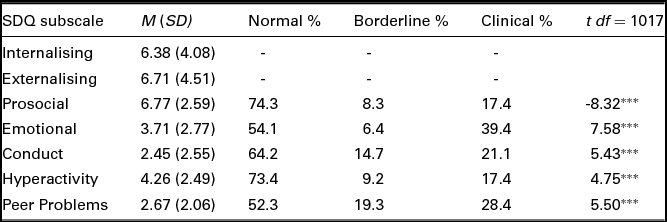
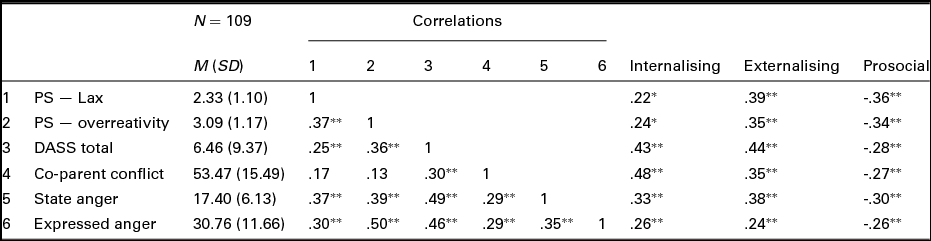
The means and standard deviations for each first and second order subscales and the percentage of the sample in the normal, borderline and clinical ranges of the SDQ are shown in Table 2. Because no data are available for the normal and clinical ranges for the second-order subscales, these are only provided for the first-order subscales. The means and standard deviations for the independent variables are shown in Table 3.
Percentage of Children in the Normal, Borderline and Clinical Range on the SDQ

Note: SDQ = Strengths and Difficulties Questionnaire.
***p < .001.
Correlations Between Independent Variables

Note: PS = Parenting Scale.
**p < .01.
A series of independent t tests were used to compare the scores for the dependent and independent variables in this sample with the published community normative samples for each measure (Arnold et al., Reference Arnold, O'Leary, Wolff and Acker1993; Crawford & Henry, Reference Crawford and Henry2003; Mellor, Reference Mellor2005; Spielberger, 1996). This sample had significantly higher scores on the five SDQ subscales than the Australian normative sample (shown in Table 2). There was no significant difference between this sample and the normative sample on lax parenting, t(130) = .46, p = .65, and parental adjustment as measured by the DASS total score, t(117) = -.78, p = .44. However, this sample scored significantly higher than the non-clinical normative samples for overactivity, t(148) = 4.63, p < .001. The sample was significantly lower for state anger t(157) = -2.86, p < .01, and expressed anger, t(159) = -2.37, p = .02.
Zero-Order Correlations
The correlations between the predictor variables (i.e., parental adjustment, co-parenting conflict, and parenting style) and between the predictor and outcome variables were considered prior to linear regression (see Table 3). The majority of correlations between the predictor variables were significant, ranging in size from small to moderate. All correlations between the predictor and outcome variables were significantly correlated, justifying their inclusion in the regression analyses.
Predictors of Child Adjustment
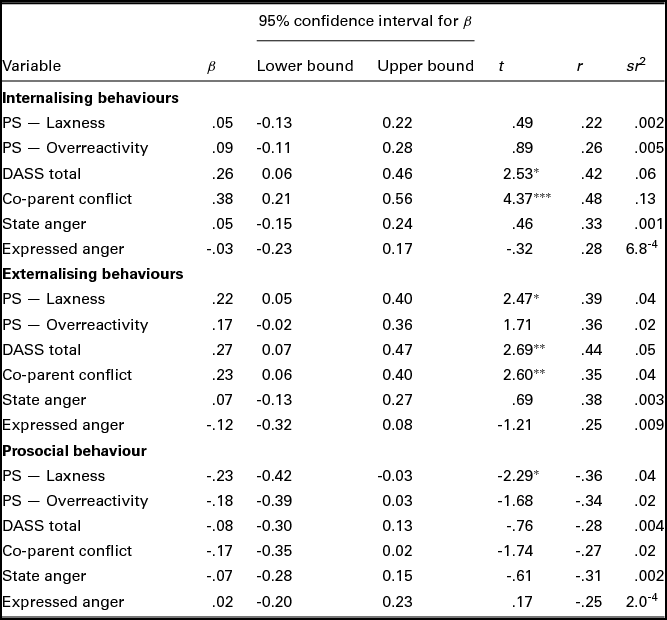
A series of multiple linear regressions were used to develop models for predicting child behaviour problems from parenting styles, parental adjustment, parent anger, and co-parenting conflict. Table 4 shows the standardised regression coefficients (β) with 95% confidence intervals and the semi-partial correlations for each analysis.
Summary of Regression Analyses Predicting Internalising and Externalising Child Problems and Prosocial Behaviour

Note: *p < .05, **p < .01; ***p < .001.
Internalising problems
The model was able to account for 29.4% of the variance in child internalising problems, F(6, 101) = 8.43, p < .001. As displayed in Table 2, only co-parent conflict and parental distress were significant predictors. Specifically, increased conflict and distress predicted increases child emotional problems.
Externalising problems
The model for predicting child externalising problems was able to account for 30% of the variance in child externalising problems, F(6, 101) = 8.73, p < .001. As displayed in Table 4, lax parenting, co-parent conflict, and parent distress were all significant predictors, such that increases in parenting laxness, conflict, and distress predicted greater behaviour problems.
Prosocial behaviour
The model for predicting child prosocial behaviour was able to account for 18% of the variance in child prosocial behaviour, F(6, 101) = 4.89, p < .001. As displayed in Table 4, lax parenting was the only significant predictor of prosocial behaviour, such that greater laxness contributed to predicting poorer prosocial skills.
Discussion
A plethora of research has identified parental mental health, co-parenting conflict, and parenting style as key factors that contribute to children's psychosocial outcomes in divorced families. Most of the available literature to date has considered these aspects of parenting and parental adjustment in separate studies. Thus, the aim of the present study was to advance our understanding of how co-parent conflict, parental adjustment, and parenting style together relate to child adjustment, such that their relative contributions could be understood. To this end, we broadly replicated and extended previous literature findings that greater parental distress and co-parent conflict are linked to increased child emotional and behavioural problems, even when considered alongside other parenting behaviours. We also extended the previous literature by finding that anger, another aspect of parental mental health that has been under-researched in divorced families, is not linked to child adjustment. Finally, we found that a lax parenting style was related to increased child behaviour problems and decreased prosocial behaviour.
Our finding that parental distress predicts child emotional and behavioural problems is consistent with previous research in both non-divorced (e.g., Foster et al., Reference Foster, Webster, Weissman, Pilowsky, Wickramaratne, Rush and Kornstein2008; O'Connor et al., Reference O'Connor, Heron, Golding, Beveridge and Glover2002) and divorced (e.g., Donald et al., Reference Donald, Dower, Correa-Velez and Jones2006; Dube et al., Reference Dube, Anda, Felitti, Chapman, Williamson and Giles2001) samples. However, our finding also clarifies some key findings. First, previous studies have largely focused on parents’ distress predicting child distress or depression specifically (e.g., Lizardi et al., Reference Lizardi, Thompson, Keyes and Hasin2009; Storksen et al., Reference Storksen, Roysamb, Holmen and Tambs2006). Our findings replicate and extend these findings by implicating parental distress as playing an important role across both internalising and externalising domains of child's adjustment. Furthermore, we found that this relationship does not extend to socially adaptive behaviour. Given these results, as well as past findings that distress is elevated in divorced parents (as they were in our study as well), it is important that parenting programs for divorced parents address these symptoms. Doing so will likely benefit mental health symptoms in parents and children.
We also extend previous literature on the relationship between parent and child adjustment by considering the possible role of parental anger, which has generally been a neglected area of research. In our sample, we did not find that parental anger predicted any aspect of child adjustment. Notably, however, parents in our sample scored lower on the measures of anger we collected than the norms for the scale. This is in contrast to a previous report that found anger to be elevated in mothers after divorce (Dreman et al., Reference Dreman, Spielberger and Darzi1998), and related to child maladjustment (Dreman & Aldor, Reference Dreman and Aldor1994). The reason for these discrepancies can only be speculated. One possible source of discrepancy could be cultural, as our sample was gathered from the general community in Australia, whereas the Dreman et al. (Reference Dreman, Spielberger and Darzi1998) sample was gathered in Israel. As such, it is possible that parents in Australia experience trait anger differently than parents in Israel. It could also be due to the nature of the samples, as our sample was open to divorced parents generally, whereas the Dreman sample was specific to the ‘stabilisation stage’, and to mothers only. Finally, it is also possible that parents’ anger, if present, is directed towards the ex-spouse, resulting in co-parenting conflict and hostility, rather than non-directed anger per se (e.g., Goodman, Bonds, Saver, & Braver, Reference Goodman, Bonds, Sandler and Braver2004), which instead is linked to children's maladjustment.
As with previous research (e.g., Amato & Cheadle, Reference Amato and Cheadle2008; Christophersen & Mortweet, Reference Christophersen, Mortweet, Christophersen and Mortweet2003; Garber, Reference Garber2004; O'Connor & Dvorak, Reference O'Connor, Dvorak and Shohov2002; Strohschein, Reference Strohschein2012), we did find a consistent relationship between increased co-parenting conflict and poor child adjustment across both domains of child problems (emotional and behavioural). Although increased conflict was also correlated with decreased prosocial behaviour, this relationship did not remain significant after accounting for other parenting variables, indicating that conflict may not play a key role in children's social skills. This is perhaps surprising, as parents provide the basis for young children's social skills through modelling and teaching (e.g., McWayne, Hampton, Fantuzzo, Cohen, & Sekino, Reference McWayne, Fantuzzo, Cohen and Sekino2004). Thus, it might be expected that children of divorced and high conflict parents would have lower social skills, such as those needed to resolve differences and disagreements. However, experiencing co-parenting conflict does not imply that parents also experience conflict or difficulties in their other relationships, and thus they may also model positive social interactions for their children. The predictive effect of co-parenting conflict on children's emotional and behavioural problems may better reflect the undermining of the child's secure relationship with both parents, rather than a modelling of poor relationship skills. Furthermore, peers may play a greater role in prosocial behaviour as the child ages. For example, as indicated in the seminal social information-processing model proposed by Crick and Dodge (Reference Crick and Dodge1994), children also develop and model their social skills based on their interactions with peers, not just parents. As such, our results indicate the importance of considering parenting conflict in the development of child problems, but not a lack of social skills.
Finally, the aspect of parenting style that showed the most robust and consistent contributions to predicting child's maladjustment was parenting laxness, not over-reactivity. Over-reacting to children's misbehaviours was correlated with children's problems and social skills, but did not significantly contribute to predicting any of these areas of adjustment after accounting for parenting laxness, parental adjustment, and co-parenting conflict. On the other hand, a lax and permissive approach to discipline was related to children's behaviour problems and prosocial skills, even after accounting for all other parenting constructs measured. This is consistent with a wealth of parenting literature showing that permissive discipline is related to child behaviour problems (e.g., Arnold et al., Reference Arnold, O'Leary, Wolff and Acker1993; Guajardo, Snyder, & Petersen, Reference Guajardo, Snyder and Petersen2009), which leads to serious child behaviour problems in the presence of harsh and negative parenting practices (e.g., Patterson & Fisher, Reference Patterson, Fisher and Bornstein2002). This study, however, is the first to document its role in predicting child adjustment in divorced families, to our knowledge. Future longitudinal research is needed to further determine the impact of lax and permissive discipline over time for children with divorced families. This is especially important considering that the majority of divorced parents are single parents, and thus a lax parent means that there was no other parent present to provide consistent discipline (as may happen in two-parent households).
There are limitations of this study that need to be considered in interpreting the results. First, the sample was comprised predominantly of mothers. This is consistent with previous research in this field, as well as the parenting literature more generally, and relatively representative of divorced parents who do the bulk of child-care taking (the majority of whom are mothers; ABS, 2011). However, this does limit our knowledge of the relationship between fathers’ adjustment, parenting style and conflict, and their child's adjustment. Second, the sample we had was a relatively small convenience sample that targeted parents of children with problems. Hence, the applicability of the findings to the broader population of divorced parents and children needs to be determined through replicating these results in a larger and representative sample. Finally, the concurrent nature of the results preclude any causal or directional interpretations or exploring possible pathways. Longitudinal studies are needed to disentangle the direction of effects. Finally, because the majority of parents were born in Australia and the study was based in Australia, possible cultural variations could not be determined.
Still, despite these limitations, the results provide a strong basis for the need for future study on the relative contributions of parent-related factors. This is important to inform the development of post-divorce interventions, of which currently relatively few have program goals that include parenting skills and parental adjustment (Sigal, Sandler, Wolchik, & Braver, Reference Sigal, Sandler, Wolchik and Braver2011). If future research replicates the role of laxness in children's behavioural and prosocial adjustment, then such results would argue for broad-based parenting interventions that address parent adjustment parenting skills, and co-parental conflict.