INTRODUCTION
Leptogorgia Milne-Edwards & Haime, Reference Milne-Edwards and Haime1857 is a widespread genus. At least 28 Leptogorgia species are recognized along the west African coast from Morocco to the Gulf of Guinea, and Angola shores and from west European coasts (Spain and Portugal) (Grasshoff, Reference Grasshoff1988, Reference Grasshoff1992); four from southern Africa (Williams, Reference Williams1992), one species from the subantarctic (Williams & Lindo, Reference Williams and Lindo1997), and 12 in the Caribbean (Bayer, Reference Bayer1961). Twenty-two species of Leptogorgia have been described from the shallow waters of the eastern Pacific (Breedy & Guzman, Reference Breedy and Guzman2005, Reference Breedy and Guzman2007), and one species from deep waters (>1900 m) of the East Pacific Rise (Bayer, Reference Bayer2000). Except for Leptogorgia bayeri Williams & Lindo, Reference Williams and Lindo1997, Leptogorgia palma (Pallas, Reference Pallas1766), and Leptogorgia gilchristi (Hickson, Reference Hickson1904) which occur along the coast of South Africa (Williams, Reference Williams1992; Williams & Lindo, Reference Williams and Lindo1997), the occurrence of Leptogorgia in the Indian Ocean and west Pacific is uncertain at present; since nine species from the Indian Ocean and west Pacific were assigned to the genus Pseudopterogorgia (Williams & Vennam, Reference Williams and Vennan2001).
Herein, we describe Leptogorgia ignita sp. nov., from Pacific Costa Rica, and discuss its relationship with other related eastern Pacific species in the genus.
MATERIALS AND METHODS
Samara Bay is located in Nicoya, Guanacaste, Pacific coast of Costa Rica, 09°53′0″N 085°33′0″W. Specimens were collected from shallow coral communities by SCUBA diving, from 5–12 m in depth. Colonies were air dried or preserved in ethanol. Axes and sclerites were prepared for light and scanning electron microscopy (SEM) following the standard techniques for structural analysis (Bayer, Reference Bayer1961; Breedy & Guzman, Reference Breedy and Guzman2002, Reference Breedy and Guzman2005). The holotype is deposited in the Museo de Zoología, Universidad de Costa Rica (UCR), as well as the paratypes, except for two, UCR 514b is deposited in the Yale–Peabody Museum, Yale University, New Haven (YPM), and UCR 514b in the Museum of Comparative Zoology, Harvard University, Boston (MCZ).
SYSTEMATICS
TYPE MATERIAL
Holotype: colony dry (Isla Chora, Bahia Samara, Costa Rica; water depth: 12 m) [UCR 514a]. Collected by H.M. Guzman, 18 March 1984.
Paratypes: colonies dry (Isla Chora, Bahia Samara, Costa Rica; water depth: 12 m) [UCR 514b, UCR 514c, UCR 514d]. Collected by H.M. Guzman, 18 March 1984. Colony dry (Isla Chora, Bahia Samara, Costa Rica; water depth: 5 m) [UCR 645]. Collected by J. Cortes, 25 April 1992. Colony preserved in ethanol (Isla Chora, Bahia Samara, Costa Rica; water depth: 12 m) [UCR 620, UCR 629]. Collected by H.M. Guzman, 18 March 1984. Colony preserved in ethanol (Bajo Samara, Bahia Samara, Costa Rica; water depth: 8 m) [UCR 1735]. Collected by O. Breedy, 1 April 1998. Colony dry (Isla Chora, Bahia Samara, Costa Rica; water depth: 8 m) [UCR 1736]. Collected by O. Breedy, 30 May 1997.
ETYMOLOGY
An adjective (L), ignitus = fiery, glowing. This species is named in allusion to the flaming aspect of the colony because of its intense orange colour.
DIAGNOSIS
Colonies of a conspicuous deep orange colour. Growth form upright, branching irregular, 3–4 times. Anastomosis is absent. Polyps sparsely placed all around branches, which are fully retractile. Axis mineralized with longitudinal strands of carbonate hydroxylapatite (CHAp); axial core chambered and filled with filaments mineralized with small microspheres of CHAp. All sclerites orange and mostly capstans and blunt spindles. Low occurrence of spindles with acute ends. Largest spindles reach up to 0.10 mm in length. Anthocodial rods flat, up to 0.09 mm in length.
DESCRIPTION OF HOLOTYPE
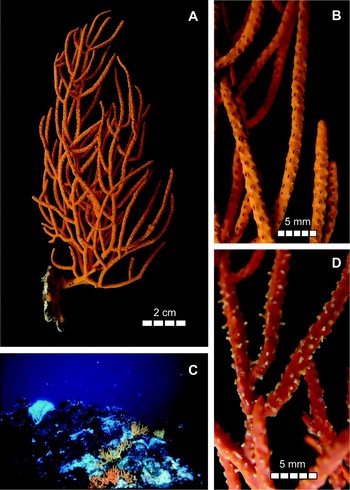
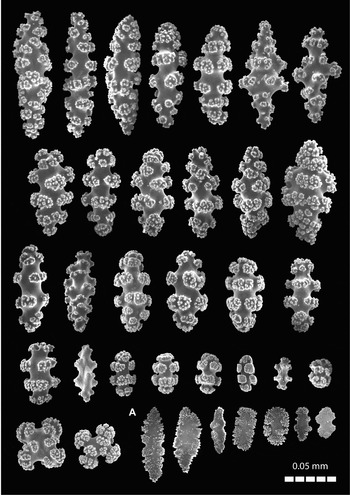
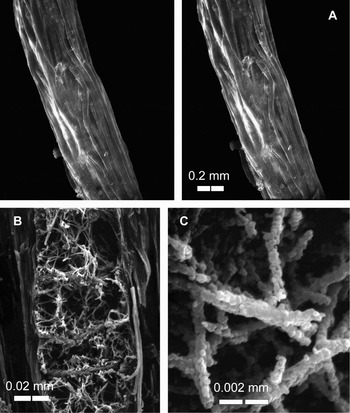
Colony is 12 cm in height and 7 cm in width of a bright orange colour (Figure 1A, B). Branches arise from a short stem, about 1 cm in length, and 4 mm in diameter; they are slightly compressed, around 3 mm in diameter at the base and tapered. Thick branches are marked with longitudinal grooves. Branching is irregular, producing branchlets (pinna-like), 1–2 mm in diameter, irregularly arranged and branching at acute angles (around 40–45°). They rebranch up to 4 times. Unbranched final twigs reach up to 5 cm in length with pointed tips. The polyps were retracted within slightly raised dome-shaped polyp-mounds leaving small, oval slit-like apertures (Figure 1B). Polyp-mounds are distributed all around the branches, and do not crowd the branches, they are scarce on the stem, and absent on the holdfast. Sclerites of the coenenchyme are all orange. They are mostly tuberculate capstans and blunt spindles, capstans reach up to 0.08 mm in length and 0.04 mm in width (Figure 2), and spindles up to 0.09 in length and 0.04 mm in width. Spindles with acute ends reach up to 0.11 mm in length, and 0.05 mm in width, with 3–4 whorls of warty tubercles, including irregular forms with an acute end and the other end blunt (Figure 2); some have slightly curved axes. Cross-shaped small sclerites about 0.06 by 0.06 mm, and micro-capstans about 0.03 mm in length and 0.02 mm in width, occur in the sclerite samples (Figure 2). Anthocodial sclerites are light orange, flattened rods covered by small spiny warts. Rods measure up to 0.09 mm in length, and 0.03 mm in width, with lobed, and dented margins (as in the paratype, UCR 629; Figure 2A). The horny axis is amber, light at the branch tips, and darker at the thick branches, with a white, chambered central core. Layers of gorgonin mineralized with CHAp surround the central core. The axis shows longitudinal strands of CHAp and dark grooves where gorgonin was removed (Figure 3A). Axial core is chambered and the chambers are filled with organic filaments, mineralized with CHAp (Figure 3B, C). The filaments are coated with microspheres of CHAp that fuse to produce an irregular meshwork of open meshes. It is not dense, and mineralization consists of small microspheres, up to 0.47 μm in diameter, (Figure 3C).
Leptogorgia ignita sp. nov. (A) Holotype [UCR 514a, dry colony]; (B) detail of colony branch; (C) living colonies of L. ignita sp. nov. (right), L. cuspidata (in the middle), and a larger colony of L. alba (left), on large rocky reef, Isla Chora, Samara Bay, Costa Rica; (D) detail of polyp, and polyp distribution [UCR 629, preserved colony].

Leptogorgia ignita sp. nov., holotype [UCR 514a]. SEM of coenenchymal sclerites. (A) Paratype [UCR 629], SEM of anthocodial sclerites.

Leptogorgia ignita sp. nov., holotype [UCR 514a], axis mineralization, SEM-micrographs of longitudinal sections of a branch. (A) Longitudinal strands of carbonate hydroxylapatite (CHAp) in the axial cortex (stereo pair); (B) chambered core with mineralized filaments; (C) detail of CHAp microspheres coating filaments.

DESCRIPTION OF PARATYPES
Colonies examined range in length and width from 5 cm to 15 cm. They grow upright; raising from spreading holdfasts. Branching is mostly irregular and multiplanar. Branches emerge from single, in some cases multiple, main stems that are slightly flattened with marked longitudinal grooves. Stems can reach up to 4 mm in diameter at the base of the holdfast. They subdivide in an irregular pinnate manner branching up to 4 times. Branches are mostly cylindrical, 2–3 mm in diameter; they diminish in diameter up to the ends, and in large colonies they are very thin, about 1 mm thick. Unbranched final twigs measure up to 6 cm in length, with pointed ends. Colour in life (Figure 1D) or ethanol preserved is deep orange throughout; it fades a little in some dry specimens. Polyps are white, sparsely distributed all around the branches, with anthocodial rods arranged in points (Figure 1C). Retracted polyps form slightly raised dome-shaped mounds, or they completely blend into the coenenchyme, leaving small oval slit-like apertures on the surface of the branches. Sclerites are all orange. Coenenchymal sclerites are mainly tuberculate capstans, in all the examined specimens. Shapes and sizes are consistent with the holotype. In some specimens spindles reach up to 0.12 mm in length. Anthocodial rods as in the holotype, measuring up to 0.09 mm in length, and 0.03 mm in width, with lobed, and dented margins (Figure 2A).
HABITAT
This species was found from five to 12 m deep, on exposed rocks forming coral communities, with strong currents and swell impact. They form small, compact patches surrounded by colonies of L. cuspidata and L. alba; these three species being the only Leptogorgia fauna coexisting at these specific spots where L. ignita is the dominant species (Figure 1D).
DISTRIBUTION
The new species has been found only in Samara Bay, Costa Rica (type locality), despite extensive searching in the rest of Costa Rica and Panama.
DISCUSSION
According to the branching pattern, polyp sculpture and colour, the eastern Pacific species of Leptogorgia are separated into three species groups, the alba-group, pumila-group, and rigida-group (Guzman & Breedy, Reference Guzman and Breedy2008). These features can be determined in living as well as in preserved specimens and allow a preliminary identification. The new species belongs to the rigida-group, which is composed of seven species (Table 1), with flat, or slightly raised polyp-mounds, branching in a variable style (irregular, pinnate, dichotomous, or any combination of them) and coloured or bicoloured colonies. Comparative characteristics are shown in Table 1. Leptogorgia ignita is different from the other species in the group especially in the conspicuous bright orange colour of the colonies and the sclerites. This feature separates the species immediately from the others, with the exception of Leptogorgia chilensis (Verrill, Reference Verrill1868), which has a lighter orange colour, but a very different branching pattern. The branching pattern of L. ignita is similar to that of Leptogorgia cuspidata Verrill, Reference Verrill1865 and Leptogorgia rigida Verrill, Reference Verrill1864, in addition to the other characteristics; however, colour of colony and sclerites are different. Leptogorgia cuspidata is of a deep purple colour and has yellow rings around the polyp apertures (an inverted pattern also occurs), which are not present in L. ignita or any other species in the group. Sclerites in L. cuspidata are yellow, purple or bicoloured, which is not the case in the new species, or in L. rigida. The latter is of an even purple colour with all the sclerites the same colour. The bright orange colony colour is present in another eastern Pacific species, Leptogorgia aequatorialis Bielschowsky, Reference Bielschowsky1929, however, this species belongs to a different morphological group, the pumila-group, and consequently, differences are obvious.
Comparative features for species in the rigida-group.

Present character: “X”. No data because of lack of specimens or incomplete specimens: “?”, “~”. Colours: brownish red (br); dark orange (do); light orange (lo); orange (o); pink (p); purple (pu); red (r); reddish purple (rpu); yellow (y). Dominant type of sclerites: capstan (c). Polyp arrangement: closely placed (cpl); sparsely placed (sp). Type of branches: stout branches (st); falling branches (f).
Type of branching: dichotomous (dich); pinnate (pi); irregular (irr).
ACKNOWLEDGEMENTS
We are grateful to Leen van Ofwegen (National Museum of Natural History Naturalis, Leiden) and Gary Williams (California Academy of Sciences, San Francisco) for critical review of the manuscript. We thank Eleazar Ruiz for his invaluable help in the fieldwork. We are grateful to the following people and institutions for their help: Rita Vargas (Museo de Zoología, UCR), Eric Lazo-Wasem (YPM), Ardis Johnston and Van Wallace (MCZ), Enrique Freer (Centro de Investigación en Estructuras Microscópicas, UCR), and Percy Denyer (UCR). This project was partially sponsored by the Vicerrectoria de Investigación (UCR) and the Smithsonian Tropical Research Institute.