Introduction
Natural disasters, such as tornados and hurricanes, devastate communities every year. No US state or territory is immune to a potential natural or human-induced disaster: 1,395 Presidentially declared disasters occurred in the United States from 2003 through 2012. 1 In 2012, the Federal Emergency Management Agency (FEMA; Washington, DC USA) declared 47 major disasters. Those 47 events caused at least 291 deaths, an unknown number of injuries and illnesses, and close to US $90 billion in property damage. 2
To mitigate negative health consequences, emergency managers, public health officials, and local authorities need to be able to identify rapidly and respond effectively to public health threats associated with disasters.Reference Malilay 3 The Community Assessment for Public Health Emergency Response (CASPER) is a tool created for rapidly assessing public health threats. The CASPER is an epidemiologic technique designed to provide quick, inexpensive, accurate, and reliable household-based public health information about a community’s needs. 4
The CASPER methodology is modeled after the World Health Organization’s (WHO; Geneva, Switzerland) Expanded Program on Immunization, which was designed in the 1970s to estimate immunization coverage.Reference Malilay, Flanders and Brogan 5 The modified cluster sampling methodology used for CASPERs involves a 2-stage sampling procedure. The first stage includes a sample of 30 clusters (census blocks), with probability proportional to the estimated number of housing units. In the second stage, seven households are selected systematically in each of the 30 clusters. 4 The CASPER methodology provides estimates for the population, including the proportion and number of persons with specific needs.Reference Malilay, Flanders and Brogan 5 – Reference Henderson and Sundaresan 7
In 2009, the Centers for Disease Control and Prevention (CDC; Atlanta, Georgia USA) developed the CASPER Toolkit to standardize the assessment methodology and provide a CASPER guidance document for public health practitioners and emergency management officials. The toolkit describes the CASPER sampling methodology, data collection, analysis methods, and how to report and disseminate CASPER results. 4 The toolkit was updated in 2012 to incorporate refinements in statistical methodology and instructions on accessing US Census 2010 data. 4 In 2008, the CDC also began offering CASPER trainings to state, local, tribal, and territorial (SLTT) health departments. The CDC has conducted over 30 CASPER trainings (1,700+ trainees) from 2009 through 2012 for epidemiologists, emergency managers, environmental health scientists, and other public health professionals.
Although the CASPER was designated originally for disaster response, CASPERs increasingly have been used for non-disaster assessments such as measuring community preparedness and conducting health impact assessments. Health impact assessments are systematic processes that help evaluate the potential health effects of a plan, project, or policy before it is built or implemented. 8 In 2010, the CDC created a metadatabase of all CASPERs conducted with assistance from the CDC to track the use of the CASPER, relevant findings, and impacts. This metadatabase was reviewed to describe uses of the CASPER, ascertain strengths of the CASPER methodology, and highlight significant findings.
Method
Information on all CASPERs in which the CDC provided any type of assistance is recorded in the metadatabase. It includes information on CASPERs for which assistance was provided onsite or remotely (eg, via telephone consultation, email, or webinars) or for any stage of the CASPER (ie, questionnaire development, sampling methodology, data analysis, or data interpretation). The metadatabase contains pertinent information about each CASPER, such as geographic location, type of event, objectives, sampling and mapping methodology, significant findings, and recommendations and action taken by decision makers. For this report, data in the CDC metadatabase for all CASPERs conducted from 2003 through 2012 were compared descriptively for differences in geographic distribution, sampling methodology, mapping tool, assessment settings, and result and action taken by decision makers; publication of results were reviewed. Microsoft Excel 2010 software (Microsoft Corporation; Redmond, Washington USA) was used for data analysis and ArcGIS 10.1 (Esri; Redlands, California USA) was used for mapping.
Results
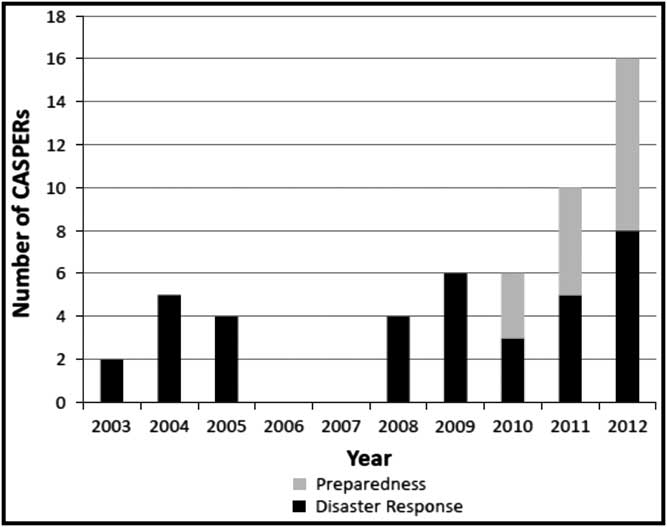
During the 10-year period reviewed, 53 CASPERs were conducted with CDC assistance in the United States and its territories. The number of CASPERs conducted with CDC assistance increased from two in 2003 to 16 in 2012 (Figure 1). The CDC personnel were deployed for 28 (52.8%) CASPERs and provided remote technical assistance for the other 25 (47.1%).
CASPERs Conducted in the United States by State, Local, Tribal, and Territorial Health Departments with CDC Assistance, 2003-2012a, by Year and Event Type (n=53). Abbreviations: CASPER, Community Assessment for Public Health Emergency Response; CDC, Centers for Disease Control and Prevention. a No CDC-assisted CASPERs were conducted in 2006-2007.

Geographic Distribution of CASPERs
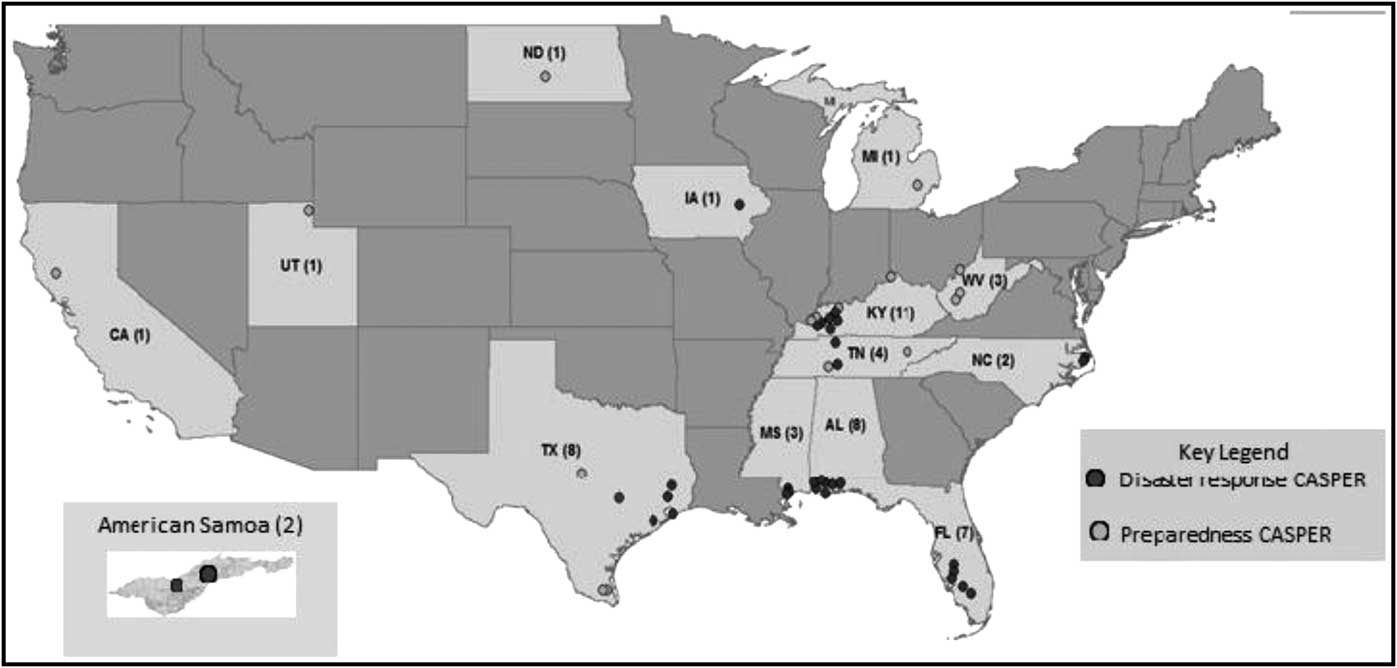
The 53 CASPERs were conducted in 13 US states and one US territory. The following US states conducted the most CASPERs: Kentucky (11), Texas (8), Alabama (8), and Florida (7; Figure 2).
Number of CASPERs Conducted in the United States by State, Local, Tribal, and Territorial Health Departments with CDC Assistance, 2003-2012 (n=53), by Location. Abbreviations: CASPER, Community Assessment for Public Health Emergency Response; CDC, Centers for Disease Control and Prevention.

Sampling Method and Mapping Tool
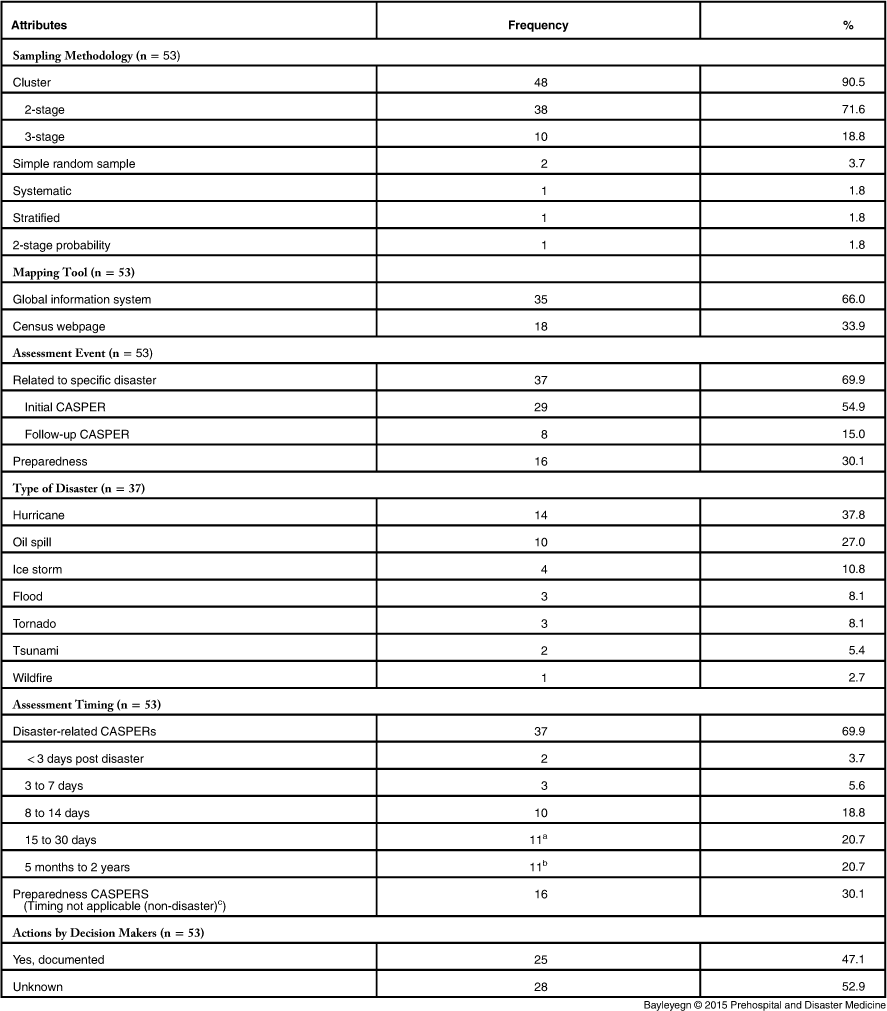
Cluster sampling methodology was used for 48 (90.5%) CASPERs. Of these, 38 (71.6%) CASPERs used traditional 2-stage cluster sampling (selection of 30 clusters in first stage and seven households per cluster in second stage), and 10 (18.8%) used a 3-stage cluster sampling methodology (Table 1). The 3-stage cluster sampling conducted following the Gulf Coast oil spill (2010) included an additional random selection of individuals for interview from selected households.
Attributes of CASPERs Conducted in the United States by State, Local, Tribal, and Territorial Health Department with CDC Assistance, 2003-2012

Abbreviations: CASPER, Community Assessment for Public Health Emergency Response; CDC, Centers for Disease Control and Prevention.
a One was a follow-up CASPER.
b Seven were follow-up CASPERs.
c No specific event.
Five (9.4%) CASPERs did not use the cluster sampling methodology. Even though these five assessments did not use the most commonly 2-stage cluster sampling methodology, they are considered as CASPERs because they were conducted to identify the needs and health status of the community and generated household-based information. The following methods were used for these five CASPERs: simple random sample (2), systematic sample (1), stratified sample (1), and 2-stage probability sample (1).
All CASPERS, regardless of sampling methodology, used US Census data to select the samples and to generate maps of selected clusters. Census data were accessed either through the US Census webpage (18; 33.9%) or geographic information system (GIS) software (35; 66.1%). The most common method (31; 58.4%) used for the second stage of sampling (selection of seven house within cluster) was the CDC-recommended systematic sample followed by sequential sampling (14; 26.4%). In three CASPERs, GIS software was used to generate seven random points in each of the selected clusters for the second stage of sampling. During these three CASPERs, interview teams were able to navigate to the points using handheld computers equipped with global positioning system plotters. 9
Assessment Setting
Of the 53 CASPERs, 37 (69.9%) were conducted in response to a natural or human-induced disaster to identify the needs and health status of the affected community. Approximately one-third of these (14; 37.8%) were in response to a hurricane (Table 1). Often, the objectives of the CASPERs conducted in response to a disaster were to obtain information rapidly about the needs of the affected community, to assess the impact of the disaster, and to monitor changes of needs during the recovery period. Of the 37 CASPERs conducted in response to a disaster, 15 (28.3%) were conducted within 15 days of the initial disaster (less than three days=2, three to seven days=3, and eight to 14 days=10; median=eight days), 11 (20.7%) within 30 days, and 11 (20.7%) within five months to two years of the initial disaster event. Eight (15.0%) were follow-up CASPERs (ie, a CASPER repeated in the same geographic sampling frame conducted to assess the effectiveness of the response or determine ongoing needs in the community) conducted between three weeks and two years after the initial disaster event (Table 1). For example, the follow-up CASPER to the American Samoa tsunami in 2009 was conducted three weeks after the event,Reference Choudhary, Chen and Martin 10 whereas the CASPERs for the 2010 Deepwater Horizon oil spill in Alabama (USA) and Mississippi (USA) were conducted yearly for two consecutive years. The findings of these follow-up CASPERs suggested the assessment was useful to monitor trends and prioritize resources.Reference Buttke, Vagi and Bayleyegn 11
Before 2010, all CASPERs were conducted in response to a disaster (Figure 1). Beginning in 2010, CASPERs were also conducted in non-disaster settings. During the period reviewed, 16 (30.1%) CASPERs were conducted in non-disaster settings. The objectives of 14 (26.4%) of these CASPERs were to assess household-level preparedness for disasters and estimate anticipated needs of a community during a disaster (eg, transportation and supplemental oxygen). Three (5.6%) of the CASPERs conducted in non-disaster settings were related to health impact assessments. The objectives of these CASPERs were to assess household-level public health perceptions and community’s awareness of proposed projects (eg, perceived risks and benefits of a proposed coal gasification plant).
Results and Action Taken by Decision Makers
For the majority of CASPERs (29; 54.7%), the preliminary findings were shared with stakeholders in a meeting at the end of the assessment, or a written summary highlighting the major findings and recommendations was distributed to emergency managers, state epidemiologists, or SLTT health department authorities within 24 to 48 hours of completing the assessment to support evidence-based public health decisions. Further, to share the experience and lessons learned to epidemiologists and public health practitioners at large, findings from 27 (50.9%) of the CASPERs conducted with CDC assistance were published in peer-reviewed journals or elsewhere.
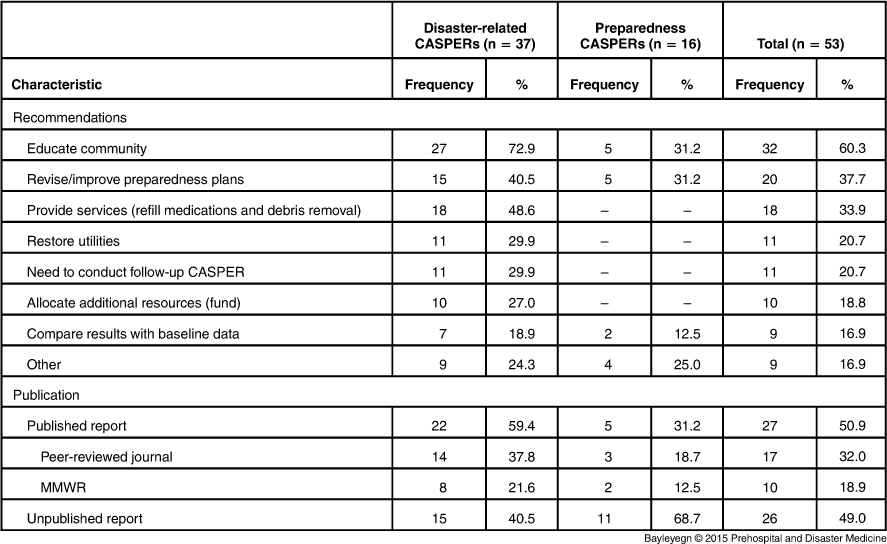
The most common recommendations resulting from a disaster-related CASPER were to educate the community on available resources (27; 72.9%), followed by provide services (18; 48.6%) in the aftermath of disaster, and revise or improve preparedness planning (15; 40.5%; Table 2). In preparedness CASPERs, the recommendation was to educate the community (5; 31.2%) and revise or improve preparedness plans (5; 31.2%).
Most Common Recommendations Based on Findings from CASPERs Conducted in the United States by State, Local, Tribal, and Territorial Health Departments with CDC Assistance, 2003-2012 (n=53)

Abbreviations: CASPER, Community Assessment for Public Health Emergency Response; CDC, Centers for Disease Control and Prevention; MMWR, Morbidity and Mortality Weekly Report.
Overall, CASPER findings that supported public health actions taken by health authorities and emergency management officials were documented for 25 (47.1%) assessments. For example, in September 2012, Oakland County Health Division (Southfield, Michigan USA), the CDC, and the Michigan Department of Community Health (MDCH; Lancing, Michigan USA) conducted a preparedness CASPER in Oakland County, Michigan, to assess residents’ general needs and emergency preparedness plans, as well as their potential reaction to instructions from county officials during a radiological disaster. The results showed that a substantial number of respondents (90%) indicated their willingness to follow instruction from county officials, specifically regarding going to a radiation screening center, evacuation, or sheltering-in-place during a radiation emergency.Reference Nyaku, Wolkin and McFadden 12 In addition, a majority of respondents with pets indicated that they would take their pets with them during an evacuation. The MDCH used the result to modify and improve existing preparedness plans.
Of the CASPERs conducted within 15 days following a disaster, the immediate needs and health status of the affected community were identified and the results provided information to decision makers for allocating response resources. In 2008, for example, a CASPER conducted in the aftermath of Hurricane Ike in Galveston, Liberty, and Manvel, Texas (USA) identified the immediate needs and associated risks of the hurricane-affected communities. Despite the response effort, a high proportion of households (45%) in Galveston reportedly still were lacking electricity and regular garbage pickup 17 days post-storm. In addition, the proportion of households with self-reported injuries in Galveston suggested the need to enhance public education on how to prevent injuries during hurricane cleanup. Galveston County Health District (Texas City, Texas USA) officials used this information to educate local emergency and elected officials of the health hazards related to lack of basic utilities and medical care in the community following the hurricane. The Health District used the results to gain local and state support for needed public health outreach activities. The assessment also provided insight to citizens’ concerns, which the Health District used in answering call-in questions and to develop a one-page flyer to address community issues. The flyer provided reference information, including contact numbers, for medical care sources, utilities, vaccination sites, transportation, garbage collection, and local municipality services. It also summarized methods for mosquito prevention, mold prevention, and safe use of generators and grills.Reference Zane, Bayleyegn and Haywood 13
Discussion
This report is the first comprehensive review of CASPERs. Over the 10 years reviewed, the number of CASPERs conducted with CDC assistance increased. There were no CASPERs conducted in 2006 and 2007 with CDC assistance, which is before CASPERs were being used for preparedness activities and reflective of the low number of domestic disasters (eg, hurricanes) that year. 14 Since 2009, at least five CASPERs have been conducted with CDC assistance annually. This increase is likely a result of increased awareness and expanded use of the CASPER by SLTT health departments due to CDC-sponsored CASPER trainings and the publication of the CASPER Toolkit.
Although originally designed for disaster response, CASPERs increasingly are being used in non-disaster settings. In 2010, the CDC’s Office of Public Health Preparedness and Response recommended the use of the CASPER to meet two of the CDC’s Public Health Preparedness Capabilities standards, one for community recovery (Capability 2) and one for mass care (Capability 7). 15 This also might have led to increased use of the CASPER as a preparedness activity. Before 2010, all CASPERs were conducted in response to a disaster (Figure 1); since 2010, half of the CASPERs conducted annually have been for non-disaster response. The CASPERs are now also being conducted to assess community-level preparedness; to assess knowledge, attitudes, and behaviors concerning environmental hazards; as training exercises; and for public health department accreditation in readiness and public health performance improvement activities. In addition, since 2003, at least 27 (50.9%) reports on the CASPER have been published, potentially increasing awareness of CASPERs conducted with CDC assistance.
Most (90.5%) of the 53 CASPERs reviewed used a cluster sampling methodology and selected clusters for the first stage of sampling based on US Census data, using either GIS software or the US Census webpage. However, the accuracy of the data (depending on the age of the data) could be a concern because the information obtained from the US Census Bureau (Washington, DC USA) might not represent adequately the current population in the sampling frame. The US Census Bureau only updates their data every 10 years. Consequently, available US Census data might not account for new residential construction, demolitions, or vacant homes; therefore, the data might not reflect the actual number of households in the assessment area at the time of the CASPER. In this situation, obtaining updated household information from local sources, such as tax or parcel data, might be advisable.
One-third (33.9%) of CASPERs reported using the US Census webpage to select the clusters and produce maps. Data provided by the US Census are free-of-charge and widely available; however, they have limited flexibility in the selection of a sampling frame and they can necessitate a lengthy process (hours) compared to GIS (minutes) that can delay the preparation phase of the CASPER. 16
To address those limitations, the CDC, in collaboration with the Agency for Toxic Substances and Disease Registry’s (ATSDR; Atlanta, Georgia USA) Geospatial Research, Analysis, and Services Program (GRASP) developed a GIS tool to enhance the sampling and mapping procedures. This tool is extremely flexible and rapid, but it does require a license to maintain the software and basic GIS training. 17 Although GIS software can be beneficial, it does have significant costs and requires technologic capacity to use. For SLTT health departments with limited or no GIS capacity, the CDC provides sampling and mapping free-of-charge to any requesting agency conducting a CASPER.
This review found deviations in the preferred sampling method for the CASPER (ie, 2-stage cluster design). Other sampling methods were used when the recommended cluster design was not feasible, such as too few households (<800) in the sampling frame. In this scenario, systematic sampling would be a more appropriate sampling method.
The primary goal of the CASPER is to provide rapid, accurate, and reliable household-level estimates of public health needs for decision makers so that the appropriate action for relief can be taken.Reference Malilay 3 Of the 37 CASPERs directly related to disasters, 15 (28.3%) initial CASPERs (ie, those not designated as a follow-up from a previous CASPER) were conducted in fewer than 15 days of the disaster impact. However, among the 15 assessments, only the two following Hurricane Isabel (2003) in North Carolina (USA) were conducted within 72 hours (less than three days) of the disaster. The delay in conducting the initial CASPER in these situations was a result of evacuation orders in the community, priority of other disaster response actions, availability of resources, logistical arrangement, safety issues, or CASPER objectives (eg, assessment of recovery efforts).
Follow-up CASPERs enabled local public health officials to monitor changes in needs over time, to evaluate the progress of public health action taken based on the initial CASPER, to identify emerging or changing public health concerns during the recovery or mitigation phase, and to document findings for future improvement in public health planning and response.Reference Buttke, Vagi and Schnall 18 , 19 For these reasons, when resources are available, follow-up assessments using the same sampling frame as the initial CASPER are encouraged. Planning for both assessments (initial and follow-up) during the planning phase of the initial CASPER might help ensure resources are available to conduct a follow-up CASPER later.
Conducting a CASPER can identify household-level public health needs that otherwise might have been unknown. 20 , 21 The CASPER provides objective information and can be useful in estimating the basic needs and health status of the community following a disaster. 22 , 23 In addition, the interaction of interview teams with household respondents during the face-to-face interview following a disaster elevates the visibility of public health in the community and reassures residents that they are not being forgotten.Reference Zane, Bayleyegn and Haywood 13
The type of information obtained from a CASPER varies according to the time of administration.Reference Nyaku, Wolkin and McFadden 12 Beyond serving as a tool for disaster response, the CASPER is also a planning tool. The CASPERs conducted in a non-disaster setting are more focused on household disaster preparedness and provide information regarding public health and community readiness for disaster response, such as preparing pet-friendly shelters in communities found to have high intent of taking pets during evacuation or educating the community in keeping supplies (eg, water and nonperishable food) for more than three days. The CASPERs conducted during the preparedness phase also assess the level of community preparedness, increase the community awareness related to potential disasters specific to the area, and improve the level of preparedness in the responding agency and at the community level. 24
After data have been collected, data analysis and dissemination of a field report with public health recommendations in a timely manner is critical.Reference Dicker 25 The CASPER Toolkit recommends completion of initial data analysis and preliminary written reports within 72 hours of conducting the CASPER and the final report within weeks or a few months. 4 These reports are meant to be shared with local officials to improve understanding of the public health needs of the affected communities. They also support evidence-based public health decisions in such areas as educating the community, improving preparedness plans, and providing services such as medication refills and debris removal following a disaster. These reports are also helpful to evaluate the assessment process or improve future CASPERs. In addition, disseminating the CASPER findings and sharing lessons learned with the wider public health community is important to highlight the existence of problems and opportunities for improvement that are common to many communities.Reference Bayleyegn, Wolkin and Oberst 26 , 27 This can be achieved by publishing the CASPER findings in peer-reviewed journals and presenting findings at scientific conferences.
Limitations
A limitation of this review is that only CASPERs with CDC assistance were included. The review did not include CASPERs independently conducted by SLTT health departments, academia, or other organizations from 2003 through 2012. The CDC has been working with SLTT health departments over the past 20 years to build the CASPER capacity and enable SLTT health departments to conduct CASPERs without CDC assistance. Some SLTT health departments likely conducted CASPERs without assistance by the CDC. Data from non-CDC CASPERs might have provided additional information on the benefits and impact of the CASPER.
Conclusion
The use of the CASPER has increased greatly over the past decade. The increase in the number of CASPERs likely has been influenced by the online release of the CASPER Toolkit, increased numbers of CASPER trainings, and increased capacity and awareness associated with the CDC’s Public Health Preparedness Capabilities standards. Overall, CASPERs conducted both in disaster and non-disaster settings addressed their intended objectives. The findings of this review suggest that CASPERs’ results support the evidence-based public health decision making process and benefit the community.
Acknowledgment
The authors would like to thank Tracy L. Haywood, Health Geographer, Texas Department of State Health Services (Austin, Texas USA); Joseph Roth, Jr., MPH, Tennessee Department of Health (Johnson City, Tennessee USA); and Ekta Choudhary, MS, MPH, PhD and Don Meadows, National Center for Environmental Health, Center for Dissease Control and Prevention (Atlanta, Georgia USA) for their contribution.