Conceptualizing Age-Friendly Communities
“Cities have the capability of providing something for everybody, only because, and only when, they are created by everybody.” (Jacobs, The Death and Life of Great American Cities, 1961, p. 238)
The idea that the environment in which older adults live profoundly impacts their lives has a long history in gerontology (Lawton & Nahemow, Reference Lawton, Nahemow, Eisdorfer and Lawton1973). Since Lawton’s seminal theoretical work and research in the field of environmental gerontology, much has been written about different types of environments, particularly the institutional environment and home environment (see Gitlin, Reference Gitlin2003; Wahl, Reference Wahl2003). Research has focused less on the macro environment – neighbourhood/community, region, or urban-rural localities – such that in an introduction to a series of articles on environmental gerontology, Kendig (Reference Kendig2003) noted that there was an “astonishing” paucity of research in these areas. In contrast, on the political and policy front, there has been increasing interest in Canada and internationally regarding the community environment and how it might promote healthy aging (Butler-Jones, Reference Butler-Jones2010; Federal/Provincial/Territorial Ministers Responsible for Seniors, 2007; Federal/Provincial/Territorial Working Group on Healthy Aging, 2009; WHO, 2007).
In discussing “age-friendly” communities, we will build on the World Health Organization (WHO) definition that an age-friendly community is one in which “policies, services, settings and structures support and enable people to age actively” (WHO, 2007, p. 5). A focus on how the community environment can support older adults is timely given the interest that the notion of age-friendliness is garnering nationally and internationally. In Canada, several provinces (British Columbia, Manitoba, Quebec, Nova Scotia, Newfoundland/Labrador) have already launched age-friendly community initiatives (Public Health Agency of Canada, 2010).
The recently released report by the Public Health Agency of Canada on population aging presents age-friendly communities as one approach to promote healthy aging (Butler-Jones, Reference Butler-Jones2010) and the final report of the Special Senate Committee on Aging (2009) recommended that the federal government actively promote implementation of age-friendly community aspects. At the 2010 Annual Scientific and Educational Meeting of the Canadian Association on Gerontology, an entire day was allocated to symposia exploring various aspects of age-friendliness.
More specifically, our purpose here is to examine age-friendly communities from an ecological perspective (Bronfenbrenner, Reference Bronfenbrenner1977, Reference Bronfenbrenner, Husen and Poslethwaite1994; Keating & Phillips, Reference Keating, Phillips and Keating2008; Stokols, Reference Stokols1992, Reference Stokols1996). Although the need to consider the older adult within the context of his or her environment is an underlying premise of age-friendly communities, ecological theory has not been systematically applied to the concept in the literature to date. By framing our discussion in an ecological context, we aim to make explicit key issues related to the interplay between the person and the environment that are usefully considered in order to advance age-friendliness research or policy decisions.
In our overview of supportive environments for older adults, we use the WHO (2007) concept as a basis, given its comprehensiveness and the worldwide momentum it has been gaining. Similarly, we use the term “age-friendly” because it is increasingly being used in the academic and policy literature. Although suggestive of a lifespan approach, the term has a distinct focus on how the community environment impacts older adults (WHO, 2007). At the same time, we recognize that community features which might be important for older adults (e.g., well-maintained sidewalks) might also be beneficial for younger adults and children (WHO, 2007).
Defining ‘Community’ – The Rural-Urban Continuum
We use community in a geographic sense to refer to settlements of any scale, be they villages, small towns, or larger urban centres. The assumption is that rather than considering communities in terms of a rural-urban dichotomy, it is more helpful to think of them on a continuum. We make this assumption for several reasons. First, the definition of “rural” and “urban” is not straightforward. Indeed, du Plessis, Beshiri, Bollman, and Clemenson (2002) noted six different definitions suitable for national level analysis in Canada. Depending on the definition used, the rural population in Canada in 1996 ranged from 22 per cent to 38 per cent (du Plessis et al., 2002). Second, many aspects of the community environment that are important for older adults (e.g., being able to access buildings or avail themselves of transportation options) are as much an urban as they are a rural issue, which means distinguishing between towns or cities might thus be an artificial differentiation.
Finally, studies of both urban and rural aging have tended to address similar key issues. For example, attachment to place in an urban context has been the focus of numerous studies of older people (Becker, Reference Becker2003; Smith, Reference Smith2009), but there is an equally strong tradition of research that relates to place within the context of rural communities (Burholt, Reference Burholt2006). Having said this, we must acknowledge that issues can manifest themselves differently across localities. For example, older persons living in a multi-ethnic poor neighbourhood in a city might experience their community very differently than older adults living in a less ethnically diverse town located in an otherwise sparsely populated rural area.
The Need for Better Communities – Age-Friendly Initiatives
Although most people live in communities, however large or small, communities might not provide ideal living environments . Appropriate, affordable housing might be scarce or green space might have been lost; a reliance on the automobile, particularly in North America, has led to sprawl, resulting in fewer convenient basic services, such as grocery stores being within walking distance, and traffic congestion can make both driving and walking treacherous, to name just a few issues related to the physical environment (e.g., Michael, Green, & Farquhar, Reference Michael, Green and Farquhar2006; Randall & Baetz, Reference Randall and Baetz2001). Older adults can be particularly vulnerable to the environments in which they live. Mobility limitations, for instance, can create unique challenges in crossing a busy intersection, or dealing with cracked sidewalks, or entering a building that can only be accessed via steps.
In urban planning, the argument has long been made that cities need to become more people-friendly, as exemplified by the quote taken from Jacobs’ classic (1961) book on urban design. More recently, a number of initiatives have emerged that focus on making communities better places for people to live (e.g., Smart Growth and Liveable Communities’ movements). Currently, there is no universally accepted definition of what constitutes an “age-friendly” (or elder-friendly) community (Lui, Everingham, Warburton, Cuthill, & Bartlett, Reference Lui, Everingham, Warburton, Cuthill and Bartlett2009). Common to all conceptualizations, however, is that factors spanning the physical and social environment have an impact on older adults’ lives and must be considered. For example, the AdvantAge Initiative launched in the late 1990s defines an elder-friendly community as one that satisfies four objectives: (a) addresses basics needs (e.g., housing, safety, and information about services); (b) promotes social and civic engagement; (c) optimizes physical and mental health and well-being; and (d) maximizes independence for frail and disabled individuals by, for example, providing accessible transportation and offering support for family and other caregivers (Feldman & Oberlink, Reference Feldman and Oberlink2003; Hanson & Emlet, Reference Hanson and Emlet2006; for other definitions, see also Alley, Liebig, Pynoos, Banerjee, & Choi, Reference Alley, Liebig, Pynoos, Banerjee and Choi2007; Lehning, Chun, & Scharlach, Reference Lehning, Chun and Scharlach2007; Lui et al., Reference Lui, Everingham, Warburton, Cuthill and Bartlett2009).
More recently, the WHO (2007) introduced the notion of age-friendly communities. Consistent with previous definitions (Alley et al., Reference Alley, Liebig, Pynoos, Banerjee and Choi2007; Feldman & Oberlink, Reference Feldman and Oberlink2003), a range of domains are considered important. These include outdoor spaces and buildings, housing, transportation, respect and inclusion, social participation, civic participation and employment, communication and information, and community supports and health services (WHO, 2007). To identify specific aspects of an age-friendly community within each of these domains, the WHO initiated focus group interviews in 33 cities around the world, including four cities in Canada (Halifax, Nova Scotia; Sherbrooke, Quebec; Portage la Prairie, Manitoba; and Saanich, British Columbia). Eight focus groups were conducted in each of the 33 cities; four with older adults (aged 60 or older), one with caregivers of seniors, and three with service providers (e.g., representatives of governmental organizations, volunteer organizations, and business).
The focus group research, which provided a rich description of features (and barriers to) making communities age-friendly, formed the basis for an age-friendly guide and checklist (WHO, 2007). For instance, in terms of outdoor spaces, focus group participants identified a clean, safe environment and green space as assets, and uneven sidewalks and unsafe pedestrian crossings as barriers. In the social domain, focus group participants commented, among many other things, on the need for bringing generations together and fostering a culture of respect for older adults.
In Canada, the WHO initiative was instrumental in the launch of an Age-Friendly Rural/Remote Communities project sponsored by the Federal/Provincial/Territorial Ministers Responsible for Seniors. The project focused on ten small rural and remote Canadian communities (with populations less than 5,000) to reflect the fact that a substantial proportion of the Canadian population lives in rural areas. It involved the same focus group protocol as that used by the WHO, and it also led to an age-friendly guide launched in November 2007 (Federal/Provincial/Territorial Ministers Responsible for Seniors, 2007). The research revealed similar issues as raised by the WHO project but also highlighted unique features and barriers associated with living in rural Canada. For instance, transportation concerns are magnified in rural areas, where the role of family and friends in driving older adults takes on increased importance.
Conceptualizing Age-Friendly Communities – An Ecological Perspective
Ecological theory, which has emerged from a variety of disciplines such as psychology, sociology, and public health, provides a general framework for understanding human behaviour, health, or well-being, depending on the context to which it has been applied (see Stokols, Reference Stokols1996, for a discussion). Ecological theory provides a useful framework with which to conceptualize age-friendly communities because it explicitly focuses on the interrelationships between the environment and the person living within it (see also WHO, 2007).
Domains of an Age-Friendly Community Environment
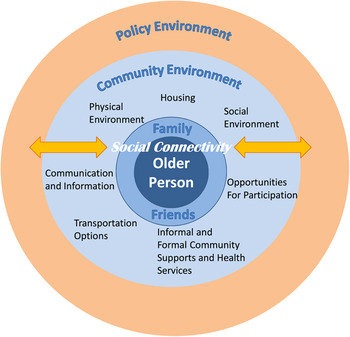
The WHO (2007) identified several domains as key aspects of an age-friendly community: outdoor spaces and buildings; housing; transportation; respect and inclusion; social participation; civic participation and employment; communication and information; and community supports and health services. These domains are consistent with determinants of health, disability, and active aging models (Evans & Stoddart, Reference Evans and Stoddart1990; WHO, 2001, 2002) and also fit with previous research on age-friendly communities (e.g., Alley et al., Reference Alley, Liebig, Pynoos, Banerjee and Choi2007; Feldman & Oberlink, Reference Feldman and Oberlink2003). Building on these perspectives, we focus here on seven age-friendly dimensions: (a) the physical environment, (b) housing, (c) the social environment, (d) opportunities for participation, (e) informal and formal community supports and health services, (f) transportation options, and (g) communication and information.
Are these seven domains the “right” ones? Or should there be fewer domains, such as two overarching ones – the physical and social environment – along the lines suggested by the Evans and Stoddart (Reference Evans and Stoddart1990) model (see also Lui et al., Reference Lui, Everingham, Warburton, Cuthill and Bartlett2009)? Two domains would be more parsimonious, however including more domains can emphasize aspects of the community environment that otherwise might not be considered. Are we missing important dimensions? For instance, safety has been identified as an aspect of an age-friendly community (Alley et al., Reference Alley, Liebig, Pynoos, Banerjee and Choi2007; Feldman & Oberlink, Reference Feldman and Oberlink2003), yet safety can also be thought of as being associated with the social environment. For example, fear of crime and perceptions of lack of safety relate to the larger socioeconomic environment of a community (e.g., Clark et al., Reference Clark, Kawachi, Ryan, Ertel, Fay and Berkman2009). A sense of safety can also arise from the availability of well-maintained sidewalks and stairs that have railings – both of which are aspects of the physical environment. Thus, safety might more usefully be thought of as an outcome, or result, of age-friendly features rather than an aspect of the community environment per se.
Similarly, the WHO (2007) included respect and social inclusion as elements of an age-friendly domain. Although worthwhile to acknowledge, these concepts or principles would seem to underlie the notion of age-friendliness as a whole. For example, a climate of respect for older adults within a community might result in opportunities or supports being created, whereas a lack of respect or ageism might translate into fewer opportunities or supports. Clearly, there is no single approach to identifying domains or classifying topics within broader categories. The question becomes, Which domains are supported by research as being important for older adults and, thus, merit being highlighted?
Briefly, we will describe each of the seven domains (a literature review of each domain is beyond the scope of this article). The physical environment includes outdoor spaces (e.g., parks, walking trails), buildings (e.g., how accessible they are, their location), and the natural environment (e.g., water, air). In recent years, researchers working in the public health domain, for instance, have taken a particular interest in the role of the physical environment in health-related behaviour (e.g., physical activity, nutrition) and health, driven to a large extent by the concern with high levels of inactivity, the obesity epidemic, and associated health problems (Dannenberg et al., Reference Dannenberg, Jackson, Frumkin, Schieber, Pratt and Kochtitzky2003; Giles-Corti, Reference Giles-Corti2006; Sallis et al., Reference Sallis, Cervero, Ascher, Henderson, Kraft and Kerr2006; Srinivasan, Liam, O’Fallon, & Dearry, Reference Srinivasan, Liam, O’Fallon and Dearry2003).
A rapidly growing body of research has focused on neighbourhood features and walking, given that walking is the most common form of exercise, particularly among older adults. Two elements – distance to businesses and land use mix – have emerged as factors that enhance neighborhood walkability in general population samples (see Saelens & Handy, Reference Saelens and Handy2008 for a review) and particularly in the older adult population (Berke, Koepsell, Moudon, Hoskins, & Larson, Reference Berke, Koepsell, Moudon, Hoskins and Larson2007; Fisher, Li, & Cleveland, Reference Fisher, Li and Cleveland2004; Nagel, Carlson, Bosworth, & Michael, Reference Nagel, Carlson, Bosworth and Michael2008; Shigematsu et al., Reference Shigematsu, Sallis, Conway, Saelens, Frank and Cain2009). Other neighborhood characteristics have also been examined, such as the presence of green space (e.g., Li, Fisher, Brownson, & Bosworth, Reference Li, Fisher, Brownson and Bosworth2005; Shigematsu et al., Reference Shigematsu, Sallis, Conway, Saelens, Frank and Cain2009) and sidewalks (e.g., Brownson, Baker, Housemann, Brennan, & Bacak, Reference Brownson, Baker, Housemann, Brennan and Bacak2001).
Housingis part of the physical environment but is usefully considered in its own right, given that it is an important aspect of the environment in which older adults live (Lawton, Reference Lawton, Friedman and Wachs1999). Much has been written about older adults’ living arrangements, housing preferences, home adaptations to reduce health risks (e.g., falls), and home-based interventions (see Gitlin, Reference Gitlin2003, for a discussion). Building accessibility can become a problematic issue for older adults as their mobility declines. Universal design principles are routinely applied in new buildings to accommodate the functional needs of everyone with or without activity limitations or disabilities (e.g., ensuring that spaces are large enough to manoeuvre a walker or wheelchair; Canadian Mortgage and Housing Corporation, 2011). Older housing stock, however, often does not measure up to these principles.
Housing can also be considered from the perspective of a care and support continuum, ranging from living in one’s home (independently or with home supports such as home care) to assisted living or supportive housing to nursing homes for frail individuals with substantial care needs (Havens, Reference Havens1995). Each of these living environments and contexts has the potential to present older adults with unique benefits and challenges. For example, living in one’s home can mean continuity and comfort (Wiles et al., Reference Wiles, Allen, Palmer, Hayman, Keeling and Kerse2009) but might be socially isolating, whereas assisted living means having to move out of one’s home but might provide new opportunities for social interaction.
The social environment is part of determinants of health models (Evans & Stoddart, Reference Evans and Stoddart1990) and is implicit in the WHO age-friendly domains (e.g., social inclusion), albeit not specifically articulated. It is usefully identified as a domain of age-friendly communities in its own right, given the large bodies of research that document its importance. We construe the social environment both at the micro level (family, friends), as well as at the macro level in terms of economics, culture, and so forth. For instance, much has been written about the relationship between the socioeconomic environment in a given community or neighbourhood, variously defined in terms of area-level income, income inequality, or other specific indicators (e.g., crime rate, safety, or social disorder) and health-related outcomes (e.g., Kawachi & Berkman, Reference Kawachi and Berkman2003). Research indicates that the relationship between the neighbourhood socioeconomic environment and health persists into old age, with the health burden being disproportionally clustered into lower income neighborhoods among older adults (e.g., Diez Roux, Borrell, Haan, Jackson, & Schultz, Reference Diez Roux, Borrell, Haan, Jackson and Schultz2004; Lawlor, Davey, Patel, & Ebrahim, Reference Lawlor, Davey, Patel and Ebrahim2005; Menec, Shooshtari, Nowicki, & Fournier, Reference Menec, Shooshtari, Nowicki and Fournier2010).
Opportunities for participationis another domain that is usefully considered part of an age-friendly community. The WHO framework includes opportunities for social participation, and for civic participation (e.g., volunteering, voting, and being involved in public affairs) and employment. We combine these into one domain, as they are both related to participation. Moreover, other important aspects of participation include opportunities for physical activity (Alley et al., Reference Alley, Liebig, Pynoos, Banerjee and Choi2007), given that physical activity plays a key role in health (e.g., DiPietro, Reference DiPietro2001). Thus, we define opportunities for participation as including not only social participation, civic participation and employment, but also other forms of participation, such as physical activity or spiritual activity. Opportunities in the community for participation may thus include exercise programs, games, lifelong learning programs (e.g., computer classes), volunteer options, and so forth.
Informal and formal community supports and health servicesare another important aspect of the environment. The health service area ranges from primary care to acute care to long-term care to health human resources (e.g., availability of health care providers). Community supports include the formal care system, specifically home care, which provides a range of services for disabled or frail individuals in their homes, such as nursing care or help with activities of daily living. Informal care providers, typically family members, further play a critical role in supporting older adults in the community, as well as in nursing homes (Cranswick & Dosman, Reference Cranswick and Dosman2008). Besides the care provided by family or friends and through home care, community supports also include services such as Meals on Wheels, whereby seniors can receive a meal in their own home; congregate meal programs; transportation services, such as volunteer drivers; volunteer visiting; and caregiver support services, such as respite programs.
Transportation optionsare not typically found in determinants of health or active aging models (e.g., Evans & Stoddart, Reference Evans and Stoddart1990; WHO, 2002), but warrant inclusion given that they are a key aspect of how people negotiate the environment. Transportation is identified in several definitions of what constitutes an age-friendly community (Alley et al., Reference Alley, Liebig, Pynoos, Banerjee and Choi2007; Feldman & Oberlink, Reference Feldman and Oberlink2003; Lehnig et al., Reference Lehning, Chun and Scharlach2007; WHO, 2007). Scooters, bicycles, cars (whether driven by an older adult, family member, or friend), public transportation (bus, train), Handi-Van (i.e., specialized transportation for those with disabilities), are all ways of getting around for older adults (e.g., Broome, McKenna, Fleming, & Worrall, Reference Broome, McKenna, Fleming and Worrall2009; Edwards & McCluskey, Reference Edwards and McCluskey2010; Hess, Reference Hess2009; Pucher & Dijkstra, Reference Pucher and Dijkstra2003). For example, a great deal of research has focused on older drivers given the importance of the private car, particularly in North America (Dickerson et al., Reference Dickerson, Molnar, Eby, Adler, Bedard and Berg-Weger2007). The negative consequences of losing a driver’s license have also been documented. For instance, driving cessation has been linked to depression and social isolation (Fonda, Wallace, & Herzog, Reference Fonda, Wallace and Herzog2001; Marottoli, Reference Marottoli2000; Marottoli et al., Reference Marottoli, Mendes de Leon, Glass, Williams, Cooney and Berkman1997).
Communication and informationis identified by the WHO (2007) and others (Feldman & Oberlink, Reference Feldman and Oberlink2003) as another age-friendly domain. Like transportation options, it is a cross-cutting theme; its importance lies in allowing people to take advantage of other opportunities, although we recognize that information might have intrinsic value as a means to gain knowledge. Does it merit being identified as a dimension of an age-friendly community? Likely yes, particularly as older adults face unique issues associated with changes in areas such as perception and vision, which can necessitate adaptations to the way information is communicated (e.g., Nichols, Rogers, & Fisk, Reference Nichols, Rogers, Fisk and Salvendy2006; Schieber, Reference Schieber, Birren and Schaie2006; Thornton & Light, Reference Thornton, Light, Birren and Schaie2006; Yoon, Cole, & Lee, Reference Yoon, Cole and Lee2009). What kinds of information do older adults need? How is the information most effectively transmitted (e.g., in person, via newspapers, through the Internet)? Is the information provided in a form that is adapted to older adults (e.g., is the print large enough)? Which factors hinder communication? These questions are all relevant in the context of an age-friendly community.
The Benefits of Age-Friendliness – Social Connectivity as a Heuristic Construct
What are the intended benefits of the age-friendly domains just outlined? The WHO has linked age-friendly communities to the concept of active aging, which is defined as “the process of optimizing opportunities for health, participation and security in order to enhance quality of life as people age” (WHO, 2002; p. 12). Yet, health, participation, and security are distal end points which, in turn, would be mediated by more proximal factors, such as health-related behavior (e.g., physical activity and nutrition), social interaction, psychological processes (e.g., perceptions of control), physiological responses (e.g., stress responses), and so forth. Elucidating the pathways by which age-friendly domains promote healthy, active aging is an important task for future research.
For our purposes, we introduce the notion of social connectivity as a basic benefit of an age-friendly community environment (see Figure 1). Fundamentally, age-friendly communities create connections – between the older person and the environment in which they live and vice versa. From the outset, note that there is not one dedicated literature exploring the concept of (social) connectivity. Instead, the concept is being offered as what Bracken and Oughton (Reference Bracken and Oughton2006) called a “heuristic metaphor” which is a device for developing thinking in a new direction and which is open to further development in a systematic manner through ongoing analogy. The intention is to enable understandings to emerge in a way that “a literal rendering cannot” (p. 377). This approach is recommended by Bracken and Oughton in situations of interdisciplinary research. A heuristic metaphor does not require but rather it suggests, thus allowing specialists to draw upon it when talking to each other.
Conceptualizing age-friendly communities

So why choose social connectivity as a heuristic metaphor in the context of age-friendly communities? Its power lies in its relevance to a wide range of research disciplines and contexts. From the perspective of information and communication technology, the metaphor refers to networked connectivity via technology and digital inclusion (Narayanan, Jain, & Bouder, Reference Narayanan, Jain and Bouder2005). In terms of social science, connectivity is linked to widely used constructs such as social capital (Dekker, Reference Dekker2010; Field, Reference Field2003; Putnam, Reference Putnam2000; Woolcock, Reference Woolcock2001) and social networks (Berkman & Syme, Reference Berkman and Syme1979; Spencer & Pahl, Reference Spencer and Pahl2006), as well as concepts of social isolation (Conor, Luanaigh, & Lawlor, Reference Conor, Luanaigh and Lawlor2008; Grenade & Boldy, Reference Grenade and Boldy2008) and social exclusion (Scharf & Bartlam, Reference Scharf and Bartlam2006, Reference Scharf, Bartlam and Keating2008; Scharf, Phillipson, & Smith, Reference Scharf, Phillipson, Smith, Walker and Hennessy2004). Connectivity also encompasses the notion of spatial and physical connectivity in geography (Brierly, Fryirs, & Jain, Reference Brierly, Fryirs and Jain2006) as well as the interrelationship of policies required to develop positive outcomes for older people in areas such as sustainable development (Scott & Murray, Reference Scott and Murray2010).
Age-Friendly Communities – Five Ecologic Principles
Having argued that seven domains within the community environment fundamentally promote social connectivity, we next consider how ecological theory can help to elucidate the concept of age-friendly communities. Ecological theory is based on several key assumptions or principles. We focus on five principles, derived from the literature (Bronfenbrenner, Reference Bronfenbrenner1977, Reference Bronfenbrenner, Husen and Poslethwaite1994; Keating & Phillips, Reference Keating, Phillips and Keating2008; Lawton & Nahemow, Reference Lawton, Nahemow, Eisdorfer and Lawton1973; Leroy, Bibeau, Steckler, & Glanz, Reference Leroy, Bibeau, Steckler and Glanz1988; Stokols, Reference Stokols1992, Reference Stokols1996), which relate to age-friendly communities and social connectivity:
• Factors in the environment are interrelated and interact with each other to influence social connectivity.
• Environmental influences can be described in terms of their immediacy to individuals or groups (close versus distal).
• The fit between the person and the environment is critical in determining social connectivity.
• Personal characteristics and environmental conditions change over time and their relationship to social connectivity is dynamic.
• There are certain “leverage points” (within the person or the environment) that are particularly key in determining social connectivity.
Factors in the environment are interrelated and interact with each other to influence social connectivity
Arguing that factors within the environment are interrelated and interact with each other may appear as a truism, but it nevertheless warrants highlighting, as research is typically still discipline bound and often does not cross content areas. For example, there is a strong tradition in the area of transportation that focuses on mobility from a rehabilitation perspective, with an emphasis on improving mobility (e.g., the ability to climb stairs) through specific exercise programs (e.g., Yeom, Keller, & Fleury, Reference Yeom, Keller and Fleury2009). This research typically has not converged with the work in other transportation and mobility domains, such as that focussing on automobile driving (Webber, Porter, & Menec, Reference Webber, Porter and Menec2010). Nor is there usually a link made to the broader issue of the spatial location of housing, services, and related resources, even though the way communities are designed has implications for transportation, mobility, and, ultimately, social connectivity.
Research indicates, for example, that urban sprawl –that is, relatively low population density coupled with an expansion of the urban space, typically in a fragmented manner (Irwin & Bockstael, Reference Irwin and Bockstael2007) – increases the need for motorized transportation, particularly the private car (Buchanan, Barnett, Kingham, & Johnston, Reference Buchanan, Barnett, Kingham and Johnston2006; Travisi, Camagni, & Nijkamp, Reference Travisi, Camagni and Nijkamp2010). A car-dependent society, in turn, potentially leads to social exclusion of those who do not, or no longer, drive. Moreover, transportation between localities creates particular challenges in rural areas (Shergold & Parkhurst, Reference Shergold and Parkhurst2010). Thus, urban design and the spatial location of housing in relation to businesses or to buildings that provide opportunities for social participation (e.g., congregate meals, games, and events) is intimately tied to transportation and mobility, and ultimately to social connectivity.
Environmental influences can be described in terms of their immediacy to individuals or groups (close versus distal)
A second assumption of ecological theory is that some environmental influences are close to the individual while others are removed (Bronfenbrenner, Reference Bronfenbrenner1977; McLeroy et al., Reference Leroy, Bibeau, Steckler and Glanz1988). McLeroy et al., for example, described influences that progress from those within the person (age, gender, income, knowledge, self-efficacy, ethnic background, etc.); to more distal factors in the environment. The influences are (a) interpersonal processes within the formal and informal social network and social support systems (e.g., family and friendship network); (b) institutional factors (e.g., organizational characteristics); (c) community factors (e.g., sociopolitical factors, or relationships among organizations); and (d) policy (local, provincial, and federal).
To simplify presentation, Figure 1 shows only a few levels of influences – the older person, family/friends, the community environment (with age-friendly domains within it highlighted) – and the policy environment. This does not imply that there are no other influences (e.g., institutions – see McLeroy et al., Reference Leroy, Bibeau, Steckler and Glanz1988) and that there are no other ways to represent the complexity of the influences. For example, we construe the social environment here as including family, friends, or other social networks, which are more immediate to the individual than the larger socioeconomic environment of the community or region in which the person lives. The policy environment can also be more proximal (e.g., at the local or municipal level) versus more distal (e.g., federal level) to the person.
In an age-friendly community, all levels of influences would be important to maximize social connectivity, which we can be illustrated once again with transportation. At the intrapersonal level, physical and cognitive function are important for driving (Dickerson et al., Reference Dickerson, Molnar, Eby, Adler, Bedard and Berg-Weger2007). Driving is also a gendered issue; older men are more likely to hold a driver’s license than older women (Manitoba Highways & Transportation, 2001), and older women stop driving earlier than men (Davey, Reference Davey2007). These patterns are likely to change, however, given the increased car use of female baby boomers relative to previous cohorts (Rosenbloom, Reference Rosenbloom2001).
For individuals who do not (or no longer) drive, family and friends become a key resource to providing transportation. Statistics Canada data show that, in 2007, about 80 per cent of individuals (mostly family members) who cared for older adults provided transportation (Cranswick & Dosman, Reference Cranswick and Dosman2008). Organizations play an important role in filling gaps when social networks are not available or for those with specific needs, such as those with mobility impairments. Moreover, public transportation, such as buses, might be available in urban centres, although their use can still be problematic, given that the same issues that make it difficult for older adults to drive can also create challenges in bus use (Dickerson et al., Reference Dickerson, Molnar, Eby, Adler, Bedard and Berg-Weger2007). Finally, policy shapes what kinds of transportation options are available and affects related issues, such as whether income tax rebates are provided for volunteer work (e.g., volunteer driving).
The fit between the person and the environment is critical in determining social connectivity
The assumption that a person’s characteristics interact with environmental conditions is integral to ecological theory (Keating & Phillips, Reference Keating, Phillips and Keating2008; Lawton, Reference Lawton, Friedman and Wachs1999; Stokols, Reference Stokols1996; WHO, 2007). The assumption lies at the heart of the question, Age-friendly for whom? As gerontologists have long known, older adults are not a homogeneous group: they vary in terms of age, gender, financial means, preferences, attitudes, health, mobility, and so forth. An age-friendly community is one that ideally accommodates this heterogeneity.
In addressing the person-environment fit in relation to characteristics of age-friendly rural communities, Eales, Keefe, and Keating (Reference Eales, Keefe, Keating and Keating2008) used the typology of “active” versus “stoic” seniors. Fit is achieved when active seniors have opportunities to be socially engaged and to volunteer, have access to the natural environment, and have a range of housing options available to them, including supportive housing (Eales et al., Reference Eales, Keefe, Keating and Keating2008). Proximity to family or friends is not as important for these seniors because they have the resources to maintain relationships across distances. Similarly, stores and services need not be particularly close by, as most of these seniors can still drive.
In contrast, according to Eales et al. (Reference Eales, Keefe, Keating and Keating2008), stoic seniors exemplify rural values of self-reliance, practicality, and hard work. For these individuals, being close to family and friends is important, as is being in their own homes and having services close by. On the other hand, being able to participate in social or community activity might be less important.
The research by Eales et al. (Reference Eales, Keefe, Keating and Keating2008) illustrates that environmental conditions cannot be examined without simultaneous consideration of the diversity of seniors and their intrapersonal characteristics. Factors such as age, socioeconomic status, cultural background, attitudes, preferences, health, and functional status are crucial to consider.
Personal characteristics and environmental conditions change over time and their relationship to social connectivity is dynamic
Individuals’ experiences, attitudes, and preferences are not static; they change over time as people explore new opportunities, gain knowledge, and adapt to new situations. People may also move from one location to another (e.g., from a house to an assisted living apartment; from one community to another), their social networks may grow or shrink, and health and function are likely to decline with increasing age.
Similarly, communities change: for example, housing stock in a given neighbourhood might fall into disrepair or, conversely, deterioriating neighbourhoods might be restored. Population decline is an issue facing many rural Canadian communities (Alasia, Reference Alasia2010), and this decline has been associated with increased time spent volunteering among women, relative to women who live in more stable or growing communities (Rozanova, Dosman, & de Jong Gierveld, Reference Rozanova, Dosman, de Jong Gierveld and Keating2008). A community’s social fabric can also fundamentally change over time. For instance, communities that brand themselves as retirement destinations may invite a sudden influx of older, and potentially quite affluent, individuals, with the consequence that longtime residents no longer perceive it as “their” place. Accordingly, a growing body of research has started to examine the experiences of older adults who move to retirement communities (Evans, Reference Evans2009). Similarly, in-migration of young families or immigrants can also have profound impacts on a community, whether urban or rural (Phillipson, Reference Phillipson2007).
These dynamic processes, both at the individual and the community level, and how they relate to social connectivity should be explored in research. For example, Wiles et al. (Reference Wiles, Allen, Palmer, Hayman, Keeling and Kerse2009), in a study examining older adults’ attachment to place, introduced the concept of “social place” to capture what they refer to as the “elastic physical, imaginative, emotional and symbolic experiences of and connections to people and place across time and in scope” (p. 670).
There are certain ‘leverage points’ (within the person or the environment) that are particularly key in determining social connectivity
Given the large number of age-friendly features that older adults consider relevant (Federal/Provincial/Territorial Ministers Responsible for Seniors, 2007; WHO, 2007), it is important to identify key issues that might play a disproportionally influential role in effecting change (Stokols, Reference Stokols1996). For instance, in a health context, banning smoking in certain public spaces might be considered a leverage point for health promotion, as it will likely have a larger impact on smoking cessation than a campaign to persuade individuals to stop smoking (cf. Stokols, Reference Stokols1996).
The issue of leverage points applies both across and within age-friendly domains. For instance, will addressing housing shortages make more of a difference in promoting social connectivity than enhancing opportunities for participation? Or should transportation take precedence over both? How would maintaining sidewalks impact older adults compared to enhancing accessibility to public buildings (e.g., post office or pharmacy)? There is clearly no one right answer to these questions; rather, the issue is to determine what could afford the greatest benefits within a given local context taking into account the make-up of the older population. This brings us back to the need to take a holistic approach to age-friendly communities within the framework of the person-environment fit. In other words, there is unlikely to be one universally effective leverage point that will work in all contexts and for all older adults.
Implications
Implications for Older Adults
It may seem redundant in an article on age-friendly communities to talk about implications for older adults; after all, the notion of age-friendliness is based on the premise that making environments age-friendly will benefit older adults, be it in terms of creating opportunities for social connectivity or, ultimately, health, well-being, and quality of life. Two issues deserve specific mention, however.
The first issue, implicit in the notion of age-friendly communities, is that older adults are an integral part of ensuring that a senior’s viewpoint is taken in decisions, policies, and planning. Presumably, older adults must be involved in identifying areas of need, prioritizing key issues, and ensuring appropriate implementation. Engagement of older adults would be, therefore, essential. Yet seniors’ engagement should not be presumed. In the political arena, the myth that there is a “senior vote”, whereby older adults identify themselves primarily in terms of their age and, consequently, vote as an age bloc has been dispelled (Binstock, Reference Binstock2000). Similarly, making communities age-friendly might not be a particular concern for many older adults. The success of communities’ becoming more age-friendly will depend, therefore, on whether seniors (and caregivers) can be mobilized towards a common goal as broad as the age-friendly community concept. Researchers should examine the role and extent of older adults’ involvement in planning, making decisions, and rolling out age-friendly initiatives.
A second issue is that we need to beware of the possible underlying agenda that might be driving the growing interest in making communities age-friendly. At a time when all government levels are facing economic challenges and are seeking cost-cutting measures, the idea of making communities more age-friendly can seem appealing because of the connotations of community involvement, citizen engagement, and volunteering. As critical gerontologists have pointed out, however, an emphasis on civic engagement and volunteering is often linked to the devolution of government programs to individuals (Martinson & Minkler, Reference Martinson and Minkler2006). Specifically, instead of sharing responsibility (among federal, provincial, and local government, community members, non-profit organizations, and business) for the common goal of enhancing older adults’ quality of life, the effect might be to offload yet another responsibility – making a community more age-friendly – entirely onto the community itself. There is no easy solution to the tension between the positive aspects of civic engagement versus the danger from devolution of responsibilities; what is critical is to continue to question and debate these issues and expose potentially hidden agendas. Researchers can support this discussion by focusing on what the impacts (both positive and negative) are on older adults, caregivers, organizations, municipal governments, and so forth, as communities move towards becoming more age-friendly.
Implications for Research
The broad conceptualization of age-friendly communities presented here provides a basis particularly for interdisciplinary research, and several issues and directions for future research should be highlighted. First, although many issues considered here under the umbrella of age-friendly communities – such as transportation, urban design, and housing – have been examined the relationships and interactions of these factors must be systematically researched across age-friendly domains, across levels of impact (from individual to policy) and over time. This might seem a daunting task as there are multiple factors within the person and the environment which interact with each other, reciprocally relate to each other, as well as change dynamically over time. What’s more, these factors must be considered against the backdrop of the person-environment fit.
Indeed, ecological theory has been criticized for being too comprehensive (Green, Richard, & Potvin, Reference Green, Richard and Potvin1996), with the corollary that it may be difficult to derive testable hypotheses. Ecological theory also presents methodological challenges; for example, measuring the person-environment fit could be difficult (Grzywacz & Fuqua, Reference Grzywacz and Fuqua2000). Nonetheless, proposing an overarching framework to accurately represent a complex world does not imply that each study must consider all possible issues. Rather, studies can focus on specific aspects, while not losing sight of the overall framework.
A second factor researchers should consider is that the age-friendly community concept has a distinctly applied focus; fundamentally, it is about what communities require to be better places for older adults to live in. Applied research is therefore needed to describe patterns, and identify relationships and interactions, with the practical goal of effecting change. Numerous directions can be pursued in this respect; two examples follow.
The age-friendly community of the future is likely to have a strong virtual component to enable older adults to stay socially connected with family or friends (e.g., through e-mail or social networking websites), participate in activities or classes through videoconferencing (e.g., via “senior centres without walls”), and receive services, such as primary health care, through in-home technology (Luptak et al., Reference Luptak, Dailey, Juretic, Rupper, Hill and Hicken2010). Such cyberconnectivity is increasingly a possibility given the rapidly growing number of seniors using the Internet in Canada (Veenhof and Timusk, Reference Veenhof and Timusk2009). The narrowing of the rural-urban digital divide (Statistics Canada, 2009) also opens new opportunities, which have the potential to address some of the transportation challenges, in rural areas. Online conferences can also help to forge connections and offer opportunities to share expertise across communities (Lehning, Scharlach, & Dal Santo, Reference Lehning, Scharlach and Dal Santo2010). Research will be needed to examine how the Internet can contribute to age-friendliness and, indeed, how it might promote virtual age-friendly communities.
As another example of a possible research direction, age-friendliness should be investigated across different localities. How age-friendliness is reflected in rural versus urban areas is a topic that needs further exploration. For example, how does the scale of communities impact the way age-friendly domains relate to social connectivity? What organizational structures and policies foster or hinder communities in addressing domains of age-friendliness (e.g., transportation, housing)? Similarly, cross-country comparisons would provide useful insights into how age-friendliness and its interaction with social connectivity differs or is similar across varied cultural, sociopolitical, and policy contexts. Evaluation research is another important aspect of this issue, particularly since more communities in and outside of Canada are trying to become more age-friendly (Public Health Agency of Canada, 2010). A pluralistic evaluation framework is usefully applied in the case of such broad-based initiatives, which lets researchers define success in multiple ways and captures in detail not only “outcomes” but also the context in which the initiative was implemented, as well as implementation issues and challenges (Means & Smith, Reference Means and Smith1988).
In sum, applied research plays an important role in helping researchers understand what age-friendliness means in different contexts and how to go about making communities more age-friendly. At the same time, much can be gained from applying existing (or by developing new) mid-level or micro theory to identify underlying processes involved, which can help to shape the research as well as the policy, ultimately (cf. Hendricks, Applebaum, & Kunkel, Reference Hendricks, Applebaum and Kunkel2010). For instance, motivational theories (e.g., attribution theory, Weiner, Reference Weiner1995; or self-efficacy theory, Bandura, Reference Bandura1986) might provide insights into why some older adults make use of age-friendly features and others do not. Another example of theoretical research that could offer insights into older adults’ sense of place and community, attachment to the home and identity, and how these factors relate to age-friendly domains is the concept of “elective belonging”. According to this concept, individuals increasingly no longer age in place but choose where to live as they age, a trend that has been linked to globalization and increasing migration (Phillipson, Reference Phillipson2007).
As a final comment, we want to highlight that an ecological framework by definition requires an interdisciplinary approach (Stokols, Reference Stokols1992); no one discipline can tackle the many complexities of an age-friendly community on its own. Moreover, a mixed-methods approach involving both quantitative and qualitative methods (Creswell, Reference Creswell2008) is essential in providing an understanding of age-friendly communities and their impacts. For example, survey data might allow examination of the relationship between aspects of an age-friendly environment (e.g., transportation options and social opportunities) and social connectivity or other outcomes, such as participation, health, or well-being. On the other hand, qualitative methods can provide rich information about older adults’ lived experiences within specific settings, such as different types of communities or different housing environments. Intervention studies (experimental designs), or quasi-experimental designs where random assignment is not possible (e.g., in evaluating age-friendly initiatives) might usefully be added to examine the effects of specific aspects of age-friendly communities (e.g., the impact of introducing virtual networking opportunities, transportation options, or activity programs).
Implications for Policy
The age-friendly framework sets the stage for policy that reflects the complex interaction among age-friendly domains and the older adult. The notion of “aging in place” provides a useful example of how an age-friendly community framework can be applied. Aging-in-place policy focuses on having individuals remain in their home or community into old age – and presumably until death. The emphasis on aging in place fits with older adults’ strong attachment to their home and neighbourhood (Wiles et al., Reference Wiles, Allen, Palmer, Hayman, Keeling and Kerse2009). An aging-in-place policy ideally addresses all age-friendly domains, the interaction between age-friendly domains and individual characteristics (e.g., age, income, and function), as well as other levels of influence, such as the local political environment in which the individual is embedded.
Housing and in-home supports are typically considered key components of aging in place (e.g., Manitoba Health, 2010). Other age-friendly domains are important as well, however. For example, without access to appropriate and affordable transportation options, aging in place may become difficult, if not impossible. Transportation options must address the range of services or programs that older adults should be able to access, such as social and exercise programs, rather than only health services, which are typically given priority for handi-van use.
As another example of policy implications, communication of information about services or programs (e.g., information on housing, or home care programs) is important to aging in place. It concerns the fundamental issue of whether older adults are even aware of the opportunities and services available in a community, whether services are accessed, and how individuals navigate the system. Denton et al. (Reference Denton, Ploeg, Tindale, Hutchison, Brazil and Akhtar-Danesh2008) demonstrated that there is a remarkable lack of awareness as to what community support services are available to older adults. This is not to say that awareness is the most important issue; we simply stress that an aging-in-place policy that does not somehow acknowledge the issue of communication and information might not achieve the expected results.
Age-friendliness is just one, however, of a number of competing societal and governmental concerns. Few would probably argue that making buildings accessible by all, enhancing opportunities for social interaction, or creating affordable housing for seniors are not at least somewhat important. Yet the notion of age-friendly communities competes with many other concerns: economic crises, global warming, environmental disasters, rising health care costs, and high unemployment rates are just a few of the issues confronting federal and provincial governments. At the municipal level, priorities might well be maintaining road infrastructure, water and sewer treatment, and dealing with crime.
Linking age-friendliness to some of these priorities might provide powerful synergies to help move the age-friendly agenda ahead – from a practical perspective in terms of making age-friendly communities a reality; from a research perspective, to create interdisciplinary collaborations; and from a policy perspective, to guide programs and services. For example, there is an obvious link between the assumption that age-friendly communities promote healthy aging and, thus, should reduce health care costs, a plausible argument that yet highlights the need for economic evaluation research. In relation to environmental concerns, researchers have started to merge the notion of walkable neighborhoods as a tool for health promotion with the need to reduce greenhouse gas emissions (Frank, Greenwald, Winkelman, Chapman, & Kavage, Reference Frank, Greenwald, Winkelman, Chapman and Kavage2010). From a community’s perspective, age-friendliness might be one approach to economic growth or sustainability by allowing older adults to age in place, which can provide the impetus for new business opportunities (e.g., housing developments, building of a recreation centre, or opening a coffee shop). For communities facing declines in population, age-friendliness might thereby represent one approach to sustainability (Alasia, Reference Alasia2010).
Conclusion
In the conceptualization of age-friendly communities presented here, we have built on the WHO definition and applied an ecological lens as a way to highlight key issues in both research and policy. Key premises – for example, that environmental conditions are interrelated, and that there must be a fit between individual and environmental conditions – suggest the need for interdisciplinary research and for a holistic approach to examining age-friendliness issues. Similarly, on the policy side, age-friendly community domains (the physical environment, housing, the social environment, opportunities for participation, informal and formal community supports and health services, transportation, and communication and information) cannot be treated separately and in isolation from intrapersonal factors such as age, gender, and income, and from other levels of influence, such as communities’ political environment. Given the increasing interest in making communities more age-friendly, both in Canada and worldwide, conceptualizing age-friendliness in a holistic way is crucial in ensuring that age-friendly initiatives indeed have their intended effect – to enhance the lives of all older adults.