Introduction
The three-spined stickleback Gasterosteus aculeatus Linnaeus, 1758 is a small, up to 11 cm in total length, teleost fish, which is known for its euryhalinity (Muus & Nielsen, Reference Muus and Nielsen1999). Most of the three-spined sticklebacks are anadromous and inhabit marine waters connected to the fresh waterbodies (Banister, Reference Banister, Whitehead, Bauchot, Hureau, Nielsen and Tortonese1986). There are also multiple freshwater populations in endorheic reservoirs that are separated from marine populations not only ecologically, but also genetically (Terekhanova et al., Reference Terekhanova, Logacheva, Penin, Neretina, Barmintseva, Bazykin, Kondrashov and Mugue2014).
The fish was never of commercial value due to its size and bone spines, which complicate both processing and consumption (Nikolsky, Reference Nikolsky1950). However, it is quite regular in by-catch while fishing for epipelagic fish in North Atlantic and North Pacific (Gordeev et al., 2019). Nevertheless, G. aculeatus plays a crucial role in the food chains of coastal ecosystems due to the fact that during the pre-spawning phase off the coast, the stickleback is the main food base for most of the fish: White Sea cod Gadus morhua marisalbi, navaga Eleginus navaga, gobies Myoxocephalus scorpii and M. quadricornis, herring Clupea pallasii, and others, as well as for birds (Altukhov et al., Reference Altukhov, Mikhailovskaya, Mukhomediyarov, Nadezhdin, Novikov and Palenichko1958; Lajus et al., Reference Lajus, Golovin, Zelenskaia, Demchuk, Dorgham, Ivanov, Ivanova, Murzina, Polyakova, Rybkina and Yurtseva2020). The stickleback itself feeds on planktonic crustaceans, larvae of aquatic insects (freshwater ones), eggs, and juveniles of other fish (Altukhov et al., Reference Altukhov, Mikhailovskaya, Mukhomediyarov, Nadezhdin, Novikov and Palenichko1958; Lajus et al., Reference Lajus, Golovin, Zelenskaia, Demchuk, Dorgham, Ivanov, Ivanova, Murzina, Polyakova, Rybkina and Yurtseva2020). So, the stickleback works as the link between plankton and senior consumers, between the first intermediate and final hosts of parasites in the trophic networks of coastal ecosystem. In the White Sea there are anadromous marine and residential freshwater populations of the three-spined stickleback (Lajus et al., Reference Lajus, Golovin, Zelenskaia, Demchuk, Dorgham, Ivanov, Ivanova, Murzina, Polyakova, Rybkina and Yurtseva2020). Moreover, anadromous individuals who have entered fresh waterbodies (rivers and lakes) for spawning live in the same ecological niche with freshwater sticklebacks; however, according to genetics, these populations do not interbreed with each other (Terekhanova et al., Reference Terekhanova, Logacheva, Penin, Neretina, Barmintseva, Bazykin, Kondrashov and Mugue2014).
Due to all of the above factors, the three-spined stickleback is one of the most popular fish species for parasitological research. Extensive studies on the parasite fauna of the three-spined stickleback have been conducted in Poland (Morozinska-Gogol, Reference Morozińska-Gogol1999, Reference Morozińska-Gogol2006), Germany (Kalbe et al., Reference Kalbe, Wegner and Reusch2002; Zander, Reference Zander2007; Josten et al., Reference Josten, Detloff and Zander2009), and the British Isles (Chappell, Reference Chappell1969; Dartnall and Walkley, Reference Dartnall and Walkey1979). Detailed studies were also conducted in North America (Hanek and Threlfall, Reference Hanek and Threlfall1970; Lester, Reference Lester1974; and others). However, most studies in the Palearctic have been conducted in the Baltic Sea basin (Poulin et al., Reference Poulin, Blanar, Thieltges and Marcogliese2011), while only a few researches have been conducted in the Arctic. In the White Sea, among the most studied Arctic seas, there are only three studies of the marine three-spined stickleback of which only two employed molecular genetic methods (Rybkina et al., Reference Rybkina, Demchuk, Lajus, Ivanova, Ivanov and Galaktionov2016; Lebedeva et al., Reference Lebedeva, Zaitsev, JaI and Makhrov2023). It is also worth noting that worldwide most studies have not involved simultaneous capture and examination of all three different types of populations of three-spined stickleback from nearby habitats. These studies have mainly focused on one or two (mainly freshwater and brackish) types of populations of the three-spined stickleback (Poulin et al., Reference Poulin, Blanar, Thieltges and Marcogliese2011). Detailed comparisons and statistical analysis of all three stickleback types were carried out, but based on data from different habitats and different catch times (Poulin et al., Reference Poulin, Blanar, Thieltges and Marcogliese2011). We therefore aimed to study all three population types simultaneously from the same area.
The White Sea Biological Station of Lomonosov Moscow State University (MSU WSBS) is one of the main Arctic research facilities in Russia, known for rich diversity of marine flora and fauna in nearby waters (Bek et al., Reference Bek, Kosobkova, Pantyulin, Pertsova, Semenova, Sharnaud and Shcherbakov1988; Pertsova & Kosobokova, Reference Pertsova and Kosobokova2003; Kudryavtseva et al., Reference Kudryavtseva, Belevich and Zhitina2017). Over the 85-year history of MSU WSBS, quantitative studies of fish parasite fauna have been conducted repeatedly; however, only a small part of them have been published (Shulman & Shulman-Albova, Reference Shulman and Shulman-Albova1953; Timofeeva & Marasaeva, Reference Timofeeva, Marasaeva and Poljanskij1984; Logvinenko et al., Reference Logvinenko, Gordeev, Ekimova and Sokolov2024). Another biostation in the nearest proximity is the White Sea Biological Station of the Zoological Institute of the Russian Academy of Sciences ‘Kartesh’ (WSBS ZIN RAS), located 33 km south of the MSU WSBS at the mouth of the Chupa Bay (Nikolaev et al., Reference Nikolaev, Levakin and Galaktionov2020; Azovsky et al., Reference Azovsky, Naumov and Savchenko2023; Nikolaev et al., Reference Nikolaev, Fedorov, Vinogradova, Levakin and Galaktionov2023; Usov et al., Reference Usov, Radchenko, Smirnov and Sukhotin2024). The long-term biological observation period makes these two locations excellent for collecting material for an ecosystem-based approach to interpreting the results.
The aim of this study is to test the hypothesis that the stickleback habitat influences their parasite communities, by testing for differences among fish from marine and freshwater habitats as well as anadromous populations of three-spined stickleback near the MSU WSBS and WSBS ZIN RAS.
Material and methods
Host examination and parasite collection
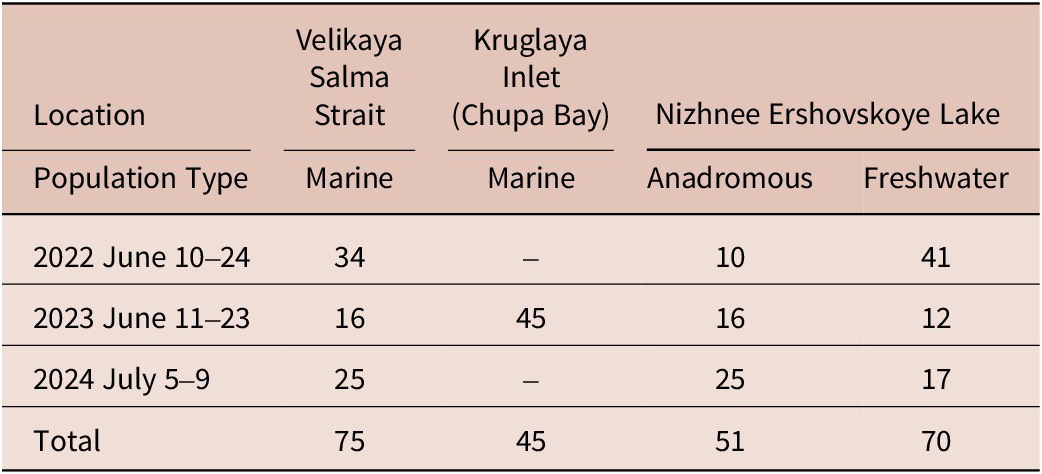
Specimens were caught using nets in the Velikaya Salma Strait near the MSU WSBS (66°33′25″ N, 33°06′02″ E) and in the Nizhnee Ershovskoye Lake (66°32’7.57″ N, 33°3’49.50" E) (see map in Fig. 1). Also, individuals were caught in Kruglaya Inlet near the Kartesh Station (66°20’18.95" N, 33°38’6.44" E) on June 17–18, 2023 (Table 1). For each individual, the total length and body weight were measured, and the sex and stage of development of the gonads were determined, in accordance with the generally accepted methodology (Pravdin, Reference Pravdin1966). Freshwater and anadromous forms were identified on the basis of the presence or absence of lateral armor plates in anadromous forms (as well as in marine ones). In freshwater forms, they are either absent or highly reduced (Bell, Reference Bell, Hendry and Kinnison2001; Terekhanova et al., Reference Terekhanova, Logacheva, Penin, Neretina, Barmintseva, Bazykin, Kondrashov and Mugue2014). Marine forms were identified by morphology and based on the fact that they were caught in the sea near their usual spawning grounds, far from any freshwater reservoirs where the anadromous form might enter to spawn.
Three-spined stickleback catch map. MSU WSBS – Moscow State University White Sea Biological Station; WSBS Kartesh – White Sea Biological Station of Zoological Institute of Russian Academy of Science.

Studied specimens of three-spined stickleback in the White Sea

Parasitological dissection was performed following standard protocols (Bykhovskaya-Pavlovskaya Reference Bykhovskaya-Pavlovskaya1985; Klimpel et al., Reference Klimpel, Kuhn, Münster, Dörge, Klapper and Kochmann2019). All endohelminths were fixed with 96% alcohol.
Species identification of trematodes, cestodes, and chromadoreans based on morphological and/or molecular characters. Morphological identification was performed according to Moravec (Reference Moravec1994), Gibson (Reference Gibson1996), and other sources (Mozgovoy, Reference Mozgovoy1953; Shulman & Shulman-Albova, Reference Shulman and Shulman-Albova1953; Gibson et al., Reference Gibson, Jones and Bray2002; Jones et al., Reference Jones, Bray and Gibson2005). Parasitological indices were calculated in accordance with Bush et al. (Reference Bush, Lafferty, Lotz and Shostak1997).
DNA extraction, amplification, sequencing, alignment, and phylogenetic analysis
We molecularly studied only frequently occurring species of parasites identification of which by morphological characteristics was impossible or raised certain doubts, namely, third-stage juveniles of ascaridoid chromadoreans and adult trematodes Phyllodistomum folium (Olfers, 1816), Alloopistholecithum cf. salmonis (Yamaguti, 1934), and Brachyphallus crenatus (Rudolphi, 1802). The results of molecular identification of larvae of the phyllobothriid cestodes Rockacestus cf. piriei (Williams, 1968) are published in a separate paper (Logvinenko et al., Reference Logvinenko, Gordeev and Biserova2025). Chromadorean juveniles were characterized by us using the cox2 genes, which have a high resolution for the species level in these groups of parasites (Mattiucci & Nascetti, Reference Mattiucci and Nascetti2008; Hernández-Orts et al., Reference Hernández-Orts, Scholz, Brabec, Kuzmina and Kuchta2018). Trematodes were sequenced by ITS2 region and/or 28S r RNA gene. Barcoding for the cox2 gene was carried out for 15 specimens of Hysterothylacium aduncum (Rudolphi, 1802) and 21 Anisakis Dujardin, 1845 specimens. Sequences of the 28S rRNA gene were obtained from 2 specimens of P. folium, 4 specimens of Alloopistholecithum cf. salmonis, and 2 specimens of B. crenatus. Sequences of ITS2 were obtained from 2 specimens of Alloopistholecithum cf. salmonis and one specimen of B. crenatus. DNA was extracted using a PALL™ AcroPrep 96-well purification plate by PALL Corp. following a protocol by Ivanova et al. (Reference Ivanova, Dewaard and Hebert2006a, Reference Ivanova, Grainger and Hajibabaei2006b). The DNA samples were used as a template for amplification of 28S rRNA for trematodes (772-1014 bp), ITS2 region (496-575 bp) for trematodes, and partial cytochrome c oxidase subunit II (cox2) (514-568 bp) for nematodes.
The nuclear 28S rRNA gene was amplified by polymerase chain reaction (PCR) with primers ZX-1 (5′-ACCCGCTGAATTTAAGCATAT-3′), 1500R (5′-GTATCCTGAGG-GAAACTTCG-3′), LSU_300F (5′-CAAGTACCGTGAGGGAAAGTTG-3′), 1090F (5′-GAAACACGGACCAAGG-3′), LSU_1200F (5′-CCCGAAAGATGGTGAACTATGC-3′), and ECD2 (5′-CTTGGTCCGTGTTTCAAGACGGG-3′) described by Waeschenbach & Littlewood (Reference Waeschenbach, Littlewood, Caira and Jensen2017). ITS2 region of trematodes was amplified by PCR with primers 3S (5-GTACCGGTGGATACGTGGCTAGTG-3) and ITS2.2 (5-CCTGGTTAGTTCTTTTCCTCCGC-3) described by Morgan & Blair (Reference Morgan and Blair1995). Cox2 of nematodes was amplified by PCR with primers 210 (5′CACCAACTCTTAAAATTATC3′) and 211 (5′TTTTCTAGTTATAGATTGRTTYAT3′) described by Valentini et al. (Reference Valentini, Mattiucci, Bondanelli, Webb, Mignucci-Giannone, Colom-Llavina and Nascetti2006).
Amplification was performed according to the following protocol: 3-min denaturation at 94 °C, 40 cycles (34 cycles for cox2, 35 cycles for ITS2) of 30 s at 94 °C, 30 s at 55 °C (cox2, 1 min at 46 °C), and 2 min (ITS2, 1 min; cox2, 1.5 min.) at 72 °C, 10-min elongation at 72 °C. The negative control was amplified using all primers. PCR was carried out in a 25-μL reaction volume (5 μL of 5× HotTaq Red buffer, Eurogen Lab, 0.5 μL of HotTaq polymerase, Eurogen Lab, 0.5 μL of dNTP (50 μM stock), 0.3 μL of each primer (10 μM stock), 1 μL of genomic DNA, and 17.4 μL of sterile water).
When setting up the sequencing reaction of DNA fragments, we used the same primers in both directions for 28S rRNA and cox2 genes, and ITS2 region. Both strands of each amplicon were sequenced with the BigDye Terminator v3.1 sequencing kit by Applied Biosystems and NovaDye Terminator sequencing kit. Sequencing reactions were analyzed by capillary electrophoresis on ABI 3500 Genetic Analyzer (Thermo Fisher, USA) or Nanophore-05 (Syntol, Russia) in the Core Centrum of the Koltsov Institute of Developmental Biology (Moscow, Russia). All new sequences were deposited in GenBank (Table 2). Raw reads for each gene were assembled and checked for improper basecalling (those sites were further modified) using Geneious Pro 10.0.9 (Biomatters, Auckland, New Zealand). Partial sequences used in our study to evaluate the phylogenetic connections of the specimens were assembled using Geneious ver. 10.0.5 software and aligned with sequences retrieved from GenBank (NCBI) (Table 1) using ClustalW DNA weight matrix within MEGA 10.0.5 software alignment explorer (Kumar et al., Reference Kumar, Stecher, Li, Knyaz and Tamura2018). We then BLASTed the resulting sequences in the GenBank database (NCBI). Subsequently, the degree of difference with the closest sequences was assessed using p-distances.
Newly obtained sequences with similar GenBank sequences

Statistical analysis
The dissimilarity of the parasite communities was illustrated by non-metric multidimensional scaling (NMDS). The Gower index was used as distance metric in two modifications – for binary and quantitative data. There is presence or absence of a species and the number of its specimens in the parasite infracommunities, respectively. The model ‘local’ with separate regressions for each point was chosen as the argument of the function ‘monoMDS’ from the vegan package (Oksanen et al., Reference Oksanen, Blanchet, Friendly, Kindt, Legendre, McGlinn, Minchin, O’Hara, Simpson, Solymos and Stevens2020). The significance of differences between study groups of the infracommunities was established by the analysis of similarities (ANOSIM) from the same package. The ANOSIM statistic R based on the difference of mean ranks between tested groups and within these groups takes values in the range from -1 to +1. The sign ‘-’ indicates that intragroup differences are greater than intergroup differences; the sign ‘+’ indicates that intergroup differences are greater than intragroup differences.
The prevalence values and mean abundance of the parasite species were compared by Monte Carlo Randomization (MCR-test) with the number of replicates B = 1000. In this approach, the significance of differences p is the adjusted share of null-model combinations (the empirical difference is not greater than the randomized difference, |d obs| ≤ |d ran|) in the total number of tests B. The critical threshold adopted for p was the standard α = 0.05 (Shitikov & Rosenberg, Reference Shitikov and Rosenberg2013). In a similar way, the ‘anosim’ function from the vegan package evaluates the significance of ANOSIM statistic R. The data were processed in MS Excel and R 4.0.1 (The R Project…, 2024) environments using basic functions and functions vegan package (Oksanen et al., Reference Oksanen, Blanchet, Friendly, Kindt, Legendre, McGlinn, Minchin, O’Hara, Simpson, Solymos and Stevens2020).
Results
Molecular data
All nematode juveniles found in the stickleback body cavity and sequenced in our study were identified by molecular data as either Anisakis simplex sensu stricto (21 specimens) or H. aduncum (15 specimens). All newly obtained cox2 gene sequences of A. simplex are identical or very similar to those available in GenBank under the numbers LT883368 and OR568605 (p-distances 0–0.85%). In turn, all cox2 sequences of H. aduncum we obtained were very similar to those in GenBank available as OK338702, MW149071, and JQ934892 (p-distances 0.19–0.97%).
We also molecularly confirmed the species identity of three frequently occurring trematode species collected from the stickleback individuals: P. folium, B. crenatus, and Alloopistholecithum cf. salmonis. For P. folium (2 specimens), only sequences of the 28S rRNA gene were obtained, which were identical or very similar to those available in GenBank under the numbers AY277707 and KX957727 (p-distance 0–0.37%). Two specimens of B. crenatus were molecularly characterized by us using the 28S rRNA gene and ITS2 region. Newly obtained 28S rRNA gene sequences were close to the sequences of B. crenatus previously deposited in GenBank as MH628299: p-distances 0.28% and 0.09%, respectively. GenBank lacks B. crenatus ITS2 sequences. For Alloopistholecithum cf. salmonis (4 specimens), sequences of the 28S rRNA gene and ITS2 region were also obtained. All obtained sequences of this species were identical to those available in GenBank under the numbers OM850382 and OM850384 (28S rRNA gene), and OM850410 and ON320555 (ITS2 region), respectively.
Helminth communities
Based on significance assessments of difference of parasitic infracommunities obtained by the analysis of similarities (ANOSIM) in addition to non-metric multidimensional scaling (NMDS), we combined some of the original samples in each of the studied host populations. First of all, these were males and females, since across all sites and seasons, differences between sex groups were statistically no greater than differences within these groups in both the species composition of parasites (ANOSIM statistics R < 0.241, p > 0.052) and number of their specimens (ANOSIM statistics R < 0.091, p > 0.194). In the next step, when comparing the seasons in each of the host populations, it was found that 2022 and 2023 also did not differ statistically either in composition (ANOSIM statistics R < 0.105, p > 0.051) or in the structure of parasite infracommunities (ANOSIM statistics R < -0.004, p > 0.467). Thus, we combined the samples of these years within each host population. At the same time, samples from 2024 differed from those of 2022+2023 for some populations by one or both metrics (see below). As a result, we consider the 2022+2023 and 2024 samples separately (Table 3).
Helminths in studied populations of three-spined stickleback

Note. P – prevalence; I – intensity of infection: min-max (mean abundance); Tr – Trematoda, Cs – Cestoda, Nm – Nematoda; l – larva; mtc– metacercaria; pl – plerocercoid
In total, 10 helminth species have been found in marine population of stickleback. All these species are characteristic of the parasite component communities 2022+2023, and only two of them were not detected in 2024 (Table 3). Core species of the parasite component communities associated with this fish population in 2022+2023 and 2024 were H. aduncum, A. simplex, B. crenatus, and H. levinseni, to which Alloopistholecithum cf. salmonis and B. scorpii were added in 2022+2023. The component communities of parasites in 2022+2023 and 2024 differ significantly only in prevalence and mean abundance of Alloopistholecithum cf. salmonis and B. scorpii (MCR-test: p < 0.039). The parasite infracommunities of marine fish formed in 2024 differ significantly from those in 2022+2023 only in species composition (ANOSIM statistic R = 0.152, p < 0.001); however, these infracommunities do not differ in abundance of parasites (ANOSIM statistic R = -0.073, p = 0.986).
In the anadromous host population, we reported 12 helminth species. All of them were present only in the parasite component community of 2022+2023. The parasite component community of 2024 is characterized by a significantly smaller number of species (4). The core species of parasite communities associated with this fish population in 2022+2023 and 2024 consists of H. aduncum and A. simplex, with the addition of Alloopistholecithum cf. salmonis in 2022+2023 (Table 3). Statistically significant differences between these study periods were manifested only in the prevalence and mean abundance of Alloopistholecithum cf. salmonis (MCR-test: p < 0.001). The helminth infra-communities of 2024 differ from those of 2022+2023 in both species composition (ANOSIM statistics R = 0.295, p < 0.001) and species abundance in infracommunities (ANOSIM statistics R = 0.117, p < 0.001).
In the freshwater population of stickleback we recorded five helminth species, two of which, S. solidus and Diplostomum sp. occupied core position in both tested time periods (Table 3). The parasite component community of 2024 significantly differed from that of 2022+2023 only by its higher occurrence and mean abundance of Diplostomum sp. (MCR-test: p < 0.049). The analysis did not reveal significant interannual differences in infracommunities either in species composition (ANOSIM statistics R = 0.205, p = 0.054) or in parasite abundance (ANOSIM statistics R = 0.149, p = 0.165).
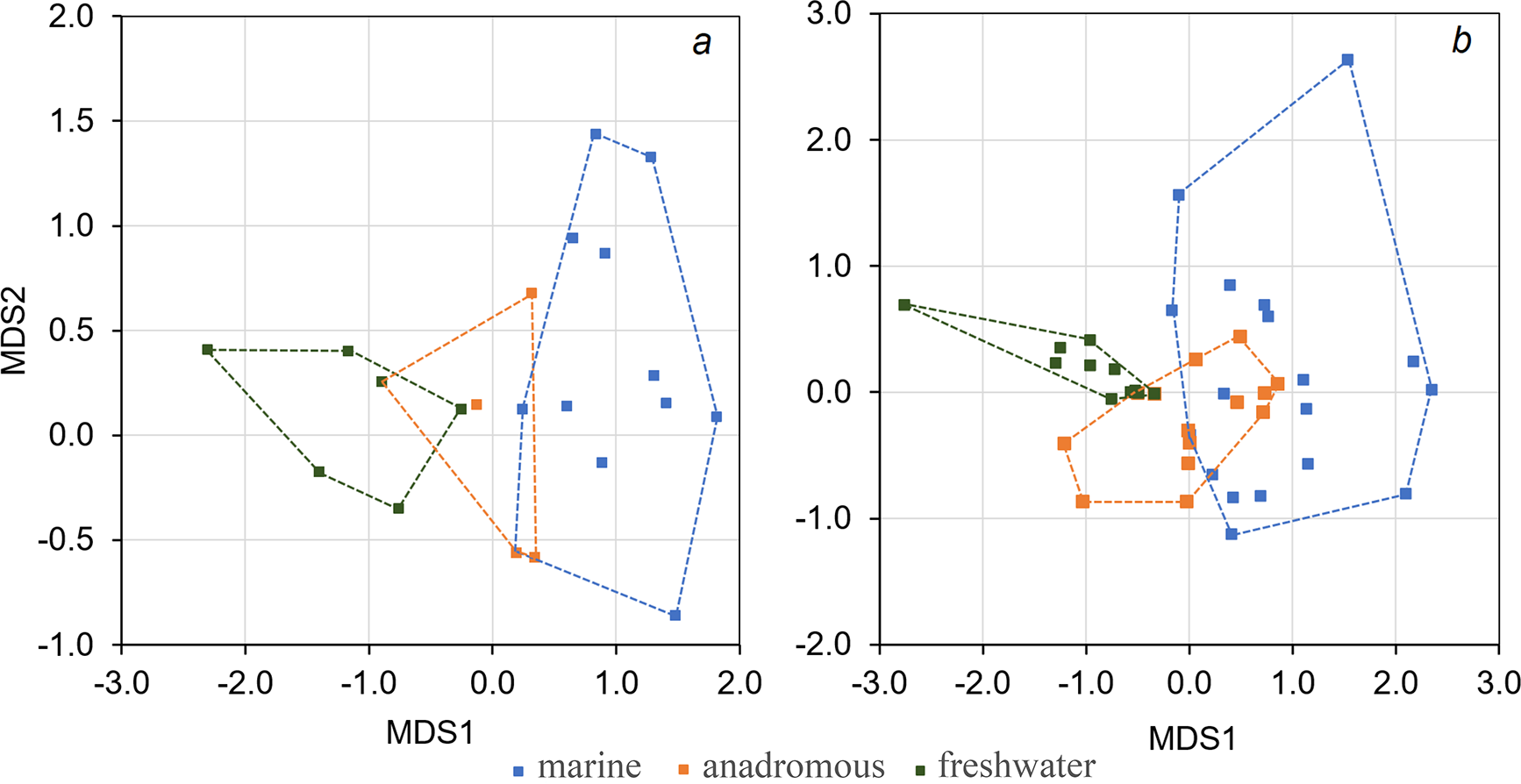
Ordination of infracommunities by species composition and number of parasite specimens (Figs. 2 and 3) revealed that those associated with individuals of the marine host population are characterized by the highest variability in both parameters, and infracommunities of fish of the freshwater population are the lowest, respectively. In 2022+2023, all observed differences between the infracommunities of parasites of anadromous and marine sticklebacks are random (Fig. 2, ANOSIM statistics R < 0.046, p > 0.245), but the infracommunities of freshwater sticklebacks differ significantly from the first two (ANOSIM statistics R > 0.353, p < 0.002). The similarity of helminth infracommunities associated with marine and anadromous fish is ensured by the presence in many of them of the most abundant marine species Alloopistholecithum cf. salmonis, A. simplex, H. aduncum, and H. levinseni (Table 3). At the same time, parasitic infracommunities of freshwater fish differ from those of marine and anadromous sticklebacks by a poor composition of marine species and the presence of freshwater helminths with a relatively wide range of intensity and occurrence.
Non-metric multidimensional scaling (NMDS) plots showing dissimilarity of parasite infracommunities of sticklebacks by their species composition (a) and number of parasite specimens (b) in 2022–2023 in marine, anadromous, and freshwater fish populations.

Non-metric multidimensional scaling (NMDS) plots showing dissimilarity of parasite infracommunities of sticklebacks by their species composition (a) and number of parasite specimens (b) in 2024 in marine, anadromous, and freshwater fish populations.

In 2024, the variability of parasitic infracommunities in marine and anadromous host populations became significantly less, which was reflected in the severity of the difference between them (Fig. 3). In this year, all three groups of helminth infracommunities are significantly different from each other in both above-mentioned metrics (Fig. 3, ANOSIM statistics R > 0.166, p < 0.002). The infracommunities of parasites of marine sticklebacks differ from the infracommunities of anadromous fish by a significantly more frequent presence of B. crenatus and H. levinseni and a higher intensity of infection of these helminths (MCR-test: p < 0.001). The infracommunities of parasites of freshwater sticklebacks differ most clearly from those of marine and anadromous hosts in the occurrence and mean abundance of the core freshwater species, in particular S. solidus (Table 3, MCR-test: p < 0.001). In addition, interannual changes assessed through infracommunity ordination were manifested by a reduction in the area of the graphs, indicating a decrease in the diversity of parasite infracommunities, most pronounced in the anadromous host population (Figs. 2 and 3).
Discussion
In this study, we performed a parasitological examination of the three three-spined stickleback populations in the White Sea. A total of 13 species of helminths were found. Two trematode species, P. folium and Alloopistholecithum cf. salmonis, and one species of cestodes, R. piriei recorded in our study deserve special attention. Phyllodistomum folium is not mentioned in previous studies of stickleback in the White Sea basin and the Kola Peninsula (Mitenev & Shulman, Reference Mitenev and Shulman2005; Garmash, Reference Garmash2019; Lebedeva et al., Reference Lebedeva, Zaitsev, JaI and Makhrov2023). Digenean Alloopistholecithum cf. salmonis is also recorded for stickleback in the White Sea for the first time. Only two lecithasterid species were previously found in the White Sea, Allopistholecithum gibbosus (Rudolphi, 1802) and Lecithaster confusus Odhner, 1905 (Dogel & Petrushevskii, Reference Dogiel and Petrushevskii1935; Shulman-Albova, Reference Shulman-Albova1952; Shulman & Shulman-Albova, Reference Shulman and Shulman-Albova1953; Shulman, Reference Shulman1956; Malakhova, Reference Malakhova1972; Mitenev, Reference Mitenev1977; Grozdilova, Reference Grozdilova1989; Barskaya et al., Reference Barskaya, Ieshko and Novohatskaya2005; Rybkina et al., Reference Rybkina, Demchuk, Lajus, Ivanova, Ivanov and Galaktionov2016). However, these nominal species appear to be absent from the White Sea, and all previous reports of them refer to Allopistholecithum salmonis complex. It is a group of cryptic species that differs only in mitochondrial markers. Therefore, the species of this complex inhabiting stickleback remains to be elucidated (Krupenko et al., Reference Krupenko, Gonchar, Krapivin, Kremnev, Skobkina and Efeykin2025). In the course of the current study it was noted that the first record in the White Sea of cestode species Rockacestus cf. piriei (Cestoda: Phyllobothriidea) (Table 3; Logvinenko et al., Reference Logvinenko, Gordeev and Biserova2025).
The diversity of the marine stickleback helminth fauna in our study is pretty much the same as reported in previous White Sea investigations (Shulman and Shulman-Albova, Reference Shulman and Shulman-Albova1953; Rybkina et al., Reference Rybkina, Demchuk, Lajus, Ivanova, Ivanov and Galaktionov2016; Lebedeva et al., Reference Lebedeva, Zaitsev, JaI and Makhrov2023, etc.). However, there are a few notable differences for several species when comparing our data to the historical data. Maximal values of prevalence of Anisakis spp. for the period 2022-2024 we studied reach 62.1% (Table 3, 2022+2023) vs 26.6% in Shulman and Shulman-Albova (Reference Shulman and Shulman-Albova1953); same for Allopistholecithum cf. salmonis - 72.6% (Table 3, 2022+2023) vs 6.6% in Shulman and Shulman-Albova (Reference Shulman and Shulman-Albova1953) and 8.0% in Rybkina et al. (Reference Rybkina, Demchuk, Lajus, Ivanova, Ivanov and Galaktionov2016); same is true for Podocotyle spp. – 2.1% (Table 3, 2022+2023) vs 18.5% and more (Shulman and Shulman-Albova, Reference Shulman and Shulman-Albova1953, Rybkina et al., Reference Rybkina, Demchuk, Lajus, Ivanova, Ivanov and Galaktionov2016, Lebedeva et al., Reference Lebedeva, Zaitsev, JaI and Makhrov2023). Infection with trematodes of the genus Cryptocotyle in Kandalaksha Bay was much lower than in the literature, almost 25 times lower in 2022+2023 – 4.2% vs 100%, and was completely absent in 2024 (Rybkina et al., Reference Rybkina, Demchuk, Lajus, Ivanova, Ivanov and Galaktionov2016, Lebedeva et al., Reference Lebedeva, Zaitsev, JaI and Makhrov2023). Perhaps this is due to the different timing of the study (most of the literature data were obtained in July–August; our data were obtained in June and early July). When compared with data from around the world (Poulin et al., Reference Poulin, Blanar, Thieltges and Marcogliese2011), it can be seen that marine stickleback helminth fauna in the Baltic Sea is on average richer than in our study (1–17 vs 10 species). However, the helminth fauna in the White Sea is richer than in the North Atlantic (2–8 vs 10 species) and in the Northern Pacific (4 vs 10 species) (Poulin et al., Reference Poulin, Blanar, Thieltges and Marcogliese2011).
As for the anadromous sticklebacks, in a study on In other locations of the White Sea basin (the Virma River and the Varzuga River) only three or four species of helminths were noted (Shulman and Shulman-Albova, Reference Shulman and Shulman-Albova1953; Mitenev and Shulman, Reference Mitenev and Shulman2005). In our study, 13 species of helminths were noted. For the first time, we obtained quantitative infection parameters for the Kandalaksha Bay basin of such species as cestodes B. scorpii, S. solidus, and trematodes Derogenes cf. varicus, B. crenatus, H. levinseni, and P. folium. Freshwater parasites such as S. solidus, P. folium, and Diplostomum sp. are rarely found in the anadromous stickleback; however, we cannot find an explanation for the absence of marine parasites such as B. scorpii, B. crenatus, and H. levinseni in earlier studies of the White Sea. For the few species recorded by both us and previous researchers there are notable differences among the three species. Maximal values of prevalence of Anisakis spp. for the period 2022-2024 we studied reach 46.2% (Table 3, 2022+2023) vs 6.3% in Shulman and Shulman-Albova (Reference Shulman and Shulman-Albova1953) and 26.6% in Mitenev and Shulman (Reference Mitenev and Shulman2005); Allopistholecithum cf. salmonis – 80.8% (Table 3, 2022+2023) vs 6.3% in Shulman and Shulman-Albova (Reference Shulman and Shulman-Albova1953); Podocotyle spp. – 3.8% (Table 3, 2022+2023) vs 18.7% (Shulman and Shulman-Albova, Reference Shulman and Shulman-Albova1953). In the Baltic Sea, available for comparison, the number of parasitic species of anadromous populations ranges from 2 to 20, and in the North Atlantic from 1 to 11 species (Poulin et al., Reference Poulin, Blanar, Thieltges and Marcogliese2011).
The helminth fauna of freshwater stickleback in the White Sea basin and the Kola Peninsula varies in different bodies of water (Mitenev and Shulman, Reference Mitenev and Shulman2005; Garmash, Reference Garmash2019). The helminth fauna of the freshwater population studied by us differs greatly in species composition from the populations described in the literature. The only common species – S. solidus. A species very characteristic of freshwater stickleback all over the world (Hanek and Molnar, Reference Hanek and Molnar1974; Morozinska-Gogol, 1999; Højgaard et al., Reference Højgaard, Steingrund and Bristow2008), whose final hosts are waterfowl. The two species that were not present in our specimens – Dibothriocephalus dendriticus (Nitzsch, 1824) Lühe, 1899 and Neoechinorhynchus rutile Muller, 1780 were found in both Nizhniy Venzin Lake and Kulonga Lake (Garmash, Reference Garmash2019) and only in Nizhniy Venzin Lake (Garmash, Reference Garmash2019) accordingly. This is due to the considerable isolation of populations from each other; the exchange of parasites between them is mainly carried out with the help of birds. Our population (2022+2023 and 2024 altogether) had the highest diversity with five helminth species, of which two are marine (B. scorpii and Allopistholecithum cf. salmonis). We cannot explain the presence of marine species in the freshwater population. The prevalence of S. solidus infection, in our study, is higher than that of Garmash (Reference Garmash2019) (92.5% (2022+2023) vs 10%, 25%, 7% in different reservoirs). This may be due to the more northern location of the reservoirs studied by Garmash (Reference Garmash2019), and the more northern (cold) temperature regime of the reservoirs, a shorter summer (photic) period, and, as a result, a lower intensity of the dynamics of the life cycles of both parasites and their hosts.
Males and females from each of the studied populations did not differ statistically either in species composition or in the structure of parasitic infracommunity. This indicates the absence of parasitological differences between sticklebacks of different sexes, despite the specifics of the ecology of males and females of this fish species during spawning and larval development (Lajus et al., Reference Lajus, Golovin, Zelenskaia, Demchuk, Dorgham, Ivanov, Ivanova, Murzina, Polyakova, Rybkina and Yurtseva2020). In the literature data, generally males are less infected with parasites than females (Reimchen & Nosil, Reference Reimchen and Nosil2001). This is consistent with data on increased immunity of males compared to females (De Lisle & Bolnick, Reference De Lisle and Bolnick2021). This difference can also be attributed to the fact that males guarding the nest do not actively feed (Reimchen & Nosil, Reference Reimchen and Nosil2001). However, no such gender differences were noted in our study. This can be explained by the absence of nest-guarding males in the study and the lower influence of the above factors on parasite infection. A more significant differentiation of parasitic infracommunity is shown for the seasons 2022+2023 and 2024 in marine and anadromous populations. Differences were also evident at the level of the respective component communities. We assume that in marine sticklebacks, the reasons for the decrease in the number of parasite species and the observed rearrangement of their abundance distribution in 2024 are potentially associated with the calendar dates of sample collection and random factors.
The latter most likely explain the absence in the 2024 marine fish sample of several species that constitute the satellite part of the component community in 2022+2023: Rockacestus cf. piriei, Podocotyle sp., and Cryptocotyle sp. (Table 3). In 2024, marine sticklebacks were caught in mid-July (5–9 of July), while in 2022+2023, the catch was made closer to mid-June (10–24 of June). We have yet to explain the specific influence of this factor. The main contribution to the observed community differences is made by two species of parasites transmitted to sticklebacks via planktonic crustaceans – B. scorpii and Alloopistholecithum cf. salmonis (Solonchenko, Reference Solonchenko1985; Krupenko et al., Reference Krupenko, Kremnev, Skobkina, Gonchar, Uryadova and Miroliubov2022). In 2024, these two parasite species showed either a decrease in prevalence and mean abundance or were completely absent. However, other species also transmitted through planktonic crustaceans, B. crenatus and H. levinseni, did not show this dynamic.
In 2022+2023, we examined anadromous sticklebacks almost immediately after they entered the lake (10–24 June), and in 2024, after about a month of their stay in the lake (10–17 July). Thus, the above-mentioned variability in species number of the component community of helminths in anadromous fish can be explained by the different length of stay of the studied fish in freshwater. The lifespan of sticklebacks is 2–4 years, with the highest age estimates being eight years (Reimchen, Reference Reimchen1992). Anadromous individuals spend most of their lives at sea, where, together with marine individuals, they become infected with marine parasites. Some anadromous sticklebacks die from exhaustion after spawning, while others return to the sea and spawn repeatedly. Anadromous stickleback individuals become infected with freshwater parasite species during a relatively short period of entering freshwater bodies. At the beginning of the spawning migration, anadromous sticklebacks may host both marine parasites, which they acquired during the marine feeding period, and freshwater parasites. The latter, for example, S. solidus, can persist in them from the freshwater stage. As they remain in freshwater, marine intestinal parasites are eliminated from the anadromous host individuals, while freshwater parasites, on the contrary, infect the anadromous individual (e.g., Mamayev & Oshmarin, Reference Mamayev and Oshmarin1963; Frimeth, Reference Frimeth1987). Interannual differences between communities associated with freshwater sticklebacks are significant only in relation to the abundance of one species (Diplostomum sp.) and only at the level of component communities. The relative stability of the component community of helminths in freshwater sticklebacks is probably determined by the less dynamic nature of the lake plankton and benthos community and/or the more conservative diet of freshwater individuals of these fish.
In both study periods (2022+2023 and 2024), the component community of helminths in marine sticklebacks was richer than that of freshwater sticklebacks, which is undoubtedly explained by the greater diversity of marine biota, providing higher opportunities for fish infection. In 2022+2023, the component community of helminths in anadromous sticklebacks had a richer species composition compared to the same type of community in marine and freshwater fish during the same study period. However, in 2024, the component community of helminths in anadromous sticklebacks turned out to be poorer than that of marine fish and comparable in species number to the component community of helminths in freshwater sticklebacks, which is undoubtedly explained by the above-mentioned differences in samples of anadromous fish between 2022+2023 and 2024 in terms of capture timing and, consequently, time spent in freshwater.
Infracommunities formed in fish of the marine population show significant differences from those in freshwater sticklebacks in species composition and parasite abundance in both study periods. This result is quite natural, since the former lack freshwater species, while the latter, although they have marine species, are present in a limited number of infracommunities and in a depleted composition (B. scorpii, Alloopistholecithum cf. salmonis). Infracommunities of anadromous fish differ significantly in both indicators in both seasons only from those of freshwater sticklebacks. However, in 2024, infracommunities of anadromous fish in terms of species composition and number of parasite individuals had significant differences from infracommunities of parasites in marine fish. As shown above, the greatest contribution to the differences between infracommunities of anadromous and marine fish, manifested in 2024, is made by the marine trematodes H. levinseni and B. crenatus. The first of these trematode species in 2024 completely dropped out of the composition of parasite infracommunities in anadromous fish, while the second sharply reduced its abundance. At the same time, the differences between the infracommunities of anadromous and freshwater fish are provided by the clear predominance of freshwater species in the latter during both study periods. The clear differences between the parasite infracommunities of anadromous and marine fish observed in 2024 are undoubtedly determined by the aforementioned degradation of the marine component of the parasite fauna in anadromous host individuals that have already spent about 1 month in the lake. At the same time, during 1 month of stay in freshwater conditions, anadromous stickleback individuals do not have time to become infected with freshwater species in parameters (species number, prevalence, and intensity) comparable to indigenous lake sticklebacks.
Thus, temporal variants in parasite communities were observed between 2022+2023 and 2024 samples in all three stickleback populations. The anadromous population showed the most significant temporal changes, with reduced marine parasite diversity in 2024. Interpopulation differences in parasite communities also experience temporal variability. In 2024, the parasite communities of marine and anadromous sticklebacks had a greater degree of difference than in 2022+2023. Both within- and between-population temporal differences in the studied parasite communities of sticklebacks are probably associated with different calendar timing of data collection.
Acknowledgements
The authors thank the staff of the MSU WSBS, and Dr. Alexander Tsetlin in particular; the staff of the ZIN RAS WSBS “Kartesh”, and Drs. Vyacheslav Halaman, Alexey Sukhotin, Daria Martynova, and Yakov Martynov. We also wish to thank Drs. Natalia Biserova and Igor Kosevich (Lomonosov MSU), Drs. Georgy Kremnev, Dmitry Laius, and Elena Rybkina (ZIN RAS) for their help in the work. The authors are grateful to Dr. Nikolai Mugue and Lyubov Mugue (Russian Federal Research Institute of Fisheries and Oceanography), as well as to Ivan Kolesnikov, Ivan Dadykin, Daria Grishina, Anastasia Urazaeva (Lomonosov MSU), and Ekaterina Kozinina for their help with the sampling. We also wish to thank Drs. Irina Ekimova and Maria Stanovova, as well as Daria Grishina (Lomonosov MSU) for their help with the genetic studies.
Financial support
This work was supported by the Ministry of Science and Higher Education of the Russian Federation. The study was conducted after the state assignment of Lomonosov Moscow State University.
Competing interests
The authors declare none.