INTRODUCTION
Bipolar disorder (BD) is frequently associated with psychosocial debilitation, including impairments in working capacity, interpersonal relationships, and quality of life (Coryell et al., Reference Coryell, Scheftner, Keller, Endicott, Maser and Klermann1993; Hofer, Biedermann, Yalcin, & Fleischhacker, Reference Hofer, Biedermann, Yalcin and Fleischhacker2014). The ability to accurately perceive, interpret, and process emotions has been shown to be of major relevance in this context. The majority of previous studies dealing with these issues investigated facial emotion perception abilities and revealed inconsistent findings (Kohler, Hoffman, Eastman, Healey, & Moberg, Reference Kohler, Hoffman, Eastman, Healey and Moberg2011). Harmer, Grayson, and Goodwin (Reference Harmer, Grayson and Goodwin2002), for example, found intact perception of most emotions and even an enhanced perception of disgust in patients with BD. Similarly, Robinson, Gray, Burt, Ferrier, and Gallagher (Reference Robinson, Gray, Burt, Ferrier and Gallagher2015) could not detect specific deficits in facial emotion labeling during periods of euthymic or depressed mood, while Venn et al. (Reference Venn, Gray, Montagne, Murray, Burt, Frigerio and Young2004) and Lembke and Ketter (Reference Lembke and Ketter2002) described an isolated impairment in the perception of fear. Reference Derntl, Seidel, Kryspin-Exner, Hasmann and DobmeierDerntl, Seidel, Krypsin-Exner, Hasmann, and Dobmeier (2009) and Van Rheenen and Rossell (Reference Van Rheenen and Rossell2014), in turn, reported on a significant overall impairment in facial emotion perception in patients compared to healthy subjects. Notably, these deficits have been shown to be more subtle in patients suffering from BD than in those suffering from schizophrenia (Rossell, Van Rheenen, Joshua, O’Regan, & Gogos, Reference Rossell, Van Rheenen, Joshua, O’Regan and Gogos2013; Yalcin-Siedentopf et al., Reference Yalcin-Siedentopf, Hoertnagl, Biedermann, Baumgartner, Deisenhammer, Hausmann and Hofer2014).
Next to this visual way, auditory signals represent another possibility to communicate emotions. Despite growing evidence of facial emotion perception deficits in BD, comprehensive investigations of emotional prosody perception in this patient group are limited and findings are inconsistent. Vaskinn et al. (Reference Vaskinn, Sundet, Friis, Simonsen, Birkenaes, Engh and Andreassen2007), for example, detected intact performance, and Bozikas et al. (Reference Bozikas, Kosmidis, Tonia, Andreou, Focas and Karavatos2007) reported that female patients were impaired in the perception of fear and surprise compared to healthy women, whereas male patients did not differ from their healthy consexuals in this regard. Rossell, Van Rheenen, Groot, et al. (Reference Rossell, Van Rheenen, Groot, Gogos, O’Regan and Joshua2013) investigated emotional prosody perception in psychosis by using the Comprehensive Affective Testing System (CATS) (Froming, Gregory, Levy, & Ekman, Reference Froming, Gregory, Levy and Ekman2003) and found impairments in both patients suffering from schizophrenia and BD. Again, these deficits were less pronounced in BD compared to schizophrenia. In a review of the literature (Van Rheenen & Rossell, Reference Van Rheenen and Rossell2013), the authors, therefore, stated that there is preliminary evidence for some behavioral impairment in the processing of emotional prosody in BD and claimed for more studies to address this gap.
We previously studied facial emotion perception abilities in symptomatically remitted patients with BD and found deficits in the identification of facial expressions depicting disgust and happiness (Hoertnagl et al., Reference Hoertnagl, Muehlbacher, Biedermann, Yalcin, Baumgartner, Schwitzer and Hofer2011). Similar to the above-mentioned studies by Rossell and Van Rheenen (Rossell, Van Rheenen, Joshua, et al, Reference Rossell, Van Rheenen, Joshua, O’Regan and Gogos2013; Rossell, Van Rheenen, Groot, et al., Reference Rossell, Van Rheenen, Groot, Gogos, O’Regan and Joshua2013), a companion study using the CATS revealed semantic but not prosodic emotional perception deficits in patients compared to healthy control subjects (Hoertnagl et al., Reference Hoertnagl, Biedermann, Yalcin-Siedentopf, Muehlbacher, Rauch, Baumgartner and Hofer2015).
Using functional magnetic resonance imaging and investigating the neural correlates of emotion processing in euthymic and depressed patients suffering from BD Lawrence et al. (Reference Lawrence, Williams, Surguladze, Giampietro, Brammer, Andrew and Phillips2004) found an increased activation of the ventral prefrontal cortex, the ventral striatum, the thalamus and the hippocampus in response to both positive and negative emotional facial expressions. Similarly, positron emission tomography studies revealed a generally hyperactive limbic system in this patient group (e.g., Drevets et al., Reference Drevets, Price, Bardgett, Reich, Todd and Raichle2002; Ketter et al., Reference Ketter, Kimbrell, George, Dunn, Speer, Benson and Post2001). Accordingly, both behavioral and neuroimaging studies suggest that deficits in the processing of emotions may represent trait markers of the disorder.
Several studies in healthy people indicate that a combination of different origins of facial and verbal cues facilitate emotion perception by giving more information (Kreifelts, Ethofer, Grodd, Erb, & Wildgruber, Reference Kreifelts, Ethofer, Grodd, Erb and Wildgruber2007; Paulmann & Pell, Reference Paulmann and Pell2011). On the other hand, relating facial and verbal emotions might make higher demands on neurocognitive abilities than the processing of either of them. To expand on the above-mentioned findings, the aim of the current study was to investigate cross-modal processing of emotions (i.e., matching of facial and prosodic emotional stimuli) in remitted patients suffering from BD by using two further subtests from the CATS. Based on our previous findings showing deficits in both facial and vocal emotion perception we expected our patients to be impaired in cross-modal emotion perception despite getting more emotional information. To understand the fundamental origin of expected impairments we investigated whether they were mainly attributable to deficiencies in (a) facial emotion perception, (b) emotional prosody perception, (c) matching facial and vocal emotions, or (d) a combination of these deficits.
PATIENTS AND METHODS
This study included 59 patients from the outpatient units of the Medical Universities Innsbruck and Salzburg meeting diagnostic criteria for bipolar I disorder and 45 healthy control subjects from the general community between 18 and 60 years of age. The Mini International Neuropsychiatric Interview (M.I.N.I.; Sheehan et al., Reference Sheehan, Lecrubier, Sheehan, Amorim, Janavs, Weiller and Dunbar1998) was used to confirm both diagnosis in patients and the absence of any axis I disorder according to DSM-IV in control subjects. The latter were chosen to match patients in age, sex, and education. The study received approval by the ethics committees of both Universities. All participants signed informed consent.
To ensure symptomatic remission in patients, a score of ≤8 on both the Montgomery Åsberg Depression Rating Scale (MADRS; Montgomery & Åsberg, Reference Montgomery and Åsberg1979) and the Young Mania Rating Scale (YMRS; Young, Biggs, Ziegler, & Meyer, Reference Young, Biggs, Ziegler and Meyer1978) was required, whereas control subjects had to have a score of ≤63 on the Brief Symptom Inventory (BSI; Franke, Reference Franke2000). Next to the assessment of partnership/employment status and living situation, in patients the overall level functioning was assessed using the Global Assessment of Functioning Scale (GAF; American Psychiatric Association, 1994).
Exclusion criteria included a history of any other axis I disorder, neurological and developmental disorders, and physical illness that might interfere with the participants’ cognitive performance.
Cross-modal Emotion Perception
Cross-modal emotion perception was assessed using two subtests from the CATS (Froming et al., Reference Froming, Gregory, Levy and Ekman2003). In subtest 11 (“Match Emotional Prosody to Emotional Face”), the prosody of one sentence with congruent semantic content expressing happiness, sadness, anger, fright, or neutrality has to be matched with one of five faces exhibiting the corresponding emotion. With 22 sentences read, the total score ranges from 0 to 22. In addition, we calculated misidentification scores.
In subtest 12 (“Match Emotional Face to Emotional Prosody”), one emotional face is shown followed by three sentences expressing happy, sad, angry, or neutral prosody, again with congruent semantic content. The subject indicates which sentence expresses the same emotional prosody as shown by the face. The number of trials is 20 and again, misidentification scores were calculated.
Statistical Methods
Before the analysis, metric variables were tested for deviations from a normal distribution by means of their skewness (skewness values >1 or <−1 were considered as substantial deviations from normality requiring non-parametric testing or transformation). The t test, Mann-Whitney U test and Chi-square test were applied to compare patients and control subjects with regard to sociodemographic variables, depending on the variable type (normally distributed, non-normally distributed, and categorical, respectively). The t test was used to compare the two groups with regard to CATS subtest 11 and subtest 12 total scores (for subtest 12 a square-root transformation was required to obtain approximate normality). In addition, analyses of covariance with adjustment for age and sex were performed to account for potential effects of these variables on test performance.
Generalized equation estimation models with binary response, logistic link function and first-order auto-regressive covariance structure were used for a more detailed analysis of CATS subtest 11 and CATS subtest 12 data to take account of the specific data structure (repeated measures with 22 items for CATS subtest 11 and with 20 items for CATS subtest 12). Two types of analysis were performed: (1) to compare CATS performance in the two groups, all possible response patterns {correct answer rc, given answer ra} were investigated and tested for significant differences between groups by means of likelihood ratio tests. This facilitated to differentiate between individual emotions and to account for both correct identification and misidentifications. In addition to the above analyses (which did not involve covariates), we conducted age and sex adjusted analyses to account for small differences in age and sex distribution between the two groups. (2) The effects of covariates (age, sex, sex of stimulus face, duration of illness, age of onset, number of inpatients stays, psychotic episodes, and medication with mood stabilizers) on test performance within groups was tested separately for all possible pairs of responses {correct answer rc, given answer ra} by means of logistic regression using the backward elimination method for the identification of significant predictors. To warrant that the effect of age and sex is always accounted for, these two variables were kept in the regression model even if their effect did not reach statistical significance.
Finally, we investigated if impairments in cross-modal emotion perception are mainly attributable to deficiencies in facial or in emotional prosody perception or in matching facial and vocal emotions (or a combination of these three deficiencies). For this purpose, the CATS subtest 11 (“Match Emotional Prosody to Emotional Face”) and CATS subtest 12 (“Match Emotional Face to Emotional Prosody”) data were pooled with formerly collected data on facial (assessed with the Facially Expressed Emotion Labeling (FEEL) test) and emotional prosody perception (assessed with the CATS subtest 9 “Conflicting Prosody – Attend to Prosody”) in the same sample (Hoertnagl et al., Reference Hoertnagl, Muehlbacher, Biedermann, Yalcin, Baumgartner, Schwitzer and Hofer2011, Reference Hoertnagl, Biedermann, Yalcin-Siedentopf, Muehlbacher, Rauch, Baumgartner and Hofer2015). The FEEL test is a computer program displaying portrait pictures of actors with the typical facial expression of one of the six basic emotion. Subjects have to decide which of the six emotions they have just seen by clicking on the appropriate label.
The pooled data were analyzed by multiple linear regression using CATS subtest 11 and CATS subtest 12 total scores, respectively, as the dependent variable. The total scores for facial emotion perception (FEEL total score) and emotional prosody perception (CATS subtest 9) and the group (patients vs. controls) served as independent variables. To quantify the contribution of the independent variables to the total variation, eta squared was used as a measure of effect size, using Cohen’s convention for quantification (0.01, 0.09, and 0.25 for small, medium, and large effect sizes, respectively). Statistical significance of the independent variables was assessed by means of likelihood ratio tests (F-test).
RESULTS
Sample Characteristics
Demographic and clinical characteristics of the study sample are summarized in Table 1. As expected, patients and control subjects differed significantly with regard to their partnership and employment status and their living situation. Patients were symptomatically remitted as shown by mean MADRS and YMRS scores of 3.1 ± 2.8 and 1.1 ± 1.4, respectively.
Sample characteristics

MADRS = Montgomery-Åsberg Depression Rating Scale; YMRS = Young Mania Rating Scale; GAF = Global Assessment of Functioning Scale; MS = mood stabilizer; AP = antipsychotic; AD = antidepressant.
a χ² = 9.23, df=3, p = .026.
b χ² = 11.52, df=3, p = .009.
c χ² = 36.03, df=7, p < .001.
d Category “mood stabilizer” includes lithium, valproate, and lamotrigine.
Cross-Modal Emotion Perception
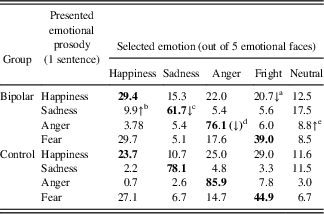
An overview of patients’ and control subjects’ cross modal emotion perception, as assessed by the CATS (Froming et al., Reference Froming, Gregory, Levy and Ekman2003), is given in Tables 2 and 3. In subtest 11, where participants were requested to match emotional prosody to emotional faces, overall performance was poorer in patients than in control subjects (total score: 53.2 ± 18.8 vs. 60.3 ± 15.2; t = 2.06, df = 102; p = .045); after adjustment for age and sex by analysis of covariance only trend-level significance was retained (F 1,100 = 2.84; p = .095). Patients were particularly impaired in matching sad and angry emotional prosody to one of five emotional faces exhibiting the corresponding emotion and significantly more frequently matched sad emotional prosody to happy faces and angry emotional prosody to neutral faces. Moreover, they tended more often to match sad emotional prosody to neutral faces.
Comparison of groups with regard to CATS subtest 11 (“Match Emotional Prosody to Emotional Face”), correct answers, and misidentifications (percentage scores)

Note. ↑ significantly higher than in the control group (p < .05). ↓ Significantly lower than in the control group (p < .05). (↓) Significantly lower than in the control group (p < .05), but significance is lost after adjustment for age and sex. Significant group differences (obtained from generalized equation estimation analysis):
a Wald χ2 = 5.80, p = .016 (after adjustment for age and sex: Wald χ2 = 4.39, p = .036).
b Wald χ2 = 14.2, p < .001 (after adjustment: Wald χ2 = 11.8, p = .001).
c Wald χ2 = 12.2, p < .001 (after adjustment: Wald χ2 = 9.89, p = .002).
d Wald χ2 = 4.51, p = .034 (after adjustment: Wald χ2 = 2.55, p = .110, i.e., significance is lost).
e Wald χ2 = 6.34, p = .012 (after adjustment: Wald χ2 = 4.29, p = .038).
CATS = Comprehensive Affective Testing System.
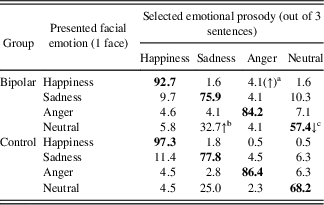
Comparison of groups with regard to CATS subtest 12 (“Match Emotional Face to Emotional Prosody”), correct answers, and misidentifications (percentage scores)

Note. ↑ significantly higher than in the control group (p<0.05). ↓ significantly lower than in the control group (p<0.05). (↑) significantly higher than in the control group (p < .05), but significance is lost after adjustment for age and sex. Significant group differences (obtained from GEE analysis):
a Wald χ2 = 4.45, p = .035 (after adjustment for age and sex: Wald χ2 = 2.23, p = .135, i.e., significance is lost).
b Wald χ2 = 6.01, p = .014 (after adjustment: Wald χ2 = 5.55, p = .018)
c Wald χ2 = 7.42, p = .004 (after adjustment: Wald χ2 = 6.67, p = .010).
CATS = Comprehensive Affective Testing System.
Patients also showed a poorer overall performance in subtest 12, that is, in matching an emotional face to emotional prosody (total score 75.2 ± 12.5 vs. 81.0 ± 12.2 in control subjects, t = 2.41; df = 102; p = .018). Significance was kept after adjustment for age and sex (F 1,100 = 4.13; p = .045). Furthermore, patients were significantly impaired in matching neutral faces to the emotional prosody of one of three sentences and significantly more often matched neutral faces to sad and happy faces to angry emotional prosody (although the last-mentioned impairment lost its significance after adjustment for age and sex).
We also conducted logistic regression analyses concerning the effect of age, sex of participant, sex of stimulus face, duration of illness, age of onset, number of psychiatric inpatient stays, psychotic episodes (yes/no), and medication (mood stabilizer) on test performance. Note that, in all these analyses, adjustment for age and sex was made, as described in the Statistical Methods section. We found a significant effect of patients´ age on the perception of sadness (p = .008), anger (p < .001), and fright (p = .005) in subtest 11 with poorer test performance in older subjects.
Similarly, in subtest 12, older age was associated with poorer performance in the perception of happiness both in patients and control subjects (p = .001 and p = .007, respectively). The same also applied for sadness (p = .053 and p = .010, respectively) and in the patient group also for neutral emotion perception (p = .005). A significant difference between sexes was observed in the patient group regarding the perception of sadness both in subtest 11 (p < .001) and subtest 12 (p = .033) as well as in the perception of neutral emotion in patients (p = 0.006) and control subjects (p = .028) in subtest 12. In all these cases, men performed significantly better than women. In subtest 11, both patients and control subjects performed significantly better in the perception of happy emotions when the face of the picture shown was female (p = .003 and p < 0.001, respectively).
Regarding treatment with mood stabilizers, use of sodium valproate was associated with poorer performance in the perception of sad (p = .003) and angry (p = .002) emotions in CATS subtest 11. Treatment with lamotrigine, in turn, went along with better performance in perceiving happy (p = .045) and neutral (p = .048) emotions in subtest 12. Finally, patients with a history of psychosis performed significantly worse in the perception of fright in CATS subtest 11 than those without (p = .018). Of interest, neither duration of illness nor age of onset or number of psychiatric hospitalizations showed a significant effect on test performance after adjustment for age and sex. There were no significant correlations between CATS subtest 11 and CATS subtest 12 task performance and partnership-status, working capacity, or functioning (GAF).
Effect of Facial Emotion and Emotional Prosody Perception on Cross-Modal Emotion Perception
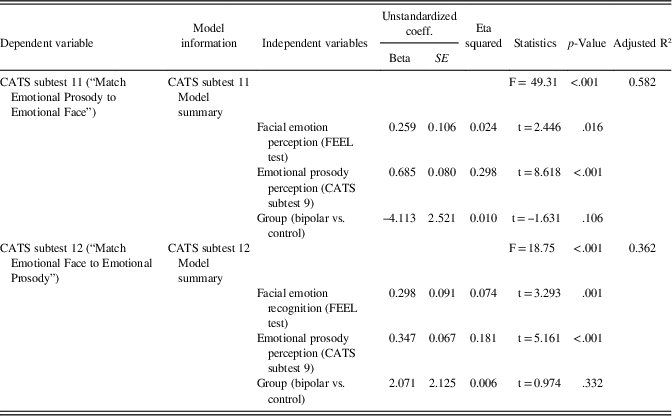
Findings of the regression analysis with cross-modal emotion perception (CATS subtest 11 and CATS subtest 12) as dependent variables and facial emotion perception (FEEL test) and emotional prosody perception (CATS subtest 9) as well as group (bipolar patients vs healthy controls) as independent variables are displayed in Table 4. Results for both CATS subtests (11, 12) were broadly similar. Both facial emotion perception and emotional prosody perception contributed significantly to the performance in CATS subtest 11 and CATS subtest 12. However, eta squared values revealed that for both CATS subtests (11, 12) the emotional prosody perception task (CATS subtest 9) contributed a considerably larger part to the total variation (large effect sizes according to Cohen’s classification) than the facial emotion perception task (FEEL test) (small to medium effect sizes).
Effects of facial emotion and emotional prosody perception and group on CATS subtest 11 and CATS subtest 12 scores: findings of regression and mediation analyses

CATS = Comprehensive Affective Testing System; FEEL test = Facially Expressed Emotion Labeling test.
After accounting for the effects of both facial and emotional prosody perception the significance of the group effect vanished. This means that group differences in CATS subtest 11 and CATS subtest 12 were almost fully attributable to the two separate tasks of facial emotion perception (FEEL test) and emotional prosody perception (CATS subtest 9).
DISCUSSION
To our knowledge, this is the first study that investigated cross-modal emotion perception, that is, matching of facial emotional stimuli and emotional prosody in patients with bipolar disorder who are in symptomatic remission. As expected, patients were impaired, namely in matching sad and angry emotional prosody to one of five emotional faces exhibiting the corresponding emotion and significantly more frequently matched sad emotional prosody to happy faces and angry emotional prosody to neutral faces compared to healthy control subjects. In addition, they were impaired in matching neutral emotional faces to one of three sentences expressing different emotional prosody and significantly more often matched neutral faces to sad emotional prosody. As deficits in cross-modal emotion perception can result in a significant social handicap our results are highly relevant for everyday life. They corroborate previous findings in children suffering from BD who showed increased limbic activity in response to neutral faces and misinterpreted them as being hostile (Rich et al., Reference Rich, Vinton, Roberson-Nay, Hommer, Berghorst, McClure and Leibenluft2006).
Further studies are needed to replicate this finding in adults. Presumably, difficulties in the identification of sad and angry emotions may cause interpersonal problems and the dialog partner may even feel provoked if a person does not react suitably to these emotions. This clearly may lead to reduced social competence and may diminish social acceptance of individuals suffering from BD. Similarly, the frequently observed misattribution of sadness to happiness and of anger to neutral emotion may lead to an assumption of insensibility due to a supposed lack of compassion, which again may have a negative impact on interpersonal relationships.
To understand the fundamental origins of the detected impairments, we performed a multiple linear regression analysis examining the associations between cross-modal emotion perception and the results of two of our previous studies investigating facial emotion perception and emotional prosody perception in the same patient group. Results revealed that both deficits in facial emotion and in emotional prosody perception influenced cross-modal task performance with the emotional prosody perception task contributing a larger part to the total variation of performance. Given that facial information is processed more easily than prosodic stimuli (Rossell, Van Rheenen, Joshua et al., Reference Rossell, Van Rheenen, Joshua, O’Regan and Gogos2013) our findings corroborate those of the literature. Of interest, patients’ performance in cross-modal emotion perception was almost fully attributable to the two separate tasks of facial emotion (FEEL test) and emotional prosody perception (CATS subtest 9), that is, there was no additional effect due to patients’ deficiencies in cross-modal affect matching.
Several previous studies have shown that the combined presentation of verbal and non-verbal information makes it easier to decode emotions, that is, more given information leads to better perception (e.g., DeGelder & Vroomen, Reference DeGelder and Vroomen2000; Kreifelts et al., Reference Kreifelts, Ethofer, Grodd, Erb and Wildgruber2007). Paulmann and Pell (Reference Paulmann and Pell2011), for example, found that emotion perception is significantly better in response to multi-modal versus uni-modal stimuli and speculated that the advance for multi-modal perception may reflect the automatic integration of congruent emotional information across channels, which enhances the accessibility of emotion-related knowledge in memory. It has to be noted, however, that the last-mentioned studies exclusively investigated healthy people, whereas patients included in the current study had a mean duration of illness of approximately 14 years.
Moreover, the previously described hyperactivity in ventral-limbic brain networks and a relative hypoactivity of dorsal brain structures (Wessa & Linke, Reference Wessa and Linke2009) may also deemed relevant in this regard. Anderson and Phelps (Anderson & Phelps, Reference Anderson and Phelps2001), for instance, proposed that limbic hyperactivity might underlie an increased salience of emotional stimuli and the resulting enhanced allocation of attentional resources to processing emotional stimuli. It has to be noted in this context that our study design posed a further challenge since participants either heard one emotional sentence which had to be matched with one of five emotional faces (CATS subtest 11) or saw one emotional face which had to be matched with one of three emotional sentences, respectively (CATS subtest 12).
Following Robinson et al. (Reference Robinson, Gray, Burt, Ferrier and Gallagher2015), tasks with elevated memory demands or time pressure response formats could elicit group differences more readily than tasks without such features. One can speculate that the combined processing of facial and prosodic emotion comprising elevated memory demands might make higher demands on neurocognitive abilities than the processing of either of them. Van Rheenen and Rossell (Reference Van Rheenen and Rossell2014) even inferred from their study that emotion perception deficits are attributable to a more general cognitive problem as opposed to one specific to emotion. We did not investigate basic neurocognition; however, approximately 60% of patients with BD have previously been suggested to suffer from significant neurocognitive impairment (Burdick et al., Reference Burdick, Russo, Frangou, Mahon, Braga, Shanahan and Malhotra2014). Moreover, previous studies have shown that the differences between bipolar patients and healthy control subjects in performance on social cognition tasks may be mediated by non-social cognition (e.g., Frajo-Apor et al., Reference Frajo-Apor, Kemmler, Pardeller, Plass, Mühlbacher, Welte and Hofer2017). This clearly should be taken into account in future studies.
As mentioned above, we found BD patients to be impaired in matching sad and angry emotional prosody to the corresponding emotional faces. This corroborates the findings of our previous study on emotional prosody perception in symptomatically remitted patients suffering from BD or schizophrenia and healthy control subjects (Hoertnagl et al., Reference Hoertnagl, Yalcin-Siedentopf, Baumgartner, Biedermann, Deisenhammer, Hausmann and Hofer2014). In contrast, in a study focusing on perceptual accuracy in affect identification in both visual and auditory domains in patients suffering from major depressive disorder or BD and healthy control subjects, performance on the auditory task did not differentiate the groups (Vedermann et al., Reference Vedermann, Weisenbach, Rapport, Leon, Hase, Franti and Mcinnis2012). On the other hand, this study revealed deficits in the identification of sad and fearful faces in bipolar patients and the authors speculated that there might be an underlying inefficiency in areas of the brain related to the processing of negative emotions (e.g., subcallosal cingulate and medial prefrontal cortex). It has to be noted, however, that patients included in that study were not symptomatically remitted. This sample is, therefore, not entirely comparable with ours.
Investigating 271 patients with BD, Bilderbeck, Atkinson, Geddes, Goodwin, and Harmer (Reference Bilderbeck, Atkinson, Geddes, Goodwin and Harmer2017) have recently reported on a negative association between treatment with lithium or antipsychotics and the perception of angry faces. The authors remark that the neurophysiological mechanisms by which these compounds may influence anger processing are unclear and refer to previous studies on the implication of the dopamine system in processing of aggressive and socially-agonistic signals (Lawrence, Calder, McGowan, & Grasby, Reference Lawrence, Calder, McGowan and Grasby2002) and the association between overuse of dopamine replacement therapy in Parkinson’s disease and heightened aggression (Lawrence, Evans, & Lees, Reference Lawrence, Evans and Lees2003). Furthermore, they mention that treatment with both lithium and dopamine antagonists has previously been associated with reduced aggression and violent offending in BD (Fazel, Zetterqvist, Larsson, Langström, & Lichtenstein, Reference Fazel, Zetterqvist, Larsson, Langström and Lichtenstein2014).
In line with those findings, patients included in the current study were impaired in matching angry facial and vocal emotional stimuli and significantly more frequently matched angry emotional prosody to neutral faces. More than two-thirds of patients included in this study were treated with antipsychotic drugs and approximately one-third with lithium. Contrary to treatment with antipsychotic drugs and anticonvulsants treatment with lithium has previously been associated with increased volumes of brain regions involved in mood regulation (Hafeman, Chang, Garrett, Sanders, & Phillips, Reference Hafeman, Chang, Garrett, Sanders and Phillips2012).
In the current study, patients treated with sodium valproate were significantly impaired in the recognition of sad and angry emotions in CATS subtest 11, whereas treatment with lamotrigine went along with better performance in recognizing happy and neutral emotions in CATS subtest 12. Notably, treatment with lithium did not impact task performance in our sample. However, due to the limited sample size validity of these results is low. Longitudinal studies are needed to investigate whether emotion perception impairments are mediated by exposure to psychotropic medications and whether different compounds differ in this regard.
Not surprisingly, test performance was found to deteriorate with increasing age in our patients. This corroborates previous studies in healthy subjects (Calder et al., Reference Calder, Keane, Manly, Sprengelmeyer, Scott, Nimmo-Smith and Young2003). We detected a significant difference between sexes regarding the perception of neutral prosody in both patients and control subjects in subtest 12 from the CATS, favoring male participants. Moreover, the perception of sadness in both CATS subtest 11 and CATS subtest 12 was significantly better in male compared to female patients. These results seem surprising at first sight, since women have been said to be more accurate in perceiving facial expressions (Montagne, Kessel, Frigerio, de Haan, & Perrett, Reference Montagne, Kessels, Frigerio, de Haan and Perrett2005) and to demonstrate greater ease at decoding nonverbal messages than men (Hall, Reference Hall1984). On the other hand, these findings corroborate those of our earlier report (Hoertnagl et al., Reference Hoertnagl, Biedermann, Yalcin-Siedentopf, Muehlbacher, Rauch, Baumgartner and Hofer2015) and show that both males and females are prone to misconceive emotional stimuli, which could potentially result in difficulties in everyday life.
Generally, emotion perception deficits have been shown to be more subtle in patients suffering from BD than in those suffering from schizophrenia (Rossell, Van Rheenen, Groot, et al., Reference Rossell, Van Rheenen, Groot, Gogos, O’Regan and Joshua2013; Yalcin-Siedentopf et al., Reference Yalcin-Siedentopf, Hoertnagl, Biedermann, Baumgartner, Deisenhammer, Hausmann and Hofer2014). This finding has been suggested to reflect a greater degree of brain abnormalities in regions associated with facial emotion perception such as in the amygdala and hippocampus in schizophrenia patients (Goghari & Sponheim, Reference Goghari and Sponheim2012). In the current study, bipolar patients with a history of psychosis were more impaired in perceiving fearful emotions compared to those without. Accordingly, one can hypothesize that psychotic symptoms in patients suffering from BD are associated with similar brain abnormalities as in patients with schizophrenia, which might explain the worse test performance in this subgroup of patients. Of interest, neither duration of illness nor age of onset or number of psychiatric hospitalizations showed a significant effect on test performance after adjustment for age and sex. Accordingly, the neurobiological and neurocognitive changes associated with the illness might have a stronger influence on emotion perception abilities than the age of onset or the number of mood episodes. Again, these hypotheses need to be tested in larger samples.
The significant differences between patients and control subjects concerning partnership, employment status, and living situation corroborate those of other studies (Altshuler et al., Reference Altshuler, Post, Black, Keck, Nolen, Frye and Mintz2006; Gutierrez-Rojas et al., Reference Gutierrez-Rojas, Gurpegui, Ayuso-Mateos, Gutierrez-Ariza, Ruiz-Veguilla and Jurado2008; Robinson & Ferrier, Reference Robinson and Ferrier2006; Simon, Bauer, Ludman, Operskalski, & Unutzer, Reference Simon, Bauer, Ludman, Operskalski and Unutzer2007; Tohen et al., Reference Tohen, Hennen, Zarate, Baldessarini, Strakowski, Stoll and Cohen2000). However, we found no direct link between task performance and patients’ working capacity or partnership-status. The ability to accurately process emotions is an important aspect of human social communication and impacts on social functioning, although impairments in emotion perception are obviously not the sole reason for psychosocial deficits in this patient group. Accordingly, continuous medical and psychosocial care including psychotherapeutic interventions strengthening skills to recognize and communicate emotions need to be provided even when patients are in symptomatic remission.
We also found no direct correlation between cross-modal emotion perception and the patients’ functioning as assessed by the GAF. One possible explanation for this finding might be that functional outcome is affected by such a large number of clinical, demographic and other factors that the contribution of emotion perception alone was too small to have a direct effect on the GAF.
The current study has some limitations. First, as the MADRS and YMRS remission criteria were applied cross-sectionally, patients may have experienced different durations of clinical stability. Second, as mentioned above, we included a relatively small sample and did not assess basic neurocognition, which may be significantly impaired even during euthymia (Bora, Yücel, & Pantelis, Reference Bora, Yücel and Pantelis2010) and may influence emotion perception abilities. Accordingly, longitudinal studies on emotion perception as well as neurocognitive functioning during both mood episodes and periods of remission are needed to determine how the associations of these determinants interact and change over time. In addition, investigating the effects of specific training programs on emotion perception and psychosocial functioning is clearly a critical issue to explore in future research.
ACKNOWLEDGEMENTS
This research did not receive any specific grant from funding agencies in the public, commercial, or not-for-profit sectors. The authors declare no conflicts of interest.