




No CrossRef data available.
Digital Identity: The Construction of Virtual Selfhood in the Indigenous Peoples' Movement
Published online by Cambridge University Press: 18 August 2005
Extract
Inventions have their greatest impact when they go beyond their possible practical applications and act upon the imagination. When Martin Behaim invented the first globe in 1490, a functionally useless object consisting mostly of terra incognita, he was widely ridiculed; but somehow the ideas that his globe represented stuck, and within a few decades the basic validity of his construction was confirmed by the voyages of Columbus, Cabot, Vasco de Gama, Magellan, and others. Today, with efforts to situate the rapid growth of information and communication technologies (ICTs), especially the Internet, in the context of globalization, there is a similar division between those who dismiss it as being of no importance and those who see in it a looming (for good or ill) global revolution. But, as with Behaim's globe, the imaginary possibilities of these innovations are important in determining how and to what extent human existence is to be transformed by them.
Information
- Type
- Research Article
- Information
- Copyright
- © 2005 Society for Comparative Study of Society and History
Acknowledgments
This article is an elaboration and complete revision of a brief discussion of digital identity in A World Beyond Difference (Niezen 2004). I am therefore indebted twice over to those whom I have already acknowledged in the book. My thanks to the Grand Council of the Crees (Eeyou Istchee) merit mentioning again since without the support of this organization I would have lacked the concrete basis from which to begin a study of abstract identity attachments.
A Paradoxical Sense of Self
Inventions have their greatest impact when they go beyond their possible practical applications and act upon the imagination. When Martin Behaim invented the first globe in 1490, a functionally useless object consisting mostly of terra incognita, he was widely ridiculed; but somehow the ideas that his globe represented stuck, and within a few decades the basic validity of his construction was confirmed by the voyages of Columbus, Cabot, Vasco de Gama, Magellan, and others. Today, with efforts to situate the rapid growth of information and communication technologies (ICTs), especially the Internet, in the context of globalization, there is a similar division between those who dismiss it as being of no importance and those who see in it a looming (for good or ill) global revolution. But, as with Behaim's globe, the imaginary possibilities of these innovations are important in determining how and to what extent human existence is to be transformed by them.
The potential of the Internet to globally reshape the politics of identity is partly concealed by the fact that it is an amalgam of innovations that have long been with us. The first revolution of instant messaging, for example, came through the invention of the telegraph. Households first became connected to a global network of instant communication through the widespread use of the telephone. And, in another repackaging of earlier transformations, the introduction of Internet access to politically isolated communities seems to have an effect similar to that of literacy, only more quickly paced, including raising the status of those who have the skills to use it, providing them with an ability to communicate (and hence establish political connections) over great distances, and, at the most skilled level, providing access to legal knowledge that confers an advantage in dealing with state administrations.
While acknowledging such familiar dynamics, we should not avoid the possibility that the Internet is mapping a new geography of identity formation. In this medium, the only limits to the construction and presentation of culture—even cultures that embody the primal values of technological simplicity and self-sufficiency—are access (directly or through intermediaries) to computer hardware, a telephone infrastructure, and a modicum of sophistication in their use. The so-called anti-globalization movement has shown that simultaneous instant messaging to a large number of subscribers is a powerful tool of political activism, which has been particularly evident in the protests that have taken place at virtually every major economic summit since the 1999 meeting of the World Trade Organization in Seattle. This tool is now also serving the organizational purposes of a wide array of once marginalized communities. The global cognitive/political revolution following from the spread of alphabetic literacy to previously oral societies has therefore recently magnified its effects through ICTs. And along with these technologies, a new stratum of computer literati is reshaping the status hierarchies, resistance strategies, and conceptions of collective self of many so-called traditional societies.
The study of community self-presentation on the Internet would by itself run up against received ideas about ethnographic location, relying as it does on unbounded, de-localized digital artifacts.1
Internet “fieldwork,” for example, does not figure as a possibility in Akhil Gupta and James Ferguson's (1997) collection of essays that scrutinize and assess anthropological ideas of the “field.”
The nature and extent of my research in aboriginal communities and their sponsorship of participation in international human rights forums are discussed in Niezen 2003.
Following from this experience, I have chosen to focus this study of Internet identity on the international movement of indigenous peoples, a movement that has taken the form of a global community of those who share a remarkably consistent sense of self, a common sense of timelessness and fragility. There are several central paradoxes at the heart of this movement that make it a near-perfect example of the conceptual instability and creative dynamics of identity formation. First, the term “indigenous peoples” has only quite recently come into wide usage, yet it carries with it a sense of permanence, inter-generational continuity, inviolable tradition, and perhaps above all a willingness to defend these ideals against the forces of destruction, the leveling powers of nation-states and transnational corporations. It is grounded in ideas of eternalness, yet, in effect, has only recently come into being.
Second, it is based on attachments to oral iteration, the authority of elders, and informal, consensus-oriented systems of justice and politics, yet it derives its existence largely from international law, from the development of legal standards, formal negotiation, and lobbying in the arenas of global governance. This, in turn, demonstrates that the anchorages of identity can be at the same time informal and formal, local and global, making it seem possible, from a broader perspective, that we are approaching a time in which even those who want nothing more than a return to community, to the values of small economies, kinship, and personal recognition, are partly motivated by dreams of universal identity and, what is more, will often be required to appeal to the highest levels of global governance in order to realize them.
Another paradox, with which I will be principally concerned here, derives from the fact that the content of indigenous identity is usually oriented toward defending subsistence-based economies and the local production of technology. At the same time, however, advanced information and communication technologies now have a prominent place in expressing and affirming this identity. Although I do not have a date for the first Web posting by an indigenous peoples' organization, it is safe to say that a vigorous network of these organizations had developed by the late 1990s, around the time that the Internet began to be considered a medium of mass communication. This simple observation indicates the rise of a formally educated indigenous elite with the linguistic and technological skills to use the Internet as a tool of global networking, lobbying, and self-expression, while being dedicated to applying these skills to the defense of ways of life that they depict as requiring patience, fortitude, simplicity, and careful attention to the rhythms of the natural world. This further implies that members of this elite occupy an uncomfortable situation, a condition sometimes awkwardly referred to as “bi-culturalism,” a state of “in-betweenness,” or a condition of “diaspora,” but with the added poignancy and complexity that arises from their cultural positions at the opposite poles of human experience (Niezen 2004:77).
My first task here is to situate the Internet's expressions of indigenous distinctiveness in the context of a more general understanding of identity construction, which places particular emphasis on the dynamics of cooperation across cultural boundaries, the importance of which has been accentuated by new possibilities of communication and self-expression. I will then outline the origins of the indigenous peoples' movement with particular attention to the cultivation of an educated strata—those who eventually acquired computer skills or practical access to those with them—among the world's most politically marginalized peoples and communities. Finally, I will consider the content, cultural dynamics, and implications of indigenous peoples' Internet activism, with attention to both the global expansion of indigenous identity and its reinforcement of local cultural attachments, boundaries, and claims of autonomy.
Memory, Truth, and the Dynamics of Identity Formation
A few years ago, while living in an aboriginal community in northern Manitoba, I was told about a Web site under construction that was to present the community to the world as “Pimicikamak Cree Nation,” representing the rebirth of what had once been Cross Lake First Nation. This new presentation of self seemed to grow out of a lingering dispute with the governments of Canada, Manitoba, and Manitoba Hydro over a stalled compensation package that was to have followed a late 1970s hydroelectric mega-project. Deflecting responsibility for the breech of compensation promises, spokesmen for Manitoba Hydro had earlier argued that Cross Lake did not suffer significant ill effects from the hydroelectric installation nine miles upstream on the Nelson River, that fish and animal populations were stable (the beavers, for example had learned to make multi-story lodges and to move their kits up and down in response to water fluctuations) and that the hunting and fishing economy was healthy. Instead, they pointed to the community's history of compulsory residential school education from 1919 to the early 1970s—schools that separated children from their families in conditions of deprivation and abuse—as an explanation for its spiraling rates of addictions, crime, and suicide. The Web site, with its restoration of the Cree word pimicikamak (describing the Nelson River's transverse entry into Cross Lake), seemed to be an affirmation of collective self that reacted against this dominant, rival interpretation of community experience.
The Web site did not directly address the issue of “social pathology.” Instead, it focused on human rights and on the environmental impact of the Hydro project and its consequences for the traditional Cree lifestyle, apparently in an effort to reach the environmental lobby on both sides of the U.S./Canada border. I had been told about this site while it was still under development, and knew it to be a cooperative venture between a technically inclined college activist, a lawyer, and several computer-literate employees of Cross Lake's Band Office. Given the backgrounds of the site's authors, one of its pages struck me as especially noteworthy because it presented a statement of their essential values that, without a trace of intentional irony, included the words: “We are an oral people. We listen, and we speak. Our culture is our language. Our ancestors and elders speak to us the wisdom of thousands of generations.”3
The site from which this material was taken has since been dismantled. It is cited in Niezen (2003:175).
Such a representation of a community's innermost being—an electronically inscribed claim of oral essentialism—might well raise a conundrum: is it an intentional fabrication, inseparable from politically inspired efforts to enhance the value of cultural distinctiveness? Or is it intended sincerely, as a hopeful view of one's heritage (or the heritage of others), an effort to conjure new conditions of life and a will toward cultural self-improvement? A third possibility should also be considered: that it may be both at the same time, an earnest falsehood, a self-convincing effort to reveal only the best of oneself while attempting to persuade others of the intrinsic value of one's distinct heritage.
It is now widely recognized that the effort to fix collective memory (and memory of collectivities) in history is engaged in with greater intensity as the connection with the past becomes uncertain, divided by the dislocations and discontinuities of trauma, or when memory, and hence the sense of self, is denied, contested, and repressed by cultural rivals. Under these circumstances collective memory, in Antze and Lambek's (1996:xiii) apt characterization, “becomes as ‘site,’ a monument visited, rather than a context, a landscape inhabited.” To address the consequences of displacement and denial, to have a stabilizing effect on selfhood, memory is expressed in the form of the publicly exhibited artifact.
Those historians whose goal has been to pursue historical science, to construct truthful narratives of the birth of nations, have long viewed such artifacts with suspicion. Not only are memories unreliable and even official documentation open to almost routine error and distortion, there are also intrusions of collective hope in the constructions of events and eras that historians rely upon for their information. Marc Bloch, the great historian whose execution by the Vichy regime left his work on historical method unfinished, reflected on this problem in a way that was unusually forthright: “The periods most attached to tradition have also been those that have taken the most liberties with their exact heritage. As though . . . by venerating the past one was naturally led to invent it” (1993:98, my translation). Bloch pointed out sardonically that the material through which entire historical eras are presented to us may be “a vast symphony of frauds” from which it is impossible to extract anything approaching a harmonious truth.
But there is still comfort to be found in this. A recognized falsehood is in its own way a piece of evidence. It expresses thought and instructs us about the circumstances that inspired it.4
Bloch, in Apologie pour l'histoire (1993:96), does, with reservations, admit to this possibility.
A striking feature of the artifacts of identity displayed on the Internet is their relative freedom from the imposition of editorial censorship. There seems to be almost no limit to the ways in which the past can be construed or constructed, the present contested or justified, and the future imagined. The Internet's encouragement of relatively uncensored ideas makes it easier to see some of the primary thoughts behind the forging of new identities, even while, in Bloch's terms, such license also encourages falsehoods. More precisely, the Internet's displays of collective being can be seen as free-flowing manifestations of a new stratagem of release from political repression, one that emphasizes the public expression of strivings toward self-determination.
A more general quality of indigenous identity is the high degree of cooperation involved in the production of its cultural and legal “artifacts.” This applies not just to those cultural products accessible on the Internet but to a wide range of ideas and images associated with indigenous peoples. It has become increasingly common, especially since the rise of the human rights movement in the post-World War II era, for professional relationships and their conceptual apparatuses to cross social and cultural boundaries with the goals of envisioning and realizing collective liberation; and this has facilitated (and been facilitated by) a kind of social transference that is in some ways analogous to the interpersonal dynamics of psychoanalysis: the collective manifestation of affect, self-examination, and modification of self-image that can occur in the context of a close relationship between a relatively powerless ethnic minority and a dominant group or organization, a relationship premised upon the goal of the minority's liberation from oppression.5
My understanding of transference relies on Freud's 1912 essay, “On the Dynamics of Transference” (Zur Dynamik der Übertragung, 1999a), and to a lesser extent on his 1915 essay, “Remarks on Love Transference” (Bemerkungen über die Übertragungsliebe,1999b). Transference was, according to Freud, an expression of heightened affect in the patients' interactions with the psychoanalyst, which could take the negative form of rejection and hostility, or which could be expressed as erotic attraction or romantic infatuation. Analysts themselves were not immune from its effects, and could very easily fall into the trap of reverse transference (Gegenübertragung), a hatred of or infatuation with their patients driven by psychic conflict, from which, if it ever happened, it was very important for them to extricate themselves. Besides its hostile and erotic manifestations, Freud noted another form, which seems to relate more directly to identity construction: a steady, fruitful willingness to engage with the therapist in common cause against the sources of neurosis. This was occasionally expressed by a eagerness of the patient to assimilate the conceptual apparatus of psychoanalysis, even to absorb the particular slant or preferences of their own analyst, and to reproduce them fluently in their sessions, sometimes going so far as to obstruct therapy by smothering the possible insights of free-flowing self-presentation with premature, unprofessional interpretation. Such enthusiasts occasionally went on to receive training in psychoanalysis and to open their own practices. Freud was careful to note that the dynamics of transference were not restricted to psychoanalysis, but could be found in other relationships in which individuals sought out professional authority to meet a perceived need for self-improvement. Although I did not invoke Freud with the intention of offering a critique of psychoanalysis, a dogmatic quality of his approach to transference does stand out. By connecting transference with resistance, in the form of both hostility and obstructionist enthusiasm, Freud was able to make psychoanalysis impervious to criticism and misuse (both dismissible as manifestations of resistance) and to elevate its therapeutic promise by providing a ready explanation for the postponement of results.
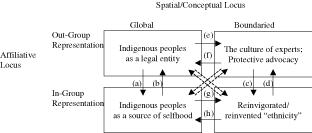
Cooperative relationships are an important part of the indigenous peoples movement, however, not only because of the affect involved in collective strivings toward liberation, but also because of the complexity of the legal ideas underpinning self-determination and the difficulty one faces in bringing claims of distinct rights to a sympathetic audience. Indigenous identity is part of a growing trend toward the use of lobbying—influencing political decisions through organized media campaigns—as a strategy of cultural survival. Cultural activism directed toward a global audience of cultural spectators relies upon the guidance of experts, lobbyists, and other intermediaries. When we consider the influence of international legal opinion and the cultural mediation of experts and advocates on indigenous identity at the local and global levels, a schema of the dynamics of indigenism can be sketched, as in Figure 1:

This is perhaps simply another way of saying that memory is a cooperative venture. We should be attuned to the fact that there is more going on than just technical cooperation in the inter-cultural dynamics of the Internet's presentations of selfhood. The collective sense of self, above all the sense of injustice and suffering based upon past wrongs, is not arrived at in isolation from behind closed cultural boundaries, but rather is inspired by and negotiated with others in personal, often professional, relationships and adjusted to the tastes of a universal public. The essential features of a community's history and culture are now more than ever an outcome of global collaboration.
Toward a Global Community of Peoples
Indigenous identity—a sense felt strongly by some people that they belong to a global community of similarly constituted “first peoples”—can be seen as a product of international law and in particular the human rights movement. The use of the term indigenous in reference to a distinct human group or community is fairly recent. From its earliest use in the seventeenth century to about the mid-twentieth century it did not generally apply to people, but rather was almost exclusively used in reference to plants and livestock native to a particular region. Only starting in the mid-twentieth century was it more commonly used in reference to human society, first in verb form as part of the vocabulary of a hoped-for culturally sensitive approach to colonization, as in the indigenization of native school curriculums or approaches to theology, and subsequently as an adjective referring to human groups.
The term made one of its earliest legal appearances in the 1953 report of the International Labour Organization, Indigenous Peoples: Living and Working Conditions of Aboriginal Populations in Independent Countries. From that point onward it developed a global currency closely connected to emerging human rights standards. This human rights effort began modestly, without direct consultation with the people concerned, with the 1957 International Labour Organization Convention (No. 107) Concerning the Protection and Integration of Indigenous and Other Tribal and Semi-Tribal Populations in Independent Countries. The reference to indigenous peoples in the human rights literature eventually received concrete affirmation—in the form of self-identifying indigenous leaders—in two international meetings: the 1977 International NGO Conference on Discrimination against Indigenous Populations in the Americas, and the 1981 International NGO Conference on Indigenous Peoples and the Land. In 1982 the United Nations Working Group on Indigenous Populations was formed by the Commission on Human Rights, beginning with relatively small meetings of thirty or forty participants, and eventually bringing together hundreds of indigenous spokespeople from around the world in annual two-week gatherings in the Palais des Nations in Geneva. The formal recognition of indigenous peoples as a distinct human rights concern took its most recent step in 2002 with the creation of the Permanent United Nations Forum for Indigenous Issues, dedicated to gathering information on conditions relevant to human rights in indigenous communities, with annual meetings led by a panel jointly represented by indigenous peoples and nation-states.6
I detail the connections between the concept of indigenous peoples and the legal and institutional development of human rights in The Origins of Indigenism (2003).
The progress of the indigenous peoples' movement toward regular representation in human rights forums has corresponded with a worldwide decline in the legitimacy of state-sponsored policies of assimilation, policies that were directed toward, for example, prohibiting or restricting language use, removing children from their home environments to be raised by “national” families, or separating them institutionally in boarding schools. Such practices were aimed ultimately at eliminating unwanted minority societies by shifting the attachments of children from suspect, “unwholesome” families and communities toward a progressive, “civilized” life, driven by personal ambition and self-reliance, and for this reason they are sometimes referred to in human rights discourse as programs of ethnocide or, more emotively, cultural genocide. The goal of assimilation was pursued with perhaps the most rigor, and at the same time with the most self-defeating emotional barrenness and cruelty, in the infamous residential or boarding schools of Canada, the United States, Australia, India, and elsewhere—schools that removed aboriginal children from family and community, supposedly to be properly and professionally “improved,” but in a way that more often conveyed a legacy of bitterness, loneliness, and a pointed sense of grievance.
Assimilation policies inevitably failed in their mission to eliminate unwanted communities, based as they often were on the self-defeating premises of teaching self-reliance through unquestioning obedience and promoting the inclusion of a visibly different minority in a context of uncontested racism. But they did, in the course of things, provide skills and opportunities to a small number of motivated, talented youths, many of whom went on to create their own avenues to leadership as intermediaries between their natal communities and the governments of dominant societies, and who eventually found ways to network and to navigate the institutions of human rights and global governance.
This is not to say that formal education provided those who saw themselves as indigenous leaders with an effortlessly navigable avenue to human rights representation. During the first Working Group meetings in the 1980s, in particular, many state representatives expressed concerns about the motives behind and implications of the solidifying presence of “minority” representatives who, in their view, had no business asserting dangerous claims of sovereignty in international forums. A few state representatives even expressed skepticism about the indigenous spokespeoples' qualifications for formal leadership, as though they had overreached their abilities and were merely inexperienced political weanlings who had acquired a new measure of autonomy, but without the ability to stand on their own. Even the U.N. administrations acted upon such concerns of states by restricting the scope of possible political claims by indigenous peoples, mainly by refusing any legal characterization of them as “peoples,” which in its plural form denotes rights in international law to self-determination. Hence, for example, the title of the recently established Permanent Forum invokes “indigenous issues” rather than “indigenous peoples.”
But even if the United Nations has shown reluctance to further the status of indigenous peoples as “peoples,” it is at the same time the primary source of ideas from which a conceptualization of indigenous peoples as a global form of society and expression of identity developed. The conceptual apparatus of international law is on many points shared by international officials and indigenous representatives. Human rights are seen, from their different points of view, as a potential source of indigenous peoples' empowerment, political reform, social justice, and liberation. It has been taken up with alacrity by those from the world's most oppressed, marginalized, and disenfranchised communities and adopted, with a focus on the category “indigenous peoples,” as a source of personal knowledge and collective identity. It has been disseminated through a kind of legalistic, uncharismatic messianism. And it is this conceptual apparatus that has been the starting point for the expression of universal indigenous rights and selfhood through electronic media.
Virtual Indigenism
There is seemingly an infinite variety of Web sites dedicated directly or indirectly to the topic of indigenous peoples. The information contained on these sites includes the human rights of indigenous peoples and communities worldwide; the specific grievances of particular communities, framed in the conceptual apparatus of a global cause; records and documents relating to international meetings of indigenous peoples; historical narratives of peoples or regions; links to other indigenous Web sites; travel narratives by European hobbyists; and even international news from on-line radio broadcasts that present the concerns and points of view of indigenous communities. Despite the plethora and diversity of these sites, there are still a number of uniform features of indigenous Internet identity that stand out.
First, the English language predominates in the promotion of indigenous information and viewpoints on the Internet. Although tallies of Web pages are notoriously changeable and unreliable, the English language results for the term “indigenous peoples” on just about any search engine will outnumber the closest rival in a European language, the Spanish term pueblos indigenas, by a ratio of about 40:1, with the French terms peuples indigènes and peuples autochtones and the German terms indigene Völker and Ureinwohner (“original inhabitant”) appearing even less frequently.
The German-language Web sites bring out another prevailing trend in indigenous digital identity: they tend, far more commonly than their equivalents in English, Spanish, or French, to be dedicated to an admiration or even veneration of the virtues of the Indian way of life. The terms indigene Völker and Ureinwohner recall subject matter that is geographically diverse, with observations of Native Americans supplemented by information on the original inhabitants of the Amazon, Taiwan, Malaysia, Africa, and (especially commonly) on tours of Australia, where the Aborigines feature as part of the exotic travel experience. But German-language Web pages also tend to evoke cultural romanticism, the idea of original peoples living in balance with the earth, whose teachings are a heritage of humanity, whose sources of spiritual energy are in some ways accessible, possibly encountered and included as part of one's life experience. This kind of Internet Sehnsucht cannot be adequately explained as simply a product of a Germanic New Age consciousness, or as a mere holdover from Herder's influential romance of cultural primitiveness. The relative absence of legal content associated with the terms indigene Völker and Ureinwohner is more likely traceable to the fact that the German-speaking nations of Europe do not include minority peoples or populations that consider and represent themselves as indigenous. The Romansh speakers of the Grison region in eastern Switzerland might qualify as having pursued a distinct way of life from time immemorial, but their minority status has been successfully constitutionalized and they do not appear internationally as claimants of distinct identity. It could also be because German is not a language of international diplomacy, but that instead English, French, and Spanish comprise the central language apparatus of international law and governance. The use of English above all as the newest “lingua franca” of international law is inseparable from its function as a global vehicle for expressing indigenous identity.
The themes of New Age cultural idealism and self-improvement through the eclectic adoption of spiritual concepts do not entirely disappear from the indigenous Web literature built around the term “indigenous peoples,” but they are put completely in the shadow of sites dedicated to legal and political goals. Again keeping in mind the fluctuating nature of Web-page tallies, an overview of the main subject matter of the first ten pages of search-engine listings reveals that some 54 percent provide legal resources, while a look at the sites' origins shows that 34 percent are sponsored by nongovernmental organizations. The global nature of the indigenous peoples' movement can be gleaned from a sample of the Web sites' main titles: the Arctic Council Indigenous Peoples' Secretariat, the Russian Association of Indigenous Peoples of the North, the Native American Rights Fund, Indigenous Peoples in Latin America, the College of Australian Indigenous Peoples, Te Karere Ipurangi—Maori News Online, and the Southeast Asia Regional Initiatives for Community Empowerment. The titles reveal another noteworthy quality of digital indigenism: almost every use of the word “indigenous” on the Internet is ultimately associated with a collective claim (or network of claims) of self-determination, understood in its starkest expression as a form of decolonization from the nation-state.
As one would expect with an identity oriented toward self-determination, there is evidence on the Internet of a fairly direct connection between the work of legal scholarship and understandings of selfhood. Consider, for example, the definition (in an Internet posting) of indigenous peoples arrived at in 1993 by the Asian Indigenous Peoples Pact: “We Asian indigenous peoples know who we are. We are the descendants of the original inhabitants of territories that have been conquered; and we consider ourselves distinct from the rest of the prevailing society. We have our own languages, religions, customs and worldview and we are determined to transmit these to future generations. We do not have centralized political institutions but are organized instead at the level of the community and have highly developed methods for arriving at decisions by consensus.”7
Asian Indigenous Peoples Pact (2003). This is an almost verbatim quotation of a 1989 report by the Asian Indigenous Peoples Pact, Indigenous Peoples in Asia: Towards Self-Determination, Report of the Peoples Forum, Chiang Mai, Thailand, Aug. 1988, (cited in McCaskill and Kampe 1997:5). I have cited the 1993 document because of its use of “we,” making it a more direct expression of selfhood.
This regional conceptualization of self contains distinct echoes of José Martínez Cobo's formal definition of indigenous peoples in his 1987 Study of the Problem of Discrimination against Indigenous Populations, written at the behest of the Commission on Human Rights: “Indigenous communities, peoples and nations are those which, having a historical continuity with pre-invasion and pre-colonial societies that developed on their territories, consider themselves distinct from other sectors of the societies now prevailing in those territories, or parts of them. They form at present non-dominant sectors of society and are determined to preserve, develop and transmit to future generations their ancestral territories and their ethnic identity, as the basis of their continual existence as peoples, in accordance with their own cultural patterns, social institutions and legal systems” (p. 48). One can see such adoption of formal concepts as a selection and exhibition of ideas that somehow match efforts toward self-determination.
Ideas about the essence of indigeneity are sometimes expressed by officials in ways that seem to do away entirely with the constraints of legal or bureaucratic style. The construction of a global identity, for example, is apparent in the ideas expressed by Gro Harlem Brundtland, former prime minister of Norway and former director general of the World Health Organization, when she extols the important positive contribution that can be made by indigenous peoples to world health: “Indigenous peoples teach us about the values that have permitted humankind to live on this planet for many thousands of years without desecrating it. They teach us about holistic approaches to health that seek to strengthen the social networks of individuals and communities, while connecting them to the environment in which they live. And they teach us about the importance of a spiritual dimension to the healing process.”8
Brundtland 1999.
Ibid. Here she is citing the words of Wally N'Dow, Secretary-General of the 1996 United Nations Conference on Human Settlements.
A much more frequent way to conceptualize the common denominator that brings together the world's indigenous peoples is to emphasize the global patterns by which they have been oppressed. The Asian Indigenous Peoples Pactprovides an example of this form of definition in the same Declaration on the Rights of Asian Indigenous Tribal Peoples cited above: “We are being pushed to extinction not only through invasion planned population transfers and transmigration of other peoples to our territories but also through the efforts of dominant Asians to assimilate us, to impose languages, religions and political concepts which are alien to us.” Here too it is possible to find a close correspondence between the indigenous representatives' sense of self and statements made by U.N. officials, such as that of Louise Frechette, Deputy Secretary-General of the United Nations, in an address to the first session of the Permanent Forum on Indigenous Issues held on 13 May 2002:
Indigenous people have been killed, tortured and enslaved. They have been deprived of their political rights, such as the right to vote. Their lands have been taken over by conquest and colonization, or decreed to be terra nullius and claimed for “national” development. Even today, their children too often grow up in poverty, and die from malnutrition and disease. In some countries, indigenous people are still not allowed to study their own languages in schools. Their sacred objects have been stolen and displayed, in violation of their beliefs. They face discrimination and exploitation. And all too often, governments have resisted the use of the word “peoples” with an “s.” Instead they have preferred the singular, so as to avoid recognizing collective rights.10
Frechette 2002.
Frechette's understanding of the common patterns of victimization that unify indigenous peoples suggests that indigenous spokespeople are in some ways able to influence the official interpretation of their common experience, and vice versa. Whether we see this (following the analogy with psychoanalysis) as an example of cultural transference or counter-transference, the correspondence of ideas between indigenous representatives and U.N. officials suggests that the concept of indigenous peoples has been collaboratively developed. The content of many Web sites dedicated to the interests of indigenous peoples reflects the close connection between legal concepts and indigenous identity and, in particular, elements of conceptual exchange between U.N. officials and indigenous representatives.
The tools of global shrinking—initially the high-speed travel and telephone infrastructure used to organize the first international meetings of indigenous peoples and later the (more or less) worldwide infrastructure of computer networking—certainly seem to have facilitated this connection. But does the Internet have any effect on indigenous identity that we can point to as unique, as contributing to an altogether new way of imagining and representing the collective “We”?
If such a distinct quality of the Internet's powers of representation is to be found anywhere it is in the way it has enabled the concept of indigenous peoples to rapidly expand its politico-geographical base, from an original conception that included the Americas, Northern Europe, Australia, New Zealand, and the Pacific Islands, to apply more broadly to peoples who did not initially fall within the United Nation's tacit definitional jurisdiction. The first step in this direction occurred in the 1990s with the participation in international meetings of many representatives from Asia and Africa. Some U.N. officials and state representatives objected to the extension of representation by indigenous peoples to recently decolonized regions, mainly because of its introduction of added complexity to already confused patchworks of legally inscribed identities with the potential, they argued, to spark ethnic unrest in politically unstable nation-states. In response to these objections, indigenous representatives campaigned vigorously, pressing for affirmation of the claims of indigenous peoples from Africa and Asia, mainly through practical demonstrations—in meetings and Internet postings—of the effectively established global distribution of peoples with legitimate claims to status as “indigenous.” Although some nation-states, the more powerful among them being India and China, still object to the recognition of indigenous peoples within their borders, the globalization of the indigenous peoples' movement has in practical terms now been realized. And use of the Internet's powers of virtual identity was one of the principal ways that the claims of indigenous peoples from Africa and Asia were given substance.
A more recent extension of the indigenous peoples concept makes the Internet's powers of representation stand out more clearly. During the last few years a surprising amount of interest has been built around the idea of including the Palestinians as an indigenous people. Among the many thousands of Web pages that combine the words “indigenous peoples” and “Palestinian,” browsers can find a site titled “Indigenous Peoples and the Law,” which includes information on Palestinian peoples ‘right to return’ under international law;11
http://www.kennett.co.nz/law/indigenous. Updated 30 July 2003.
“Indigenous Peoples' Rights,” http://www.saveourplanet.org/memorgs/indig.html. Accessed 4 Aug. 2003.
http://www.psgateway.org/pdgs-topics. Accessed 4 Aug. 2003.
The connection between indigenous identity and Palestinian nationalism is not something that would have arisen naturally through face-to-face dialogue or through the epiphany of encounter at international meetings. High-ranking Palestinians and indigenous representatives simply do not mingle in the same circles. For one thing, the Palestine Liberation Organization makes use of international diplomacy rather than human rights venues in its pursuit of political goals. It is also noteworthy that meetings under the aegis of the United Nation's Economic and Social Council (and, within its jurisdiction, the Com>mission on Human Rights) as a matter of policy do not admit representatives of peoples or organizations that advocate or directly sponsor violence. I would assume, then, that spokesmen for groups that engage in terrorism on behalf of Palestinians such as Hamas and Islamic Jihad have not appeared at annual meetings of the Working Group on Indigenous Populations, or the Permanent Forum on Indigenous Issues. The inclusion of the Palestinians within the indigenous peoples' movement is mostly abstract and the principal venue for its expression is the Internet.
The Internet, then, is able to give shape and substance to political relationships that might otherwise be only fleeting, and even, in the case of the inclusion of Palestinians to the working definition of indigenous peoples, to define alliances that exist only as ideas rather than as personally negotiated realms of common experience and interest. This point can be taken further: Cultural boundaries are blurred in the unrepressed Web literature by the absence of limits on representation. Uncensored cultural representation makes possible the presentation of community ideals that originate in no recognizable community. More than ever before, it has become possible to express nostalgia for times that one has never experienced and pride toward peoples among whom one has never belonged.
(Re)bounded Identities
But at the same time the Internet performs a counter-miracle, an antidote to globalized abstraction: it acts as a tool for the solidification and preservation of local cultural boundaries. The reinvigoration of local identities through the Internet does not place as much direct emphasis on the legal pathways toward self-determination as on the promotion of indigenous language as a starting point for solidifying attachments to lore, land, and lifestyle.
Such local promotion of distinct culture is of course inseparable from the international politics of identity. Indigenism does not stand alone, but rather derives its energy from community-level dissent and the forging of local identities. Indigenous representatives originate from places and peoples that they are personally, and often professionally, deeply attached to. Indigenism is therefore inseparable from a global pattern of localism, from sharpened boundaries of community identity and intensified pursuits of autonomy. Consequently, Web sites built around the term indigenous peoples, in any of its linguistic variations, commonly make claims of representing living peoples, of being expressions of their histories, cultures, and collective aspirations.
The James Bay Crees, for example, have developed a program that includes the promotion of indigenous language use on the Internet. In responding to the challenge of competing with the dominant English and French languages of Quebec, the Cree Regional Authority, the administrative umbrella of nine communities in northern Quebec, has for the past five years been developing a Cree Cultural Institute (referred to in Cree as the Aanischaaukamikw, the “bridge,” or a bridge between generations), one of the main functions of which is language preservation.14
The concept and ambitions of Aanischaaukamikw are explained on the Web site http://www.creeculture.ca/e/institute/what.html. Accessed 7 Aug. 2003.
The Samis of northern Europe are also among those indigenous peoples who have developed a sophisticated infrastructure of information and communications technology. Besides hosting a number of radio and television stations with their own coverage of local and international events, the Samis have developed SameNet (http://www.sapmi.net), described in its English language home page (also available in Sami, Swedish, and Finnish), as “a joint Nordic meeting place . . . founded on fundamental Sami values.”15
SameNet/Sápmi Online, http://www.sapmi.net/topp.htm. Accessed 28 June 2003. I am grateful to Kristian Myntti for bringing this Web site and some of its significant features to my attention.
It is interesting to think of the login page on this Web site as a digital manifestation of an us/them boundary. In this case, there is a sense in which the boundary promotes elements of both cultural vitality and democratic transparency. The closed network provides news, information, email accounts, and courses in the Sami language, of which there are nine dialects. A complete “internet school” for adult Samis is under development. More significantly, SameNet hosts discussions of the Sami democratic system, facilitates access to political candidates and incumbents, and provides information on voting procedures for elections of the Sami parliaments of Norway, Sweden, and Finland (Niezen 2004:76).16
The Sami Intranet does not have a mechanism for on-line voting, probably because of the limited number of subscribers and the ongoing influence of village based, consensus-oriented, face-to-face political values.
It is too soon to tell whether a significant number of other indigenous peoples worldwide will make such creative use of electronic media, but if the Cree and Sami initiatives are anything to go by, indications are that those whose identities are based on closed kinship networks and the simplest subsistence technologies can at the same time be at the forefront of community-based cyberculture.
The Digital Divide
The concept of the digital divide, the separation of those with access to information and communications technology and those without, can be applied to two contexts—local and global. First, it can be seen to occur at the community level, widening the distance between those with attachments to the inter-generational oral transmission of values and life skills and those who see important possibilities in reshaping and defending tradition through the tools of modernity. The computer literati are endowed with a unique ability to culturally represent their people, and in the process to redefine their people's values, opportunities, and even their criterion for group membership. The tools and strategies needed to lobby effectively for the protection of indigenous societies are at the same time instruments of the displacement of indigenous peoples' traditional authority.
The digital divide is more commonly recognized as having important implications for the communicative effectiveness of dissident peoples and communities, leaving those who are electronically disadvantaged in a condition of isolated powerlessness. The cultural survival of marginalized peoples may soon depend (if it does not already) on an ability and willingness among the otherwise defenseless to plug into—literally and figuratively—transnational lobby networks.
The simplest way to understand this condition is to look from a global perspective at the difference in technological resources between those peoples and communities most active in Internet lobbying and those who are notably absent. The United Nations Human Development Report for 2001, dedicated to the application of new technologies to human development, includes information that suggests a wide disparity in use of information and communication technology among the many countries from which indigenous representatives originate. The number of internet hosts per 1,000 people in the year 2000, for example, varied from 200.2 in Finland; 193.6 in Norway; 179.1 in the United States; and 108.0 in Canada—a sample drawn from the industrialized, temperate countries—to 1.9 for Panama; 0.7 in Peru; 0.4 in Nicaragua; 0.2 in Kenya; and 0.2 in Indonesia, representing those countries categorized in the U.N. report as “marginalized.” Only a few countries, such as Mexico (with 9.2 hosts per 1000 people) and the Russian Federation (with 3.5), fall somewhere in the middle (albeit at the low end) of these extremes.17
United Nations 2001:49–50.
This means that if Internet communication has become or is becoming a significant way to express identity—and at times to defend it—then those who have only limited or no access to the necessary hardware, infrastructure, or knowledge will experience their culture differently from those who do. They will not have the same tools of literacy development, self-instruction in rights and legal resources, language instruction, cultural boundary definition, and, most significantly, transnational networking as those with greater access to technology. More to the point, if Internet lobbying is a key strategy for defense against unwanted mega-projects, forced resettlement, environmental degradation, or policies of linguistic and cultural assimilation, then those who exist on the margins of technology will also have marginal hopes for cultural survival.
The dynamics of cultural activism through international lobbying could well become one of the few outlets for the expression of identity across cultural boundaries. Some effects of electronic activism seem to work in a direction of global cultural convergence, opposite to the reassertion of cultural boundaries exemplified by the Crees and Samis. The digital divide is in the process of becoming part of a wider phenomenon in which cases for protection of distinct societies can only be presented through globally uniform avenues, in other words, in which distinct societies are made essentially similar through their strategies of defense.
Conclusion
At first glance, there might seem to be a close connection between the development of a borderless, instant-access medium of information storage and retrieval and the growth in popularity of a global concept—“indigenous peoples”—that reinforces primary attachments to land, language, and lifestyle. Benedict Anderson's (1991) perception of the close relationship between the progress of print-as-commodity and the congealing of national consciousness would appear in this case to be confirmed on a broader scale: a vast, borderless, relatively uncensored store of ideas, information, and images has now made it easier to imagine global communities or cosmopolitan federations of peoples, basically alike in their expressions of grievance, collective pride, and hope.
At the same time, the very freedom that makes borderless thinking increasingly possible also contributes to the re-imagination and reinvigoration of micro-nations, local epistemologies, and languages of limited distribution. Commercial censorship no longer restricts the availability of print and visual media to large popular audiences communicating in homogenized languages of mass consumption. Among its many functions, the Internet is a bulletin board for small-scale collective self-perceptions and aspirations. There is an element of unbridled cultural democracy at work in the relationship between the Internet and identity attachments.
The Internet has created conditions in which identity can be freely contested and reformulated, while reflecting (and accentuating) the growing importance of border-transcending knowledge. In particular, the knowledge and professional authority associated with international law and global governance have become primary resources for collective affirmation and emancipation. In this dynamic, the Internet has become something like a hypnotist's pocket watch, providing a focal point for an odd combination of both guidance and liberated self-expression.
The significant features of this self-expression stand out most clearly when we shift our focus from the global and regional identities and regimes of rights built around the term indigenous peoples to the sites that represent cultural artifacts and aspirations of particular peoples—the Cree, Sami, Innu, Ainu, Mapuche, Guarani, Tuareg, Amazigh, Hopi, Pequot, Tarahumara, Maya, and Maori, to name but a few. Through these artifacts, they claim historical continuity from pre-invasion and pre-colonial societies, arguing that they and their ancestors occupied their territories “from time immemorial”; they point out that they possess collective attachments to their distinctive languages, means of subsistence, institutions, and legal systems; they express determination to transmit their distinctive ways of life to future generations; and they lament that they are dominated by others who often threaten their continued existence as distinct peoples. These are peoples who for many embody the virtues of slowness, patience, technological simplicity, and self-reliance. Yet some of them, in an apparent paradox of modernity, have found a way to advance these virtues through sophisticated use of computer technology.
What are the wider implications of this use of information and communication technology? Computer literacy seems to confer something more than just the advantages of high-speed communication. It has at the same time simplified and solidified the connection between dissent and identity. The Internet in particular is a tool of both liberation and of liberative imaginings of the self. It is a window to the world that can simultaneously describe a condition of oppression and show deliverance as an accomplished fact. More than any other innovation in the technology of communication, the Internet facilitates the construction of memory and selfhood; it invites its users to reflect on their historical essence before presenting it to a global audience. Because of its multi-media potential, it encourages the display of historical and cultural artifacts, digital exhibitions in which the most impressive, representative relics of collective being are selected for display, while jumbles of imperfect, ignoble artifacts are locked away from public view. Ideas that appeal across the widest spectrum are those most likely to be received as expressing the essence of a peoples' innermost being.
It is difficult to find a social or cultural effect that is clearly exclusive to the Internet, which cannot also be attributed one way or another to the consequences of writing. But the mere fact that it sharpens and broadens the impact of writing endows it with the same revolutionary potential as the printing press. Following from the widely recognized historical connections between commercial publishing and the rise of nationalism, we should be attuned to the potential for the Internet to be a vehicle for new forms of selfhood. With this in mind, I have demonstrated that the Internet has already made it more possible to express abstract identity attachments at both ends of a spectrum: as a source of global identification between peoples who see themselves as suffering from the same leveling powers of state governments, international agencies, and private organizations; and as a local source of cultural reawakening and boundary reinforcement, a community based answer to the effects of cultural disembedding and dissolution.
References
Anderson Benedict
1991
Imagined Communities: Reflections on the Origin and Spread of Nationalism
London
Verso
Antze, Paul and Michael Lambek
1996
Tense Past: Cultural Essays in Trauma and Memory
New York
Routledge
1993
Asian Indigenous Peoples Pact
Declaration on the Rights of Asian Indigenous Tribal Peoples
Asian Indigenous Peoples Pact General Assembly Meeting
Chiangmai, Thailand
18–23 May
http://www.unesco.org/most/Inngo3.htm
Bloch Marc
1993 [1949]
Apologie pour l'histoire ou Métier d'historien
Paris
Armand Colin
Brundtland Gro Harlem
1999
“International Consultation on the Health of Indigenous Peoples”
Geneva
World Health Organization
Paper presented 23 Nov. http://www.who.int/director-general/speeches/1999/english/19991123_indigenous-people.html
Frechette Louise
2002
Address to the First Session of the Permanent Forum on Indigenous Issues
New York
13 May
http://www.un.org/rights/indigenous/dsg.htm
Accessed 20 July 2003
Freud Sigmund
1999a [1912]
“Zur Dynamik der Übertragung,”
Gesammelte Werke 8
Frankfurt am Main
Fischer
Freud Sigmund
1999b [1915]
“Bemerkungen über die Übertragungsliebe,”
Gesammelte Werke 10
Frankfurt am Main
Fischer
Gupta, Akhil and James Ferguson
1997
Anthropological Locations: Boundaries and Grounds of a Field Science
Los Angeles
University of California Press
Martínez Cobo José
1987
Study of the Problem of Discrimination against Indigenous Populations
United Nations doc.E/CN.4/Sub.2/1986/7/Add.4
5Google Scholar
McCaskill, Don and Ken Kampe
1997
Development or Domestication? Indigenous Peoples of Southeast Asia
Chiang Mai, Thailand
Silkworm Books
Niezen Ronald
2003
The Origins of Indigenism: Human Rights and the Politics of Identity
Los Angeles
University of California Press
Niezen Ronald
2004
A World Beyond Difference: Cultural Identity in the Age of Globalization
Oxford and Boston
Blackwell
United Nations.
2001
Human Development Report 2001
Making New Technologies Work for Human Development
New York and Oxford
United Nations Development Programme
 You have
Access
- 25
- Cited by