INTRODUCTION
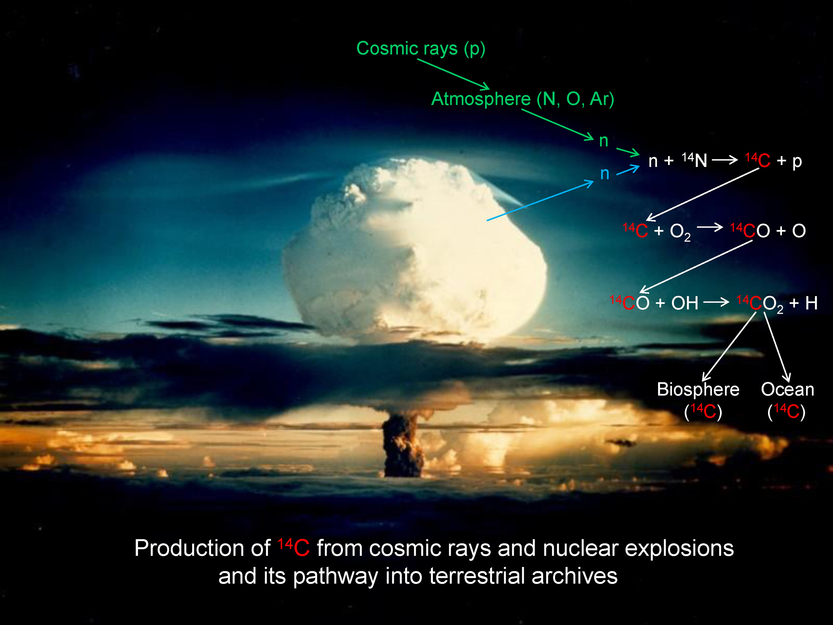
The above-ground nuclear weapons testing program in the 1950s and early 1960s approximately doubled the atmospheric radiocarbon (14C) content in 1963, as compared to its pre-nuclear cosmogenic value. The global carbon cycle distributed the 14C excess into the ocean and the biosphere (Figure 1). The nuclear test ban treaty of 1963 stopped further anthropogenic 14C production in the atmosphere, and since then 14C decreases down continuously (F14C = 1.0488 ± 0.0012 in March 2011 in the here relevant Southern Hemisphere mean summer intertropical convergence zone, Hua et al. Reference Hua, Barbetti and Rakowski2013). This so-called “14C bomb peak” was established from measurements of 14C in atmospheric CO2 (see e.g. Levin and Hesshaimer Reference Levin and Hesshaimer2000; Levin et al. Reference Levin, Naegler, Kromer, Diehl, Francey, Gomez-Pelaez, Steele, Wagenbach, Weller and Worthy2010) and constitutes a unique isotope label of carbon for the second half of the 20th century. The precision of 14C measurements and the large annual 14C change in the atmospheric CO2 allows one to follow closely these changes also in material, which is in rapid exchange with atmospheric CO2, thus making it possible to pin down events with a time resolution of one to two years during the bomb-peak era. However, for a single 14C determination always two possible calendar time ranges are obtained. Further information is required to exclude one of the two possible dating results. In addition, it must also be noted that the high precision can only be achieved in the steep areas of the bomb peak curve. Today the decline of the values is slow and results in a lower time resolution.
Schematic presentation of 14C production in the atmosphere through the nuclear reaction 14N(n,p)14C, with neutrons originating from both cosmic-ray induced spallation of atmospheric nuclei and nuclear explosions. The subsequent two-step oxidation of 14C to 14CO2 (Kutschera Reference Kutschera2013; Bjork et al. Reference Bjork, Bui, Heckl, Changala, Spaun, Heu, Follman, Deutsch, Cole, Aspelmeyer, Okumura and Ye2016) and its uptake by the biosphere and the ocean is also indicated. (Photo: first hydrogen-bomb test “Ivy Mike” in 1952, National Nuclear Security Administration/Nevada Site Office)

In general, 14C bomb peak dating allows a large number of applications (Grimm Reference Grimm2008). To name a few, it includes forensic medicine (Wild et al. Reference Wild, Golser, Hille, Kutschera, Priller, Puchegger, Rom, Steier and Vycudilik1998, Reference Wild, Arlamovsky, Golser, Kutschera, Priller, Puchegger, Rom, Steier and Vycudilik2000), molecular biology (Spalding et al. Reference Spalding, Bhardwaj, Buchholz, Druid and Frisén2005; Frisèn Reference Frisén2016), art forgery (Caforio et al Reference Caforio, Fedi, Mando, Minarelli, Peccenini, Pellicori, Petrucci, Schwartzbaum and Taccetti2014), shark dating (Hamady et al. Reference Hamady, Natanson, Skomal and Thorrold2014; Nielsen et al. Reference Nielsen, Hedeholm, Heinemeier, Bushnell, Christiansen, Olsen, Bronk Ramsey, Brill, Simon, Steffensen and Steffensen2016), and illegal ivory trade (Cerling et al. Reference Cerling, Barnette, Chesson, Douglas-Hamilton, Gobush, Uno, Wasser and Xu2016). The last application is related to the current work.
The question of illegal ivory trade is regulated by CITES, The Convention on International Trade in Endangered Species of Wild Fauna and Flora. It is an international agreement between governments, which was established 1973 in Washington DC (CITES 1973). Its aim is to ensure that international trade in specimens of wild animals and plants does not threaten their survival. Austria joined CITES in 1982 (Austria 1982). In 1989, the African elephant was put by CITES into Appendix I, which lists species with the highest degree of protection (Austria 1990). Unfortunately, this did not prevent the recent killing of African elephants, which was confirmed by 14C measurements in seized ivory from illegal trade (Cerling et al. Reference Cerling, Barnette, Chesson, Douglas-Hamilton, Gobush, Uno, Wasser and Xu2016). These findings confirmed the rapid decline in African elephant populations. Intense discussions are being conducted about this situation, and how one might help to protect African elephants in the future (Biggs et al. Reference Biggs, Holden, Braczkowski, Cook, Milner-Gulland, Phelps, Scholes, Smith, Underwood, Adams, Allan, Brink, Cooney, Gao, Hutton, Macdonald-Madden, Maron, Redford, Sutherland and Possingham2017).
Concerning illegal trade and the violation of CITES, an important point is the proof that ivory from African elephants originates indeed from times before the corresponding CITES regulation entered into force.
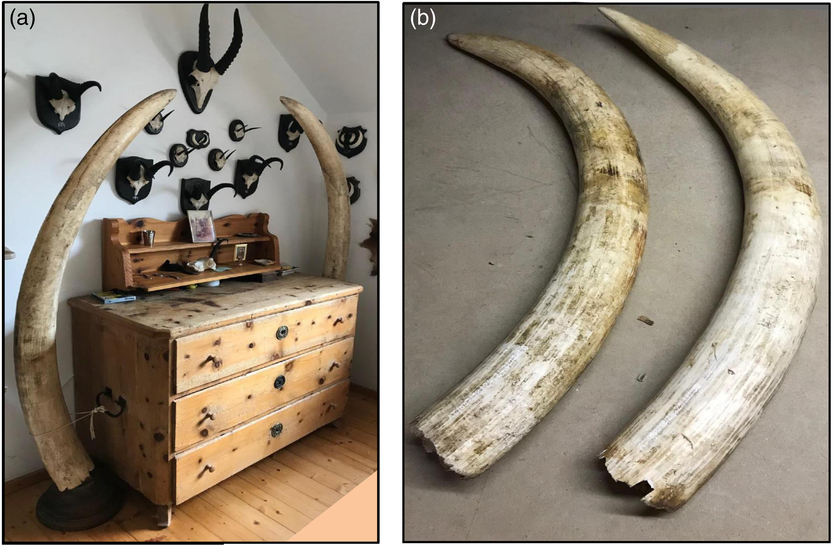
We were recently contacted by the owner of three pairs of elephant tusks (Figure 2), which are part of the heritage of a professional hunter who lived and worked in Tanzania and Kenia from 1961–1962 until 1979. The elephant tusks originate from elephants most likely shot during this time. Interestingly, each of the tusks was marked with an individual code where the last two numbers seem to indicate the year when the animal was shot (see last two numbers in the Sample Name in Table 1). If true, a measurement of 14C in the youngest part of the tusks (growing zone, Figure 2b) should provide a proof because the period lies well within the 14C bomb peak era.
Two of the three pairs of elephant tusks on which 14C measurements were performed. The results are listed in Table 1. The left figure (a) shows tusks 1A and 1B, and the right one (b) tusks 3A and 3B. The rectangular hole in the growing zone of tusk 3B is the location where a sample was taken for the 14C measurement.

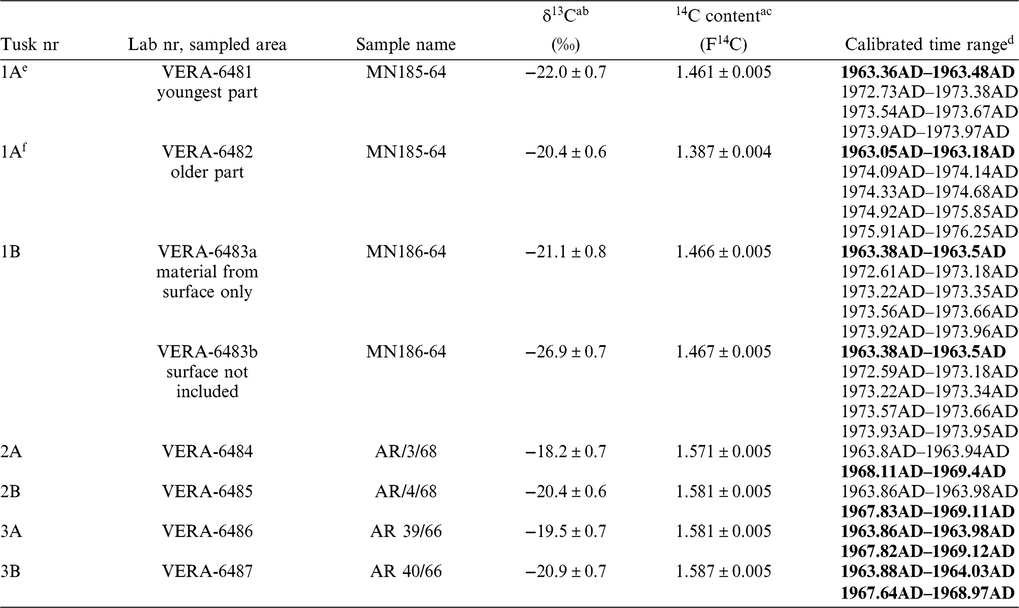
Radiocarbon results for samples from the 3 pairs of tusks.

a 1σ uncertainty.
b δ13C values measured with the AMS system.
c F14C = Fraction modern, for definition of F14C see Reimer et al. (Reference Reimer, Brown and Reimer2004).
d determined with the calibration curve BOMB13SH3 (Hua et al. Reference Hua, Barbetti and Rakowski2013) and OxCal 4.2.4 for a 2σ confidence interval (95.4%); resolution set to 0.01; relevant time ranges are marked in bold characters.
e, f 2 sub-samples were measured for tusk 1A: one (e) closest to the growing zone (youngest part) and a second one (f) in approx. 10–15 cm distance from the growing zone (older part).
MATERIAL AND METHODS
Modern ivory is a material that is well suited for 14C dating. Thus, we performed AMS 14C- determinations of samples from each tusk. Usually at least two samples with an age difference of some years should be available for 14C dating with the bomb peak, in order to decide whether the ascending or the descending part of the bomb-peak curve is relevant for the age determination (Wild et al. Reference Wild, Arlamovsky, Golser, Kutschera, Priller, Puchegger, Rom, Steier and Vycudilik2000; Cerling et al. Reference Cerling, Barnette, Chesson, Douglas-Hamilton, Gobush, Uno, Wasser and Xu2016). For an elephant tusk this is no major problem since the tusks are continuously growing, with the recently formed part next to the skull and the oldest part at the tip. We decided to take two consecutive samples from only one tusk (1A, MN185-64; see Table 1), because the elephants were most likely hunted in the period between 1961–1962 and 1973, when the professional hunter worked in Tanzania and in Kenia, and it should only be clarified whether the tusks originate from pre-CITES times. For the current investigation we therefore took only one sample from the youngest part of the other tusks.
A modified version of the Longin method (Longin Reference Longin1971) with a 1M HCl – 0.01M NaOH −1M HCl treatment preceding the gelatinization step was applied to obtain gelatine from the ivory samples. The first HCl step in this procedure was performed at 8°C. The demineralization was controlled by a qualitative complexometric test for Ca2+ ions in the repeatedly renewed HCl solution. A negative test was assumed to indicate the completeness of the demineralization (Rumpelmayr Reference Rumpelmayr2012). After dissolution of the collagen the resulting solution was filtered with an Ag filter (Millipore AG4502550, 25 mm, 0.45 µm). The further processing of the samples and the 14C measurement were performed according to routine procedures of the VERA laboratory (Wild et al. Reference Wild, Golser, Hille, Kutschera, Priller, Puchegger, Rom, Steier and Vycudilik1998, Reference Wild, Chr, Einwögerer Th, Steier and Brock2008; Steier et al. Reference Steier, Dellinger, Kutschera, Priller, Rom and Wild2004).
RESULTS AND DISCUSSION
Results of the 14C measurements for the six tusks are summarized in Table 1 and displayed graphically in Figure 3.
Display of the 14C results from Table 1 on the calibration curve BOMB13SH3 (Southern Hemisphere mean summer intertropical convergence zone) of Hua et al. (Reference Hua, Barbetti and Rakowski2013). The crosshatched area indicates the time region where African elephants are subject to the highest protection according to CITES.

From the figure it can easily be seen that the 14C values allow for two different time ranges, one on the ascending and one on the descending part of the 14C bomb-peak calibration curve. Notwithstanding this double-valued time ranges, it is obvious that all results are consistent with a hunting time of the elephants before the year 1989. We took, however, two samples from different locations of tusk 1A (Table 1), in order to find out whether the ascending or descending part of the bomb curve is valid for the time determination. It can be seen from Table 1 and Figure 3 that the older part of tusk 1A (VERA-6482) results in the lower F14C value as compared to the younger part (VERA-6481). This indicates that the left (ascending) part of the bomb peak curve is valid for the assignment of the calibrated date, which falls into the time range around the year 1963. This, then, supports the notion that the code (64, cf. column 3 in Table 1) on the tusks 1A & 1B correctly indicate the hunting year of the elephant. The code given on tusks 2A & 2B (68) is in agreement with the calibrated 14C time range on the descending part of the 14C bomb peak. Only for the tusks 3A & 3B the 14C result deviates slightly from the code (66), which however is not significant for the assignment of these tusks to the time prior to 1989 (see Figure 3).
Unfortunately, the illegal trade of ivory from African elephants hunted long after the year 1989 is still going on, as confirmed by the finding of Cerling et al. (Reference Cerling, Barnette, Chesson, Douglas-Hamilton, Gobush, Uno, Wasser and Xu2016) and Wasser et al. (Reference Wasser, Torelson, Winters, Horeaux, Tucker, Otiende, Sitam, Buckleton and Weir2018). At this point it is not clear what to do about the situation (Biggs et al. Reference Biggs, Holden, Braczkowski, Cook, Milner-Gulland, Phelps, Scholes, Smith, Underwood, Adams, Allan, Brink, Cooney, Gao, Hutton, Macdonald-Madden, Maron, Redford, Sutherland and Possingham2017), since different countries in Africa have different ideas. In short, it seems unclear whether a complete ban on killing African elephants is the better way to protect them as compared to allowing for limited and legally regulated hunting. One can only hope that a solution can be found which will not drive these beautiful animals into extinction.