

1. Introduction
The aim of this paper is to highlight the potential poverty-trap implications of a common property resource (CPR) used as insurance. Several case studies have considered the insurance role of commonly held resources, such as forests, commonly held lands, or fisheries. Indeed, in many developing countries, credit and insurance markets are incomplete, and weaknesses of the welfare state often coincide with poverty and high inequalities. In this case, CPR extraction appears to be an important risk-management strategy for poor households.
Taking the example of non-timber forest products (NTFP)Footnote 1 extraction in open-access forests, Angelsen and Wunder (Reference Angelsen and Wunder2002) wonder if this activity constitutes a poverty trap for poorer households. Indeed NTFP extraction habitually has low return to labor, so that it has poor potential to alleviate poverty (Wunder, Reference Wunder2001; Angelsen and Wunder, Reference Angelsen and Wunder2002). Moreover Neumann and Hirsch (Reference Neumann and Hirsch2000) argue that the poorest people are those who are most engaged in NTFP extraction. NTFP extraction has therefore both the advantage of offering to poor households an activity to survive, with the disadvantage of keeping them in poverty.
Thus considering how a CPR constitutes both a safety net and a poverty trap is an important issue, because it concerns both the population's welfare and the quality of the environment. Azariadis and Stachurski (Reference Azariadis, Stachurski, Aghion and Durlauf2005) define a poverty trap as a ‘self reinforcing mechanism which causes poverty to persist’. We consider here that a poverty trap is a situation in which households do not get more than their subsistence requirement, while more lucrative, but riskier, opportunities are available. We differ therefore from the usual poverty trap applications, which involve dynamics and multiple equilibria.
In the context studied here, CPR extraction has both properties of offering minimum income to low skilled households and insurance. Indeed some households mix their labor allocation between risk-free CPR extraction and a risky but more profitable activity. As an extreme case, since the average return from CPR extraction is decreasing with total labor allocated, households need to allocate all their labor to the CPR to be properly insured. A poverty trap is considered as a situation in which households cannot get more than their subsistence requirement from their activities, while more profitable outside options are available. Households are trapped in CPR extraction activity because of their need for insurance, which keeps them away from other development opportunities.
Thus CPR extraction may constitute a poverty trap as a result of a tragedy-of-the-commons process. Too many households are in need of insurance and the resource cannot provide enough to properly insure all the population. They face thus the classic poverty−environment nexus, where poor people depend too much on their environment and overuse it. Therefore, analyzing this type of situation may highlight win–win opportunities to improve the welfare of populations and preserve the environment at the same time. For example, introducing inter-household or private insurance or credit mechanisms may relax pressure on the resource and be a partial solution to the poverty trap.
Section 2 gives a brief review of the case studies, investigating the insurance role of the commons. Section 3 presents the insurance role of CPR extraction and section 4 derives the conditions under which CPR extraction constitutes both a safety net and a poverty trap. Sections 5 and 6 investigate the impact of the introduction of cooperative and private insurance mechanisms, respectively. Section 7 concludes and discusses potential policy implications.
2. Insurance properties of common resources
In the case of market incompleteness, commonly held resources are frequently used as an insurance tool by poor households. Pattanayak and Sills (Reference Pattanayak and Sills2001) find a positive correlation between NTFP collection, agricultural shortfall, and expected agricultural risk. According to Bromley and Chavas (Reference Bromley and Chavas1989), non-exclusive property rights can be seen as an integral part of risk sharing. In this case, common forests can be considered as an asset of last resort (Baland and Francois, Reference Baland and Francois2005). A strong link between poor people and CPR is often underlined. Dasgupta and Maler (Reference Dasgupta and Maler1993) argue that local commons provide the rural poor with partial protection in time of unusual economic stress. A study of tribal groups in rural Bihar qualifies communally held forests as the only means of survival for poorer members in lean seasons (Agarwal, Reference Agarwal, Ahmad, Dreze, Hills and Sen1991). Reddy and Chahravaty (Reference Reddy and Chakravaty1999) observe in India a more intensive use of CPR by poor households. Das Gupta (Reference Das Gupta1987) notes a higher level of CPR products in low labor productivity regions. Jodha (Reference Jodha1986) finds a negative relationship between CPR income and rural inequalities.
Baland and Francois (Reference Baland and Francois2005) analyze the insurance property of a CPR, and compare it with the increased efficiency if this resource is privatized. In their paper, each household has the choice between two activities: CPR extraction and a private project. CPR extraction requires low skilled labor, which implies homogenous returns for labor. The private projects provide heterogenous returns, depending on the household skills. Therefore, CPR extraction represents for low skilled households an outside option to a private project, while the most skilled households allocate their labor to the private projects. The authors found a potential negative impact of resource privatization on the welfare of the community's poorest members.
Most papers agree on the fact that CPR extraction is an important risk-management tool, especially for poorer households; Wunder (2001) notes the low development potential of NTFP extraction, and Angelsen et al. (Reference Angelsen, Sunderlin, Ahmad Dermawan and Rianto2001) argue that relying too much on this activity may lead to a poverty trap. Building on Baland and Francois (Reference Baland and Francois2005), the following model shows the mechanism that leads a CPR when used as insurance to becoming a poverty trap. A poverty trap refers here to a situation in which households are trapped in an activity that cannot provide more than their subsistence requirements, while there exist more profitable outside options. In this context, a cooperative shift in labor allocation may sustain other equilibria, bringing households out of poverty. The introduction of private insurance may also be a potential solution to the problem.
Although the literature on CPR insurance properties is quite developed, very few papers analyze the impact of the introduction of insurance mechanisms or microcredit on CPR extraction. First, Godoy et al. (Reference Godoy, O'Neill, Groff, Kostishack, Cubas, Demmer, McSweeney, Overman, Wilkie, Brokaw and Martinez1997), in a study on Amerindian households in Honduras, notes that households with stronger credit constraints tend to use more intensively forest resources. McSweeney (Reference McSweeney2005) finds that households with cattle and other types of belongings used less forest resources when hurricane Mitch occurred. Indeed, these households may sell those belongings in order to smooth consumption, and thus do not need the insurance properties provided by common forests. McSweeney (Reference McSweeney2003), in a study on indigenous households of the Tawahka Asangni Biosphere Reserve (Nicaragua), finds that the households able to borrow money from their relatives tend not to use NTFP extraction. Finally, Anderson et al. (Reference Anderson, Locker and Nugent2002), citing several microcredit institutions opinions, argue that the introduction of microcredit should decrease forest over-exploitation. However, the authors note the lack of case studies and empirical analysis on the impact of microcredit introduction on CPR use.
The following sections present a simple model of CPR extraction used as insurance that may lead to poverty trap situations.
3. Commons as insurance
Building on Baland and Francois (Reference Baland and Francois2005), we consider a second-best economy, with no insurance and no credit market. The N households of the community allocate their unit of labor between two activities. First, labor can be allocated to a private project (e.g., private agriculture). Second, it can be allocated to CPR extraction (e.g., NTFP extraction from commonly held forests). Each household can divide its labor and allocate a share to both activities.
Baland and Francois consider successively a risk-free private project with heterogeneous returns, and a risky private project with homogeneous returns. Conversely, we consider here a risky private project with heterogeneous returns, while CPR extraction provides safe and homogeneous returns. Therefore, CPR extraction may have two motivations. First, households have different expected returns from their private project, and less skilled households allocate all their labor to CPR extraction. CPR returns, therefore, represent the minimum income of the society. Second, households also face different levels of risk on their private projects and thus allocate a share of their labor supply to CPR extraction in order to insure themselves. Whereas Baland and Francois consider separately these two kinds of heterogeneity, the model presented here studies the possible poverty-trap implications of the coexistence of these two roles of the CPR: minimum income and insurance. The main consequence of this extension is that households mix here their labor allocations, while they tend to allocate all their labor to only one activity in Baland and Francois.
3.1. CPR extraction and private project
As in Baland and Francois (Reference Baland and Francois2005), we assume that all labor allocated to the CPR is equivalently productive and receives the average product  , with li ∈ [0, 1] the amount of labor allocated to the CPR by household i and L = ∫N0li di the aggregate amount of labor allocated to the commons.Footnote 2 The commons production function, Y(L), is strictly increasing and concave in L. Therefore, the average product is decreasing in L, which constitutes a tragedy-of-the-commons effect: labor allocated by one household has a negative externality on the other households. Moreover, total labor allocated to the commons can be an indicator of environmental damages. Indeed, the overuse of a resource coincides with the degradation of the ecosystem.
The private projects provide uncertain returns. The expected private project return of household i is E(θi).(1 − li). In the worst case, the private project provides  . Note here that only E(θi) and
 (and not the whole distribution of the private project returns) are needed to describe the household characteristics. We restrict ourselves to the case of common risk, i.e. we define:
 , where C is the same across households. Expected returns, E(θ), and minimum returns,
 , constitute a representation of household heterogeneity in terms of skills and risk, respectively.
The households are sorted according to their expected return from the private project. The first household has the lowest expected return and household N has the highest.
3.2. Household's objective
At the beginning of the period, each household chooses its labor allocation between the two activities to maximize its expected return Π(li)

Moreover, households need to insure a minimum consumption requirement Cmin in the worst state of the world (i.e if occurs). We assume here that the minimum requirement is the same across the population. We consider basic needs to survive, such as nutrition. If this requirement is not met, the households decide to migrate. Migration is therefore an outside option for the households if their environment cannot insure their livelihood. We implicitly assume that migration provides the minimum requirement. The choice of any household i to migrate (Mi = 1) or not (Mi = 0), is therefore
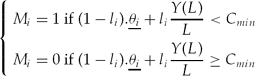
Thus households are risk neutral, as long as they get their minimum requirement, and are infinitely risk averse up till that point. We define as poor a household not getting more than its subsistence requirement: it cannot get more from its activities than what it needs to survive. This set up may seem unconventional, but appears quite accurate to describe behaviors of poor communities. Indeed, the main objective of those populations is likely to be insuring survival. Income maximization only comes after this requirement is met.
Two kinds of households decide not to migrate. First, private projects may be profitable enough for some households, even in the worst state of the world:  . These households are naturally insured. Second, households properly insured by CPR extraction also decide not to migrate. Thus CPR extraction needs to be profitable enough to insure these households properly, which need to allocate a minimum amount of labor to the CPR. The conditions for these households to stay in the community are as follows
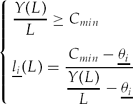
Return from CPR extraction is decreasing in total labor allocated. Thus, if too much labor is allocated to the CPR, the average product goes down to its bottom value Cmin. Therefore, a maximum possible amount of labor allocated to the CPR can be defined
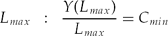

If too many households are in need of insurance, the insurance capacity of the resource, Lmax, may be too low. At this point, some households have to migrate and migration occurs until the point at which every remaining household is insured, with the average return being equal to the minimum requirement. Migration is considered here as an action of last resort: the environment cannot provide a livelihood to some households, and thus they have to leave. Households are therefore assumed to migrate from the area if and only if they cannot get their minimum requirement from their livelihood. The number of households having to migrate is therefore
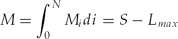
with S the population in need of insurance

In equilibrium, three classes of households can be distinguished, related to their labor allocation.
3.3. Classes of households at equilibrium
The equilibrium is a combination of a total amount of labor allocated to the commons, Le, a share of labor allocated to the commons by each household, Li, and the number of households that have to migrate, M.
In equilibrium, three classes of households can be distinguished related to their allocation of labor. Two classes are in need of insurance and therefore allocate a share of their labor to CPR extraction, while the third one is ‘naturally’ insured.
Unskilled households
Less skilled households have an expected return from the private project less than or equal to the average product on the CPR. These households allocate all their labor to the CPR. Therefore, they get the average product
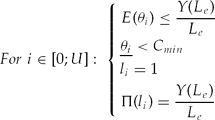
CPR extraction is motivated here by a lack of better opportunities. Less skilled households rely on this activity because it requires low skilled labor and provides higher returns than their private projects.
Skilled households
The most skilled households are those who get at least their minimum requirement from their private project. Moreover, the expected return from their private project must be greater than the average product on the CPR. Thus they allocate all their labor to the private project. Their expected income is the expected private return.
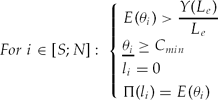
This class of household is naturally insured: they always get enough return from their private project to satisfy their basic needs.
Middle class
This last class of household does not appear in Baland and Francois. For this class, the private project is in expectation more profitable than CPR extraction. However, there are some states of the world in which this private project does not provide their minimum requirement. Therefore, they put some labor into CPR extraction in order to get insured. Because the expected private project return is greater than the return from CPR extraction, these households allocate the minimum amount of labor to the CPR in order to get exactly their minimum requirement in the worst state of the world.
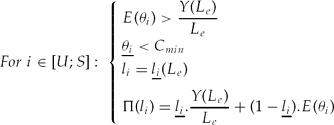
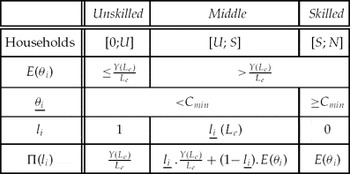
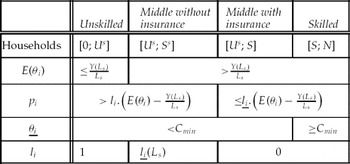
While in a world with perfect insurance, these middle-class households would allocate all their labor to the private project, they need here to extract from the CPR in order to be properly insured at the expense of reducing their expected return. Note here that S represents the population in need of insurance (unskilled and middle class). Table 1 synthesizes the patterns of the different classes in equilibrium.
Classes of households in equilibrium

In order to show how CPR extraction becomes a poverty trap, we need to determine what is the total amount of labor to the CPR.
3.4. Equilibrium amount of labor allocated to the CPR
Only two classes of households allocate labor to CPR extraction: unskilled and middle-class households. First, unskilled households allocate all their labor to the CPR. Note here that the number of households classified in the unskilled class depends on the total amount of labor allocated to the CPR.
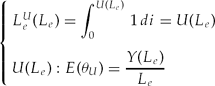
Second, middle-class households allocate only a share of their labor supply to the CPR.
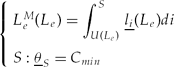
The size of the population in need of insurance S is independent of the total amount of labor allocated to the CPR. However, the total amount Le influences the repartition between unskilled and middle-class households.
CPR extraction constitutes a poverty trap if the average product of CPR extraction goes below the minimum requirement. This situation occurs if too much labor is allocated to the CPR. In this case, CPR extraction cannot properly insure every household in need of insurance, and both unskilled and middle-class households cannot get more than their minimum requirement and allocate all their labor to CPR extraction. They are, therefore, trapped into poverty because of this over-allocation of labor. Moreover, M households have to migrate until the average return  equals the minimum requirement Cmin.
Thus, if CPR extraction does not constitute a poverty trap, the equilibrium amount of labor allocated to the CPR is
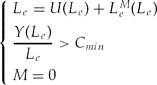
Note here that the total amount of labor allocated to the CPR in the non-poverty-trap case is a fixed point whose existence needs to be proven (see appendix).
The equilibrium amount of labor allocated to the CPR in the poverty trap case is
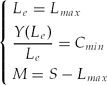
At this point, it is possible to describe the two types of situation.
4. Tragedy of the commons and poverty trap
It is well known that an open-access resource suffers from the tragedy of the commons: individuals do not take into account the negative externality of their actions on the others. In the case studied here, with CPR used as insurance and minimum income, this phenomenon can lead to a poverty trap: the population in need of insurance (unskilled and middle-class households), is trapped in CPR extraction, and cannot get more than its minimum requirement. Moreover, some households have to migrate.
4.1. Insurance without poverty trap
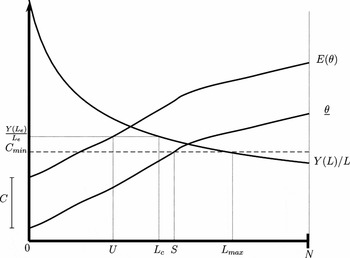
We consider here the case where: Le < Lmax. Therefore, the insurance use of the CPR does not lead to a poverty trap. Nevertheless, CPR extraction is characterized by a tragedy-of-the-commons process. Note for example that both unskilled and middle-class households would be better off with an insurance scheme. Indeed, middle-class households could allocate all their labor to their private project, which is more profitable in expectation. Moreover, the unskilled households would be better off too, because the labor supply allocated to the commons and thus the tragedy-of-the-commons effect would be lower. Therefore, the average product of CPR extraction would be bigger. Figure 1 illustrates this case.
Insurance with no poverty trap and common risk

4.2. Insurance with poverty trap
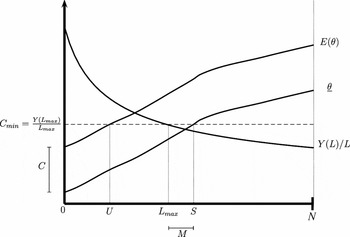
The poverty-trap case is a result of: Le = Lmax, M > 0. More precisely, it is essentially an extreme consequence of the tragedy of the commons described before. As already showed, M households have to migrate until the point at which the average product of CPR extraction reaches the minimum requirement. At this point, middle-class households have to allocate all their labor to the CPR in order to be insured. Therefore, both unskilled and middle-class households are perfectly insured but cannot get more than their minimum requirement, which constitutes a poverty trap (as defined in the introduction). Figure 2 describes the poverty trap case. Note here that skilled households get the same outcome whatever the type of situation.
Insurance with poverty trap and common risk

4.3. The causes of the poverty trap
A poverty trap is therefore the result of two main factors. First, population factors are important. If the population in need of insurance (S) is large, the poverty-trap case is more likely. The size of this population is a consequence of two components: distribution of skills (E(θ)) and distribution of risk (). First, the larger the population with a relatively high expected return from private profit, the less the unskilled population. Second, the smaller the risk to which the households are exposed, the larger the population that does not depend on the resource.
Second, the CPR extraction function determines the threshold population (Lmax) able to exploit it. If the environment is fragile, it is quickly saturated and the threshold is low.
Proposition 1:In a context of risk on the private projects, the use of CPR extraction as insurance and minimum income can lead to a poverty trap if the population in need of insurance is too large and the resource has low capacity. Then, both unskilled and middle-class households are trapped in CPR extraction and cannot get more than their basic needs in return.
Proof: A poverty trap situation is characterized by: Le = Lmax, Π(li) = Cmin and Li = 1 for households [O; Lmax], and M = S − Lmax. S determines the equilibrium amount of labor allocated to the CPR (Le), while the capacity of the resource determines the production function, and thus the maximum amount of labor allocated to the CPR (Lmax).
As already mentioned, the poverty-trap situation is an extreme case of a tragedy of the commons. The only difference in terms of welfare between those two cases is the fact that the middle class de facto disappears when CPR extraction becomes a poverty trap. Indeed, middle-class households can be insured only at the cost of allocating all their labor to the CPR. They lose, therefore, all the extra return they could get from their private project. Only two classes of households remain in the society: unskilled and skilled households.
The case studied here has therefore implications both in terms of development and environment. At the same time, the population using the resource is trapped in poverty, and the resource they use is overexploited. However, another equilibrium may be sustainable at the same time if a cooperative shift of labor allocation is made by middle-class households.
5. Inter-household insurance
Allowing for inter-household insurance may allow for a cooperative equilibrium outside the poverty trap. Indeed, a cooperative shift in the labor allocation may provide an equilibrium in which every household is insured and the minimum income is above the minimum requirement.
Indeed, consider the following insurance contract:Footnote 3 middle-class households commit not to allocate any labor to the CPR, which would raise the return from CPR extraction above the minimum requirement:  C min. Conversely, if middle-class households get poor return from their private project (θ < Cmin), unskilled households commit to compensate for it, filling the gap between the private outputs and the minimum requirement: Cmin − θ. Thus middle-class households could concentrate on the most profitable activity, being insured to get at least their minimum requirement. Moreover, unskilled households would get more than their minimum requirement, since labor allocated to the CPR would be reduced.
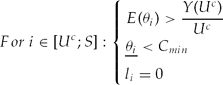
The number of unskilled households in this cooperative equilibrium would be larger than in the preceding one, but they would be the only households to allocate labor to CPR extraction. Moreover, as these households allocate all their labor to the CPR, the number of unskilled households is also the equilibrium labor allocation to the CPR: Lc = Uc. The unskilled class would be defined as follows
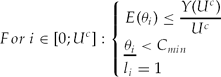
Middle-class households would now allocate all their labor to their private project, which is more profitable
Finally, the skilled class would remain unchanged
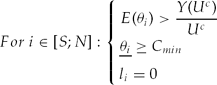
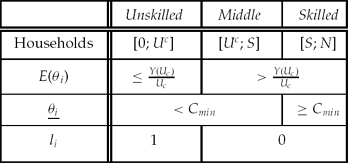
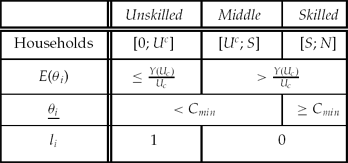
Table 2 shows these equilibrium classes.
Classes of households with inter-households insurance
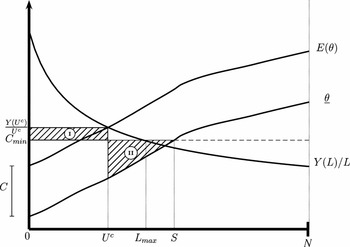
This new equilibrium, represented in figure 3, could be sustained as long as the total increase in CPR extraction could compensate every middle-class household if the worst state of the world occurs
Inter-households insurance


Graphically, equation (18) holds if zone I is larger than or equal to zone II in figure 3.
Basically, this cooperative equilibrium consists of unskilled households insuring middle-class households for the risk they take. Unskilled households would not be directly compensated for providing insurance, but they may have an interest in subsidizing insurance because it would increase their return from CPR extraction. This is therefore a win–win opportunity for both types of households.
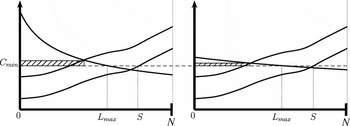
The cooperative insurance capacity (zone I of figure 3) represents the maximum amount available to compensate middle-class households. Its size depends mainly on the capacity of the resource and especially the CPR extraction function. If the average return from CPR extraction decreases quickly, a reduction in labor allocated can have an important effect on the size of zone I. Figure 4 shows the impact of the CPR extraction function on the cooperative insurance capacity. Return from CPR extraction decreases more quickly in the left graph, while both functions have the same maximum capacity Lmax. Potential efficiency gains are thus more important in the left graph, which reveals a better cooperative insurance capacity.
The cooperative insurance capacity increases with the slope of the CPR extraction function

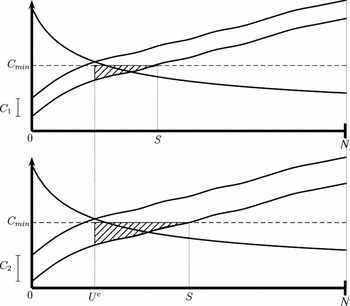
The cooperative insurance needs are represented in zone II and consist of the amount that is necessary to properly insure every middle-class household if the worst state of the world occurs. Its size depends on aggregate risk. If many middle-class households have the very low, worst possible output, the decrease in labor allocated may be insufficient to properly insure every household. Figure 5 shows the impact of risk on the cooperative insurance needs. Aggregate risk is more important in the lower graph, which creates larger insurance needs than in the upper graph.
Stronger aggregate risk (C 1 < C 2) increases the cooperative insurance needs

Thus, if some conditions are met concerning the distribution of risk and the extraction function of the common resource, an inter-household insurance scheme may provide a cooperative equilibrium outside the poverty trap. If the condition described in equation (18) is not respected, however, this type of equilibrium cannot be sustained. In this case, a private insurance mechanism may offer another type of solution.
6. Private insurance mechanism
Another potential solution to the poverty trap described before could be the introduction of a private insurance mechanism. In the set up presented here, an insurance scheme would consist of paying a risk premium in order to get the minimum requirement in case of economic stress. The insurance system would therefore be paid a premium pi by insured households and would fill the gap between a bad private return and the consumption requirement (that is  if the worst state of the world occurs).
The risk premium therefore depends on the amount the insurance system would have to pay to fill the gap between the worst private outcome and the minimum requirement. Less skilled households would therefore have to pay a higher risk premium:  . Moreover, this risk premium would be increasing in the probability of occurrence of bad states of the world.
First, skilled households would not be interested in this insurance scheme, because they are naturally insured. Therefore, only households belonging to classes in need of insurance (S) could be willing to subscribe. Second, less skilled households, with too high risk premiums, could not afford the insurance scheme, and would not subscribe. Thus only some middle-class households subscribe to the insurance.
The condition for subscribing to the insurance is

which implies that household i subscribes to the insurance if the risk premium is not to high. Ls is the new equilibrium amount of labor allocated to the CPR.
Two types of middle-class households can now be distinguished. Some of them subscribe to the insurance
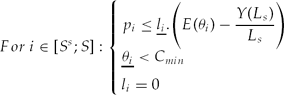
while other middle-class households keep on using CPR extraction as insurance, because the insurance scheme is too expensive for them
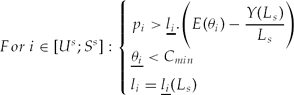
Ss is the first household subscribing to the insurance scheme and Us is the first middle-class household.
Table 3 describes the new classes in equilibrium.
Classes of households with private insurance

The new equilibrium amount of labor allocated to the CPR is
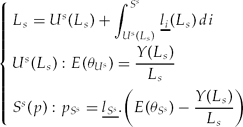
Several implications of the introduction of an insurance scheme can be determined. First, the population in need of insurance S remains stable, because the conditions for being in the skilled class do not change. Second, if some households subscribe to the insurance scheme, the population allocating labor to the CPR decreases, Ss < S, and total labor allocated to CPR extraction decreases, Ls < Le. Third, since the equilibrium amount of labor allocated to the resource decreases, average return from CPR extraction increases. Therefore, the amount of labor allocated by middle-class households not subscribing to the insurance decreases, because less labor is needed to fill the gap between the worst private outcome and the minimum requirement:  . Finally, the number of unskilled households increases Us > U, and their welfare increases
 .
Overall, the introduction of a private insurance scheme may be a solution to the poverty trap case described before, if the number of subscribing households is sufficiently large, thus if the risk premiums are not too high, and the middle class sufficiently important.
7. Conclusion
The aim of this paper is to show how a CPR used as insurance may become a poverty trap. Namely, this mechanism can be described as an extreme case of a tragedy of the commons.
We consider here a CPR used as insurance and which provides a minimum level of income to the society. If the resource has low capacity, i.e. if its exploitation is quickly saturated, the poverty trap is more likely. Moreover, if the population in need of insurance is too large, this use of the resource is also more likely to lead to a poverty trap. If the first condition is not under the control of anything but nature, the second one has some implications in terms of economic and social polices.
If some conditions on the extraction function and the population distribution are met, the development of cooperative insurance mechanisms may reduce labor allocated to CPR extraction enough to sustain other equilibria outside the poverty trap. Moreover, private insurance schemes may also be potential solutions to the poverty trap. In this context, reducing risk may be a useful tool to attain both objectives of development and protection of natural resources.
Educational policies should also have an impact in term of skills. Indeed, a more educated population leads to less of the population in need of the resource to obtain a minimum income. The introduction of a minimum income by the welfare state could also reduce the minimum income use of the resource.
Finally, an important restriction here is that the size of the resource is supposed to be fixed. If some policies reduce the dependence of the populations on the resource, a possible consequence is the decrease in the size of the resource, because of a decrease in its perceived value (Delacote, Reference Delacote2007).
Overall, even if the literature gives insight that CPR have important insurance properties, very few empirical analyses and case studies consider how the introduction of insurance mechanisms and microcredit affects the use of common property resources. Delacote (Reference Delacote2007) considers the extensive land use and advances the idea that introducing insurance may decrease the forest cover. In contrast, focusing on intensive labor allocation, this paper argues that the introduction of inter-household or private insurance may reduce pressure on common forests and decrease poverty at the same time. Some empirical analyses and case studies would thus be required to give some evidence of those two effects and to distinguish which one is the most important.
Appendix: Le as a fixed point
The total amount of labor allocated to the CPR in the non-poverty-trap case is a fixed point. First, we need to prove that U(Le) + LMe(Le) is decreasing in Le.
Note that U(Le) is decreasing in Le. Indeed the number of unskilled people is defined as: E(θU) ≤ Y(Le)/Le, which is decreasing in Le by assumption.
Therefore, if Le increases, some households pass from the unskilled class to the middle class. Those households reduce the amount of labor allocated to the CPR. Indeed, the unskilled households allocate all their labor to the CPR, while middle-class households allocate only a share of it.
Overall, an increase of Le induces a reduction in labor allocated by the unskilled class, which over-compensate the raise in labor allocated by the middle-class households. It follows that the total amount of labor allocated to the CPR decreases.
Second, U(Le) + LMe(Le) is positive, as the amount of labor allocated by insurance-seeking households is necessarily positive. It follows that Le = U(Le) + LMe(Le) is a fixed point.