INTRODUCTION
New democracies, and some older ones, increasingly include gender provisions in their constitutions. What is the impact of these provisions on women's political and economic status? Does constitutionalizing gender serve to empower women? If so, what kinds of provisions have an empowering effect and under what conditions do they matter? Feminists disagree whether women, and the political movements that represent them, should pursue policies based on their equality with men or if they should accept and embrace their differences with men and pursue policies that make allowances for women's difference (Jaquette Reference Jaquette2001). The former is consistent with the liberal feminist view that individuals should be treated equally irrespective of their descriptive differences. The latter approach is often called “difference feminism” or “maternalism” and argues for special rights and protections based upon women's different needs. In this study, we explore whether, and how, one or another approach to constitutionalizing gender equality affects key legislative and judicial outcomes that impact women's lives.Footnote 1
We analyze two country cases in southern Africa with constitutions that represent dramatically different approaches to gender—Botswana and South Africa. Botswana's constitution is essentially neutral toward gender difference, whereas South Africa's constitution is strongly egalitarian. We examine how gender has been constitutionalized and how specific constitutional provisions have informed and structured gender-specific legislation, policy outcomes, and landmark high court rulings in three policy areas: women's rights within the family, gender-based violence, and employment rights. The case study analysis focuses on the policy implications of constitutional provisions, and it speaks to a larger debate about recognizing gender difference in the law and the types of legal and political strategies that best promote gender equality and social change.
We begin with a brief discussion of why, and potentially how, law can affect social change. Drawing on the law and social change literature, we argue that gendered constitutional provisions affect policy outcomes because they provide a legal basis and legitimacy for women's rights advocacy, help prevent policy reversal, and increase the likelihood of favorable decisions in the courts. The case studies detail the incorporation of gender into the national constitutions of Botswana and South Africa, as well as the impact of gender-equality provisions in the three policy areas. The comparative analysis reveals a complex political picture in which constitutional provisions are one of several factors affecting policy outcomes. At the same time, the case studies demonstrate that where gender-equality provisions are absent (as they are in the Botswana case), political actors are more limited in their efforts to pursue policies that contribute to women's equality. In each of the policy areas, the case studies illustrate how constitutional language that enumerates women's rights influences the content of legislation as well as judicial review of government policy.
Why Constitutions Matter For Social Change
The question of whether women's equality is best achieved by constitutional recognition is closely related to a fundamental debate about the effect of law on society and social change. One perspective is that the law is not transformative and does not independently affect or cause social change. Rather, the law simply reflects the ideology or interests of the dominant classes or groups at the time the law or constitution was written. For example, David Strauss argues that constitutional amendments are “irrelevant” and serve only “to ratify changes that have already taken place in society” (Reference Strauss2001, 1459).Footnote 2 Likewise, in his comparative analysis of constitutional development in four countries, Ran Hirschl contends that the effect of constitutions on distributive justice is often “overrated if not outright negligible” and appears “to have only a limited capacity to advance progressive notions of social justice” (Reference Hirschl2004, 13). That is, other factors shape and influence social outcomes regardless of whether particular laws or constitutional provisions are in place.
Another perspective argues that law can influence social policy and rights and “has the potential to further progressive causes” (Rosenberg Reference Rosenberg1996, 436). This potential, however, may be mediated by social and political forces (McCann Reference McCann1994; Scheingold Reference Scheingold2004). Thus, constitutional law matters for women, but it is not a panacea (Baines and Rubio-Marin Reference Baines, Rubio-Marin, Baines and Rubio-Marin2005; Banda Reference Banda2005), nor can a constitution “in itself secure rights for women” (Jagwanth and Murray Reference Jagwanth, Murray, Beverly and Ruth2005, 231). Instead, we might expect outcomes to be shaped by both constitutional provisions and activist legal agendas. In their analysis of women and constitutions, Alexandra Dobrowolsky and Vivien Hart agree that both constitutional provisions and activism are necessary and “remind us that while women must help write the constitutional text, [and] women's citizenship and equality must be inscribed in the constitutional text, only constant vigilance and the hard grind of sustained activism ensure that over time textual promises are honoured and … women's lives change for the better” (Reference Dobrowolsky, Hart, Alexandra and Vivien2003, 3).
Studies on constitutions, gender, and law suggest several reasons why gender-equality provisions may matter for women's social, economic, and political status. First, constitutional gender-equality provisions enhance the legitimacy of rights claims (Jagwanth and Murray Reference Jagwanth, Murray, Beverly and Ruth2005; O'Sullivan and Murray Reference O'Sullivan and Murray2005). Second, an egalitarian constitution is part of an “enabling framework” that facilitates legal change (Waylen Reference Waylen2007, 538). Third, women's rights provisions help establish a more solid legal foundation and “provide women with tools to challenge state activity in the courts” (Baines and Rubio-Marin Reference Baines, Rubio-Marin, Baines and Rubio-Marin2005, 9). For example, Lisa Baldez, Lee Epstein, and Andrew Martin (2006) find that equal rights provisions increase the standard of the law that is applied and increase the likelihood of a favorable judicial decision for those asserting women's rights.Footnote 3 The presence of constitutional rights may give courts greater leeway to interpret rights more broadly than legislated rights, whereas the absence of enumerated rights: “puts pressure on the courts … to stretch their powers of statutory interpretation to its limits” (Fombad Reference Fombad2004, 143). Fourth, with respect to the law and African women's lives, Fareda Banda argues that although the law is often a means for oppressing women, “sometimes legal change has resulted in social change or a different way of seeing the problem” (2005, 301). Finally, the presence of rights might encourage underrepresented groups to mobilize for social change (Scheingold Reference Scheingold2004).
These studies suggest that constitutional gender-equality provisions provide a legal basis for women's rights advocacy and inspire the content of subsequent legislation and judicial interpretation of laws and constitutional rights. Where egalitarian constitutional provisions are present, women's movements can use them as a legal tool to fight gender discrimination and proactively push for women's equality. Where these constitutional provisions are absent, women's movements (and the political and institutional machinery of which they are a part) may have a limited capacity to pursue policies that impact gender equality. Thus, we would expect to see clear differences in policy change and judicial enforcement depending on the extent and nature of constitutional provisions concerning gender equality.Footnote 4
CASE STUDIES
Origins and Implications of Constitutional Gender Provisions
We selected Botswana and South Africa because both country cases exhibit maximum variance on our independent variable of interest (constitution type) while holding several alternative explanations constant or nearly constant. Botswana's constitution contains a simple sex-equality statement, while South Africa's constitution actively seeks to establish and promote gender equality. Thus, Botswana is neutral with respect to gender difference, though it is not completely silent on gender, whereas South Africa constitutionalizes gender difference in a decisively egalitarian manner. Additionally, the comparison holds several important factors roughly constant. Foremost among these is that the two countries share legal system characteristics that are directly traceable to Roman Dutch law (Himsworth Reference Himsworth1974, 173). Both countries also recognize the validity of customary law at the constitutional level and seek to strike a balance between the individual rights recognized in the constitution and customary law, particularly with respect to marriage and family law. Our country cases also share similar exposure to global and regional pressures to implement policies and create national gender machineries to improve the lives of women in southern Africa.Footnote 5 The international and regional context has had a profound effect on the policy content of local activism, as well as on the character of local state institutions designed to support gender mainstreaming. Both Botswana and South Africa now have national gender machineries at the highest levels of government and civil society, though they follow somewhat different models, as discussed in the case studies.Footnote 6
Botswana and South Africa exhibit important political differences. In particular, as the case studies demonstrate, women's rights advocates in South Africa benefit from a more favorable political climate with respect to several key factors associated with gender policy, including the predominance of a left party in government and stronger representation of women in parliament. Additionally, while each of our cases has a relatively organized and strong women's movement from the 1990s onward, South Africa's women's movement enjoyed influence at the critical time of transition to democracy. As a result, women's rights advocates participated in writing the constitution and were instrumental for the inclusion of a strong gender-equality commitment and other proactive provisions (Hassim Reference Hassim2002; Seidman Reference Seidman1999). The timing of the transition to democracy and the commitment of the African National Congress (ANC) to gender and racial equality have contributed significantly to public policy affecting women in South Africa (Waylen Reference Waylen2007). Botswana's constitution, on the other hand, was written in an earlier era, and women were not included in the process. Moreover, politics in Botswana has been dominated by a single conservative party, and women's representation in national politics is low. These different political circumstances affect the legislative climate for passing gender policy. In the case studies, we explore these differences further and find that gender-equality provisions are an important part of an enabling framework that increases the chances of policy change, are frequently cited in both legal documents and decisions, and thus contribute to a firmer legal foundation for women's rights.
Botswana's Gender-Neutral Constitution
Botswana is one of the few success stories in Africa with a relatively long history of political and economic stability. However, its society and legal system are highly discriminatory against women. As in many African countries, the government has strongly resisted pressures to accommodate gender-based change in the political arena (Leslie Reference Leslie2006). The country gained independence “as a bourgeois, bureaucratic state through a generally peaceful, colonially-mediated process, with no particular commitment to the emancipation of women beyond the right of suffrage and the same ambiguities about women's status embedded in its Constitution as could be found elsewhere in southern Africa” (Van Allen Reference Van Allen2000, 142). At the time of independence, “women did not feature in political parties much at all” and enjoyed few political or economic rights (Geisler Reference Geisler2004, 100).
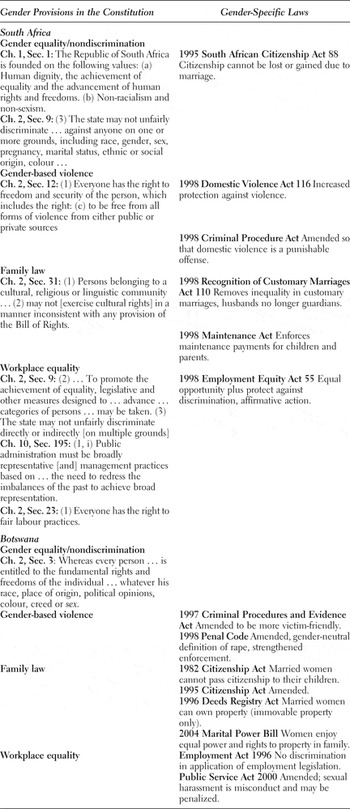
Botswana's constitution was adopted in 1965 prior to elections and independence in 1966. The constitution mentions “sex” once under the fundamental rights and freedoms of the individual (see Table 1). Additionally, Section 15(3) prohibits discrimination against several categories, but not sex. Many government officials (including the attorney general in the Unity Dow case discussed here) maintained that sex discrimination did not violate the constitution. The absence of a strong women's movement and the adoption of the constitution well before the appearance of international women's organizations or broader norms about the promotion of women's rights help explain the scarcity of gender-equality provisions in the constitution.
Constitutional gender provisions and gender-specific legislation in South Africa and Botswana

Despite the lack of attention to women's rights in the Botswana constitution, the single sex-equality clause has proven to be central for women's citizenship and gender-equality struggles. In fact, a constitutional challenge to a 1982 citizenship law became the focal point for women's organization and was instrumental in the development of the women's movement in Botswana.
In 1982, the Botswana government passed the Citizenship Act, which denied citizenship to the children of Tswana women married to foreigners. The organization Emang Basadi, or EB, (Emang Basadi is Setswana for “Stand Up, Women!”) formed in the mid-1980s to pressure the government to repeal all legislation that was discriminatory against women and, in particular, the Citizenship Act of 1982 (Molokomme Reference Molokomme1991; Van Allen Reference Van Allen2000). The Citizenship Act was challenged in court by Unity Dow, who argued that the law constituted discrimination and was unconstitutional. In Attorney General of the Republic of Botswana v. Unity Dow, the Botswana High Court ruled in favor of Dow (Leslie Reference Leslie2006). The government argued that the writers of the constitution had intended to maintain “patrilineal custom,” but the High Court judge rejected this position, stating that “the time that women were treated as chattel or were there to obey the whims and wishes of males is long past and it would be offensive to modern thinking and the spirit of the Constitution to find that the Constitution was framed deliberately to permit discrimination on the grounds of sex” (Van Allen, citing the Dow decision, 2007, 104). In 1994, the Court of Appeals upheld the ruling, finding that the Citizenship Act was unconstitutional. The Dow ruling effectively interpreted the equality and discrimination clauses together as implying that the Botswana constitution prohibits discrimination on the grounds of sex (Van Allen Reference Van Allen2000).
In the fallout from Dow, the ruling Botswana Democratic Party (BDP) was reluctant to grant equal rights to women and proposed a referendum to amend the constitution in order to allow the Citizenship Act to stand. The threat of amendment galvanized women's organizations (especially Emang Basadi). After two years of campaigning and lobbying, women's groups succeeded in getting the Citizenship Law changed (Leslie Reference Leslie2006).Footnote 7 Unlike South African women, “Botswana women emerged on the political scene not on the basis of an opening up of political systems by democracy but instead on account of a tightening of already restricted rights extended to women” (Geisler Reference Geisler2004, 166). That is, the women's movement rose up to fight an attempt to further limit women's rights, rather than to pursue greater equality.
Emang Basadi built on its success with the Citizenship Act and has continued to organize and raise awareness of women's issues. The EB is now perceived as a legitimate representative of women's interests and is often consulted by government (Leslie Reference Leslie2006). The policy changes, such as the Citizenship Act of 1995, the Deeds Registry Act, and the Marital Power Bill, are consistent with EB demands (see Table 1). More generally, EB is credited with initiating a real increase in democratic participation among women and men and improving the quality of democracy in Botswana (Leslie Reference Leslie2006; Selolwane Reference Selolwane, Edge and Lekorwe1998). Nonetheless, the women's movement in Botswana, while moderately strong, faces a government that has been “slow to adopt policies and laws related to women, [and] even slower and more reluctant to implement those decisions and policies that passed” (Leslie Reference Leslie2006, 117). The conservative Botswana Democratic Party, which has been in power since independence, has largely stood in the way of women's rights and has only grudgingly made changes when forced to (e.g., by the courts). The main opposition party, the Botswana National Front (BNF), is a social democratic party and more supportive of women's equality, but has been weakened by factionalism and a split in 1998 (Van Allen Reference Van Allen2007, 97).
Botswana women have long played an important political role in grassroots party mobilization efforts, fund-raising campaigns, and party recruitment; however, women continue to be marginalized in political party structures (Somolekae Reference Somolekae2006). As a result of women's advocacy efforts, nearly every political party in Botswana now has a women's wing, and those organizations are applying internal pressure for political inclusion of women. The BNF, for example, which created a women's wing in 1977, has adopted positive measures to increase representation of women at every level of party structure. However, even after the adoption of party quotas, the level of women's involvement is still below the BNF's expectations (Somolekae Reference Somolekae2006, 31). The conservative BDP created a women's wing in 1987 but has staunchly opposed the adoption of an internal party quota. Nevertheless, the party moved to incorporate women (co-opt, according to some) and the president appointed two women to the legislature (out of four “specially elected seats”), as well as Unity Dow (the defendant in the Citizenship Act case) as the first female judge on the High Court in 1998 and Athaliah Molokomme as the second female High Court judge in 2003 and later attorney general in 2005.
Women's representation in parliament is somewhat low in Botswana and has fallen in recent years. Women's representation in parliament dropped from 18% in 1999 to 11.1% in 2004, and by 2009 it had reached as low as 8% (Maundeni et al. Reference Maundeni, Mpabanga, Mfundisi and Sebudubudu2007, 16; see also Inter-parliamentary Union at http://www.ipu.org, accessed November 20, 2009).Footnote 8 Comparatively low levels of women's representation are related to the dominance of the conservative BDP in the party system, as well as to the first-past-the-post electoral system, which, in Botswana as elsewhere, has contributed to marginalizing women in the electoral arena. Moreover, at the local level, women remain underrepresented and governance structures are male dominated. In fact, the “proportion of women in political leadership, either as mayors/chairpersons or deputy mayors/chairpersons dropped from 21% in 1999 to a mere 14% in 2004” (Maundeni et al. Reference Maundeni, Mpabanga, Mfundisi and Sebudubudu2007, 38).
Despite low levels of female representation, Botswana's national gender machinery has become an important advocate for women's rights. One of the most important components of the national gender machinery is the Women's Affairs Department (WAD) located in the Ministry of Labor and Home Affairs. Originally established in 1981 as the National Women's Unit, it was promoted to a division in 1991 and then a department in 1996. The WAD is charged with mainstreaming gender in national policy and promoting women's empowerment. It is complemented by the efforts of the Botswana National Council on Women (BNCW), a high-level policy advisory body established in 1999, and the “gender focal points” in government ministries (Alexander Reference Alexander2005, 4-5). Like many gender machineries elsewhere, the WAD faces challenges that stem from limited resources that reduce its capacity, a limited recognition of its role within the public sector, and gender-insensitive attitudes among government officials.
Women's groups and women representatives have secured the passage of key pieces of legislation affecting women (summarized in Table 1 and discussed later). Although these laws constitute legislative successes for women's rights advocates in Botswana, it is important to note that these laws protect women's rights in the negative sense. That is, none of these laws include proactive measures to increase women's political or economic power; instead, they are generally focused on removing discriminatory legislation.
South Africa's Egalitarian Constitution
With respect to substantive rights, the South African constitution is one of the most inclusive in the world. It incorporates individual rights along with a wide array of social and cultural rights, and establishes a clear commitment to overcoming past injustices while recognizing diversity (Bauer and Taylor Reference Bauer and Taylor2005, 249). The constitution includes the right of human dignity and a principle of nonsexism, a strong and substantive equality-protection clause, and detailed rights for women, including rights to freedom and security of the person and bodily autonomy, freedom from violence, reproductive choice, and a prohibition against any expression that amounts to advocating gender hatred. The constitution requires courts to interpret legislation in the spirit of the Bill of Rights and to let international law and jurisprudence in other democracies guide judicial interpretation of the Bill of Rights (SA Constitution 39 [2]; see also Mokgoro Reference Mokgoro2004). The constitution is one of the most progressive in seeking to recognize women's difference, promote gender and racial equality, and redress past discrimination. The constitution's strong commitment to gender equality is visible both as a foundational value in South Africa's new democracy and as a set of substantive rights specifically related to gender equality. These provisions are summarized in Table 1.
The emphasis on gender equality can be attributed to several factors, including the timing of the transition to democracy, the role of the African National Congress in constitutional negotiation, the inclusion of women at the negotiating table, and a “favorable political opportunity structure” (Hassim Reference Hassim2002; Seidman Reference Seidman1999; Waylen Reference Waylen2007). The transition to democracy took place at the height of a global discourse on gender equality and at a time when international agencies increasingly linked funding to the goals of gender equality (Seidman Reference Seidman1999). At the same time, anti-apartheid activists organized separate women's forums to discuss how apartheid treated black women and men differently, stressing the need to incorporate women's issues into new political institutions (Seidman Reference Seidman1999). Feminist ideas gained currency within the ANC and contributed to calls for greater representation for women within national negotiations for a new constitutional framework, including the institutional basis for South Africa's gender machinery (Geisler Reference Geisler2000; Hassim Reference Hassim2002; Seidman Reference Seidman1999).
The strength and autonomy of the women's movement in South Africa has fluctuated over time. During the early 1990s, the women's movement was at its strongest and most united. The Women's National Coalition (WNC) brought together more than 90 different women's organizations and eight regional coalitions under an umbrella organization (Britton Reference Britton2002; Hassim Reference Hassim2002, Reference Hassim2006; Murphy Reference Murphy, Alexandra and Vivien2003). The WNC's Women's Charter articulated a commitment to broad principles that allowed the WNC to “present a strong, unified, and powerful voice, despite internal divisions and disagreements” (Britton Reference Britton2002, 41). The WNC was strong and autonomous during the transition period but soon after became fragmented: “[H]aving fulfilled its mandate of ensuring greater representation of women in political structures and developing a women's charter, the coalition was no longer needed” (Hassim Reference Hassim2006, 165). Although there are many organizations at the national, regional, and local level pursuing women's issues and rights, the movement currently suffers from a lack of leadership and is no longer united by a common purpose (Gouws Reference Gouws2004; Manjoo Reference Manjoo2005; O'Sullivan and Murray Reference O'Sullivan and Murray2005; Hames and Koen Reference Hames and Koen2006).
As in the Botswana case, South Africa's multiparty democracy is dominated by a single party, the ANC. The ANC has won sizable majorities in every election since the transition to democracy. Unlike the Botswana case, where the ruling party is largely hostile to women's rights and women's issues, the ANC has made a serious effort to promote gender equality. The ANC's gender egalitarian principles were strongly influenced by women's activism during the transition, and can also be seen partially as a response to electoral pressures (Hassim Reference Hassim2006; Murphy Reference Murphy, Alexandra and Vivien2003). The ANC committed itself to increasing gender representation by agreeing to a 30% party quota for women on its party list. This decision immediately catapulted South Africa into the global top 10 for representation of women (Reynolds Reference Reynolds1999), and today women hold 45% of all legislative seats in South Africa. While all political parties accept the principle of gender equality, the ANC is the only party that has systematically applied a quota and placed women in prime positions on the party list. Consequently, 82% of women members of parliament are ANC members. South Africa also leads the southern African countries in percentage of women with cabinet posts (42% women ministers and a woman deputy president) (Hames and Koen Reference Hames and Koen2006).
The National Gender Machinery in South Africa is complex and overlapping and includes structures at several governmental and nongovernmental levels. At the national executive level, the Office on the Status of Women (OSW), housed in the deputy president's office, facilitates and monitors the implementation of gender policy. In 1996, gender focal points were set up in government departments to integrate and mainstream gender into department policymaking and responsibilities. However, the various institutions at the executive level have been hamstrung by problems of political authority, low-level staffing, and insufficient resources (Hames and Koen Reference Hames and Koen2006). At the parliamentary level, the key gender structure is the Committee on the Improvement of the Quality of Life and the Status of Women (CIQLSW), which has a mandate to monitor progress toward achieving gender equality. Finally, the constitution required the creation of an independent body, the Commission on Gender Equality (CGE) to advocate for gender equality and monitor both the government and the private sector. The CGE has struggled: It is beset by internal dissent and immobilized by disagreements concerning how the nominally independent body should relate to the government and to the NGO community (Seidman Reference Seidman2003).Footnote 9
Overall, the National Gender Machinery “does not function in a coordinated and strategic manner [and] has been conflict-ridden since its inception” (Manjoo Reference Manjoo2005, 269). According to the Women in South Africa report (Hames and Koen Reference Hames and Koen2006), one of the central weaknesses of the National Gender Machinery in South Africa is that while there is strong commitment within the government for gender equality and gender mainstreaming, accountability for gender mainstreaming resides nowhere within the administration. In fact, that accountability was assumed to come from a strong women's movement, which is now in disarray (Seidman Reference Seidman2003). Moreover, while the women's machinery at the government level is extensive in South Africa, it has not been as effective as anticipated.
Nonetheless, the policy gains have been substantial (see Table 1). The following comparison illustrates how the constitutionalization of gender equality rights in South Africa shapes and informs gender-specific legislation, policy outcomes, and court rulings and how this contributes to substantially different outcomes in Botswana.
Botswana and South Africa Compared
There are several expectations that follow from the law and social change literature discussed earlier. First, if constitutional rights provisions increase the legitimacy of rights claims or provide an enabling legal framework for policy change, then South Africa should be more likely to pass gender-specific laws. We also might expect that the rights and protections elaborated in these laws would be more proactive in South Africa, make reference to gender equality provisions, and clearly state how policy is to be implemented or enforced. Judicial challenges to these laws, in turn, will be harder to sustain when constitutional provisions clearly enumerate women's rights as citizens. To evaluate these expectations, we compare constitutional provisions, legislation, and High Court cases across countries in three policy areas: family and customary law, gender-based violence legislation, and workplace equality (see Table 1).
Family and Customary Law
Customary law has been identified by women's groups as a particularly contentious area of law.Footnote 10 Women's movements across Africa have pursued a rights-based strategy to challenge customary law, particularly with respect to land tenure and inheritance (Tripp Reference Tripp2004). The relationship between customary law and civil law is fundamentally different in South Africa and Botswana, but those differences are consistent with the approach each country takes to constitutionalizing gender difference—minimally and neutrally in Botswana versus proactively and equality oriented in South Africa. Both countries have passed important legislation regarding family law; however, there are clear differences in the nature and extent of this legislation, and in the judicial protection of women's rights in marriage and property, that may be traced to the constitutional status of customary law.Footnote 11
Customary law governs marriage and divorce, a woman's rights within marriage, and her rights with respect to division of shared property, inheritance, and child custody. South Africa's constitution recognizes the right to celebrate traditional customs but explicitly states that customary law is subject to the constitution and must be consistent with the Bill of Rights. These constitutional conditions guided the passage of the Recognition of Customary Marriages Act,Footnote 12 which removed inequality in customary marriages and abolished the power of husbands as guardians: “The wife in a customary marriage has in all respects a status equal to that of her husband” (RCMA 1998, Section 6). A memorandum on the act explains that the motivation of the law is to bring customary law in line with the constitution and international law. In particular, it states that it tries to reconcile the constitutional principle of preserving African cultural traditions with the right to equal treatment and nondiscrimination.
The South African High Court has generally interpreted customary law in light of the Bill of Rights. In Mabuza v. Mbatha (2003), the court found that customary law could regulate marriage so long as the law did not contravene the constitution (in particular, the equality clause).Footnote 13 An earlier case, Prior v. Battle and Others (1999), found that customary law contravened the constitution because it granted the husband “guardianship” over his wife, which the court found “outmoded and anachronistic.”Footnote 14 Similarly, with respect to inheritance and customary law, the South African Constitutional Court found a rule of male primogeniture in African customary law to entrench patriarchy and violate women's constitutional guarantees to human dignity and equality. In Bhe v. Magistrate, Khayelitsha and Others (2004), the court argued forcefully that the challenged customary law was not only inconsistent with the constitution but that customary law generally must evolve to meet new community standards.Footnote 15 In Shilubana and Others v. Nwamitwa (2008), a case concerning community leadership, the court recognized that customary law can evolve to promote gender equality. Similarly, in Gumede v. President of the Republic of South Africa and Others (2008), the court confirmed a Durban High Court ruling that gender discrimination in the division of property in divorce proceedings cannot be justified by customary law and is unconstitutional on gender-equality grounds. The constitutional requirement to reconcile customary law to the Bill of Rights in South Africa has informed legislation, shaped the legal strategies of women's rights advocates such as the Legal Resources Centre and the Women's Legal Trust (which have written “friend of the court” briefs in cases such as Gumede), and helped to protect and advance individual women's rights in the face of legal challenges.
In contrast, in Botswana, the relationship between civil law and customary law has left new family laws vulnerable to political and judicial challenges. Not only does the Botswana constitution lack any provision requiring that customary law be brought into line with individual constitutional rights (or international law), but it also includes a provisionFootnote 16 that exempts customary law from the equality and nondiscrimination provisions (Fombad Reference Fombad2004). As a result, women in Botswana have few legal grounds to challenge customary laws and achieve a more equitable legislative framework in the areas of marriage, inheritance and property rights, and child custody and maintenance.
Botswana operates under a dual system of general law (civil and common law) and customary law, where customary law is adjudicated by chiefs and local leaders and general law by a national court system. Under both systems of law, women have received unequal treatment in matters of family law (Leslie Reference Leslie2006). The Deeds Registry (Amendment) Act was amended in 1996 to allow married women to hold property in their own names, though anecdotal evidence suggests that enforcement is spotty at best (Nyamu-Musembi Reference Nyamu-Musembi, Mukhopadhyay and Singh2007). In 2004, the parliament passed the Marital Power Act abolishing “the power of men as household heads and sole decision-makers in family property and other related issues” (Alexander Reference Alexander2005, 34). The scope of these statutes is greatly limited because they do not explicitly apply to customary and religious marriages, an interpretation supported by the High Court.Footnote 17 EB has fought hard but unsuccessfully to subsume customary law to women's equal rights (Van Allen Reference Van Allen2007). Thus, advocates for women's rights must defend legislative advances in the face of opposition from “Chiefs and Parliamentarians [who] have opposed the abolition of men's marital power and argued that ‘men are natural heads of households and decision-makers’ which should not be questioned” (Alexander Reference Alexander2005, 35).
Gender-Based Violence
Violence against women is a violation of individual constitutional rights and fundamental freedoms and constitutes one of the “most widespread human rights abuses and public health problems in the world today” (Committee on African Affairs 2007, 1). The constitutions of Botswana and South Africa present starkly divergent constitutional approaches to women's rights and state obligations regarding violence against women.
South Africa's constitution states that all citizens have an “inherent dignity and the right to have their dignity respected and protected.” Moreover, the constitution provides everyone with the right to “bodily and psychological integrity, which includes the right to security and control over their body.” Finally, the South African constitution also states that the government has a duty to prevent violence and asserts that everyone has the right “to be free from all forms of violence from either public or private sources.”
South Africa has enacted far-reaching legislation that draws on these constitutional provisions. For example, the preamble of South Africa's Domestic Violence Act (116 of 1998) states that domestic violence is a serious social problem and that the state has a responsibility to end violence against women and children. It invokes the constitution (the right to equality, freedom and security of the person) and international commitments (UN Convention on the Elimination of All Forms of Discrimination Against Women, or CEDAW). The law defines domestic violence in broad terms (including physical, economic and emotional abuse, harassment, and intimidation), specifies police procedures and obligations (and disciplinary measures if police fail to meet these obligations), and details court powers and procedures for applying for protection and issuing arrest warrants.
Moreover, in cases concerning domestic violence and violence against women, the South African Constitutional Court has drawn on gender equality provisions (Isaac Reference Isaac2005). For example, in deciding S v. Baloyi (2000), the court argued that because “domestic violence predominantly affects women[,] the constitutional right to gender equality is jeopardized by a legal system that fails to adequately address this violence.” In Carmichele v. Ministry of Safety and Security (2001), the court went further to uphold the claim that the state has a positive duty with respect to violence against women: “The Court noted that in addressing such obligations in relation to dignity and the freedom and security of the person, ‘few things can be more important to women than freedom from the threat of sexual violence’” (Isaac Reference Isaac2005, 36). This ruling was reinforced in Van Eeden v. Minister of Safety and Security (2001), in which the Court of Appeal found that the “state is obliged under international law to protect women against violent crime and against the gender discrimination inherent in violence against women” (Isaac Reference Isaac2005, 39).
The constitution of Botswana includes a provision for the protection of “life, liberty, security of the person and the protection of the law.” However, in the absence of a stronger constitutional commitment to gender equality in Botswana, the individual right to personal security has not been as powerful an argument or anchor for antiviolence policy, and there has been little progress on antiviolence legislation. Some strides have been made with respect to reforms to the penal code. The new penal code is gender neutral and provides protections for all victims of sexual violence, as well as minimum sentences for convicted offenders (Committee on African Affairs 2007).Footnote 18
Significantly, national law in Botswana does not recognize marital rape, and neither do the courts. For example, in a 2003 court case brought by a woman who was abducted and repeatedly raped by her husband, the judge ruled that marriage implied consent. Moreover, customary law allows a man to “chastise” his wife (Selolwane Reference Selolwane, Edge and Lekorwe1998; U.S. State Department 2005). Recently, women's rights activists were “incensed” when a domestic violence bill proposal did not prohibit marital rape.Footnote 19 Marital rape and intimate partner violence exceptions in law imply the state's consent to discriminatory laws and customs that systematically disadvantage women and contravene international law. The lack of government action on gender-based violence continues despite the fact that Botswana has signed the African Protocol and other international treaties that require antiviolence legislation.
Workplace Equality
With regards to equal opportunity in the workplace, Tswana women have little legal standing to fight discrimination or to pursue equal rights. The Employment Act of 1996 is generally gender neutral and simply states that employment law applies to both sexes. The 1996 amendment is more gender neutral in that it eliminated protections for female employees that restricted night work and working underground in mines. However, the act also contains provisions for paid maternity leave and the right to nurse. Otherwise, there is no mention of sex discrimination, positive action, sexual harassment, or other gender-specific language.Footnote 20 Finally, enforcement of the Employment Act is reported to be weak in the private and informal sectors (Alexander Reference Alexander2005, 17).
By contrast, South Africa's 1998 Employment Equity Act (EEA) explicitly prohibits unfair discrimination on the basis of race, gender, sex, pregnancy, and marital status. The Employment Equity Act directly reflects the commitment to gender equality and positive actions to remedy past discrimination. Specifically, the preamble of the legislation states that the objective is to “promote the constitutional right of equality and the exercise of true democracy.” The act also provides for positive action to remediate inequalities in the workplace in order “to promote equal opportunity through elimination of unfair discrimination [and] implement[s] affirmative action measures to redress … disadvantages” (Chapter 1, Section 2).Footnote 21 The EEA also includes extensive details on prohibition of discrimination, positive action, monitoring, enforcement, and legal proceedings.
Court cases have reinforced the EEA and constitutional rights to equality and fair labor practices. Case law related to employment equality has favored women alleging discrimination. In CWIU v. Johnson and Johnson Ltd. (1998), female employees argued that a series of layoffs were discriminatory because the only jobs not targeted for layoffs were those open only to men. The Labour Court agreed that this was discriminatory behavior (ILO 2008).Footnote 22 In Beverly Whitehead v. Woolworths (Pty) Ltd. (1999), Whitehead successfully argued that she was the victim of sex discrimination when a full-time employment contract was withdrawn and changed to a part-time contract upon discovering that she was pregnant (ILO 2008). However, Woolworths subsequently appealed the decision and won a reversal. The reversal on appeal highlights the uneven judicial protection of women's rights in the workplace, and points up the uncertainty of rights-based strategies of legal change.
How and When Constitutional Provisions Matter
The cases of Botswana and South Africa underscore the ways in which constitutional provisions can provide an enabling framework for women's rights advocacy and inspire and shape the content of subsequent legislation and judicial revision of discriminatory laws and policies. There are important differences with respect to policy change and legislation on behalf of women's equality that is related to the extent and nature of constitutional provisions concerning gender equality rights. In South Africa, constitutional provisions recognize women as a category of individuals who require protection and promotion to achieve equality. Gender equality is a stated constitutional value in South Africa, and subsequent legislation has drawn on these constitutional ideals and concrete provisions to actively promote gender equality. Legislation is also more specific with respect to objectives, scope, and enforcement than in the Botswana case. Furthermore, South African courts, particularly the Constitutional Court, have actively upheld and interpreted the constitutional concept of gender equality and worked to balance gender equality against other constitutional values. This supports the contention that constitutional guarantees provide stronger legal foundations and allow courts to interpret rights more broadly. Botswana's constitution, with its single sex-equality statement is basically neutral toward the principle of gender equality, and policy related to gender equality has been much less extensive and specific than in the South African case.
Although Botswana's constitution was not motivated by gender equality or influenced by a strong women's movement, the single constitutional sex-equality provision has nonetheless proven to be important for at least three reasons. First, this provision was central to reversing the discriminatory Citizenship Act despite strong opposition from the ruling party. Without this provision, the case against the act would not have had solid legal footing, and most likely this fight would have lasted even longer than it did. Second, the court decision led to a new interpretation of the equality clause and the antidiscriminatory clause (which does not specify sex) to include gender discrimination. Third, the equality provision provided the nascent women's movement (Emang Basadi) with a tool to successfully fight discriminatory laws. Consistent with Stuart Scheingold's (2004) argument, the presence of the right to equality and the legal challenge to the Citizenship Act helped mobilize the women's movement. That is, without this early success in constitutional adjudication of women's rights, the EB might have lost momentum and/or enjoyed considerably less success. In short, for women's rights advocates, the minimal constitutional recognition of sex equality is better than no recognition of gender differences.
At the same time, when compared with South Africa's constitution, the lack of a commitment to gender equality rights in Botswana's constitution has clearly imposed limits on activists' ability to promote women's equality. Although Botswana's single provision has made it possible for women to successfully oppose and abolish a number of discriminatory laws, they have had far less success in getting more proactive policies to promote women's equality. That is, the constitution provides the legal grounds for protecting women's right to equality in the negative sense; it does not promote equality, includes no positive actions to redress past discrimination, and constitutional doctrine does not envision a positive duty for the state to ensure that rights are enforced. Another critical difference is the absence of a constitutional provision that sets limits on customary law, which has hindered the effectiveness of legislative policies intended to remove discriminatory practices in family law. Compared to circumstances in South Africa, women's groups in Botswana have been on the defensive.
The South African case study also demonstrates the importance of constitutional gender equality provisions on law and judicial interpretation. The language of the South African constitution, which is arguably one of most progressive with respect to gender equality, has made its way into specific laws and policies seeking to improve women's social, economic, and political status. Moreover, several key court decisions have upheld these laws and have reinforced and/or clarified the constitutional status of women's individual rights.
CONCLUSION
The Botswana–South Africa comparison demonstrates that gendered constitutional provisions can matter for political and judicial outcomes. Constitutional provisions affect legislation and judicial decisions because the provisions strengthen the legal foundations for rights claims and challenges to discriminatory laws and give constitutional weight and justification to legislation. Gender-equality provisions thus are one of several tools available to lawmakers, rights advocates, judges, and citizens to pursue a legal strategy of social equality.
Egalitarian constitutional provisions in South Africa have provided women's movements with a legal tool to fight gender discrimination and proactively push for women's equality. In the Botswana case, constitutional equality rights are minimal, and political actors are more limited in their ability to pursue policies that advance women's equality. In each of three policy areas—family law, gender-based violence, and employment—the case study analysis reveals how constitutional language and particular gender-based rights significantly influence the content of subsequent legislation, as well as the judicial revision of laws and policies.
The case studies reveal a complex political context in which constitutional provisions are one of several factors affecting policy, including the strength of women's movements, the gender machinery, and the ruling party's commitment to gender equality. Constitutional provisions are neither self-enforcing nor self-interpreting; they do not elicit policy change. The efforts of women's movements and women's machineries in both Botswana and South Africa have been instrumental in driving policy change, but have enjoyed very different degrees of success. Botswana's women's movement is strong but faces an uphill battle to combat sex discrimination and improve gender equality. In contrast, South Africa has achieved far more rights-based legislation and court rulings, despite the fact that the women's movement is no longer the united and powerful political force for change that it was when the 1996 Constitution went into effect. In short, the differences between Botswana and South Africa are not limited to constitutional provisions, but the country comparison demonstrates that the constitution is an important factor shaping political opportunities and judicial decision making.
The comparison raises interesting questions for future research about the ways in which constitutional provisions can affect political strategies. For example, how do social and political actors utilize constitutional provisions to achieve their goals? Under what conditions are such strategies successful? One way to address these kinds of questions is through in-depth surveys with women's rights advocates, legislators, and judges in Botswana and South Africa in order to investigate their perceptions of the usefulness of constitutional provisions and the ways in which they incorporate them into their strategies and decision making.