Introduction
Solar radiation is the main source of energy for the photosynthetic process, determining the growth and development of plants. In forested areas, the amount of such energy reaching the forest floor must pass through small to medium gaps of the forest canopy (Chazdon Reference Chazdon1988; Leakey et al. Reference Leakey, Scholes and Press2005; Valladares et al. Reference Valladares, Laanisto, Niinemets and Zavala2016). As a result, in well-developed and preserved rainforests, less than 2% of the solar radiation reaching the forest canopy effectively penetrates it and become available for the plants located on the forest understorey (Chazdon Reference Chazdon1988; Chazdon & Pearcy Reference Chazdon and Pearcy1991). Moreover, 10–90% of available solar radiation in the forest understorey occurs in the form of intermittent beams of solar radiation known as sunflecks (Chazdon Reference Chazdon1988; Leakey et al. Reference Leakey, Scholes and Press2005; Way & Pearcy Reference Way and Pearcy2012). In tropical areas, the well-preserved forests are structurally characterised by a uniform closed canopy with a large number of small gaps randomly distributed along this upper layer (Montgomery & Chazdon Reference Montgomery and Chazdon2001). Consequently, solar radiation by means of sunflecks reaches the understorey at short- and intermittent-time intervals during the day. By contrast, secondary forests in earlier successional stages generally comprise shorter and thinner forest stands with a higher number of medium and large canopy gaps (Faria et al. Reference Faria, Mariano-Neto, Martini, Ortiz, Montingelli, Rosso, Paciencia and Baumgarten2009; Rocha-Santos et al. Reference Rocha-Santos, Pessoa, Cassano, Talora, Orihuela, Mariano-Neto, Morante-Filho, Faria and Cazetta2016). Under such different canopy architecture, the amount of solar radiation reaching the understorey does so at longer time intervals (Barton et al. Reference Barton, Fetcher and Redhead1989; Chazdon & Fetcher Reference Chazdon and Fetcher1984). Thus, there is a link between the size and distribution of canopy gaps, as well as the duration and frequency of sunflecks, to the degree of forest disturbance (Chazdon Reference Chazdon1988; Muscolo et al., Reference Muscolo, Bagnato, Sidari and Mercurio2014; Whitmore Reference Whitmore1989).
The duration and frequency of sunflecks can affect forest dynamics and structure in different ways, mainly by influencing plant establishment and growth in the forest understorey (Frey and Ashton Reference Frey and Ashton2018; Heaston et al. Reference Heaston, Kaylor and Warren2017; Leakey et al. Reference Leakey, Scholes and Press2005). In particular, the physiological adaptation and/or acclimation to the use of short-lasting sunflecks are very important for plants growing in the deeply shade of tropical rainforest understories (Leakey et al. Reference Leakey, Press and Scholes2003a, Reference Leakey, Scholes and Press2005). On the other hand, as the solar radiation spectrum that reaches Earth’s surface is composed by visible light and infrared radiation (Nobel Reference Nobel2005), the excessive solar radiation due to long-lasting sunflecks can increase not only plant growth but also seedling mortality. In many cases, the mortality of tree seedlings and saplings exposed to long-lasting sunflecks is related to the photoinhibition of photosynthesis (Way & Pearcy Reference Way and Pearcy2012), in addition to the damages caused by microclimatic changes, such as high thermal amplitude and water deficit (Leakey et al. Reference Leakey, Press and Scholes2003b, Reference Leakey, Scholes and Press2005; Valladares et al. Reference Valladares, Laanisto, Niinemets and Zavala2016). Thus, the degree of adaptation and/or acclimation of different plant species to the light regime in the forest understorey, which is a consequence of the duration and frequency of sunflecks, is an important driver structuring of tropical rainforest communities and ecosystems (Lüttige Reference Lüttige2007).
The classification of plant species according to the tropical forests dynamics and, consequently, to shade tolerance has been subject of discussions in the scientific literature for many decades (Budowski Reference Budowski1965; Poorter et al. Reference Poorter, Bongers and Bongers2006; Rüger et al. Reference Rüger, Condit, Dent, DeWalt, Hubbell, Lichstein and Farrior2020; Swaine & Whitmore Reference Swaine and Whitmore1988; Whitmore Reference Whitmore1989). Currently, there is a consensus that shade tolerance changes from the early stages of forest succession (Budowski Reference Budowski1965; Swaine & Whitmore Reference Swaine and Whitmore1988; Whitmore Reference Whitmore1989), as well as along the ontogeny of species that regenerate in advanced stages of forest succession (Poorter et al. Reference Poorter, Bongers and Bongers2006; Rüger et al. Reference Rüger, Condit, Dent, DeWalt, Hubbell, Lichstein and Farrior2020). In this context, in addition with the herbaceous and shrub species that inhabit the forest understorey, and some tree species that never reach the upper layers of the canopy, tree species that naturally regenerate within forests are considered shade tolerant during the early stages of ontogeny (seedling and sapling phases) (Poorter et al. Reference Poorter, Bongers and Bongers2006). Growing under more shaded environments of the forest understorey (Leakey et al. Reference Leakey, Press and Scholes2003a, Reference Leakey, Scholes and Press2005) involves the use of short-lasting sunflecks and, thus, specific physiological and morphological mechanisms to maximise light absorption (Mathur et al. Reference Mathur, Jain and Jajoo2018). Thus, it is expected that highly shade-tolerant plants are particularly vulnerable to excess of solar radiation (light plus infrared radiation), caused by the long-lasting sunflecks (Leakey et al. Reference Leakey, Scholes and Press2005; Way & Pearcy Reference Way and Pearcy2012). Because canopy structure such as the size and distribution of canopy gaps can determine the duration and frequency of sunflecks, these features can ultimately influence species composition in tropical forest ecosystems.
It has been shown that landscape-scale deforestation triggers a series of structural changes in forest fragments, including the increasing of canopy openness (Rocha-Santos et al. Reference Rocha-Santos, Pessoa, Cassano, Talora, Orihuela, Mariano-Neto, Morante-Filho, Faria and Cazetta2016). Nevertheless, it is unclear the extent to which canopy openness precisely translates the understorey light regime, which is the more proximal aspect influencing plant survival. For instance, although the amount of solar radiation penetrating from several small apertures within forest canopy can be the same as the amount resulting from a single large canopy gap, light regime is essentially different under each circumstance. In other words, while many small canopy gaps would allow solar radiation to penetrate the forest understorey predominantly by short-lasting sunflecks, large canopy gaps would result in long-lasting sunflecks (Chazdon & Pearcy Reference Chazdon and Pearcy1991). Consequently, sunflecks are likely to be a more reliable proxy of the understorey light regime than most measures of canopy aperture. Therefore, it is expected that changes in sunfleck dynamics could contribute to local shifts in species composition. In particular, the increasing amount of solar radiation reaching the forest understorey is likely to favour the replacement of species adapted to the interior of the forest (shade tolerant) by those thriving in disturbed or open areas (light-demanding species) (Nascimento & Laurance Reference Nascimento and Laurance2006). In this context, the assessment of the occurrence and dimension of forest canopy gaps through the duration and frequency of sunflecks (hereafter the sunfleck dynamics) may be an important tool to understand the forest understorey light regime and the consequent changes in forest composition.
In the Atlantic Forest of southern Bahia, Brazil, a major pocket of species diversity and endemics within the biome, several studies have shown that the reduction of forest cover at landscape scale triggers a myriad of changes in local fragments, including forest structure and floristic composition (Pessoa et al. Reference Pessoa, Rocha-Santos, Talora, Faria, Mariano-Neto, Hambuckers and Cazetta2017; Rigueira et al. Reference Rigueira, Rocha and Mariano-Neto2013; Rocha-Santos et al. Reference Rocha-Santos, Pessoa, Cassano, Talora, Orihuela, Mariano-Neto, Morante-Filho, Faria and Cazetta2016). Fragments within more deforested landscapes retain structural attributes compatible with early successional stages, including less dense, thinner, and shorter tree assemblages with more open canopies (Rocha-Santos et al. Reference Rocha-Santos, Pessoa, Cassano, Talora, Orihuela, Mariano-Neto, Morante-Filho, Faria and Cazetta2016). The diversity, richness, and abundance of tree assemblages in these fragments are negatively affected by landscape-scale deforestation as a result of the selective extinction of shade tolerant, but not those light-demanding species (Rocha-Santos et al. Reference Rocha-Santos, Benchimol, Mayfield, Faria, Pessoa, Talora, Mariano-Neto and Cazetta2017). Specifically, landscape deforestation decreases the local richness and abundance of species of the families Myrtaceae and Sapotaceae, which are predominantly composed of shade-tolerant species (Lima & Mariano-Neto Reference Lima and Mariano-Neto2014; Rigueira et al. Reference Rigueira, Rocha and Mariano-Neto2013). This shift in floristic composition – i.e. shade-tolerant species being replaced by light demanding in fragments immersed in deforested landscapes – is therefore compatible to an overall increasing of light available at forest understorey, although such information is still lacking. Herein, we conducted a study aiming to assess how the loss of forest cover at landscape level (i.e. deforestation) affects the sunfleck dynamics, a proxy of light regime in forest understorey. Our main hypothesis was that fragments located in landscapes with less forest cover have a high number of larger canopy gaps and, consequently, long-lasting sunflecks. Our study explores for the first time the influence of forest cover decreases at landscape scale in the sunfleck dynamics, seeking to contribute to the knowledge of the causal mechanisms of the changes already observed in the establishment and recruitment of different successional groups of the plant communities.
Methods
Study area
The study was conducted in forest remnants of the Brazilian Atlantic Rainforest of southern Bahia State, Brazil, characterised as dense ombrophylous forest (Thomas et al. Reference Thomas, Carvalho, Amorim, Garrison and Arbeláez1998). The lowland tropical rainforest predominates in the region and is characterised by high richness and species endemism, with many epiphytes, canopy, and understorey trees (Thomas et al. Reference Thomas, Carvalho, Amorim, Garrison and Arbeláez1998). The climate is type Af in the classification of Köppen, hot, and humid, with no defined dry season, with annual average temperature and precipitation of 25ºC and 1,800 to 2,000 mm (INMET 2021).
Area selection
The sample site selection was based on the mapping of satellite high-resolution images (RapidEye from 2009 to 2010, QuickBird and World View from 2009 to 2011), from the region between Jequitinhonha and Contas rivers, with latitudes from 13º34ʼ44" S to 16º26ʼ02" S. The map was created by manually digitising the land cover characteristics visually interpreted at a scale of 1:10,000, which is adequate for identifying patches based on differences in colour, texture, and shape. The patches were classified according to the forest areas and different land uses such as pasture, forestry, agriculture, and shaded cocoa plantations, provided by the Brazilian Institute of Geography and Statistics (IBGE 2006). We selected all forest sites located in lowland forest fragments with similar soils, topography, and vegetation types, avoiding sampling Montane Forest (mostly in the northwest, at elevations of 500 masl or higher) or Restinga Forests (mostly in southeast, with sandy soil), according to Fernandes & Queiroz (Reference Fernandes and Queiroz2015). The next step was to validate all potential forest sites (total of 58) in the field, which covered an area of 3,470 km2, including the municipalities of Belmonte, Una, Santa Luzia, Mascote, and Canavieiras. From 58 forest sites, 40 were possible to access and to obtain the formal consent from landowners to survey.
Forest cover in surrounding landscapes
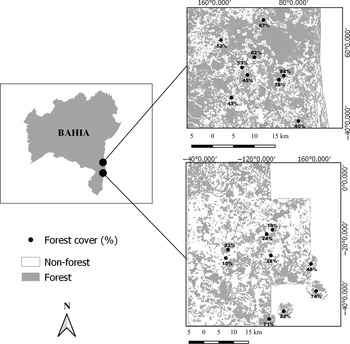
We randomly selected 18 forest fragments, and, from the centre of each fragment, we calculated the percentage of remaining forest cover, using ARCGis 10.2 (ESRI, 2014). We considered as forest cover only the amount of native forest (excluding cacao agroforests and eucalyptus plantations), present within a circular area measured from the centre of each fragment. We adopted the patch-landscape approach (McGarigal & Cushman Reference McGarigal and Cushman2002), in which the response variables are assessed within the forest fragments and the landscape variables are measured within a specific area around each fragment. In this way, the multiple buffer approach is used to identify the spatial extent (or landscape size) in which spatial patterns best predict the response (Thompson & McGarigal Reference Thompson and McGarigal2002). We delimited buffers of nine different radius sizes, every 200 m, the smallest radius size being 400 m and the largest was 2,000 m. A selection of models was made to obtain the best buffer. We used a general linear model to test the relationships between forest cover amount of nine different radius sizes and each sunfleck temporal classes. We determined the most parsimonious model for each sunfleck temporal class by selecting the one with the lowest dAICc (delta Corrected Akaike Information Criterion). The scale of the most plausible model for most sunfleck classes was selected as the best scale and used for the next analysis. The 1,400 m radius was selected as the best scale, since it was the most plausible for six of eight8 classes (Table S1 in Supplementary Material). Thus, the 18 fragments sampled comprised a gradient between 10% and 88% of remaining forest cover at landscape scale (Figure 1).
Spatial distribution of the 18 forest fragments with their respective percentage of forest cover at landscape scale (1,400 m buffer), surveyed in southern Bahia, Brazil.

Sampling design and hemispherical photographs
In each of the 18 forest fragments, a plot of 100 per 50 m was established. To avoid the influence of edge effects, the sampling plots were located in the centre of each fragment, at least 30 m from any forest edge. In each plot, we took 10 hemispherical photographs, totaling 180 photos between June and November of 2017. Because hemispheric photographs cover a 10 m radius, we systematically took pictures in five points on each side of the sampling plot, each point at least 20 m apart from another. This distribution assured that the photos did not overlap each other while covering almost the entire plot area. So, the mean value of these 10 photographs was used to represent the forest fragment. Hemispherical photographs were obtained at a height of 1.5 m using a tripod and a Nikon Coolpix 4300 digital camera, equipped with a fisheye lens (180°). To obtain the images, the lens was leveled with a common bubble level. In addition, a point along the perimeter of the lens was marked to be used as a reference to magnetic north, which was georeferenced. Hemispheric photographs were obtained preferably shortly before sunrise, shortly before sunset, or under cloudy skies, to obtain the best contrast and avoid overexposure.
Sunfleck analyses
The sunfleck analyses were performed using hemispherical photographs and the free software Gap Light Analyzer – GLA (Frazer et al. Reference Frazer, Canham and Lertzman1999). Similar procedure was used in previous publications by Beaudet & Messier (Reference Beaudet and Messier2002), Founier et al. (Reference Fournier, Gosselin, Proctor, Gauthier, Khanizadeh and Dorais2004), and Esteso-Martínez et al. (Reference Esteso-Martínez, Peguero-Pina, Valladares, Morales and Gil-Pelegrín2010). First, the images of the hemispherical photos were registered, and the geographic orientation identified. The magnetic north was used as well as the coordinates of the magnetic declination for the sites and the circular extension of the hemispheric image were established. Subsequently, the images were binarised between black (vegetation) and white (sky) pixels and manually found the threshold between the contrasts of the pixels. Images that needed to be treated because of overexposure; different thresholds were defined for each part of the photo; and this refinement helps to better separate the vegetation from the sky. It can be solved using the blue channel, an option found in the programme itself, which proved to be the best for the separation of vegetation and sky pixels (Hardya et al. Reference Hardya, Melloha, Koeniga, Marksb, Winstralb, Pomeroyc and Linkd2004). Moreover, this error can be smoothed if the same person evaluates all the images, since the errors would be standardised for all the photos (Beaudet & Messier Reference Beaudet and Messier2002). To calculate the duration of the sunflecks, we used the function ‘Plot Sunfleck Distribution’ in the utility menu of the GLA software. Calculations were made for a total of 183 days throughout the year, from June 21 to December 21, thus encompassing the winter (shortest day duration) and summer (longest day duration) solstices. Because it is based on hemispheric photographs, the assessment of sunfleck duration using the GLA software does not consider the effects of dynamic events, as wind and clouds (Canham et al. Reference Canham, Denslow, Platt, Runkle, Spies and White1990). The movement of leaves and branches by the wind and the presence of occasional clouds are important factors for the dynamics of short-time duration sunflecks (at scale of seconds). So, in our study, the minimum duration of sunflecks was set at 2 min. Sunflecks were grouped into six classes of time duration: 2 > 4, 4 > 8, 8 > 16, 16 > 32, 32 > 64, and ≥ 64 min. The sunflecks were also separated into contrasting groups < 32 min, and ≥ 32 min, based on the 30-min reference time from which a possible photoinhibition of susceptible seedlings and young plants acclimated to the understorey occurs to a longer period of time of incidence of sunflecks in the understorey (Eliáš Reference Eliáš2014).
Statistical analysis
Linear regression models were used to analyse the relationship between the percentage of forest cover remaining in each landscape and the number of sunflecks of the different temporal classes. Due to over dispersion, a Poisson regression (GLM) was used that adjusted to over dispersion of the data. All statistical analyses were performed using software R (R Core Team 2013).
Results
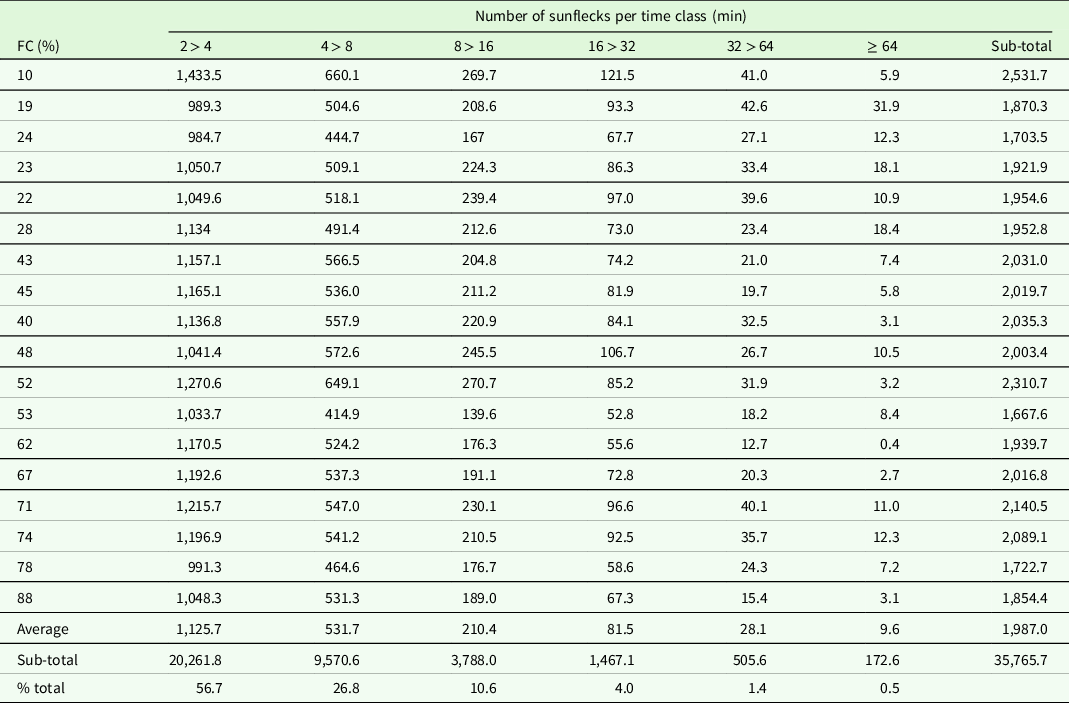
In the period of 183 days, between winter and summer solstice (June 21 to December 21), a total of 35,765 sunflecks were reported, considering all temporal classes (Table 1). The highest number of sunflecks occurred in the shortest time class (2 > 4 min), while the smallest number in the longest time class (≥64 min). In the 2 > 4 min class, an average of 1,125 sunflecks were found, ranging from 984.7 to 1,433 sunflecks in the fragment within a landscape of 24% and 10% of forest cover, respectively, whereas in the longer class, the mean was 9.6 sunflecks, being more abundant in the fragments immersed in more deforested landscape (<30% of forest cover), and uncommon in more forested landscape (≥60% of forest cover).
Number of sunflecks in each of 18 forest fragments immersed in a gradient of forest cover amount (FC %) at landscape scale in south Bahia, Brazil, in total and along six classes of duration (min), the relative contribution of the classes to the total number of sunflecks, herein as average number of sunflecks, the total number of sunflecks, and the % contribution to the total

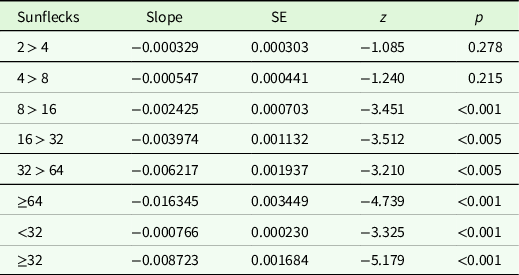
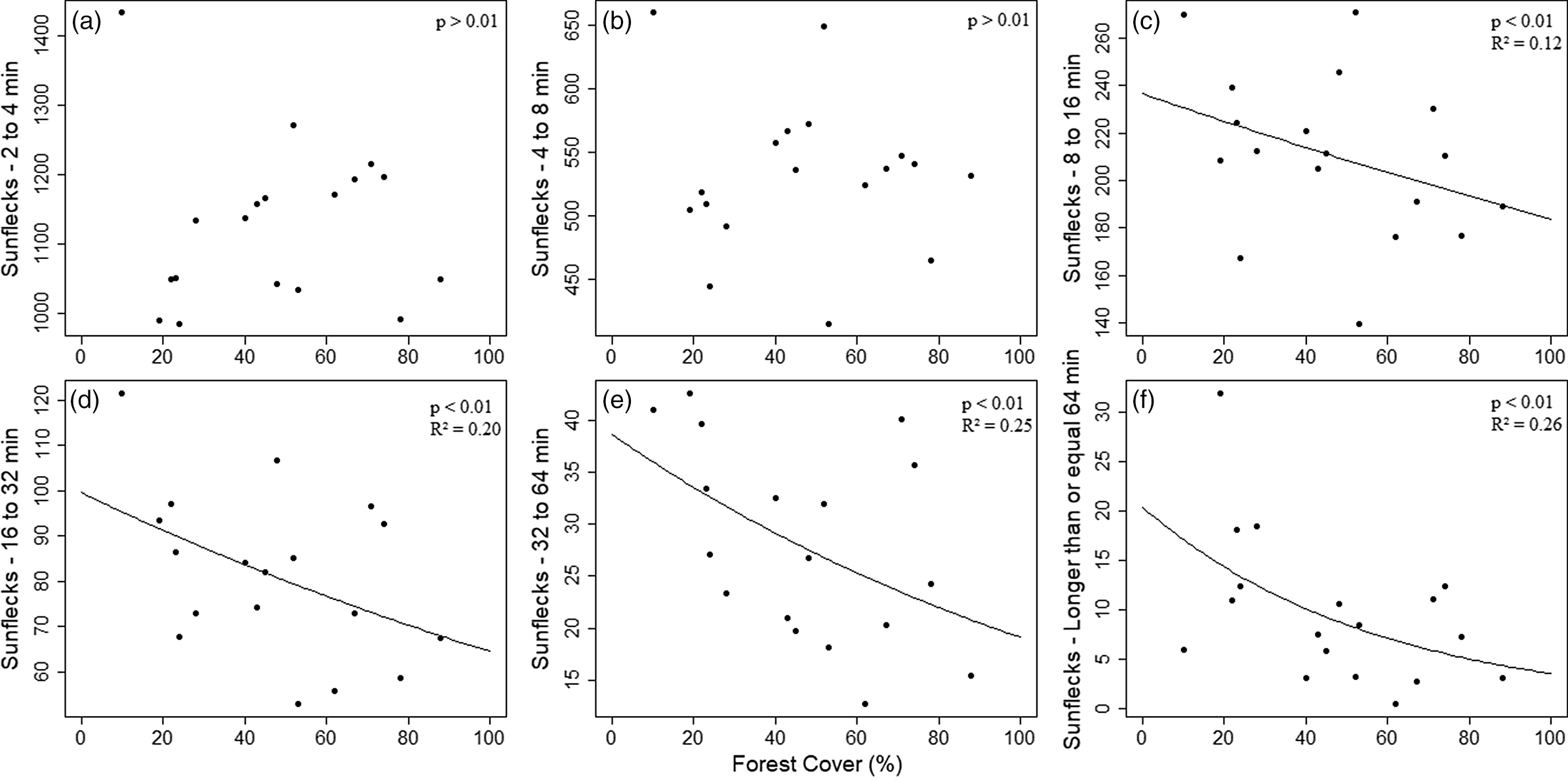
The number of shorter-lasting sunflecks (2 > 4 and 4 > 8) was not influenced by the total amount of forest cover at landscape scale, but the remaining sunfleck classes were significantly and negatively related to this predictor variable (Table 2 and Figure 2). However, when the sunflecks were grouped in only two contrasting temporal classes (shorter or longer than 32 min), the number of sunflecks of both classes significantly increased as forest cover decreased (R² = 0.023, p < 0.01; R² = 0.33, p < 0.001, respectively) though more intense marked for long-duration sunflecks (Table 2).
Slope log values, standard error (SE), z value, and probability (p) for regressions of the number of sunflecks time classes (min) along a gradient of forest cover amount remaining at the landscapes (n = 18 fragments) in southern Bahia, Brazil

Relationship between the total number of sunflecks in six classes of duration (min) and the percentage of forest cover at landscape scale in 18 forest fragments of Atlantic rainforest in south Bahia, Brazil. Sunflecks time duration: (a) 2 > 4 min, (b) 4 > 8 min, (c) 8 > 16 min, (d) 16 > 32 min, (e) 32 > 64 min and (f) ≥ 64 min.

Discussion
This study revealed for the first time that landscape-scale deforestation significantly affects the sunfleck dynamics, thus altering the duration and frequency of light beams reaching the understorey layer of forest fragments. Shortest-lasting sunflecks are the largest fraction of the sunflecks recorded in all fragments. Despite this, the occurrence of short-lasting sunflecks (<8 min) was not related to the forest cover at landscape scale, even though fragments immersed in more deforested landscapes are characterised by an increasing frequency of the long-lasting sunflecks. We suggest that this shift in the understorey solar radiation regime reduces habitat suitability of local fragments to species highly shade tolerant in initial life stage – those better adapted to grow and survive in environments where light is more limited – while increasing suitability for those light-demanding species. Profound changes in forest understorey solar radiation regime are likely a key underlying mechanism triggered by landscape deforestation influencing the establishment and recruitment of different successional groups of the plant communities in the studied landscapes, as previously reported by Rigueira et al. (Reference Rigueira, Rocha and Mariano-Neto2013), Rocha-Santos et al. (Reference Rocha-Santos, Pessoa, Cassano, Talora, Orihuela, Mariano-Neto, Morante-Filho, Faria and Cazetta2016), and Pessoa et al. (Reference Pessoa, Rocha-Santos, Talora, Faria, Mariano-Neto, Hambuckers and Cazetta2017).
As deforestation progresses, we observed an increasing representation of long-lasting sunflecks (i.e., ≥32 min), an abrupt change in the local conditions for the establishment and survival of the more shade-tolerant species. The increasing solar incidence often triggers a myriad of alterations on the local conditions, particularly reducing local levels of relative humidity while increasing air temperature. Altogether, the combined effect of photoinhibition due to excess of light and the associated microclimatic changes may increase the mortality rate of seedlings exposed to the excess of solar radiation (Leakey et al. Reference Leakey, Scholes and Press2005; Lovelock et al. Reference Lovelock, Jebb and Osmond1994). For example, high solar radiation often reduces water availability, and such exposure to water stress can impair plant’s growth, eventually leading to its death (Valladares et al. Reference Valladares, Dobarro, Sánchez-Gómez and Pearcy2005). Therefore, as deforestation advances, we showed that local fragments are increasingly exposed to more frequent long-lasting sunflecks, indicating that these forest fragments are becoming less suitable for the species that are high shade tolerant in its initial life-stage. We suggest that such underlying mechanism is likely to contribute to the local demise observed for this ecological group (Benchimol et al. Reference Benchimol, Talora, Mariano-Neto, Oliveira, Leal, Mielke and Faria2017; Lima & Mariano-Neto Reference Lima and Mariano-Neto2014; Rigueira et al. Reference Rigueira, Rocha and Mariano-Neto2013; Rocha-Santos et al. Reference Rocha-Santos, Benchimol, Mayfield, Faria, Pessoa, Talora, Mariano-Neto and Cazetta2017). By contrast, more light-demanding species, in the other extreme of the continuum shade tolerance spectrum, are favoured by long-lasting sunflecks. These species present higher photosynthetic rates in addition to other mechanisms that contribute to the low occurrence of photoinhibition, including high transpiration rates and decrease in leaf temperature (Krause et al. Reference Krause, Koroleva, Dalling and Winter2001). This pattern can favour the increased representation of light-demanding species in more disturbed forests, as already recorded in deforested and fragmented landscapes (Benchimol et al. Reference Benchimol, Talora, Mariano-Neto, Oliveira, Leal, Mielke and Faria2017; Lôbo et al. Reference Lôbo, Leão, Melo, Santos and Tabarelli2011; Tabarelli et al. Reference Tabarelli, Aguiar, Girao, Peres and Lopes2010).
The increasing canopy openness is a feature associated with changes in solar radiation regime typically occurring in disturbed, early successional forests (Küppers et al. Reference Küppers, Timm, Orth, Stegemann, Stöber, Schneider, Paliwal, Karunaichamy and Ortiz1996; Laurance et al. Reference Laurance, Delamonica, Laurance, Vasconcelos and Lovejoy2000), including forest sites immersed within more deforested landscapes in southern Bahia, Brazil (Andrade et al. Reference Andrade, Jardim, Santos, Melo, Talora, Faria and Cazetta2015; Benchimol et al. Reference Benchimol, Talora, Mariano-Neto, Oliveira, Leal, Mielke and Faria2017; Cerqueira et al. Reference Cerqueira, Rocha-Santos, Benchimol and Mielke2021; Rocha-Santos et al. Reference Rocha-Santos, Benchimol, Mayfield, Faria, Pessoa, Talora, Mariano-Neto and Cazetta2017). However, canopy openness alone does not necessarily provide accurate information on the spatial distribution of the existing canopy gaps, as the same canopy openness levels can be attributed to either a sum of many small gaps or few large gaps. In addition, the canopy openness is calculated as a percentage relationship between the area attributed to open sky and canopy coverage in a hemispheric image (Frazer et al. Reference Frazer, Canham and Lertzman1999). On the other hand, the number of sunflecks in each time class was calculated considering the sun path during the winter and summer solstices and, consequently, it is a better proxy for the direct radiation incident in the forest understorey (please see Figure S1 in Supplementary Material). Thus, the analysis of the duration and frequency of sunflecks performed in our study represents a more direct link between the temporal and spatial distribution of gaps in forest canopies and the distribution of available solar radiation in the forest understorey. Altogether, our result suggests that sunflecks are a more direct and reliable measure likely to translate the proximal mechanism of understorey light regime.
Herein, we propose that the general decay observed for the shade-tolerant species (Benchimol et al. Reference Benchimol, Talora, Mariano-Neto, Oliveira, Leal, Mielke and Faria2017; Lima & Mariano-Neto Reference Lima and Mariano-Neto2014; Rigueira et al. Reference Rigueira, Rocha and Mariano-Neto2013; Rocha-Santos et al. Reference Rocha-Santos, Benchimol, Mayfield, Faria, Pessoa, Talora, Mariano-Neto and Cazetta2017) triggered by landscape-scale deforestation is a direct result of the changes in the understorey light regime in more disturbed fragments, specifically the increasing frequency of long-lasting sunflecks. This key change in local conditions after deforestation – the excessive solar radiation reaching the forest understorey – may limit the growth, survival, and recruitment of seedlings of vulnerable species and, thus, changing forest regeneration. The described shifts on the understorey solar radiation regime likely represent an environmental filter explaining the selective extinction of such ecological group, as previously reported by Benchimol et al. (Reference Benchimol, Talora, Mariano-Neto, Oliveira, Leal, Mielke and Faria2017) and Rocha-Santos et al. (Reference Rocha-Santos, Benchimol, Mayfield, Faria, Pessoa, Talora, Mariano-Neto and Cazetta2017), which is key to assure the functionality of a given forest. Indeed, the particular extinction of shade-tolerant plant species is one of the most striking consequences affecting tree assemblages in fragments within deforested, human-modified landscapes, but such pattern goes beyond the numeric depletion of plant biodiversity. The demise of such assemblages transforms local forest structure (Magnago et al. Reference Magnago, Rocha, Meyer, Martins and Meira-Neto2015; Rigueira et al. Reference Rigueira, Rocha and Mariano-Neto2013; Rocha-Santos et al. Reference Rocha-Santos, Benchimol, Mayfield, Faria, Pessoa, Talora, Mariano-Neto and Cazetta2017), affecting the fauna by altering the local conditions and a myriad of available key resources such as shelter and food (Bello et al. Reference Bello, Galetti, Pizo, Magnago, Rocha, Lima, Peres, Ovaskainen and Jordano2015; Laurance Reference Laurance2012; Morante-Filho et al. Reference Morante-Filho, Faria and Mariano-Neto2015). Further functional modifications due to plant diversity impoverishment in our forest sites include the decreasing of fruit removal rates (Menezes et al. Reference Menezes, Cazetta, Morante-Filho and Faria2016), carbon stocks (Rocha-Santos et al. Reference Rocha-Santos, Pessoa, Cassano, Talora, Orihuela, Mariano-Neto, Morante-Filho, Faria and Cazetta2016), and tree regeneration (Rocha-Santos et al. Reference Rocha-Santos, Benchimol, Mayfield, Faria, Pessoa, Talora, Mariano-Neto and Cazetta2017). These aforementioned functional modifications are in line with the findings in other areas under similar trajectories (Bello et al. Reference Bello, Galetti, Pizo, Magnago, Rocha, Lima, Peres, Ovaskainen and Jordano2015).
Conservation remarks
We showed that landscape-scale deforestation amplifies the frequency of long-lasting sunflecks, changing the forest understorey light regime. We suggest that this mechanism is probably a key driver impairing the establishment and recruitment of species from later successional groups within forest remnants (Benchimol et al. Reference Benchimol, Talora, Mariano-Neto, Oliveira, Leal, Mielke and Faria2017; Lima & Mariano-Neto Reference Lima and Mariano-Neto2014; Rigueira et al. Reference Rigueira, Rocha and Mariano-Neto2013; Rocha-Santos et al. Reference Rocha-Santos, Benchimol, Mayfield, Faria, Pessoa, Talora, Mariano-Neto and Cazetta2017). Under such altered environment, natural regeneration process may become unfeasible due to the limitations caused by the excess solar radiation that reaches the understorey for vulnerable species. To curb such an arrested successional condition, the recovery of these areas could be undertaken through the enrichment of these forest remnants with seedlings of species of different levels of shade tolerance (Campoe et al. Reference Campoe, Stape and Mendes2010; Rappaport & Montagini Reference Rappaport and Montagnini2014). In addition, we propose that sunfleck dynamics can be easily monitored as an indicator of restoration success, particularly as if represents a low cost and simple methodology based on hemispheric photographs to indirectly analyse the light available in the forest understorey (Chianucci Reference Chianucci2020). Finally, our study reinforced the importance of maintaining forest cover on a landscape scale as a means of preventing long-lasting sunflecks, by triggering changes in the microclimate of the understorey, possibly changing the trajectory of driving changes in the floristic composition and functionality of the forest remnants.
Supplementary material
To view supplementary material for this article, please visit https://doi.org/10.1017/S0266467421000110
Acknowledgements
We are grateful to all landowners who enabled us to work on their properties. Funding for Igor P. Reis and Adrielle Leal during this study was provided by scholarships from CAPES. Deborah Faria (307990/2018-4) and Marcelo S. Mielke (305477/2018-8) gratefully acknowledge CNPq for the award of fellowship of scientific productivity.
Financial support
This study was financed by the Brazilian National Council for Scientific and Technological Development (CNPq 563216/2010-7) and by the Coordenação de Aperfeiçoamento de Pessoal de Nível Superior – Brasil (CAPES) – Finance Code 001. This is the publication number 40 of the REDE SISBIOTA (CNPq 563216/2010-7).
Competing interests
The authors declare none.