Introduction
Plants produce a diverse array of secondary metabolites that serve a variety of purposes, including defensive activity against insects and pathogens (Byers Reference Byers, Carde and Bell1995; Seybold et al. Reference Seybold, Huber, Lee, Graves and Bohlmann2006). Although they are termed “secondary,” these compounds can be produced in copious amounts, and plants use considerable energy and basic metabolites to make them, invoking tradeoffs between defence, growth, and reproduction (Herms and Mattson Reference Herms and Mattson1992). Some herbivorous insects that specialise on certain hosts are able to detect and follow volatile plumes of secondary metabolites to locate susceptible plants (Byers Reference Byers, Carde and Bell1995), helping them to forage effectively and efficiently by reducing their searching time and the corresponding likelihood of encountering predators or inclement conditions during searches (Bell Reference Bell1991; Bernays and Chapman Reference Bernays and Chapman1994).
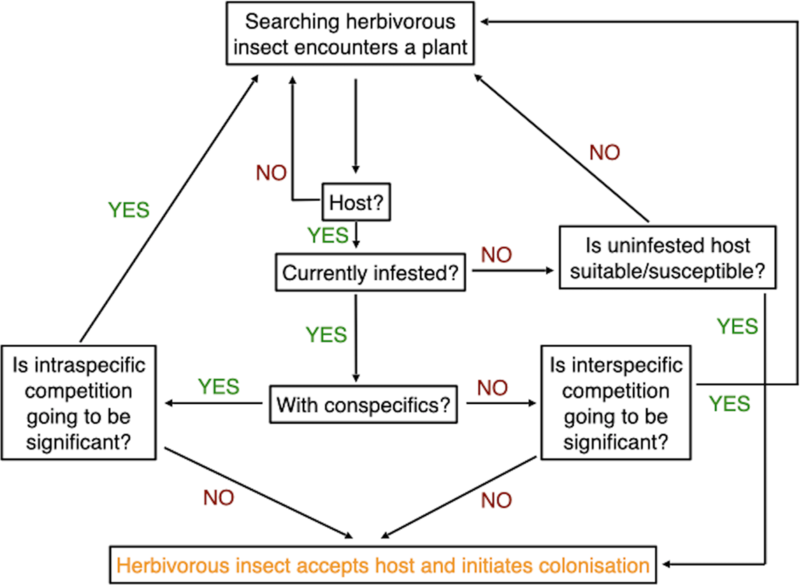
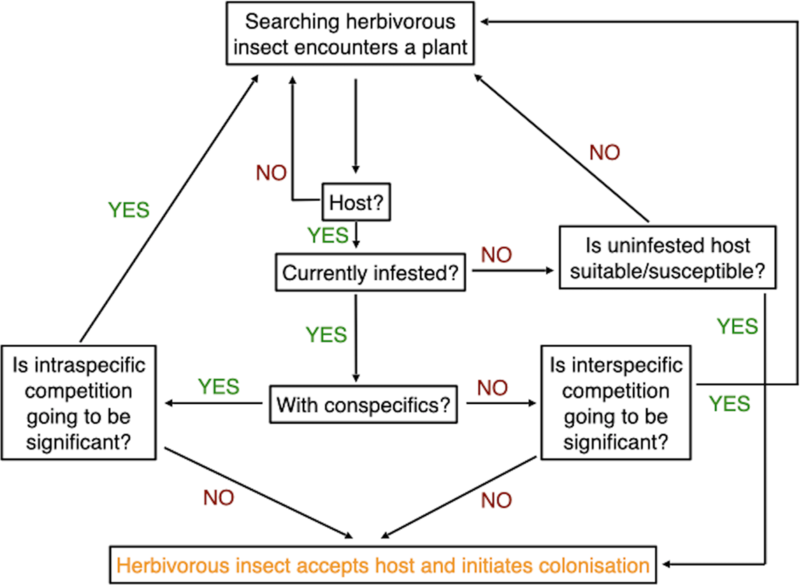
However, one insect species’ host is a nonhost for many other sympatric insect species whose individuals are simultaneously foraging for food or breeding material. Herbivorous insects should thus be able to detect volatile kairomones from their hosts but should also be able to detect and avoid some subset of nonhost volatile secondary metabolites. In an idealised situation, the first decision that a foraging herbivorous insect should make as it encounters a plant – before determining whether conspecific mates or competitors are present or whether the plant is susceptible – is whether the plant is indeed a host (Borden Reference Borden, Carde and Minks1997; Fig. 1). That is particularly the case if hosts and nonhosts are sympatric and if they share similar characteristics (e.g., size and shape). In such situations, foraging individuals that could detect and avoid nonhosts would have an adaptive advantage that would enable them to find and exploit host resources before potential competitors do.
Generalised decision tree for decisions that a searching herbivorous insect addresses when encountering a plant. All negative responses lead to continued searching. In coniferophagous bark beetles, several of these decision nodes may be exploited by the application of nonhost volatiles.
Mistakes during dispersal and foraging can be costly and deadly. Failure to find a new host rapidly can cause dispersing coniferophagous bark and ambrosia beetles (Coleoptera: Curculionidae: Scolytinae) to land on bodies of water where they may be consumed by fish (Morris et al. Reference Morris, Mustaphi, Carter, Watt, Derr and Pisaric2015) or to be dispersed by the wind onto alpine glaciers (Furniss and Furniss Reference Furniss and Furniss1972). When these beetles are induced with synthetic aggregation pheromones to land on and to potentially feed on nonhost conifers, they are generally reluctant to do so (Pureswaran and Borden Reference Pureswaran and Borden2003; Ott et al. Reference Ott, Fettig, Munson, Runyon and Ross2021), indicating likely adverse fitness consequences. Foraging inefficiently also has energetic consequences (Atkins Reference Atkins1969) that could translate into declines in reproductive output (Evenden et al. Reference Evenden, Whitehouse and Sykes2014). If a bark beetle could avoid nonhost trees while in flight through the detection of nonhost volatiles rather than landing on a nonhost and testing it directly, not only would its search time be reduced but so would the risk of predation (Dahlsten Reference Dahlsten, Mitton and Sturgeon1982).
Avoidance by agricultural insect pests of nonhosts via detection of their secondary metabolites has been exploited by humans for millennia. Even today, subsistence farmers use intercropping of nonhost plants to push herbivore pests away from host crops (Pickett et al. Reference Pickett, Woodcock, Midega and Khan2014). In addition to reducing the need to use chemical insecticides, this tactic can have other benefits, such as nitrogen fixation, soil stabilisation, and diversification of crop yields and revenues. Until the last two decades, the potential for exploiting nonhost tree species and the secondary metabolites (usually volatile) that they produce has not been explored as a viable pest management tactic.
Before nonhost volatiles could be considered as a tactic in integrated forest pest management, several questions had to be answered. For coniferophagous bark beetles, the most basic question was whether they had evolved the capability to detect nonhost volatiles in flight or if they randomly selected trees and tested them after landing on them. Coniferophagous bark beetles will encounter relatively few large hosts in a more biologically diverse setting than will most agricultural pests that search within monocultures of large numbers of small plants.
Gries et al. (Reference Gries, Nolte and Sanders1989) modelled four possible European spruce bark beetle (Ips typographus (Linnaeus, 1758) (Coleoptera: Curculionidae)) foraging scenarios: completely random search, upwind search with no response to host volatiles, random search with a short-range response to host volatiles, and upwind search with response to host volatiles. They found that upwind search with response to host volatiles was the most efficient strategy, followed closely by random search with short-range response to host volatiles. This work provided the theoretical argument that coniferophagous bark beetles must forage nonrandomly and that they likely have experienced selection pressure for nonrandom search during dispersal and foraging. Furthermore, the authors suggested that completely random search likely would not allow for survival of endemic populations of I. typographus (Gries et al. Reference Gries, Nolte and Sanders1989).
However, there is evidence that at least some bark beetles randomly search for host silhouettes and make decisions while in direct contact with host or nonhost bark. For instance, Elkinton and Wood (Reference Elkinton and Wood1980) showed that Ips paraconfusus Lanier, 1970 (Coleoptera: Curculionidae) males bore nonpreferentially through the outer bark of both host ponderosa pine ((Pinus ponderosa Douglas ex Lawson) (Pinaceae)) and nonhost white fir (Abies concolor (Gordon) Lindley ex Hildebrand (Pinaceae)). The beetles halted their boring activity only when they encountered the phloem of the nonhost, indicating that a decision point followed gustatory testing and that no useful gustatory cues were present at sufficient quantities in the outer bark. These behaviours were evident in both laboratory and field experiments (Elkinton and Wood Reference Elkinton and Wood1980). Furthermore, I. paraconfusus bores preferentially in fissured bark, which is more commonly prevalent on the host than on the nonhost, indicating an element of tactile information gathering during contact with trees.
In another experiment, when Moeck et al. (Reference Moeck, Wood and Lindahl1981) weakened conifer host trees by dry ice freezing the root collars and by axe frilling, they showed that two Dendroctonus spp. and two Ips spp. seemed to land randomly on both weakened and unweakened trees. Attacks were prevented by placing screens around those trees, and thus release of pheromone components was prevented. As such, host selection could not have occurred through direct contact or interaction with the prospective host trees.
More recently, Huber et al. (Reference Huber, Aukema, Hodgkinson and Lindgren2009) documented mountain pine beetles (Dendroctonus ponderosae Hopkins, 1902 (Coleoptera: Curculionidae)) attacking both host lodgepole pines (Pinus contorta Douglas ex Loud (Pinaceae)) and nonhost interior hybrid spruce (Picea engelmannii × glauca (Pinaceae)) during a massive D. ponderosae outbreak in central British Columbia, Canada. The apparently mistaken beetles actually produced more brood in Picea trees than their Pinus-infesting neighbours, possibly due to lack of heavy competition in Picea. Similarly, Audley et al. (Reference Audley, Fettig, Munson, Runyon, Mortenson and Steed2020a) reported that Engelmann spruce trees (Picea engelmannii Parry ex Engelmann (Piceae)) were colonised and killed by D. ponderosae in Colorado, United States of America during a large outbreak. Other work has shown that female D. ponderosae exhibit preference for Picea spp. over Pinus spp. and that females have similar reproductive potential in Picea and Pinus spp., but that actual per-female reproductive output in Picea is lower than in Pinus (McKee et al. Reference McKee, Huber and Aukema2013, Reference McKee, Huber, Hodgkinson, Lindgren and Aukema2015).
Pureswaran and Borden (Reference Pureswaran and Borden2003) showed that spruce beetles (Dendroctonus rufipennis (Kirby) (Coleoptera: Curculionidae)) and western balsam bark beetles (Dryocoetes confusus Swaine, 1912 (Coleoptera: Curculionidae)) would not attack nonhosts subalpine fir (Abies lasiocarpa (Hooker) Nuttall (Pinaceae)) and white spruce (Picea glauca (Moench) Voss (Pinaceae)), respectively, even when A. lasiocarpa and Pi. glauca were baited with synthetic aggregation pheromone components. Ott et al. (Reference Ott, Fettig, Munson, Runyon and Ross2021) reported similar results for D. rufipennis and the nonhost Colorado blue spruce (Picea pungens Engelmann (Pinaceae)). Douglas-fir beetles (Dendroctonus pseudotsugae Hopkins (Coleoptera: Curculionidae)) and D. ponderosae also discriminate between hosts and nonhosts (Pureswaran and Borden Reference Pureswaran and Borden2003). Although Pureswaran and Borden (Reference Pureswaran and Borden2003) did not directly address discrimination in flight, the researchers captured similar numbers of D. pseudotsugae and D. ponderosae in unbaited multiple-funnel traps placed one metre away from all test trees, indicating no strong avoidance of nonhost trees. Some nonhost trees displayed boring activity in the outer bark, but the beetles did not reach the phloem.
Although these and other results (see references in Moeck et al. Reference Moeck, Wood and Lindahl1981) indicate that some coniferophagous bark beetle species randomly search for hosts in particular contexts and make a decision concerning selection only once in contact with a host, other work strongly supports the ability of bark beetles to respond to host and nonhost volatiles in flight. For example, McMullen and Atkins (Reference McMullen and Atkins1962) treated host and nonhost trees with insecticides and captured D. pseudotsugae only on host trees, suggesting in-flight decision making. Chapman (Reference Chapman1962, Reference Chapman1963) definitively showed that a variety of bark and ambrosia beetles respond solely to host volatiles, particularly in an experiment (Chapman Reference Chapman1963) where host volatiles were released near traps via an air vent system. Moeck and Simmons (Reference Moeck and Simmons1991) demonstrated that D. ponderosae was attracted to host volatiles in flight in the absence of visual cues such as a vertical cylindrical silhouette. They placed P. contorta bolts into cages to exclude bark beetle attack (and subsequent pheromone release) and captured more beetles in traps near cages containing pine bolts than in traps placed near empty cages. The only plausible explanation was that D. ponderosae was attracted to the host material, likely due to the presence of host volatiles, and were subsequently captured in the traps. Brattli et al. (Reference Brattli, Andersen and Nilssen1998) found that some bark beetle species were able to detect and differentiate between traps baited with host and nonhost material in flight in host, nonhost, and mixed (containing hosts and nonhosts) stands. Similarly, Audley et al. (Reference Audley, Homicz, Bostock and Seybold2020b) showed that Pityophthorus juglandis Blackman (Coleoptera: Curculionidae) can discriminate between hosts and nonhosts while in flight.
Basic research into the chemical ecology of nonhost volatiles
Selection of compounds to test for behavioural activity on coniferophagous bark beetles was initially based on known angiosperm leaf volatiles. Primary among these were green leaf volatiles – six-carbon alcohols, aldehydes, and related esters that are now known to function in plant defence and endocrine responses (Scala et al. Reference Scala, Allmann, Mirabella, Haring and Schuurink2013). The first work of this kind was executed by Dickens et al. (Reference Dickens, Billings and Payne1992) and showed that two green leaf volatiles, hexanal and hexan-1-ol, acted individually or in combination to reduce catches of southern pine beetles (Dendroctonus frontalis Zimmermann, 1868 (Coleoptera: Curculionidae)), Ips avulsus (Eichhoff, 1868) (Coleoptera: Curculionidae), and Ips grandicollis (Eichhoff) (Coleoptera: Curculionidae) in attractant-baited traps. This was the first work to show a disruptive effect of nonhost semiochemicals against Ips spp. and to show that the same two green leaf volatiles were similarly active against beetles in different genera. At around the same time in Europe, Schroeder (Reference Schroeder1992) showed that Tomicus piniperda (Linnaeus, 1758) (Coleoptera: Curculionidae) and Hylurgops palliatus (Gyllenhal, 1813) (Coleoptera: Curculionidae), both coniferophagous species, avoided traps baited with ethanol, an attractant, when in the presence of nonhost material (Populus and Betula spp. (Salicaceae and Betulaceae)). Rhizophagus depressus Fabricius, 1792 (Coleoptera: Monotomidae), a predator of conifer-infesting beetles, was also disrupted from traps treated with the nonhost material (Schroeder Reference Schroeder1992).
These initial results stimulated further research in North America and Europe. Borden et al. (Reference Borden, Carde and Minks1997) tested various combinations of four green leaf alcohols, 1-hexanol, (E)-2-hexen-1-ol, (Z)-2-hexen-1-ol, and (Z)-3-hexen-1-ol, against the striped ambrosia beetle (Trypodendron lineatum Olivier) (Coleoptera: Curculionidae) in multiple-funnel traps baited with the beetle’s aggregation pheromone in two different biogeoclimatic zones in British Columbia. The researchers hypothesised that local populations of T. lineatum had encountered different selective pressures due to different uses of host material in these biogeoclimatic zones. In other related work, a pair of nonhost green leaf aldehydes, hexanal and (E)-2-hexenal, seemed to enhance the response of T. lineatum to its aggregation pheromone, a result that suggests that bark beetle responses to green leaf volatiles may be unexpectedly complex. Deglow and Borden (Reference Deglow and Borden1998a, Reference Deglow and Borden1998b) found that the four green leaf alcohols disrupted the responses of Gnathotrichus sulcatus (LeConte, 1868) (Coleoptera: Curculionidae) and G. retusus (LeConte, 1868) to attractant-baited traps and that, as with T. lineatum, the two green leaf aldehydes enhanced trap catches. In Europe, three green leaf alcohols individually disrupted the response of pine-infesting Pityogenes bidentatus (Herbst, 1783) (Coleoptera: Curculionidae) to baited traps (Byers et al. Reference Byers, Zhang and Birgersson2000). Additive combinations of four green leaf alcohols and two aldehydes disrupted responses of T. piniperda, a European pine-infesting species that has been introduced to North America (Poland and Haack Reference Poland and Haack2001). In that instance, smaller groupings of green leaf volatiles (e.g., the two aldehydes together or individual alcohols or aldehydes) did not have a disruptive effect. In some of the earliest research on Dendroctonus spp., several green leaf volatiles – 1-hexanol, (E)-2-hexen-1-ol, (Z)-2-hexen-1-ol, hexanal, and (E)-2-hexenal – were found to disrupt responses of western pine beetle (Dendroctonus brevicomis LeConte, 1876 (Coleoptera: Curculionidae)) and D. rufipennis to attractant-baited traps (Poland et al. Reference Poland, Borden, Stock and Chong1998).
All of the preceding assays were performed without prior knowledge of the target species’ sensory perception. The assumption, which turned out to be mainly valid, was that a generalised nonhost signal exists that coniferophagous bark beetles detect and respond to, and that this signal is composed of a fairly limited number of compounds. However, electrophysiological experiments were required to determine the full range of the nonhost signal. Tømmerås and Mustaparta (Reference Tømmerås and Mustaparta1989) found single-cell responses to European birch (Betula pubescens Ehrhart (Betulaceae)) volatiles in the antennae of European T. lineatum. Following that work, other researchers used coupled gas chromatographic–electroantennographic detection analyses (GC–EAD) and subsequent mass spectroscopy or other methods to determine the identity of nonhost volatiles detected by the antennae of a large group of coniferophagous bark beetles. Wilson et al. (Reference Wilson, Borden, Gries and Gries1996) tested an array of synthetic green leaf alcohols and aldehydes and some shorter- and longer-chain alcohols and aldehydes on antennae of D. ponderosae and recorded responses to only the six-carbon alcohols. These results were used to design field experiments in which disruption of D. ponderosae to attractant-baited traps and trees was demonstrated. Similarly, Zhang et al. (Reference Zhang, Schlyter and Anderson1999b) used GC–EAD to test nine synthetic green leaf volatiles on the antennae of I. typographus in Europe and then demonstrated disruption to attractant-baited traps. Borden et al. (Reference Borden, Wilson, Gries, Chong, Pierce and Gries1998) tested bark extracts from trembling aspen (Populus tremuloides Michaux (Salicaceae)) instead of individual synthetic compounds; he found that D. ponderosae could detect 1-hexanol, nonanol, benzaldehyde, and benzyl alcohol and that blends of all four compounds disrupted catches of D. ponderosae in attractant-baited traps. This was the first time that compounds other than green leaf volatiles were implicated in the nonhost signal and were shown to have a disruptive effect in an additive manner.
In comprehensive work on six species of North American coniferophagous bark beetles (D. ponderosae, D. rufipennis, D. pseudotsugae, D. brevicomis, Dr. confusus, and the pine engraver (Ips pini (Say) (Coleoptera: Curculionidae)), Huber et al. (Reference Huber, Gries, Borden and Pierce2000b) and Shepherd et al. (Reference Shepherd, Huber, Seybold and Fettig2007) tested antennal responses to volatiles of seven different angiosperm trees. Volatiles were collected from aeration of the bark of black cottonwood (Populus trichocarpa Torrey & A. Gray ex. Hook (Salicaceae)), Po. tremuloides, red alder (Alnus rubra Bongard (Betulaceae)), Sitka alder (Alnus alnobetula (Ehrhart) K. Koch) (Betulaceae)), bigleaf maple (Acer macrophyllum Pursh, 1813 (Sapindaceae)), paper birch (Betula papyrifera Marshall (Betulaceae)), and California black oak (Quercus kelloggii Newberry (Fagaceae)). Most of the potential combinations of beetles and nonhost bark volatiles were tested. Similar contemporaneous work was conducted with European and Asian bark beetles (I. typographus, I. sexdentatus (Boerner, 1776) (Coleoptera: Curculionidae), I. subelongatus (Motschulsky) (Coleoptera: Curculionidae), T. minor (Hartig, 1834) (Coleoptera: Curculionidae), T. piniperda) and sympatric nonhost angiosperms (Betula pendula Roth (Betulaceae), Betula pubescens (Ehrhart) (Betulaceae), Populus tremula Linnaeus (Salicaceae), and Sambucus nigra Linnaeus (Adoxaceae)); Zhang et al. Reference Zhang, Birgersson, Zhu, Löfstedt, Löfqvist and Schlyter1999a, Reference Zhang, Schlyter and Birgersson2000, Reference Zhang, Schlyter, Chen and Wang2007; Schlyter et al. Reference Schlyter, Zhang, Anderson, Byers, Wadhams, Löfqvist and Birgersson2000; Jactel et al. Reference Jactel, Van Halder, Menassieu, Zhang and Schlyter2001). Although some differences among species were observed, all of these assays across a broad range of coniferophagous bark beetle species, nonhost tree species, and geographies confirmed that (1) previously tested green leaf volatiles were generally antennally active, (2) a number of other compounds in nonhost bark volatiles were antennally active, (3) antennally active compounds were not generally unique to any one nonhost angiosperm, and (4) coniferophagous bark beetles across genera showed sensory responses to similar individual nonhost volatiles.
The explosion of research on antennal responses of coniferophagous bark beetles to nonhost volatiles over about a decade left no doubt that bark beetles search for hosts in a very complex sensory environment and that many species can detect nonhost volatiles. Although responses to conspecific and heterospecific pheromone components and host kairomones were well established years earlier for the most notable bark beetle species, it was now obvious that, in mixed stands, various combinations of nonhost volatiles are also important cues. Subsequent trapping studies on all of the aforementioned species spanning North America, Europe, and Asia tended to show that the nonhost signal was somewhat generic, redundant, and additive (Zhang et al. Reference Zhang, Schlyter and Anderson1999b, Reference Zhang, Schlyter, Chen and Wang2007; Huber et al. Reference Huber, Borden and Stastny2001; Jactel et al. Reference Jactel, Van Halder, Menassieu, Zhang and Schlyter2001; Huber and Borden Reference Huber and Borden2001a, Reference Huber and Borden2003; Zhang Reference Zhang2003; Zhang and Schlyter Reference Zhang and Schlyter2004; Fettig et al. Reference Fettig, McKelvey and Huber2005, Reference Fettig, McKelvey, Dabney, Borys and Huber2009b). In other words, removing one behaviourally active nonhost volatile from a blend and replacing it with another behaviourally active nonhost volatile imparts a similar disruptive effect, and the more nonhost volatiles in a mixture, the stronger the behavioural effect will be. The adaptive significance of these traits is that a coniferophagous bark beetle can detect and avoid almost any nonhost angiosperm tree without having to discriminate among nonhost species. This is important because testing and potential selection of nonhosts can have dire consequences in terms of fitness and longevity. However, there are exceptions: some green leaf aldehydes seem to enhance the response of certain coniferophagous bark beetles to their aggregation pheromone (Borden et al. Reference Borden, Carde and Minks1997; Deglow and Borden Reference Deglow and Borden1998a, Reference Deglow and Borden1998b). Of note, one nonhost volatile, trans-conophthorin, showed a synergistic repellent effect in I. typographus when combined with other nonhost volatiles (Zhang and Schlyter Reference Zhang and Schlyter2004). In I. pini, a variety of nonhost volatiles disrupted the beetle’s response to attractant-baited traps (Huber et al. Reference Huber, Borden and Stastny2001) but only when combined with conophthorin, and conophthorin was the only nonhost volatile that was behaviourally active alone in I. pini.
Before it was found to be an antennally active nonhost volatile in the bark of Betula spp. in North America and Europe, as well as in lower amounts in other angiosperms (Byers et al. Reference Byers, Zhang, Schlyter and Birgersson1998; Huber et al. Reference Huber, Gries, Borden and Pierce1999; Zhang et al. Reference Zhang, Schlyter and Birgersson2000, Reference Zhang, Tolasch, Schlyter and Francke2002), conophthorin was known primarily as a pheromone in some bark beetles. It is now known from other bark beetles, as well as from wasps, and in keeping with the hypothesis of natural parsimony (Blum Reference Blum and Beroza1970, Reference Blum1996; Huber et al. Reference Huber, Gries, Borden and Pierce1999), it has numerous other biological functions (see reviews in Huber et al. (Reference Huber, Gries, Borden and Pierce1999) and Kühnholz et al. (Reference Kühnholz, Gries and Borden2020)). Another pheromone, frontalin, is primarily known as a multifunctional pheromone in Dendroctonus spp. (Kinzer et al. Reference Kinzer, Fentiman, Page, Foltz, Vité and Pitman1969; Ryker and Libbey Reference Ryker and Libbey1982; Borden et al. Reference Borden, Ryker, Chong, Pierce, Johnston and Oehlschlager1987), but it is also found in A. rubra and A. alnobetula (Huber et al. Reference Huber, Gries, Borden and Pierce1999) and in Asian elephants (Elephas maximus Linnaeus (Elephantidae); Perrin et al. Reference Perrin, Rasmussen, Gunawardena and Rasmussen1996). These findings, along with the generally behaviourally disruptive effect of conophthorin in some bark and ambrosia beetles (Byers et al. Reference Byers, Zhang, Schlyter and Birgersson1998; Huber et al. Reference Huber, Gries, Borden and Pierce1999, Reference Huber, Borden, Jeans-Williams and Gries2000a; Huber and Borden Reference Huber and Borden2001a, Reference Huber and Borden2003; Zhang and Schlyter Reference Zhang and Schlyter2004; Graves et al. Reference Graves, Holsten, Ascerno, Zogas, Hard and Huber2008; Fettig et al. Reference Fettig, Burnside, Hayes, Kruse, Lisuzzo and McKelvey2013; although also see Ranger et al. Reference Ranger, Gorzlancyk, Addesso, Oliver, Reding, Schultz and Held2014), led to the hypothesis that conophthorin may present an aposematic warning odour and that its repellent effect on animals in various taxa across Kingdoms represents semiochemical Mullerian mimicry (Huber et al. Reference Huber, Gries, Borden and Pierce1999). This hypothesis deserves further comparative study. There are examples, for instance, in orchids (e.g., Stökl et al. Reference Stökl, Brodmann, Dafni, Ayasse and Hansson2011; Bohman et al. Reference Bohman, Phillips, Menz, Berntsson, Flematti and Barrow2014), of plants mimicking insect-pheromone components or other insect-associated scents to exploit the behaviour of pollinators or predators, but in most cases, the scents are attractive rather than repellent. And, unlike in the orchid example in which the floral emissions closely match a single insect species for the purpose of attraction, conophthorin and frontalin seem to have widespread use in communication by organisms across Phyla and even perhaps across Kingdoms (Zhao et al. Reference Zhao, Ganji, Schiebe, Bohman, Weinstein and Krokene2019).
Although the basic chemical ecology of the perception and response of coniferophagous bark beetles to nonhost volatiles is now substantially well elucidated, much of the work was done with the hope of developing operational tools that could be used to protect individual trees or forest stands from bark beetle infestation. Most research on nonhost volatiles since that time has focussed on developing such tools.
Applied research into nonhost volatiles for tree protection
Research on the operational use of nonhost volatiles to disrupt aggregation or foraging by coniferophagous bark beetles on host trees has tended to focus on economically important species, mirroring the GC–EAD and trapping assay work that mainly preceded it. Initial work at this scale focussed on protection of individual trees and moved towards protection of forest stands dominated by one host species. In most of the experiments, as in the trapping assays, putative operative synthetic nonhost volatile mixtures were challenged with synthetic attractants (baits), typically synthetic bark beetle aggregation pheromone components occasionally in combination with synthetic host kairomones. Generally, but not always, all of the semiochemicals were attached to the boles of standing trees in close proximity to each other, and attack density (attacks per square metre) during and following beetle dispersal flight was measured. This methodology does not fully emulate a natural situation: one would be unlikely to find either coniferophagous bark beetle pheromones emanating from a tree that produces both host kairomones and nonhost volatiles or bark beetle pheromones being released from a single tree for periods of up to several months. However, it creates a scenario wherein candidate nonhost volatile blends must be powerful enough to overcome the challenge imposed by potent baits affixed to experimental host trees.
Early on, it became apparent that levels of tree protection could be enhanced by combining synthetic nonhost volatiles with a synthetic antiaggregation pheromone, with verbenone being the most studied antiaggregation pheromone. Verbenone has been tested on its own (e.g., Amman et al. Reference Amman, Thier, McGregor and Schmitz1989; Lindgren et al. Reference Lindgren, Borden, Cushon, Chong and Higgins1989) and in conjunction with nonhost volatiles in numerous studies (e.g., Borden et al. Reference Borden, Birmingham and Burleigh2006), most often for management of D. ponderosae in western North America (see review by Progar et al. Reference Progar, Gillette, Fettig and Hrinkevich2014). Trace amounts of verbenone were first identified from the hindguts of emergent and feeding D. ponderosae females (Pitman et al. Reference Pitman, Vité, Kinzer and Fentiman1969) and from the air surrounding mating pairs (Rudinsky et al. Reference Rudinsky, Morgan, Libbey and Putnam1974). In field experiments, verbenone inhibited responses by D. ponderosae to selected host- and beetle-produced attractants (Ryker and Yandell Reference Ryker and Yandell1983). Today, verbenone is regarded as a more universal bark beetle repellent (e.g., Seybold et al. Reference Seybold, Bentz, Fettig, Lundquist, Progar and Gillette2018).
Below, we focus on the operational evaluation of synthetic nonhost volatiles for protection of conifers from three notable coniferophagous bark beetles in western North America.
Dendroctonus ponderosae
Dendroctonus ponderosae colonises and kills several hosts, most notably P. contorta, and is the most important forest insect pest in North America. As such, it is no surprise that the effects of nonhost volatiles on bark beetles have been most extensively studied in D. ponderosae. In a pioneering tree-protection experiment, Wilson et al. (Reference Wilson, Borden, Gries and Gries1996) found that a combination of the green leaf alcohols (E)-2-hexen-1-ol and (Z)-3-hexen-1-ol reduced the number of P. contorta trees attacked by D. ponderosae to about the same level as that of the unbaited control group. Only three of 10 treated trees were mass attacked (> 31.25 attacks/m2), compared to eight of nine bait-only trees. In addition, host trees surrounding green leaf volatile-treated trees were less likely to experience spillover attacks (i.e., colonisation of nearby trees due to placement of baits).
Huber and Borden (Reference Huber and Borden2001b) conducted similar experiments, informed by previous GC–EAD and trapping assays, of various blends of nonhost volatiles, including benzyl alcohol, benzaldehyde, conophthorin, guaiacol, (E)-2-hexen-1-ol, (Z)-3-hexen-1-ol, nonanal, and salicylaldehyde, as well as the antiaggregation pheromone verbenone. In one experiment, mass attacks by D. ponderosae on baited P. contorta were reduced to three trees out of 20, compared to all 20 trees being mass attacked in the bait-only treatment. Different combinations of the nonhost volatiles were demonstrated to be effective, but the most effective combination included all of the nonhost volatiles and verbenone. Host trees within five metres of the treated trees were also protected. Huber and Borden (Reference Huber and Borden2001b) also conducted an experiment in which they separated the bait from the nonhost volatiles by suspending it between host trees. Mass attacks were reduced to only three of 25 pairs, compared to 22 of 25 bait-only pairs. They also conducted an experiment using no baits in an area of heavy infestation by D. ponderosae. In that experiment, 13 of 60 untreated trees were attacked, compared to 11 of 60 nonhost volatile- and verbenone-treated trees, but mean D. ponderosae attack density on the treated trees was below the threshold (40 attacks/m2; Raffa and Berryman Reference Raffa and Berryman1983) required to kill mature P. contorta. Generally, randomly selected unbaited trees are infrequently colonised during such experiments, even when D. ponderosae population are at epidemic levels, which is why baiting is used in most experiments.
Following these studies, Borden et al. (Reference Borden, Chong, Earle and Huber2003) tested the nonhost blend used by Huber and Borden (Reference Huber and Borden2001b) without conophthorin (because it was difficult and expensive to procure) with different release rates of verbenone to protect stands of P. contorta from D. ponderosae. Plots were 40 m × 40 m, and all had a baited tree at the centre. Treatment plots had combinations of the nonhost volatile blend and verbenone dosages arrayed in a surrounding 16-point grid at 10-m intervals. The 10 plots treated with nonhost volatiles and high-dose verbenone experienced significantly reduced attacks within their boundaries – only 2.1% of 523 susceptible P. contorta were mass attacked, compared to 26.6% of 432 trees in the bait-only treatment. This work demonstrated that nonhost volatiles could be used beyond individual-tree protection tactics for treatment of larger areas. The tactic was also effective using a further reduced nonhost volatile blend of only benzyl alcohol, (E)-2-hexen-1-ol, and (Z)-3-hexen-1-ol in a test of a push–pull tactic against D. ponderosae (Borden et al. Reference Borden, Birmingham and Burleigh2006).
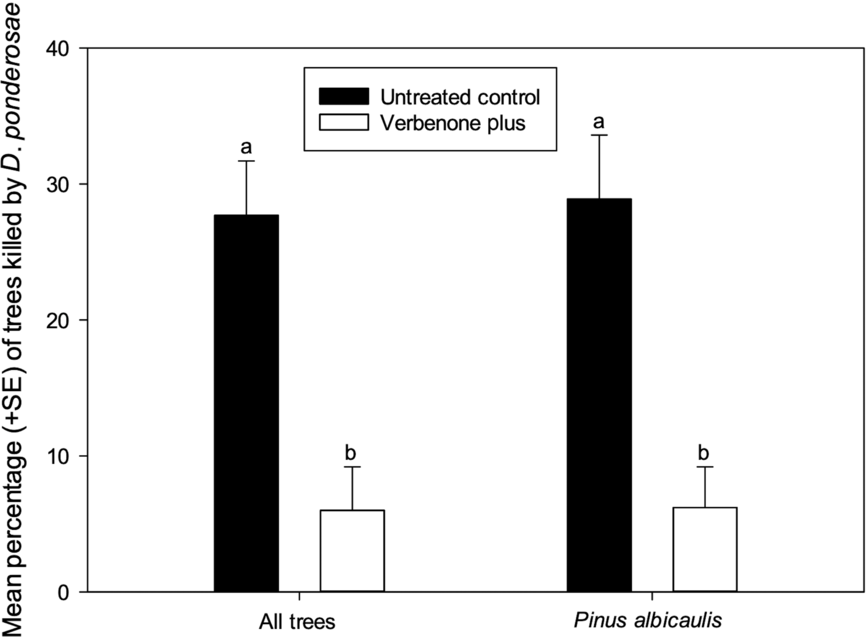
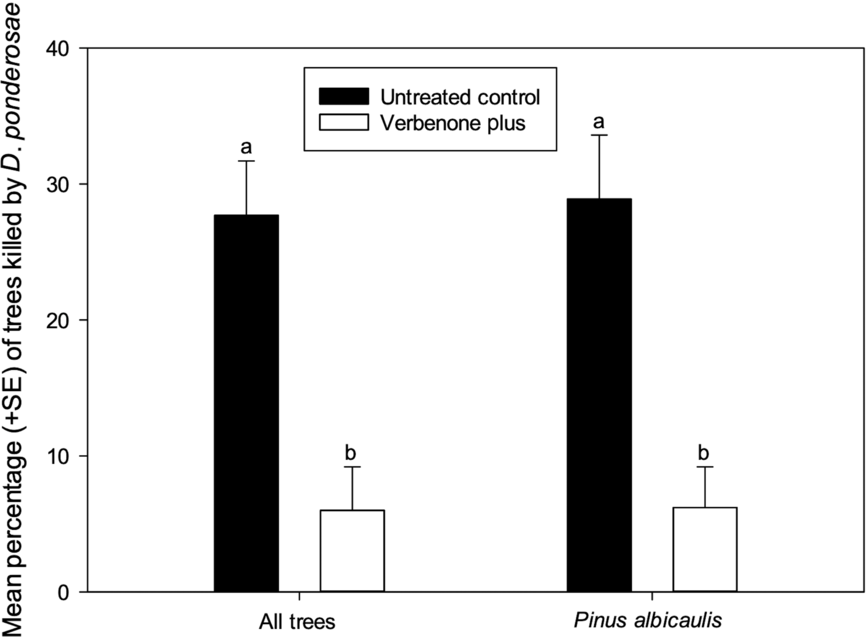
Fettig et al. (Reference Fettig, Bulaon, Dabney, Hayes and McKelvey2012a) demonstrated the efficacy of acetophenone, (E)-2-hexen-1-ol + (Z)-2-hexen-1-ol, and verbenone (called Verbenone Plus) for protecting highly vulnerable small stands of subalpine whitebark pine (Pinus albicaulis Engelmann (Pinaceae)) from D. ponderosae at June Mountain, California, United States of America (Fig. 2), where operational treatments of verbenone alone had been unsuccessful. Although D. ponderosae populations have declined in most areas affected by the recent outbreak, some populations of whitebark pine remain imperilled by D. ponderosae in both Canada and the United States of America (Mahalovich and Stritch Reference Mahalovich and Stritch2013). More recently, Fettig and Munson (Reference Fettig and Munson2020) demonstrated that Verbenone Plus was effective for protecting individual P. contorta and small stands of P. contorta from mortality attributed to D. ponderosae, but they also showed that Verbenone Plus and verbenone alone were equally effective.
Mean percentage (+ SE) of trees killed by Dendroctonus ponderosae on 0.41-ha plots treated with and without Verbenone Plus (acetophenone, (E)-2-hexen-1-ol + (Z)-2-hexen-1-ol, and verbenone) at June Mountain Ski Area, Inyo National Forest, California, United States of America. Means followed by the same letter within groups are not significantly different (t-test, P > 0.05). Data obtained from Fettig et al. (Reference Fettig, Bulaon, Dabney, Hayes and McKelvey2012a).
Dendroctonus brevicomis
Dendroctonus brevicomis is a major cause of P. ponderosa mortality in much of western North America. Fettig et al. (Reference Fettig, McKelvey and Huber2005) demonstrated that combinations of bark volatiles (benzaldehyde, benzyl alcohol, (E)-conophthorin, guaiacol, nonanal, and salicylaldehyde), green leaf volatiles ((E)-2-hexenal, (E)-2-hexen-1-ol, and (Z)-2-hexen-1-ol), and the nine compounds combined did not affect attraction of D. brevicomis to attractant-baited traps. However, when the bark and green leaf volatiles were combined with verbenone, significant reductions in trap catch were observed below those caused by verbenone alone (Fettig et al. Reference Fettig, McKelvey and Huber2005). Verbenone is the primary antiaggregation pheromone of D. brevicomis (Byers et al. Reference Byers, Wood, Craig and Hendry1984), but verbenone alone is insufficient to protect individual P. ponderosa (Gillette et al. Reference Gillette, Stein, Owen, Webster, Fiddler, Mori and Wood2006) or small stands of P. ponderosa (Fettig et al. Reference Fettig, McKelvey, Borys, Dabney, Hamud, Nelson and Seybold2009a). Based on this work, Fettig et al. (Reference Fettig, Dabney, McKelvey and Huber2008) demonstrated that applications of formulas combining nonhost volatiles and verbenone protected P. ponderosa from mortality attributed to D. brevicomis. Only four of 30 attractant-baited P. ponderosa treated with benzyl alcohol, benzaldehyde, guaiacol, nonanal, salicylaldehyde, (E)-2-hexenal, (E)-2-hexen-1-ol, (Z)-2-hexen-1-ol, and verbenone died, whereas 50% mortality (15/30) was observed in the bait-only treatment.
Fettig et al. (Reference Fettig, McKelvey, Dabney, Borys and Huber2009b, Reference Fettig, McKelvey, Dabney and Huber2012b) further examined the response of D. brevicomis to several blends of nonhost volatiles and verbenone in attractant-baited traps in hopes of improving the efficacy of their nine-component blend and reducing the number of components involved. The researchers documented the inhibitory effect of a revised five-component blend comprising nonanal, (E)-2-hexenal, (E)-2-hexen-1-ol, (Z)-2-hexen-1-ol, and verbenone, and they later demonstrated that adding acetophenone (Erbilgin et al. Reference Erbilgin, Gillette, Mori, Stein, Owen and Wood2007, Reference Erbilgin, Gillette, Owen, Mori, Nelson, Uzoh and Wood2008) to this blend allowed removal of the aldehydes nonanal and (E)-2-hexenal without compromising efficacy. The resulting four-component blend, called Verbenone Plus (acetophenone, (E)-2-hexen-1-ol, (Z)-2-hexen-1-ol, and verbenone), has been demonstrated to inhibit the response of D. brevicomis to attractant-baited traps and to reduce colonisation and mortality of individual P. ponderosa and small stands of P. ponderosa in several studies in California and British Columbia (Fettig et al. Reference Fettig, McKelvey, Dabney and Huber2012b, Reference Fettig, McKelvey, Dabney, Huber, Lait, Fowler and Borden2012c). Verbenone Plus remains the only effective semiochemical repellent identified for D. brevicomis (Borden Reference Borden2020).
Dendroctonus rufipennis
Dendroctonus rufipennis is the most significant mortality agent of mature Picea spp. in North America (Jenkins et al. Reference Jenkins, Hebertson and Munson2014). 3-Methylcyclohex-2-en-1-one (MCH) is the primary antiaggregation pheromone of D. rufipennis, but MCH alone is only marginally effective for protecting Picea trees from D. rufipennis (Seybold et al. Reference Seybold, Bentz, Fettig, Lundquist, Progar and Gillette2018). Hansen et al. (Reference Hansen, Munson, Blackford, Wakarchuk and Baggett2016, Reference Hansen, Munson, Blackford, Graves, Coleman and Baggett2017, Reference Hansen, Munson, Wakarchuk, Blackford, Graves, Stephens and Moan2019) showed that, when MCH was combined with an Acer spp. blend (AKB) consisting of linalool, β-caryophyllene, and (Z)-2-hexen-1-ol, efficacy was increased. The MCH–AKB combination is much less effective for protecting Pi. glauca in Alaska, United States of America from D. rufipennis than for protecting Pi. engelmannii in the Intermountain West of the western United States of America (Hansen et al. Reference Hansen, Munson, Wakarchuk, Blackford, Graves, Stephens and Moan2019). One hypothesis for the lack of efficacy of the MCH–AKB combination in Alaska may be the existence of a genetically distinct race of D. rufipennis (Maroja et al. Reference Maroja, Bogdanowicz, Wallin, Raffa and Harrison2007) that is unresponsive to this composition. An alternative blend, consisting of acetophenone, (E)-2-hexen-1-ol, (Z)-2-hexen-1-ol, and MCH, being evaluated for management of D. rufipennis in Pi. engelmannii in Wyoming, United States of America has shown promise (Gillette and Fettig Reference Gillette and Fettig2020).
Conclusion
The pioneering discovery by Dickens et al. (Reference Dickens, Billings and Payne1992) that two green leaf volatiles could disrupt host-selection responses by three bark beetle species provoked a pronounced shift in research emphasis from exploring how bark and ambrosia beetles find their hosts to how they avoid nonhosts. In addition to increasing our understanding of bark beetle foraging and dispersal, new semiochemical-based management tools were identified and developed. These advances were the result of the research of dozens of entomologists working in several countries across three continents. Thirty years later, we have a strong but still-evolving understanding of these systems (Bentz et al. Reference Bentz, Bonello, Delb, Fettig, Poland, Pureswaran, Seybold and Stanturf2020).
It is now accepted that most coniferophagous bark beetles detect differences between conifer hosts and nonhost angiosperm trees in flight and make avoidance decisions without needing to land on a nonhost (Fig. 1). Fewer than a dozen nonhost volatiles make up a generalised nonhost angiosperm message for conifer-infesting bark beetles. Nonhost volatiles tend to act in an additive and redundant manner in terms of their message, with different combinations being approximately equally effective disruptants and with larger groupings generally being the most effective. Several compounds among nonhost volatiles are generally thought of as bark beetle pheromones. One of these, conophthorin, has broad behavioural activity that has yet to be fully studied either from a theoretical perspective or from a perspective of elucidating and comparing the metabolite’s biosynthetic pathways in insects and plants. Further work in this field will enhance the efficacy of nonhost volatile operational tactics. We look forward to future studies that move these tactics into new pest management strategies for a wider range of coniferophagous bark beetles in diverse contexts.
Acknowledgements
The authors thank our numerous colleagues who have shaped our thinking and research into the chemical ecology of nonhost volatiles, many of whom are contributors to this special issue. The authors express our immense gratitude for our deceased friend and colleague, Dr. Steven J. Seybold, whose contributions to our field are incalculable and who was one of DPWH’s mentors. He is sorely missed.