For decades now, social scientists have been studying the factors effecting relationship satisfaction in order to understand how some relationships continue over time while others do not last. As Rusbult, Martz, and Agnew (Reference Rusbult, Martz and Agnew1998, p. 358) stated, “the implicit or explicit assumption is that if partners love each other and feel happy with their relationship, they will be more likely to persist in their relationship.” Feeling happy with a relationship is highly associated with what individuals bring into their relationships. Particularly, individuals’ perceptions, expectations, and emotional responses are crucial components of their happiness in relationships while these factors are influenced by cultural practices and may appear differently in different cultures.
Rusbult and Buunk (Reference Rusbult and Buunk1993) defined relationship satisfaction as an interpersonal evaluation of the positivity of feelings for one’s partner and attraction to the relationship. In a complementary description, Caughlin, Huston, and Houts (Reference Caughlin, Huston and Houts2000) stated that stable (intrapersonal) factors each partner brings to the marital relationship influence how they respond to one another, which indirectly affect their marital satisfaction. For example, relationships, which contained high levels of pro-social maintenance strategies (e.g., positivity, openness, assurances), were more likely to be stable and committed, and individuals in these relationships appeared to be more satisfied with their relationships (Guerrero, Anderson, & Afifi, Reference Guerrero, Anderson and Afifi2011). Therefore, researchers have been examining different intrapersonal factors associated with relationship satisfaction (e.g., Lockhart, White, Causby, & Isaac, Reference Lockhart, White, Causby and Isaac1994; Samenow, Reference Samenow1995). However, the appearance of these intrapersonal factors in different cultures may be variant. Therefore, there are an increasing number of studies with non-Western as well as cross-cultural examinations (e.g., Hamamcı, Reference Hamamcı2005; Wendorf, Lucas, İmamoğlu, Weisfeld, & Weisfeld, Reference Wendorf, Lucas, İmamoğlu, Weisfeld and Weisfeld2011). In the current study, we will examine different intrapersonal predictors of relationship satisfaction in a sample from a largely collectivistic society, Turkey.
Romantic relationships typically address our deepest needs for intimate human connection and are the source of our emotional dependency on our partners. As an important element of love, dependence is a critical concept in many of the theories’ premises guiding interpersonal relationship research (e.g., Hindy, Schwarz, & Brodsky, Reference Hindy, Schwarz and Brodsky1989; Peele, Reference Peele, Sternberg and Barnes1988; Rubin, Reference Rubin1970). One of the most influential theories, Interdependence Theory (Kelley, Reference Kelley1979; Thibaut & Kelley, Reference Thibaut and Kelley1959), views an individual’s dependence on a relationship as a function of the degree to which goodness of received outcomes in the current relationship in comparison to the goodness of available outcomes in the individual’s best alternative relationship. Other theoretical models, such as Cohesiveness Model (Levinger, Reference Levinger1976) and Investment Model (Rusbult, Reference Rusbult1983), also raise the concept of dependence in the estimation of relationship permanence. As a basic type of interpersonal closeness, emotional dependency is related to unity and connection; more specifically, it refers to the degree of an individual’s need for their partner, belief that their relationship is worth more than living alone or choosing another partner, feeling that they cannot live without their partner, and tendency to have a hard time with being alone. According to Rusbult, Drigotas, and Verette (Reference Rusbult, Drigotas, Verette, Canary and Stafford1994), emotional dependency is strongest when individuals put significant investment (i.e., time, effort) and devotion into their relationships, and potential alternative relationships are unappealing. The degree of emotional dependency may predict higher relationship satisfaction or quality, but also lack of autonomy. Higher emotional dependency in relationships may also contribute to negative mood through its role in generating negative interpersonal outcomes. In both opposite-sex (e.g., Samenow, Reference Samenow1995) and same-sex relationships (e.g., Lockhart et al., Reference Lockhart, White, Causby and Isaac1994), higher emotional dependency was reported as a correlate of abusive and controlling responses.
Individuals’ perceptions and expectations in a relationship are also important predictors of their relationship satisfaction. Cognitive Theory suggests that the endorsement of certain irrational expectations about what makes relationships functional and healthy strongly affects an individual’s ability to adjust within a relationship (Beck, Reference Beck1976). Similarly, according to Rational Emotive Behavior Therapy (REBT; Ellis, Reference Ellis1955), psychopathology is a result of people endorsing irrational beliefs that sabotage their goals and purposes. At the basis of all human disturbance, the tendency to make devout, absolutistic evaluations of perceived events lies, which also comes in the form of dogmatic musts or shoulds (Ellis & Dryden, Reference Ellis and Dryden1987). Likewise, Epstein (Reference Epstein1986) has pointed out that the most pervasive and most enduring cognitive variables that led to marital distress were extreme beliefs about one’s self, partner, and nature of their relationship. Thus, a major focus of research in investigating the relationship phenomena, predominantly affective qualities such as satisfaction and adjustment, has been on irrational beliefs as an important facet of individual differences (Baucom, Epstein, Sayers, & Sher, Reference Baucom, Epstein, Sayers and Sher1989).
Irrational thinking leads to self-defeating behavior and, thus, is seen to affect poorer adjustment, while more rational/functional thinking affects better adjustment in romantic relationships (Stackert & Bursik, Reference Stackert and Bursik2003). The cause of disturbed marital interactions also involved unrealistic expectations that partners held not merely about themselves and others, but also about the marital affiliation itself (Ellis, Sichel, Yeager, DiMattia, & DiGuiseppe, Reference Ellis, Sichel, Yeager, DiMattia and DiGuiseppe1989). These unrealistic expectations were also frequently found to be negatively correlated with relationship satisfaction (Bradbury & Fincham, Reference Bradbury and Fincham1988; Metts & Cupach, Reference Metts and Cupach1990; Moller & van der Merwe, Reference Moller and van der Merwe1997). REBT suggests that a marriage ends when one or both spouses hold irrational beliefs, being defined as highly exaggerated, inappropriately rigid, illogical, and absolutist (Dryden, Reference Dryden and Dryden1985). Ellis and colleagues (Reference Ellis, Sichel, Yeager, DiMattia and DiGuiseppe1989) identified these irrational beliefs as (a) demandingness (e.g., dogmatic shoulds about a spouse’s behavior and the nature of marriage), (b) neediness (e.g., spouses believe that they need to be lovingly mated because otherwise they are worthless), (c) intolerance (e.g., spouses convince themselves that they cannot stand the problems they experience or anticipate in their relationships), (d) awfulizing (e.g., being intolerant when things are not as they are supposed to be), and (e) damning (e.g., taking the spouse’s feelings as a mirror of one’s lovability and human value).
In the same line with cognitive theorists’ suggestions, researchers found that married individuals’ dysfunctional relationship beliefs (specifically, interpersonal rejection, unrealistic relationship expectations, and interpersonal misperception) were negatively correlated to dyadic adjustment and marital satisfaction (e.g., Sullivan & Schwebel, Reference Sullivan and Schwebel1995). In a study with a nonclinical Turkish sample, Hamamcı (Reference Hamamcı2005) also found negative associations between married Turkish individuals’ dysfunctional relationship beliefs and, dyadic adjustment and marital satisfaction. In another study, Sığırcı (Reference Sığırcı2010) reported that married Turkish individuals with low levels of marital satisfaction tended to display more avoidant and anxious attachment styles and held more irrational beliefs when compared to those with a high level of marital satisfaction. Güven and Sevim (Reference Güven and Sevim2007) also found that problem-solving skills and unrealistic relationship expectations were significant predictors of marital satisfaction among married Turkish individuals.
Despite similarities between the findings from Western and Turkish samples, Goodwin and Gaines Jr (Reference Goodwin and Gaines2004) suggested differences in the level of dysfunctional relationship beliefs across cultures. In their study, they found a significant pan-cultural correlation between the dysfunctional beliefs and relationship quality of manual workers, students, and entrepreneurs from Georgia, Hungary, and Russia. They also reported that country of origin had a moderating effect where the dysfunctional beliefs of Hungarian participants explained more than four times of the variance in the relationship quality of participants from the other countries.
On the other hand, gender and length of marriage were frequently examined as important factors in predicting married individuals’ relationship satisfaction. As previous research studies revealed contradictory findings regarding the role of gender (e.g., Antonucci & Akiyama, Reference Antonucci and Akiyama1987; Heaton & Blake, Reference Heaton and Blake1999) and length of marriage (e.g., Demir & Fışıloğlu, Reference Demir and Fışıloğlu1999; Karney & Bradbury, Reference Karney and Bradbury1997; Wendorf et al., Reference Wendorf, Lucas, İmamoğlu, Weisfeld and Weisfeld2011; Zainah, Nasir, Hashim, & Yusof, Reference Zainah, Nasir, Hashim and Yusof2012) in relation to relationship variables, we believe it is critical to control the effects of both variables in predicting relationship satisfaction.
In brief, to date, no study has examined married individuals’ emotional dependency and dysfunctional relationships beliefs while monitoring the effects of gender and length of marriage in a Turkish sample. We believe that examining the contributors to relationship satisfaction in a non-Western culture will expand our understanding of relationship dynamics. Particularly, discussion of cultural nuances will provide bases for further research, such as comparative studies, as well as mental health practices not only with individuals in Turkey but also in other countries.
In the present study, we aim to examine the role of emotional dependency and dysfunctional relationship beliefs in predicting married Turkish individuals’ relationship satisfaction. Our overarching research question is when gender and length of marriage are controlled, what are the roles of emotional dependency and interpersonal cognitive distortions, namely, interpersonal rejection, unrealistic relationship expectations, and interpersonal misperceptions, in predicting married Turkish individuals’ relationship satisfaction. We hypothesize that, after controlling for gender and length of marriage, (a) emotional dependency will be a significant positive predictor whereas (b) interpersonal rejection, (c) unrealistic relationship expectations, and (d) interpersonal misperceptions will be significant negative predictors of married Turkish individuals’ relationship satisfaction.
Method
Participants
Participants of the present study were 203 female (52.9%) and 181 male (47.1%) married Turkish individuals with an age range of 21 to 73 years (M = 35.98, SD = 8.00). The average length of marriage among the participants was 10.09 years (SD = 8.24). Approximately 86% of the participants had college degrees whereas 14% reported graduate degrees. We used convenience sampling to recruit the participants from urban cities of Turkey.
Instruments
Demographic information form
A self-report demographic information form included questions regarding participants’ gender, age, length of marriage, and education level.
Relationship assessment scale (RAS)
The Relationship Assessment Scale was developed by Hendrick, Dicke, and Hendrick (Reference Hendrick, Dicke and Hendrick1988) to measure the relationship satisfaction of individuals in romantic relationships. RAS includes seven items (e.g., How good is your relationship compared to most?) with two reverse-coded items and a five-point Likert scale (1: Low Satisfaction, 5: High Satisfaction). In the original study, one-factor solution explained 46% of the total variance and the internal consistency for the total scale was .86. The Turkish adaptation of the scale was conducted by Curun (Reference Curun2001) with university students who were currently in romantic relationships. The results of the factor analysis yielded one factor accounting for 52% of the variance with an alpha coefficient of .86. In the current study, we used a seven-point Likert scale (Curun, Reference Curun2001) and obtained a Cronbach alpha reliability coefficient of .92 for the total scale.
Emotional dependency scale (EDS)
The nine-item (e.g., It would be difficult for me to live without my partner) Emotional Dependency Scale was developed by Buunk (Reference Buunk1981) to measure emotional dependency of romantic partners. EDS involves a seven-point Likert scale (1: Completely Disagree, 7: Completely Agree) and a reverse-coded item. The original EDS was reported as one-dimensional with an internal consistency of .81. Karakurt (Reference Karakurt2001) adapted EDS into Turkish and also reported a one-factor structure explaining 48.2 % of the total variance with an alpha coefficient of .87. In the current data set, EDS had a Cronbach alpha reliability coefficient of .84.
Interpersonal cognitive distortions scale (ICDS)
The Interpersonal Cognitive Distortions Scale was developed by Hamamcı and Büyüköztürk (Reference Hamamcı and Büyüköztürk2004) to assess cognitive distortions in individuals’ interpersonal relationships. The ICDS consists of 19 items representing three subscales, eight-item Interpersonal Rejection (negative attributions of the individuals toward people’s behaviors, characteristics, and beliefs related to being close to others in their relationships; e.g., “Being very close to people usually creates problems”), eight-item Unrealistic Relationship Expectations (individuals’ high expectations concerning both their own behaviors and the behaviors of others in their relationships; e.g., “In order for me to feel good about myself, other people should have positive thoughts and feelings about me”), and three-item Interpersonal Misperception (the belief that individuals can predict the thoughts and emotions of others without overt communication; e.g., “Even though people would not express, I could understand what they think”). Cronbach alpha internal consistency coefficient scores for each of the subscales were found as .73, .66, and .43, respectively. Due to its low reliability score, Hamamcı and Büyüköztürk (Reference Hamamcı and Büyüköztürk2004) recommended using Interpersonal Misperceptions subscale cautiously. Test-retest coefficient for 15-day-interval was reported as .74. Convergent validity was confirmed through the positive correlations among ICDS subscales and the Turkish versions of Automatic Thoughts and Irrational Belief Scales. Construct validity was also obtained through the positive correlations between overall ICDS and the Conflict Tendency Scale. In the current study, the Cronbach alpha coefficients for the total ICDS was .81 while the alpha coefficients for Interpersonal Rejection was .79, Unrealistic Relationship Expectations was .74, and Interpersonal Misperception was .77.
Data analyses
We performed all statistical analyses with the IBM Statistical Package for the Social Sciences Version 22.0 (SPSS). A p value of .05 was deemed statistically significant.
Preliminary analyses
Initially, we performed a series of data screening procedures to examine the assumptions for hierarchical regressions analysis (e.g., sample size, univariate and multivariate outliers, multicollinearity). First, to define a minimum sample size for a robust power for the study, we specified the power level at .80, alpha level at .05, and minimum expected effect size at .05 for a regression model including two observed (i.e., gender and length of marriage) and five measured variables (i.e., emotional dependency, interpersonal rejection, unrealistic relationship expectations, interpersonal misperception, and relationship satisfaction). The recommended sample size was a minimum of 293 participants. With 384 participants, we obtained an adequate sample size to claim robust results in the current study.
We, then, examined the data for entry correctness and missing values. Missing data was not more than 1% in any of the variables; thus, we conducted Expectation Maximization (EM) to replace missing values. The accuracy of data with the univariate and multivariate outliers were examined through Z-scores, Cook’s Distance, and Mahalonobis Distance values. There were four cases exceeding the Z-scores range of –3.29 –3. 29 (p < .001, two tailed test; Tabachnick & Fidell, Reference Tabachnick and Fidell2007). As a rule of thumb, we further examined the Cook’s distance values for the univariate outliers. We did not observe any cases exceeding the value of 1 for the Cook’s distance (Stevens, Reference Stevens2002). Examination of Mahalanobis Distance for multivariate outliers did not yield any cases exceeding the critical probability value of .001, either (Stevens, Reference Stevens2002). Thus, we decided to continue on our analysis with those four cases.
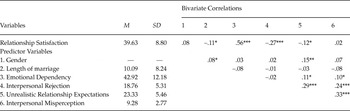
We also examined multicollinearity in the current data set through observing tolerance and Variance Inflation Factor (VIF) values. None of the tolerance values were less than .1 or VIF values were greater than 10 (Tabachnick & Fidell, Reference Tabachnick and Fidell2007). Moreover, despite significant bivariate correlations among the predictor variables (i.e., Emotional Dependency, Interpersonal Rejection, Interpersonal Misperception, Unrealistic Relationship Expectations; see Table 1), none of the correlation coefficients indicated a large effect size (> .50; Cohen, Reference Cohen1988). Therefore, the current data set appeared to meet the minimum requirements for conducting a hierarchical multiple regression analysis. Table 1 also presents the means, standard deviations, and the intercorrelations among the dependent and predictor variables.
Means, standard deviations, and intercorrelations for relationship satisfaction and predictor variables

Note: N = 384, *p < .05, **p < .01, ***p < .001.
Hierarchical regression analysis
To analyze the data, we conducted a Hierarchical (Sequential) Regression Analysis with two blocks. We entered gender and length of marriage into the first block, and emotional dependency and the subscales of ICDS (i.e., interpersonal rejection, unrealistic relationship expectations, and interpersonal misperception) into the second block. By entering gender and length of marriage in the first block, we aimed at controlling their effects on both outcome and predictor variables.
Results
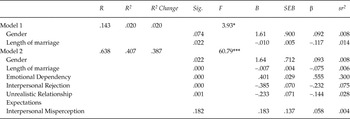
Our results revealed that gender and length of marriage together accounted for a small part of the variance. After controlling for these two variables, emotional dependency, interpersonal rejection, unrealistic relationship expectations, and interpersonal misperception together accounted for a relatively large portion of the variance in married Turkish individuals’ relationship satisfaction. Table 2 summarizes hierarchical regression analysis results and each of the models.
Hierarchical multiple regression analysis predicting relationship satisfaction of married turkish individuals

Note: *p < .05, **p < .01, ***p < .001.
According to the hierarchical multiple regression analysis results, multiple correlation coefficient between the linear combination of two predictors, gender and length of marriage, and relationship satisfaction was found .14. Gender and length of marriage significantly predicted relationship satisfaction F(2, 377) = 3.93, p < .05, R 2 = .020. In this model, the combination of these two predictors accounted for 0.2% of the variance in relationship satisfaction. The unique contribution of gender to the explained variance was found to be insignificant t(377) = 1.79, p > .05 whereas length of marriage significantly contributed to relationship satisfaction t(377) = –7.54, p < .001, sr 2 = .014. Particularly, length of marriage had a negative contribution to relationship satisfaction (β = –.12). In other words, longer length of marriage was related to lower levels of relationship satisfaction in our sample.
In Model 2, after controlling for the effects of gender and length of marriage, multiple correlation coefficient between the linear combination of emotional dependency, interpersonal rejection, unrealistic relationship expectations, and interpersonal misperception, and relationship satisfaction elevated to .64. Model 2 was also significant F(4, 373) = 60.79, p < .001, R 2 = .407 and four predictors together accounted for 39% of the variance in relationship satisfaction. In this model, emotional dependency uniquely explained a big part of the variance (30%) in relationship satisfaction with a significant positive contribution t(373) = 13.73, p < .001, β = .56. Interpersonal rejection, on the other hand, explained 7.5% of the variance and had a significant negative contribution to relationship satisfaction t(373) = –.5.49, p < .001, β = –.23. Similarly, unrealistic relationship expectations accounted for 2.8% of the variance and was negatively associated to participants’ relationship satisfaction t(373) = –3.29, p = .001, β = –.14. Nevertheless, the contribution of the interpersonal misperception to relationship satisfaction was not significant t(373) = 1.34, p > .05.
Discussion
In the current study, we investigated to what degree emotional dependency and dysfunctional relationship beliefs (i.e., interpersonal rejection, unrealistic relationship expectations, and interpersonal misperception) predicted relationship satisfaction levels of married Turkish individuals. The data supported three out of four of our hypotheses. More specifically, when we removed the effects of gender and length of marriage, emotional dependency was a significant positive predictor, whereas interpersonal rejection and unrealistic relationship expectations were significant negative predictors of relationship satisfaction. Contrary to our expectations, interpersonal misperception did not significantly contribute to participants’ relationship satisfaction.
First, examining the degree to which emotional dependency predicted relationship satisfaction in our Turkish sample, we obtained an expected yet interesting finding. Among the variables tested, emotional dependency, explaining 30% of the variance, was the biggest predictor of married Turkish individuals’ relationship satisfaction. Considering our basic need for love, attachment, and closeness as human beings and how much these needs are addressed in romantic relationships, emotional dependency’s significant positive contribution to relationship satisfaction was an anticipated finding. Thus, the more emotionally dependent individuals could be on their partners, the more satisfied they were with their relationships. Although higher emotional dependency may be considered as dissipation of independence and autonomy, we believe our finding was in line with Feeney’s (Reference Feeney2007) empirical evidence for the paradoxical hypothesis; indicating acceptance of dependency promoting autonomous functioning. In other words, with a converging and convincing evidence for attachment theory’s proposition, Feeney suggested that, by accepting and responding to the significant other’s attachment needs, individuals could explore the world confidently and independently. This finding was also in line with Sığırcı’s (Reference Sığırcı2010) report stating that married Turkish individuals with lower levels of relationship satisfaction displayed more avoidant and anxious attachment styles. A positive, mature, or healthy dependence in close relationships could integrate the need for connection with others as a factor of healthy human functioning (Bornstein, Reference Bornstein and Bornstein2005; Bornstein & Languirand, Reference Bornstein and Languirand2003). In a collectivistic yet rapidly westernizing society, traditionally, Turkish people tend to be emotionally connected and dependent on one another in a deeper level both in their social and romantic relationships. Feeling emotionally connected to their partners, married Turkish individuals may be comfortable enough to express themselves in their relationships, feel loved, supported, and owned by their partners as well as feel the ownership of their partners. Being owned must be considered as a euphemism for the feeling of belonging to one’s partner where they do not feel lonely, but deeply connected and fulfilled. Therefore, such a deep emotional connection is a crucial contributor to more satisfaction in married Turkish individuals’ relationships.
Secondly, our hypothesis regarding interpersonal rejection as a negative predictor of married Turkish individuals’ relationship satisfaction was also supported. This finding was also supportive of previous findings from different profiles (e.g., Sullivan & Schwebel, Reference Sullivan and Schwebel1995), yet was contrary to the findings with a Turkish sample where marital satisfaction was not predicted by interpersonal rejection and mind reading (Güven & Sevim, Reference Güven and Sevim2007). Compared to individuals who were less sensitive to interpersonal rejection, highly sensitive individuals reported feeling less satisfied with their romantic relationships while being more likely to have negative beliefs about their relationships and exaggerate the extent of their partners’ dissatisfaction (Downey & Feldman, Reference Downey and Feldman1996). Downey and Feldman (Reference Downey and Feldman1996) also stated that individuals who were sensitive to interpersonal rejection had a tendency to anxiously expect, quickly perceive and overreact to it. Being in a high-context culture, Turkish people may be inclined to pay significant attention to nonverbal cues and underlying messages, and communicating in an indirect manner in their relationships. Due to this tendency, Turkish people could be prone to feeling rejected in their social and romantic relationships as a result of reading into vague interpersonal cues. The more partners experience such occurrences and keep it to themselves or act impulsively on their perceptions, the relationship satisfaction may decrease. Thus, increased sensitivity to interpersonal rejection may decrease relationship satisfaction and even lead to relationship termination.
Thirdly, as hypothesized, unrealistic relationship expectations negatively predicted married Turkish individuals’ relationship satisfaction. Güven and Sevim (Reference Güven and Sevim2007) also found that marital satisfaction was predicted by partners’ unrealistic relationship expectations and problem-solving skills. In their study with individuals in dating relationships, Sullivan and Schwebel (Reference Sullivan and Schwebel1995) reported that individuals with lower levels of irrational relationship beliefs described their relationships as more satisfying. Thus, the expectations we bring into our relationships shape our thoughts, feelings, and behaviors, and ultimately our satisfaction in that relationship (Ellis, Reference Ellis1955). As Ellis and his colleagues (Reference Ellis, Sichel, Yeager, DiMattia and DiGuiseppe1989) stated, when individuals contemplate on how their partners should behave and the nature of their marriage should be, they become intolerant in their relationships and impatient with their partners. In the same line with what we discussed earlier, feeling a deeper connection with their partners, some Turkish individuals may give and expect a great deal of attention and affection in their relationships. Not having their expectations met may lead to lower satisfaction with their relationships as well as marital distress (Epstein, Reference Epstein1986).
Lastly, contrary to our hypothesis, interpersonal misperceptions did not significantly predict relationship satisfaction among married Turkish individuals. In summary, married Turkish individuals in this study reported that their relationship satisfaction was positively related to their emotional dependency and negatively associated with their interpersonal rejection and unrealistic relationship expectations.
The main limitation of the current study was the convenience sampling strategy. Our participants were also living in urban cities in Turkey and had college and above degrees. Participants with different demographics may yield different results. Therefore, our results cannot be generalized to the entire society living in Turkey.
Our findings yielded additional questions to be examined in future research. Comparisons of individuals from rural and urban settings and/or from different education backgrounds in terms of their emotional dependency, cognitive distortions, and other relationship dynamics (e.g., jealousy, trust, marriage type) could reveal a more comprehensive understanding of married Turkish individuals’ relationship satisfaction and quality. In addition, in the current study, we only gathered data from married individuals. Studies that include data from both partners would provide better understanding of the dyadic dynamics. Considering the increasing divorce rates in Turkey, such studies would facilitate better understanding of relationship satisfaction or dissatisfaction. Furthermore, studies examining relationship satisfaction of dating, cohabiting, and same-sex couples would also provide valuable knowledge of similarities and differences among diverse romantic relationship groups in Turkey.
Our study results also have implications for mental health professionals working with couples and relationship issues. In the globalized world we live in, understanding individuals from different cultural backgrounds is an important part of mental health professionals’ practices. Specifically, a better understanding of the marital dynamics of individuals coming from collectivistic societies could be useful for practitioners who are trained and are working in Western societies. Even though our findings supported universal patterns between relationship-oriented emotional and cognitive characteristics and relationship satisfaction, cognitive distortions could be defined differently in different societies. Thus, working with clients within their perspectives based on their cultural backgrounds while helping them to understand themselves and their culture is a challenging, but crucial goal of therapy. On the other hand, in the quickly westernizing Turkish society, Turkish mental health professionals may also want to take emotional dependency as well as perceptions of interpersonal rejection and unrealistic relationship expectations into consideration while working not only with couples, but also with individuals. Due to the changing nature of the society, individuals’ relational issues may be connected to their personal struggles with emotional dependency and distorted relationship views. In brief, therapists, particularly those working with cognitive-behavioral models, could make use of our findings in terms of challenging clients’ irrational beliefs in relation to themselves, their partners, and their relationship, and even societal expectations.