INTRODUCTION
The blue mussel, Mytilus edulis Linnaeus 1758, and the Mediterranean mussel, Mytilus galloprovincialis Lamarck 1819, occur widely over much of northern Europe, and wherever they are sympatric they hybridize (Skibinski et al., Reference Skibinski, Beardmore and Cross1983; Gosling, Reference Gosling and Gosling1992a, Reference Gosling and Goslingb). The hybrid zone is large, spanning more than 1400 km of coastline from western France to the north of Scotland, and is spatially complex, containing a mixture of pure, hybrid and introgressed individuals (Skibinski et al., Reference Skibinski, Beardmore and Cross1983; Gosling, Reference Gosling and Gosling1992b; Bierne et al., Reference Bierne, Borsa, Daguin, Jollivet, Viard, Bonhomme and David2003a). Partial ecological segregation of M. edulis and M. galloprovincialis is said to account for most of the small-scale genetic patchiness within the hybrid zone, with M. edulis occupying sheltered estuarine habitats, and M. galloprovincialis largely found in wave-exposed habitats (Gosling & Wilkins, Reference Gosling and Wilkins1981; Skibinski et al., Reference Skibinski, Beardmore and Cross1983, Bierne et al., Reference Bierne, David, Langlade and Bonhomme2002; Hilbish et al., Reference Hilbish, Timmons, Agrawal, Schneider and Gilg2003). Post-settlement habitat-dependent selection (Hilbish et al., Reference Hilbish, Timmons, Agrawal, Schneider and Gilg2003) or habitat choice by settling larvae (Bierne et al., Reference Bierne, Bonhomme and David2003b), have been suggested as agents responsible for ecological segregation of the taxa.
There is no single morphological character that can be reliably used to separate mixed populations, particularly at wave-exposed locations where hybridization and introgression between M. edulis and M. galloprovincialis generate large numbers of intermediate forms (Seed, Reference Seed1974). About four protein (allozyme) marker loci are well differentiated but not diagnostic between any pair of blue mussel taxa (McDonald et al., Reference McDonald, Seed and Koehn1991; Gosling, Reference Gosling and Gosling1992b). Two polymerase chain reaction (PCR)-based DNA markers, Me15/16 and Glu-5′ have now been developed, which diagnostically identify the three taxa, M. edulis, M. galloprovincialis and Mytilus trossulus, and allow accurate estimation of the frequency of parental and hybrid mussel classes within hybrid zones (Inoue et al., Reference Inoue, Waite, Matsuoka, Oda and Harayama1995; Rawson et al., Reference Rawson, Joyner, Meetze and Hilbish1996).
Recently, Coghlan & Gosling (Reference Coghlan and Gosling2007) used the Me15/16 marker to investigate the genetic composition of mussels from two wave-exposed sites and one sheltered, estuarine site, in Galway Bay, western Ireland. In spat and adults the frequency of the M. galloprovincialis allele was high (0.56–0.80), due to high frequencies of M. galloprovincialis (>37%) and hybrid (>33%) genotypes, and there were correspondingly low frequencies of the M. edulis genotype (<11%). They concluded that the three sites, all within 6 km of each other, share a common larval source, that recruitment is genetically homogeneous, and that the M. edulis genotype has no apparent advantage in sheltered, estuarine conditions. In contrast, results from an earlier study by Gosling & Wilkins (Reference Gosling and Wilkins1981) on Mytilus from 26 sites on Irish coasts, using partially diagnostic allozyme markers (Gpi, Pgm and Lap-2), showed that mussels in the Irish Sea constituted a single panmictic population of Mytilus edulis alone, whereas on Atlantic wave-exposed shores, and to a much lesser extent on wave-protected shores, mussels comprised an interbreeding mixture of M. edulis and Mytilus galloprovincialis. A later study by Skibinski et al. (Reference Skibinski, Beardmore and Cross1983), using a larger number of loci, confirmed our observations for Irish Sea and Atlantic Ocean sites.
Since Coghlan & Gosling (Reference Coghlan and Gosling2007) only sampled a small part of the distribution of Mytilus on Irish coasts, the aim of this study was to carry out a broader survey of 20 sites to see if the genetic structure established for Galway Bay Mytilus is typical of other populations on Irish Atlantic coasts. Also, because a number of sites in Gosling & Wilkins (Reference Gosling and Wilkins1981) and Gosling & McGrath (Reference Gosling and McGrath1990) were also sampled in the current study this provided us with the opportunity to qualitatively compare allozyme and molecular data sets for the sites in common.
MATERIALS AND METHODS
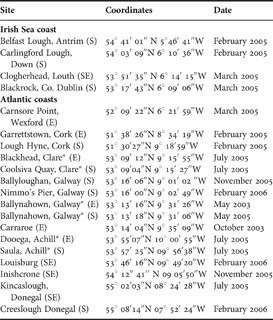
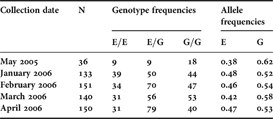
Mussels were collected from 20 sites on the Irish Sea and Atlantic coasts of Ireland. At each site the sample was collected from one spot on the shore, usually the mid-shore (Table 1), and an attempt was made to collect a representative size-range of mussels. Among the 20 sites, three paired geographically close sites were sampled: Achill Island (exposed (E) Dooega, and sheltered (S) Saula; 5.5 km apart), Southern Connamara (Ballynahown E and S; 900 m apart) and Northern Clare (Blackhead (E) and Coolsiva, semi-exposed; 2 km apart). Because the sample size in this study was generally small (N = ~40), we tested the reliability of our results by comparing allele and genotype frequencies at a single site (Ballynahown sheltered; N = 36; July 2005) with four larger samples from the same site (N = 133–150) collected in January, February, March and April 2006.
Details of sites and dates of Mytilu s sample collection.

S, sheltered; E, exposed; SE, semi-exposed; *paired sampling sites.
Once collected, mussels were either preserved in 100% alcohol or frozen at −20°C. DNA extraction, PCR amplification and electrophoresis followed methods outlined in Coghlan & Gosling (Reference Coghlan and Gosling2007).
Conformance to Hardy–Weinberg equilibrium (HWE) and comparisons of allele and genotype distributions between pairs of populations were assessed using Fisher's exact tests as implemented in GENEPOP 3.4 (Raymond & Rousset, Reference Raymond and Rousset1995), with specified Markov chain parameters of 10 000 dememorization steps, followed by 100 batches of 5000 iterations per batch for all populations. To correct for multiple pairwise comparisons the false discovery rate procedure of Benjamini & Yekutieli (Reference Benjamini and Yekutieli2001) was applied. This method accommodates large numbers of potentially dependant tests while balancing risks of Type I and Type II errors and is a good alternative to the very conservative Bonferroni correction (Rice, Reference Rice1989), which is effective in reducing Type I, but not Type II errors (Narum, Reference Narum2006).
RESULTS
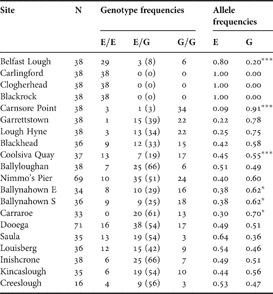
Table 2 lists the genotype and allele frequencies for 1306 individuals from the 20 locations. All samples were in HWE with the exception of four Galway Bay sites: Coolsiva (P < 0.001), Ballynahown wave-exposed (P < 0.05) and wave-protected (P < 0.05), and Carraroe (P < 0.05), plus Belfast Lough (P < 0.001) and Carnsore Point (P < 0.001), which are situated at entry points to the Irish Sea. Departures from HWE were due to deficits of heterozygotes, with the exception of Carraroe where an excess of heterozygotes was observed.
Genotype and allele frequencies in 20 samples of Mytilus on Irish coasts. N, sample size. Figure in parentheses is the percentage of the hybrid genotype. Asterisks indicate samples that show significant deviations from Hardy–Weinberg equilibrium; *P < 0.05; ***P < 0.001.

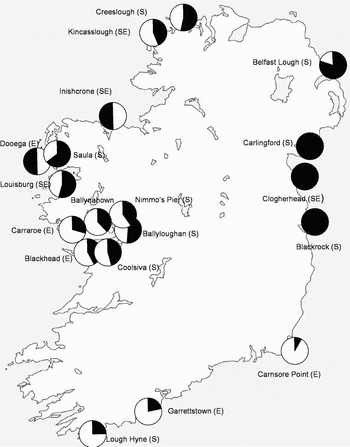
The samples collected from Irish Sea sites were exclusively Mytilus edulis, with the exception of Belfast Lough (Table 2; Figure 1), where the frequency of the G allele was moderately high (0.20), with hybrid and Mytilus galloprovincialis genotypes at a frequency of 8% and 16%, respectively. As a consequence, pairwise comparisons between Belfast Lough and the other three Irish Sea sites differed significantly in both genotypic (P < 0.05) and allelic (P < 0.001) proportions.
Frequency of the Mytilus edulis allele (black) and the Mytilus galloprovincialis allele (white) at Irish sampling sites. Because allele frequencies were identical for the Ballynahown wave-exposed and sheltered sites, only one frequency is presented.

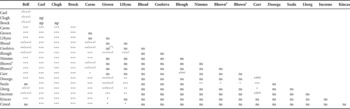
On Atlantic coasts the frequency of the G allele ranged from 0.36 at Saula, to 0.91 at Carnsore Point (Table 2; Figure 1). All samples differed significantly in both genotypic (P < 0.001 to 0.05) and allelic (P < 0.001 to 0.01) proportions from Irish Sea sites (Table 3), with the exception of Belfast Lough, which, while significantly different from the majority of Atlantic coastal samples in both genotypic (P < 0.01 to 0.05) and allelic (P < 0.01 to 0.001) proportions, did not differ significantly from Saula and Creeslough on the west and north-west coasts.
Pairwise comparisons of genotypic proportions at the Me15/16 locus in samples of Mytilus on Irish coasts. Asterisks indicate significant pairwise comparisons from Fisher's exact tests, after the Benjamini & Yekutieli (Reference Benjamini and Yekutieli2001) procedure: *P < 0.0086; **P < 0.0017; ***P < 0.0002. Where significance levels differed between genotypic and allelic comparisons, the level is indicated in parentheses.

np, not possible; ns, not significant; Belf, Belfast; Carl, Carlingford; Clogh, Clogerhead; Brock, Blackrock; Carns, Carnsore Point; Gtown, Garrettstown; LHyne, Lough Hyne; Bhead, Black Head; Coolsiva, Coolsiva Quay; Blough, Ballyloughan; Nimmo, Nimmo's Pier; Bhowne, Ballynahown E; Bhowns, Ballynahown S; Carr, Carraroe; Dooega, Dooega; Saula, Saula; Lburg, Louisburg; Incrone, Inishcrone; Kincas, Kincaslough; Creesl, Creeslough.
There was a remarkable degree of genetic homogeneity between the 12 samples from west and north-west Atlantic coast sites (Table 3). This was not related to geographical distance between sites, as mussels from sites that were far apart from each other were as genetically similar as those that were collected closer together, irrespective of the exposure level of the shore. However, Saula, which had the highest frequency of the E allele on Atlantic coast sites, differed significantly from mussels at four of the sites in Galway Bay (Tables 2 & 3).
Mussels from the three south coast sites, Carnsore, Garrettstown and Lough Hyne, were genetically similar to each other, but were significantly differentiated from samples (N = 12) analysed from the west and north-west Atlantic coast sites (Table 3). The greatest differentiation was observed between Carnsore and the other 12 Atlantic sites (P < 0.001 to 0.05) due the high frequency of G (0.91) and the corresponding low frequency (3%) of the hybrid genotype in the Carnsore sample. Garrettstown and Lough Hyne samples were significantly differentiated in both genotypic and allelic (P < 0.05 to 0.001) proportions from 6–8 of the west and north-west Atlantic coast samples, most of these from sites situated north of Galway Bay (Table 3).
Because sample sizes were small (N = 39 ± 11.4) we tested the reliability of our results by comparing genotypic and allelic frequencies for the Ballynahown sheltered site (N = 36) with four larger samples collected from the same site (Table 4). There were no significant differences in either genotypic or allelic proportions for any pairwise comparison, which demonstrates that taking small samples gives as good an estimate of genetic structure as larger ones. Also, it is clear that the genetic structure of mussels does not vary significantly either within or between the two years, at least at this particular site.
Genotype and allele frequencies in small and large samples of Mytilus from the wave-protected shore at Ballynahown, Galway Bay.

DISCUSSION
Results for the 16 Atlantic coast sites supported those reported by Coghlan & Gosling (Reference Coghlan and Gosling2007) for Galway Bay Mytilus: (1) a high frequency of the M. galloprovincialis (G) allele and genotype (mean: 0.592 ± 0.134; 0.378 ± 0.198, respectively); (2) a high frequency of the hybrid genotype (0.429 ± 0.175), although our frequencies ranged from a low of 0.03 at Carnsore Point, to 0.66 at two sites on the west coast (Table 2); (3) correspondingly low frequencies of the M. edulis genotype (0.194 ± 0.107); and (4) no relationship between allele or genotype frequency and exposure level of the shore, i.e. no support for the partial ecological segregation of the two taxa reported by Gosling & Wilkins (Reference Gosling and Wilkins1981) for Irish Atlantic coast sites.
In contrast to Atlantic coasts, Irish Sea samples were almost exclusively M. edulis. What factors are responsible for the virtual absence of M. galloprovincialis in this region are unknown. From satellite imagery a distinct thermal front develops during late spring at the boundary between the stratified Celtic Sea and the mixed waters of the southern Irish Sea (Brown et al., Reference Brown, Carrillo, Fernand, Horsburgh, Hill, Young and Medler2003). This breaks down with the onset of winter cooling and increased wind-induced mixing. Stratification also occurs within the Irish Sea, especially to the west of the Isle of Man where the water is deeper and the tides weaker than to the east of the island. This front also breaks down in winter and re-forms in spring. Mussels in the Irish Sea may thus be a self-recruiting population, with the thermal fronts at the northern and southern entrances preventing the influx of spring-spawned Mytilus larvae. The importance of fronts as biogeographical boundaries for phytoplankton, zooplankton and planktonic stages of fish and invertebrate species in European waters has been well documented (Holligan, Reference Holligan1981; Quesada et al., Reference Quesada, Zapata and Alvarez1995; Munk et al., Reference Munk, Larsson, Danielsen and Moksness1999; Duran et al., Reference Duran, Palacin, Becerro, Turon and Giribet2004). However, because there is inter-annual variation in the timing of formation and break-up of the fronts (Xing & Davies, Reference Xing and Davies2001), we cannot rule out the possibility that larvae enter but due to a scarcity of suitable substrates may not recruit to sites along the south-eastern or north-eastern coasts, or, alternatively, larvae may only settle in the sublittoral region. But if the latter were true then we would expect to see recruitment of M. galloprovincialis at intertidal sites along the south-eastern and north-eastern coasts. This may be what is happening in Belfast Lough, or alternatively, because Belfast is one of the busiest of Irish ports, M. galloprovincialis may have been brought into the Lough either as larvae in ballast water or as a fouling organism on boat hulls.
With the exception of Carnsore Point, Belfast Lough and some samples in Galway Bay, the majority of samples were in HWE, suggesting the strong possibility that populations on Atlantic coasts are highly introgressed. Recent analysis of the reproductive cycle has shown that hybrids are fertile (Doherty, unpublished data) and, therefore, both the two-banded and single-banded genotypic classes probably contain some F2 backcross individuals. This in turn means that for Atlantic coast samples the Me15/16 locus is less diagnostic than we thought; it is useful for estimating the frequency of E and G alleles, but only provides an approximate estimate of the proportions of M. edulis, M. galloprovincialis and F1 individuals in our samples. For this reason comparing hybrid frequencies based on the partially diagnostic allozyme loci of Gosling & Wilkins (Reference Gosling and Wilkins1981) with Me15/16 hybrid genotype frequencies could be problematic. Instead, comparing frequencies of Me15/16 E and G alleles with frequencies of compound alleles at loci with high discriminatory power, e.g. Est-D, could be very worthwhile.
We believe that allele frequencies indicate that M. galloprovincialis is increasing, not just at exposed Atlantic sites, but more strikingly, at wave protected locations. A supposed increase might be explained by the increase in sea surface temperature (0.6°C) in the North Atlantic over the last century (Jones et al., Reference Jones, Osborn and Briffa2001). In the north-eastern Atlantic cold-water species of phytoplankton and zooplankton have retreated northwards and warm-water species have followed them; the changes have been so dramatic in the last 20 years that marine scientists are referring to this as ‘a regime shift’ and one clearly forced by global warming. Other plausible explanations for an increase could be movement of mussel seed for aquaculture. Exposed shore mussels are the primary source for seeding ropes on many sheltered sites on Atlantic coasts. It is interesting that Gardner & Skibinski (Reference Gardner and Skibinski1988), in an allozyme study of hybrid mussel populations in south-west England, found little evidence of a change in genetic structure in the period between 1980–1981 and 1986–1987, although a subsequent survey has not been carried out.
To test if M. galloprovincialis has increased in frequency over the past 25–30 y we plan to analyse Mytilus from the same 15 Irish locations sampled in the late 1970s by Skibinski et al. (Reference Skibinski, Beardmore and Cross1983), using Est-D and Odh in addition to the Me15/16 DNA marker. These allozyme loci have good discriminatory value (Gosling, Reference Gosling and Gosling1992b), but were not in use when Gosling & Wilkins (Reference Gosling and Wilkins1981) carried out their analyses. The use of allozyme and DNA markers on the same individuals will allow us to evaluate the discriminatory power of the two different marker types.
ACKNOWLEDGEMENTS
We thank all who helped with sample collection: Tony Knights, Rob McAllen, Niall McDonagh, Carmel O Connor, Margaret O Toole, and Anne Marie Power. Thanks also to Anna Was for helpful discussion. Funding was provided under the Department of Education Technological Sector Research Programme (2005–2007).