


Introduction
Medication reconciliation is a core function of a pharmacist’s role in care transitions. Suboptimal prescribing of antimicrobials at hospital discharge has implications for increased antimicrobial treatment failure, adverse effects, and antimicrobial resistance. Well defined institutional and national consensus guidelines exist to help direct appropriate antimicrobial choices and durations to mitigate these negative outcomes. Pharmacists are in a prime position to ensure optimal execution of antimicrobial prescribing at discharge through medication reconciliation.
Pharmacist discharge medication reconciliation (DMR) has been demonstrated to have an impact on clinically important medication errors (absolute reduction of 52.6%) in a teaching hospital in Slovenia. Reference Jošt, Kerec Kos, Kos and Knez1 However, there was no change in readmission rates within 30 days and specific pharmacist interventions were not tracked nor reported. Reference Jošt, Kerec Kos, Kos and Knez1 Stashluk et al examined pharmacist interventions and intervention rates in an outpatient oral antimicrobial therapy (OPAT) program. They detected a 48.9% overall pharmacist intervention rate in a model with OPAT orders entered by both Infectious Diseases specialists and other physician teams. Reference Stashluk, Ramos and Carettini2 54.2% of the interventions in this study were related to medication dose and frequency. Reference Stashluk, Ramos and Carettini2 Mercuro et al examined a pre- and post-intervention effect of DMR on oral antimicrobials at hospital discharge by clinical and antimicrobial stewardship pharmacists. This intervention included pharmacists entering prescriptions for oral antimicrobials that were then cosigned by a physician. A statistically significant increase in optimal antimicrobial prescribing at discharge from 36% to 81.5% and similar increases between academic and community hospital settings were seen. Reference Mercuro, Medler and Kenney3 They also saw reductions in prolonged durations of therapy from 44.2% preintervention to 9.2 % post- intervention. Reference Mercuro, Medler and Kenney3
Internally reported data within our health system has approximated pharmacist DMR intervention rates at 10% for the comprehensive model and <5% in the targeted model. These rates are believed to be influenced by low recording/reporting and are well below those internally tracked and reported by our pharmacist-driven OPAT program, which are approximately 30%, and more closely align with rates reported in the literature for pharmacist-driven interventions as previously detailed. Reference Jošt, Kerec Kos, Kos and Knez1,Reference Stashluk, Ramos and Carettini2,Reference Mercuro, Medler and Kenney3
This retrospective chart review sought to evaluate pharmacist interventions on oral antimicrobials at discharge as well as antimicrobial choice, and duration at discharge for urinary tract infections (uncomplicated and complicated), pneumonia, and Gram-negative bacteremia.
Methods
Design and setting
This multi-center retrospective review included discharge antibiotic prescriptions from September 2024 through August 2025. The M Health Fairview health system consists of ten hospitals. At most hospitals (n = 9) in the system, pharmacists perform comprehensive DMR following receipt of in-basket message, which includes a complete review of the outpatient and inpatient medication lists, addressal of discrepancies, documentation of pharmacist interventions at discharge, the pharmacist rated significance of the intervention, and estimated time to complete DMR. Another system hospital, the academic medical center (n = 1), completes a targeted DMR on “high risk” medications which includes immunosuppressives, anticoagulants, antiseizure medications, and antimicrobials via verification order queue. The targeted DMR does not include a complete review of the inpatient and outpatient medication list. Pharmacists are encouraged to document interventions but have no formal departmental requirements for documentation of the pharmacist interventions or time spent completing DMR. Pharmacists at all hospitals may communicate with prescribers face to face or via electronic messaging platforms to make interventions. No sites had a collaborative practice agreement allowing the pharmacist to directly manipulate or change the prescription at the time of discharge. The study was deemed to qualify as non-human research by the University of Minnesota Institutional Review Board.
Participants, data collection, and outcomes
Participants were included if they were 18 years or older at the time of hospital discharge, discharged from an inpatient unit, and were discharged with an oral antibiotic prescription with a clinician-defined indication of community acquired pneumonia (CAP), hospital acquired pneumonia (HAP), uncomplicated urinary tract infection (uUTI), cUTI, or Gram-negative bacteremia. Participants were excluded if they had a history of hematopoietic stem cell transplant, solid organ transplant, moderate-severe neutropenia defined as ANC <1000 cells/mm, Reference Mercuro, Medler and Kenney3 and/or infectious diseases or antimicrobial stewardship involvement with discharge plan. Other exclusion criteria included participants with a positive Legionella urinary antigen within 30 days of discharge, positive Legionella pneumophila PCR within 30 days of discharge, or clinician suspected Legionella pneumonia with an intention to treat. Exclusion criteria also included bacterial prostatitis and nephrolithiasis requiring surgical intervention. Catheter associated UTI and nephrolithiasis not requiring surgery were included in analysis. If not specified by the treating team, uUTI and cUTI were differentiated retrospectively by the study investigators using criteria from IDSA 2025 Guideline Update on Complicated Urinary Tract Infections. Reference Trautner, Cortés-Penfield and Gupta4
Prescriptions were collected from the electronic health record (Epic Systems Corporation) via reports based on inclusion and exclusion criteria and then further narrowed through manual chart review. Data collected included the discharging hospital, prescription order ID, medical record number, order date, antibiotic name, frequency of antibiotic, quantity of antibiotic, prescription directions, indication of use, pharmacist intervention, description of pharmacist intervention, duration of antibiotics received as an inpatient, culture and susceptibility data available at the time of discharge. The duration of appropriate antibiotic received as an inpatient was added to the duration received as an outpatient (based on quantity and frequency prescribed) to calculate total DOT (DOT). Pharmacist interventions were recorded by investigator analysis of pharmacist shift sign-outs, provider discharge summaries/notes, pharmacist intervention tracker (“i-Vents”), and a novel method based on the number of discharge antibiotic prescriptions. For example, if two prescriptions with the same intended indication and microbial coverage were ordered but differed in antibiotic, formulation, dose, frequency, or duration, the discontinuation of the prior prescription was recorded as a pharmacist intervention with the assumption that the pharmacist intervened to institute the change in prescription.
The primary outcomes included pharmacist intervention rates in the two methods of DMR. Secondary outcomes included descriptive analysis of the type of pharmacist interventions (antibiotic duration, dosing, selection, management of drug-drug interactions) as well as the “appropriateness” of antimicrobial choice, and DOT as detailed in Table 1.
Reference durations and antibiotic selection stratified by indication

Table 1. Long description
A table with five rows and four columns comparing antibiotic treatment durations. The columns are labeled Indication, Antibiotic, Institutional guidance, and National consensus guidance. The rows detail different infections and their corresponding antibiotic treatments. Row 1: CAP, Beta lactam, fluoroquinolone (levofloxacin, moxifloxacin, gemifloxacin), azithromycin, doxycycline, 5 days (if clinically improved) 7 days if confirmed MRSA or pseudomonas, 5 days (if improving by day 3) 7 days if confirmed MRSA or pseudomonas. Row 2: HAP, Beta lactam, fluoroquinolone (levofloxacin, moxifloxacin, gemifloxacin), 7 days, 7 days. Row 3: uUTI, Nitrofurantoin, 5 days, 5 days. Row 4: uUTI, SMX-TMP, 7 days, 3 days. Row 5: uUTI, Fluoroquinolone (ciprofloxacin, levofloxacin), 5 days (ciprofloxacin), 3 days. Row 6: uUTI, Beta lactam, 7 days, 3-7 days. Row 7: cUTI, Fluoroquinolone (ciprofloxacin, levofloxacin), 7 days (ciprofloxacin) 5 days (levofloxacin), 5-7 days. Row 8: cUTI, SMX-TMP, 7-14 days (7 days if afebrile), 7 days. Row 9: cUTI, Beta lactam, 7 days, 7 days. Row 10: Gram negative bacteremia (urinary source), Beta lactam, SMX-TMP, fluoroquinolone, 10-14 days, 7 days (urinary source) 10-14 days (non-urinary source).
dCommunity acquired pneumonia.
eHospital acquired pneumonia.
funcomplicated urinary tract infection.
gcomplicated urinary tract infection.
hSulfamethaxazole-trimethoprim.
I Methicillin resistant staphylococcus aureus.
Statistical analysis
Categorical variables were compared using the chi-squared test of independence, with Fisher’s exact test applied when expected cell counts were<5. Intervention rates were evaluated using contingency table analysis. For the primary comparison, the comprehensive DMR site was compared to all other sites combined using a 2x2 contingency table. Because the primary objective was to assess overall performance relative to the comprehensive intervention model, comprehensive sites were aggregated for analysis. Site-level outcomes were also examined descriptively to assess heterogeneity across institutions. Given the limited number of participating sites, hierarchical or mixed-effects models accounting for clustering were not performed.
Results
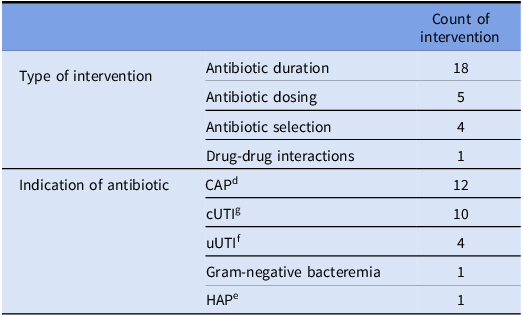
Approximately 2000 prescriptions were reviewed and 333 met inclusion criteria. Prescriptions from a comprehensive DMR site totaled 266 whereas 67 were from the targeted DMR site. We found an 8.4% overall pharmacist intervention rate at discharge. The comprehensive DMR sites had an intervention rate of 7.1% whereas a 13.6% intervention rate was seen at the targeted DMR site. Overall, there was a statistically significant difference in intervention rates between individual sites (Chi Squared P = .002), however, the numerical difference between the comprehensive and targeted DMR models was not statistically significant (Fisher’s exact test P = .15). Intervention types were similar between DMR methods. Common intervention types were pharmacists recommending a transition to an oral antibiotic based on microbial culture and susceptibilities available at the time of discharge, switching to a more highly bioavailable oral antibiotic, renal dose adjustments, aligning total DOT, and managing drug-drug interactions as provided in Table 2. Community-acquired pneumonia and cUTI accounted for the highest percentage of pharmacist interventions (46% and 39% respectively). Rates of discharge interventions standardized for prescription count were 17% for HAP, 15% for cUTI, 7% for CAP, 7% for uUTI, and 5% for Gram negative bacteremia.
Count of pharmacist interventions by type and indication

Table 2. Long description
A table with two rows and five columns. The first row contains the headers: Type of intervention and Count of intervention. The second row contains the headers: Indication of antibiotic and Count of intervention. The table is divided into two main sections: Type of intervention and Indication of antibiotic. Under Type of intervention, the rows are: Antibiotic duration with a count of 18, Antibiotic dosing with a count of 5, Antibiotic selection with a count of 4, and Drug-drug interactions with a count of 1. Under Indication of antibiotic, the rows are: CAP with a count of 12, cUTI with a count of 10, uUTI with a count of 4, Gram-negative bacteremia with a count of 1, and HAP with a count of 1.
dCommunity acquired pneumonia.
eHospital acquired pneumonia.
funcomplicated urinary tract infection.
gcomplicated urinary tract infection.
Forty-three percent of prescriptions for cUTI, 44% of prescriptions for CAP, 61% of prescriptions for Gram-negative bacteremia, 63% of prescriptions for uUTI, and 73% of prescriptions for HAP were found to be an appropriate total DOT based on the criteria in Table 1.
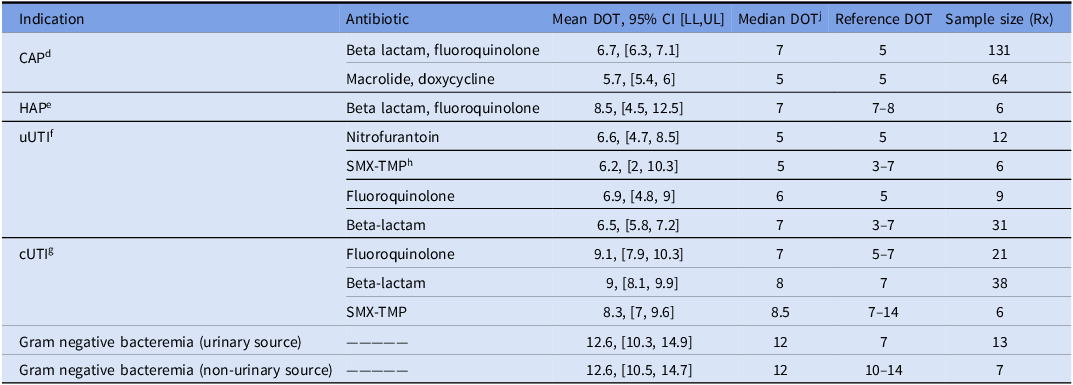
In the treatment of CAP, antibiotics in which the reference duration was outside of the mean DOT upper and lower limits included: beta lactam or fluoroquinolone (6.7 days, 95% CI [6.3, 7.1]), azithromycin or doxycycline (5.7 days, 95% CI [5.4, 6]) as shown in Table 3. Confirmed methicillin resistant Staphylococcus aureus or Pseudomonas aeruginosa pneumonia 7-day regimens were standardized to 5 days and azithromycin 500 mg IV/PO every 24 hours x3 days was standardized to a 5-day regimen (500 mg IV/PO x1 day followed by 250 mg IV/PO x4 days) for reporting.
Total durations of therapy prescribed by indication and antibiotic

Table 3. Long description
A table comparing the durations of therapy prescribed for various indications and antibiotics. The table has six columns: Indication, Antibiotic, Mean DOT with 95% CI, Median DOT, Reference DOT, and Sample size. Row 1: CAP, Beta lactam, fluoroquinolone, Mean DOT 6.7, 95% CI [6.3, 7.1], Median DOT 7, Reference DOT 5, Sample size 131. Row 2: CAP, Macrolide, doxycycline, Mean DOT 5.7, 95% CI [5.4, 6], Median DOT 5, Reference DOT 5, Sample size 64. Row 3: HAP, Beta lactam, fluoroquinolone, Mean DOT 8.5, 95% CI [4.5, 12.5], Median DOT 7, Reference DOT 7-8, Sample size 6. Row 4: uUTI, Nitrofurantoin, Mean DOT 6.6, 95% CI [4.7, 8.5], Median DOT 5, Reference DOT 5, Sample size 12. Row 5: uUTI, SMX-TMP, Mean DOT 6.2, 95% CI [2, 10.3], Median DOT 5, Reference DOT 3-7, Sample size 6. Row 6: uUTI, Fluoroquinolone, Mean DOT 6.9, 95% CI [4.8, 9], Median DOT 6, Reference DOT 5, Sample size 9. Row 7: uUTI, Beta-lactam, Mean DOT 6.5, 95% CI [5.8, 7.2], Median DOT 7, Reference DOT 3-7, Sample size 31. Row 8: cUTI, Fluoroquinolone, Mean DOT 9.1, 95% CI [7.9, 10.3], Median DOT 7, Reference DOT 5-7, Sample size 21. Row 9: cUTI, Beta-lactam, Mean DOT 9, 95% CI [8.1, 9.9], Median DOT 8, Reference DOT 7, Sample size 38. Row 10: cUTI, SMX-TMP, Mean DOT 8.3, 95% CI [7, 9.6], Median DOT 8.5, Reference DOT 7-14, Sample size 6. Row 11: Gram negative bacteremia (urinary source), Mean DOT 12.6, 95% CI [10.3, 14.9], Median DOT 12, Reference DOT 7, Sample size 13. Row 12: Gram negative bacteremia (non-urinary source), Mean DOT 12.6, 95% CI [10.5, 14.7], Median DOT 12, Reference DOT 10-14, Sample size 7.
dCommunity acquired pneumonia.
eHospital acquired pneumonia.
funcomplicated urinary tract infection.
gcomplicated urinary tract infection.
hSulfamethaxazole-trimethoprim.
JDuration of therapy.
For the treatment of uUTI, the reference duration was within the mean DOT upper and lower limits for all antibiotic selections. For the treatment of cUTI, antibiotics in which the reference duration was outside of the mean DOT upper and lower limits included: fluoroquinolone (9.1 days [7.9, 10.3]), and beta lactams (9 days, 95% CI [8.1, 9.9]). The four discharge prescriptions found to be an inappropriate antibiotic selection were all indicated for urinary tract infections and the targeted pathogens were resistant to the discharge antibiotic at the time of patient discharge and not reconciled by the prescriber or pharmacist at discharge.
Antibiotic selection for the treatment of Gram-negative bacteremia was not analyzed other than ensuring the antibiotic covered the targeted pathogen. For treatment of a urinary source Gram negative bacteremia, the mean DOT was 12.6 days, 95% CI [10.3, 14.9], and median of 12 days. DOT for bacteremia was assessed as number of days since blood culture clearance on pathogen-susceptible therapy.
Discussion
We saw similar intervention types between models indicating that pharmacists practice similarly between sites and intervene on similar issues at discharge. The rates of intervention between DMR methods were not significantly different, indicating that a more targeted approach may be a better utilization of pharmacist time and resources with similar outcomes on discharge prescriptions.
The rates of discharge interventions standardized for prescription count are higher than the overall health system pharmacist intervention rate in the indications of HAP and cUTI but still well below those reported in prior literature. Rates of appropriate duration were less than 70% for indications of cUTI, CAP, Gram negative bacteremia, uUTI indicate opportunity for realigning DOT at discharge and during inpatient admission if a patient is improving on therapy and is medically stable for discharge. Overall, these rates were similar to those reported by Mercuro et al in their preimplementation phase.
Indications where the reference DOT fell outside of the 95% CI of the mean DOT included CAP treated with a beta lactam, fluoroquinolone, doxycycline, or azithromycin; cUTI treated with a fluoroquinolone or beta lactam; and Gram-negative bacteremia of a urinary source. Notably the DOT for uUTI treated with a beta lactam is on the upper end of the reference DOT range of 3–7 days. This could be influenced by institutional guidelines recommending 7 days which is discrepant with national consensus guidelines recommending a range of 3–7 days of treatment. Regardless of source, Gram-negative bacteremia was treated with similar mean and median durations of therapy, potentially also due to the influence of institutional and national guideline discrepancies. High rates of appropriate antibiotic selection indicate appropriate adjustment of antibiotic based on antimicrobial culture and susceptibilities.
This review has several limitations. Due to retrospective analysis, it may be difficult to assess patient clinical improvement or other scenarios where a longer DOT may be clinically valid. Additionally, several indication and antibiotic pairings had less than 10 prescriptions included in analysis which include HAP, cUTI treated with SMX-TMP, uUTI treated with SMX-TMP, uUTI treated with fluoroquinolone, non-urinary source Gram-negative bacteremia. This review is also subject to reporting bias in relying upon pharmacists to self-document each intervention. DOT may be overestimated as it was calculated via total days supply of outpatient antibiotics plus days received as an inpatient. Overestimation may result if a discharge prescription was written several days prior to discharge and the patient was then separately educated to complete a specific duration of antibiotics (instead of taking all remaining pills). There was also no reconciliation of the aggregate number of days of antimicrobial therapy reduced by pharmacist intervention which could be an interesting estimate from a health system perspective. Also, criteria to evaluate antibiotic selection was limited and did not consider oral bioavailability or antibiotic concentration at the site of infection due to lack of guidance in institutional and national consensus guidelines. Finally, is the potential for site-level heterogeneity among the comprehensive intervention sites. Although sites were pooled to provide an overall comparison with the target site, individual site performance varied, suggesting that local factors may have influence results. As a result, aggregation of sites may have obscured differences observed at individual institutions. The small number of participating sites limited the feasibility of hierarchical or mixed-effects modeling to formally account for clustering.
The recording of a pharmacist intervention when multiple discharge prescriptions for the same indication and patient were sent to a discharge pharmacy was a novel way to help estimate pharmacist interventions in this study but could potentially overestimate true intervention rate by giving pharmacists credit for a change where they may not have been involved.
This study has several implications for ongoing clinical impact within this health system and other similarly structured systems. First, it highlights the need to continually update institutional guidelines (currently in process within this health system) and tailor them to well-defined criteria of the patient population. It also demonstrates the continued need for close attention during DMR, particularly in the reconciliation of outpatient DOT with the duration received while an inpatient. In this health system, stop dates placed on inpatient orders are automatically carried over to discharge prescriptions by the EHR if the same antibiotic is prescribed at discharge. Further electronic health record prompting and automation could be a partial stop gap solution to this problem. This review also makes apparent the need to automate the recording of pharmacist interventions within the electronic health record. Standardization of pharmacist intervention documentation will allow for continual tracking and subsequent process improvements.
In conclusion, this study emphasizes the opportunity for further pharmacist interventions based on the low rates of appropriate durations of therapy seen across the health system and builds on existing literature of real-world durations of therapy in selection antimicrobial indications. Accurate recording of pharmacist’s interventions continues to be an opportunity for automated integration within the electronic health record.
Acknowledgements
We acknowledge the contributions of Emeline Nemeth and Elizabeth Ruder (University of Minnesota-College of Pharmacy, PharmD students) to the data collection phase of this study including data recording, and quality control checks.
Author contribution
PA engaged in project conceptualization, data curation, formal analysis, investigation, methodology, writing—original draft. JR engaged in project conceptualization, data curation, formal analysis, investigation, methodology, writing—reviewing and editing.
Financial support
None reported.
Competing interests
All authors report no conflicts of interest relevant to this article.


 Open access

