Introduction
Evidence-based medicine is the combination of evidence-based research and clinical expertise.Reference Masic, Miokovic and Muhamedagic1 The evaluation of the quality of research conducted in the field of otolaryngology is strongly related to the recognition of the role of evidence-based medicine.Reference Wasserman, Wynn, Bash and Rosenfeld2 In an effort to provide tools for continuous improvement in the quality of patient care, databases based on otolaryngologists’ performance and research status could be used. The construction of such databases in the field of otolaryngology could impact the scientists’ work and contribution to the progress of their specialty.Reference Rijcke, Wouters, Rushforth, Franssen and Hammarfelt3,Reference Moed4 Consequently, scientific progress, efficient utilisation of the scientific workforce and research assessment contribute to increased patient safety and higher quality of the provided medical services.
Academic productivity is assessed for physicians pursuing leadership roles. Both the number of total citations and the h-index have been used to evaluate the academic impact of a scientist.Reference Hill, Boeckermann, Huwyler and Jiang5 The h-index is a calculated score, whereby a higher h-index is associated with higher academic productivity.Reference Hirsch6 A large-scale comparative evaluation of Greek scientists has been conducted using the Scopus database.Reference Ioannidis, Koutsioumpa, Vakka, Agoranos, Mantsiou and Drekolia7 ‘Brain drain’, the large-scale flow of highly educated individuals, specifically doctors from Greece over the last decades, has been well documented.Reference Ifanti, Argyriou, Kalofonou and Kalofonos8 This has also been the case for otolaryngologists born and raised in Greece who moved abroad for professional and academic reasons. No mapping effort for Greek otolaryngologists is available in the current literature. Thus, we created a database of Greek academic otolaryngologists, working both in Greece and abroad, including information beyond their academic output and rank, as well as their age, gender and location.
Understanding gender trends in otolaryngology is of importance. Female otolaryngologists are underrepresented both in residency and fellowship programmes, and tend to have a lower h-index and academic rank compared to male otolaryngologists of the same age.Reference Eloy, Svider, Chandrasekhar, Husain, Mauro and Setzen9,Reference Epperson, Gouveia, Tabangin, Takiar, Howell and Altaye10 Despite the continuous evolution in gender diversity in surgery, women still tend to be underrepresented in leadership positions in otolaryngology.Reference Choi and Miller11,Reference Johnson12 Analysis of the academic merit of female otolaryngologists, through meticulous observation of the database we have created, provides the simultaneous opportunity to examine the gender composition of otolaryngologists and evaluate their representation in leadership positions.
As no researcher works in a vacuum, it is important to assess the effect of the country of work on the academic output, and to evaluate the differences (if any) in the academic output and rank, age, and gender among otolaryngologists working in different countries. Although academic output is one of the most important factors in academic ranking, it is by no means the only one; hence, we assessed the relative importance of different factors influencing academic ranking.
The primary objective of this study was to provide descriptive data and a comparative evaluation of academic otolaryngologists. The secondary objective was to demonstrate gender, age and location-related differences among academic otolaryngologists, and to assess how they affect their academic ranking.
Materials and methods
Search strategy and selection process
The search for otolaryngologists was conducted using the Scopus database (Elsevier) between 1 December and 31 December 2022, based on the previous large-scale mapping of Greek scientists published in 2021.Reference Ioannidis, Koutsioumpa, Vakka, Agoranos, Mantsiou and Drekolia7,Reference Baas, Schotten, Plume, Côté and Karimi13 The search strategy aimed to capture Greek otolaryngologists who had their current affiliation in Greece or in another country, and had at least one Scopus-indexed article. Researchers working in otolaryngology-associated fields, such as facial plastic surgery, maxillofacial surgery, speech pathology and audiology, and researchers who had published articles referring to ENT disorders but did not pursue a career in otolaryngology were excluded. All the names of otolaryngologists that seemed to be of Greek origin were assessed for suitability for inclusion by two authors (PK and AP). Examination of additional sources (databases or institutional websites) was retrieved for otolaryngologists whose origin was not clear only by the available data in the Scopus database, so as to avoid missing potentially eligible names. When data were felt to have been duplicated, the most recent affiliation was taken into account.
Data collection process
A data extraction template was prepared (using Microsoft Office Excel® spreadsheet software), which included the name, age, gender and academic rank (professor, associate professor, assistant professor, lecturer) of the otolaryngologist, the country of work, the institution of the listed affiliation, the total citations, and the h-index. The country of work, the institution and academic productivity, the latter of which was defined in our study as the number of citations and the h-index, were determined according to the Scopus database. If the Scopus database did not refer to the location, it was identified through the provided affiliation. Data on age, gender and academic rank were obtained from individuals’ own professional websites or institutional websites.
Thus, a database was created of Greek academic otolaryngologists, with stratification based on the number of total citations. The first name in the rank of our database referred to the otolaryngologist with the highest number of total citations. The following ranks were appropriately configured. In the case of individuals with the same number of total citations, the h-index was used for ranking. To be more precise, for two otolaryngologists with the same number of total citations, the one with the higher h-index was listed first in the database. Additionally, in the presence of the same number of total citations and h-index simultaneously, the allocation in the database was performed randomly. The number of total citations and the h-index were recorded between 30 December and 31 December 2022 for all the included otolaryngologists in the database. Our aim was to reduce the presence of potential significant deviations in the ranking among otolaryngologists if new citations of their published articles were added.
Statistical analysis
The statistical analysis was conducted using SPSS software version 21.0 (IBM, Armonk, New York, USA). The outcomes were calculated using an analysis of variance, after inspecting the data for normality and homoscedasticity. A linear regression was performed to assess the relative importance of several factors influencing academic ranking. A p-value of less than 0.05 was considered to be statistically significant.
Results
A total of 276 Greek academic otolaryngologists were identified through our search in the Scopus database.
Location
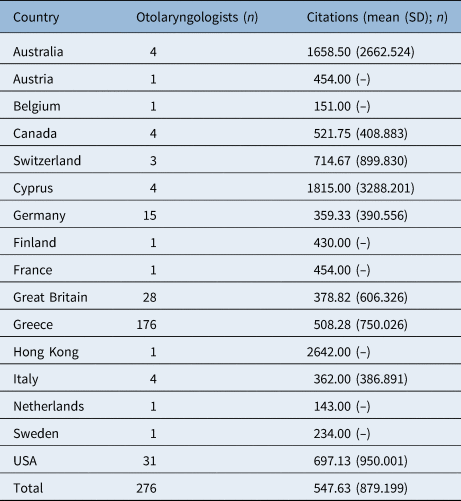
The vast majority of Greek academic otolaryngologists who have published at least one Scopus-indexed article are based in Greece (63.8 per cent). The second biggest group is based in the USA (11.2 per cent), followed closely by Great Britain (10.1 per cent) and Germany (5.4 per cent). Data on the country of work of Greek otolaryngologists are summarised in Table 1.
Country of work of Greek academic otolaryngologists

Age and gender
Of the top-ranked Greek academic otolaryngologists, 15.9 per cent were women. Data regarding age are missing for 152 individuals. The mean age of the remaining otolaryngologists is 53.9 years (standard deviation = 11.5, range of 33–82 years); the women are slightly younger than the men (mean age of 47.2 vs 54.8 years).
Academic rank
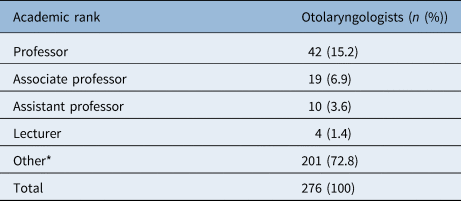
Seventy-five of the 276 otolaryngologists (27.1 per cent) hold a university position; of these, 42 (15.2 per cent) are professors, 19 (6.9 per cent) are associate professors, 10 (3.6 per cent) are assistant professors, and 4 (1.4 per cent) are lecturers (Table 2). However, women are vastly underrepresented in academic positions, with only 4 (5 per cent) of all academic posts awarded to women, despite women representing 15.9 per cent of cited Greek otolaryngologists (p = 0.002) (Figure 1). The average age of the Greek academic otolaryngologists is highest in those located in Greece (60.5 years), followed by Cyprus at 52 years, and then by the USA at 51 years, and the lowest is identified in Canada at 34 years (p = 0.02).
Academic rank of Greek otolaryngologists

* Clinical or research positions without possession of a university post
Gender representation of Greek otolaryngologists in academic and non-academic positions.

Citations and h-index
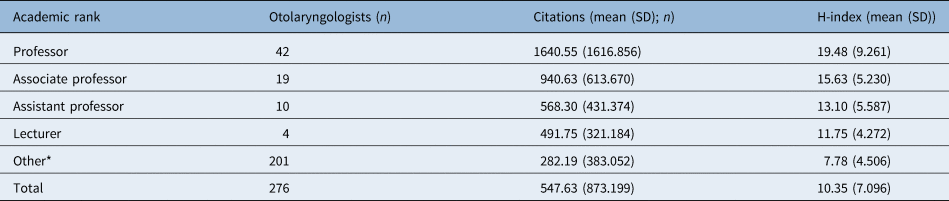
The mean number of citations and h-index by the academic ranking are shown in Table 3.
Stratification of citations and h-indexes of Greek otolaryngologists by academic rank

* Clinical or research positions without possession of a university post. SD = standard deviation
Main findings
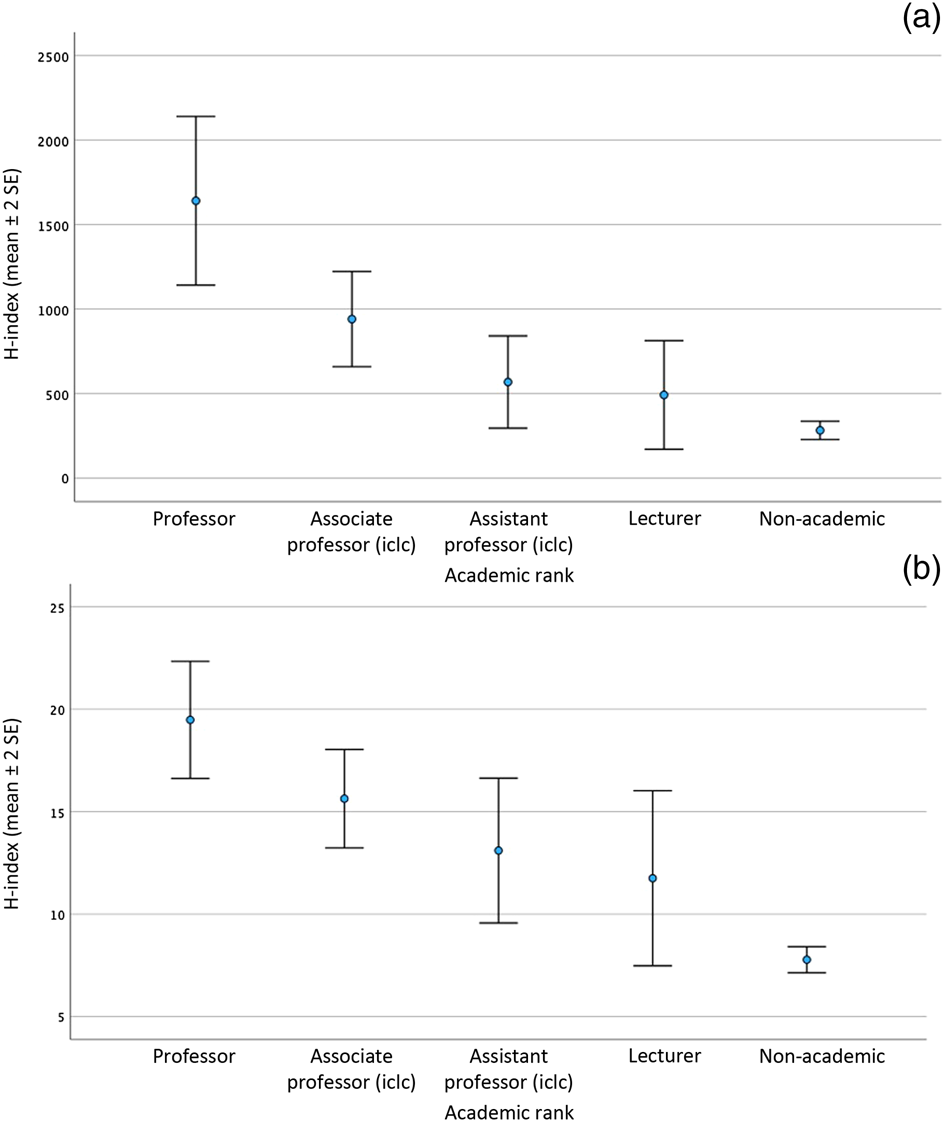
As expected, there is a strong correlation between academic ranking and citations (p < 0.001), as well as between academic ranking and h-index (p < 0.001). However, the strength of the correlation is stronger for h-index than for citations (R = 0.626 vs R = 0.550). The mean and the standard error of mean of the h-index and citations per ranked position are shown in Figure 2. Age is strongly correlated with: number of citations (R = 0.249, p = 0.03), with h-index (R = 0.293, p < 0.01), and even more with academic ranking (R = 0.325, p < 0.01). There are also significant differences in the mean number of citations and h-index according to the country of work. As shown in Tables 4 and 5, average citations are highest in Hong Kong, followed by Cyprus, Australia, Switzerland and USA. Although 63.8 per cent of all Greek academic otolaryngologists are based in Greece, only 3 of the top 10 cited or h-indexed otolaryngologists have a Greek institutional affiliation. The 10 top-cited otolaryngologists (ranked from highest to lowest) are based in Cyprus, Greece, Australia, Greece, USA, USA, Greece, United Kingdom, USA and Hong Kong.
(a) Mean and standard error of mean (SEM) of total citations per ranked position, and (b) mean and SEM of h-index per ranked position. SE = standard error

Stratification of citations of Greek otolaryngologists by country of work

SD = standard deviation
ANOVA of relationship between citations and country of work

ANOVA = analysis of variance; df = degrees of freedom
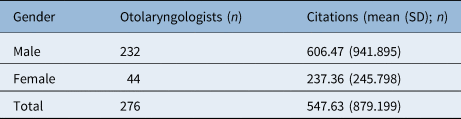
Gender is also a factor influencing both academic ranking and academic productivity. The mean number of citations of female Greek academic otolaryngologists is almost one-third that of males (237.36 vs 606.47, p = 0.01). Data on gender and academic productivity are shown in Tables 6 and 7.
Stratification of citations of Greek otolaryngologists by gender

SD = standard deviation
ANOVA of relationship between citations and gender

ANOVA = analysis of variance; df = degrees of freedom
We additionally tried to assess the effect of age, citations, location and gender on academic ranking. However, given the small number of Greek female otolaryngologists (n = 4) in academic posts, it was difficult to specifically assess the effect of citations, location and age.
We applied logistic regression modelling to further examine academic ranking, adjusting for all potential factors (age, gender, location, h-index, number of citations). The use of h-index and age provided a good model fit that explained almost 65 per cent of the total variability (R = 652, p < 0.001), while gender, citations and location were excluded from the model (stepwise regression).
Discussion
This is the first study to map Greek academic otolaryngologists (local and diaspora). More than half of Greek academic otolaryngologists are based in Greece. The majority of them are pursuing a career in otolaryngology in clinical or research positions, but do not possess an academic post. Academic otolaryngologists have a significantly higher number of total citations and a higher h-index compared to otolaryngologists working in positions independent from academic institutions. It is not surprising that there is a clear, linear association between the level of academic position and the number of total citations and h-index, with the average number of citations ranging from 1640 for professors to 492 for lecturers. Interest in academic positions among otolaryngology residents seems to be increasing, and more and more residents plan to pursue an academic career.Reference Rosenberg, Kelley, Dowdall, Replogle, Liu and Raol14
Otolaryngologists working in the diaspora have a higher mean number of citations compared with local otolaryngologists. This trend is even more visible in the highest-ranked otolaryngologists, with only 3 out of the 10 most cited otolaryngologists working in Greece. Cyprus, the USA and Great Britain seem to be the countries where these otolaryngologists are located. This finding might be associated with the ‘brain drain’ process, which has affected many scientific fields, including otolaryngology.Reference Ioannidis, Koutsioumpa, Vakka, Agoranos, Mantsiou and Drekolia7,Reference Ifanti, Argyriou, Kalofonou and Kalofonos8 The results regarding otolaryngologists’ country of work might reflect the migration trends of Greek society, both in the past and in the present.Reference Clogg15 Greek diaspora has been an entity since Homeric times. In the modern era and especially after World War II, Greeks departed from traditional homelands, both for economic and political reasons, to earn a living in a new country. Countries like the USA, Great Britain, Germany and Australia became the home of the Greek diaspora. Residents and consultants continue to leave Greece, temporarily or permanently, to pursue a career in a country with more scientific opportunities.Reference Anastasakis, Nicolaidis, Pratsinakis, Anastasakis, Pratsinakis, Kalantzi and Kamaras16 The higher productivity of Greek otolaryngologists in Great Britain over Germany demonstrates that Great Britain is probably the most popular European destination for Greeks who want to develop an academic output.
Another important factor is the difficulty in promoting research in Greece, as journals might be biased towards English-speaking researchers, increasing difficulties in presenting and promoting academic work. Research funding and opportunities in Greece have been severely curtailed during the years of financial crisis.Reference Vrachnis, Vlachadis, Iliodromiti, Valsamakis and Creatsas17 More direct collaboration and an extrovert outlook are vital, and have been shown to reduce the negative impact of reduced research opportunities and to encourage research in Greece.Reference Vrachnis, Vlachadis, Deligeoroglou, Mastorakos and Iliodimiti18 The Greek diaspora is an obvious and the easiest way to build bridges and achieve this goal, by enabling mutually beneficial collaboration that could help to extinguish such discrepancies. This could include, without being limited to, sharing research projects, participating in multi-centre studies, sharing doctoral (PhD) and/or post-doctoral research, and being appointed in clinical and research fellowships.
Our study found that women are inappropriately represented in otolaryngology. Female otolaryngologists have a statistically significantly lower number of citations compared to their male counterparts. This finding is in accordance with other studies which reported that female members are underrepresented in otolaryngology societies.Reference Choi and Miller11,Reference O'Connell Ferster and Hu19–Reference Eloy, Blake, D'Aguillo, Svider, Folbe and Baredes24 In an effort to explain gender differences among otolaryngologists, some assumptions can be made. As more women have entered medicine in general and otolaryngology in particular in recent years, the average graduation year of women otolaryngologists is more recent, resulting in fewer research-productive years than men. This assumption is partly validated by the fact that the average age of women otolaryngologists in our study is indeed slightly lower than that of men.
Moreover, gender seems to be associated with career advancement. Raising children without adequate state and institutional support places an additional burden, and possibly delays career advancement and reduces academic productivity. Women in otolaryngology and other fields of medicine feel that having children negatively affected their careers.Reference Epperson, Gouveia, Tabangin, Takiar, Howell and Altaye10,Reference Carr, Ash, Friedman, Scaramucci, Barnett and Szalacha25 Data on women's representation in leadership positions demonstrate that while women are proportionately represented among programme directors, they are underrepresented as department chairs.Reference Smith, Chiu, Sykes, Eck, Hierl and Villwock22 The leadership still seems to remain predominately male, even though evidence shows that women are equally effective.Reference Rosser26 Eloy et al. reported that men in all specialties have higher research productivity across all ranks.Reference Eloy, Svider, Chandrasekhar, Husain, Mauro and Setzen9 Men in otolaryngology have statistically significantly higher h-indexes compared to their female counterparts.Reference Eloy, Svider, Chandrasekhar, Husain, Mauro and Setzen9 However, women in otolaryngology seem to have more difficulty in publishing their research compared to men, as shown in a recent Canadian study.Reference Mavedatnia, Payandeh, Neocleous, Davidson, Dzioba and Strychowsky27 Female representation is expected to increase through the years, as more women seem to enter medical school and more barriers impairing their advancement are lifted. Indeed, a greater percentage of women seem to follow surgical residency than in the past.Reference Okafor, Tibbetts, Shah, Tillman, Agan and Halderman21,Reference Chorfi, Schwartz, Young, Joseph and Nguyen28 Therefore, monitoring female representation in otolaryngology will ensure equal gender representation both in residency and in leadership positions.
• This is the first study to map Greek academic otolaryngologists (local and diaspora)
• Academic productivity was assessed for physicians pursuing leadership roles
• Academic otolaryngologists have a significantly higher number of total citations and a higher h-index compared to otolaryngologists working in positions independent from academic institutions
• Despite the continuous evolution in gender diversity in surgery, women remain underrepresented in leadership positions in otolaryngology
• Female otolaryngologists have a statistically significantly lower number of citations compared to male counterparts
There are no historical data on the evolution of female participation in otolaryngology in Greece. Data from Canada demonstrate a 13 per cent increase in the female proportion of otolaryngologists over an almost 18-year period.Reference Fu, Wu, Campisi, Witterick and Chan23 It is encouraging to see that the number of female otolaryngologists seems to increase through the years, promoting equality in medicine. Future studies based on gender proportions of Greek otolaryngologists could permit a comparative evaluation to be conducted. Addressing disparities in representation requires action. Removing the obstacles that prevent career advancement could result in a larger proportion of women in otolaryngology. Mentorship for female otolaryngologists could empower women's academic productivity and support women in leadership positions.Reference Shrestha29 A culture of inclusivity is vital. Training programmes during residency should promote equality in medicine, an interest in research, and collaborations with other institutions. There is evidence that programmes which provide diversity and inclusion initiatives tend to have more female residents.Reference Smith, Chiu, Sykes, Eck, Hierl and Villwock22
The main limitation of this study is associated with potential missing names of otolaryngologists. Although the first name, last name, country of work and institution of work were assessed meticulously by two authors (PK and AP) to identify if the otolaryngologist was of Greek origin or not, some otolaryngologists' names may have been missed. Moreover, we assessed academic rank and productivity through the academic position and the number of citations and h-index respectively. Other aspects such as participation in teaching, committees and clinical leadership roles are also very important. However, objective and measurable numeric data on such factors are much more difficult, if not impossible, to gather and compare. Exact data on the age of otolaryngologists could not be retrieved from the individuals’ own professional websites or institutional websites for all of the otolaryngologists included in the database.
Conclusion
Our study aimed to map academic otolaryngologists, working both locally and in the diaspora. There are significant age, gender and location-based differences in terms of both academic output and ranking. Overcoming these discrepancies will require active measures to help nurture a culture of openness and collaboration, between local and diaspora scientists. The representation of women and the full use of their potential in medicine require proactive measures to lift the burdens limiting their participation and development. Being the first in the field, our study could be used as a baseline to monitor progress over the coming years.
Competing interests
None declared