INTRODUCTION
Home range was described by Burt (Reference Burt1943) as ‘the area traversed by the individual in its normal activities of food gathering, mating, and caring of young’. Recently, Powell (Reference Powell, Boitani and Fuller2000) defined home range as a ‘fairly confined area where animals enact their day-to-day activities’. The size of an animal's home range is usually correlated with habitat heterogeneity, productivity and the biological requirements of a species (McNab, Reference McNab1963). Most animals do not use their entire home range with equal intensity, but tend to concentrate their time in particular areas (Dixon & Chapman, Reference Dixon and Chapman1980; Samuel et al., Reference Samuel, Pierce and Garton1985). These particular sectors of an animal's home range are called core areas and usually are associated with greater density of resource. As a consequence, they will be used more than expected by random use (e.g. Samuel et al., Reference Samuel, Pierce and Garton1985; Powell, Reference Powell, Boitani and Fuller2000).
Methods to estimate home ranges have been used for decades. From location data, most home range estimators produce a utility distribution (UD) describing the intensity of use of different areas by an animal (Powell, Reference Powell, Boitani and Fuller2000). Thus, the UD maps intensity of use and can be transformed to a probabilistic model of home range which describes the relative amount of time an animal spends in any place (Seaman & Powell, Reference Seaman and Powell1996; Powell, Reference Powell, Boitani and Fuller2000). Both parametric and non-parametric methods have been used to estimate the UD (Worton, Reference Worton1989). The kernel density estimator (see Silverman, Reference Silverman1986), introduced to ecologists as a home range estimator by Worton (Reference Worton1989), is one of the best non-parametric statistical methods to estimate probability densities because of its robustness and large applicability (Seaman & Powell, Reference Seaman and Powell1996; Seaman et al., Reference Seaman, Millspaugh, Kernohan, Brundige, Raedeke and Gitzen1999; Powell, Reference Powell, Boitani and Fuller2000).
A considerable amount of studies regarding cetacean use of area are based on the application of the photo-identification technique (Würsig & Würsig, Reference Würsig and Würsig1977; Hammond et al., Reference Hammond, Mizroch and Donovan1990), which allows the identification of individuals through time and space. Naturally marked individuals provide important information on cetacean ranging patterns (e.g. Connor & Smolker, Reference Connor and Smolker1985; Wells et al., Reference Wells, Scott, Irvine and Genoways1987; Bigg et al., Reference Bigg, Olesiuk, Ellis, Ford, Balcomb, Hammond, Mizroch and Donovan1990; Würsig & Harris, Reference Würsig, Harris, Leatherwood and Reeves1990; Herzing, Reference Herzing1997; Marten & Psarakos, Reference Marten and Psarakos1999; Santos et al., Reference Santos, Acuña and Rosso2001). Flores & Bazzalo (Reference Flores and Bazzalo2004) were the first to estimate home ranges of Guiana dolphins, Sotalia guianensis (Van Bénéden, 1864), in a long-term study conducted in Baía Norte (27°S), Santa Catarina State, Brazil. Although several other studies described Guiana dolphins' range patterns and habitat use (e.g. Rossi-Santos et al., Reference Rossi-Santos, Wedekin and Sousa-Lima2006; Azevedo et al., Reference Azevedo, Oliveira, Viana and Sluys2007; Wedekin et al., Reference Wedekin, Daura-Jorge, Piacentini and Simões-Lopes2007), most used group location to detect habitat ‘preferences’ or ranges of the investigated populations. Individuals within a particular population can differ greatly in ranging patterns (Defran et al., Reference Defran, Weller, Kelly and Espinosa1999) and may shift between local site-fidelity and longer movements away from the site where they were first identified (Würsig & Würsig, Reference Würsig and Würsig1979; Wells et al., Reference Wells, Hansen, Baldridge, Dohl, Kelly, Defran, Leatherwood and Reeves1990; Würsig & Harris, Reference Würsig, Harris, Leatherwood and Reeves1990; Bearzi et al., Reference Bearzi, Notarbartolo-Di-Sciara and Politi1997). A low number of studies explored individual home ranges of S. guianensis using the minimum convex polygon (e.g. Flores & Bazzalo, Reference Flores and Bazzalo2004; Hardt, Reference Hardt2005; Rossi-Santos et al., Reference Rossi-Santos, Wedekin and Monteiro-Filho2007; Batista, Reference Batista2008) and the kernel density estimator (e.g. Flores & Bazzalo, Reference Flores and Bazzalo2004; Hardt, Reference Hardt2005). It would be recommendable to invest more efforts to conduct such studies along this poorly known cetacean species distribution.
Sotalia guianensis dwell in coastal and estuarine waters of the western South Atlantic, from southern Brazil to Honduras (Flores & da Silva, Reference Flores, da Silva, Perrin, Würsig and Thewissen2009). In the Cananéia estuary (25°S), located in south-eastern Brazil, S. guianensis has been the focus of several studies since the end of the 1990s (e.g. Santos et al., Reference Santos, Rosso, Siciliano, Zerbini, Zampirolli, Vicente and Alvarenga2000, Reference Santos, Acuña and Rosso2001; Santos & Rosso, Reference Santos M.C. and Rosso2007, Reference Santos M.C. and Rosso2008). Due to its ecological relevance, the Cananéia estuary was designated as a protected reserve in the 1980s (Schaeffer-Novelli et al., Reference Schaeffer-Novelli, Mesquita and Cintrón-Molero1990). However, in recent years part of this ecosystem has been threatened by non-regulated tourism activities and destruction of mangroves for housing. Understanding the way S. guianensis uses its area is an important tool to plan management and conservation actions. Therefore, the aim of this study was to investigate spatial patterns of use and estimate core areas and home range sizes of Guiana dolphins in the Cananéia estuary.
MATERIALS AND METHODS
Study area
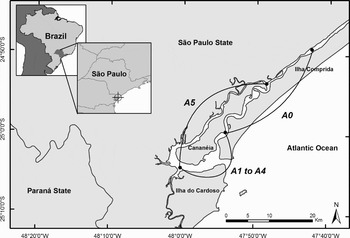
The Cananéia estuary (25°03′S 47°55′W) is located on the southern coast of São Paulo State, Brazil, and the surveyed area included the waters encircling the Cananéia Island (Figure 1). The 132 km2 surveyed area was divided into three smaller sub-sets known as A0, A1–A4, and A5. There are no physical barriers isolating the quoted sub-areas, which were stratified in order to cover the entire estuarine area where dolphins can be found in a lesser amount of days. Based on their sizes and daylight time available for observations, sub-areas A1 to A4 were surveyed on the same day, and A0 and A5 on two other separate days. A1–A4 were surveyed from 2000 on, A0 from 2001 on and A5 from 2002 on.
Map showing the Cananéia estuary in the southern limit of São Paulo State, Brazil. Subareas A1–A4, A0 and A5 were surveyed in distinct days from 2000 to 2003. Black dots are the limits of subareas.

Data collection
Field work was conducted from May 2000 to July 2003. Efforts were unevenly distributed in time and space. Small motor-powered boats (15 and 30 hp) were used to survey subareas in zigzag movements to find as many groups of dolphins as possible. Surveys were conducted in Beaufort sea states from 0 to 2. When an individual dolphin or a group of dolphins was found, the boat approached the animal(s) in a parallel orientation for the photo-identification efforts. Group/individual position was collected with a GPS using datum WGS 84. On most occasions, all individuals in a group including calves were photographed using a 35-mm reflex camera with a 300 mm zoom lens and ISO-400 colour printed films. Pictures were taken at distances ranging from 2 to 15 m. Photo analyses protocols followed the methodology described by Santos & Rosso (Reference Santos M.C. and Rosso2008). Individuals with distinct notches on the dorsal fin border which allowed re-sightings were catalogued. Catalogued individuals were identified as females based on long-term observations (≥5 identifications in different months) during which they were in close companionship with calves (echelon position sensu Mann & Smuts, Reference Mann and Smuts1999) yet isolated from other individuals. In contrast, animals were identified as ‘possible males’ after long-term observations (≥5 identifications in different months over a 3-year period) during which they were not observed with calves (Santos & Rosso, Reference Santos M.C. and Rosso2008). The sex of the KN#86 individual was determined using molecular genetic procedures based on skin samples obtained with an adapted 80-pound crossbow. Details on the DNA analyses are described in Santos & Rosso (Reference Santos M.C. and Rosso2008).
Data analysis
Using ArcGIS® 9.2 edition tools, a cartographic base was created in digital format by manual vectorial edition from remote sensing products ETM + /Landsat-7, orbit 220/77, dated from 26 September 1999, projected coordinate system WGS 84–22S zone. A shape file was created for each photo-identified Guiana dolphin with 20+ geographical locations collected in distinct dates. If a dolphin was photographed more than once in a day, only the first sighting was used for analyses to avoid auto-correlation of data. The home range for each individual was calculated using the extension Home Range Tools (HRT) version 1.1 in the ArcGIS® 9.2. The HRT software is an ArcGIS® version of the Home Range Extension (HRE) for ArcVIEW 3.1. The HRT extends ArcGIS® to analyse home ranges of animals and is available from http://blue.lakeheadu.ca/hre/ (Rodgers et al., Reference Rodgers, Carr, Beyer, Smith and Kie2007). The HRT extension also permits the determination of the output UD raster form, so raster cell size was defined as 100 m and scaling factor as 1,000.000. The fixed kernel density estimator using the least squares cross-validation (LSCV) to choose the band width was performed to calculate the utilization UD. The fixed kernel keeps band width (h) constant for a data set (see Powell, Reference Powell, Boitani and Fuller2000). Isopleths of 95%, 50% and 25% (UD contours) of the home ranges were generated to compare sizes of the areas and their possible cores. The home range areas usually had parts estimated on land due to the proximity of several location points to shallow waters and mangrove borders. Areas which overlapped with land were extracted using the tool ERASE from the ArcGIS®.
RESULTS
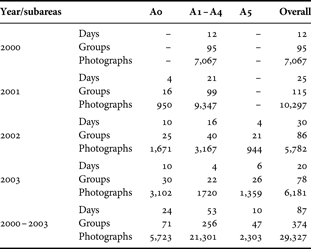
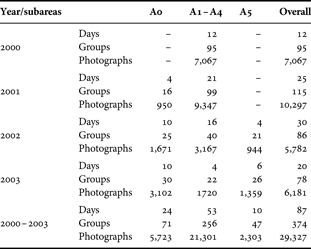
A total of 374 groups of Guiana dolphins, ranging from 2 to 60 dolphins per group, were photographed in 87 survey days (Table 1). A total of 29,327 photographs were analysed, from which 6,312 (21.5%) were considered useful for identification purposes.
Efforts invested in photo-identification studies of Guiana dolphins (Sotalia guianensis) in the Cananéia estuary, Brazil. The number of survey days, sighted groups and photographs taken are described by subarea between 2000 and 2003.
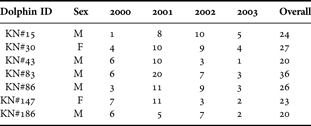
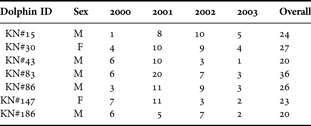
From a total of 138 catalogued individuals, only 7 (5.1%) were photographed on 20+ distinct occasions and thus were selected for home range analyses. Their identification numbers and sighting history are detailed in Table 2.
Gender and number of locations recorded for seven Guiana dolphins (Sotalia guianensis) photo-identified between 2000 and 2003 in the Cananéia estuary, Brazil.
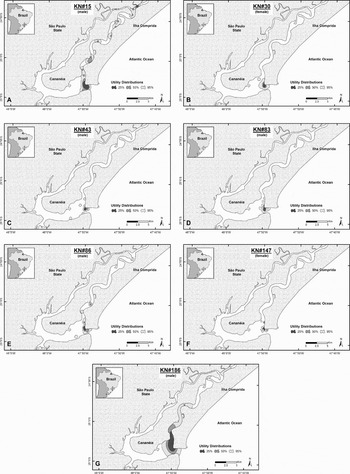
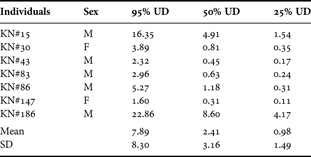
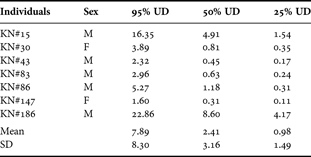
The 95% home range estimated outlines varied from 1.6 to 22.9 km2 (Table 3). The largest ranging area was 22.9 km2 and the smallest one was 1.6 km2, regarding a male and a female, respectively. Estimated areas for males varied from 2.3 to 22.9 km2, and for females varied from 1.6 to 3.9 km2. In both cases these areas were estimated using the 95% UD. Data on 50% and 25% UD are shown in Table 3. All home range polygons are shown in Figure 2 A–G. The polygons created had usually an amoeboid shape and in some cases more than one centre of activity.
(A–G) Home ranges of seven Guiana dolphins (Sotalia guianensis) monitored from 2000 to 2003 in the Cananéia estuary, Brazil.

Home ranges of seven Guiana dolphins (Sotalia guianensis) individually identified from 2000 to 2003 in the Cananéia estuary, Brazil. Columns indicate respectively individual identification, sex and the home range area (km2) represented by the 95%, the 50% and 25% utility distributions (UDs).
DISCUSSION
Although the presented results were based on a relatively small number of monitored dolphins (N = 7), it is the first assay estimating individual Guiana dolphins home ranges in the Cananéia estuary based on a short-term photo-identification effort from 2000 to 2003. Those results were gathered in a large area of ~132 km2, which can be fully monitored in three distinct days using one boat, where the local abundance of dolphins reaches ~300 to 400 individuals and using developed films and older reflex cameras which rendered almost 30,000 photographs to be analysed. It is also important to consider the low rate of useful photographs (21.5%) when dealing with a shy small cetacean species such as S. guianensis. In a catalogue composed of 138 individuals, only seven adults showed 20+ sightings in distinct dates after 87 fielding days. Based on this scenario, in this first assay using S. guianensis sightings in the Cananéia estuary, emphasis was given in investing efforts on careless steps to evaluate home range areas (see Data Analysis section), as well as comparing the observed home range sizes with several other studies using the same technique and methods. As only two females were included in the analyses, comparisons involving gender were avoided based on small sample size.
The kernel density estimator was chosen for these first observations in Cananéia because it is considered the best estimator available for estimating home ranges (see Seaman & Powell, Reference Seaman and Powell1996; Seaman et al., Reference Seaman, Millspaugh, Kernohan, Brundige, Raedeke and Gitzen1999; Powell, Reference Powell, Boitani and Fuller2000). It produces an unbiased density estimate directly from data and it is not influenced by grid size or placement (Silverman, Reference Silverman1986). The minimum convex polygon estimator is still being used and remains as a commonly applied technique mostly for comparisons to previous studies and due to its ease of calculation (see Seaman & Powell, Reference Seaman and Powell1996; Seaman et al., Reference Seaman, Millspaugh, Kernohan, Brundige, Raedeke and Gitzen1999; Flores & Bazzalo, Reference Flores and Bazzalo2004). However, comparisons to previous work are unreliable given the extreme sensitivity to sample size by the minimum convex polygon, which also ignores the information provided by interior data points and produces only crude outlines of animals' home ranges (Powell, Reference Powell, Boitani and Fuller2000).
It is possible to observe differences of the values of the estimated areas in four different regions of the Guiana dolphins' distribution in Brazil. Individual home range areas observed for Guiana dolphins in the Cananéia estuary varied from 1.6 to 22.9 km2. The results presented by Flores & Bazzalo (Reference Flores and Bazzalo2004) in Baía Norte showed home ranges varying from 5.4 to 21.5 km2 with the minimum convex polygon, and from 12.6 to 19.6 km2 using the kernel density estimator. In Baía da Babitonga (26°S), Santa Catarina State, home ranges of Guiana dolphins varied from 1.6 to 25.7 km2 using the minimum convex polygon, and from 4.3 to 91.5 km2 with the kernel estimator (Hardt, Reference Hardt2005). Using the minimum convex polygon, Batista (Reference Batista2008) found a variation from 1 to 8.7 km2 on home ranges observed for Guiana dolphins found in the Rio Paraguaçu estuary (12oS), Bahia State, Brazil. The use of different estimators and different minimum number of sightings may have partially influenced those differences. Other factors such as local habitat characteristics, food availability in time and space, population abundance and individual variations based on age and sex may also have influenced the observed differences. Standardization of analyses will surely be of some help in further comparisons. Differences among home range sizes have already been discussed for bottlenose dolphins. Gubbins (Reference Gubbins2002) found smaller home ranges when studying Tursiops truncatus in South Carolina, compared with bottlenose dolphins observed in Texas (Würsig & Lynn, Reference Würsig and Lynn1996) and Florida (Wells, Reference Wells, Pryor and Norris1991). Gubbins (Reference Gubbins2002) assumed that the smaller home ranges observed could indicate abundant food uniformly distributed in space and time.
The minimum number of sightings to estimate individual S. guianensis home ranges varied from 10 (Hardt, Reference Hardt2005; Batista, Reference Batista2008) to 33 (Flores & Bazzalo, Reference Flores and Bazzalo2004) and maximum from 18 (Batista, Reference Batista2008) to 53 (Flores & Bazzalo, Reference Flores and Bazzalo2004). In the present study, the numbers of sightings ranged from 20 to 36. Mares et al. (Reference Mares, Willig and Bitar1980) and Schoener (Reference Schoener1981) suggested that a minimum number of 20–25 sightings per individual would be important to ensure independence of home range area from sample size. Home range estimations are significantly affected by sample size and by the estimator used. Thus, a greater sample size can result in a more precisely estimated home range (see Seaman & Powell, Reference Seaman and Powell1996; Seaman et al., Reference Seaman, Millspaugh, Kernohan, Brundige, Raedeke and Gitzen1999; Powell, Reference Powell, Boitani and Fuller2000; Owen et al., Reference Owen, Wells and Hofman2002). Several of the relatively small home ranges found in this study may be underestimated. Further investigations are possible to be conducted with a broader sample size in the Cananéia estuary as the monitoring programme has continued.
When comparing the quoted studies on small cetacean home ranges, it was possible to detect that T. truncatus showed larger home ranges when compared to the areas regarding S. guianensis. Are those differences simply the product of the influence of species' size? Detailed investigations should be conducted to compare the size of home ranges of different cetacean species in order to detect the main factors driving such differences. Previous studies on ecological aspects regarding S. guianensis showed individual site fidelity in several areas of the species distribution (e.g. Santos et al., Reference Santos, Acuña and Rosso2001; Azevedo et al., Reference Azevedo, Oliveira, Viana and Sluys2007). It is likely that there is a tendency for individuals of this species to use relatively smaller areas when compared to other cetacean species such as bottlenose dolphins.
The UDs showed location points concentrated in the main entrance of the Cananéia estuary, which could reflect the emphasis on efforts given to the subareas A1–A4 in the first year of the survey. Efforts were evenly distributed since 2002 in order to minimize the effects of a non-uniformly distributed investigation. After expanding the monitored areas, no consistent differences on sighting locations were observed for the seven monitored individuals presented herein.
Home ranges may change in time and space and such dynamics require continuous observations for a better understanding of the ecological factors underlying their establishment. Animals are capable of having cognitive maps of where they live (Peters, Reference Peters, Hall and Sharp1978) and such maps must change as the animal learns about its environment, hence, the maps change with time. As new resources are discovered and old ones disappear, the cognitive map may change, as well as the home range (Powell, Reference Powell, Boitani and Fuller2000). Thus, home ranges may represent a transitory situation of a determined length of time and this is why a continuous monitoring of this population of Guiana dolphins inhabiting the Cananéia estuary is important.
Using satellite tags should be an important step to explore the dynamics regarding S. guianensis' home ranges, rendering precise short-term information on location points with a smaller amount of efforts when compared to photo-identification in a large habitat and considering a population of hundreds of dolphins. The use of coastal waters is another important issue that deserves further attention because movements outside the estuary may represent important components for several monitored dolphins. Thus, further investigations in coastal waters could add important pieces to the puzzle on Guiana dolphins' home ranges. Regarding conservation issues, these results suggest that awareness for tourists and boat owners should be important as the main entrance of the Cananéia estuary usually shelters large aggregations of Guiana dolphins and hosts the main area of usage of several monitored dolphins. Coastal dolphins can be good indicators for examination of pollutant or disease vectors in nearshore habitats (Moore, Reference Moore2008). Therefore, considering the small range of S. guianensis distribution and its fidelity to some estuaries and shallow waters, this species could be seen as sentinel of marine ecosystem changes (e.g. Moore, Reference Moore2008) which provides an important tool to guide conservation and management activities in the Cananéia estuary and in other parts of its distribution.
ACKNOWLEDGEMENTS
Logistic support was provided by the Instituto Oceanográfico da Universidade de São Paulo. We also thank the referees who provided important comments for the improvement of the final text. The Whale and Dolphin Conservation Society, the Society for Marine Mammalogy, the Earthwatch Institute and the Cetacean Society International financially supported Guiana dolphins' photo-identification studies in the Cananéia estuary. Marcos Santos received grants from Fundação de Amparo à Pesquisa do Estado de São Paulo (FAPESP) to conduct his doctoral studies (process number 01/05128-8) and receives grants from ‘Programa Jovem Pesquisador—FAPESP’ (process numbers 05/59439-5 and 05/54149-9). Júlia Emi de Faria Oshima received grants from Programa de Recursos Humanos da ANP para o setor de petróleo e gás—PRH 05-ANP/MCT/FINEP (process number 48610002667/99-16) and grants and fellowship from Fundação de Amparo à Pesquisa do Estado de São Paulo (FAPESP) (process number 2008/56543-4).