Introduction
Thiamine (vitamin B1) is an essential vitamin required for nervous system function (Thomson and Marshall, Reference Thomson and Marshall2006). Thiamine deficiency (TD) is associated with Wernicke's encephalopathy (WE), an acute neuropsychiatric condition that can present as confusion, ataxia, and ophthalmoplegia (Thomson and Marshall, Reference Thomson and Marshall2006). Although often associated with alcoholism (Sanvisens et al., Reference Sanvisens, Zuluaga and Fuster2017), TD is also seen in other conditions linked to poor nutritional balance (Sechi and Serra, Reference Sechi and Serra2007), including cancer (Isenberg-Grzeda et al., Reference Isenberg-Grzeda, Rahane and DeRosa2016b). Using thiamine level to estimate the prevalence of TD, a study found 55.3% of hospitalized cancer patients to have TD (Isenberg-Grzeda et al., Reference Isenberg-Grzeda, Shen and Alici2017). Cancer patients are vulnerable to TD due to increased demand by tumor cells, reduced oral intake, lack of absorption, and altered thiamine metabolism from drug interactions with chemotherapeutic agents. (Pirzada et al., Reference Pirzada, Ali and Dafer2000; Kwon et al., Reference Kwon, Kwon and Kim2010; Isenberg-Grzeda et al., Reference Isenberg-Grzeda, Rahane and DeRosa2016b). Additionally, cancer and cancer treatment can confound cognitive symptoms, highlighting the importance of TD identification in oncology (Pelgrims et al., Reference Pelgrims, De Vos and Van den Brande2000; Cefalo et al., Reference Cefalo, De Ioris and Cacchione2014).
Diagnosis of TD can be challenging. Only 16% of patients present with the classic triad (Harper et al., Reference Harper, Giles and Finlay-Jones1986), leading to the proposal of new diagnostic criteria for WE (Caine et al., Reference Caine, Halliday and Kril1997). Diagnostic tools include blood thiamine levels and brain MRI (Boros et al., Reference Boros, Brandes and Lee1998; Isenberg-Grzeda et al., Reference Isenberg-Grzeda, Rahane and DeRosa2016b). Brain imaging findings can vary widely (Zuccoli et al., Reference Zuccoli, Santa Cruz and Bertolini2009) and the sensitivity is only 53% (Antunez et al., Reference Antunez, Estruch and Cardenal1998). As such, WE remains a clinical diagnosis that requires a high index of suspicion (Isenberg-Grzeda et al., Reference Isenberg-Grzeda, Rahane and DeRosa2016b). Even after TD is diagnosed, treatment is complicated by the lack of standardized guidelines with regards to formulation, dose, and duration of thiamine supplementation (Day et al., Reference Day, Bentham and Callaghan2013). Although parenteral administration is encouraged (Thomson et al., Reference Thomson, Cook and Touquet2002; Galvin et al., Reference Galvin, Bråthen and Ivashynka2010), researchers noted only 29% of thiamine orders were via the intravenous route (Nakamura et al., Reference Nakamura, Tatreau and Rosenstein2018).
Given these difficulties in diagnosis and treatment, one area worthy of study is prevention. Because TD is the cause of WE, early recognition of TD can potentially decrease the incidence of WE. TD has mostly been described in the inpatient oncology setting (Isenberg-Grzeda et al., Reference Isenberg-Grzeda, Alici and Hatzoglou2016a) thus far in the United States. However, TD has been noted in the outpatient setting in Japan (Onishi et al., Reference Onishi, Ishida and Tanahashi2018c) and with delayed symptom onset post-discharge (Restivo et al., Reference Restivo, Carta and Farci2016). We describe three cases of TD in the outpatient oncology setting, with a focus on identifying features that may improve detection of TD.
Methods
One of the authors reviewed the medical charts of three adult patients seen for outpatient psychiatric clinic. Thiamine blood levels were used to identify patients with TD. Because of the descriptive nature of the report, there were no exclusion criteria. Information regarding (a) demographics, (b) medical comorbidities, (c) laboratory results, (d) mental status exam, (e) neurological exam, and (f) thiamine-related treatment were obtained from the chart.
The institution review board approved the study and informed consent was waived.
Data analysis
Descriptive statistics was used for the data analysis: continuous data expressed in mean and standard deviation, categorical data expressed in percentage.
Results
Demographics
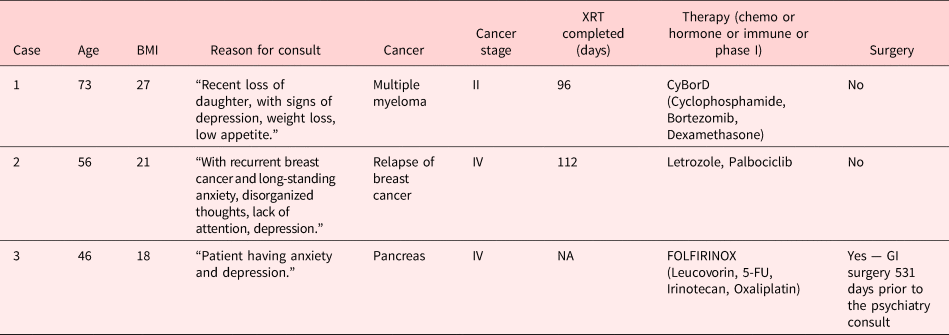
Patients with TD were 73, 56, and 46 years old (Tables 1–3). Two patients had solid organ tumors and the third had multiple myeloma. At the time of evaluation, all patients were in some form of cancer treatment. For all three patients, the reason for psychiatric referral was depression and one had an additional cognitive concern. None of the patients reported recent alcohol use.
Demographics

BMI, Body Mass Index; XRT, radiation; GI, gastrointestinal; 5FU, Fluorouracil.
Medical Comorbidities — Unbalanced Nutrition (which were noted within 7 days of the psychiatric evaluation)

Medical Comorbidities — Risk factors associated with metabolism or excretion

The most common medical comorbidity was weight loss, followed by nausea and renal disease. However, all patients maintained nutrition orally. Only one patient was seen by neurology within 20 days of the psychiatric evaluation.
Neurological examination
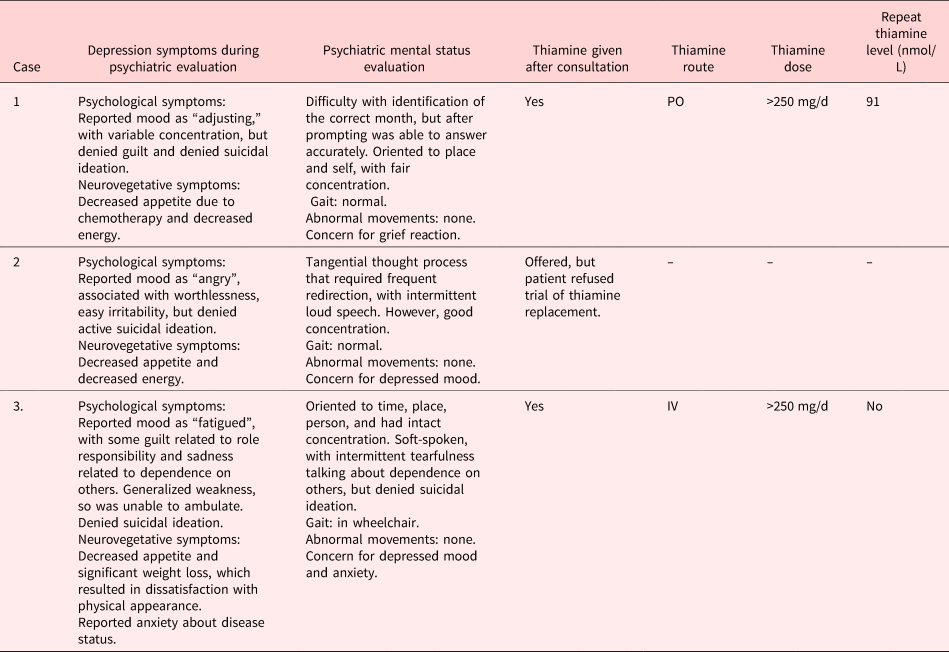
One of the three patients had some difficulty with orientation questions, but not concentration (Table 6). One felt too weak to walk, and so was in a wheelchair. The remaining two patients ambulated independently. None of the patients had ocular, cerebellar, nor involuntary movements.
Laboratory results
Blood thiamine was 68, 54, and 45 nmol/L, respectively (Tables 4 and 5). One patient had chronic kidney disease of moderate to severe degree, but the rest of the results were normal. None of them had brain imaging nor cerebrospinal fluid analysis within 10 days of the psychiatric evaluation. Albumin levels were normal and vitamin B12 levels were in the normal to high range.
Laboratory results

WBC, White Blood Count; Cr, Creatinine; Na, Sodium; K, Potassium; Mg, Magnesium; TSH, Thyroid Stimulating Hormone; FT4, Thyroxine Free Level; B1, Whole Blood Thiamine Level. B6 — none of the patients had B6 levels at the time of evaluation.
Laboratory results continued

ALT, Alanine Aminotransferase; AST, Aspartate Aminotransferase; Alk PO4, Alkaline Phosphatase.
Mental status and thiamine treatment
Of the three, two had concern for depressed mood and one had grief reaction (Table 6). Based on thiamine results, thiamine replacement was offered. One patient refused, one took oral thiamine, and one was given parental thiamine during the admission immediately after psychiatric evaluation. Refusal was due to the patient's health beliefs regarding vitamin usage in cancer.
Mental status and thiamine treatment

Discussion
We describe the clinical characteristics of three patients with TD in the outpatient psychiatric oncology setting. Early identification of TD is important to prevent complications like WE. One patient displayed a possible manifestation of WE in the form of mild cognitive impairment. This highlights the importance of early identification of TD and the possibility of such, even in the outpatient setting.
The common theme for outpatient psychiatric consultation was depression. Depression is more common in cancer patients (Mitchell et al., Reference Mitchell, Chan and Bhatti2011) with psychological symptoms more indicative of depression than neurovegetative symptoms (changes in appetite, sleep, and energy level (Dantzer et al., Reference Dantzer, O'Connor and Freund2008)) of depression. It is important to distinguish between the two types of symptoms for appropriate management. Neurovegetative symptoms may shed light on the nutritional status, that would guide further tests such as thiamine level. In our report, in addition to psychological symptoms of depression, two patients had appetite loss with weight loss (one patient had a BMI of 18). Therefore, thiamine level was considered in all three. Thiamine levels can help identify those at risk for WE (Thomson et al., Reference Thomson, Cook and Touquet2002), so that timely repletion can prevent progression to WE.
Decreased appetite, whether due to neurovegetative symptoms of depression, cancer progression, or cancer treatment, is a serious concern in cancer patients. Researchers have suspected TD even in the absence of cognitive changes, based on a history of appetite loss for more than 2 weeks (Onishi et al., Reference Onishi, Ishida and Tanahashi2018d, Reference Onishi, Ishida and Tanahashi2018e, Reference Onishi, Ishida and Uchida2019). In patients with poor nutritional status, the evaluation of other B vitamin levels may be natural. In our report, two of three patients had normal folate levels and all had normal or high vitamin B12 levels. High B12 levels were due to recent vitamin replacement and longer body stores (Nielsen et al., Reference Nielsen, Rasmussen and Andersen2012). Interestingly, the majority of patients with TD in the inpatient oncology setting had normal B12 and folate (Isenberg-Grzeda et al., Reference Isenberg-Grzeda, Shen and Alici2017). Our results highlight the importance of screening for TD in patients with poor oral intake, even in the absence of other vitamin level abnormalities.
Historically, WE was observed in certain types of cancer: greatest number reported in hematological cancers, followed by gastrointestinal (GI) cancers (Isenberg-Grzeda et al., Reference Isenberg-Grzeda, Rahane and DeRosa2016b). Possible reasons may be increased demand due to rapid cell turnover for hematological cancers, and decreased intake, absorption, and use of parental nutrition after surgical resection for GI cancers. This is reflected in our case series. Our third patient had advanced breast cancer. Although there are fewer reports of breast cancer presenting with TD (Aksoy et al., Reference Aksoy, Basu and Brient1980; Kuo et al., Reference Kuo, Debnam and Fuller2009; Onishi et al., Reference Onishi, Ishida and Tanahashi2018e), this cancer should not be overlooked when screening for TD.
TD is common during or soon after chemotherapy, specifically with antimetabolite and alkylating agents (Boros et al., Reference Boros, Brandes and Lee1998). Of the various chemotherapeutic agents, 5-FU interferes with the formation of the biologically active form of thiamine (Pirzada et al., Reference Pirzada, Ali and Dafer2000) and reduces thiamine levels in the liver and spleen (Aksoy et al., Reference Aksoy, Basu and Brient1980). The above effects were significant even when compared with other chemotherapeutic agents (Aksoy et al., Reference Aksoy, Basu and Brient1980). This condition was recognized in one patient, who had received treatment with 5-FU.
Our report describes the clinical characteristics of TD in the outpatient oncology setting. To our knowledge, TD in the outpatient oncology setting has been limited to case reports in Japan (Onishi et al., Reference Onishi, Ishida and Kagamu2018a, Reference Onishi, Ishida and Takahashi2018b, Reference Onishi, Ishida and Tanahashi2018e, Reference Onishi, Ishida and Uchida2019, Reference Onishi, Okabe and Uchida2020). Similar to Onishi et al., patients in our report have different types of cancer, but most were in the advanced stage with more determinants of unbalanced nutrition. Although their case reports utilized thiamine level, the results were not comparable to ours. Our report adds to the existing literature by capturing TD in cancer outpatients, possibly at an earlier stage, prior to the development of severe WE. As in other studies, we noted various possible causes of unbalanced nutrition. However, we also provide information about the presence or absence of medical conditions which may contribute to TD.
Our report has some limitations. Due to the retrospective design, data are limited to the visit documentation and details about degree of weight loss or duration of nausea were not obtained. Although two patients agreed to thiamine replacement, repeat thiamine level was only obtained in one patient. Because identification of TD in the outpatient setting was the goal, treatment-related factors were not explored in the current paper. However, this could be expanded in future studies. Lastly, a larger study could address the concern with the small sample size.
Conclusion
Cancer patients have numerous risk factors for TD and are at risk for WE. Thiamine levels can help identify patients at risk. Identification of at-risk patients who have not yet manifested symptoms of WE would allow for timely treatment. In the setting of poor oral intake as a neurovegetative symptom of depression in the outpatient psychiatric clinic, the most common clinical presentations were weight loss and orientation difficulty. It is hoped that early detection of TD in cancer patients may prevent sequelae and improve overall clinical outcome in this vulnerable population.