Introduction
The paper draws on a randomised controlled trial, involving older people with coronary heart disease in the North West British city of Salford. It aims to test the hypothesis that informal e-learning with peer support is an effective strategy for overcoming the digital divide. The results have implications for social policy.
There is a persisting digital divide that mirrors other social divides based on social class, income, education, place of residence and age (OxIS, 2005). Yet government policy claims that information and communication technology (ICT) has the potential to combat social exclusion. By freeing learning from traditional institutional constraints and overcoming spatial and temporal barriers, ICT can ‘help stimulate and sustain community activity, the fostering of self and mutual help, the ownership of local issues, and the generation of common purpose’ (DTI, 2000: section 2.5). The key claim in relation to e-learning is that ICT can produce a radical transformation in society by empowering individuals through new forms of learning that can deliver the widest available access (Central Office of Information, 1998). This is to be achieved by freeing learning from traditional institutional constraints and overcoming spatial and temporal barriers.
Providing access is not always enough to bridge the digital divide as social capital (e.g., skills and education) is also needed to engage with technology (Lindsay et al., Reference Lindsay, Smith, Bell and Bellaby2007). Social capital may be implicated in ICT adoption and is a key means of tackling digital exclusion (Commission of the European Communities, 2005). Such an approach is based on the assumption that participation in the information society is a community endeavour where positive social outcomes require complementary interventions in different spheres of community life. More recently there has been a policy shift from strategies to combat the digital divide that focus exclusively on public access provision, towards a belief that public access is not full access (Liff et al., Reference Liff, Steward, Watts and Woolgar2002).
Public Internet access points (PIAPs) mainly augment the facilities available to people who already have experience with and access to ICT (Selwyn, Reference Selwyn2002). Governments have invested heavily in public Internet access in an effort to make participation in the information society available in most localities. Evaluations show that the impact on social exclusion has been slight. In EU countries users of PIAPs are disproportionately younger and better educated (European Opinion Research Group, 2001). Estimates suggest that at best around a quarter of current non-users of ICT can be included by a policy of public provision alone (Hall Aitken, Reference Hall, Wyatt, Allison, Donoghue, Horton and Kearney2003). Evidence shows that not only one's own home but even relatives’ and friends’ houses are perceived as potential points of access to the Internet by more people, especially among those from lower socio-economic groups and the elderly, than public access sites (European Opinion Research Group, 2001; Selwyn, Reference Selwyn2002). Consequently, there have been increasing attempts to take ICT directly into people's homes (Loader and Keeble, Reference Loader and Keeble2004). Projects such as Wired Up Communities (England) and Digital Communities (Scotland) for certain social groups exemplify this approach, with mixed results (Devins et al., Reference Devins, Darlow, Petrie and Burden2003, DTZ Pieda Consulting/tns, 2004). They diverge from traditional community development models by investing primarily in resources (PCs and Internet access) destined for private homes, rather than (though in some cases as well as) in community facilities. In the experiment undertaken here, we too provided new computers and home Internet access to older persons with heart disease from a deprived area. We argue, however, that for such an approach to be effective, informal learning and peer support is necessary, especially among older people.
Patterns of technology adoption
People often adopt technology in ways that fit in with their lives without taking time away from other activities (Gershuny, Reference Gershuny2002). Actor-network theorists suggest that the meaning of technology is strongly determined by the current activities and inter-personal networks of individuals (Tatnall and Lepa, Reference Tatnall and Lepa2003). Conversely, Kraut et al. (Reference Kraut, Kiesler, Boneva, Cummings, Hegelson and Crawford2002) argue that the growing socialisation of the Internet can make it easier for Internet adopters to integrate their online and offline relationships in a way that supports social networking. This adaptability, however, is not necessarily evident to non-users contemplating technology adoption. Thus, Cushman and Klecun (Reference Cushman and Klecuan2005) discovered that first time e-literacy students found it difficult to imagine what they might do with ICTs.
In motivating older adults to adopt technology it is vital to convey the context-specific benefits and the uses that relate to their social interactions (Tatnall and Lepa, Reference Tatnall and Lepa2003). If benefits are contextualised in relation to people's own social networks and in everyday life, older adults may be more motivated to make the investment in learning how to use a tool like email (Melenhorst et al., Reference Melenhorst, Rogers and Caylor2001). This assumes that a person's social network is sufficiently technologically enabled to sustain communication by email, which may not always be the case in excluded groups. If not, then it becomes especially important for facilitators to take account of the offline social worlds that will co-determine the adoption process, which tends to be strongly socially mediated for low-income groups (Crang et al., Reference Crang, Crosbie and Graham2006).
The barriers to employing such a strategy to make a real difference to patterns of digital exclusion are considerable. Selwyn (Reference Selwyn2005) found that 85% of people aged over 60 do not use the Internet. Rates of non-use are highest among those with fewer educational qualifications and those working in unskilled or partly skilled jobs. Older people typically have access to significantly less peer or family reinforcement in using the Internet. Without hands-on support, many older people may not be able to go online (Fox, Reference Fox2004), but such support may not be forthcoming either due to limited social networks or because this does not fit with perceived generational roles.
The influence of virtual learning on tackling social exclusion
Social institutions are important mediators for the meanings people ascribe to technology (Holloway and Valentine, Reference Holloway and Valentine2003). The social practice of technology adoption may differ substantially from designers’ intentions and also according to specific localised contexts. This can be exploited in the design of community computing programmes. For instance, in Cleveland a training programme in PC repair was designed to ‘foster a culture of computer tinkering’ analogous to car-tinkering that was both a social and an economic phenomenon in the neighbourhood (Horrigan, Reference Horrigan2002: 29). This encouraged technology adoption by taking its cue from an existing culture of practice, creating a better fit with people's lives.
Claims about the capacity of virtual communication to include groups traditionally excluded from learning activities tend to cite the advantages of deindividuation, role-play and anonymity as factors that can overcome participants’ inhibitions (Rogers and Lea, Reference Rogers and Lea2005; Wyatt et al., Reference Wyatt, Lea, Spears and Woolgar2002). The expression of minority identities and the collaboration of culturally diverse groups are examples where a virtual learning environment might be more socially inclusive. Given that most of our sample is not already online, our strategy must therefore combine elements of the real with elements of the virtual in order to generate use values relevant to the everyday lives and social relations of novice Internet users.
Within this context, public Internet access plays a role in tackling social exclusion. PIAPs can be a very valuable supplementary resource within territorial communities, especially if there is provision of appropriate support to learners (Devins et al., Reference Devins, Darlow and Smith2002) or if the facility is already an important site for social networking (Hall Aitken, Reference Hall, Wyatt, Allison, Donoghue, Horton and Kearney2003). In these circumstances, community associations can act very effectively as informal support for socially excluded people (Foley, Reference Foley2004). If virtual learning is understood as a process that connects various settings into a multiplex environment (Haythornthwaite, Reference Haythornthwaite2001), involving informal learning tailored to ordinary lives, there are grounds for believing that socially excluded groups can be empowered to find meaningful uses for the Internet.
Informal learning
The Internet offers potential for interaction with the source of information and is a medium for influencing learning (Nguyen et al., Reference Nguyen, Carrieri-Kohlman, Rankin, Slaughter and Stulbarg2004). This is consistent with Dewey's (Reference Dewey1991) educational philosophy, which has been influential in informal education. Dewey sought to displace attention from learning facts to the process of interactive learning in the course of activity and experience and to focus on growth in capacity.
With the increasing use of ICT and the Internet, computer-aided learning has taken a turn toward the social aspects of learning. This is linked with a growing interest in social constructivist approaches in education (Brown et al., Reference Brown, Collins and Duguid1989). The new emphasis on learning through interaction with peers links to the observation that patients’ trust in experts tends to decline following a heart attack, which may be the case with our sample. In this circumstance, learning by interacting with peers may be effective in encouraging patients to not only self-manage their disease but also learn about computers in the process (Stout et al., Reference Stout, Villegas and Kim2001).
The collaborative structure of the learning environment in our project portal is intended to correspond with what we know about how informal, everyday learning occurs. Overt facilitation, however, can add to unmediated peer-based learning by offering more challenging or transformative experiences. It can offer a space and the impetus for reflection on practice and experience, thus prompting re-evaluations by participants, and it can guide participants towards key resources (Hamilton, Reference Hamilton2006). The roles of facilitators (from the research team) and participants will likely overlap. Both are seen as key actors in processes of translation, tailoring and mapping the knowledge of groups formed in our project portal and the wider social networks interlinked through each member.
Methods
This randomised controlled trial drew a sample (n =108) of men and women aged 50–74 from GPs’ coronary heart disease registries. Our sample was drawn from Salford, Greater Manchester, because it is one of the most multiply deprived wards in England (Salford, PCT, 2005). The sample was divided at random into an experimental and a control group of equal sizes. All participants were given home computers and a one-year broadband subscription; however, only the experimental group received learning support and access to the project portal, designed to focus on heart disease management. A technician installed the computers in the participants’ homes and assisted with any technical difficulties that arose for the duration of the project. Weekly drop-in sessions and phone-in support was available to all participants.
Access to the project website was through a purpose-built, password-protected portal. We established Hearts of Salford (http://www.heartsofsalford.net/) where the experimental group could interact in groups, initially in a dedicated closed group, with support from researchers who acted as facilitators (see Lindsay et al., Reference Lindsay, Bellaby, Smith and Baker2008 for further details). The portal uses Moodle, which is ‘a free, Open Source software package to help educators create effective online learning communities’ (http://moodle.org). The social architecture of the portal evolved according to our preliminary theory of change, but it also responded flexibly to participant demands and capabilities.
Repeat questionnaires, focus groups and Internet log data were collected from May 2006 to June 2007 to assess the influence of our health portal on the management of heart conditions before they were given the computers and six months after they were introduced to the Internet. Focus groups and the discussion forums from our project website were sorted, coded and categorised with the aid of NVIVO. This program assisted in condensing the data and identifying relationships among central themes around the issues of informal learning and peer support. Each transcript was read several times while key themes and patterns were noted.
The average age of the sample was 62.9. The total household income for the majority of the sample was under £13,000. Although 75% of our sample had some previous computer experience less than half (47%) owned a home computer. Over half of the participants said that they had used the Internet at some point (56.5%). Of these participants, however, only 36% had home Internet access.
Overcoming fears of going online
The participants engaged in many forms of informal learning throughout this project. At first, since most participants lacked computer experience they needed to overcome their fears of new technology. They achieved this through training and informal support. Once they became more comfortable with computers, they began seeking information on their own, which helped to build their confidence. This then enabled them to both provide social support to and receive it from others with similar health conditions. In reality, these three stages of learning are intertwined. Building confidence was also about establishing trust in others. At the beginning of the project many participants did not feel confident enough to be fully open with each other. For example, one participant claimed: ‘I thought I should I have a go at puttering on the net, but I'm not quite confident enough yet’ (#43, male). Many of the participants were relieved to find out they were in the same boat as others in terms of having little computer experience. Posting their queries to a ‘computer questions’ forum helped them to build their confidence so they could benefit from the computer.
A common ground needed to be established before the participants could share information with others and seek support from them. For example, several groups developed discussions around local issues, memories of Salford, and football. This provided a mechanism for building a shared interest where participants could get to know each other.
Although there were several barriers to overcome, having an interactive learning approach seemed to help them to overcome their fear of computers. The project seemed to offer a compelling proposition because the learning opportunities were strongly contextualised as something purposeful. For example:
I've not got the foggiest idea about computers. I've only watched the grandchildren on theirs and they are fantastic but it's something I've always wanted to get into. (#88, male)
In another case, it would be the social context of a computer class that provided the missing reason to learn:
I have got to the stage where you press a button on the front and a green light comes on. I have no idea what you do. Then I went to the library and they asked me if I would like to go on a computer course. I went there and I thoroughly enjoyed it. It's an endless laugh from the time you go in to the time you go out. I've learnt a lot and I've thoroughly enjoyed it and I now know a little bit more about a computer. (#40, male)
These older men and women needed some encouragement at first and a compelling proposition linked to their own lives to help overcome their fear of turning a computer on and going online. Once they found the courage to get into it most of those in the experimental group seemed to enjoy it.
Examples of informal learning
Self-learning, peer support and assistance from project staff were the key mechanisms of informal learning for the experimental group. A wide range of informal learning processes occurred in the group discussion forums. Some discussion threads exhibited instances of seeking and providing information, argumentation and problem solving. The information shared was mostly experiential or anecdotal. Participants only occasionally referred to specified expert sources, but they did often adopt the role of lay expert.
The Internet provided an opportunity to interact with others and to receive social support. There are also references in the discussion forums to informal self-learning. One participant described how he learned to download music:
what I've done is noted down the procedure then typed out the instructions then printed it off and stuck it on the wall behind my computer for easy access. (#43, male)
There are also several examples of tips, advice and recommendations for particular learning materials. For example, one participant said: ‘I had a quick look at the BBC tutorial and I highly recommend it to any of the first time users out there’ (#57, male). Other participants found learning resources for themselves (mainly about times of computer classes). For example, a participant described how he taught himself to use a computer by signing out books from the library. He used:
a series called ‘Made Easy’ and they actually show you how to do things. What I did was I concentrated on elements that interested me at that time rather than getting a book of everything. (#46, male)
One participant did not like the idea of formal computer training but enjoyed the challenge of learning on his own. He described his experience:
I like finding my way through; its part of the challenge, isn't it? Every time I want to go on the computer I'm doing something new so I feel I'm achieving something. I'm learning as I go along. If you learn that way it sticks. Expand your knowledge and straight away you see a link and you can actually go on to expand it even more. So it is never ending. (#45, male)
Informal learning played an important role for several of the participants (in the experimental group).
Peer support online
Whether it was a computer query, health issue, hobby or general interest many participants in this sample found the Internet useful for interacting with others. They especially wanted to know if it was normal to feel the way they did after they had their heart attack and particularly whether other people had similar feelings and experiences.
Several participants posted questions on our ‘computer problems’ section. The following is an example of how they relied on one another for support:
one great thing about the net is being able to print out complicated information, however, I'm getting low on printer inks, do you or anyone else reading this know a cheap supplier? Has anyone tried the refill kits? (#47, male)
This post preceded a long thread in which participants compared the pros and cons of re-filling versus buying new cartridges and compared the prices of the two options.
Many groups found the discussion forums valuable as an informal learning environment because they facilitated role interchangeability. Participants readily switched between asking for and providing information and support, and enjoyed being part of a shared learning experience.
Assistance from project staff
Although we did not offer a formal training course, we did provide informal support online, over the phone and through weekly drop-in sessions facilitated by our project technician. During the first few weeks after participants received their computers, most of the support was provided first through brief informal training sessions and help over the phone. As participants gained more skills and confidence they would email us with questions or post them on the discussion board. Those who were still having difficultly (mostly with email/message, or basic computer skills) came to the weekly drop-in sessions.
The dependence of participants on project staff was substantial. The learning model initially envisaged was for a combination of self-learning, mutual support and referral to formal courses available in the community. It seems that asking informal questions such as how to get your email up and running, how to turn the sound on your computer and what to do when you get an error message, helped them to realise that the problem could be dealt with quite simply and they began to rely on one another for technical support.
Impact of informal learning and peer support
Information seeking and confidence building
In addition to seeking support from others in a similar situation, participants wanted to become more informed about their heart condition. Many of the participants found that their confidence to use computers also increased once they found out about how the heart works. They described how they wanted to learn more about their heart condition in order to increase their confidence in managing it. They all tended to agree that you need to educate yourself once you have had a heart attack. The Internet was readily accepted as a useful resource for informing patients and helped to reduce the fear of what had happened to them.
Becoming more informed about their heart condition also helped to build their confidence. This encouraged them to seek more support from others in similar situations. Even if their health problems did not trigger a desire to learn more about the condition, for some participants it was a significant point of change in their general attitude to life, and ICTs could be re-appropriated in ways that reflected altered life circumstances (such as retirement due to ill health):
I've bought a computer when I first left work because my intention was to start a little business. I do my banking on my computer and run a pensioner's club. (#51, male)
Learning informally, whether by practicing on their own or getting help from others, built up their confidence to pursue other interests online. Intra-group friendship and solidarity also began to emerge:
it's been great knowing all the people you know. Because we don't actually see each other socially but you feel as if you are all friends now. (#46, male)
Many of the participants (in the experimental group) described the positive experience of learning how to use a computer. Several participants share their experiences:
Use of the keyboard I find more natural than writing in longhand and the script is more legible so that letters and e-mails are much easier. (#24, male)
One participant was particularly delighted that he did not need to go to the post-office so often.
It has opened up the world to me at the press of a button and the touch of my fingertips. I can quickly email friends and organisations without having to trek to the post office. It's great to find answers on any subject when all normal avenues have been exhausted and opens your eyes to things you didn't know existed. (#43, male)
Others described how their computer provided a solution to loneliness and boredom:
when living on your own it is a form of communication. The information it holds is yours to explore and make you aware of things happening around the world. Sometimes in the winter months you don't see or speak to people on a day-to-day basis so the computer does compensate. (#44, female)
Another said:
It has solved a problem of boredom. I can always find something interesting and informative to do. I'm enjoying the learning challenge. It has made me feel more useful and productive. I have been able to save money, gas and electric bills, shopping etc. This is a big help when on a low fixed income. It has made me think I may eventually be able to generate an income doing book keeping. (#46, male)
Most of the participants in the experimental group reported a positive experience in learning how to use a computer and navigate their way through the Internet.
Computer literacy
Informal learning helped to encourage many participants to engage in more formal learning. Several participants mentioned learning, training, classes or courses in the discussion forums. There are references to adult education classes that people have taken both in computing and in other areas. A few participants took the beginners’ course offered at public libraries and their experiences were extremely positive.
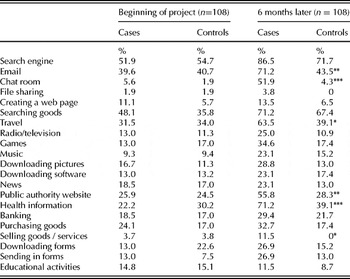
Our repeat surveys revealed several interesting differences between the cases and controls. After using a computer and the Internet for six months, there were some notable changes between the experimental group and the controls (refer to Table 1). Significantly more of the experimental group used email (71.2%) compared to the control group (43.5%). This was likely a result of the experimental group receiving support from the project staff on how to get their email up and running. Not surprisingly, significantly more of the experimental participants engaged in chat rooms and forums (51.9% versus 4.3%), which was mainly through the use of the project website. Other significant differences in searching for information online were found in use of public authority websites (55.8% versus 28.3%), health information (71.2% versus 39.1%), and selling goods and services (11.5% versus 0%). Some of these differences may be a result of our project website having links to public authority and health websites. The finding in relation to selling goods and services may stem from the greater confidence that the experimental group had in using the Internet, and possibly more trust in using the Internet for financial transactions. Finally, significantly more of the experimental group also used the Internet for travel information and booking tickets (63.5% versus 39.1%). Again, this may be a result of the experimental group having greater confidence and trust in the Internet. Several participants also swapped tips and favourite websites which may have helped to spur their use of the Internet.
Computer skills and Internet use, beginning of the project and 6 months later

Note: *p<.05, **p<.01 ***p<.001.
Providing access is not always enough to bridge the digital divide
Our results suggest that merely providing a computer and Internet access is not enough in itself to enable this population group to benefit from e-learning because support is also needed. There were a few participants in the experimental group who rarely or never viewed a web-page or posted a message. Several told us how they struggled to get started at all. Meanwhile, many participants in the control group (who did not receive training or support) found that overcoming barriers in learning this new technology very difficult. For example, one man said: ‘I have had profound difficulties in engaging myself in the use of the computer. My inhibitions have thus far precluded participation in your program’ (#7, male). Another man similarly claimed that the computer and broadband access that we provided ‘did not influence my life a great deal. Self-learning is proving difficult and more input on teaching is required’ (#49, male).
The control group often became frustrated and felt isolated without access to the project portal. For most participants this was the first computer they ever owned. Many of them found that learning how to use this new technology, especially at their age, was an uphill battle. In fact, a handful of participants from the control group phoned in and told us that we might as well take the computer back because they felt there was no way that they could learn how to use it on their own.
Discussion and conclusions
This project tested the extent to which home based e-learning could help bridge the digital divide by providing free home computers and broadband subscription to a sample of older heart patients in a deprived area. Our results suggest that many of our participants needed to overcome their fears of new technology before they could learn how to use it effectively. Once their fears were eased and they started to become more comfortable with their computer they began seeking information on their own which helped to build their confidence.
As they gained in confidence, members of the experimental group tended to emphasise the social aspects of interaction grounded in their shared identity (place-based, life-stage) as opposed to specific interests (either health-related or leisure pursuits), as we had originally anticipated. One particular discussion forum in which all participants could mingle, but which did not have a specific theme, proved most popular, and health issues were typically discussed here instead of some more obviously signposted areas of the portal. Participants thus colonised the space of the portal in such a way that the learning which took place about health promotion and prevention became almost an incidental aspect of the general chat (‘learning by stealth’) rather than a purposive learning endeavour.
The pattern of technology adoption for this sample may not have followed the typical pattern because they were given these computers to help them manage their heart condition, something that does not necessarily fit with their everyday life. It may have been even more challenging for them to learn. Many of these people were sceptical at first that computers could be beneficial to them but adapted their learning towards something meaningful such as football or travel. Our findings contrast past research which suggests that older people typically have less access to peer or family reinforcement in relation to using the Internet (Fox, Reference Fox2004). In our sample, we found that participants received much help from their families even though in most cases they did not live in the same household. Peer support also came from fellow participants and it seemed to help people to learn how to use technology and also learn through the medium of technology such as information about health.
It is claimed that ICT can produce a radical transformation in society by empowering individuals through new forms of learning that can deliver opportunities available to groups generally regarded as excluded (socially, geographically, culturally etc). Our findings suggest that, although ICT with training and support may help some people, simply providing access alone does not appear to be enough to help bridge the digital divide, as social and cultural capital are also needed to help foster learning.
Our findings support the notion that a whole systems approach is necessary in health promotion. Such an intervention needs to engage people around general quality of life and well-being issues rather than focusing narrowly on health and illness. Addressing the whole person increases the prospects of generating self-sustaining learning and of participants developing a sense of ownership of the online space.
Acknowledgements
This project was funded by the Economic and Social Research Council within its ‘e-Society’ programme and HEFCE Science Research Infrastructure Fund. We acknowledge the contribution of our project staff George Gergianakis and Safeena Aslam in addition to the broader influence exercised by Paul Bellaby's co-investigators: Rose Baker Frances Bell and Steve Kay.