Another Chinese Theatre has for some time been talked of, and if it requires 3 theatres to satisfy the demand in this respect, Chinese dramatic art must certainly be looking up in Victoria. The new building as at present projected is to be situated on Cormorant Street above and adjoining the theatre already erected. It will be a wooden building 36 ft. by 70 ft. and 28 ft. post, of the plainest description and will have a pitched shingled roof, the exterior being covered with rough boards. … It is estimated that the building will be capable of holding 600 people, and it is to be finished by the 6th of January. Mr. Trounce is the architect and Messrs. McKilliean & Anderson the contractors.
The Victoria Daily Colonist, 2 December 1882
One of the most curious aspects about Canadian Chinese cultural history is the role of opera theatres. They served as the public face of the community, as cultural ambassadors or even artistic curiosities, but at the same time provided Chinese audiences a fantastic world of melodious and emotive musical drama. Because of their public role, they were often ambitious projects rather than makeshift operations, as reflected by the erection of theatre buildings like those described in the report of the Daily Colonist. Also, as in Victoria, it was common that several companies ran concurrently in different theatres in the same city. This Colonist reporter should not have been surprised by the establishment of two new Chinese theatres in the following three years, the latter of which, and the fifth in the city, opened on 4 August 1885, held 800 seats and claimed to ‘compare favorably with any Chinese theaters on the west coast’.Footnote 1 The abundance of theatres reflected their central role in the Chinese immigrant communities.
Although Chinese theatres’ vibrancy and significance in early British Columbia is beyond doubt, the lack of sources is a challenge for any exploration of this part of Canadian music history. From the late nineteenth century, we only have journalistic accounts in English newspapers, mostly in The Colonist, which provide a rough picture of Chinese theatres. The situation for the early twentieth century is slightly better, since from 1914 on Vancouver published a Chinese-language newspaper, the Chinese Times, that occasionally reported on theatrical activities. Later it also published daily playbill advertisements. Only a small handful of theatre playbills have survived, as well as the business records of one theatre company, Yongkang Nian (also known as Wing Hong Lin).Footnote 2 Despite the limitations of these sources – depictions of the theatre buildings are neither lively or expressive, newspaper accounts of the theatres were erratic in nature, and company records were mostly of the business and receipts – we nevertheless gain from them a better understanding of the scale of the opera performances as well as a sense of the space for lively stages filled with performers.
Since first appearing in Victoria in the 1860s, Chinese theatres played an integral role in its community life.Footnote 3 They featured performance of Cantonese opera, the regional genre known to the majority of Chinese immigrants that came from the Pearl River Delta of southern China. Cantonese opera is a traditional art form that blends Chinese legend, music and drama into a vibrant performance style rich with symbolic meaning. On stage the singers were engaged in martial arts, acrobatics and dramatic movements. The orchestra accompaniment includes melodic instruments (bowed and plucked strings and winds) and percussion instruments (drum, clapper, gong and cymbal). Singers’ oral delivery included heightened and rhymed speeches, arias and vernacular songs. Because singers performed from scenario scripts that included formulaic scenes, stock arias and so forth, the practice of improvisation was important to provide bridges connecting scenes or to allow extempore performance among singers.Footnote 4 There were 12 or more role types, including warrior, statesman, scholar, young belle and comic character. The repertoire drew from a large set of familiar classical operas featuring historical stories, legendary figures, fictional characters, fixed tunes, classical-verse lyrics and visual elements filled with symbolism, including stage props, facial painting and costumes.Footnote 5 Even though the audiences might speak different dialects of Cantonese, they could easily enjoy the opera (sung with a combination of Chinese dialects), since the stories of Chinese history and mythology from which these dramas are written were familiar to them. While plain in certain aspects – abstraction was an important aspect of the tradition and the earlier theatres were devoid of realistic scenery – these stages provided a rich array of spectacle, sonority and acrobatic display. The entertainment was so significant that audiences rushed to the theatres for exciting happenings, be it the arrival of the first actress in Victoria (24 October 1884), the opening of a three-story theatre (23 July 1885), benefit performances linked to community initiatives or debuts of famous performers. The farewell of an adored performer could be a public spectacle, while stores could close early for their significant premieres.
The success of Chinese theatre in Victoria was not an isolated phenomenon, but rather closely connected to other cities along the Pacific coast, which constituted part of what Henry Yu aptly calls the ‘Cantonese Pacific’, the transnational network dominated by Chinese migrants speaking different dialects of Cantonese.Footnote 6 Yu defines the ‘Cantonese Pacific’ as the extension of an existing migration network between southern China and Southeast Asia to a transpacific one connecting ports such as Yokohama, Hong Kong, Sydney, Honolulu, Victoria, Vancouver, San Francisco, Manzanillo (Mexico), Havana, Lima and Trinidad. Yu estimated that this network was firmly established by the 1880s. While he wrote metaphorically about the way in which we might strain to hear how ‘the life cycles of these tens of thousands of individual male migrants created a vast rhythm of transpacific movement’,Footnote 7 Cantonese opera literally constituted the music of the Cantonese Pacific. In North America, the theatres were established first in the United States: the first appearance was the Hong Fook Tang troupe in 1852, which began in San Francisco, then continued on to New York City and Washington DC. More troupes followed in its steps. San Francisco's first permanent theatre was built in 1867 with materials shipped from China, and by the late 1870s the city had six theatres running concurrently.Footnote 8 Though a latecomer, Victoria joined San Francisco as one of the earliest key posts for Cantonese opera performance in North America in the late nineteenth century. From there the troupes’ footprints extended to cities large and small, including Vancouver, Cumberland, Edmonton, Calgary and Toronto. As we will see, when Chinese performers were forbidden to enter the United States, Vancouver grew to become an important port for Cantonese opera performances in North America.
This essay provides a preliminary overview of the theatres, troupes and performers in Canada, their wider impact and the national and transnational forces that shaped them. It will address several key issues related to this history: the effect of immigration control, the relevance of Chinese theatres to community life and border crossings. Limited by very sparse primary and secondary sources, these snapshots of the daily lives, aspirations, and activities of the Chinese theatres and their performers do not constitute a comprehensive or thematically focused history; they nevertheless breathe life into this neglected history, and shed light on the close connection between the histories of Chinese opera theatres in the United States and Canada. If, as historian Wing Chung Ng urges, we go beyond the history of isolated communities with a genuinely transnational approach, the intertwined history of these communities reveals that a thriving culture of Cantonese opera performances in Canada, especially in the 1910s, played a crucial role in that culture's circulation throughout North America for decades to come.Footnote 9
Chinese Immigration and Anti-Chinese Sentiment
The large number of Chinese theatres in Victoria alluded to above reflected the vibrant Chinese community in the second half of the nineteenth century. The Fraser Canyon Gold Rush of 1858 attracted an influx of miners and prospectors from North America, Europe, China, Mexico, the West Indies and elsewhere. From then on, Canada became an important destination for southern Chinese, who undertook the transnational journey to fulfil their golden-mountain dream. When Prime Minister John A. Macdonald promised to ‘unite Canada by rail’, and insisted upon employing Chinese labour for the task, an even larger Chinese labour force arrived between 1881 and 1885 for the construction of the Canadian Pacific Railway (CPR).Footnote 10 The CPR hired 7,000 Chinese workers from California and 5,000 from China. Between 1881 and 1884, 17,501 Chinese from China, San Francisco and Puget Sound landed in Victoria.Footnote 11 At the same time, anti-Chinese sentiment had been growing since the 1870s; bylaws and ordinances targeted Chinese immigrants and riots broke out. In 1885, after a Royal Commission on Chinese Immigration, the federal government passed the Chinese Immigration Act, imposing a head tax on Chinese immigrants to discourage them from entering Canada. The head tax increased sharply over the years, from the initial $50 to $100 in 1900, and to $500 in 1903. As the high head tax did not stop the flow, in 1923, the Chinese Immigration Act replaced prohibitive fees with a ban on most Chinese immigration to Canada.
All the while, Chinese theatres existed alongside the anti-Chinese sentiment. As we have seen, prior to the Chinese head tax law, Victoria alone already had five Chinese theatres. And even after 1885, according to Ng, Chinese performers were exempted from the head taxes. Instead, they could be admitted under the sponsorship of a local business with a bond ($500), refundable upon their departure. Each permit was valid for six months and could be extended for up to three years.Footnote 12 As a result, the admission and residence of Chinese opera performers were closely tied to their status at the theatres, and the theatres, in order not to forfeit their bond, had to be fully in charge of the whereabouts of the performers. While the mobility of the performers was definitely reduced and controlled by the theatres and government, they could nevertheless be admitted into Canada with some regularity.
In the early twentieth century, important changes in the United States had an effect on the performance scene. The 1882 Chinese Exclusion Act passed by the US Congress had been extended with additional amendments and harsher regulations such that Chinese opera performers were no longer allowed to enter the United States by the beginning of the century. The discrepancy between the two country's exclusionist policies gave Chinese theatres in Canada a great advantage. When the 1906 earthquake and fire in San Francisco burned down the last Chinese opera theatre, and the stage lights there were extinguished for the next 16 years, Cantonese opera continued to thrive in Canada, growing with the quickly evolving community. This period saw the construction of many Chinese theatres, as well as the coming and going of performers and troupes. As modern steamships cut the cost and risk of the trans-Pacific travel, British Columbia became the new ‘Gold Mountain’ for the Cantonese opera profession. The movement of Cantonese opera performers to Victoria and Vancouver continued throughout the 1910s.
Building Chinese Opera Theatres in the British Columbia: Victoria
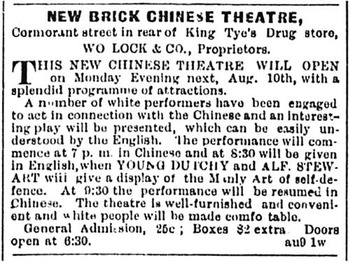
If the capacities of Chinese theatres between 1882 and 1885 – ranging from 250 to 800 seats – are an indication, opera theatre was a significant part of the daily life for the quickly expanding Chinese community in Victoria, similar to its counterpart in California. As both entertainment and ritual practice, opera was deemed a necessity for prosperous Chinese communities, and it interacted with the mainstream community in many different ways. Construction of the Canadian Pacific Railroad made many Chinese merchants and contractors successful, and they in turn financed theatres both to serve the Chinese community and to offer general entertainment. The construction of a theatre building was often the first step; as we have seen, reputable architects were contracted for plans, and the buildings’ progress and costs were reported in English-language newspapers. Sometimes, advertisements also followed the completion of a new Chinese theatre, noting that ‘white people will be made comfortable’ (see Fig. 1).Footnote 13
Advertisement from the Victoria Daily Colonist, 9 August 1885

By also including white performers, the new Victoria theatre endeavoured to reach a wider audience, not an uncommon tactic, but one that invariably backfired: the engaging of white performers unschooled in the art of Cantonese opera proved unsatisfying or even insulting to Chinese audiences. In one instance a protest erupted in less than a week.Footnote 14 However popular vaudeville performance was for non-Chinese audiences – as, for instance, when the city's Pantages Theatre staged ‘A Visit to Chinese Theater’ by George and Lizzie Bird to an audience rolling with laughter – it had no place on any Cantonese opera stage where competence in singing, acting and the opera tradition was the minimal requirement for performers.Footnote 15 Engaging with the value system of the new settlement had other challenges. Not unlike their counterparts elsewhere in North America, Chinese theatres in Victoria ran into difficulty with authorities for violating the Sabbath laws, resulting in fines or shutdowns, though occasionally they convinced the authority that the performance was religious. This was partly true, because, in addition to entertainment, Cantonese opera was a form of worship, marking initiations and playing an important role in celebrations of the birthdays of various deities.Footnote 16 Early itinerant troupes in the Pearl River Delta existed primarily for this social function, often performing in front of temples as a form of worship.
Throughout the end of the nineteenth century and the beginning of the twentieth, Chinese theatres were mainstays in Victoria. The large Chinese community generated and sustained circulation of practices, identities and knowledge that became the basis of the high demand for Cantonese opera. The theatres’ revenue, however, fluctuated frequently and dramatically. They usually received a boost from the arrival of new troupes or performers. In December 1901, for instance, The Colonist reported that a new troupe, Shu Foon Neue, opened with grand fanfare in Victoria, featuring performers from China and San Francisco.Footnote 17 In October 1907, a troupe finished a season in Vancouver and began a run in Victoria, which would be followed by performers from Seattle. The Colonist mused that ‘the Chinese population seem to have great pleasure in it for they flock to the theatre night after night and the players seldom have to perform without a full house’.Footnote 18
During 1915 and 1916, several troupes – Qin Fengnian, Guo Taiping, Jock Ming'on and Zhu Huanian – were active. As merchants owned businesses in both Vancouver and Victoria, these troupes moved between the two cities, taking residence for several weeks or months at a time. When the admired actor Liang Fu from Zhu Huanian finished his engagement and departed for China, colleagues sent him off at the dock with gifts, and in the papers critics paid tribute to his mastery of opera.Footnote 19 Immigration control of theatres remained mostly in the background, but people were reminded of it occasionally; the Victoria office arrested two actresses for failing to stage performances regularly, which they were required to do in order to maintain their status. Bailed out by colleagues, they returned to the stage.Footnote 20
Building Chinese Opera Theatres in the British Columbia: Victoria
Demand was high in Vancouver as well; by the 1910s, it had three Chinese theatres that staged Cantonese opera: on Shanghai Alley, Columbia Street and East Pender Street. Three prominent merchants, Yip Sang, Chang Toy and Loo Gee Wing, were heavily involved in the opera business, from erecting buildings and hiring troupes to maintaining professional supplies such as makeup, instruments and costumes. Yip Sang (a former CPR contractor) built a 500-seat theatre in 1898, adjacent to his family's building near Shanghai Alley. In late 1913, Chang Toy (and his Sam Kee Company) made a plan to build a new Chinese theatre on Keefer and Columbia Streets, at the cost of $25,000; this eventually was named Sheng Ping Theater.Footnote 21 Loo Gee Wing, who already owned a theatre in Victoria, built the Gao Sheng Theater on 124 (122) East Pender Street around late 1914, and hired a troupe from China to perform in January 1915.Footnote 22 By 1915, the two latter theatres were busy with performances: the Qin Fengnian troupe at Gao Sheng Theatre and the Guo Taiping troupe at the Sheng Ping Theater. Traditional repertoire was likely the norm at these houses, but new operas were also on the rise: The Chinese Times noted a playwright's debut production with Qin Fengnian.Footnote 23 Despite their rivalry, as the community relied on theatres for public initiatives, the two troupes came together in a moral drama (staged with specially designed scenery) produced by a local organization for fundraising. The Chinese Times reported that the successful production – staged at the Sheng Ping Theater – attracted audiences of 600–700 people.Footnote 24
In 1916, Chang Toy and other merchants founded a theatrical company, Yongkang Nian, which hired a troupe of 29 members to perform in the Sheng Ping Theater.Footnote 25 The first troupe performed for eight months (November 1916 to May 1917). It was a great success, earning more than $2,000 in the first ten days! By contrast, at the Gao Sheng Theater, business was doing so poorly that a newspaper noted that its owner Loo Gee Wing delayed paying his staff at the end of 1916, citing the recession resulting from World War I as the cause.Footnote 26 When Yongkang Nian's first troupe completed its engagement, a second troupe was hired to perform another eight months (October 1917 to May 1918). The highlight of its second season was a four-week stretch (8 December 1917 to 5 January 1918) during which it made over $4,600. This was a remarkable success, considering the presence of a strong new competitor. We know that at least by September 1917, a new troupe, Puruyi, opened at the theatre on Shanghai Alley, run by the Lian An Company.Footnote 27 An announcement of its benefit performance in December listed 52 members, including 30 actors, 3 actresses, and 19 acrobats.Footnote 28 This was a good size troupe, if not large by the profession's standard in southern China. The Sheng Ping Theater might have had even more performers, since it was a bigger and better facility than the theatre at Shanghai Alley.
Growth and Innovation
Both the personnel and the programming of the theatres reveal their security and high standards. In early 1918, the combined number of Cantonese opera performers in Vancouver could easily have exceeded a hundred; in early 1919 it had an Actor's Alliance with 93 elected members.Footnote 29 Both of its opera companies had shareholders and engaged stellar performers. An actress, Zhang Shuqin, led the Puruyi troupe, while actress Huang Xiaofeng was featured in the second troupe of the Yongkang Nian company; both were stars in the Cantonese opera profession. Zhang, a performer of the young belle role type, was a great theatrical attraction and was hired at the annual salary of $6,000, according to the newspaper, compared to $1,000 for the top-paid actress in 1915; she was the first actress in Canada to receive this level of stardom.Footnote 30 On 21 January, the Chinese Times printed a long prose composition and laudatory poems from a fan marvelling at her beautiful voice, graceful dance and artistic interpretation of a full array of diverse characters: the astute and charming maid of Pavilion Peony; the brilliant young lady of letters playing Xie Daohui; the quintessential melancholy woman in The Great Wall story of Meng Jiangnu's Bitter Weeping; and the outstanding heroine in Lady Liang Fending off Insurgent Attack. Zhang would win similar acclaim a few years later from critics of Shanghai's largest newspaper, Shen Bao.Footnote 31 Her staging made an indelible impression on the community.
With print culture that included promotional newspaper articles, laudatory poetry and announcements, the public image of Zhang Shuqin was widely disseminated, shaping public discourse about her art. Such representational discourse surrounding star performers, particularly actresses, would become the norm for Chinatowns in subsequent decades. The publicly printed laudatory poems constituted an important way that stars and opera fans exchanged their mutual admiration and appreciation. These mostly adulatory poems crystallized attributes of the star and brought them to the attention of fans, idealizing her not only in singing and acting but also as a model of womanhood.Footnote 32 In addition, the encomiastic poetry had the effect of immortalizing the actresses’ fame, as they could be shared and savoured by people of similar literary aspiration in other North American Chinese communities, or even beyond, as well as collected into anthologies; Chinese classical poetry, after all, has a fine tradition of such occasional pieces. As such, this poetry was both ephemeral tribute and a durable promotion tool.Footnote 33 In addition, as photographs became more popular, they became part of the print culture that enhanced her stardom; long after her departure, Zhang's photographs were still being sold at the local salon.Footnote 34 Finally, notes and poems of appreciation published by Zhang (probably written by the theatre) were also published, which extended her gestural performance from the stage to the public arena.Footnote 35
At the rival Yongkang Nian theatre company, Huang Xiaofeng, junior to Zhang, was an actress of young belle roles exclusively. She did not receive quite the same public praise at the time, though an incident at her theatre reveals her popularity as well. On 9 March 1918, the newspaper reported a tumultuous evening at the Sheng Ping Theater where the classic opera Golden Leaf Chrysanthemum was interrupted when audiences on the balcony threw apples at the lead actor performing on stage, hitting his head as well as the stage's electric and oil lights, sending broken glass flying. One audience member bled profusely, while others jumped on stage, brawling with the actor and stopping him from performing. The cause was his behaviour on the previous evening, the report noted: the instigators felt that Huang had been disgraced by the lead actor's lewd movement!Footnote 36 Though Huang was still a few years away from the height of her career, she was clearly the prima donna of Sheng Ping Theater, as reflected in the prominent acknowledgement of her donation to a community initiative in the newspaper, or her placement on the list of the Actor's Alliance.Footnote 37 Ten years later a commentator for the Chinese Times would reminisce fondly that Huang, who had since become very famous, had graced Vancouver years ago.Footnote 38
It is unclear whether Zhang and Huang, the two prima donnas of the rival theatres, met or even had a cordial relationship in Vancouver at the time; but even if they did, neither could have anticipated that six years later, in 1925, they would both reemerge in San Francisco as the respective prima donnas of the rival Mandarin and Great China theatres. In this later encounter, the competition was explicit and intensified on some evenings by the staging of the same repertoire.Footnote 39 Clearly an indication of their popularity, the rivalry of the 1910s in Vancouver reveals the importance that the community placed on Chinese theatres, the audiences’ continuing interest, and the strength of the productions.
While the engagement of top actresses reflected the booming performing culture in Chinese theatres of this time, the adventurous and innovative programming they presented showed their maturity and confidence. Adapting a play from Shakespeare would perhaps be the furthest thing one would expect of a Cantonese opera troupe performing in Vancouver during this time. Yet the drive to become an outstanding and eminent performing troupe, or a desire to highlight its affinity to modernity, might explain the Puruyi troupe's adaptation of an unspecified Shakespearean play into an opera entitled Family Education, which was enthusiastically reported by Chinese Times.Footnote 40 With the stated purpose of following the modern trend of enlightening society with uplifting new repertoire, Ziyaba, known in China as an erudite actor of the gongjiao type – a bearded, middle-age character associated with filial piety, loyalty and honesty – led the production. In the performance, he even incorporated a speech about modern society and various Chinese cultural customs. The merging of such a quintessential Chinese archetype with a Shakespearean character pointed to the theatre's self-identity and aspiration. And the need for novelty intensified in the face of competition.
New Troupe and Cultural Practices beyond the Cities
Rivalry, however, could also cut into profit. A sharp contrast with its best two-week revenue (9–22 December 1917) of the season, $2,532, in the last two-week period (14–27 April 1918) for the Yongkang Nian company earned merely $277. Following the end of this second season, the company seems to have dissolved. Some of its performers remained, however, and there was no shortage of entrepreneurs who would jump at the opportunity of a vacant theatre. A new troupe was quickly organized at the Sheng Ping Theater, adeptly named Zhu Sheng Ping (Zhu means ‘best wish’), perhaps using existing performers, including the famous Huang Xiaofeng.Footnote 41 The troupe inaugurated an important new practice – daily advertisement of its playbills in the newspaper. This practice brought discourse about the theatre into an even wider public arena. Newspaper subscriptions often covered a wide area, reaching nearby cities that did not have their own papers. Now, with a mere glance at the published playbills, people from the entire vicinity with access to newspapers could learn of theatre attractions, sometimes with detailed descriptions of arias, a synopsis or a cast list. Such advertisement functioned to attract audiences from nearby communities, who could frequent Vancouver's theatres with only short trips. These regular newspaper advertisements opened up new ways to cement opera theatre's daily presence in the community. In addition, as phonographs became increasingly popular, the new listening culture grew quickly, as indicated by the augmentation of advertisement for records. In early 1918 the Eng Chow Company of Vancouver began advertising its record catalogues in the Chinese Times; within six months, the initial catalogue of 21 titles grew to 97.Footnote 42 The continued growth showed their popularity in British Columbia: by 1925 newspaper advertisements of records occupied a quarter of a page, and by 1928, half of the page.Footnote 43
In his recent study of Chinese entering Canada between 1885 and 1923, Henry Yu shows that despite the dominant image of Chinese in North America inhabiting ‘Chinatowns’, many of them in fact spread quickly into rural areas, often with just one or two Chinese immigrants running a restaurant or general store in a small town.Footnote 44 This finding further underscores the significance of both the print media, which disseminated happenings at the theatres, and the new listening culture associated with the increasing popularity of phonograph records. The newspaper's theatre advertisements were occasionally accompanied by pieces providing details about the titles or performers’ alluring characteristics, situating them among the top performers of the day. In addition to news and playbill advertisements, there were also often additional things to enjoy about Cantonese opera in the newspaper. The literary section often included short satires and musings about Cantonese opera, or innuendo about performers, playing to readers’ familiarity with Cantonese opera convention or theatres. And print also facilitated the growth of another medium: catalogues of recorded Cantonese opera expanded quickly, and a long list of aria titles had a daily presence in the newspaper. A plenitude of recordings quickly became available at various stores. They not only enhanced the listening pleasure of Cantonese opera fans, but also enabled the amateur culture to grow, in cities large and small, from Vancouver to Edmonton.Footnote 45
In spite of its shrewd move in newspaper advertisement, Zhu Sheng Ping turned out to be short-lived. Less than a year later, affected by the Spanish Influenza epidemic and left with only nine performers with unexpired permits, it ceased operation and was sold to the Puruyi troupe. Notices in the newspaper warned that all tickets held by its shareholders would become invalid following a final performance on 12 April. Perhaps in a gesture of farewell, Huang Xiafeng appeared in one of the last performances, on 11 April. The merged troupe, now run by the Lian An Company, premiered at the Sheng Ping Theater. Huang Xiaofeng disappeared from the news after the merger, likely leaving for her engagement with a top female troupe in China; she would emerge in Shanghai in 1920. Meanwhile, Zhang Shuqin finished her engagement of one and a half years and departed for China in June 1919, but not before a weeklong farewell. In the newspaper a series of her notes of gratitude was printed, detailing special banquets, gifts, a parting visit to Victoria and so on. Shortly thereafter, the Puruyi troupe went to Victoria, returning to Vancouver only the next year. As the 1910s were drawing to a close, it seemed the vibrant live performance of Cantonese opera in Vancouver had quieted down somewhat, and it was in need of new stimulant.
Leading the 1920s Opera Renaissance in North America
Vancouver had only one Chinese theatre in 1920, an unusual lack of competition; indeed, it was the least eventful year in its recent Chinese theatre history. Even the top ticket price slipped down from 65 cents to 55 cents in December, then further down to 45 cents (January 1921) and 35 cents (June). It seems the programming comprised nondescript classical repertoire, while the new leading performers were not of the calibre of the previous years. Their premiere did not draw much attention, judging by the quick return of ticket price to the average low of the month. Even though the advertisements appeared regularly, they were simple notices not designed to evoke emotional response or incite anticipation. The alluring and fanciful advertisement associated with the beginning of the practice in September 1918 was no more. The situation was about to change, however, in large part due to circumstances outside of Vancouver, or even British Columbia.
In China, Cantonese opera had recently witnessed the rise of female troupes and an immense increase in the prominence of virtuosic performers. Several female troupes rose to the top, becoming alternatives to traditional male troupes. Meanwhile a new emphasis on virtuosity grew, and many star performers came into the spotlight, their star power built on a signature style of performance. The rapid growth of Chinese urban theatres also resulted in a proliferation of new, more fully scripted operas. This recent remarkable change in Cantonese opera included other innovations as well: a new singing style, elaborate scenery and realistic sets, new repertoire, new tunes, and new instruments in the accompaniment. The unprecedented, extraordinary, explosive energy and proliferation of talents in Cantonese opera escalated the circulation of performers and troupes throughout the Cantonese Pacific, and came to shape Chinatown opera performances in Canada. That energy would soon make Vancouver even more important as a hotbed for Cantonese opera performance.
Given the enormous growth in Cantonese opera profession, it was not surprising that a series of virtuosic performers began to arrive at the Sheng Ping Theater in 1921. If the playbills are to be taken as a reasonable reflection of the theatre, the announcement of two renowned actresses on the playbill advertisements in April invigorated the otherwise nondescript theatre offering since February.Footnote 46 In the fall more stellar performers came, who would have a busy career in North America, Hong Kong and Guangzhou. One such performer was Fengqing Qi, an actor of the young scholar type, who would later be remembered as a key performer of that role in the 1920s.Footnote 47 His stage counterpart was a female impersonator, Xian Huada, also a highly esteemed actor with an excellent voice and graceful style; together they performed classic repertoire. The newspaper also reported the wonderful debut of a significant actor of the bearded warrior role type, Jiazi Ren, praising his high-toned statesman's posture, powerful voice and elegant dance. His art was acclaimed as providing ‘timely exhortations to virtue and purity in the New World’!Footnote 48 There were many other performers of similar calibre: Zhou Yulin, a warrior role type, who was thought to be outstanding with roles such as the quintessential warrior Guan Gong; Doupi Qing, a comic actor from a top all-male troupe; and Li Xuemei, hailed as the best actress to appear in Vancouver since Huang Xiaofeng and Zhang Shuqin of the late 1910s.Footnote 49 Li's appearance in Vancouver even warranted a notice in San Francisco's Chinese newspaper. She contributed to San Francisco's initiative for a Chinese hospital with a $100 donation and an open letter from Vancouver, and in turn was revered as a model figure in its newspaper.Footnote 50 In Vancouver, her donation to local causes was also $100, at the level of top merchants in the community. With many performers of similar stature arriving, by the end of the year the Sheng Ping Theater was equipped with great talent: 10 stellar performers of a wide variety of role types. The troupe's only regret might have been that its splendid cast was somewhat eclipsed by a brilliant new rival.
Le Wan Nian at the Imperial Theater and beyond
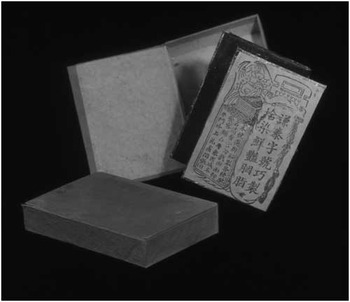
Indeed, it was the unprecedentedly grand announcement of a full new troupe, Le Wan Nian, on 1 September 1921 that signalled the renaissance of Cantonese opera in North America. This prominent announcement, taking up the bottom row across a newspaper page for several days, listed various details about the new troupe including the full cast of 15 and the nine-member management team.Footnote 51 At the centre, it listed a cast of 12 different role types in large boldface print. Separate commentary was given to key performers on the sides, highlighting their special repertoire and their prior success. The former Imperial Theatre on 720 Main Street was bought to house the troupe. The arrangement and presentation of this impressive announcement showed the ambition of this company, a fully equipped professional troupe complete with new repertoire, theatrical techniques and stellar professionals. This grand entrance might not have been planned by a new hand, however: the eminent merchant and opera fan Yip Sang (1845–1927) and his powerful Wing Sang Company was the sponsor for the troupe. The company clearly engaged deeply in the opera business, as years later remnants of theatrical supplies from the Wing Sang building were uncovered. These artefacts – such as the opera rouge in the box of its Guangzhou manufacturer shown in Figure 2 – support the notion of the once vibrant business of imports for the theatre.
Chinese opera rouge makeup (Courtesy of the Museum of Vancouver Collection: H990.277.165)

The arrival of Le Wan Nian troupe was remarkable for many reasons. It was the first troupe to organize and advertise a full cast with known performers for each role type. The list of nine management members showed a serious modern business structure, including managers, a secretary, accountants, bookkeeper, public relations staff and supervisor. The cast showed a better gender balance than any previous troupe, including four actresses of the young belle type, with no female impersonators. This troupe also brought realistic scenery paintings as stage backdrops, which had been used commonly in Hong Kong since the 1910s. It would enable the Chinatown theatre stage to match the most recent development of Cantonese opera, as well as the norm of modern spoken drama. Overall, the grand announcement conveyed a new image of Cantonese opera theatre, and Le Wan Nian was presented as the most ambitious Cantonese opera venture on this side of the Pacific Ocean. The elaborate advertisement signalled the arrival of new era of Cantonese opera performance in North America.
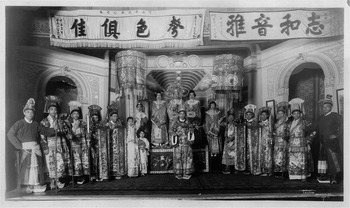
Debuting on 7 September 1921, the troupe was soon joined by a star actress from Hong Kong. Guan Yinglian was a bright star in an all-female troupe. Her ravishing beauty and command as a prima donna had few peers, as Figure 3, a photograph of the full troupe, clearly shows. Guan Yinglian appears at the back centre of the grandly arranged picture; this image symbolized the glorious moment of Cantonese opera history as well as recording the prosperity of Chinese opera theatres in Vancouver.
The Le Wan Nian troupe, 1923. (Courtesy of the University of British Columbia Library, Rare Books and Special Collections, Chung Collection, Cecil B. Wand’[Cantonese opera, Vancouver, B.C.]’, EX-5.3-1)

The troupe was performing with great success and managed to maintain a higher ticket price than the rival troupe at Sheng Ping; these two theatres clearly had an intense rivalry. At the beginning, their daily playbill advertisements were printed on separate pages, but very soon they were placed side-by-side every day. As might be expected, each tried to lure audiences with highlights of grand productions, fanciful titles, top cast or fancy new props. The Vancouver opera scene that year was unprecedented for the city; even from the day-to-day newspaper advertisements, one can sense the intensity of the competition, as well as the richness of their productions. Yet, even the best troupe cannot entertain the same audience night after night and retain the same allure. As the ticket price at the Le Wan Nian dropped gradually, it became clear that the troupe needed more mobility and varied performing opportunities. The United States would be an obvious choice, but it had been closing its door to Chinese performers. The problem of border crossing was now made even more acute by the presence of these two spectacular troupes in Vancouver. Chinese theatrical entrepreneurs were eager to broaden their circuit in North America, and large Chinese communities in United States were eager to embrace them.
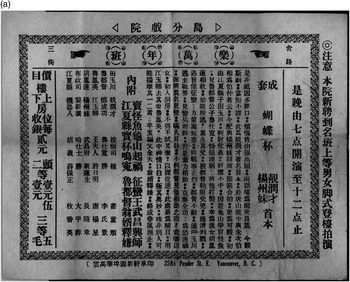
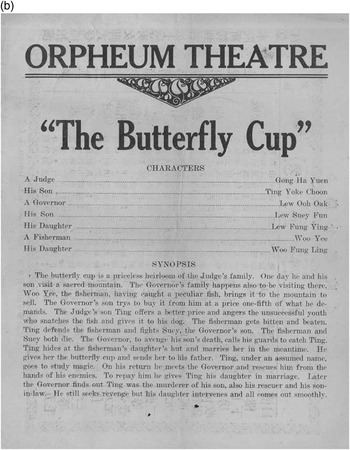
Indeed, Chinese merchants in Victoria and Vancouver had shown increasing interest in venturing into the United States, where no professional theatre had existed since 1906. Now, with the presence of the top troupes in Vancouver, the solution was pursued even more enthusiastically, and not by one or two groups alone. Just as the Le Wan Nian troupe was perhaps weighing its future, its rival troupe at the Sheng Ping Theater succeeded first. Sponsored by merchants who formed the Lun On theatrical company that solicited a top legal broker, a troupe of 33 members successfully entered the United States in Seattle, en route to San Francisco. On 5 October 1922, a Chinese theatre opened its doors again in San Francisco with performers from Vancouver. Three months later, the same Lun On company bought the Le Wan Nian troupe and sent it to Seattle as well. Mindful of the power of advertisement and print media in the public arena, the Lun On company brought along playbills printed by Vancouver's Chinese newspaper publisher for its performances at Seattle's Orpheum Theatre. Undated, these generic playbills gave a full synopsis as well as the casts and ticket prices in Chinese on one side and in an abridged version in English on the other. For example, one playbill (Fig. 4) listed a cast of six main characters in English for the opera The Emperor's Concubine, whereas the Chinese side listed a cast of 18 roles. Clearly the Lun On Company, armed with the top performers in the profession and the troupe's success in Vancouver, had envisioned this venture into the United States as a step toward realizing Chinese theatre's full potential in North America, not only within the Chinese community, but also introducing it to English-speaking audiences.
Chinese side of bilingual playbill for The Emperor's Concubine at the Orpheum Theatre, Seattle, 1920s (Courtesy of Wing Luke Asian Museum, Seattle)

English side of bilingual playbill for The Emperor's Concubine at the Orpheum Theatre, Seattle, 1920s (Courtesy of Wing Luke Asian Museum, Seattle)

Ironically, no playbills of Le Wan Nian in Vancouver seem to have survived, and we now must imagine their format and content through the plate they printed for Seattle. The question remains whether they used bilingual playbills at the Imperial Theatre in Vancouver, as they did at the Orpheum Theatre in Seattle. Or had they spruced up their practices to meet the new challenge of the United States? We may never know for certain, but in any case, Le Wan Nian had built a professional image and reputation through its elaborate advertisement, playbills and photographs, all of which reflected a vital Cantonese opera culture.
Transborder Practices and Circulations in the Pacific Northwest
This vibrant performing culture in Vancouver and Victoria contributed to a lively presence for Cantonese opera in the entire Pacific Northwest Region, one that crossed both national and linguistic boundaries. Before the early twentieth century, when railroad construction and the rise of extractive industries required Chinese and other Asian migrants being brought to the Pacific Northwest, border crossings between Canada and the US were treated casually. As noted earlier, when the Prime Minister insisted on hiring Chinese labour for CPR, 7,000 workers came from California to work on the railroad. And in the 1880s, 17,501 Chinese came from China, San Francisco and Puget Sound. The great demand for a Chinese workforce meant that Chinese immigrants moved across the border freely, and as Kornel Chang notes, ‘the laborers, merchants and entrepreneurs helped create and sustain a transborder world of motion in the Pacific Northwest’.Footnote 52 But as a result of the two nations’ anti-Chinese efforts, by the 1910s a new emphasis on border policing and surveillance drew a rigid line of division between Canada and the US to curtail Chinese immigration. Chinese immigrants were stopped at the border unless they had documents allowing them to cross. However, if strict border crossing rules succeeded in materially restricting the mobility of Chinese, they did not change the mode of transborder commerce already developed by the Chinese community in the Pacific Northwest. The region's significant triangle – Victoria, Vancouver and Seattle – was made still closer by a popular triangle route of CPR steamships. And in the end, it was the proximity of the cities within the triangle that enabled Lun On to introduce and transport the Vancouver opera troupes to Seattle and San Francisco. When the initial troupe left Vancouver and sailed for Seattle, its admission into the United States was to be determined at the port, as the government declined to approve its request in advance.
So it was only with the ambitious and strategic approach of Chinese merchants of Victoria and Vancouver and the proximity of the ports in the triangle that the mobility of performers within the Pacific Northwest Region was regained, leading to the 1920s’ renaissance of Cantonese opera in North America. The performances of the Sheng Ping and the Le Wan Nian troupes in San Francisco and Seattle, initially sponsored by the 12 Victoria and Vancouver merchants, mark the beginning of this development. Also in 1922, another Cantonese opera troupe, Lok Tin Tsau, travelled from Vancouver across Canada, stopping to perform in Toronto and Montreal, before entering the US to perform for the Thanksgiving holidays in Boston. In 1923, a group of merchants in Vancouver organized the Kue Hing Company, sponsoring a new troupe from China. This troupe went through San Francisco, and eventually played in Honolulu.Footnote 53 Another troupe, Jock Ming'on, was hired to perform in the Sheng Ping Theater in 1923, and by the end of 1924 it was sold to a merchant in New York and left Canada, landing in Seattle, then travelling by train to New York City. Meanwhile, Vancouver was not left without Cantonese opera. New troupes arrived from China to continue the lively performance scene.
The routes of these opera troupes show the close connection between the Chinese communities of the British Columbia and the United States. The increased mobility of Cantonese opera performers within the Pacific Northwest Region helped strengthen the performing network, and the robust performing network and the constant arrival of stellar performers from all directions – China, San Francisco, New York, Havana and elsewhere – in turn helped enrich the performing life of Vancouver's Chinese theatre stages and fostered many amateur performing clubs. While the national border control played a role in curtailing movement, it could not stop the Pacific Northwest Region from developing its distinctive characteristics, nor could it prevent the formation of cultural affinities. Supported by newspapers, playbills and phonograph records, Cantonese opera performance blossomed in the Pacific Northwest and spread beyond it. In this way, the performing circuit of Cantonese opera in the Americas – Canada, US, Mexico, Cuba and Peru – grew rapidly in the 1920s, and was sufficiently supported by a network of multiple theatres and myriad transborder activities.
In 1923, the Parliament of Canada passed its own Chinese Exclusion Act (the Chinese Immigration Act), banning most forms of Chinese immigration to Canada, with the exception of diplomats, students and ‘special circumstance’. Chinese Canadians also lost the right to vote.Footnote 54 The number of Chinese immigrants decreased drastically, to single digits annually between 1924 and 1929. Yet, by then, the mobility of Cantonese opera performers within the Pacific Northwest Region had been re-established, and for the next 20 years Cantonese opera performers continued to arrive in Canada from China, the United States, Cuba and elsewhere. This expanded circuit became the most popular way for performers and troupes to take full advantage of their trans-Pacific journey – a mark of the business's success at circumventing the bi-national effort to keep out Chinese immigrants. Among the major Chinatown theatres in the United States, San Francisco's Mandarin Theatre stood out as the only company that was founded and managed exclusively by San Francisco merchants, bringing in performers directly from China. Yet even so, the Mandarin Theatre also quickly became absorbed into the transborder network of Cantonese opera performing troupes, both in terms of its recruitment of talent to replenish the cast and in terms of its own business expansion. In 1927, the Sheng Ping Theatre of Vancouver presented a new troupe to the community: the Mandarin Theatre Co.Footnote 55
As the circuit developed, the national boundary between Canada and the US itself came to play a positive role in the dissemination of Cantonese opera in the Americas. Chinese performers arriving from Canada with their domicile status were admitted at the US border more easily than those arriving directly from China, and this expedited the entry of many troupe members. While the maximum stay of Chinese opera performers in US was three years, because performers with Canadian domicile status were required to return to Canada to meet their residency requirement, their regular trips crossing the border allowed them to easily re-enter with a new date, thus circumventing US immigration's arbitrary three-year rule. Thus, in a letter of 15 October 1926, Philip Kee, the manager of the Lok Tin Tsau Theatre in New York City, requested the city's immigration office to allow its four performers to travel to Canada in order to ‘protect their registration and domicile in that country and then return to the US’.Footnote 56 This was the first of many such requests from this manager. And with constantly renewed entries, these performers ended up performing in the US from 1922 to 1933. Ironically, then, instead of excluding performers, restrictive border crossing regulations were now used to facilitate their extended residence.
Conclusion
Whether through the five Cantonese opera theatres in the bustling town of Victoria in the late nineteenth century, the three new theatres in the burgeoning cosmopolitan Vancouver of the early 1910s, the amateur performing groups in Edmonton, Calgary and Cumberland, or the itinerant performing troupes passing through these smaller towns, as well as Toronto and Montreal, Chinese in Canada strived to maintain lively performance of Cantonese opera in their daily life. Rather than being satisfied with low-grade performances, they recruited the best performers whenever possible, and built theatres that were as extravagant as feasible. The significance of opera theatres as cultural expression and musical entertainment was reflected not only in strong audience demand, but also in the way that wealthy merchants could be depended on to erect theatre buildings, furnishing capital, help troupes work their way through immigration hurdles and support the recruitment of performers from China itself and from the entire American circuit. Outside the theatres, opera performances also featured prominently in larger community events, as Chinese newspapers often enthusiastically reported, marking festival and celebrative community occasions, as well as participating in social and political causes. The lively Cantonese opera culture grew as Chinese immigrants established roots in Canada and endeavoured to enhance the musical and cultural life of the community. The performing body and voice of top opera singers like Zhang Shuqin contributed significantly to the fashioning of opera culture and discourse about them, which in turn fostered the formation of social and cultural memory for generations to come. As we have seen, that enduring presence was made possible to a previously unrecognized extent by the activity centred in Vancouver in the 1910s, which eventually facilitated the circulation of the performers and troupes throughout North America. And in 1921, Vancouver's stages reached another high point, with troupes that signalled the managerial ambition and professionalism of a new era. The quick growth of record sales in the 10-year span from 1918 to 1928 further enhanced Cantonese opera culture in Chinese communities by fostering a new listening culture, itself influenced by vibrant live performances.
The foray of Cantonese opera troupes into United States, at a time when that country was closed to Chinese immigrants, reveals the significance of the Pacific Northwest region in facilitating the mobility of the performers and the circulation of the troupes, musical practices, and print and listening culture. This fluidity becomes apparent only if we take into account the various transnational forces, multi-stranded connections and social and legal contexts of interrelated communities. And finally, this approach also enables us to see that, while the prosperity of Vancouver's opera theatre precipitated the renaissance of Cantonese opera in the United States, merely a couple of years later, it was the other way around. The robust Cantonese opera performing network propelled by San Francisco's two powerful theatres, Great China and Mandarin, grew so quickly and powerfully that it in turn helped maintain Vancouver's performing culture at a time when Canada had begun its own Chinese Exclusion that shut the door to most Chinese immigrants. The connections forged by theatrical ventures and trans-border circulation of performers had become an important network that sustained and continued the vibrant performing circuit all through the 1920s.
 ), 15 November 1922.