Introduction
The use of blame management strategies by office holders is a widely used analytical lens in the study of executive politics (Weaver, Reference Weaver1986; McGraw, Reference McGraw1990; Bovens et al., Reference Bovens, ‘t Hart, Dekker, Verheuvel and Anheier1999; Hood, Reference Hood2002, Reference Hood2011; Brändström and Kuipers, Reference Brändström and Kuipers2003; Moynihan, Reference Moynihan2012; Mortensen, Reference Mortensen2013; Hinterleitner, Reference Hinterleitner2018a; Hinterleitner and Sager, Reference Hinterleitner and Sager2017). While these studies show that avoiding blame is an important driver of political executives’ behaviour, few studies have systematically explored the role of institutional contexts in shaping political executives’ blame management strategies (Mortensen, Reference Mortensen2012, Reference Mortensen2016; Hinterleitner and Sager, Reference Hinterleitner and Sager2015; Resodihardjo et al., Reference Resodihardjo, Carroll, Eijk and Maris2016). The hitherto most sophisticated empirical analyses of politicians’ blame management strategies focus on top-level politicians’ reactions to public allegations of blameworthy individual behaviour (Hood et al., Reference Hood, Jennings and Copeland2016) and policy fiascos caused by the government bureaucracy (Hood et al., Reference Hood, Jennings, Dixon, Hogwood and Beeston2009). However, those situations represent a specific type of public service provision with a clear allocation of responsibility. This article aims at broadening the literature’s perspective by studying blame management strategies under the conditions of the ‘regulatory state’, which is characterized by a complex interplay of different organizations, public and private, which take on different roles (e.g. purchaser, provider, owner, regulator) (Scott, Reference Scott2000).
This is the first article that systematically studies the public attribution of blame to decision-makers and those actors’ blame avoidance behaviour in a complex institutional setting, contributing to an emerging literature on blame games taking place within complex institutional arrangements such as ‘public service networks’ (Moynihan, Reference Moynihan2012), ‘governance networks’ (Hasler et al., Reference Hasler, Kübler and Marcinkowksi2016), ‘fuzzy governance’ (Bache et al., Reference Bache, Bartle, Flinders and Marsden2015), or ‘complex international institutions’ (Rittberger et al., Reference Rittberger, Schwarzenbeck and Zangl2017). Most of this scholarship focuses on the unclear distribution of formal responsibilities, pointing at problematic challenges of pinpointing democratic accountability due to the notorious problems of ‘many eyes’ and ‘many hands’ involved in service delivery (Bovens, Reference Bovens2007). This article studies those problems through analysing the public attribution of blame and blame-takers’ presentational strategies during a major crisis.
The blame management literature distinguishes between anticipatory and reactive forms of blame avoidance (Hinterleitner and Sager, Reference Hinterleitner and Sager2017). Whereas office holders may engage in anticipatory blame avoidance before a blameworthy event occurs, they will use strategies of reactive blame avoidance when faced with public allegations of blameworthy behaviour. The use of complex institutional architectures or ‘partnership structures’ is considered an instrument of anticipatory blame avoidance, characterized by the allocation of unclear responsibilities among a large number of actors so ‘that no ordinary person can ever hope to figure out who exactly is responsible for what’ (Hood, Reference Hood2011: 81). This article builds upon the idea that anticipatory and reactive blame avoidance strategies are causally connected (Hinterleitner and Sager, Reference Hinterleitner and Sager2017). We ask whether complex institutional architectures will effectively diffuse blame to multiple actors in the wake of policy fiascos and thereby provide limitations to holding single organizations and their representatives to account.
While there is a growing body of scholarship on the attribution of blame in partnership structures (Bache et al., Reference Bache, Bartle, Flinders and Marsden2015; Hasler et al., Reference Hasler, Kübler and Marcinkowksi2016; Rittberger et al., Reference Rittberger, Schwarzenbeck and Zangl2017), there is only limited empirical knowledge about the effects of partnership structures on reactive blame management strategies. We contribute to filling this gap by developing and testing theoretical expectations about the effects of partnership structures on reactive forms of blame avoidance variously labelled as ‘presentational strategies’ (Hood, Reference Hood2002: 16), ‘argumentative tactics’ (Bovens et al., Reference Bovens, ‘t Hart, Dekker, Verheuvel and Anheier1999: 142), ‘framing strategies’ (Brändström and Kuipers, Reference Brändström and Kuipers2003: 282), ‘political excuses and justifications’ (McGraw, Reference McGraw1990), or ‘blame-shifting rhetoric’ (Mortensen, Reference Mortensen2012). The article tests the widespread claim that presentational strategies follow a sequential order, in which blame-takers will first downplay the problem and will only admit personal failings after other presentational strategies have been exhausted (Bovens et al., Reference Bovens, ‘t Hart, Dekker, Verheuvel and Anheier1999; Brändström and Kuipers, Reference Brändström and Kuipers2003; Hood et al., Reference Hood, Jennings, Dixon, Hogwood and Beeston2009; Hood et al., Reference Hood, Jennings and Copeland2016; Resodihardjo et al., Reference Resodihardjo, Carroll, Eijk and Maris2016). Whereas most studies focus on the blame avoidance behaviour of executive politicians or ‘delegators’ (e.g. Bovens et al., Reference Bovens, ‘t Hart, Dekker, Verheuvel and Anheier1999; Hood et al., Reference Hood, Jennings, Dixon, Hogwood and Beeston2009, Reference Hood, Jennings and Copeland2016; Hinterleitner and Sager, Reference Hinterleitner and Sager2015), we also analyse senior executives of the service provider, or ‘delegatees’ (see Mortensen, Reference Mortensen2016 for a similar approach).
This article sets out to study blame attribution and blame management in the wake of a major crisis of the rapid transit railway system (S-Bahn) in the capital region of Berlin in 2009. The crisis resulted in an intense blame firestorm in media and parliament, which makes it a suitable case for the study of blame games in complex delegation structures. The rapid train services are contracted in a purchaser–provider system involving several public, quasi-public, and private organizations that is embedded in the multi-level structure of a federal country. The article is a single case study of a typical case of complex delegation structures, where the roles of purchaser, provider, and regulator are distributed among multiple actors and levels of government (Mortensen, Reference Mortensen2013; Bache et al., Reference Bache, Bartle, Flinders and Marsden2015; Hinterleitner, Reference Hinterleitner2018b). While a single case study cannot claim representativeness, we suggest that the Berlin case provides a suitable context for developing and testing claims regarding the dynamics at play in complex service delivery structures. Our empirical, theoretical, and methodological contribution can pave the way towards systematic comparative analyses of blame dynamics in complex institutional structures.
In the next section, we review the main arguments and findings of the blame management literature and subsequently develop our conjectures regarding the public attribution of blame and blame management strategies in complex delegation settings. After that, we present the case and our research design, followed by the results of our statistical analysis. We use media content analysis to study the public attribution of blame to key actors and their use of argumentative tactics to fight off public criticism during the peak of the crisis in 2009. Finally, we discuss our main findings and their implications for the study of blame avoidance and accountability in complex delegation structures.
The politics of blame avoidance
The central assumption of the blame management perspective is a negativity bias among the public, who allegedly value actual or perceived losses higher than gains. This negativity bias leads to a dominant motivation of policy-makers to, above all, avoid blame for such losses, rather than claim credit for gains that resulted from their support of a particular policy (Weaver, Reference Weaver1986). The news media are said to be driven by negativity bias, too, amplifying public attention to failures (Hood, Reference Hood2011). Although there is reason to believe that policy-makers are guided by a range of alternative motivations, blame avoidance provides a parsimonious explanation of many phenomena in executive politics.
Hood (Reference Hood2011) offered the most systematic account of blame avoidance in executive politics and distinguishes three types of blame avoidance strategies: presentational strategies, involving the use of arguments and other methods of diverting attention from the blame-takers (see also Hood, Reference Hood2002; Hood et al., Reference Hood, Jennings, Dixon, Hogwood and Beeston2009; Hood et al., Reference Hood, Jennings and Copeland2016); agency strategies, working through the apportioning of responsibility for the exercise of public tasks among various organizations (Mortensen, Reference Mortensen2013, Reference Mortensen2016); and policy strategies, characterized by the selection of policy alternatives or decision routines and procedures that will minimize the attribution of agency to would-be blame-takers (Hinterleitner, Reference Hinterleitner2018a).
The blame avoidance framework has been empirically tested in a number of studies, each with a somewhat different analytical focus and methodological approach. Many studies stress the importance of framing and public argumentation and take a closer look at specific episodes of crises and policy failures. This body of scholarship addresses executive politicians’ sequential use of presentational strategies and their effectiveness in reducing blame attribution (Bovens et al., Reference Bovens, ‘t Hart, Dekker, Verheuvel and Anheier1999; Brändström and Kuipers, Reference Brändström and Kuipers2003; Boin et al., Reference Boin, ‘t Hart and McConnell2009; Hood et al., Reference Hood, Jennings, Dixon, Hogwood and Beeston2009; Hood et al., Reference Hood, Jennings and Copeland2016). Others explore the deployment of particular tactics of blame avoidance, such as establishing commissions of inquiry (Sulitzeanu-Kenan, Reference Sulitzeanu-Kenan2007) or the stepwise announcement of problems (‘salami tactics’) in large-scale projects (Hinterleitner, Reference Hinterleitner2018b). A third body of literature investigates audiences’ reactions to argumentative tactics (McGraw, Reference McGraw1990) and their attribution of blame to office holders (Mortensen, Reference Mortensen2013, Reference Mortensen2016).
A growing number of studies seek to understand the role of institutions in blame management. Among them, Mortensen (Reference Mortensen2013) has demonstrated that delegation – vertically to subnational levels of government – can successfully deflect blame from the central government level. In another study, centralization of jurisdiction had no significant impact on blame attribution (Mortensen, Reference Mortensen2012). Moynihan’s (Reference Moynihan2012) study explores blame avoidance dynamics in a network setting in the wake of Hurricane Katrina. It demonstrates that members of public service delivery networks are willing to blame other members to defend their reputation outside the network. In an experimental study, Bartling and Fischbacher (Reference Bartling and Fischbacher2012) show that delegation is an effective instrument for avoiding responsibility for unpopular decisions.
More recently, scholars have used experimental designs to study how service delivery by the public sector, as opposed to contracting out public services, affects the attribution of blame by citizens, delivering mixed results. James et al. (Reference James, Jilke, Petersen and Van de Walle2016) and Marvel and Girth (Reference Marvel and Girth2016) find that politicians cannot avoid blame for poor services provided by private contractors. In contrast, Piatak et al. (Reference Piatak, Mohr and Leland2017) find that citizens attribute blame for poor service to service providers rather than politicians, but will blame politicians if the latter have greater control over service provision.
In short, whereas several studies elaborate on how institutions shape blame attribution, we are unaware of any research that systematically tests how partnership structures affect blame avoidance behaviour. This is an obvious gap in the literature, considering that complex delegation structures have become widespread across multiple domains of public service delivery, in particular those characterized by features of the regulatory state (Scott, Reference Scott2000). Analysing blame games in complex delegation structures not only begs the question of the public attribution of blame to different actors; it also points our attention to different actors’ blame avoidance strategies, including both delegators (politicians) and delegatees (service providers).
Blame attribution and blame avoidance strategies in complex delegation structures
As elaborated above, presentational strategies are reactive strategies used in the firestorm of an acute crisis, whereas agency and policy strategies are anticipatory mechanisms to deflect or minimize blame in a future blameworthy situation (Hinterleitner and Sager, Reference Hinterleitner and Sager2017). However, although often analysed separately, preventive and reactive blame avoidance strategies are connected, as preventive strategies should lower the chances of blame attribution occurring in the first place and because ‘anticipatory blame avoidance can enhance the chances of prevailing in a reactive blame game’ (Hinterleitner and Sager, Reference Hinterleitner and Sager2017: 595). We explore this connection by studying blame attribution and reactive blame avoidance behaviour in complex institutional structures, which are typically understood as anticipatory mechanisms of blame avoidance.
The effect of institutional design on blame attribution
The existing literature on institutional effects on the attribution of blame in field settings has focused on fairly simple delegation relationships, such as corporatization (Mortensen, Reference Mortensen2016) and regionalization (Mortensen, Reference Mortensen2013). The experimental literature likewise focuses on blame attribution in simple delegation settings (Bartling and Fischbacher, Reference Bartling and Fischbacher2012; James et al., Reference James, Jilke, Petersen and Van de Walle2016; Marvel and Girth, Reference Marvel and Girth2016; Piatak et al., Reference Piatak, Mohr and Leland2017). This article resonates with an emerging literature focusing on blame attribution in complex delegation structures. In a case study of climate policy implementation in the United Kingdom, Bache et al. (Reference Bache, Bartle, Flinders and Marsden2015) argue ‘that politicians may create or tolerate increasingly complex and fluid governance structures as a rational self-defence mechanism when faced with apparently intractable socio-political challenges’ (65). These authors demonstrate how ‘fuzzy governance’ results in ‘fuzzy accountability’ inhibiting effective problem solving (Bache et al., Reference Bache, Bartle, Flinders and Marsden2015). Focusing explicitly on the attribution of blame to different actors, other scholars have studied the multi-level structure of the European Union (EU) (Rittberger et al., Reference Rittberger, Schwarzenbeck and Zangl2017) and metropolitan governance networks (Hasler et al., Reference Hasler, Kübler and Marcinkowksi2016). However, this literature has produced mixed empirical findings, suggesting that blame is attributed to implementing actors in the EU (Rittberger et al., Reference Rittberger, Schwarzenbeck and Zangl2017), whereas elected actors have been found to be ‘over-blamed’ for policy failures compared to other actors involved in metropolitan service delivery (Hasler et al., Reference Hasler, Kübler and Marcinkowksi2016).
Following Hood’s (Reference Hood2011) argument about agency strategies of blame avoidance, our conjecture is that Berlin’s public transport regulatory regime represents a partnership structure featuring ‘shared responsibility and organizational complexity’ (81), rendering it virtually impossible to attribute a policy fiasco to a single actor. Hence, assuming that a partnership structure is an effective blame avoidance mechanism, blame attribution might diverge from the actual distribution of responsibility (Hasler et al., Reference Hasler, Kübler and Marcinkowksi2016; Rittberger et al., Reference Rittberger, Schwarzenbeck and Zangl2017). We expect that an unclear distribution of responsibility in complex delegation structures leads to the attribution of blame to a larger number of actors, effectively diverting blame from executive politicians. We therefore propose a diffused blame attribution hypothesis:
HYPOTHESIS 1: In complex delegation structures, blame will be attributed to various actors involved in service provision, rather than to executive politicians alone.
We contrast this conjecture with a competing assumption, namely that major policy failures will almost inevitably be blamed on executive politicians, no matter how formal responsibility is allocated (for experimental evidence, see James et al., Reference James, Jilke, Petersen and Van de Walle2016; Marvel and Girth, Reference Marvel and Girth2016). Horn (Reference Horn1995) argues that even though legislative politicians in parliamentary systems frequently delegate responsibilities, this shift will not be an effective tool of blame avoidance, given the supposedly clear lines of responsibility in such systems. Moreover, criticizing a naïve picture of the public in early accounts of blame attribution, Horn (Reference Horn1995) argues that stakeholders will not simply allocate blame to delegatees, but will also take into consideration the delegator’s procedural constraints on delegatees. Put differently, rather than deflecting blame from the delegator, dissatisfaction with the delegatee may well backfire onto the delegator in the public’s eye. Moreover, delegatees may not accept being scapegoated and respond strategically to blame delegation by politicians, which eventually ‘may result in blame sharing or blame boomeranging rather than blame shift away from politicians’ (Hood, Reference Hood2002: 28). In conjunction with the blame diffusion hypothesis, this suggests that complex delegation structures may only temporarily protect politicians from becoming blame-takers. Hence, following the idea that partnership strategies are ineffective devices for deflecting blame in the long run, we formulate a deferred blame attribution hypothesis:
HYPOTHESIS 2: In complex delegation structures, executive politicians will eventually become blame-takers for policy fiascos, yet blame will first be directed at service providers, rather than executive politicians.
The sequencing of presentational strategies by blame-takers in complex delegation structures
In addition to blame diffusion, this article investigates the often made claim that blame-takers use a typical sequence of rhetorical blame avoidance tactics when facing a blame firestorm. According to the ‘sequencing’ or ‘staged retreat’ assumption about reactive blame avoidance behaviour, office holders (or, more generally, blame-takers) will first respond to allegations with problem denial or justification, claiming that ‘the consequences of the act are not necessarily undesirable and that blame is unwarranted’ (McGraw, Reference McGraw1990: 120). If the existence or severity of a problem cannot be plausibly denied anymore, then blame-takers will admit to a problem but deny personal responsibility. In other words, actors will provide excuses that question the causal link between the actor and the problem (McGraw, Reference McGraw1990: 120). The ultimate tactic will then consist of both problem and responsibility admission (Hood et al., Reference Hood, Jennings, Dixon, Hogwood and Beeston2009).
Few studies have empirically tested the assumption of a sequential order of presentational strategies. Hood et al. (Reference Hood, Jennings, Dixon, Hogwood and Beeston2009) find partial empirical support for their sequencing hypothesis according to which executive politicians will only admit personal responsibility for a policy fiasco after having used other presentational strategies. Likewise, Hood et al. (Reference Hood, Jennings and Copeland2016) find support for an ideal-typical staged retreat pattern in the early phase of office holders’ responses to allegations. However, after that period, presentational strategies no longer follow the linear, sequential pattern. Resodihardjo et al. (Reference Resodihardjo, Carroll, Eijk and Maris2016) find that blame-takers become more accommodative with increasing levels of blame, but also show that such staged retreat tactics lead to increasing, rather than decreasing, levels of blame attribution.
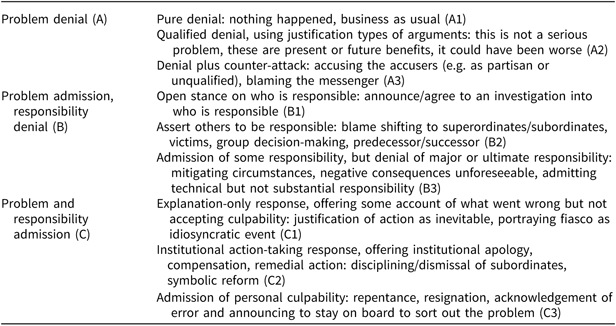
This article responds to calls for conducting systematic studies of the sequential use of presentational strategies (Hood et al., Reference Hood, Jennings and Copeland2016) and for studying theoretical assumptions about blame avoidance behaviour across different contexts (Hinterleitner and Sager, Reference Hinterleitner and Sager2015). In the words of Hood (Reference Hood2011), ‘if blame avoidance means anything, it will tend to mean that the sequencing approach will be commonly observable’ (155). To test this assumption, we use the analytical categories proposed by Hood et al. (Reference Hood, Jennings, Dixon, Hogwood and Beeston2009: 698) and supplement their coding scheme with additional elements based on McGraw (Reference McGraw1990) and Bovens et al. (Reference Bovens, ‘t Hart, Dekker, Verheuvel and Anheier1999) (see Table 1).
The blame avoidance continuum of argumentative tactics

Source: Hood et al. (Reference Hood, Jennings, Dixon, Hogwood and Beeston2009), modified drawing on McGraw (Reference McGraw1990) and Bovens et al. (Reference Bovens, ‘t Hart, Dekker, Verheuvel and Anheier1999).
The article adds to the existing literature in two ways. First, we test whether the assumption about the staged retreat of blame-takers also holds for politicians in complex delegation structures. Second, we test whether the staged retreat assumption also holds for actors other than executive politicians. Previous studies have typically looked at ‘allegations of individual misconduct or misjudgement by senior office holders’ (Hood et al., Reference Hood, Jennings and Copeland2016: 544) and their reactive blame avoidance strategies. In complex delegation structures, we expect blame to be directed at different types of actors, yet we do not know whether these actors’ attempts to spin their way out of trouble are similar to politicians’ presentational strategies. Following Hood et al. (Reference Hood, Jennings, Dixon, Hogwood and Beeston2009), we propose two different versions of the sequencing hypothesis:
HYPOTHESIS 3a: Blame-takers in complex delegation structures will use strategies of problem denial (strategy A) before all other responses (B+C).
HYPOTHESIS 3b: Blame-takers in complex delegation structures will use problem denial (A) or admission but responsibility denial (B) before problem and responsibility admission (C).
The final hypothesis explicitly connects anticipatory and reactive strategies of blame avoidance (Hinterleitner and Sager, Reference Hinterleitner and Sager2017). From a blame avoidance perspective, the rationale behind complex delegation structures is to ensure (or at least tolerate) a fuzzy allocation of responsibility (Hood, Reference Hood2011). A complex delegation structure provides excellent opportunities for blame shifting to delegatees by executive politicians (Bache et al., Reference Bache, Bartle, Flinders and Marsden2015). However, we lack systematic empirical studies of politicians’ blame-shifting behaviour in such settings. We conjecture that complex delegation structures also allow other actors, such as service providers, to use blame shifting as a reactive blame avoidance strategy (Moynihan, Reference Moynihan2012). Hence, we propose the following blame shifting hypothesis:
HYPOTHESIS 4: Blame-takers are most likely to react to public attributions of blame by ‘passing the buck’ to other actors in a complex delegation structure.
In our analytical framework, blame shifting (strategy B2) is one of several presentational strategies (see Table 1). The use of blame shifting as strategic action by blame-takers will, therefore, contribute to observed patterns of public attribution of blame (H1 and H2).Footnote 1 Before we present our research design, we provide a brief overview of the institutional architecture of the rapid train system.
The institutional architecture of the S-Bahn: privatization, federalism, and corporate strategy
The S-Bahn crisis evolved against the background of an economic and regulatory structure that was the result of regulatory reform policies adopted in the 1990s when the Federal Railways (now Deutsche Bahn, DB) were formally privatized under 100% ownership of the federal government in 1994 [see Bach and Wegrich (Reference Bach, Wegrich, Christensen and Lægreid2016) for a more comprehensive account of the reform and its implications on accountability relations]. While the privatization of shares was a key element in the original reform plans, the degree and exact mode of privatization remained contested. The business strategy during the 2000s was to develop DB into a profitable transport company by engaging in ever more activities and by expanding its geographic scope. Moreover, various reforms of the DB governance structure were introduced to prepare for the partial privatization and initial public offering, in particular the separation of infrastructure and the railway network from operational services. The initial public offering planned for 2008 was postponed in the midst of the worldwide financial crisis and eventually buried in 2011.
The regulatory regime under which S-Bahn Berlin GmbH (limited company) provides its service in the Berlin metropolitan area is one of a purchaser–provider contract system. The contract at the time, running from 2003 to 2017, established an annual subsidy payment of 236 million euro (in 2010) from the Berlin government. The contract between Berlin and Brandenburg (the state that surrounds Berlin) and the S-Bahn was only made accessible to the public after increased public pressure.
The key problems were that the level of service provision was initially not specified in much detail and indemnities were capped at a maximum of 5% of annual subsidies, which amounted to 12 million euro in 2009. Under these conditions, DB had a clear incentive to neglect investments in order to raise profits (‘asset sweating’). With limited options to increase revenues, DB introduced a cost-cutting programme in 2005 for the S-Bahn, which included staff reduction, the scrapping of trains to cut maintenance costs, the closure of maintenance facilities, the extension of maintenance cycles, and cost cutting in procurement. For instance, the number of train drivers was cut from 1017 to 834 between 2003 and 2009 (VBB, 2012). Likewise, DB steeply increased its profit targets for the Berlin S-Bahn. The profit target for the Berlin S-Bahn in 2010 was set at 125.1 million euro, compared to public subsidies of about 232 million euro per year.
Another player in the regulatory architecture is the regional public transport authority (VBB), which coordinates all public transport companies within Berlin and Brandenburg on behalf of the two states and local governments. It has essentially a service provider function for its owners, such as organizing public tenders for train lines, supervising whether the quality of public transport corresponds to contractual specifications (e.g. timeliness, customer satisfaction), and coordinating public transport schedules. Throughout the crisis, the then-chief executive of the VBB was a harsh critic of the monopoly position of the S-Bahn and of DB’s corporate policy of profit maximization (Franz, Reference Franz2010).
To summarize, the institutional architecture of the rapid train network in Berlin is characterized by a number of players who are located both at the state and the federal level (Bach and Wegrich, Reference Bach, Wegrich, Christensen and Lægreid2016). At the state level, the governments of Berlin (the Senate) and Brandenburg are the purchasers of public transport services.Footnote 2 To this end, they have concluded a contract with the S-Bahn, a full subsidiary of DB, which is a fully state-owned company in the hands of the federal government. DB itself has a complex holding structure, the responsibility for the S-Bahn lying with DB Regio AG. Thus, even though the federal government in theory has some influence on DB (within the confines of corporate law), DB has generally been sitting in the driver’s seat as regards corporate policies. The states of Berlin and Brandenburg have delegated quality control and public tendering of train services to the VBB. Finally, the federal railway safety regulator is in charge of supervising safety standards and authorizing infrastructure and rolling stock (i.e. vehicles on railways). Although it has been accused of lenient oversight of the incumbent company DB by private competitors (Lodge, Reference Lodge2002), the strict enforcement of safety standards by the federal regulator has played a key role in triggering the two crisis episodes under scrutiny in this article.
Research design
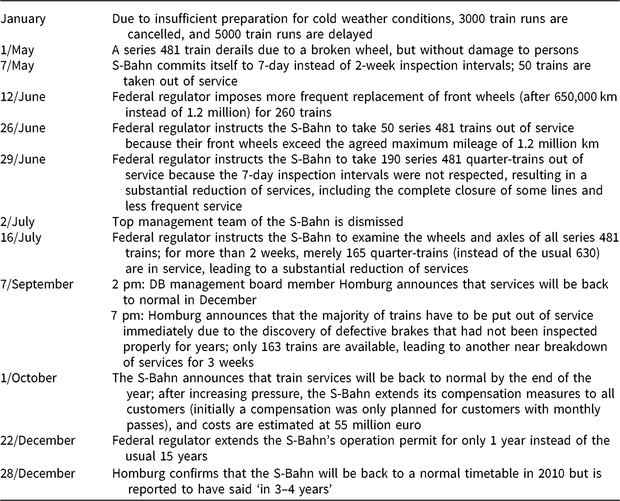
The article analyses blame attribution to decision-makers and their blame management during two major crisis episodes in 2009. Those episodes involved major reductions in rolling stock due to regulatory action taken by the federal railway regulator (see Table 2). The first crisis episode started on 1/May/2009 when a train derailed due to a broken wheel. This incident resulted in several enforcement decisions by the federal train safety regulator, who detected that the S-Bahn did not comply with its self-proclaimed standard of a 7-day maintenance cycle for wheels. The regulator’s decision resulted in a significant reduction of services, including the complete closure of several lines, shorter trains, and lower frequencies for all lines. This first episode ends with the dismissal of the entire leadership team of the S-Bahn by the company’s board on 2/July/2009.
Timeline of S-Bahn crisis in 2009

The sacking of the S-Bahn leadership did not help to end the pertinent problems of the company, however. When another major breakdown took place in early September, both the minister in charge of transport and the DB executive in charge of passenger transportation faced a severe blame firestorm. This second episode started on 7/September/2009 and lasted until the end of 2009. This time, a lack of maintenance caused problems with the brakes, and again train services were reduced significantly. In October, the S-Bahn announced compensation measures for passengers and promised that train services would be back to normal by the end of 2009. The second crisis episodes ended on 28/December/2009 when the DB executive announced that the S-Bahn would be back to a normal timetable in 2010. (It was only in August/2014 that the S-Bahn’s CEO announced the end of the crisis on the occasion of the company’s 90th anniversary.)
The article primarily draws on systematic media analysis to capture blame attribution and argumentative tactics of blame avoidance. Following earlier research on blame attribution and management in crises (Hood et al., Reference Hood, Jennings, Dixon, Hogwood and Beeston2009; Hood et al., Reference Hood, Jennings and Copeland2016; Resodihardjo et al., Reference Resodihardjo, Carroll, Eijk and Maris2016), we systematically analysed the coverage of the S-Bahn crisis (May–December/2009) in three local broadsheet newspapers with different editorial policies (Berliner Morgenpost-centre right, Berliner Zeitung-centre left, and Der Tagesspiegel-centre). The S-Bahn crisis mostly had a local character and was, therefore, only selectively covered by national newspapers, which were not included in the sample. We conducted a full-text search in an online database (LexisNexis) for the study period using the search term ‘S-Bahn’ and a minimum article length of 500 words, which resulted in 2454 articles. We read all articles and subsequently focused only on articles explicitly referring to the crisis. In order to familiarize ourselves with the regulatory regime and crisis dynamics, we analysed publicly available documents, such as minutes from parliamentary sessions and evaluation reports, and conducted a small number of confidential interviews with experts and stakeholders.
The article uses several types of data and methods. For the analysis of blame attribution, the units of analysis are explicit attributions of blame to decision-makers, such as executive politicians, the DB and its representatives, and the service provider (e.g. ‘the S-Bahn reduced the number of trains and closed down maintenance facilities, and now it’s the passengers who have to foot the bill’). The attributions of blame originated with different actors, including opposition politicians, journalists, the federal railway safety regulator, and union representatives, among others. If an article contained blame attributions to several actors, we coded them as separate instances of blame attribution. Likewise, if the same article contained attributions of blame to the same blame-taker originating from different blame-givers, we coded those as separate instances of blame attribution.
To study the attribution and timing of blame (H1 and H2), we coded all newspaper articles (N = 85) containing an explicit attribution of blame to decision-makers during the first crisis episode. The service provider (the S-Bahn), the owner (DB), and political executives (the Berlin Senate) received the largest share of blame by a fair margin, whereas the federal government and the mayor of Berlin were hardly blamed at all. We, therefore, excluded them from the quantitative analysis. The first crisis episode can be characterized as a ‘framing contest’ (Boin et al., Reference Boin, ‘t Hart and McConnell2009) about finding the responsible(s) for the crisis, which ended with a clear attribution of responsibility to the S-Bahn leadership. In contrast, the second episode was characterized by a stronger focus on how to solve the crisis, when it will be solved, and on passenger compensation. Therefore, we analyse patterns of blame attribution only for the first episode.
We use descriptive statistics to analyse the degree of diffusion of public blame to different decision-makers. We use event history analysis to compare the timing of blame attribution between the different decision-makers (Box-Steffensmeier and Jones, Reference Box-Steffensmeier and Jones2004). To this end, we calculated the number of days elapsed since the onset of the crisis for each attribution of blame and consider each attribution of blame as the occurrence of an ‘event’ which may occur several times for the same actor (see also Hood et al., Reference Hood, Jennings and Copeland2016: 551–552). Similar to Hood et al. (Reference Hood, Jennings and Copeland2016), we use Kaplan–Meier survival estimates and model a repeated-events survival process.
To test our hypotheses on different actors’ blame management, we coded the presentational strategies used by the three main blame-takers: The service provider’s chief executive, Tobias Heinemann, faced severe criticism during the first crisis episode. The minister of transport of the Berlin government, Ingeborg Junge-Reyer, and the DB management board member in charge of passenger transportation, Ulrich Homburg, faced a severe blame firestorm, including calls for resignation, during the second crisis episode. In our analysis of blame management strategies, we combine (and compare) the presentational strategies used by these three blame-takers in the first episode (S-Bahn CEO) and the second episode (transport minister and DB executive).
The coding process followed the blame avoidance continuum of argumentative tactics (see Table 1) developed by Hood et al. (Reference Hood, Jennings, Dixon, Hogwood and Beeston2009), which allows for the operationalization of the sequencing hypothesis. We used these categories to code the individual actors’ statements (N = 71), which were typically found in articles from several newspapers from the same day. In other words, we condensed information gathered from a larger number of articles into a consolidated dataset containing blame-takers’ responses on a given day. Those statements represent the entire universe of presentational strategies by the three main blame-takers in the S-Bahn crisis as reported by the newspapers included in the analysis. The coding also opens up for the possibility that blame-takers may resort to several presentational strategies simultaneously [e.g. the S-Bahn CEO denying a problem (A1) and taking an open stance on who is responsible (B1) on day two of the crisis; see online appendix]. A full overview of how we coded different blame-takers’ argumentative tactics is available in the article’s online appendix. The number of observations may seem low, yet they correspond to similar analyses of blame avoidance behaviour in crisis situations. For instance, in their study of four prime ministers’ or presidents’ blame avoidance behaviour, Hood et al. (Reference Hood, Jennings and Copeland2016) identified 106 responses using a similar coding scheme, but their analysis covered periods of more than 1 year in three out of four cases.
To analyse whether the sequencing of the actors’ statements corresponds to the theoretical expectation of a staged retreat (H3a and H3b), we used event history analysis (see Hood et al., Reference Hood, Jennings and Copeland2016 for a similar approach). To assess the use of blame-shifting strategies (H4), we provide a descriptive analysis of a detailed breakdown of argumentative tactics used by the three main blame-takers.
Blame attribution and sequencing of blame responses during the crisis: undeniable problems, blame shifting, and deferred exhaustion of presentational strategies
The first part of the analysis focuses on the attribution of blame in complex delegation structures. To recap, we expect that blame will be directed at multiple actors, rather than executive politicians alone (H1, diffused blame attribution hypothesis), but will eventually include executive politicians too (H2, deferred blame attribution hypothesis). In order to investigate patterns of blame attribution, we study the first crisis episode, which lasted from early May/2009 until the sacking of the S-Bahn senior management on 2/July/2009. We focus on all attributions of blame for the crisis directed at the main blame-takers, the S-Bahn company and its CEO, the Berlin Senate, and the DB.
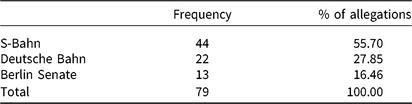
A descriptive analysis of the absolute and relative number of allegations directed at the three main blame-takers shows that the majority of public allegations was directed at the S-Bahn and its leadership, followed by the DB and the Berlin Senate (Table 3). As indicated above, the federal government and the city’s mayor were also publicly blamed for the crisis during the first crisis episode, though much more infrequently than the three main blame-takers.Footnote 3 These findings support our conjecture that partnership structures effectively diffuse blame to multiple actors, with executive politicians being one group of blame-takers among others (H1).
Blame-takers, first episode, and number of allegations

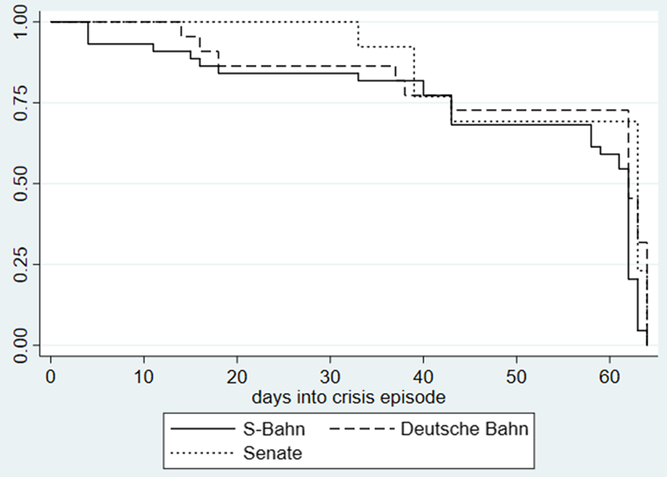
In order to investigate deferred blame attribution to political actors, we compare the duration until someone publicly attributes blame for the crisis to one of the three main blame-takers (Figure 1). At t = 0 all three actors are yet to experience the attribution of blame, with each attribution of blame leading to a dip in the respective line. Figure 1 shows that the S-Bahn, that is, its leadership, was blamed much earlier than the DB. The Berlin Senate was blamed for the first time more than 1 month after the onset of the episode. Further statistical analysis supports the observation of blame being attributed in divergent temporal patterns. The median, that is, the point of time at which more than 50% of all public attributions of blame have occurred, is approximately 62 days for all three blame-takers. This similarity results from a major train service breakdown occurring towards the end of this crisis episode, which resulted in a blame firestorm directed at the S-Bahn leadership, the DB, and the Berlin Senate. However, a log-rank test for equality of survivor functions (χ 2 (2) = 8.84, P = 0.012) indicates dissimilar temporal patterns of blame attribution to the three main blame-takers, supporting the above analysis of Figure 1. Overall, our findings support the deferred blame attribution hypothesis (H2) for this first crisis episode.
Kaplan–Meier survival estimates of blame attribution in first crisis episode.

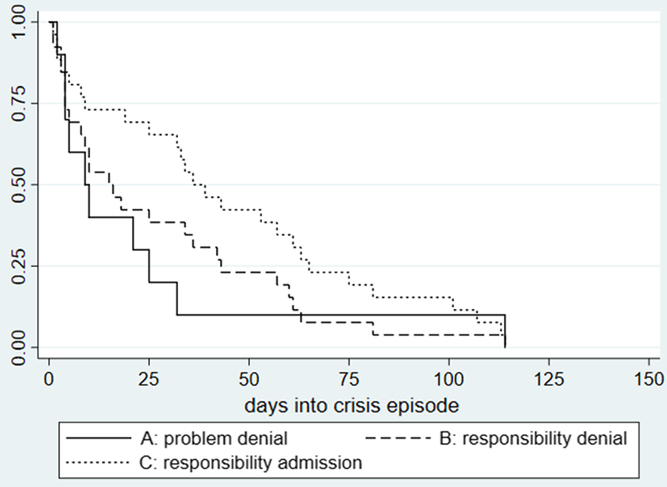
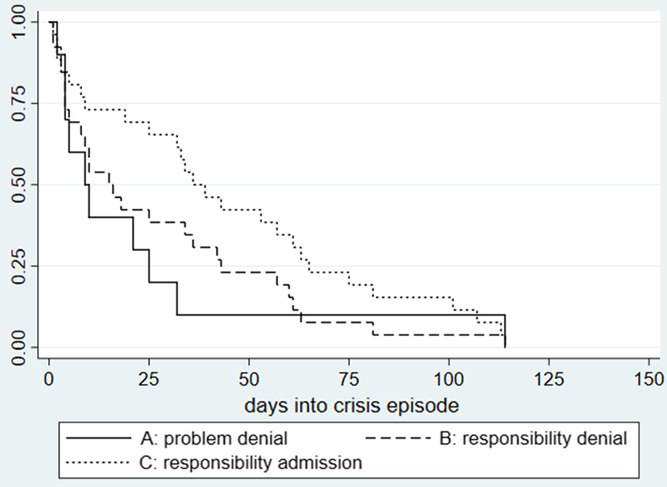
Next, we investigate whether blame-takers – both politicians and other actors – use a staged retreat pattern of presentational strategies (H3a and H3b, sequencing hypothesis). Again, we use a repeated-events model to investigate this claim for the three blame-takers together and for each of them individually, which allows us to compare the use of argumentative tactics in a dynamic perspective. As can be gleaned from Figure 2, the expectation of a staged retreat pattern seems to hold for blame avoidance behaviour of a diverse set of actors in a complex delegation structure. For strategies of the problem denial type (strategy A), the blame-takers had used more than 50% of all such claims after 9 days (median survival time; see Table 4). For problem admission but responsibility denial types of responses (B), this threshold was reached after 15 days, whereas admission of responsibility types of responses (C) were used by 50% only after 36 days. One explanation for the rather quick exhaustion of A-type responses is that problem denial was obviously rather pointless, given the severity of the situation felt every day by hundreds of thousands of passengers. The pattern of a staged retreat is less clear-cut at the beginning and the end of this episode, however, where argumentative tactics tend to overlap.
Kaplan–Meier survival estimates, argumentative tactics of three blame-takers.
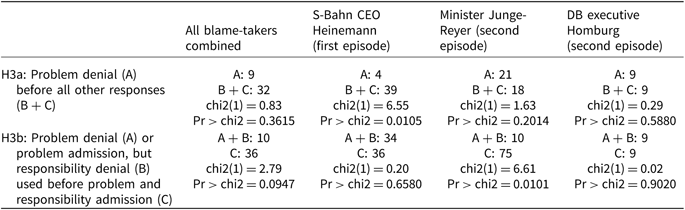
Testing sequences of blame avoidance strategies, median, and log-rank test statistics

Note: The unit of analysis for the median is ‘days into crisis episode’.
Table 4 summarizes statistical tests for H3a and H3b using log-rank test statistics, which test the equivalence of survival functions. Whereas the above analysis indicated a sequential use of presentational strategies, the staged retreat assumption finds only limited support when testing the two hypotheses for all three blame-takers. For the combined analysis of the three blame-takers, H3a gets no empirical support, but we find some evidence (P < 0.1) that problem denial (A) and problem admission but responsibility denial responses (B) become exhausted before responsibility admission responses (C), which is in line with the second sequencing hypothesis (H3b).
The results of the analysis of individual blame-takers’ argumentative tactics can also be found in Table 4. The analysis shows that for the S-Bahn CEO, the first sequencing hypothesis can be confirmed (H3a), but not the second one (H3b). Indeed, and similar to the two other blame-takers, the S-Bahn CEO hardly used strategies of the problem denial type, due to the obvious problems of service provision (see also Table 5). For the minister of transport, the second sequencing hypothesis (H3b) is supported, but not the first one (H3a). This indicates that she did not start defending herself by denying the existence of a problem, which is again hardly surprising given the obvious nature of the crisis. The two sequencing hypotheses do not get any empirical support for the DB executive, who used responsibility admission responses from the beginning of the observation period. Moreover, whereas the median survival time for responsibility admission responses is 36 days for the S-Bahn CEO and 9 days for the DB executive, it took 75 days for the minister of transport to exhaust 50% of problem and responsibility admission responses. In other words, the minister admitted responsibility much later than any of the other actors, which can plausibly be explained by deferred blame attribution to politicians in complex delegation structures (see above).
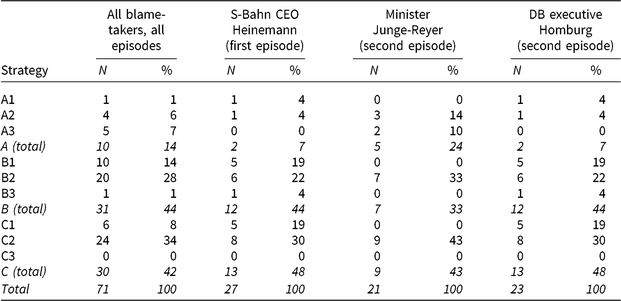
Argumentative tactics by blame-takers

Note: Percentages refer to the total number of claims in each column.
Finally, we use descriptive statistics to test the blame shifting hypothesis, according to which blame-takers will shift blame to other actors within the broader network in cases of public allegations (H4, blame shifting hypothesis). We first take an aggregate perspective of the argumentative tactics of three individuals: the S-Bahn CEO, the minister of transport, and the DB board member in charge. Then, we dissect each individual’s use of argumentative tactics. Table 5 summarizes the results of the systematic coding of argumentative tactics.
Three key findings emerge. First, pooling all three blame-takers’ argumentative tactics, problem admission but responsibility denial (strategy B) claims dominate, followed by admission of responsibility (strategy C) and problem denial (strategy A). Again, the latter finding is hardly surprising given the nature of the crisis, characterized by the undeniable existence of a major problem.
Second, we find that argumentative tactics employed by the transport minister are dominated by institutional action-taking (C2) and blaming others (B2). She directed many of her institutional action-taking claims at the S-Bahn, such as urging the company to set up a passenger compensation scheme, rather than involving action taken by government itself. The minister threatened the S-Bahn with an early termination of its service contract, announced cutbacks in subsidies to the S-Bahn, and criticized the compensations for commuters that had been suggested by the S-Bahn as insufficient. Moreover, she not only attacked the S-Bahn leadership but also attacked DB for alleged lack of oversight of its subsidiary. The overall strategy of the responsible minister could thus be described as one of blame shifting to the S-Bahn and DB management.
Third, both the S-Bahn CEO and the DB executive made extensive use of blame-shifting arguments as well, attributing blame to the railway industry (S-Bahn CEO and DB executive), the company’s maintenance staff (S-Bahn CEO), and the S-Bahn’s senior management (DB executive). The dominant strategies of the S-Bahn CEO were announcements of new measures to put trains back into service (C2) as well as blaming others (B2), including the industry but also employees who allegedly did not follow maintenance routines. Those findings suggest that partnership structures open up opportunities for blame shifting not only by executive politicians but also by other actors within those structures, in line with H4.
To sum up, the empirical analysis suggests that the overall blame dynamics in this setting of complex delegation structure are characterized by blame diffusion to multiple actors. This not only becomes evident from patterns of blame attribution and their temporal dynamics during the first episode, but also from the sequence of the two crisis episodes as such: the minister (and the DB executive) only faced a massive blame firestorm after the second major breakdown of train services, which undoubtedly showed that the problem had not been solved. However, at that point, the S-Bahn’s senior management had been dismissed and could no longer serve as a lightning rod. Moreover, the analysis provides mixed support for our conjectures regarding a typical sequencing of blame avoidance tactics of the presentational strategy type (Hood et al., Reference Hood, Jennings, Dixon, Hogwood and Beeston2009; Hood, Reference Hood2011; Hood et al., Reference Hood, Jennings and Copeland2016). We observe staged retreat patterns for the S-Bahn CEO and the minister of transport, yet observe a quite different mea culpa strategy for the DB executive. We address the implications of those findings in the concluding section.
Conclusion
This article investigated the dynamics of blame avoidance behaviour in the wake of a major public infrastructure crisis. We analysed the institutional architecture of Berlin’s rapid train system as a case of anticipatory blame management through the complex allocation of responsibility for public service delivery (Hood, Reference Hood2011). More specifically, we investigated the connection between anticipatory and reactive forms of blame avoidance (Hinterleitner and Sager, Reference Hinterleitner and Sager2017) by studying the public attribution of blame and the use of argumentative tactics, including blame shifting, by key decision-makers in a complex delegation setting.
The empirical analysis generally confirmed our theoretical expectations, showing that blame for the crisis was attributed to multiple actors, indicating a blame diffusion effect of complex delegation structures. Moreover, we provided evidence for a deferred attribution of blame to executive politicians, indicating that responsibility for public service delivery cannot be engineered away by institutional design. Partnership structures diffuse blame, but they cannot possibly protect politicians from eventually becoming blame-magnets. We also showed that most actors used a typical sequential pattern of argumentative tactics. Finally, the analysis indicates that executive politicians, but also other types of actors, exploit the complex delegation structure to shed blame onto other actors in the service delivery network.
The case stands out by the undeniable severity of the problem, which was experienced by hundreds of thousands of travellers every day over an extended period. This has two implications for our findings. First, the analysis indicated that the staged retreat assumption received only mixed empirical support, as the involved actors only had limited possibilities in denying the existence of a problem. The S-Bahn CEO was the only blame-taker who used this argumentative tactic before resorting to other arguments. The transport minister and the DB executive could hardly claim that no problem existed. These findings also resonate with the study of Hood et al. (Reference Hood, Jennings and Copeland2016), who find that blame-takers’ presentational strategies follow a sequential pattern in the early phases of a crisis, but become less clear-cut over time.
Second, and relatedly, the case suggests that blame avoidance strategies may become less useful over time, which might be a typical phenomenon in a complex delegation structure. The asymmetric attribution of blame to the S-Bahn CEO (and his eventual sacking) arguably exhausted the leeway of other decision-makers to use problem denial as a credible argument at a later stage of the crisis. This finding resonates with the findings of Hinterleitner (Reference Hinterleitner2018b) on the decreasing effectiveness of salami tactics in appeasing critics of cost and time overruns in infrastructure projects. Complex delegation structures may provide politicians with short-term advantages in terms of blame diffusion to other actors, but they may also constrain their repertoire of blame avoidance tactics in the long run. Nonetheless, the analysis also suggests that complex delegation structures may allow politicians to buy valuable time to prepare policy responses to crisis situations and blame avoidance strategies to blame attributions.Footnote 4
We do not claim that any institutional architecture is solely designed by politicians to avoid blame, yet in line with other research (Mortensen, Reference Mortensen2013; Piatak et al., Reference Piatak, Mohr and Leland2017), we argue that distinct delegation structures systematically affect blame attribution. Hence, our findings resonate with the argument that blame management can be analysed as sequential games in which decisions at one point in time limit or increase available strategies at later points (Hinterleitner and Sager, Reference Hinterleitner and Sager2017). In an ideal world, we would have been able to compare our findings with those regarding blame avoidance behaviour in a similar case, ideally involving a public transport service that affects many citizens and is publicly subsidized, though with a clear allocation of responsibility for service delivery. We encourage researchers to study other cases of blame avoidance in partnership structures to test the robustness of our theoretical claims. Those studies could also systematically compare politicians’ and other actors’ response times to public allegations in different institutional contexts. Moreover, future studies could also investigate the potential trade-off between the effectiveness of institutional configurations in terms of blame avoidance for executive politicians and their effectiveness in terms of service delivery (Hood, Reference Hood2002; Hinterleitner, Reference Hinterleitner2018a).
Another potentially fruitful strategy for assessing the blame avoidance effects of institutional design is to study changes in blame attribution and blame avoidance strategies after major institutional reform (Mortensen, Reference Mortensen2013, Reference Mortensen2016). That said, complex structures usually evolve gradually rather than resulting from a single reform, making such comparisons inherently difficult. Yet (rare) cases of major changes turning simple structures into complex ones may well provide fertile ground for investigating blame avoidance motives among institutional designers.
The article shows that complex delegation structures offer an effective opportunity structure for blame avoidance and blame-shifting tactics. Yet another important lesson from this study is that complex delegation structures may actually increase the overall level of blame attribution in executive politics, as they amplify blame games by allowing passing the buck between the actors. While protecting executive politicians from immediate blame attribution, such (mutual) blame games might contribute to a popular disenchantment with politics more generally and hence undermine the legitimacy of the political system in the long run.
Finally, the case illustrates that partnership structures potentially create what could be labelled ‘accountability fog’, inhibiting the clear allocation of responsibility. This is problematic from a normative point of view that stresses the democratic, constitutional, and learning aspects of accountability (Bovens, Reference Bovens2007). There is a (partial) misalignment between public blame allocation and whether actors were held accountable in the sense of facing consequences, inasmuch as no responsible actor suffered, in particular no one at DB. The almost ridiculous attempt of DB to shift the blame to the S-Bahn worked at least in the sense that the DB management was never seriously threatened. The Berlin Senate repelled criticism about poor contract design on the grounds that nobody could have ever imagined that the S-Bahn leadership would turn into an ‘amoral calculator’ by pushing the limits of its service quality.
Supplementary material
To view supplementary material for this article, please visit https://doi.org/10.1017/S1755773919000213
Acknowledgements
We would like to thank Peter B. Mortensen and Mark Hallerberg for their helpful comments on earlier versions of this paper. The paper also benefitted from various colleagues’ comments at the Structure and Organization of Government Conference ‘Accountability and Welfare State Reforms’ in Bergen (2015) and the section ‘Executive Politics and Agenda Dynamics’ at the ECPR General Conference in Glasgow (2014).