INTRODUCTION
Fasciolosis caused by liver flukes of the genus Fasciola (Trematoda: Fasciolidae) is a major problem in the livestock industry. Humans are also susceptible to Fasciola spp., and the World Health Organization (WHO) estimates that 180 million people are currently at risk worldwide (Mas-Coma et al. Reference Mas-Coma, Valero and Bargues2009). Fasciola hepatica, which occurs mainly in Europe, the Americas and Oceania, and Fasciola gigantica, which occurs mainly in Africa and Asia, are well-known pathogens that cause fasciolosis (Torgerson and Claxton, Reference Torgerson, Claxton and Dalton1999). Both the species have normal spermatogenetic ability and reproduce bisexually by cross-or self-fertilization. The presence of abundant mature sperms in the seminal vesicle, the male reproductive organ for temporary storage of self-produced sperm, is a prominent feature of both the species (Terasaki et al. Reference Terasaki, Itagaki, Shibahara, Noda and Moriyama-Gonda2001). On the other hand, aspermic Fasciola flukes that lack sperm in their seminal vesicles have been reported throughout Asia (Terasaki et al. Reference Terasaki, Akahane and Habe1982; Hayashi et al. Reference Hayashi, Ichikawa-Seki, Mohanta, Singh, Shoriki, Sugiyama and Itagaki2015). Aspermic Fasciola flukes exhibit abnormal spermatogenetic ability, and are therefore thought to reproduce by parthenogenesis (Terasaki et al. Reference Terasaki, Moriyama and Noda1998, Reference Terasaki, Noda, Shibahara and Itagaki2000, Reference Terasaki, Itagaki, Shibahara, Noda and Moriyama-Gonda2001). So far, internal transcribed spacer 1 (ITS1) genotype of nuclear ribosomal DNA has been used for molecular characterization for Fasciola flukes (Itagaki et al. Reference Itagaki, Kikawa, Sakaguchi, Shimo, Terasaki, Shibahara and Fukuda2005a ). Three ITS1 genotypes were observed among aspermic flukes, namely F. hepatica (Fh) type, F. gigantica (Fg) type and a mixed genotype of Fh and Fg types (Fh/Fg). The existence of Fh/Fg type suggests that natural hybridization occurred between F. hepatica and F. gigantica (Itagaki et al. Reference Itagaki, Kikawa, Sakaguchi, Shimo, Terasaki, Shibahara and Fukuda2005a ). However, when Fasciola flukes display Fh or Fg type in ITS1, species identification could not be precisely performed if spermatogenetic status of the fluke remains unclear. On the other hand, phylogenetic relationships among Fasciola flukes have been analysed by using nucleotide sequences of mitochondrial NADH dehydrogenase subunit 1 (nad1). Aspermic Fasciola flukes show the two major nad1 haplotypes; one of them belongs to the F. hepatica clade, whereas the other belongs to the F. gigantica clade (Itagaki et al. Reference Itagaki, Kikawa, Sakaguchi, Shimo, Terasaki, Shibahara and Fukuda2005a ), indicating that the maternal ancestors of aspermic Fasciola flukes are either F. hepatica or F. gigantica with these nad1 haplotypes (Itagaki et al. Reference Itagaki, Kikawa, Terasaki, Shibahara and Fukuda2005b ). Even though spermatogenic status, ITS1, and nad1 were employed for species identification, there were confusions in some of our previous studies (Ichikawa et al. Reference Ichikawa, Bawn, Maw, Htun, Thein, Gyi, Sunn, Katakura and Itagaki2011; Mohanta et al. Reference Mohanta, Ichikawa-Seki, Shoriki, Katakura and Itagaki2014). Indeed, three aspermic Fasciola flukes from Myanmar and Bangladesh displayed Fg type in ITS1 and showed nad1 haplotypes belonging to an F. gigantica haplogroup instead of an aspermic Fasciola haplotype. They were therefore identified as F. gigantica that had temporally lost their spermatogenic ability, probably because of ageing. Furthermore, one spermic Fasciola fluke from Bangladesh, displaying Fg type in ITS1, carried an identical nad1 haplotype to that of the aspermic Fasciola flukes.
As ribosomal DNA contains hundreds of copies organized as tandem repeats, the ITS1 region are highly recombinogenic and unstable (Miyazaki and Kobayashi, Reference Miyazaki and Kobayashi2010). Because of this nature, ribosomal DNA cannot provide definitive evidence for interspecific hybridization. Therefore, novel nuclear single-copy markers, phosphoenolpyruvate carboxykinase (pepck) and DNA polymerase delta (pold), were recently developed for precise discrimination of Fasciola spp. (Shoriki et al. Reference Shoriki, Ichikawa-Seki, Suganuma, Niato, Hayashi, Nakao, Aita, Mohanta, Inoue, Murakami and Itagaki2015). They were considered adequate to detect the interspecific hybridization between F. hepatica and F. gigantica, because aspermic flukes exclusively displayed Fh/Fg type even though they displayed Fh or Fg type in ITS1 (Shoriki et al. Reference Shoriki, Ichikawa-Seki, Suganuma, Niato, Hayashi, Nakao, Aita, Mohanta, Inoue, Murakami and Itagaki2015).
China should be regarded as a candidate for the cradle of the hybridization because geographical distributions of F. hepatica and F. gigantica appear to overlap in the country (Torgerson and Claxton, Reference Torgerson, Claxton and Dalton1999). It was reported that F. hepatica- and F. gigantica-like flukes were distributed in the northern and southern parts of mainland China, respectively, and that the Fasciola flukes with the Fh/Fg type in ITS1 and ITS2 of nuclear ribosomal DNA also existed in China (Huang et al. Reference Huang, He, Wang and Zhu2004; Lin et al. Reference Lin, Dong, Nie, Wang, Song, Li, Huang and Zhu2007). Our previous study (Peng et al. Reference Peng, Ichinomiya, Ohtori, Ichikawa, Shibahara and Itagaki2009), on the basis of spermatogenetic status, ITS1 genotype, and nad1 haplotype, revealed that F. hepatica, F. gigantica and aspermic Fasciola flukes were distributed in China; however, the number of samples and locations analysed was insufficient to reveal the cradle of the interspecific hybridization. Therefore, the present study aimed to analyse Fasciola flukes throughout mainland China by using the nuclear pepck and pold instead of ITS1 genotype to precisely detect the evidence of hybridization between F. hepatica and F. gigantica.
MATERIALS AND METHODS
Collection of Fasciola flukes and inspection of seminal vesicles
A total of 211 Chinese Fasciola flukes were used in this study (Table 1). In addition to 44 flukes that were analysed in the previous study (Peng et al. Reference Peng, Ichinomiya, Ohtori, Ichikawa, Shibahara and Itagaki2009), 167 were newly collected from bile ducts of slaughtered cattle, water buffaloes and yaks. The geographical origins of the flukes were 13 locations in mainland China (Fig. 1). The flukes were fixed in 70% ethanol between two glass slides under mild pressure. The anterior parts, including the seminal vesicle, were removed, stained with haematoxylin–carmine solution, and observed under an optical microscope to examine the presence of sperm within the seminal vesicles.
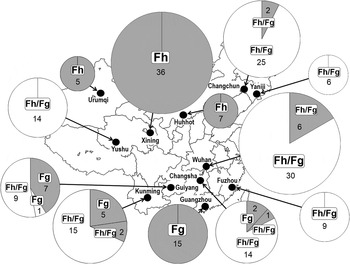
Combined data of spermatogenesis and the nuclear phosphoenolpyruvate carboxykinase (pepck) and DNA polymerase delta (pold) for Chinese Fasciola flukes from the 13 geographical locations. Numeric characters in circles indicate the number of samples. Spermic and aspermic flukes are shown as grey and white, respectively.

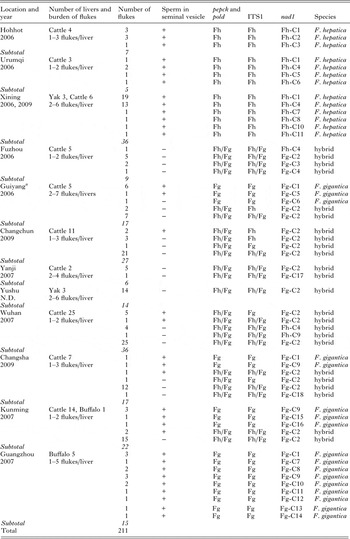
Profiles for 211 Fasciola samples from China

N.D. means no record.
a One fluke (G2–4) previously reported by Peng et al. (Reference Peng, Ichinomiya, Ohtori, Ichikawa, Shibahara and Itagaki2009) was excluded because DNA solution had been used up.
DNA extraction, multiplex PCR, PCR–RFLP, sequencing
Nuclear pepck and pold genes were analysed for all of the 211 flukes, whereas mitochondrial nad1 was analysed for only 167 flukes that were newly included in this study. To exclude sperms from other flukes, only the posterior parts of the flukes without the uteri were used for DNA extraction. Total DNA was extracted from individual flukes using either the E.Z.N.A. Mollusc DNA Kit (Omega Bio-tek, Doraville, GA, USA) or the High Pure PCR Template Preparation Kit (Roche, Mannheim, Germany).
DNA fragments of pepck were analysed using the multiplex PCR method with Fh-pepck-F, Fg-pepck-F and Fcmn-pepck-R primers (Shoriki et al. Reference Shoriki, Ichikawa-Seki, Suganuma, Niato, Hayashi, Nakao, Aita, Mohanta, Inoue, Murakami and Itagaki2015). DNA fragments of pold were analysed using the PCR–RFLP method with Fasciola-pold-F1 and Fasciola-pold-R1 primers. Subsequently, PCR amplicons were digested by the restriction enzyme, AluI (Roche) (Shoriki et al. Reference Shoriki, Ichikawa-Seki, Suganuma, Niato, Hayashi, Nakao, Aita, Mohanta, Inoue, Murakami and Itagaki2015). ITS1 genotype was also analysed by using the PCR–RFLP method as described previously (Ichikawa et al. Reference Ichikawa, Bawn, Maw, Htun, Thein, Gyi, Sunn, Katakura and Itagaki2011).
DNA fragments of nad1 were amplified using Ita 10 and Ita 2 primers (Itagaki et al. Reference Itagaki, Kikawa, Sakaguchi, Shimo, Terasaki, Shibahara and Fukuda2005a ). Partial nucleotide sequences of the nad1 gene (535 bp) were directly determined in both the directions using the BigDye Terminator v3·1 Cycle Sequencing Kit and ABI Prism 3100-Avant Genetic Analyser (Applied Biosystems, Foster City, CA, USA). The partial nad1 sequences were aligned using GENETYX version 10·0·2 (Genetyx, Tokyo, Japan), and different haplotypes were distinguished.
Phylogenetic analyses
Our results were compared with relevant reference data from Japan, Korea, Vietnam, Myanmar, Thailand, Bangladesh, Nepal and India (Itagaki et al. Reference Itagaki, Kikawa, Sakaguchi, Shimo, Terasaki, Shibahara and Fukuda2005a , Reference Itagaki, Kikawa, Terasaki, Shibahara and Fukuda b , Reference Itagaki, Sakaguchi, Terasaki, Sasaki, Yoshihara and Van-Dung2009; Ichikawa et al. Reference Ichikawa, Iwata and Itagaki2010, Reference Ichikawa, Bawn, Maw, Htun, Thein, Gyi, Sunn, Katakura and Itagaki2011; Chaichanasak et al. Reference Chaichanasak, Ichikawa, Sobhon and Itagaki2012; Ichikawa and Itagaki, Reference Ichikawa and Itagaki2012; Mohanta et al. Reference Mohanta, Ichikawa-Seki, Shoriki, Katakura and Itagaki2014; Shoriki et al. Reference Shoriki, Ichikawa-Seki, Devkota, Rana, Devkota, Humagain and Itagaki2014; Hayashi et al. Reference Hayashi, Ichikawa-Seki, Mohanta, Singh, Shoriki, Sugiyama and Itagaki2015), and 575 samples were used for phylogenetic analyses. Median-joining (MJ) networks were constructed using Network 4·6·1·3 software (Bandelt et al. Reference Bandelt, Forster and Rohl1999) to elucidate the phylogenetic relationships among the nad1 haplotypes detected in Fasciola flukes from China and those from neighbouring reference countries. Haplotype diversity (Hd) and nucleotide diversity (π) were calculated using DnaSP 5·10·01 (Librado and Rozas, Reference Librado and Rozas2009).
RESULTS
Sperm in seminal vesicles
A spermic fluke possessed abundant mature sperms in at least half of the seminal vesicle, whereas an aspermic fluke possessed no sperm or abnormal sperms (a few sperms or rosette cells) in the seminal vesicle. Among the 211 Chinese Fasciola flukes, 88 and 123 flukes were found to be spermic and aspermic, respectively (Table 1, Fig. 1).
Nuclear pepck and pold
Fragment patterns of Fh and Fg types, and a mixed fragment pattern of both the species (Fh/Fg type) (Shoriki et al. Reference Shoriki, Ichikawa-Seki, Suganuma, Niato, Hayashi, Nakao, Aita, Mohanta, Inoue, Murakami and Itagaki2015) were detected in nuclear pepck and pold. The results of the two markers were consistent with each other. All the spermic Fasciola flukes from Urumqi, Xining and Hohhot were identified as F. hepatica, whereas all of those from Guangzhou were F. gigantica because they displayed Fh and Fg types, respectively. Fasciola gigantica was also found from Changsha, Guiyang and Kunming. Notably, 122 of 123 Chinese aspermic Fasciola flukes possessed the Fh/Fg type. The remaining one fluke from Guiyang was regarded as F. gigantica because this fluke possessed Fg type. On the other hand, 11 spermic flukes from Changchun, Wuhan, Changsha and Kunming were found to have Fh/Fg type (Table 1, Fig. 1). These findings revealed that F. hepatica and F. gigantica were detected in the northern and southern parts of China, respectively, and Fasciola flukes that possess the Fh/Fg type were distributed between the habitats of the two species. Moreover, the Fasciola flukes with Fh/Fg type were predominant (63·0%) in China (Table 1, Fig. 1).
Comparison of pepck and pold with ITS1
Fh, Fg and Fh/Fg types were detected in ITS1. Interestingly, the results of ITS1 were inconsistent with those of pepck and pold in total of 14 flukes from Guiyang, Changchun, Wuhan and Changsha. These flukes possessed Fh or Fg type in ITS1, however, all of them displayed Fh/Fg type in pepck and pold (Table 1).
Mitochondrial nad1 haplotypes
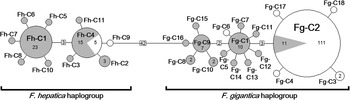
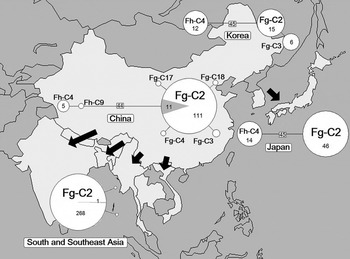
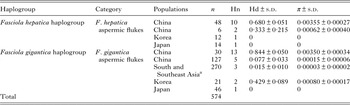
Among the 211 Chinese Fasciola flukes, 11 haplotypes belonged to F. hepatica haplogroup designated as Fh-C1 to Fh-C11, whereas 18 haplotypes were included in F. gigantica haplogroup designated as Fg-C1 to Fg-C18 (Table 1, Fig. 2) (accession nos. AB477357–AB477369, AB604926–AB604942, AB605772, AB697063–AB697065). In the F. hepatica haplogroup, 10 nad1 haplotypes were found in Chinese F. hepatica where eight haplotypes were derived from the numerically predominant haplotype Fh-C1 or Fh-C4 with a single nucleotide mutation. Fh-C4 and Fh-C9 were found in Chinese aspermic Fasciola flukes. It is noteworthy that Fh-C4 was detected in both F. hepatica and aspermic flukes (Table 1, Fig. 2). Among the 13 nad1 haplotypes found in Chinese F. gigantica, 11 were derived from the major haplotype Fg-C1 or Fg-C9 with a single nucleotide mutation (Fig. 2). Fg-C6 was included here and was constituted by one aspermic Fasciola fluke from Guiyang with Fg type in pepck and pold (regarded as F. gigantica) (Table 1, Fig. 2). A centrally positioned, predominant haplotype in Chinese aspermic Fasciola flukes belonging to the F. gigantica haplogroup (Fig. 2) was Fg-C2, from which the derivative haplotypes Fg-C3, Fg-C4, Fg-C17 and Fg-C18 coalesced with a single nucleotide mutation (Fig. 2). All the 11 spermic flukes with Fh/Fg type in pepck and pold were included in Fg-C2 (Table 1, Fig. 2). Moreover, Fh-C4 displayed identical sequence to the nad1 haplotypes detected in aspermic Fasciola flukes from Japan and Korea, whereas Fg-C2 displayed identical sequence to the nad1 haplotypes detected from aspermic flukes from Korea, Japan, Vietnam, Myanmar, Thailand, Bangladesh, Nepal and India (Fig. 3). Again, Fg-C3, one of the derivative haplotypes of Fg-C2, displayed the identical sequence to that of aspermic Fasciola flukes detected in Korea (Fig. 3). As a result of these phylogenetically close relationships among the aspermic Fasciola haplotypes, the values of Hd and π in the Chinese aspermic populations were much lower than those in F. hepatica and F. gigantica populations from China (Table 2). Chinese aspermic flukes possessed the largest number of haplotypes in the aspermic populations, and Hd and π values were higher in Chinese aspermic populations than in the neighbouring aspermic populations, except the Korean aspermic populations of F. gigantica haplogroup, which showed the highest values because of the frequency of Fg-C3 (Table 2, Fig. 3).
MJ networks constructed for the NADH dehydrogenase subunit 1 (nad1) haplotypes of Fasciola flukes from China. A circle represents a haplotype. The haplotype name is labelled adjacent to the circle. Numeric characters in circles are the number of samples. The haplotypes found in spermic and aspermic Fasciola flukes are shown in grey and white, respectively. The number of nucleotide substitutions between haplotypes is labelled on the nodes. In case the number is one, there is no label.

MJ networks constructed for the NADH dehydrogenase subunit 1 (nad1) haplotypes of the aspermic Fasciola lineages across Asia. The haplotype name is labelled adjacent to the circle. When the haplotype identical to the Chinese one is found from the neighbouring countries, it is labelled as well. Numeric characters in circles indicate the number of samples. The haplotypes found in spermic and aspermic Fasciola flukes are shown in grey and white, respectively. The number of nucleotide substitutions between haplotypes is labelled on the nodes. In case the number is one, there is no label. South and Southeast Asian populations include the aspermic lineage found from Vietnam, Myanmar, Thailand, Bangladesh, Nepal and India. For South and Southeast Asian population, one spermic fluke with Fg-C2 was excluded from population genetics calculations because the species of the fluke could not be precisely identified in the previous studies (Mohanta et al. Reference Mohanta, Ichikawa-Seki, Shoriki, Katakura and Itagaki2014). The arrows indicate the dispersal direction of the aspermic Fasciola lineage.

Haplotype diversity (Hd) and nucleotide diversity (π) of Fasciola flukes used in this study

‘n’ and ‘Hn’ are the number of samples and of haplotypes, respectively.
a South and Southeast Asia includes Vietnam, Myanmar, Thailand, Bangladesh, Nepal and India. One fluke was excluded because it could not precisely be identified in the previous studies (see Fig. 3).
DISCUSSION
In this study, both the nuclear markers, pepck and pold, aided in precise discrimination of F. hepatica, F. gigantica and their hybrids. On the other hand, the ITS1 genotype of the 14 flukes was Fh or Fg type even though they had Fh/Fg type in pepck and pold (Table 1). This strongly indicates pepck and pold should be used to detect interspecific hybridization instead of ITS1. One aspermic fluke from Guiyang was characterized as F. gigantica not only because it displayed Fg type in the nuclear markers, but also because it possessed Fg-C6 in the nad1 gene (Table 1), one of the derivatives of the major F. gigantica haplotype, Fg-C1 (Fig. 2). This F. gigantica fluke appeared to lose the mature sperm due to ageing or some other unknown reason. On the other hand, 122 aspermic and 11 spermic Fasciola flukes were considered to be derived from interspecific hybridization between F. hepatica and F. gigantica because they possessed Fh/Fg type in both the nuclear markers. They possessed Fg-C2, the predominant haplotype of aspermic flukes (Table 1, Fig. 2), and were therefore included in the aspermic population without exception. These findings strongly support the hybrid origin of aspermic Fasciola lineages. Hereafter, we suggest that they should be termed as ‘hybrid’ Fasciola flukes rather than ‘aspermic’ flukes, since the 11 flukes retain sperm in the seminal vesicle. Spermic hybrids seem to be rare, nevertheless, they are found from the wide area. One spermic fluke found from Bangladesh were reported to have Fg type in ITS1 and Fg-C2 in nad1 (Mohanta et al. Reference Mohanta, Ichikawa-Seki, Shoriki, Katakura and Itagaki2014). This fluke was regarded as a hybrid because it possessed Fh/Fg type in pepck and pold (unpublished). More recently, spermic hybrids were found also in Japan (unpublished). Further study is needed to reveal the reproductive mechanism of hybrids Fasciola flukes.
Some vertebrates displaying parthenogenetic reproductive patterns have been considered descendants originated through hybridization of the two related species, exhibiting sympatric geographical distribution, and carry nuclear genomes of both the related species (Avise et al. Reference Avise, Quattro, Vrijenhoek, Hecht, Wallace and Macintyre1992). Similarly, the coexistence of F. hepatica and F. gigantica in mainland China might have allowed them to undergo interspecific hybridization (Fig. 1). The coexistence was observed exclusively in China and not in neighbouring South and Southeast Asian countries (Itagaki et al. Reference Itagaki, Sakaguchi, Terasaki, Sasaki, Yoshihara and Van-Dung2009; Ichikawa et al. Reference Ichikawa, Bawn, Maw, Htun, Thein, Gyi, Sunn, Katakura and Itagaki2011; Chaichanasak et al. Reference Chaichanasak, Ichikawa, Sobhon and Itagaki2012; Mohanta et al. Reference Mohanta, Ichikawa-Seki, Shoriki, Katakura and Itagaki2014; Shoriki et al. Reference Shoriki, Ichikawa-Seki, Devkota, Rana, Devkota, Humagain and Itagaki2014; Hayashi et al. Reference Hayashi, Ichikawa-Seki, Mohanta, Singh, Shoriki, Sugiyama and Itagaki2015). The maternal progenitors of the hybrids were thought to be F. hepatica with Fh-C4 or F. gigantica with Fg-C2, which are the common nad1 haplotypes of aspermic flukes detected from Asian countries (Fig. 3). Although F. hepatica with Fh-C4 existed in China, F. gigantica with Fg-C2 appeared to become extinct in the country (Table 1). The hybrids seemed to have superior fecundity, which might cause extinction of one of their progenitors. As a result, the coexistence of F. hepatica, F. gigantica and the hybrids was not found in any of the location in this study. This speculation was manifested by the predominant distribution of the hybrids (63·0%) between the habitats of F. hepatica and F. gigantica in China (Fig. 1).
Chinese hybrid Fasciola flukes had the largest number of haplotypes and possessed higher Hd and π values compared with most of the neighbouring populations (Table 2). Hybrid Fasciola flukes with the derivative haplotypes of Fh-C4 and Fg-C2 probably emerged through single nucleotide mutations (Fig. 2). This fact also supports the Chinese origin of the hybrid flukes, because genetic diversity in modern populations generally decreases with the distance from the geographical origin (Troy et al. Reference Troy, MacHugh, Bailey, Magee, Loftus, Cunningham, Chamberlain, Sykes and Bradley2001; Beja-Pereira et al. Reference Beja-Pereira, Caramelli, Lalueza-Fox, Vernesi, Ferrand, Casoli, Goyache, Royo, Conti, Lari, Martini, Ouragh, Magid, Atash, Zsolnai, Boscato, Triantaphylidis, Ploumi, Sineo, Mallegni, Taberlet, Erhardt, Sampietro, Bertranpetit, Barbujani, Luikart and Bertorelle2006; Chen et al. Reference Chen, Lin, Baig, Mitra, Lopes, Santos, Magee, Azevedo, Tarroso, Sasazaki, Ostrowski, Mahgoub, Chaudhuri, Zhang, Costa, Royo, Goyache, Luikart, Boivin, Fuller, Mannen, Bradley and Beja-Pereira2010). Actually, the Korean aspermic population of F. gigantica haplogroup showed the highest Hd and π values (Table 2). However, this result was probably inconsistent with the actual history, because Fg-C3 of the Korean aspermic population was one of the derivative haplotypes of Fg-C2 and was also observed in the Chinese population (Fig. 3).
Extremely low values of both Hd and π in the hybrid Fasciola populations (Table 2) indicate the quite recent emergence of the two hybrid Fasciola lineages; these findings also suggest that these lineages rapidly spread into neighbouring countries (Fig. 3). Interestingly, the worldwide distribution of F. hepatica and F. gigantica almost corresponds to that of domestic definitive hosts, in particular, taurine cattle (Bos taurus) and zebu cattle (Bos indicus), respectively (Phillips, Reference Phillips1961; Torgerson and Claxton, Reference Torgerson, Claxton and Dalton1999). In China, the taurine types are found mainly in the northern part and zebu types in the southern part; hybrid breeds between the two types (for example, yellow cattle) are found in the central part (Cai et al. Reference Cai, Chen, Lei, Wang, Xue and Zhang2007). Therefore, distribution of cattle breeds in China completely corresponds with that of Fasciola spp. (Fig. 1). Taurine cattle are believed to have been introduced into central and northern China between 5000 and 4000 years before present (YBP) (Flad et al. Reference Flad, Yuan, Li, Madsen, Chen and Gao2007), whereas zebu cattle spread to southern China approximately 2500 YBP (Higham, Reference Higham1996). Water buffalo (Bubalus bubalis), another important domestic definitive host for F. gigantica, was distributed in southern China at least 3400 YBP (Chang, Reference Chang, Hutchinson, Clark, Jope and Riley1976). Fasciola hepatica and F. gigantica were assumed to be introduced into China, along with migration of these domestic ruminants, facilitating the hybridization between the two Fasciola species; thereafter, the emergence of the hybrid Fasciola flukes was ultimately triggered by the dispersal of the domestic hosts throughout China. The time of emergence could not be estimated accurately because the precise mutation rate has not yet been established for this genus. Nonetheless, the hybrid lineages might have been introduced into Korea, with the migration of domestic cattle from China, after their emergence. Around the second century (approximately 1800 YBP), the lineages were further introduced into Japan along with domestic cattle from Korea (Mukai et al. Reference Mukai, Tsuji, Fukazawa, Ohtagaki and Nambu1989; Itagaki et al. Reference Itagaki, Kikawa, Sakaguchi, Shimo, Terasaki, Shibahara and Fukuda2005a , Reference Itagaki, Kikawa, Terasaki, Shibahara and Fukuda b ; Ichikawa and Itagaki, Reference Ichikawa and Itagaki2012) (Fig. 3).
The high prevalence rate of hybrid Fasciola flukes in China suggests that they have adapted to the environment, and that asexuality could be a successful evolutionary strategy. A possible explanation of the superiority of the hybrids is ‘heterosis’, the improved or increased function of any biological quality in the hybrids. The biological feature of the hybrids should be carefully investigated to elucidate a possibility of erecting a new species for hybrid Fasciola flukes in the future. Furthermore, adequate and effective control strategies against hybrid Fasciola flukes should be developed to limit their further distribution.
ACKNOWLEDGEMENT
We are grateful to laboratory members of Laboratory of Veterinary Parasitology, Iwate University for their invaluable help in this research.
FINANCIAL SUPPORT
This study was supported in part by the Japan Society for the Promotion of Science for a Japanese Junior Scientist (to M. I.) and by a Grant-in-Aid for Scientific Researchers (B) (grant no. 2340544, to T. I.).