Introduction
Among the main phytosanitary problems that affect the production and commercialization of fresh fruits, for certain markets, the occurrence of fruit flies (Diptera: Tephritidae) is one of the main obstacles. Fruit flies of economic and quarantine importance in Brazil are Ceratitis capitata (Wiedemann, 1824), known as Medfly, discovered at the beginning of the 20th century, and currently has 94 confirmed hosts and distributed in 27 botanical families; Anastrepha Schiner, with about 121 species in the country, the most polyphagous being A. fraterculus (Wiedmann, 1830) and A. obliqua (Macquart, 1835); and Bactrocera carambolae Drew & Hancock, 1994, originally from Asia, but its presence has been confirmed in the states of Amapá, Pará, and Roraima (Zucchi and Moraes, Reference Zucchi and Moraes2012). Based on a European Union Execution Directive 2019/523, published on 21 March 2019, non-European Tephritidae species are now of quarantine importance for the export of citrus and mango fruits (European Union, 2019).
Ceratitis capitata is considered as the main quarantine pest of the world fruit and in Brazil, it mainly infests exotic fruits in 23 states of the 26 Brazilian states, beyond the Federal District (Zucchi and Moraes, Reference Zucchi and Moraes2012), there was no record only in three states Amapá, Amazonas, and Sergipe (Zucchi and Moraes, Reference Zucchi and Moraes2012).
The control of these tephritids is mainly performed through the use of toxic baits, containing a lethal agent (insecticide molecule) mixed with a food-based attractant (Arioli et al., Reference Arioli, Botton, Machota, Nunes and Rosa2018). Insecticide spinosad has been used in fruit fly control programs in several countries. In Brazil, spinosad is available in a concentrated suspension formulation and as a ready-for-use toxic bait (Harter et al., Reference Harter, Botton, Nava, Grutzmacher, Gonçalves, Junior, Bernardi and Zanardi2015). However, the extensive use of spinosad for controlling olive fruit fly and other tephritids can cause problems related to the selection of populations resistant to this insecticide (Kakani et al., Reference Kakani, Zygouridis, Tsoumani, Seraphides, Zalom and Mathiopoulos2010).
The continued use of insecticides has an increasing limitation, mainly consumer pressure, owing to the presence of residues in fruits; thus, it is necessary to evaluate other control strategies for inclusion in the management of fruit flies (Dias et al., Reference Dias, Zotti, Montoya, Carvalho and Nava2018).
The use of mineral and natural particle films may be a viable alternative to the use of insecticide, mainly because they do not contaminate the environment or leave toxic residues that are harmful to humans and animals in treated products. Kaolin, the main component of the technology the particle film, is a white, non-abrasive, and chemically inert aluminosilicate mineral formulated for use in plants (Puterka et al., Reference Puterka, Glenn and Sekutowski2000).
The use of kaolin for pest management is based on the interruption of the insect in recognizing its host plant, alteration in the texture of leaves or fruits, and masking of leaves or fruits by their light-reflective properties (Showler, Reference Showler2002). Thus, one of the first modes of action of particle films is host camouflage, which makes plants unrecognizable by pests. Particle films have been used to control fruit flies in apple (Mazor and Erez, Reference Mazor and Erez2004; Leskey et al., Reference Leskey, Wright, Glenn and Puterka2010), nectarine (Mazor and Erez, Reference Mazor and Erez2004; D'aquino et al., Reference D'aquino, Cocco, Ortu and Schirra2011), cherry (Yee, Reference Yee2012), blueberry (Lemoyne et al., Reference Lemoyne, Vincent, Gaul and Mackenzie2008) and citrus and peach (D'aquino et al., Reference D'aquino, Cocco, Ortu and Schirra2011).
In addition to mineral polymers, natural polymers have wide applicability in several areas owing to their high availability and properties, such as biocompatibility and biodegradability, and they are used in agriculture as a coat in the preservation of fruits before and after harvest (Kaushik et al., Reference Kaushik, Sharma and Agarwal2016; Gomes et al., Reference Gomes, Paschoalin and Del Aguila2017). Cellulose, agar, starch, pectin, guar gum, alginates, carrageenans, xanthan gum, chitin, and chitosan are among the most well-known and used natural polymers. Among them, chitin and chitosan have been used as natural seed treatment agents, growth stimulators, and in the control of plant diseases (Kulkarni et al., Reference Kulkarni, Butte and Rathod2012; Ambore et al., Reference Ambore, Kanthale, Gavit, Rathod and Dhadwe2013; Casemiro et al., Reference Casemiro, Bacchi, dos Reis and Gavassoni2019). Besides the reduction of the ripening process of mango fruits subjected to the hydrothermal process, chitosan can also inhibit the development of eggs and larvae of A. ludens (Salvador-Figueroa et al., Reference Salvador-Figueroa, Aragón-Gómez, Hernández-Ortiz, Vázquez-Ovando and Adriano-Anaya2011, Reference Salvador-Figueroa, Hernández-Ortiz, Ventura-González, Ovando-Medina and Adriano-Anaya2013).
Most of the species of fruit flies have stereotypical oviposition behaviour that comprises stages of arrival on fruit, inspection, aculeus insertion, egg deposition, aculeus cleaning, and in most species, aculeus dragging (Díaz-Fleischer et al., Reference Díaz-Fleischer, Papaj, Prokopy, Aluja, Norrbom, Aluja and Norrbom2000). Moreover, films can constitute barriers to oviposition, causing interference to the host, mainly in colour and penetrability (Aluja and Mangan, Reference Aluja and Mangan2008).
Owing to the possible effects of these films on the physical–chemical characteristics of fruits and oviposition of fruit flies, we hypothesize that particle films can reduce the use of grape by C. capitata for oviposition, changing their behaviour, and consequently decreasing their infestation in fields.
Therefore, the aim of this study was to evaluate the effect of mineral and natural films on the physical–chemical properties of grapes (V. vinifera L.), cultivar Itália and oviposition behaviour of C. capitata.
Material and methods
Origin of C. capitata and fruits used in bioassays
Studies were conducted at the Laboratory of Fruit Flies, State University of Southwestern Bahia-UESB, campus of Vitória da Conquista, Bahia, Brazil, from June to December 2019.
The C. capitata flies used in this study were reared at the Fruit Flies Laboratory of the State University of Southwest Bahia. With the aim of obtaining larvae, eggs were collected daily, sterilized, and subjected to the diet containing oat bran, sugar, beer yeast, soybean meal and distilled water, in addition to preservatives, as adapted from Tanaka et al. (Reference Tanaka, Steiner, Ohinata and Okamoto1969). Approximately ten days after larvae hatched, formed pupae were collected and placed in plastic containers with vermiculite until adults emerged. The adults were transported to cages, suitable for breeding, mating, and oviposition, and fed a diet based on sugar and yeast extract (Bionis YE MF) (Silva Neto et al., Reference Silva Neto, Santos, Dias, Joachim-Bravo, Benevides, Benevides, Silva, dos Santos, Virgínio, Oliveira, Walder, Paranhos and do Nascimento2012), offered on filter paper. Cages were kept in an air-conditioned room at an average temperature of 25 ± 2°C and relative humidity of 70%. All bioassays used six-day-old C. capitata pairs of males and females, and flies were exchanged after 24 h of exposure to treatments. The mature grapes (V. vinifera L.), cultivar Itália, used in this experiment were obtained in open markets. They were selected on the basis of uniform maturity, size, and absence of fruit fly punctures.
Fruit characterization
Fruit uniformity was determined by assessing some physicochemical characteristics of grapes, such as length, diameter, firmness, colour, total soluble solids (TSSs) content, and titratable acidity (TA). Fruit uniformity was determined in order to confirm the uniformity of the substrate used for oviposition. Grape weight (grams) was determined using a precision semi-analytical scale. Grape diameter and length in millimetres (mm) were obtained with the aid of a digital calliper. Firmness was determined using a TR penetrator (model WA68, Italy), with 8 mm diameter tip. TSS content was obtained through a direct reading of the berry pulp extract in a digital refractometer and results expressed in °Brix. TA was determined by titration, with a 0.1 N sodium hydroxide (NaOH), and expressed in grams of tartaric acid per 100 ml of juice. pH was determined using a Mars pH meter (model MB-10), with readings directly made on the sample with 100 ml of fruit juice. Three replicates of ten grapes (N = 30) were used for each evaluated parameter: firmness, TSS, and TA, and each group of grapes came from a bunch.
Fruit colour was measured before and after the application of treatments, resulting in two measurements per fruit on the same position (opposite sides), thus, four fruits per treatment were used in each bioassay (N = 40). Changes in colour were determined using colorimeter CR-400 (Minolta®). The device was calibrated using white ceramic plate and D65 illuminant (z = 85.7; x = 0.3175; y = 0.3253). Luminosity (L), ranging from 0 to 100 (black/white), red/green intensity (+/−) (a), and yellow/blue intensity (+/−) (b) values were determined. In addition to these colour coordinates, colour parameters such as chroma value [C = (a 2 + b 2)1/2], which represents colour purity and angle measurement (Hue) [H = tg−1 (b/a)], which represents colour tone (Lemoyne et al., Reference Lemoyne, Vincent, Gaul and Mackenzie2008) were also determined. After the application of the highest suspension of treatments, the second analysis of fruits was also performed in relation to firmness to detect possible changes that could influence oviposition.
Oviposition: non-choice test (bioassays 1 and 2)
To assess oviposition in non-choice test, a completely randomized design with ten treatments and four repetitions was used, with three replicates on consecutive days. Treatment components were: T1-kaolin Surround® WP; T2-kaolin 607 cream; T3- kaolin 608 white; T4-kaolin 611 grey; T5-talc 657; T6-chitosan; T7-cassava starch; T8-potato starch; T9-guar gum and T10-control (distilled water). All the treatment components were dissolved in distilled water at 100 g L−1 (bioassay 1) and 200 g L−1 (bioassay 2), except for T9-guar gum, which was dissolved in water at 5.0 g L−1, as it was added as a thickener in the same amount to all treatments. Guar gum acts as a thickener, improving the viscosity and stability of formulations, being commonly used in chemical and biological insecticide formulations, including nanoemulsions (Campos et al., Reference Campos, Oliveira, Fraceto and Singh2015; Gao et al., Reference Gao, Guo, Li, Li, Wu, Hu, Hu, Mo and Wu2020).
The chitosan used in the bioassays was obtained from the shell of crustaceans; it was also dissolved in distilled water, and the mixture maintained under constant agitation. Kaolin Surround® WP was obtained from NovaSource company; kaolin 607, 608 and 611 and talc were purchased from Brasil Minas company and natural polymers from ‘Mercadão Natural.’
Plot consisted of a cage containing treated grapes and C. capitata pairs of males and females. Fruits were tied on pieces of plastic tape; subsequently, they were individually immersed for 10 s in a beaker containing 60 ml of a suspension that correspond to each treatment. After treatment, fruits were left at 25° ± 2°C a temperature for 1 h to dry. Subsequently, a single fruit was hung from the top of each cage using an adhesive tape, following the methods outlined by Silva et al. (Reference Silva, Bezerra-Silva, Vendramim, Forim and Sá2015), which was adapted for this trial. Bioassays were maintained in the laboratory at 25 ± 2°C and 70% relative humidity. Fruits were removed after 24 h of exposure to flies, and the number of eggs per fruit and punctures with and without eggs were recorded.
Oviposition: choice test (bioassays 3 and 4)
Bioassays with choice were similar to those of non-choice, however, two fruits per cage were exposed: one was treated, the other was a control (distilled water). Bioassays were conducted in a completely randomized design with nine treatments and four repetitions, with three replicates on consecutive days. The treatments and procedures used were the same as those described in bioassay 1, except for control treatment (T10), which was offered together with the other treatments in the same plot. The treatments were dissolved in distilled water at 100 g L−1 (bioassay 3) and 200 g L−1 (bioassay 4). After immersion and drying, fruits (treated and control) were placed 10 cm apart and hung from the top of each cage using adhesive tape, following the methods outlined by Silva et al. (Reference Silva, Bezerra-Silva, Vendramim, Forim and Sá2015), which was adapted for this trial. Bioassays were kept under the same conditions as bioassay 1 with 24-hour exposure, and the same variables recorded.
Behavioural response of C. capitata to treated and untreated fruits
The design was completely randomized comprising kaolin Surround®, kaolin 607, kaolin 608, kaolin 611, and guar gum suspensions. These suspensions (200 g L−1) resulted in better oviposition responses in bioassays choice and non-choice, in addition to control (water) and chitosan treatment that stimulated oviposition. The experimental plot consisted of a cage with two six-day-old fertile C. capitata females and a fruit (grape). Eight (8) flies were used per treatment, lower than in other studies (McDonald and Mclnnis, Reference McDonald and Mclnnis1985; Jang et al., Reference Jang, McInnis, Kurashima and Carvalho1999; Yee, Reference Yee2012), but sufficient to observe all expected behaviours as indicated in preliminary tests. Fruits were immersed in treatments for ~10 s and soon after, dried at room temperature to remove excess moisture. The fruit was hung from the top of each cage and flies released with the help of a sucker.
Evaluations were carried out with the same fruits and flies for two consecutive days, from 8:00 am to 12:00 pm, following the method adapted from Lemoyne et al. (Reference Lemoyne, Vincent, Gaul and Mackenzie2008) and Yee (Reference Yee2012). After the two days period of exposure, another cage was prepared, with another flies and fruit for observation, totalling 16 hours of observation for each treatment. The following behavioural parameters were evaluated: arrival at the fruit (landing), search, puncture, aculeus dragging and cleaning, time of first landing, number of landings and time landed on the host, number and time of fruit searching, time and number of punctures, number and time for aculeus dragging, and time and number for aculeus cleaning.
Statistical analyses
The parameters firmness, TSS, and TA were not statistically analysed because they were only used to characterize the fruits before immersing them in suspensions. In addition, it was only in bioassays with 200 g L−1 suspensions that firmness was determined, after the immersion of fruits in suspensions. Paired t-test in the R software version 3.6.1 (R Development Core Team, 2019) was used to compare the average values of luminosity, chroma and hue angle before and after applying the suspensions of 100 and 200 g L−1.
For oviposition non-choice tests (bioassays 1 and 2), data obtained for the behavioural response of C. capitata to treated and untreated fruits and the physical characteristics (weight, length, diameter, luminosity, chroma and hue angle) of fruits were subjected to Bartlett and Shapiro-Wilk tests for evaluation of homoscedasticity assumptions of treatment variances and normality of residues, respectively. In the absence of these assumptions, data were transformed into $\sqrt x$ or $\sqrt {x + 1}$
 and subsequently subjected to analysis of variance (ANOVA) for comparison of means using the Tukey test (P < 0.05) in the R software version 3.6.1 (R Development Core Team, 2019). For the number of eggs in bioassay 1, treatments were compared using the generalized linear models (GLMs) of the R software ‘nlme’ (Pinheiro et al., Reference Pinheiro, Bates, DebRoy and Sarkar2020) and ‘lsmeans’ (Lenth, Reference Lenth2016) packages.
The oviposition data obtained with choice tests (bioassays 3 and 4) did not meet ANOVA premises, thus, a Monte Carlo type randomization was carried out, with 1000 simulations to guarantee 95% probability. To confirm significant differences among treatments, a priori orthogonal contrast was performed using the R software version 3.6.1 (R Development Core Team, 2019).
Data on the behavioural response (time of first landing, number of landings, search time, number of searches, puncture time, number of punctures, aculeus dragging time and number of aculeus dragging) and pulp firmness were transformed into log (x + 10). For variables such as time of first landing and puncture time, Poisson distribution was used for the variables time to first landing and time to puncture. It was used GLM, considering each parameter separately and the Poisson error distribution with a log-binding function (as the data were not normally distributed), whit α set at 0.05. All of the analyses were performed utilizing the statistical program R (R Core Team, 2018), the statistical procedure also used by other authors in works with fruit flies, such as A. fraterculus (Proença, Reference Proença2019), A. obliqua and C. capitata (Silva et al., Reference Silva, Roriz, Petitinga, Lima, do Nascimento and Joachim- Bravo2020).
Results
Fruit characterization
Grapes showed an average pulp firmness of 5.4 N, TSS content of 18.1 °Brix, TA of 1.3 and pH of 3.7. Among the variables analysed (weight, length, diameter, luminosity, chroma and hue angle), significant differences were observed only for diameter and luminosity, indicating slight variations in characteristics of fruits used as a substrate for oviposition in the various bioassays. The mean values for weight (F = 1.0573; df = 9, 39; P = 0.42075) and length (F = 1.587; df = 9, 39; P = 0.16428) ranged from 8.76 ± 0.61 to 10.50 ± 0.55 g and 27.20 ± 0.77 to 30.12 ± 1.05 mm, respectively. The diameter of grapes in all treatments was equal to the diameter of control fruits, however, significant differences were found only for the diameter of grapes used in T1 (kaolin Surround®) and T6 (chitosan) treatments (F = 3.2634; df = 9, 39; P < 0.001) (table 1). Regarding luminosity of fruits before treatments, fruits immersed in potato and cassava starches and guar gum films were the same as those immersed in other treatments; their values were higher than that of the control (F = 3.0522; df = 9, 39; P = 0.0102). Regarding the two other factors related to colour, chroma or purity (F = 1.3576; df = 9, 39; P = 0.25062) and hue angle (F = 1.0598; df = 9, 39; P = 0.41904), fruits were uniform as there was no significant difference between them; their values ranged between 10.14 ± 0.50–11.39 ± 0.93 and 1.10 ± 0.02–1.15 ± 0.02, respectively (table 1).
Weight (g), length (mm) and diameter (mm), luminosity, chroma and hue angle (mean ± standard deviation) of the grapes of the variety Italy used in the treatments before immersion in suspensions.

Mean ± SD values in the same column followed by the same letter do not differ significantly at P < 0.05 (Tukey's test).
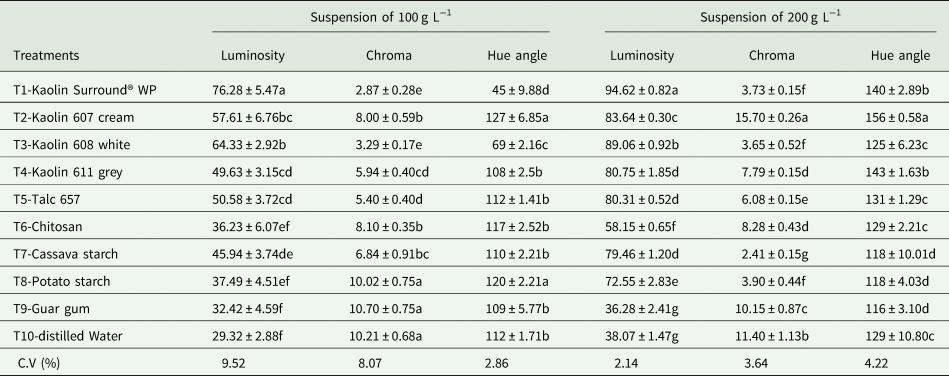
Films suspension at 100 g L−1 had effects on luminosity (t = 4.0613; df = 39; P < 0.001), chroma (t = 8.6448; df = 39; P < 0.001) and hue angle (t = 12.456; df = 39; P < 0.001) of fruits. A comparison of luminosity values before (table 1) and after immersion in suspension at 100 g L−1 (table 2) shows that all films increased fruit luminosity after treatment, indicating that fruits immersed in mineral films had higher values than those in control.
Luminosity, chroma and hue angle (mean ± standard deviation) of the grapes after immersion in suspensions at 100 and 200 g l−1.

Mean ± SD values in the same column followed by the same letter do not differ significantly at P < 0.05 (Tukey's test).
For treatments at 100 g L−1, significant differences were observed between the following parameters: luminosity (F = 42.885; df = 9, 39; P < 0.001), chroma (F = 93.96; df = 9, 39; P < 0.001), and hue angle (F = 32.536; df = 9, 39; P < 0.001). Luminosity, which can vary from 0 (black) to 100 (white), was significantly higher in fruits immersed in kaolin Surround® (76.28 ± 5.47, close to white) compared to that of fruits in all other treatments, including that of control (29.32 ± 2.88). Chroma values obtained before (table 1) and after immersion of grapes in suspensions (table 2) showed that there was a general reduction in all treatments, however, this reduction was less pronounced in fruits treated with potato starch, guar gum film, and water. In addition, immersion in suspensions significantly altered the hue angle of fruits. There was an increase in the hue angle of fruits treated with Kaolin 607 and a reduction in those treated with kaolin Surround® and 608, which were different from other treatments (table 2).
Films suspension at 200 g L−1 also affected luminosity (t= 10.712, df = 39, P < 0.001), chroma (t= 5.0254, df = 39, P < 0.001) and hue angle (t = 4.1679, df = 39, P < 0.001) (table 2). Luminosity values before (table 1) and after immersion at 200 g L−1 (table 2) showed that all films increased fruit luminosity after treatment, that is, fruits treated with mineral films had higher values compared to those in control.
Similar results were obtained for fruits immersed in suspensions at 200 g L−1; particle films had effects on luminosity (F = 718.89; df = 9, 39; P < 0.001), chroma (F = 248.9; df = 9, 39; P < 0.001) and hue angle (F = 9.39; df = 9, 39; P < 0.001). It was observed that the luminosity values of fruits immersed in suspensions at 200 g L−1 were higher than those in suspensions at 100 g L−1, and the average values of all treatments, except for guar gum, differed from that of control, almost reaching white colour in fruits immersed in kaolin Surround® (94.62 ± 0.82). Chroma values ranged from 2.41 ± 0.41 (cassava starch) to 15.70 ± 0.26 (kaolin 607), the highest average was observed in fruits treated with Kaolin cream (15.70 ± 0.26). Hue angle ranged from 116 ± 3.10 (guar gum) to 156 ± 0.58 (kaolin 607), and only kaolin 608, talc and chitosan did not differ from control in hue angle.
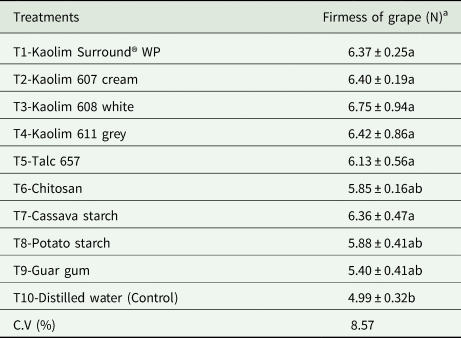
Mineral films (kaolin Surround®, 607, 608 and 611 and talc) and cassava starch increased pulp firmness than control (F = 4.3069; df = 9, 39; P < 0.001) (table 3).
Firmness of grapes (mean ± standard deviation) subjected suspensions at 200 g L−1.

Mean ± SD values in the same column followed by the same letter do not differ significantly at P < 0.05 (Tukey's test).
a Data transformed into log (x + 10).
Oviposition: non-choice tests (bioassays 1 and 2)
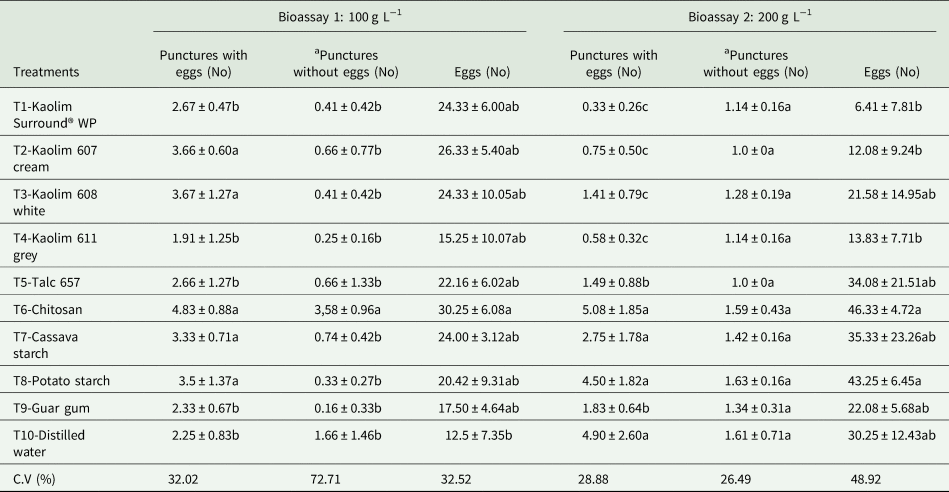
In bioassay 1, which is characterized by the immersion of fruits in 100 g L−1 film suspensions, increase in punctures with eggs in kaolin (607 and 608), chitosan and starch (cassava and potato) treatments was observed, and their average values were significantly higher than those in distilled water treatment (F = 3.1682; df = 9, 39; P = 0.0083067) (table 4). As for the number of punctures without eggs, significant differences were observed (F = 3.5728; df = 9, 39; P = 0.004027), and only chitosan differed from control with 3.58 ± 0.96 punctures. Regarding the number of eggs, only chitosan, with the highest average number of eggs (30.25 ± 6.08), differed from control (F = 2.4247; df = 9, 39; P = 0.033221).
Puncture with and without eggs and eggs (mean ± standard deviation) of C. capitata in grapes, submitted to suspensions in bioassays 1 and 2 (non-choice).

Mean ± SD values in the same column followed by the same letter do not differ significantly at P < 0.05 (Tukey's test).
a Data transformed in √x + 1.
At the highest suspension (200 g L−1 – bioassay 2), all mineral films (kaolin Surround®, 607, 608 and 611 and talc) and guar gum treatments resulted in the lower average number of punctures with eggs compared to control, whereas the other treatments (chitosan and cassava and potato starches) did not have any effect on this variable (F = 3.0753; df = 9, 39; P = 0.0098394) (table 4). Regarding the number of punctures without eggs, there were no significant differences among treatments and control (F = 9.7759; df = 9, 39; P = 8.4543), with average values ranging from 1.0 ± 0 to 1.63 ± 0.16.
For the average number of eggs, it was observed that no treatment differed from control; however, significant differences were found between kaolin Surround®, 607 and 611 and chitosan and potato starch (F = 4.3264; df = 9, 39; P = 0.0011156), with fruits treated with kaolin having lower average values (table 4).
Oviposition: choice tests (bioassays 3 and 4)
In bioassay 3 (suspension of 100 g L−1), significant differences were observed among treatments for punctures with eggs (F = 4.9854; df = 8, 35; P < 0.0001) and number of eggs (F = 8.7221; df = 8, 35; P < 0.0001), but were not observed for punctures without eggs (F = 0.9853; df = 8, 35; P = 0.4628) (fig. 1). Kaolin Surround® was the only treatment that reduced the number of punctures with eggs, whereas others, except for guar gum treatment, increased the average values of this variable (fig. 1a). However, the reduction in the number of punctures with eggs by kaolin Surround® did not result in the lower average number of eggs in the same treatment (fig. 1c).
Punctures with eggs (a) and punctures without eggs (b) and eggs (c) (mean number ± standard deviation) of C. capitata in grapes, submitted to mineral and natural films, at 100 g L−1, obtained in the bioassay 3 (choice test).

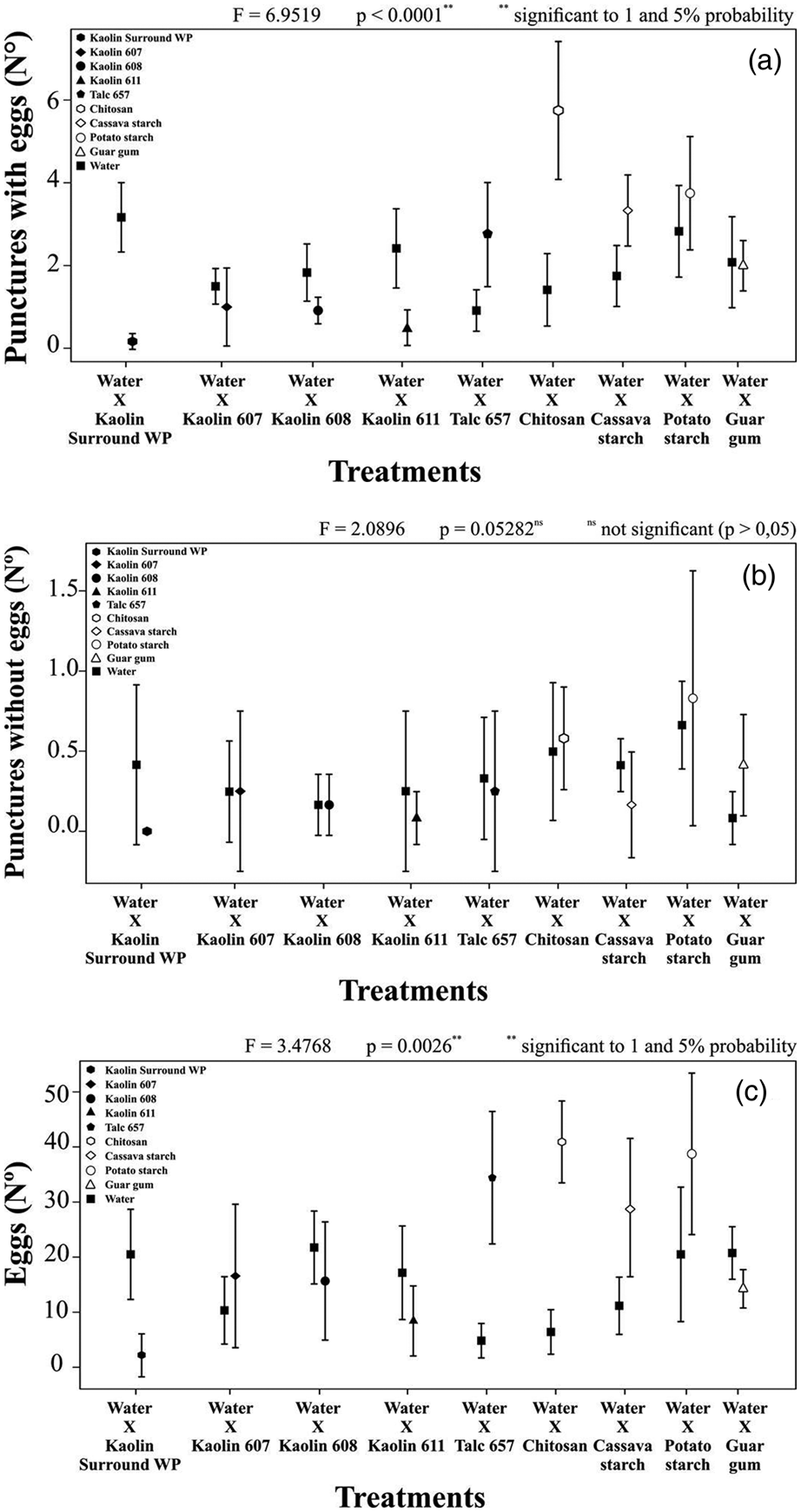
For bioassay 4 (immersion at 200 g L−1), responses of flies to treated and untreated fruits were different compared to those in bioassay 3, with a significant reduction in the average number of punctures with eggs (F = 6.9519; df = 8, 35; P < 0.00001) by kaolin Surround®, 607, 608 and 611 and guar gum treatments, and a significant increase in the same variables by other treatments (fig. 2a). Similar responses occurred for the number of eggs (F = 3.4768; df = 8, 35; P = 0.0026), except for kaolin 607, which resulted in a higher average number of eggs compared to control (fig. 2c). Treatments did not affect the number of punctures without eggs (F = 2.0896; df = 8, 35; P = 0.05282) (fig. 2b).
Punctures with eggs (a) and punctures without eggs (b) and eggs (c) (mean ± standard deviation) of C. capitata in grapes, submitted to mineral and natural films, at 200 g L−1, obtained in bioassay 4 (choice test).

Behavioural response of C. capitata to treated and untreated fruits
Time of first landing on fruit did not differ among treatments and control (F = 14.143; df = 6; P > 0.05; coefficient of variation (C.V) = 28.62%), with values ranging from 1.68 ± 0.216 (kaolin Surround®) to 2.12 ± 0.173 s (guar gum), (fig. 3a); however, for number of landings, kaolin Surround® treatment resulted in the lowest number of landings (2.43 ± 0.094) compared to control (F = 0.73892; df = 6; P < 0.01; C.V = 6.77%) (fig. 3b). Search time for all treatments did not differ from that of control (F = 20.564; df = 6; P = 0.388; C.V = 19.22%), however, kaolin Surround® treatment (3.72 ± 0495 s) and chitosan (6.11 ± 0495 s) were significantly different between each other, with shorter search time recorded for kaolin Surround® (fig. 3c).
Oviposition behaviour (number mean ± standard deviation) of C. capitata in grapes, submitted the suspensions at 200 g L−1. Time of first landing (a) number of landings (b) search time (c) number of search (d) puncture time (e) number of punctures (f) aculeus dragging time (g) number of aculeus dragging (i) cleaning time of the aculeus (j) (number of cleaning of the aculeus). * Data transformed into log (x + 10).

Regarding the average number of searches, differences were found only between kaolin Surround® (2.49 ± 0.107) and kaolin 608 (2.94 ± 0.107) (fig. 3d) (F = 0.97042, df = 6, P = 0.0811, C.V = 7.82%). Time for aculeus insertion in fruits (puncture) did not differ among treatments (F = 4.3002, df = 6, P = 0.162, C.V = 20.64%) (fig. 3e); however, differences in the number of punctures were observed only between kaolin 607 (2.43 ± 0.081) and kaolin 611 (2.78 ± 0.081) (F = 0.55152, df = 6, P < 0.05, C.V = 6.31%) (fig. 3f). Time for aculeus dragging on fruit surface after oviposition differed only between kaolin (607 and 611) and chitosan (F = 16.126, df = 6, P < 0.001, C.V = 25.76%); (fig. 3g). The difference found in the average number of ovipositor aculeus dragging was not significant among treatments (F = 0.21976, df = 6, P = 0.3748, C.V = 4.26%) (fig. 3h). Regarding the time for aculeus cleaning, treatments did not differ from control (F = 3.4687, df = 6, P = 0.5003, C.V = 15.51%), however, differences were found between kaolin 608 (3.28 ± 0.203 s), kaolin 607 (2.30 ± 0.203 s), and chitosan (2.30 ± 0.203 s) (fig. 3i). Regarding the number of times aculeus cleaning behaviour was performed, treatments did not differ from control (F = 8, df = 6, P = 0.5728, C.V = 123.44%), except for kaolin 611, which resulted in the greater number of times (1.75 ± 0.309 times) (fig. 3j).
Discussion
Studies were developed using grape as a substrate for C. capitata oviposition owing to its economic importance for export and the easy visualization of punctures and eggs, which help in minimizing experimental errors. The grapes used in the bioassays of this study were within the commercial standards reported in Normative Instruction No. 1 of 1 February 2002 (BRAZIL, 2002), which stated that fine table grapes should have a minimum soluble solids equal to 14° Brix and TA <1.5 (Carvalho and Chitarra, Reference Carvalho and Chitarra1984). In this study, the values obtained for mass, length and diameter of grapes can be considered to be within commercial standards (Mascarenhas et al., Reference Mascarenhas, Silva, Lopes and Lima2010, Reference Mascarenhas, Guerra, Aquino and Leão2013). Before bioassays, grapes were uniform in terms of weight, length, chroma and hue angle, with variations only in diameter and luminosity values (table 1), indicating good fruit uniformity.
Variations in the diameter values of grapes did not interfere with the responses of females. According to Corrêa et al. (Reference Corrêa, Wille, Hoffer, Boff and Franco2018), grapes of different varieties and diameters did not influence the oviposition of C. capitata and A. fraterculus. Regarding the luminosity values obtained in grapes before applying treatments, differences were observed only between potato and cassava starches and guar gum and control, however, they were statistically equal to the values of grapes used in other treatments.
Thus, this factor alone probably did not influence females in choosing between fruits treated with different films (table 1). In general, it is considered that grapes had good uniformity for use in bioassays, and it could be inferred that variations in responses of flies to oviposition were only due to treatments applied.
Regardless of the method used (choice and non-choice tests), studies with mineral and natural films indicated that suspension at 100 g L−1 does not protect grapes from C. capitata oviposition (table 4 and fig. 1), but even increases oviposition variables (punctures with eggs and number of eggs). The only exception was Surround® treatment in choice test, which resulted in a lower average number of egg punctures (fig. 1a), however, it did not result in fewer eggs on grapes (fig. 1c). These results differ from that recorded in some laboratory, where there was a reduction in punctures of C. capitata oviposition in citrus (D'aquino et al., Reference D'aquino, Cocco, Ortu and Schirra2011) and nectarine treated with Surround® at 30 g L−1 and 60 g L−1, respectively; flies avoided landing on treated fruits, resulting in no infestation (Mazor and Erez, Reference Mazor and Erez2004); and reduction in punctures of Rhagoletis mendax Curran fly oviposition in blueberry treated with Surround® at 60 g l−1 (Lemoyne et al., Reference Lemoyne, Vincent, Gaul and Mackenzie2008). In the field, kaolin sprays at 50 g L−1 in citrus (Braham et al., Reference Braham, Pasqualini and Ncira2007; Lo Verde et al., Reference Lo Verde, Caleca and Lo Verde2011) and apple plants (Villanueva and Walgenbach, Reference Villanueva and Walgenbach2007) resulted in a significant reduction in the number of damaged fruits, indicating negative effects on oviposition.
For suspension at 200 g L−1, the reduction of C. capitata oviposition in grapes was evidenced in treatments with mineral films and guar gum in the choice test of hosts by fly (bioassay 2). In this case, Surround® reduced the number of punctures with eggs and the number of eggs by ~15 and 5 times, respectively (table 4). In bioassay 4, where flies had a choice for treated or untreated fruits, flies discriminated the treatments in two groups: oviposition inhibitors (Surround®, kaolin 608, kaolin 611 and guar gum) and stimulants (kaolin 607, talc, chitosan and potato and cassava starches). In this case, the greatest inhibition was achieved with Surround®, ~19 and 9 times the number of punctures with eggs and number of eggs, respectively. In a suspension at 200 g L−1, kaolin and liquid limestone applied to apple and mango fruits resulted in an inhibition of C. capitata oviposition (Ourique et al., Reference Ourique, Redaelli, Efrom and Pedrini2017). The average number of punctures in apples and mangoes was 7 to 8 times and 3 times lower, respectively, when treated with both products.
Few ripe fruit species are white in colour and white can be considered a very neutral surface, reflecting a range of wavelengths within the visible spectrum of tephritids. According to Díaz-Fleischer et al. (Reference Díaz-Fleischer, Papaj, Prokopy, Aluja, Norrbom, Aluja and Norrbom2000), in laboratory experiments, females such as A. fraterculus, A. ludens and C. capitata generally show little or no discrimination between white spheres (substrate for oviposition) and spheres of other colours. With the use of suspension at 200 g L−1, fruits from T1, T2, T3 and T4 treatments showed whitish colour, evidenced by luminosity values ≥80. Surround® and kaolin 607 reduced the oviposition of C. capitata and both showed high luminosity value of 94.62 ± 0.82 and 83.64 ± 0.30, respectively, which also indicates reflectance. The colour change resulting from the effects of these films probably impaired the perception of host, a fact already reported by Katsoyannos et al. (Reference Katsoyannos, Panagiotidou and Kechagia1986) for wild C. capitata flies. In the laboratory, the authors found that flies preferred to oviposit in spheres coloured in black, blue and red than in those coloured in yellow and white, which received smaller number of eggs. The preference observed for certain colours depends on both colour tone and intensity of total light reflected (brightness) and white spheres showed 100% reflectance (Katsoyannos et al., Reference Katsoyannos, Panagiotidou and Kechagia1986).
In all bioassays, when fruits were dissected for egg counting, it was observed that grapes with mineral films had punctures with eggs, but had a reduced number of eggs; however, smaller number of punctures with greater amount of eggs was observed under the fruit pedicel. Perhaps, this behaviour is owed to the perception that flies had towards the films in fruit, making them search for a more appropriate place without foreign substances for oviposition. It was observed that fruits with films had changed colour but did not prevent C. capitata from finding and accepting the host. However, the changed colour somehow prevented flies from having prolonged direct contact with foreign substances, causing them to look for alternative places in the fruit to oviposit.
According to Mazor and Erez (Reference Mazor and Erez2004), kaolin-treated fruits are visually recognized by flies as host, but their colour does not match what not expect something appropriate for oviposition. Even in inappropriate hosts, in an attempt to leave offspring, fruit flies can oviposit on these substrates (Aluja and Mangan, Reference Aluja and Mangan2008). In the absence of a primary host, C. capitata searches for an alternative host, such as Opuntia ficus-indica (L.) Mill and Pereskia bahiensis Gürke, to ensure offspring survival, even though they are poorly suited hosts for larval development (Leite et al., Reference Leite, Castellani, Ribeiro, Costa, Bittencourt and Moreira2017; Leite et al., Reference Leite, da Costa, Ribeiro, Moreira, Sá Neto and Castellani2019).
Natural polymers have wide applicability in several study areas owing to their properties such as biocompatibility, biodegradability, high availability and non-toxicity (Azevedo et al., Reference Azevedo, Chaves, Bezerra, Lia Fook and Costa2007). The use of natural films at both suspension rates did not reduce Medfly ovipositions. This result was not expected, mainly owing to the colour change provided by these films. Chitosan affected the posture of C. capitata, with a consequent increase in the number of eggs; this result may have an application in bio-factories for massal rearing of fly, especially when aiming to sterile insect technique.
Regarding oviposition behaviour, C. capitata took the same time to recognize fruits with and without films (fig. 3a). It was observed that the average number of landings was lower in treatment with Surround® (2.43 ± 0.094) compared to that in control (2.92 ± 0.094). These results are in accordance with those obtained by Mazor and Erez (Reference Mazor and Erez2004) in studies of C. capitata oviposition in nectarine, in which average landing was 0.05 in kaolin-treated fruits and 4.95 in untreated fruits. The authors attributed their results to the whitish colour left by the film on fruits, impairing the detection of hosts by flies (Mazor and Erez, Reference Mazor and Erez2004). In the present study, the number of C. capitata landings on fruits treated with Surround® was five times lower than that in untreated fruits (taking into account original unprocessed data). Probably, the particle films masked the volatile emission of fruits, interfering in the oviposition behaviour of fly. Studies using other films on ‘Golden Delicious’ apple fruits confirm that volatile compounds can be inhibited by up to 75% (Saftner, Reference Saftner1999) for this type of coverage. However, in the present study, the determination of volatiles by means of chromatographic analysis would be necessary to confirm this hypothesis.
Mineral films form a physical barrier over fruit, which is evidenced by the change in pulp firmness (table 3); however, this barrier did not influence the duration of aculeus insertion (puncture) (fig. 3e). Mineral films resulted in an increase in pulp firmness compared to control, which may have negatively affected oviposition at the highest suspension. Ceratitis capitata females prefer to oviposit on grape fruits with more advanced physiological development stage, that is, with lower firmness, lower TA and higher content of TSS (Gómez et al., Reference Gómez, Paranhos, Silva, Lima, Silva, Macedo, Virginio and Walder2019). The same fact has already been observed by Jang and Light (Reference Jang and Light1991) for Bactrocera (Dacus) dorsalis Hendel in papaya.
Some fruits also possess epicarps that show resistance so that some species with short aculeus, like C. capitata, are unable to make punctures and deposit eggs (Aluja and Mangan, Reference Aluja and Mangan2008). According to Saour and Makee (Reference Saour and Makee2004), mineral particles make fruit surface rough and may make them unsuitable for oviposition. Among the variables determined or observed in this study, the number of punctures without eggs occurred in all bioassays and in all treatments, but without significant difference. This resistance, mainly provided by minerals films, may influence flies to make punctures without depositing eggs on fruits. Films should also inhibit this behaviour, since, for certain thin-skinned fruits, the injury caused by puncture also results in microorganism contamination (Engelbrecht et al., Reference Engelbrecht, Holz and Pringle2004). It is observed that films resulted in a reduction in the number of landings of fly on fruits, but did not prevent them from recognizing and puncturing the treated grapes; this fact was also reported for blueberry fruits treated with Surround® and exposed to the fly R. mendax (Lemoyne et al., (Reference Lemoyne, Vincent, Gaul and Mackenzie2008). The interference of films in colour (brightness, chroma and hue angle) and, probably, in the dispersion of volatiles, made it difficult for the females to recognize the fruits while the firmness may have acted directly in oviposition. Ceratitis capitata has short aculeus, smaller than other tefritids and usually selects fruits in more advanced maturation stages to oviposit.
After the puncture, flies exhibit the behaviour of circulating the fruit and occasionally dragging ovipositor to deposit marking pheromone (Díaz-Fleischer et al., Reference Díaz-Fleischer, Papaj, Prokopy, Aluja, Norrbom, Aluja and Norrbom2000). All treatments showed this behaviour, without significant difference. According to Díaz-Fleischer et al. (Reference Díaz-Fleischer, Papaj, Prokopy, Aluja, Norrbom, Aluja and Norrbom2000) flies clean aculeus to disperse marking pheromone and remove fruit pieces that are attached to the aculeus. It was observed that this cleaning was not mandatory, and in kaolin 607 and chitosan treatments, flies did not perform this procedure (fig. 3j). The absence of aculeus cleaning behaviour reinforces the hypothesis that flies did not recognize chitosan as an inappropriate substrate for oviposition, otherwise, an increase in oviposition regardless of suspension and type of test (in choice and non-choice) would have been observed. Such a hypothesis can be made because, in kaolin-treated blueberry fruits, R. mendax females made relatively short walks, followed by frequent cleaning sessions, suggesting that some fragment in the film would have hindered the perception of stimuli (chemical compounds on the surface, blocked or absorbed by the particle film) needed to assess the suitability of hosts (Lemoyne et al., Reference Lemoyne, Vincent, Gaul and Mackenzie2008).
The results obtained in this study are promising, given the scientific evidence that films of mineral particles such as kaolin (Surround®, 607, 608 and 611) change the firmness, luminosity, chroma and hue angle of fruits and reduce the oviposition of C. capitata. In addition, we also observed that natural polymers do not deter C. capitata females, but rather seems to stimulate oviposition.
Acknowledgements
We are grateful to the Foundation for Research Support of the State of Bahia (FAPESB) and the CAPES Foundation (Brazilian Ministry of Education; Finance Code 001) for financial support. The companies Brasilminas and NovaSource for donating the kaolin samples.