INTRODUCTION
Palliative cancer care has been intensively studied in respect to patients' information preferences (Parker et al., Reference Parker, Clayton, Hancock, Walder and Butow2007) and it has been shown that patients' search for knowledge occurs not only at single turning points but also over time throughout their cancer journey (Street & Horey, Reference Street and Horey2010). Although many cancer patients report receiving sufficient information about the disease, they raise issues regarding communication in decision-making situations (DesHarnais et al., Reference DesHarnais, Carter, Hennessy, Kurent and Carter2007), at turning points related to changes in treatment (Clayton & Kissane, Reference Clayton, Kissane, Kissane, Bultz, Butow and Finlay2010; Friberg & Öhlén, Reference Friberg and Öhlén2007), and in situations when healthcare professionals must convey relevant prognostic information (El-Jawahri et al., Reference El-Jawahri, Traeger, Park, Greer, Pirl and Lennes2014) and bad news (Del Vento et al., Reference Del Vento, Bavelas, Healing, MacLean and Kirk2009). Due to a variety of concerns, from the practical to the existential, patients in palliative care situations — especially related to palliative chemotherapy — may require many different types of information from healthcare providers. In addition, they may need help in articulating issues of importance for their quality-of-life, which in turn may reveal further information needs with underpinning value conflicts. The diversity of patient concerns, distress and information needs over time make patient information provision in clinical palliative cancer care a critical issue (Beaver & Booth, Reference Beaver and Booth2007; Kazimierczak et al., Reference Kazimierczak, Skea, Dixon-Woods, Entwistle, Feldman-Stewart, N'Dow and MacLennan2013). Increasingly knowledgeable and information-seeking patients put demands not only on providers' communicative skills but also on their related powers of organization, for example, in organizing consultations (Husson et al., Reference Husson, Thong, Mols, Smilde, Creemers and van de Poll-Franse2013). Further, this is a growing issue related to the rapid progress in new oncology regimens for advanced colorectal cancer, which contributes to increased survival time (Glimelius & Cavalli-Björkman, Reference Glimelius and Cavalli-Björkman2012). All of these factors challenge existing models guiding the provision of communication in palliative cancer care and especially the way such models are informed by current views on communication complexity (see e.g., Klein, Reference Klein2014).
A changed view on communication could be related to the so-called narrative turn, which occurred decades ago (Bruner, Reference Bruner2004). Although constructionist views have had a breakthrough in the research literature related to communication, including models for cancer care communication, such views are largely informed by systems theoretical inspired models (see, Brundage et al., Reference Brundage, Feldman-Stewart and Tishelman2010). Theoretical models aimed at informing professional providers' communication in the field of palliative care tend to present communication as linear or step wise, with emphasis on the first consultation rather than the process character of ongoing palliative care. Moreover, such models present the professionals as setting the agenda and giving information (Brown & Bylund, Reference Brown, Bylund, Kissane, Bultz, Butow and Finlay2010), which could be regarded as counteractive to the view of the patient as a person who assumes agency, initiative and responsibility for taking part in encounters (Radley, Reference Radley1994).
Further, in addition to models with a delimited focus on formal communication between physician and patient (Brundage et al., Reference Brundage, Feldman-Stewart and Tishelman2010), we need models that guide providers' formal as well as informal team-oriented communication with patients. This is motivated by the fact that many clinical dialogues are informal and narratively co-constructed by patients and healthcare providers. We therefore require practical knowledge of how to invite the patient to share not only their experiences but also their beliefs and conceptions and of how to create arenas facilitating the sharing of knowledge, experiences and mutual agreement of future care. Patient values and preferences, involvement of family members, and making patient information understandable are some of the core aspects included in person-centered communication (Zucca et al., Reference Zucca, Sanson-Fisher, Waller and Carey2014). Incorporating person-centered approaches to therapeutic planning and decision-making would also be advantageous here (Popa-Velea et al., Reference Popa-Velea, Cernat and Tambu2010). Practice-relevant models informed by both patients' and health professionals' experiential knowledge that goes beyond purely providing information are needed to meet these demands. Important here too are establishing procedures to make practice-based evidence more transparent (Morse et al., Reference Morse, Penrod and Hupcey2000) and providing tools supporting knowledge translation for implementation of research (Leeman & Sandelowski, Reference Leeman and Sandelowski2012). This would improve conditions for patient safety (Martin et al., Reference Martin, Navne and Lipczak2013) and assure a stringent discussion about practice-based ethics related to person-centered information and communication (Redman, Reference Redman2013).
PROJECT BACKGROUND
The model described in this article derives from a larger fieldwork project with the overall aim of contributing to person-centered communication in palliative cancer care. An outpatient oncology unit at a Swedish university hospital with emphasis on palliative care served as context for the fieldwork that preceded this project. Patients diagnosed with advanced gastro-intestinal cancer receiving chemotherapy were followed over time by means of narrative interviews and participant observations supplemented by recordings of planned consultations. As the patients regularly attended the unit for palliative chemotherapy treatments and follow-up visits, the setting provided us with rich opportunities for dialogues about treatment and life situations, supplemented by narrative interviews in patients' homes. Major results are reported (Friberg et al., Reference Friberg, Lidén, Håkanson and Öhlén2014; Friberg & Öhlén, Reference Friberg and Öhlén2007; Reference Friberg and Öhlén2010; Karlsson et al., Reference Karlsson, Friberg, Wallengren and Öhlén2014; Liden et al., Reference Lidén, Öhlén, Hyden and Friberg2010; Öhlén et al., Reference Öhlén, Elofsson, Hyden and Friberg2008; Öhlén et al., Reference Öhlén, Wallengren Gustafsson and Friberg2013).
Once the fieldwork was finalized, the researchers (JÖ, FF) were invited by the oncology unit team to share the ongoing data analysis with the aim of discussing communication and information routines. More specifically, we reflected on the challenges presented by difficult dialogues with palliative cancer patients and how to improve communication skills. As a result of our few meetings, we decided to collaborate in a participatory action research (PAR) project with the aim of developing practical implications of the results from the fieldwork project. We then met regularly with the team for reflective dialogues about the communicative challenges in palliative care, in a format similar to focus group discussions (FGD). Gradually, the FGD increasingly took the form of mutual sharing of knowledge, resulting in the collaborative development of a practice model combined with a local process of change at the oncology outpatient unit. This also prompted the idea to invite key team members to become co-researchers in line with PAR methodology. The unit manager and chief physician verified the participatory design, the unit manager also supporting the study with time and space for FGD during working hours. In this way, the two researchers and one team began collaborating, then developed and reflected the tentative model, which was further developed by utilizing the experiences and expertise of patients and additional palliative care team members. Finally, the researchers and co-researchers advanced the model here presented.
AIM
The aim was to put forward a practice model for communication between patients, their family members, and professional providers during ongoing palliative chemotherapy: a model supporting the providers to enable person-centred communication.
METHODS
Design
The model was developed step-wise in three interrelated cycles according to PAR (Kemmis & McTaggart, Reference Kemmis and McTaggart1997) using results from qualitative research to lay the foundation for the development of a clinically applicable model (Morse et al., Reference Morse, Penrod and Hupcey2000). Results from previous studies from palliative cancer care were processed in relation to professional providers' experience-based clinical knowledge. We assumed practice to inform theory and vice-versa, thus intending to bridge theoretical and clinical knowledge. In explicating and reflecting on the professionals' practical knowledge, theoretical knowledge was used like a scaffold (Thorne, Reference Thorne2008); a supportive structure for the development of the model. We continue here by outlining the theoretical scaffolding and the methods utilized in the process.
Theoretical Scaffolding
“Alleviation of suffering,” as an overall aim for palliative care, is considered an embodied personal experience which is inter-personally created and dependent (Öhlén et al., Reference Öhlén, Bengtsson, Skott and Segesten2002) and here combined with communicative challenges in terms of “enabling of learning” (Febe Friberg, Reference Friberg2001; Friberg et al., Reference Friberg, Andersson and Bengtsson2007). In a broad sense, alleviation of suffering is closely related to being affirmed as a person and in one's existential situation (Öhlén, Reference Öhlén2000; Öhlén et al., Reference Öhlén, Bengtsson, Skott and Segesten2002). The interrelatedness between suffering and learning is marked in patients' struggling regarding “making sense” of receiving palliative treatments (Öhlén et al., Reference Öhlén, Wallengren Gustafsson and Friberg2013). The sense-making process is constructed narratively, through patients' search for knowledge and understanding as well as awareness of their perceptions and beliefs related to illness. It can also be seen as a process of existential and experiential learning in order to gradually handle a changed and changing life situation (Friberg & Öhlén, Reference Friberg and Öhlén2007). In this way, sense-making can be framed by a dialectic pattern of living in wait and in the present, thus influencing how uncertainty is handled (Öhlén et al., Reference Öhlén, Wallengren Gustafsson and Friberg2013). Movement between uncertainty and certainty may be apparent, paving ways for personal development and the possibility to move toward increased self-knowledge (Karlsson et al., Reference Karlsson, Friberg, Wallengren and Öhlén2014). This necessitates health providers acting wisely and sensibly in communicative situations (Öhlén, Reference Öhlén2002), their task being to identify the patient's way of reasoning in order to understand the patient's logic and use it as a basis for dialoguing (Friberg et al., Reference Friberg, Andersson and Bengtsson2007; Reference Friberg, Lidén, Håkanson and Öhlén2014; Friberg & Öhlén, Reference Friberg and Öhlén2007; Jarvis, Reference Jarvis2006). The socially shaped nature of sense-making implies that patients and health providers interactively develop and communicatively construct meanings (Lidén et al., Reference Lidén, Öhlén, Hyden and Friberg2010; Öhlén et al., Reference Öhlén, Elofsson, Hyden and Friberg2008). Thus, a constructionist perspective, where communication is socially and interactively shaped (Jarvis, Reference Jarvis2006; Schütz, Reference Schütz1972) is relevant. Here we take the view of the person as capable, rational, and self-reflective with activities, values, reasons, preferences, and goals. The person presents him/herself biographically with both capability and fragility (Ricœur, Reference Ricœur1992).
Action Research Cycles, Data, Participants and Settings
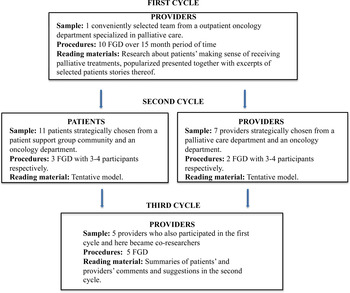
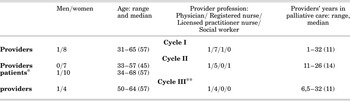
The PAR process was performed in three interrelated cycles as described in Figure 1. In the first cycle, one team providing outpatient palliative cancer care participated in repeated FGD over a 15-month period. In the second cycle, FGD were performed with additional participants. Finally, in the third cycle, a core group of providers who participated in the first cycle became co-researchers (Table 1). The theoretical scaffold (see above) was used as a foundation to merge with the participants' experiential practical knowledge in order to construct new findings (Morse et al., Reference Morse, Penrod and Hupcey2000). Reading materials were used to facilitate reflection in the FGD (Fig. 1), with concurrent analysis informing the subsequent FGD and the process emphasizing contextualizing, synthesizing and theorizing. Data was documented by audio recordings supplemented by field notes in phases I and II and field notes in phase III.
The development process of the model: three interrelated cycles

Participants in the development of the model

* Patients' major medical diagnoses were: breast, lung, skin and colon cancer. One relative participated, and one patient also had simultaneous experience as a relative of a severely ill adult child. Occupations were: working (9), retiree (2)
** all providers who participated in cycle III also participated in cycle I.
In the first cycle, a tentative model was developed in FGD taking the form of reflective workshop sessions. Field notes were taken by the researchers during and after every FGD, and a reflective summary of each one was sent to the participants before the subsequent FGD. The focus group sessions were audio recorded and transcribed verbatim. The FGD centered on sharing experiences related to challenges in dialoguing with patients and family members, with participants invited to comment on each other. A popularized text presenting the major results of patients' sense-making of receiving palliative treatments, together with excerpts of selected patients' stories were used as a discussion prompt for the second and third FGD. The group collaborated on successively mind-mapping central features of the complexity related to communication with their patients and initially used the mind maps for deepening the reflective discussions and increasingly revising and re-modelling in the following FGD. The tentative model gradually built up to be composed of three major actors (patient, provider and family) dialoguing in a communicative arena. In the final session, the group came to the conclusion that the model would benefit from critique.
In the second cycle, the tentative model was commented on in FGD with patients and health providers. In the FGD, the participants were first presented with an overview of the model and then invited to relate it to their own experiences: Is the model understandable? Is the model practice relevant? What parts of the model are unnecessary? What do we need to add to get a valid model? Professional strategies, responsibilities between different categories of health professionals and organizational matters in connection to the accomplishment of person-centered communication were elaborated upon and the participants gave comments, critique and suggestions for revision.
Finally in the third cycle, the researchers and co-researchers processed the comments and suggestions generated in the second cycle, focusing on the structure, clarity, and practice implications of the model. Specific premises and concepts in the model were formulated by means of either existing definitions in the literature or from the theoretical scaffold.
Data Analysis
In the first cycle, a constant comparative analysis adapted to PAR was applied (Dick, Reference Dick, Bryaut and Charmaz2007). After every workshop session, the researchers (JÖ, FF) made a preliminary analysis of the FGD data and field notes for identification of commonalities and variations. Themes were first identified before being elaborated on during the subsequent focus groups sessions, mirroring the content and structure of the developing model. The discussed themes in the focus groups were: characteristics of model under development, experiences of conversations with patients in different stages of the illness trajectory, palliative turning points, patients' concerns and distress and their beliefs and knowledge-seeking.
The final analysis was focused on commonalities and variations between the FGD data from the second cycle, the theoretical scaffold and the tentative model, with particular focus on clarification of premises, domains and concepts and their relationship.
RESULTS
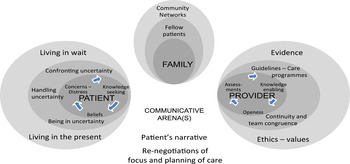
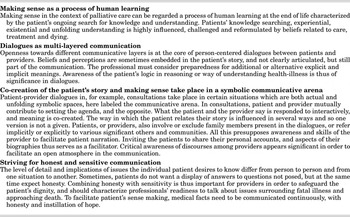
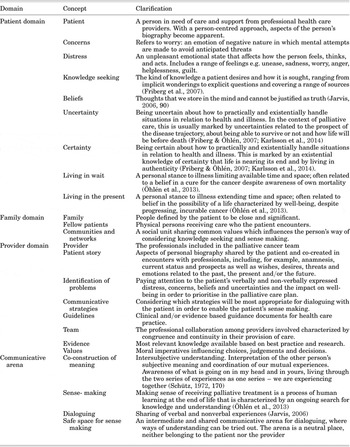
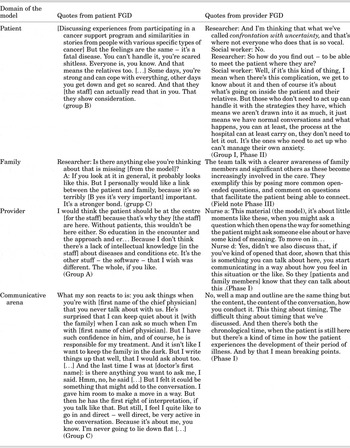
The Enabling Sense Making (ESM) model for person-centered communication comprises three domains, which are also the major communicative actors in palliative care: the patient, the family, and the provider. These actors are put in a context of a communicative arena (Fig. 2). The domains in combination could be regarded as sensitizing frames for the provider to handle the complexity in enabling the patient's sense making. The three respective domains are built up in different layers, discriminating significant aspects of person-centered communication in the context of advanced conditions (here colorectal cancer), from the manifest that is most usually explicated in dialogues to the latent that tends to be implicitly mediated. Four specific theoretical premises underpin the model (Table 2) and each of the central concepts in the domains are clarified (Table 3). Examples from the FGD are given in order to illustrate the three domains and the communicative arena for enabling patients' sense-making (Table 4).
The Enabling Sense Making model for person-centred communication in palliative care.

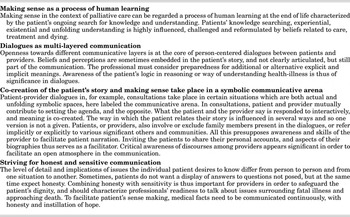
Premises in the model for person-centered palliative cancer care communication
Conceptual clarifications of central concepts in the domains of the model

The significance of the patient, provider and family domains and the communicative arena for enabling patients' sense making. Illustrative examples from the FGD with patients and providers

The Patient Domain
The discrimination of three layers aims to direct the providers' attention in the communication to aspects of complexity in the patient's health-illness. The first layer directs attention to the patient's concerns and distress, factual knowledge, and beliefs and knowledge seeking. The second layer concerns different aspects and meanings of uncertainty and certainty related to receiving palliative care. The third layer is related to more or less reflected stances of moving between “living in wait” and “living in the present.”
The patient's concerns and distress could be regarded a given focus in patient-provider dialogues. Here, these two concepts are used to highlight the complexity in symptom experience. Since palliative care cannot usually relieve all symptoms and chemotherapy usually involves side-effects and symptoms, it is relevant to focus on the symptom experiences that cause most concern and distress. Concerns and distress may be related to the patient's factual knowledge and beliefs, as well as ways of seeking knowledge. Movements between meanings of uncertainty and certainty and between living in waiting and living in the present can be recurring, for example, when new side-effects arise. The movement between living in waiting and the present could be regarded as significant framings in the patients' story telling. Such movements and framings can be used by providers in assessing patients' concerns, distress and knowledge-seeking.
The Provider Domain
The first layer explicates the significance of listening to the patient's story, identifying the patient's problems and considering relevant strategies for communication. The second layer frames the provider's assessment and strategy consideration with influencing and conditional factors such as clinical guidelines and team resources. The third layer further frames the assessment and consideration with attention to values and potential value conflicts, as well as knowledge evidence.
Listening to the patient's story, assessing needs and problems related to knowledge seeking and consideration of communicative strategies should be related to the patient's concerns and distress, factual knowledge, and beliefs (first layer). A central aspect to facilitate such communication is the provider's efforts to identify the patient's logic and rational underpinning beliefs, concerns, and search for knowledge. Available clinical guidelines and the individual provider's team resources frame how to apply these activities. Person-centered communication is facilitated by continuity and team congruence. The third layer frames the provider's communication in relation to evidence and ethics; what is possible to do, best practice and evident treatment routines and procedures that might be in conflict with the patient's situation and preferences. In order to handle such conflicts or dilemmas, clarification of values could be a significant step forward in person-centered communication. To what extent such clarifications are explicated in dialogues needs consideration, and might depend on the actual communication situation.
The Family Domain
The family, as defined by the patient, i.e., partner, children, parents, relatives or various significant others, or the absence of significant others, forms the first layer. The second layer directs attention to fellow patients who become significant for a patient's sense-making. The third layer is related to various networks and communities, for example, volunteer patient support groups and patient associations; virtual as well as real encounters. Ways of including family members in dialogues have to be negotiated with the patient. Family members might be present in dialogues between patient and provider and thus directly involved in the communication. Indeed, whether or not family members are present in the dialogues, either the patient or the provider or both could refer to them. Networks and communities might function as (re-)sources that provide, obstruct or facilitate sense-making. Patients might meet fellow patients in spontaneous dialogues, for example, in connection with treatment sessions or support programs. Different interactive e-health programs on the Internet may also be companions in patients' knowledge-seeking.
The Communicative Arena
The communicative arena constitutes the hub in the model as an interactive and social space where the patient's narrative is unfolding, listened to, commented and processed, in order to enable the patient's sense-making. Thus, every encounter between a patient and a provider is considered an arena of communicative possibilities. All actors — patient, family, and provider — benefit from understanding the others' way of reasoning, and, for example, the logic that underpins certain beliefs. Reflected as well as un-reflected statements about, for example, diagnosis, treatment, prognosis and hope and death occur together and are bound to tacit socially and culturally based values and perceptions. Dialoguing might help the patient gain a fresh understanding of their own situation or tell their own story in a different manner. Likewise, providers may be assisted by the dialogue to continue their communication in new ways. The communicative arena is therefore not a space owned by only one of the actors, but is co-created. It is as much a safe space for dialoguing as it is unsafe in that any or all of the actors may take risks. Consequently, patients' desires may be facilitated and realized thanks to dialogue, or they may be declined based on arguments from evidence. In the short term, this may disappoint patients, but they may re-evaluate the experience in time.
DISCUSSION
A practice-based model for person-centered communication in the context of outpatient palliative treatment is put forward: the ESM model. As the model is informed by research,Footnote 1 professionals' experienced-based knowledge and patients' preferences and opinions of communication with professionals, we argue that the model mirrors both practice-based and research-based knowledge of significance in informing evidence-based practice (Leeman & Sandelowski, Reference Leeman and Sandelowski2012; Morse et al., Reference Morse, Penrod and Hupcey2000). In the focus group sessions, the previous research results were transformed to practice-relevant aspects, which allowed a critical discussion about usefulness for practice. In this way, professionals shared and reflected on their implicit and tacit personal and collegial knowledge, which through analysis was explicated in terms of a model translated to collective theoretical knowledge possible to critique, apply and further develop (Cf., Bengtsson, Reference Bengtsson1995). This kind of transformation from specific study results and experience-based knowledge to practical guidance can make the complexity of the communication with the patient manageable and comprehensible — an advantage when sensitively communicating illness progression. In the domains of the model, complexity is illustrated as “layers” that aim to direct the provider to the multi-level character of the communication.
The ESM model aims to support patients' sense-making processes, which will be facilitated thanks to the providers' awareness of the complexity in living with fatal illness and receiving palliative chemotherapy for both the patient and the family. Suggested outcomes for person-centered communication in relation to the model are sensitive communication paving the way for timely reorientation towards palliative interventions, and patients' decreased distress and uncertainty. As a result of sensitive communication, timely reorientation will be facilitated.
The ESM model is focused on contextually situated communicative encounters related to early and palliative care over time, including professionals' awareness of implicit expressions of significant aspects in the communication. It assumes the person is both capable and dependent on others (Ricœur, Reference Ricœur1992), which foregrounds, for example, the co-constructive notion of the patient's story and the significance of continuity in patient-provider relationships. In communicative health care situations, the patient is strikingly dependent on professionals, but also on the presence or absence of family members. Of significance for both individual patients and the goal of palliative care is the notion that a communicative arena might create possibilities for the patient and the family to view the fatal situation in new ways, which in turn can transform desolating suffering into consolation (Norberg et al., Reference Norberg, Bergsten and Lundman2001).
At the core of the communicative arena is the creation of space for the patient's story to unfold, to be expressed, shared, listened to and responded to. For a person who suffers — the illness, the distress, the treatment, the dependency, the losses, the body, the life and more — the personal story tends to be silent and untold due to the fragility and existential threat in the suffering (e.g., Öhlén et al., Reference Öhlén, Bengtsson, Skott and Segesten2002), which in turn hampers the patient in making sense of the situation (Cf., Kenne Sarenmalm et al., Reference Kenne Sarenmalm, Thoren-Jonsson, Gaston-Johansson and Öhlén2009; Radley, Reference Radley1994; Öhlén et al., Reference Öhlén, Wallengren Gustafsson and Friberg2013). It also impedes articulation of wishes and preferences related to palliative regimens, care planning and other aspects significant to the receipt of palliative care (Öhlén et al., Reference Öhlén, Wallengren Gustafsson and Friberg2013).
The patient's story and the actors' ways of talking are, of course, influenced in several ways. For example, a certain belief related to treatment might need to be communicatively challenged in order to decrease the patient's distress. Consequently, it is important for health professionals to be sensitive in helping patients share their personal stories and enabling them to do so on their own terms (Friberg et al., Reference Friberg, Lidén, Håkanson and Öhlén2014). This necessitates professionals having a communicative presence and flexible dialoguing rather than structured and standardized communicative strategies (Cf., Floriani & Schramm, Reference Floriani and Schramm2012). Patients and family members have explicit or implicit beliefs related to a range of issues that have import for and form part of palliative care. Providers have guidelines, collegial beliefs related to best practice and personal experience-based knowledge. Ways of handling ethical challenges might be both collegially and personally shaped.
The context for dialogues between patient, provider, and family is considered to be simultaneously situational and metaphorical and is a place for co-construction of meaning. The arena is a concrete situation because it takes place in a certain physical location, for example, a consultation or treatment room. The metaphorical space may be a step for the patient to creatively try out meanings and possibilities in order to handle disease, illness and life, with the prospect of their own death. Accordingly, the communicative arena emphasizes that dialoguing is about coming to know a shared reference; it is a way of talking.
One starting point that facilitates trust may be to talk about the suggested agenda and significant conditions of the healthcare provision. Once the provider learns certain aspects of the patient's life, and conversely, the patient becomes familiar with important aspects of the care provision, then a foundation is laid for the creation of a partnership between patient and provider (Ekman et al., Reference Ekman, Swedberg, Taft, Lindseth, Norberg and Brink2011). This allows for creative and innovative ways of understanding and talking about illness and health-related aspects of the patient's treatment and life (although different professionals will have different responsibilities related to this). Health insurance and related policy might also be considered and included in the communication between patient, family, and providers.
The communicative arena directs the provider's attention to how the communication between patient, family, and provider is interactively shaped and co-constructed. The social shaping of patients' sense-making not only highlights the essentiality of significant others (as defined by the patient) but also the involvement of fellow patients, friends, and virtual and real communities (resources, obstacles, enablers) that might be referred to in patient dialogues with providers. Since culture is assumed as a dimension of life, socially embedded norms and values will embrace all aspects and actors taking part in the communication. The beliefs related to what is communicated might be the most concrete aspect of culture “alive” in the communicative arena.
In the communicative space, a variety of issues and topics may be discussed such as symptom assessment, re-orientation of care, advanced care planning — all components included in palliative care. The topic of changed dependencies and relationships between patient and family (Carlander, Reference Carlander2011) may be particularly important for providers to rise in communications. At the same time, the ways family members are involved in patient-provider communication present challenges which put increased ethical demands on the professional in terms of responding to the patient. Several of the participating patients in our study stressed the importance of including their family, and suggested, for example, that the model incorporated patient and family circles of equal size. Nevertheless, the health care mandate starts with the patient, who in turn is the one to invite family members. Specifying the Family domain and strategies for communication with family members might be of special importance in further development of the model.Footnote 2
Based on the PAR approach taken in its development, we argue the ESM-model is feasible and applicable in out-patient palliative chemotherapy services (excluding care such as for the dying). However, we assume it might have broader applicability since the core of the model has a generic view of communication as co-created and non-specific regarding its clinical content orientation. One major limitation is that only a single team applied it and participated as change agents,Footnote 3 while the other professionals and patients who contributed to the model were not supported in using it.Footnote 4 The model thus needs further development of its application, and testing. Moreover, we consider the need for clinical context adaptation of the model as a strength since no theory is fixed and complete (Thorne, Reference Thorne2008). Practice models need not only to be internalized by the individual, but also to be contextualized, re-interpreted and specified (and even captured) as “one's own” in order to inform and guide own practice. For team congruence, every provider in the team must encompass the intended goals, principles and strategies and the specific contextual features in the setting. The development of the ESM model demonstrates that it can be used to guide reflective team discussions where team members critique and learn from their own professional experience. In this way, the providers' stock of knowledge (Schütz, Reference Schütz1972) will be expanded through an integration of research-based and experience-based knowledge, the experience base instilling life to the abstract knowledge, thus influencing and being influenced by the individual's experiences. We assume such knowledge integration to be essential for the ESM model to influence patient outcomes. Without relating the model to one's own practice it may remain too abstract for the provider. Implementation of the model may thus require a structure of reflective team discussions over a period of time.
CONCLUSION
The ESM model for person-centered communication in outpatient palliative care was developed by means of interplay between previous research results, patients' experiences and professional providers' experiential knowledge. A practice-based model for facilitating person-centered communication was developed from the four domains: patient, provider, family and communicative arena. The model is to be regarded a frame for directing the awareness of the professionals, enabling the provider to structure consultations based on some significant communicative parts. The model focuses on how to communicate and how to consider the patient's way of reasoning (or rationale), which not only guarantees openness to emotions but also to cognitions. Specified premises underline views on communication related to human learning, dialoguing, co-creation of the patient's story and making sense, and honest and sensitive communication. In order to reach the suggested outcomes of decreased distress and uncertainty, the model was developed with the aim of striving for continuity between individual providers and patients rather than encounters with a variety of individual team members and patients. The model thereby facilitates timely reorientation of care from curative treatment or rehabilitation to palliation, as well as the introduction of appropriate palliative interventions over time during palliative phases. Topical areas are not elaborated on in the model but should be applied according to the individual patient's situation. The communicative content thus differs according to the specific situation. The model should be further evaluated in regard to practice evidence. It could be used as a complement to other strategic initiatives for the advancement of palliative care communication, including communication skills training (Moore et al., Reference Moore, Rivera Mercado, Grez Artigues and Lawrie2013) and trans-disciplinary leadership skills programs (Otis-Green et al., Reference Otis-Green, Yang and Lynne2013).
ACKNOWLEDGEMENT
Our thanks to the colleagues and participants for their contributions. Joakim Öhlén has received financial support from the Erling Persson Family Foundation, Sweden.