Introduction
‘We believe the time has come for the United States Government to mount a WTO-challenge against these rules. Doing so would expose them for what they are – discriminatory trade barriers that have nothing to do with health or safety and that have actually decreased consumer choice.’ This statement by the American Soybean Association refers to the EU's regulatory framework on biotech products, and it does not date back to the years before the EC–Biotech dispute, as one might think, but to May 2006.Footnote 1 Even more recently, the offices of the US Trade Representative announced that the US will oppose India's proposed import notification and labeling policies for genetically modified foods.Footnote 2 Indeed, the US complained about the proposed Indian rules at the June 2006 meeting of the WTO's Committee on Sanitary and Phytosanitary Measures.Footnote 3
The EC–Biotech Footnote 4 dispute at the WTO has been the first dispute concerning regulations of biotech product. However, it will almost certainly not be the last. Therefore, the panel report in EC–Biotech deserves great attention, even if, as has been pointed out frequently, the requests and arguments of the complainants in EC–Biotech did not lead to a substantive discussion or to findings on the general permissibility of restrictive national regulations of biotech products.Footnote 5 Indeed, the dispute focused on the implementation of administrative approval procedures and delays, as well as on the simple need to base decisions on scientific principles and risk assessments. Future panels may nevertheless have to decide upon the ultimate question of the permissibility of restrictive national regulations of biotech products.Footnote 6 Although formally reports do not have precedent value in WTO law, previous dispute settlement practice also suggests that the EC–Biotech panel report can be expected to shape the reasoning of future panels dealing with similar regulations – at least along the lines of the panel's most basic findings.
This comment therefore focuses on a fundamental aspect of the EC–Biotech panel report: The choice of the SPS Agreement as a basis for the review. The SPS Agreement is considered lex specialis to the Agreement on Technical Barriers to Trade (TBT Agreement)Footnote 7 and contains independent obligations vis-à-vis the General Agreement on Tariffs and Trade (GATT). Had the panel rejected the applicability of the SPS Agreement in part or fully, it would have resorted to the GATT and the TBT Agreement instead.Footnote 8 Under the GATT, the assessment of national biotech regulations that apply to imported products would face some familiar difficulties. There are striking similarities between genetic engineering and other processes and production methods (PPMs). Accordingly, a panel reviewing biotech regulations under the GATT would face some fundamental and unsolved questions of WTO law: Do comparatively small physical differences, such as those between biotech and conventional products, suffice to justify different treatment, as accorded by the EC? Is a difference in treatment relevant under WTO law, even if the measure does not de jure – and perhaps not even de facto – discriminate against foreign products? If the disputed regulations violate a GATT obligation, what would be the requirements for justifying such measures under Article XX?
The panel, however, did not discuss any of these legal questions in depth. It found the SPS Agreement to be applicable, and under this agreement the questions are irrelevant.Footnote 9 This shows that the three agreements vary considerably in terms of requirements, restrictions on domestic regulation, and relevant legal problems. Consequently, the panel's decision to rest its review on the SPS Agreement was of highest importance for the dispute, and it has set the course for future disputes in similar cases. In addition to its implications for future biotech disputes, the panel's decision to apply the SPS Agreement could also have far-reaching effects for other disputes. Since it was the first time that the applicability of the SPS Agreement and the qualification as SPS measures had actually been contested in a dispute,Footnote 10 the findings of this panel will likely have an impact on all future disputes concerning measures that might somehow qualify as SPS measures.
This comment argues that there are great doubts regarding the applicability of the SPS Agreement to the EC measures on biotech products. The primary objective of this comment, however, is not to prove wrong the panel's finding that the SPS Agreement is applicable. Instead, attention shall be drawn to the shortcomings of the panel's merely technical, and therefore short-sighted, interpretation of the terms that ultimately determine the substantive rules that apply. Whether or not the substantive provisions of the SPS Agreement are more restrictive than other WTO Agreements is a question yet unanswered and is certainly beyond the scope of this comment.Footnote 11 So far, there is little WTO ‘jurisprudence’ to shed light on the substance of rules laid down in the SPS Agreement. In scholarship, some stress the importance the SPS Agreement ascribes to non-economic values such as health,Footnote 12 but others are worried by extensive standards of review. Robert E. Hudec expressed concerns that new ‘post-discriminatory’ standards such as those that may have been put in place with the SPS Agreement ultimately call for international tribunals to second-guess the rationality of national regulatory judgmentFootnote 13 – a task that would certainly exceed the limited role assigned to WTO tribunals. Others doubt that the legal rules contained in the SPS Agreement allow for dealing adequately with situations of scientific uncertainty or of conflicting science.Footnote 14 To conclude from their argumentation and strategy, the parties to the EC–Biotech dispute seem to have shared the view that the SPS Agreement might be more restrictive than other relevant WTO Agreements.
Against the backdrop of these concerns, the following sections discuss and analyze the panel's approach and arguments for applying the SPS Agreement.Footnote 15 The main points of critique are (1) the panel's overly broad interpretation of SPS measures under Annex A, (2) the differences between the risks addressed by the contested EC measures and those addressed by SPS measures in previous disputes, and (3) coverage of the SPS Agreement with respect to environmental protection and biodiversity as subjects of protection.
1. The panel's approach to interpreting the definition of SPS measures
The panel's legal analysis of the contested measuresFootnote 16 – the EC approval procedures for biotech products – begins with a general discussion of the applicability of the SPS Agreement to the EC regime on biotech products. The applicability of the crucial substantive provisions of the SPS Agreement require a qualification of those measures as SPS measures according to Annex A (1) of the SPS Agreement.Footnote 17
Annex A defines SPS measures as those which are exclusively applied to protect specifically enumerated objects from specifically enumerated risks.Footnote 18 The panel accordingly first identifies the multiple objectives of the relevant EC laws, including the risks they address, and then discusses whether these are covered by the legal definition of SPS measures. Since the definition does not explicitly refer to genetically modified organisms (GMOs) or biotech products, the question arises whether potential risks related to such products are included in any of the categories of threats and circumstances listed in the definition. In contrast to recent scholarship, which claimed that measures regarding GMOs or biotech products are a poor fit for any of the listed categories of SPS measures,Footnote 19 the EC–Biotech panel found that risks arising from biotech products could fall under several of the Annex's alternatives, whether qua risks from pests, disease carrying organisms, feedstuffs, additives or contaminants. In order to better understand how the panel reached these rather generous findings, one must examine the EC–Biotech panel's use of the ‘rational relationship’ concept,Footnote 20 upon which the panel repeatedly relies.Footnote 21
The panel places great emphasis on interpreting the crucial terms of the Annex, quoting from various dictionaries and other textual sources. Yet its attempt to shoehorn GMO risks into the Annex alternatives ultimately appears strained. For example, the panel does not give a straightforward answer as to whether GM plants are ‘pests’. Instead, the panel finds that GM plants can be regarded as pests in certain situations, such as when GM plants grow where they are undesired, but not in other situations.Footnote 22 Moreover, according to the panel, measures controlling the release of GM plants into the environment can be considered measures protecting from ‘pest’ risks for purposes of the Annex – even in situations where GM plants cannot be regarded as pests themselves. This is because certain cross-breeds created by unintentional gene flow from GM plants to other plants could be regarded as pests.Footnote 23 The risk in this case arises only indirectly from the restricted product: The pest is not the GM plant itself, nor the modification, but another organism created or modified by biological interactions. Taking into account the broader indirect and direct effects of the contested product on the environment greatly facilitates qualifying measures as SPS measures. Within this context, the panel established the requirement of a ‘rational relationship’ between controlling the release of GM plants that might cross-breed on the one hand, and the goal of protecting life and other values from risks arising from pests on the other.Footnote 24
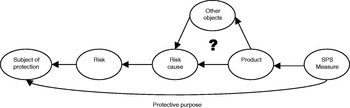
It is unclear which side of the relationship the panel is testing for ‘rationality’. Figure 1 below shows that the concept of SPS measures as construed by Annex A(1) of the SPS Agreement contains several interrelated characteristics to which the panel could potentially refer. According to the Annex, an SPS measure must be applied so as to protect one or more of the enumerated subjects of protection, such as human health, from risks arising from certain causes, such as pests, diseases or additives. It is self-evident that the restricted product need not be identical to the risk-cause that the SPS measure seeks to prevent.Footnote 25 Since SPS measures are applied to protect only from risks arising from specific causes, there must be a hypothetical causal relationship between the product to be imported and at least one of the risk causes listed in Annex A.
Hypothetical causal relationships in SPS measures

According to this logic, the panel uses ‘rational relationship’ to denote the relationship between product and risk-cause implied in Annex A (1). The panel seems to affirm that the hypothetical causal relationship between product and listed risk-cause may also be an indirect one, possibly comprising a longer cause-and-effect chain. In the cross-breed situation, the restricted GM plants are not identical to the pests that generate risks, but the creation of cross-breeds as an intermediary step apparently does not prevent the finding of a ‘rational relationship’ between the GM product and the risk-cause required for an SPS measure. For the panel, it suffices that the restricted products could, via biological interactions, lead to organisms that could in turn be regarded as pests. However, the panel does require some sort of link between restricted products and risk-causes. This minimal hypothetical causality seems to be what the panel specifies as a ‘rational relationship’ (see Figure 1).Footnote 26
The panel gives no guidance, however, as to the precise meaning of the requirement that the relationship be ‘rational’. Is this requirement fulfilled even if the causal link between product and risk-cause is mediated by one or several other objects in a longer causal chain? If so, then almost all trade-related environmental measures could qualify as SPS measures. Any noticeable damage to the environment has numerous side effects on a number of objects or organisms, which at some point can result in diseases, and certainly environmental regulations aim at preventing these. If this is the case, does the SPS Agreement also encompass national security measures that impact trade, such as import and export restrictions for nuclear waste or other environmentally harmful substances? Are regulations which establish safety requirements, such as the use of special containers for hazardous waste SPS measures, because the use of unsafe containers increases the risk of contamination and disease? In other words, how far does the SPS Agreement ultimately reach?
Earlier in the EC–Biotech report, the panel briefly mentioned the problem of an overly expansive reach of the SPS Agreement with respect to coverage of environmental measures. The panel rejected the idea that measures to reduce air pollution could possibly qualify as SPS measures, even if they protected human life and the health of plants.Footnote 27 It argued that the measures would not protect plants from any of the enumerated risk-causes, such as pests or diseases, as required by the SPS Agreement.Footnote 28 With its concept of a ‘rational relationship’, which allows taking into account a sequence of causes and effects, the panel now invalidates its earlier argument. To take up the panel's example, there is no doubt that air pollution accompanied by a mixture of toxic pollutants leads to incalculable effects on organisms and ecosystems. These may well lead to biological interactions that impact the spread of diseases and disease-causing organisms as well as corresponding risks to plant health, and would this satisfy the definition of SPS measures in Annex A. This not so hypothetical example shows how the consideration of biological interactions would allow qualifying many environmental measures as SPS measures.
Annex A definitely does require a hypothetical causal relationship between the product and an enumerated risk-cause, and it does not exclude the possibility that this relationship could also be an indirect one. The crucial question is thus how direct or how close this relationship must be. To allow any indirect link to suffice would greatly expand the scope of the SPS Agreement, and a broad interpretation seems inconsistent with the comprehensive and specific definition of SPS measures in Annex A (1).Footnote 29 Moreover, minimal requirements regarding the causal relationship would render meaningless the specific list of risk-causes in Annex A. The panel gives no further hints as to the precise meaning of a ‘rational relationship’, nor does it determine a proper threshold for finding such a relationship. In order to avoid a proliferation of SPS measures, and as a corollary excessive application of the SPS Agreement, further clarification of the concept of a ‘rational relationship’ is required. The panel's qualification of the EC measures as SPS measures under so many alternatives contained in Annex A is to a considerable extent due to an overly expansive interpretation of this concept.
2. GMO regulations do not constitute ‘classical’ SPS measures
By affirming numerous alternatives in Annex A to qualify the EC measures as SPS measures, the panel seems to take a ‘better safe than sorry’ approach in determining the SPS Agreement applicable. However, the question arises whether a finding, that nearly all alternatives listed in Annex A cover a single measure, truly supports the applicability of the SPS Agreement. Such a finding might also contrarily indicate that the measure in question exceeds the limited scope, and perhaps the limited capacities, of this agreement.
A quick look at previous SPS disputes might shed light on this question. It seems that in some important aspects the contested EC measures differ considerably from measures challenged in previous SPS cases. In Australia–Salmon for example, Canada contested Australia's import restrictions on salmon. Australia claimed that the measures were to prevent about 24 diseases present in Canadian salmon from spreading to the Australian salmon population.Footnote 30 In Japan–Agricultural Products, Japan banned imports of certain plants from the US on grounds that the plants might host a pest that did not exist in Japan.Footnote 31 Most recently, in Japan–Apples, Japan imposed import prohibitions and various requirements on apples imported from the United States, allegedly in order to prevent fire blight disease from entering Japan.Footnote 32 In each case, the importing country justified its action as protection of animals and plants from risk-causes, in these cases pests and diseases, borne by the contested products. The alleged risk-causes in each case were directly and physically related to the restricted products, which were suspected of either hosting pests or carrying disease-causing bacteria. In sum, the risks in the three cases derived from specific, well-known diseases or pests that endangered well-defined objects in the importing country.
In EC–Hormones, the risk situation was slightly different. The EC cited human health risks to prohibit the importation of meat that had been treated with any of six specific growth hormones.Footnote 33 The panel agreed with the parties that hormones were ‘contaminants’ under the SPS Agreement.Footnote 34 In contrast with the Australia–Salmon or Japan cases, the alleged damage from beef hormones was not limited to a specific disease, but consisted in broader effects to the human body. Nevertheless, most factors in EC–Hormones were clear: Hormones as risk-cause, food consumption as the way the risk could materialize, and human beings as the subjects at risk were all clearly identified. If derived from EC–Hormones, Australia–Salmon, and the Japan cases, a typical SPS measure seems to be one that is designed to protect specific subjects from damages or risks that arise from specific causes listed in Annex A of the SPS Agreement.
In contrast, EC–Biotech offered only one clear factor to the panel: the existence of genetic modifications as the potential risk transmitter. It remains unclear if, how, or which risks could materialize, and neither is the nature of the potential damages nor the potentially endangered subjects and objects delimited in any way.Footnote 35 It is indeed because of this difficult situation that the panel finds the EC measures to satisfy nearly all of the Annex's alternatives. By hypothetically affirming nearly all risks enlisted in the Annex, the panel recognizes that the potential risks from GM products are much more diffuse, and therefore more difficult to address, than the risks to which previous cases pertained.
It seems necessary to consider whether the SPS Agreement, the language of which suggests that it has been designed as lex specialis to deal with ‘classical’ SPS measures addressing specific risks for specific subjects of protection, also has the capacity to adequately deal with measures that address unusually diffuse risks for undefined objects. On this point the panel fails to step back from its rather textual and technical examination and appraise the measures in light of the SPS Agreement's general purpose and function within the complex legal framework established by the WTO Agreements.
3. The panel's appraisal of the environment and biological diversity as subjects of protection
The third point of criticism relates to the panel's appraisal of the EC measures' objectives, especially protection of the environment and biodiversity. The EC legislation makes no specific reference to biological diversity, but mentions threats to ‘dynamics of populations of species’ and ‘genetic diversity’ in a list of the potential adverse effects of GMOs that the EC measures seek to prevent.Footnote 36 Environmental concerns – even more than health concerns – are arguably central to the EC–Biotech dispute,Footnote 37 since most of the relevant product-specific measures and all of the national safeguard measures were concerned with the release of biotech plant cultivars into the environment, such as through seed cultivation.Footnote 38 The panel discusses these subjects of protection, but it is questionable whether or not it explores and considers their full meaning. Since the doubts regarding both subjects are similar, it will suffice to explain the more obvious concerns with respect to biodiversity.
In its analysis of Annex A, the panel reasons that GM plants might crowd out or eliminate other plants, which would put at risk the survival of certain plant species and thereby affect genetic diversity.Footnote 39 The panel finds that in this way GM plants would act as pests and harm the life or health of other plants, and that they would thus create risks listed in Annex A (1)(a).Footnote 40 Regardless of the substance of these findings, the panel's logic is dubious. The panel construes Annex A of the SPS Agreement in the context of EC directives instead of analyzing whether the EC measures fall within the scope of the SPS Agreement. With this approach, the panel finds out that in cases where GM plants crowd out other plants they cause harm to the life and health of plants. However, the panel does not answer the crucial questions: What precisely is biodiversity? Does it constitute an independent value beyond the life and health of single plants and animals? Is it covered in its entirety by any of the subjects of protection enumerated in Annex A?
The panel returns to the issue of biodiversity in its analysis of Annex A (1)(d), the alternative covering measures to prevent or limit ‘other damage’. In this context, the panel resorts to various dictionaries to define biological diversity, quoting a definition which refers to diversity ‘within species, between species and of ecosystems’.Footnote 41 Despite having introduced the new aspect of ‘ecosystems’, the panel merely states that damage to biodiversity implies damage to living organisms,Footnote 42 and therefore rejects the view that the term ‘other damage’ can include damage to biodiversity as such.Footnote 43 Instead, the panel holds that damage to biodiversity or living organisms may fall under Annexes A(1)(a) and (b), which refer to the protection of animal and plant life and health.Footnote 44
The panel's conclusion implies that biodiversity is not an independent subject of protection. It rather equates biodiversity with a higher quantity of other values, namely the life and health of animals and plants – subjects of protection which are explicitly covered by Annex A.Footnote 45 One can certainly disaggregate the various objectives of the EC measures into protecting numerous single objects, such as the protection of countless individual plant and animal species, and other open-ended environmental aspects. As a result, the number of potentially threatened subjects of protection would be very high, which even seems to encourage the measures' qualification as SPS measures and thus ensure the applicability of the SPS Agreement. This rather technical approach seems to underlie the panel's qualification of biodiversity as a subject of protection covered by the SPS Agreement.
On the other hand, a more normative approach might produce a different result. An extremely high quantity of very diverse subjects of protection could also indicate the existence of an entirely different and possibly higher value category, or subject of protection, that goes beyond the scope of the SPS Agreement. Biodiversity might constitute such a different value category. It is then highly questionable whether a large number of those single subjects of protection as listed in alternatives (a)–(c) can truly reflect biodiversity as a value in its own right. After all, a normative approach would fit the SPS Agreement's declared objective of positively improving human health, animal health, and the phytosanitary situation in all WTO members, rather than merely minimizing negative trade effects.Footnote 46
One reason why the panel fails to explore the full meaning of biodiversity is that it ignores the normative weight of international agreements and documents regarding the matter. Earlier in its analysis the panel determined that applying the Convention on Biological Diversity or the Biosafety Protocol was not required, since neither document applied to all parties to the dispute.Footnote 47 There is a crucial difference, however, between using international agreements to interpret a WTO Agreement and using agreements as a tool for interpreting national regulations of WTO members. In the former case, there may be good reasons for rejecting international agreements based on Article 31(3)(c) of the Vienna Convention on the Law of Treaties (VCLT).Footnote 48 However, there is no reason to ignore international agreements in the case of a domestic or unilateral measure, especially since the regulating country may have adopted the measure in order to comply with an international agreement. Since genetic diversity is a subject of EC regulations and not part of the language of WTO Agreements, the panel should have looked at international agreements and documents to which the EC or its member states have acceded, such as the Convention on Biological Diversity. This would have allowed for a more comprehensive interpretation and better understanding of the purposes of the EC measures, which is crucial to determine whether the measures fall under the SPS Agreement. To interpret a regulatory measure, referencing an international agreement specific to the matter would certainly have been more relevant and authoritative than referring to a definition from the Concise Oxford Dictionary, on which the panel relied instead.Footnote 49
Would a different interpretive method have produced a different answer regarding the SPS Agreement's coverage of biodiversity? Had the panel recognized biodiversity as a separate subject of protection rather than the sum of other Annex A (1) subjects, then the panel would have had to respect the principle expressio unius est exclusion alterius, or a contrario Footnote 50, for its interpretation of the Annex. Given Annex A's very specific definition of SPS measures and the subjects they seek to protect, the panel would have needed to resort to the term ‘other damage’ in Article A (1)(d).Footnote 51 An interpretation of alternative (d) that would have determined ‘other damage’ to include biodiversity would have encountered the problem that this alternative is limited to threats of ‘pests’.
Finally, the panel would have had to address whether biological diversity can be limited to national boundaries, or whether it constitutes inherently a global value. This issue is problematic with respect to coverage of the SPS Agreement in a twofold way. From a formal point of view, only national measures applied to protect values ‘within the territory’ of the acting state can constitute SPS measures. In contrast, measures that also protect extraterritorial objects or global values are not covered by the SPS Agreement. From a more normative point of view, biological diversity is related to the idea of conservation of species and the protection of biological resources. Parallels to general exception (g) in GATT Article XX, which offers justification for certain measures relating to the protection of exhaustible resources, become thus apparent. The Appellate Body in the Shrimp Turtle dispute found that living species can constitute exhaustible resources in this sense,Footnote 52 and likewise biodiversity, which relates to the conservation of animal and plant species, might be a subject matter covered by general exception (g). As compared to the complex requirements established by the SPS Agreement, the requirements in exception (g) seem to be fulfilled more easily, especially those regarding the means–end relationship, which is defined by the rather weak term ‘relating to’ instead of a ‘necessity’ requirement. Given that the preamble of the SPS Agreement explicitly mentions only the health exception in GATT Article XX (b), the question would arise if the SPS Agreement can possibly be considered lex specialis vis-à-vis GATT Article XX (g) when it comes to measures aiming at the protection of exhaustible resources, or biodiversity for that matter.
Conclusion
The above analysis shows that the EC–Biotech panel's elaborations concerning the applicability of the SPS Agreement – despite 60+pages discussing the matter – lack a comprehensive legal analysis that would go beyond a merely technical and textual approach to the SPS Agreement. The SPS Agreement is an agreement containing special rules for a special subject matter, and therefore it is necessary to carefully analyze if the special objective elements that warrant application of the special rules are truly existent. Moreover, there is yet considerable legal uncertainty as to the content of crucial substantive rules of the SPS Agreement, and there are concerns that these rules may not be entirely adequate for dealing with situations of vague risks and scientific uncertainty.Footnote 53 Therefore, a cautious and normative approach is imperative to determine if the provisions of the SPS Agreement apply to measures concerning biotech products.
One other observation of the EC–Biotech panel relates to the question whether only the SPS Agreement as lex specialis is pertinent to biotech regulations with multiple objectives. The panel stated that a single measure may constitute a SPS measure and a non-SPS measure at the same time.Footnote 54 This implies that if a panel withholds SPS Agreement coverage from just one of several objectives of a measure, it is required to review the same measure under the different standards of other WTO Agreements. Its permissibility would then effectively depend on the requirements laid down in other WTO Agreements and would render immaterial a finding by a panel that a measure is in violation of the SPS Agreement. This is, because the WTO member that enacted the contested measure could comply with such a decision simply by removing the SPS purpose from the language of the measure, while leaving its substance untouched. In that case, the measure would be permissible, because SPS standards would no longer apply. In EC–Biotech, however, this construct did not become relevant because the panel found that each of the contested safeguard measures constituted an SPS measure ‘in its entirety’.Footnote 55 Therefore, there was no room for assessing the measures under the standards of other applicable WTO Agreements. Given the multiple objectives and functions of national regulations of biotech products, however, the ‘two in one’ construct might prove to have far-reaching consequences in future disputes.
The panel's determination that the SPS Agreement applies to measures which regulate biotech products remains highly questionable. The panel faced the difficult task of determining the scope of the SPS Agreement despite a lack of comprehensive case law on the agreement's often ambiguous substantive provisions. Instead of focusing on the purpose and function of the SPS Agreement, the panel couched its rather technical solution in a textual interpretation of terms contained in Annex A. However, determining the scope of an agreement with respect to a highly sensitive subject matter without having properly explored the substance of the rules and their implications for the matter at issue is an approach that satisfies jurisprudential formalities rather than the real concerns of the parties to the dispute. Since the limited terms of reference in EC–Biotech left many important questions unresolved, the importance of this decision might only become apparent in light of future cases. Future WTO adjudicatory bodies might have to rule on the general permissibility of restrictive national regulations of biotech products more than on questions of procedure. These again may concern measures that are possibly non-protectionist and that have been adopted by democratically elected legislators within a legislative process under public deliberation. Such a case would put to the test the SPS Agreement's suitability for adequate substantive review of national biotech measures.
In the absence of the best solution, namely a clarification of ambiguous terms in Annex A by the WTO membership, the WTO tribunals are assigned with the task of statutory interpretation. This responsibility needs to be exercised with due caution, especially if sensitive political matters are involved. It is submitted, that given the ambiguity of the language determining the scope of the SPS Agreement, it should be considered whether in order to determine the correct legal basis for a review, the rule of minimal obligations, also referred to as in dubio mitius, could be of use. This rule would require taking into account the substantive provisions of different alternatively applicable agreements in the course of determining the most appropriate legal basis for a review.
There is no doubt that the public judges the WTO on how it resolves disputes that ultimately affect society's essential problem-solving capacities, especially with respect to the protection of the environment and human lives. In order to promote respect for and confidence in the WTO, the adjudicatory bodies need to make sure that their decisions are based on solid legal grounds. Given that the emergency brake of authoritative interpretations is always available to WTO membership, future panels should consider supplementing a thorough interpretation of crucial terms with a more comprehensive legal analysis without refraining from normative and foresighted considerations.
SPS Agreement Annex A (1)
DEFINITIONSFootnote *
1. Sanitary or phytosanitary measure – Any measure applied:
(a) to protect animal or plant life or health within the territory of the Member from risks arising from the entry, establishment or spread of pests, diseases, disease-carrying organisms or disease-causing organisms;
(b) to protect human or animal life or health within the territory of the Member from risks arising from additives, contaminants, toxins or disease-causing organisms in foods, beverages or feedstuffs;
(c) to protect human life or health within the territory of the Member from risks arising from diseases carried by animals, plants or products thereof, or from the entry, establishment or spread of pests; or
(d) to prevent or limit other damage within the territory of the Member from the entry, establishment or spread of pests.
Sanitary or phytosanitary measures include all relevant laws, decrees, regulations, requirements and procedures including, inter alia, end product criteria; processes and production methods; testing, inspection, certification and approval procedures; quarantine treatments including relevant requirements associated with the transport of animals or plants, or with the materials necessary for their survival during transport; provisions on relevant statistical methods, sampling procedures and methods of risk assessment; and packaging and labelling requirements directly related to food safety.