The 1990s were a contentious period in the study of Japanese politics. Two intertwined debates were at the heart of the ‘discussion’. First, countering a long-held view that power in Japan centered on the country's bureaucracy, newer approaches contended that legislators were powerful. Second, at least as controversial as the substance of the new findings was the way that these conclusions were reached. Traditional perspectives (e.g., Johnson Reference Johnson1982; Pempel Reference Pempel1974) had followed an inductive approach, while the most publicized challenges of the 1990s (Ramseyer and Rosenbluth Reference Ramseyer and Rosenbluth1993) utilized a deductively based rational choice framework. Over time, the intensity of the debates died down, but the effects lingered, and academic discussion of decision making in Japan has focused ever since on the power of bureaucrats and politicians relative to one another.
However, in reality, the rational choice work of the 1990s was hardly new in offering an interpretation that highlighted the activism of rank and file politicians. In the 1980s, a wave of new studies of Japanese politics – especially written in Japanese – contended that a major shift had occurred and that the ruling Liberal Democratic Party's (LDP) rank and file had taken on a much larger role in the policy-making process. This ‘new paradigm’ literature set the stage for the 1990s analysis on politician–bureaucrat relations, and its empirical findings remain the conventional wisdom on Japanese policy-making patterns under the ‘1955 System’ (1955–1993), prior to the coalition government period.
In this paper, we offer a critical reinterpretation of the new paradigm literature. We do not offer new empirical analysis, but, rather, reconsider this conventional wisdom by putting a new spin on the evidence previous authors utilized to analyze the policy-making process in Japan under the 1955 System. We begin by briefly reviewing the new paradigm, focusing on the major interpretive threads that guided the literature. We argue that despite the advances made by the literature, there remains no solid model within which to situate policy making under the 1955 System. We therefore suggest specific guidelines to follow in studying power in the policy-making process and, using a general analytical framework, founded on the degree to which politics were centralized or fragmented, we offer a new interpretation of policy-making power in Japan.
In part, we discuss the new paradigm of the 1980s and the rational choice work of the 1990s in the hopes of bringing methodology back to the table. The 1990s’ debate was unfortunate in that it left many focusing on one methodological issue – the merits of inductive as opposed to deductive analysis – while ignoring other more important ones. We argue that the analysis of the new paradigm in the 1980s utilized research designs that biased the literature's findings. As we argue in this paper, many important conclusions reached by scholars regarding policy making in the postwar period in Japan are a result of generalizing from unique policy areas, an imbalance in the type or amount of information used to compare different periods, not sufficiently taking into account the effects of economic growth on policy-making behavior, and a misdiagnose of policy activity as policy initiative. As a result, many analyses of power and shifts in power were overstatements that gave a biased view of what policy making in Japan in fact looked like.
We also argue that the 1990s debate over the power of bureaucrats and politicians has clouded over too much of what has really been at work in decision making in Japan. Focusing on competition between politicians and bureaucrats creates an impression of two wholly distinct groups, when very often alliances of politicians and bureaucrats battle other alliances of politicians and bureaucrats. At least as important, focusing on the relative power of politicians and bureaucrats under the one-party dominant system ignores a much larger issue: whether a specific group really was ‘in charge’. Given van Wolferen's (1989) assertion that Japan is actually an acephalous society – i.e., one with no head or leader – it remains important to take seriously the question of whether anyone is clearly responsible for decision making in Japan.
We argue that policy making under the 1955 System was the product of centralized and fragmented polic-making processes. Decision making was the product of actions taken by both ‘subarena’ politicians and bureaucratic specialists and general arena ‘heavyweights’, such as party and cabinet heads and leaders of the powerful ministries.
Based on our framework, we arrive at a new set of interpretations of the nature of policy making in Japan under its single party dominant 1955 System (1955–1993). Contrary to the conventional view of strong central bureaucratic power, we argue that in the 1960s policy making was quite fragmented. In contrast to literature suggesting substantial politician influence in the 1980s, we argue that there was a decline in the influence of politicians in general in policy making. Ultimately, then, reconsidering policy making in Japan is important for more than just abstract conceptualizing: it has substantive implications, as it gives us a different perspective on who is exerting policy influence and when changes in power occur.
Literature on decision making in Japan
In studying a country's politics, it is important to ask (1) whether anyone is in charge and, if so, (2) who that somebody is. The first question has to do with the extent to which authority and power are unified and centralized or fragmented and decentralized. In democratic societies, much of the second question usually hinges on the relationship between the key players within the legislature and the bureaucracy.
Both questions have long been central to the study of Japanese politics. For years the prevailing view was that decision making was centralized and dominated by a relatively cohesive ‘power elite’ of the bureaucracy, LDP, and big business, with the bureaucracy generally seen as taking the lead (see, e.g., Johnson Reference Johnson1982; Pempel Reference Pempel1974). In the 1990s, Ramseyer and Rosenbluth (Reference Ramseyer and Rosenbluth1993) attracted attention with their argument – based on rational choice analysis – against this view, explaining that politicians held power and authority in Japan.
But in many ways, this latter view had actually gained favor in the 1980s. The view was the product of clever research by several Japanese political scientists, including Inoguchi Takashi, Muramatsu Michio, Nakano Minoru, Ohtake Hideo, Satô Seisaburô, Sone Yasunori, and Yamaguchi Jirô. It was also reflected in several articles in English by both Japanese and American political scientists.Footnote 1 The Japanese politics field owes a great debt to this research, which combined rich factual detail with sophisticated and nuanced understandings of how politics work. While it is unjust to the diversity and complexity of these individual studies to lump them together, all these authors contributed to an important ‘new paradigm’ of Japanese decision making, which can be summarized as follows.
First, Japanese politics at the time of writing were more pluralistic than previously assumed: more actors participating; more social interests with influence; more points of access to the decision-making system; more variation in style, participation and outcome among policy areas or from case to case. The extent of pluralism fell short of its pure form and thus the system was called ‘patterned’, ‘canalized’, or ‘compartmentalized’ competition or pluralism. But in contrast to earlier power-elite or bureaucratic-domination models, Japanese decision making became seen as quite fragmented.
Second, power shifted from the bureaucrats toward the politicians. As Inoguchi and Iwai explained, ‘Policymaking had operated under bureaucratic domination for so many years, but recently many policy areas have seen an explosive growth of the phenomenon of “party on top, government down [tôkô seitei]” or “party on top, bureaucracy down [tôkô gyôtei]” – the LDP actively participating and exerting strong influence’ (Inoguchi and Iwai Reference Takashi and Tomoaki1987: i).
Many of these writings emphasized zoku: informal but highly institutionalized participation in decision making by LDP Diet members who became experts in various policy areas. It was argued that stronger ties between the party and interest groups ‘fundamentally changed the relative roles and influence of politicians in policymaking . . . [toward] a more equal but specialized relationship between politicians and bureaucrats’ (Muramatsu and Krauss Reference Muramatsu and Krauss1987: 541–542). Some came to see the politicians as ‘hunting dogs’ who fight bureaucrats, rather than cooperative ‘watch dogs’ in the policy-making process (Inoguchi and Iwai Reference Inoguchi1987: 277–281). This new paradigm of the Japanese decision-making system became a near-consensus among academic specialists on the topic, and even began to replace the older images of ‘Japan, Inc’. and the like in more popular accounts.
The new paradigm literature brought a new sense of policy making and power relations in Japan and clearly influenced the work of the 1990s. At the same time, while the new paradigm saw a change in the relative power relations, Ramseyer and Rosenbluth, writing in the early 1990s, saw something different. To Ramseyer and Rosenbluth, who had power did not change from the 1960s to the 1970s, but overt policy-making activity did. Prior to the 1970s, LDP backbench politicians delegated power to their leaders (who in turn assigned discretion to the bureaucracy). With the rise of urbanization in the 1970s and the accompanying perceived need to distribute public goods on a larger scale, LDP leaders cut back on the private goods sought by individual LDP politicians. In response to such moves, Ramseyer and Rosenbluth argue, these backbenchers became substantially more active in policy making, in particular using Policy Affairs Research Council (PARC) mechanisms to bring their constituents private goods.
In short, both the new paradigm and the 1990s rational choice work saw an identical change in behavior, but interpreted the change differently. To Ramseyer and Rosenbluth, power had always been decentralized – in the hands of backbench LDP members – but until the 1970s had been exerted through the centralized party leadership and bureaucracy. To the new paradigm literature, change was more fundamental and real: from a more cohesive to a more fragmented system, and from bureaucratic leadership if not dominance toward a much larger role for the LDP in policy making.
Pempel offers a clear-cut distinction, what he calls the ‘unbundling of Japan, Inc.’: decision making changed ‘dramatically’ in the first years of the 1970s from a ‘relatively clear and smooth running system’ in which ‘the several bureaucratic ministries . . . were the primary locus of policy initiative’. The new system was characterized as ‘policy making by paper clip and bailing wire’, the development of autonomous pockets of power bringing more ‘diversity and division’, and ‘unmistakable signs of a decreasing influence by the national bureaucracy, combined with a rising influence by LDP politicians’ (Pempel Reference Pempel1987: 278–279, 281, 293–294). Several of the new paradigm scholars associate such milestones as the oil shock (1973), the Tanaka Premiership (1972–74), and the advent of new issues like pollution (1970) and welfare (1972) with this transition. For example, Inoguchi and Iwai (1987: 277–278) contrast the first and second halves of the first three decades of LDP rule, which puts the division around 1970, and Yamaguchi (Reference Yamaguchi1989: 150–152) similarly find a sharp change at the end of the 1960s and beginning of the 1970s.
While Ramseyer and Rosenbluth focus on making general statements about power in Japan and noting what they see as a behavioral change in the 1970s, the new paradigm gave substantial attention to politics in the 1980s, seeing that decade as the culmination of the new-paradigm pattern. The new paradigm gave considerable attention to the subgovernment phenomenon, weakness of leadership, and how powerful LDP zoku had become. It is quite understandable that scholars and journalists would highlight the weakness of central leadership vis-à-vis ‘special interests’ and the power of (especially zoku) LDP politicians in the 1980s, since incident after incident revealed these patterns. The result, as pointed out most strongly by ‘revisionists’ like van Wolferen (1989), was policy immobilism.
Thanks to the contributions of the 1980s and since, we have a far more comprehensive and accurate picture of Japanese policy making. Moreover, the emphasis in the literature on analyzing how and when things have changed is more productive than simple attempts to characterize Japanese policy making across the postwar period as a whole.
Nevertheless, with notable exceptions, this literature in general has left us without a clear guiding framework for helping us understand the decision-making process. On one side, much of the literature focused on specific cases that left us with no clear model for understanding decision making. On the other, in general, attempts to create more coherent, overall statements of policy making tended to overemphasize the undifferentiated shape of all policy making and ignore the dynamic and varying nature of decision making.
A framework for understanding policy making under the 1955 System
To begin to develop a more comprehensive understanding of the policy-making process, we introduce a new – albeit simple – framework.
However, before turning to this framework, we should be clear about a critical difference between our analysis and much of what came before. One thing held in common by both the bureaucratic dominance and politician power arguments is the implicit idea that power within Japanese policy making is zero-sum: greater influence by politicians means less power by bureaucrats and vice versa. Such a conception may make sense in many contexts, but it is less applicable to policy making under the 1955 System, which was characterized by decades of single party dominance. As we discuss in greater detail in this paper, in studies of numerous specific policy cases, the norm in Japan was cooperation between politicians and bureaucrats. Indeed, such cooperation makes great sense in the context of one-party dominance, where LDP politicians and ministerial bureaucrats work side by side for many years.
As a result, more recent studies have begun to characterize Japanese politics under the 1955 System as founded on a positive-sum game, in which shared information and expertise between politicians and bureaucrats helped both to achieve their policy-making goals (Kato Reference Kato1994, Reference Kato2002; Muramatsu and Scheiner Reference Muramatsu and Scheiner2006). In such a world, it makes less sense to determine whether politicians or bureaucrats were more powerful. However, once we include both politicians and bureaucrats as central to our analysis, we confront a context in which many groups may be involved in the policy process. In such a context, it is important to determine how power works: In particular, is power centrally concentrated or fragmented with many different groups weighing in on most policies?
The framework we offer here looks at policy making through this lens. In developing such a framework, we need some theoretical distinctions – that is, ways of deciphering between who is in fact exerting power and what types of power they are exerting.
First, how can we tell whether government is centralized or fragmented, and which actors are playing the biggest roles? The most reliable method is to concentrate on policy change. It is when new public policies are started, or old ones ended or altered – or at least change is being considered – that we can observe who is participating in decision making and what interests are being served (Dahl Reference Dahl1966).
Second, we need to distinguish between agenda-setting and enactment. It is not enough to know who wins, or even who is participating, once some policy change is already being debated. How did the issue come up in the first place, and why that issue rather than another? In particular, it is important to identify the actor who first raised it.
Third, looking at the process alone is not enough. We must also examine the substance of policy changes, from when they are proposed through to enactment (and sometimes before and after those stages). Among policy makers, whose interests are served by the proposal, and by its subsequent modifications? Whose interests would be damaged? We cannot understand the game without being able to see who is on the offense and on the defense.
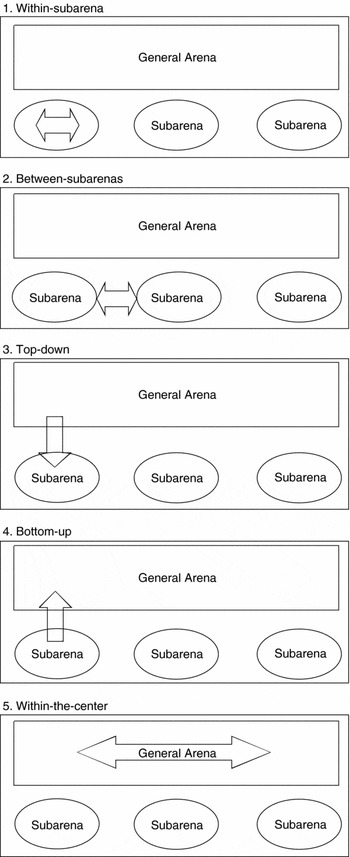
Fourth, in order to generalize, we need a fairly simple framework for describing power relations. We suggest the following. Imagine a decision-making system of two levels: above, a single ‘general arena’ populated by ‘heavyweight’ actors who pay attention to a relatively broad array of issues; below, a multiplicity of ‘subarenas’, populated by ‘specialized’ actors who mostly pay attention to a single policy area. Routine government activities and most policy changes are handled within the boundaries of the specialized arenas, while big policy changes (expensive or controversial) and those that overlap the jurisdictional boundaries of more than one subarena may be dealt with in the general arena.
In Japan at least, subarenas are usually defined by the jurisdictional boundaries of government agencies, with perhaps three or four per ministry. They are populated by bureaucrats, zoku-type politicians and PARC division members, interest-group representatives, and sometimes academic experts and reporters who specialize in that policy area. These actors work together frequently, and, although they may often disagree and even fight, they usually develop a common outlook on what problems are important and what policy solutions are plausible in their policy area. When they are relatively cohesive, these actors can be called ‘subgovernments’.
The general arena is more amorphous and may have several active participants: the prime minister (PM), other powerful politicians in the government parties, the Ministry of Finance (because of its budget authority), broad-scale interest groups such as big business, and even opposition parties. The LDP rank and file might be a participant if acting as a cohesive unit when its interests are engaged (e.g. regarding proposals to raise taxes or cut public-works spending). ‘Public opinion’ and the mass media can also be actors, and specialized-level actors (or even an entire subarena acting as a cohesive subgovernment) participate as well when their issues are on the general arena agenda.
With this framework, we can identify five types of policy-change processes, as depicted in Figure 1.
1 Within-subarena: Interactions among specialized bureaucrats, politicians, and interest group representatives with little influence from outside forces.
2 Between-subarenas: Two or more specialized subgovernments contend with one another over policy.
3 Bottom–up: A subgovernment putting an item on the general arena agenda, seeking endorsement for its policy preferences.
4 Top–down: General arena actors attempting to control the agenda of one or more subarenas.
5 Within-the-center: Struggles among the heavyweight actors to define central policy.
Modes of Policy Conflict

When most of the significant policy change is Type 4 or 5, the decision-making system is centralized. When Type 1, clearly it is fragmented. Types 2 and 3 are in-between cases. Intersubgovernmental conflict often brings participation by upper-level actors, if only as mediators, and in ‘bottom–up’ processes, heavyweights can interject their preferences by withholding approval, but in both cases the problems are defined at the lower level and reflect subarena thinking. There will always be a mix, but, in general, assertions about trends along the fragmentation-centralization dimension must rest mainly on changes in the proportions among these five types.
Naturally, the existence of one type of policy making in an area does not preclude a different type in another area. For example, the question of whether the PM and LDP leaders are becoming active and influential in setting general policy (Type 5) is not directly related to the question of whether zoku are gaining influence in particular subarenas or whether the proportion of subarenas in which politicians are active is increasing (Type 1). Moreover, an increase in policy activity by zoku may not be caused by their becoming more powerful, but simply reflect an increase in the quantity of policy conflicts where they tend to play the biggest role.Footnote 2 These are generally either intersubarena conflict (Type 2), where the weakness of intrabureaucratic conflict-resolution mechanisms may throw an issue into the LDP structure, or top–down initiatives (Type 4), which threaten interest groups that are close to the LDP.
Applying the framework: patterns of policy change under one-party LDP rule
We apply our framework to the 1955–1993 period of LDP dominance in Japan. Based on this framework, and taking into account factors that biased the conclusions of previous work, we offer new interpretations of Japanese governmental decision making. While the conventional wisdom holds that the 1960s were a period of centralized, bureaucracy-dominated policy making, we see a relatively pluralistic system in which rank and file politicians played a critical role. Whereas much work on the 1980s describes a pluralistic, politician-activist system, we find a more centralized process, where rank and file politician power was not in initiation of policy, but in their ability to defend against the activist policy-making attempts of others.
The postwar era divides fairly neatly into decades, punctuated by important transitions.
1950s
The 1950s were confused, as might be expected given the emergence from the American occupation and the creation of the LDP in 1955. However, far from being a period of purely bureaucratic dominance, we see policy making where, at the top, leading politicians wrangled over foreign and economic policy at the most fundamental level, a process later characterized as the emergence of the ‘conservative main line’ (Type 5). This was most keenly felt in 1959–1960 during the battle between the LDP and Socialists over the US–Japan Security Treaty. However, at lower levels, bureaucrats dominated much specialized decision making (Type 1), particularly when the agency with jurisdiction had come through the occupation unscathed. This was clearly the case in detailed economic policy making.
There was also much top–down (Type 4) intervention by heavyweight politicians. The conservative leadership had its own substantial policy agenda: the roll back of occupation reforms that were seen as too democratic. Several large interest groups successfully applied pressure via both rank and file Diet members and individual leaders. And a simple concern for votes brought some important policy initiatives, notably PM Kishi's promise of health insurance and pensions for all before the May 1958 election (Calder Reference Calder1988).
In short, many policy changes enacted or considered came from the general arena rather than subarenas, and reflected politicians’ interests rather than bureaucrats’, indicating a high level of policy activity among the most powerful conservative politicians. PMs were unusually forceful by Japanese standards, and faction leaders appeared more prone to fight about policy than was later the case.
1960s and 1970s
The conventional wisdom holds that a sharp transition took place in Japanese policy making in the 1970s. The perception is that there was a change away from a centralized, bureaucracy–activist system in the 1960s to a more fragmented, politician–activist system in the 1970s. However, we find that there was far more continuity from the 1960s to the 1970s than has usually been argued, in large part because the decision-making process was already quite fragmented in the 1960s. Indeed, it was the 1960s that were marked by a sharp transition.
In the 1960s, fewer policy initiatives came from the top. As a deliberate political strategy, PM Ikeda halted the reverse course; factional strife and its tendency to create policy conflict died down; and the LDP, less worried about its public support, was not as susceptible to big interest group demands or the temptation to buy votes with policy. The income-doubling plan was mainly an macroeconomic policy, relying on expansionary fiscal policy and the culture of growth to encourage private industry, rather than requiring detailed intervention into specialized policy making by the PM or other central actors.
Most policy change was initiated at lower levels: taking place within subarenas (Type 1), squabbles across subarena boundaries (Type 2), and subgovernments appealing to heavyweight actors for approval of some large policy change (Type 3). Types 2 and 3 processes were quite significant in policy terms, but did not provoke much controversy because most conflicts could be solved by additional spending. Admittedly, bitter fights broke out in non-financial areas, such as the running battle between the Ministry of International Trade and Industry (MITI) and the Welfare Ministry over environmental policy (Type 2) (McKean Reference McKean1977). However, in the more common pattern, duplications of programs in two or more ministries were permitted, and the Finance Ministry approved many enormous subarena budget requests.
A high proportion of policy-change decisions were thus left up to the subarenas (Type 1). Certainly bureaucratic agencies took the lead in many instances, but the major structural change was the increased role of rank and file LDP Diet members in the relevant PARC divisions and other organs, plus less formal zoku.Footnote 3 Their new aggressiveness was well established by the mid-1960s and was due to increased policy sophistication and the availability of money.
Campbell's (1976) research on budgetary politics, based on interviews and newspaper articles on the yearly budget process back to 1954, provides substantial evidence that the decision-making system of the 1960s was not wholly unified and dominated by bureaucrats. Campbell (1976: 37–42) demonstrates that decision making was fragmented into a pattern of ‘subgovernments’ made up of agencies, specialized LDP politicians, and interest groups – sometimes in alliance, sometimes with much internal division. Partly because of weak coordination mechanisms and leadership, conflicts between subgovernments appeared difficult to resolve. While bureaucrats may have held the upper hand in the mid-1950s in many subgovernments, rank and file politician influence gained rapidly, due to the bureaucrats’ need for support and the politicians’ own increased policy expertise (Campbell Reference Campbell1976: 115–134).
Increased rank and file LDP power meant a decline in the ability of the center – in this case, the Ministry of Finance (MOF) – to control the budget even when backed by the PM. Muramatsu and Krauss (Reference Muramatsu and Krauss1984) date the beginning of the trend toward LDP power in budgeting to 1968, and Yamaguchi emphasizes the end of the balanced budget in 1965, but already in 1961 a typical observation was: ‘the ‘budget-compilation authority’ is clearly vested in the government by the Finance Law, but this year for the first time the lead in budget compilations from start to finish has been taken by the LDP’ (Asahi Shinbun [evening edition], 19 January 1961). The MOF continued to lose ground throughout the decade, and when it tried to halt rising expenditures by launching the ‘Break Fiscal Rigidification Campaign’ in 1967, it did so by in effect handing nearly all decisions on particular programs over to the subgovernments and the LDP in a vain attempt to reassert its authority over fiscal policy (Campbell Reference Campbell1976: 241–248, 270–271). Only in 1974 did the MOF make much of a comeback (Campbell Reference Campbell1976: 257–262).
Budgeting is of course only one of several types of decision making, but the bulk of Japanese domestic policymaking, including the main negotiations over initiation of new programs or a major expansion, actually took place in the budget arena in this period (Itô Reference Itô1968). Many of the thorniest public policy problems facing the Japanese government in the 1960s were the direct result of LDP–interest group alliances exerting their power through budgeting. Notable examples were the ‘three K's’, high and rapidly growing expenditures on kome (rice subsidies), Kokutetsu (the national railroad), and Kenpo (health insurance) – all apparent by the mid-1960s, and all areas where rank and file LDP politicians clearly were more influential than the centralized power of the Agriculture, Transportation and Welfare Ministries, which held formal jurisdiction.
It seems unlikely that things were that different in most other areas. There are many anecdotes from the early period that demonstrate both fragmentation and rank and file politician power. For example, the process leading to the enactment of the National Pension in 1959 was almost chaotic, and was dominated by rank and file LDP politicians rather than bureaucrats despite the law's many difficult technical aspects (Itô Reference Itô1980: 272–316), thereby suggesting the pattern of politician involvement to be even more likely in less technical areas. Another example is labor policy change (particularly the issue of public employee unions) researched in 1965–67 by Harari, which concludes that ‘the findings of this case study are congruent with the findings of other recent studies of the dominant role of the Liberal Democratic party in the policy making process’ (Reference Harari1973: 177).Footnote 4 The cases described in Pempel's Reference Pempel1977 edited volume on policy making – most of which took place prior to 1970 – include many examples of highly fragmented or compartmentalized decision making.
The picture of relatively consensual and bureaucracy-dominated decision making in the 1960s does accord with many general assessments made at the time, but these images are contradicted by most specific studies of policy making carried out in those years. For example, based mainly on interviews in 1964–66, Thayer explains that ‘no bureaucrat who hopes to have ministry ideas translated into law will fail to touch base early and often with the party organs’ (Reference Thayer1969: 226). And, as Fukui describes, 1970s studies of Japan's policy-making process drew ‘a picture of Japanese policymaking characterized by fluidity, complexity and variability, rather than by the regularity, stability, and constancy’ (Reference Fukui and Pempel1977: 47).
To be sure, there was change in the 1970s. The early 1970s brought a surge in bottom–up pressure (Type 3) in at least two areas. In environmental policy, the combination of media attention and progressive local government activism tipped the balance against MITI and business interests. PM Satô, recognizing this trend, played the key behind-the-scenes role in breaking the old intersubgovernment stalemate and facilitated the burst of highly detailed legislation produced by environmental specialists in 1970 (Imamura Reference Imamura and Kiyoaki1976: 183–187). In social policy, the enormous pension expansion of 1972 stemmed mainly from a new interest among the general public, which energized the subgovernment (the Welfare Ministry's Pension Bureau, the unions and Nikkeiren) and brought a positive response from PM Tanaka Kakuei (Campbell 1992).
There was major policy conflict among heavyweights in the 1970s, but for the most part it actually served to fragment policy making. Tanaka's campaign for the LDP presidency was based on an explicit big-government platform, centering on his ‘restructuring the archipelago’ plan for which huge sums of public works money were required. It was popular with the public and rank and file LDP Diet members, and helped Tanaka vanquish rival candidate Fukuda Takeo and the Ministry of Finance. However, although the restructuring plan looked like a comprehensive top–down policy (Type 4), its effect was mainly pork-barrel. It liberated the bureaucrats, politicians, and interest groups in all the construction-oriented subarenas to make ever-more extravagant and particularistic demands.
The drop in economic and tax revenue growth associated with the 1973 oil shock deflated all this expansionary exuberance, but it mattered less than one might expect for decision making. What should have happened in an ideal world was more and better top–down policy, establishing priorities and limiting or redirecting at least some subarena-level programs (Type 4). Many government and private reports urged such action, and the Ministry of Finance tried to intervene in the worst cases, but for the most part the subgovernments were already strong enough to rebuff such efforts. The fact that PMs and other high-level politicians were so absorbed in factional battles and growing opposition party strength inhibited much Type 5 attention to policy problems, preventing in particular any active support for policy interventions that might be unpopular with lower-level LDP Diet members.
As a result, with the exception of the 1974 budget process, Type 1 decision making within specialized arenas proceeded without much reference to general arena preferences or the implications of slower economic growth. Even Type 3 requests by subgovernments for programs and more money were often granted. Budget expenditures rose at nearly the rate of the 1960s, with relatively equal shares of the budget maintained across the board.
Certainly, the new-paradigm pattern of subarena autonomy, weak leadership, and LDP rank and file power was at its height in the late 1970s,Footnote 5 but the general pattern of decentralized policy making, based on substantial fragmentation and rank and file politician power had been established in the previous decade. Why was there this over-perception of change from the 1960s to 1970s?
First, the new paradigm was based on more intensive scrutiny of the decision-making process than had previously been carried out. Satô and Matsuzaki's data on LDP organs and individual Diet members; Inoguchi's dissection of each policy zoku; Muramatsu's systematic interview surveys of bureaucrats, politicians, and interest-group representatives; Ohtake's detailed case studies – all represent a high-point of sophisticated political science research in Japan, and produced information of far greater depth and breadth than is available for earlier periods. This imbalance can produce inferences about change that are plausible but impossible to demonstrate. For example, in their excellent analysis of ‘patterned pluralism’, Muramatsu and Krauss (Reference Muramatsu and Krauss1987) are on safe ground in citing survey data from the late 1970s, but lacking equivalent surveys from the past, their assertions about change rest mainly on others’ somewhat tenuous generalizations about how things used to work.
Second, the extent to which Japanese policy making was governed by consensus in the pre-1970 period has often been exaggerated, in large part because of an overemphasis on a particular policy area. It is easy to perceive the goal of economic catching-up as overwhelming, and to infer that the field of industrial policy was the dominant concern of the Japanese government. It is true, as Johnson (Reference Johnson1982) has shown, that industrial policy decision making was bureaucratic-dominated in the sense that LDP politicians did not play a major role, and monetary policy was similarly dominated by the MOF and Bank of Japan (Amyx Reference Amyx2004; Vogel Reference Vogel1996). Nevertheless, from the viewpoint of contemporary participants, industrial policy was just one atypical sector of government attention. Decisions were made and policy change occurred in many fields in the late 1950s and the 1960s – land-use planning, compulsory and higher education, medical care, farm incomes, labor relations, development of the transportation network, environmental regulation, pensions, small-business promotion, and so forth.
The first point to make about these diverse policy areas is simply that they were so diverse. Different actors participated in each; no actor (except perhaps the Finance Ministry's Budget Bureau) substantially participated in all; and the degrees of conflict and styles of decision making were quite different. Second, individual LDP politicians were more active and influential in most of these areas than in, say, industrial policy (though again it was different LDP politicians in each). Third, policy in these areas was not typically aimed at promoting economic growth. Mostly it served other, more pluralistic goals, in particular including compensation for those not sharing the benefits of growth.
Decision making in the 1960s was in large measure an effect of rapid growth. It was because so much tax revenue was generated that all this policy activity could be fragmented and compartmentalized without much open conflict. For example, budgeting in this period was extraordinarily ‘balanced’, with proportional allocations of growth among policy areas regardless of differences in need or priority, thereby avoiding conflict (Campbell Reference Campbell1976).
To summarize, work on Japanese decision making underestimated the extent of fragmentation and rank and file politician influence prior to 1970. The obscuring of much implicit conflict within and among subgovernments by the effects of economic growth, the disproportionate attention to the industrial policy subgovernment in which politicians were not active, and the imbalance in the quantity of research on decision making between the 1960s and 1970s all contribute to a somewhat distorted picture of decision making in the 1960s as essentially unified, consensual, and bureaucratically dominated.Footnote 6
1980s
The new paradigm came to the fore in the early 1980s, and saw the decade as the culmination of the new paradigm pattern: a long-term linear trend that brought about pluralism and decentralization on the one hand and more power for politicians over bureaucrats on the other. Many focused on the ‘subgovernment’ phenomenon and the decentralization of power. At the same time, some of the writers of the period also emphasized what would seem to be an opposite trend, toward strong and active leadership and ‘comprehensive’ rather than fragmented policy initiatives.Footnote 7 As we discuss below, these trends are not contradictory, but in fact fit neatly together. It is precisely because of the increased central agenda setting, which forced zoku politicians to go on the ‘active defensive’, that other analyses perceive a more pluralistic, politician-active system during the decade.
Clearly inhibited by resource scarcity and the anti-big-government mood of the times, bottom–up (Type 3) initiatives from subgovernments seeking general arena approval diminished greatly in the 1980s, but the level of activity in the other four types of policy making grew, and, therefore, the pace of overall policy change increased. Three factors in the early 1980s produced a countertrend toward stronger central leadership and a corresponding weakening of the subgovernments and the LDP. Deficits and the fear of corporate tax hikes activated big business and the MOF, which pushed for spending restraint. Japanese export strength and its own economic weakness activated the United States, which pushed a variety of trade issues (and defense initiatives). Issues of economic austerity and handling international pressure were both centralizing. And Nakasone Yasuhiro, and his presidential leadership style, rose to power. As a result, heavyweight actors behaved like active policy makers (Type 5) in forming relatively effective coalitions. These coalitions dominated the policy agenda for subarenas more extensively and consistently than at any time since the 1950s (Type 4). MOF-imposed ceilings on budget requests were as important as specific policy initiatives from the top. The ceilings specified size but not content, leaving it up to the specialized bureaucrats, politicians, and interest groups in each subarena to renegotiate long-established bargains. The pace of ‘within-subarena’ (Type 1) policy change accelerated sharply. With competition over resources, there was also an increase in disputes between subarenas (Type 2), and therefore more zoku activity, since it is in jurisdictional battles that the LDP champions of subgovernments become most conspicuous.
Critical to our new interpretation is a focus on policy change, the distinction between agenda-setting and enactment, and the importance of whose ‘interests’ are at stake in any given issue. Paradoxically enough, the main reason for the new attention on policy making in the 1980s was a trend toward centralization, or rather of attempts to impose more centralized and ‘comprehensive’ policies on the entire government – that is, more ‘top–down’ agenda setting. What was new in the 1980s was more, rather than less, top–down leadership. As Pempel observes, the conflict between attempts to impose comprehensive policies across the entire government and resistance from well-established pockets of autonomous power was ‘the overarching tension affecting public policy formation in Japan’ (Pempel Reference Pempel1987: 295).
Compared to earlier periods, there was more Type 5 decision making, heavyweight actors talking seriously about large-scale policy change, and more top–down (Type 4) decision making, as proposals – mostly about fiscal and administrative reform, and trade liberalization – affected interests throughout the governmental system. Subarenas were energized by the intrusion of general arena actors. When the specialized bureaucrats, politicians, and interest groups reacted and tried to fight back against these proposals, they naturally attracted press attention.
It is because subgovernments came under attack that their power became obvious. To be sure, attempts to make comprehensive policy failed often enough to indicate that subgovernments were often capable of defending themselves against attacks from the center. But any success for comprehensive policy making indicates, at the level of the overall governmental system, a stronger central structure relative to the power of the peripheral subgovernments. Despite the attention they received, the subgovernments were therefore less powerful relative to the center than they were in the 1960s and 1970s.
Schoppa's (Reference Schoppa1991) case study of education zoku in the 1980s is illustrative. Similar to many new paradigm authors, Schoppa argues that, in the 1980s, the active presence of zoku made it more difficult for the LDP to coordinate its policies, and offers the example of the education zoku defeating PM Nakasone's education reform plan. However, a number of points in Schoppa's analysis are consistent with our discussion. The education reform plan had been initiated by the center, not the LDP rank and file. Education reform was simply one of an increasing number of issues that threatened rank and file politicians’ interests and created the appearance of greater activism on their part. There were more areas under contention, and of course the zoku were likely to win some of them. Education reform was one that the sectional interests won – but Schoppa (1991: 106) himself agrees that Nakasone won a number of these sorts of battles. Indeed, even in the case of education reform, the PM's office was able to impose budgetary restrictions on the Ministry of Education (MOE) (top–down, Type 4 policy making). Our proposition that the LDP rank and file politicians lost power in a relative sense is based on a similar logic. The rank and file participated in more policy changes, simply because there were more policy changes in the 1980s.
Moreover, to the extent that ‘between-subgovernments’ (Type 2) policy conflict increased disproportionately, party organs naturally became more prominent. It had long been true in Japan that subgovernmental disputes were more easily worked out through intraparty processes than inside the bureaucracy, which lacked any effective mechanism for resolving conflicts of interest among ministries (Campbell Reference Campbell, Krauss, Rohlen and Steinhoff1984a). Within the LDP, these processes include maneuverings among the divisions and special committees of PARC, power battles between the zoku attached to each ministry, and mediation by senior ‘policy-type’ (seisaku-tsû) Diet members. So an increase in Type 2 decision making automatically meant that LDP Diet members would be more active and prominent than earlier, but not necessarily more powerful relative to other actors. That judgment requires seeing who wins or, still more fundamentally, what the fight is about.
Most zoku participation in policy change during the 1980s was defensive, attempting to preserve as much of the status quo as possible. Much was in response to attacks from above (Type 4), although sometimes specialized politicians defended their turf against intrusion from another subgovernment (Type 2). Yet another common pattern was spontaneous resistance from the LDP rank and file, reflecting constituency interests (election districts or pressure groups) against some proposal from above.
Welfare-related policy areas in the 1980s provide numerous examples of central, bureaucracy-led policy planning and success in the face of rank and file politician opposition. Inoguchi and Iwai (1987: 194–198) argue that welfare was the area of strongest zoku influence over policy. Nevertheless, in the 1980s, the Ministry of Health and Welfare (MHW) played an active role in the process and regularly got its way. The MHW and the Administrative Reform Committee (Rinchô, ARC) pushed major policy changes in health care and pensions, aimed largely at restraining current and future spending (Campbell Reference Campbell1984b); in particular, the MHW pushed every one of the major reforms and in many cases had been doing so since the late 1970s. The reforms expanded MHW control over health care at the expense of the employment-related health insurance institutions and the Japan Medical Association, which in the past had used their ties to the LDP to advance their interests. The 1985 pension reform was similar (Campbell Reference Campbell1990).
Social policy may be an extreme case, but, in general, looking at process, government ministries were among the more active participants in agenda setting, and looking at substance, many of the proposals discussed and even enacted were in line with the preferences of at least some government officials, including those in the spending ministries. Another example is foreign affairs. While generally stressing the presence of increased pluralism and party power vis-à-vis the Ministry of Foreign Affairs (MFA) in the 1980s, Fukui (Reference Fukui1987b) also observes that during that period the MFA had ‘gotten its way on most issues taken up in the Diet’ (371), and the MFA's coordinator role was ‘maintained and even strengthened in some respects’ (376). Similar to the MHW examples, in both the MFA cases an important factor was greater effort and skill in politicking by the bureaucrats.
The choice of issues areas that get pursued can also tell us something about who is exerting influence. Naturally, several problems were thrust on to the government's agenda almost directly from the environment. Economic fluctuations and pressures from abroad were simultaneously recognized by all participants as requiring some sort of response. This path to the agenda does not tell us much about who within the Japanese decision-making system is dominating the agenda. These aside, a plausible listing of the issues on the top-level policy agenda would include: multiple attempts to enact a valued-added tax, taxing small savings accounts, ‘liberalization’ of education, the expansion of Japanese defense, election reform, trade and financial liberalization, a host of initiatives associated with administrative reform, social welfare constraints through reforms in health insurance and pensions, the privatization of public corporations – especially the national railroads – and liberalizing trade under American pressure.
Who put these issues on the agenda? What interests did they serve? The majority party is in fact an unlikely candidate. From its creation through the 1980s, LDP pressure on public policy – whether manifested by the party rank and file, zoku, PARC divisions, or (to a lesser extent) the party leadership representing the membership – had been in the opposite direction. The balance of LDP opinion generally favored lowering taxes, protecting tax-free savings accounts, leaving education much as it is (perhaps with a little more ideology), spending below 1% of GNP on defense, more spending in general and in particular for agriculture, public works and subsidies, higher benefits and lower burdens in welfare programs, and protecting money-losing local railroad lines. While each of these policy areas had its own complexities, these simple propositions generally represented the weight of LDP influence over the years. Nearly all the policy changes discussed in the 1980s thus ran against traditional LDP preferences. Moreover, an examination of the political process would reveal that the LDP as an organization was not responsible for pushing any of these proposals for policy change on to the agenda.
Did the politicians then suddenly change their minds? Some did, mainly in response to the new economic environment of the 1980s, or to appeal to more urban elements of the electorate. Others found it possible to voice doubts about, say, the merits of the welfare state, on which they had felt inhibited in the early 1970s. Such attitudes among politicians were important in gaining acceptance by the party of some of these policy initiatives. Yet, this was hardly the case for all of the issues. Moreover, it is hard to see much change in real political action: the LDP was not responsible for pushing any of these proposals for policy change on to the agenda. In fact, in most cases it resisted.
Our interpretation diverges not only from the new paradigm's analysis, but Ramseyer and Rosenbluth's (1993) as well. Applying Ramseyer and Rosenbluth's analysis would suggest that the reason for the policy-making shape of the 1980s that we describe here was that the backbenchers realized a need to delegate power to the leadership and bureaucracy. However, unlike Ramseyer and Rosenbluth, our explanation of change does not suggest shifting demographics, but instead posits the greater assertion of central power (even if backbenchers were attempting to reject the center's efforts). If the backbenchers were delegating authority to the leadership and bureaucracy in the 1980s, why would the leadership and bureaucracy raise issues (only to be defeated) that the backbenchers do not want (and then defeat)?
We argue that it was not so much greater rank and file politician power, but quite the opposite. It is because so many issues that threatened LDP interests were being considered that rank and file politicians appeared so active in decision making. The fact that they were in many battles, and won some by preventing or watering down reforms, certainly does indicate the presence of rank and file politician power. But the fact that they also lost many – or, more significant, that they were always on the defensive – indicates that LDP politicians may have actually been weaker as initiators of policy than they had been in years. After all, in the past, several policy changes had been put on the agenda and enacted primarily as a result of pressure from party politicians: many of the ‘reverse-course’ initiatives of the 1950s, the party's key role within the establishment in pushing for welfare expansions in the early 1970s, and innumerable budget grabs. It is noteworthy that there were almost no such cases in the 1980s.
Who then were the sponsors of these policy changes? For one, the PM. Nakasone was almost solely responsible for the controversies over educational reform and higher defense spending, and was a prime mover of Administrative Reform. The PM is of course from the LDP, but, in general, party leadership is but one of the roles for chief executives. Although PMs may act as representatives of their party, most often Japanese (and many other countries’) chief executives are better seen as actors in their own right. Another initiator of these policy changes was big business. The Administrative Reform campaign, with Keidanren playing such a major role, was the most systematic and comprehensive business intrusion into domestic policy making in many years. Much of the impetus for the campaign stemmed from business fears of higher taxes, and the content of many specific reforms, such as deregulation and the privatization of NTT, mainly reflected long-held business views (Campbell Reference Campbell1985). A third ‘sponsor’ was international actors. On many occasions the United States functioned virtually as a participant in the Japanese system, particularly as an initiator of contentious issues.Footnote 8 A fourth initiator, with regard to political morality, was a combination of the mass media and opposition parties.
Also, more often than has been recognized, the leading Japanese bureaucratic ministries played a major role in setting the policy agenda of the 1980s. The obvious case is the Ministry of Finance: the themes of the Administrative Reform campaign, other than big-business initiatives, were almost entirely long-held MOF objectives, virtually a replay of its abortive ‘Break Fiscal Rigidification Campaign’ of 1967 (Campbell Reference Campbell1976: 241–248). For example, the Administrative Reform Committee prominently attacked the ‘Three Ks’ (kome, Kenpô, Kokutetsu), which since the 1960s had symbolized the MOF's consistent inability to overcome rank and file politician support for high spending on rice subsidies, doctors’ fees under health insurance, and wasteful railroads. Centralized Type 5 and especially top–down Type 4 decision making were predominant as central bureaucrats and LDP leadership increased the liberalization of agriculture.
Types 4 and 5 policy making was also very clearly at work in tax reform, as is clear from the authoritative analyis by Kato (Reference Kato1994). For some time, tax reform was cited as a demonstration of party power because the various proposals were substantially worked over in PARC's Tax System Research Commission (Kishiro Reference Kishiro1985). But its main provisions – particularly the Value Added Tax and taxation of small savings accounts – had been top policy priorities of the MOF since the 1970s. Both had earlier failed mainly because of LDP rank and file opposition (also cf. Yamaguchi 1989: 238–258). The bill was turned over to the LDP precisely in order to get the politicians on board early and minimize their resistance. Withdrawal of the tax bill in the Nakasone cabinet was a disastrous defeat for the Finance Ministry and PM, and a victory for the rank and file of the LDP, which as usual was representing constituency desires. However, the fact that the issue was being discussed at all demonstrates that control of the policy agenda was in other hands. Moreover, in the end, the bill passed, Kato (Reference Kato1994) argues, largely through the efforts of MOF bureaucrats who attracted rank and file politicians to their cause by providing them with the expertise necessary to wield influence within the Diet.
What of the other ministries? The Administrative Reform campaign was aimed at big government, especially the allegedly bloated bureaucracy. Muramatsu's formulation is that Administrative Reform was an attempt at comprehensive policy change aimed at the ‘periphery’ of ministries, which mainly represented special interests (and spent money). Certainly many aspects of the campaign, including the tight ceilings on budget requests, cutbacks in administrative perquisites, and program reductions, did cause considerable pain to bureaucrats in the spending ministries. But it is notable that officials and ex-officials from the same affected ministries were prominent in writing most specific recommendations, and, in fact, more than a few of the policy proposals floating about during Administrative Reform actually were cherished goals of various central ministries.
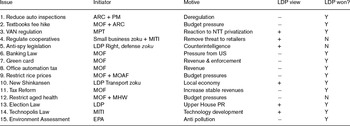
We can also offer a somewhat more systematic analysis to all of this by drawing on a set of brief case studies assembled by scholars attempting to demonstrate increased LDP rank and file power. Inoguchi and Iwai (1984 and 1987) and Muramatsu and Krauss (Reference Muramatsu and Krauss1987) present a number of cases that are intended to indicate greater LDP rank and file politician power. The list is not intended to be comprehensive. Rather, we use them because, as part of an effort to demonstrate increasing politician power, they can be used as ‘critical’ cases. If decision making in Japan in the 1980s was fragmented and led by rank and file LDP politicians, it surely would have been so in these cases.
Table 1 lists the cases and illustrates our point: The LDP may win many battles, but it initiates few of the issues. Looking at Table 1, the LDP's relative weakness as an agenda-setter becomes clear. In only five cases was the LDP (or a group within it) either the sole or a joint initiator or sponsor of a policy change, bringing the issue to the agenda. Moreover, although here the evidence can be a bit tricky to interpret, in just six cases (the + signs) did the balance of opinion in the LDP favor the policy change (as opposed to the status quo). Ultimately, in 12 of the 15 cases the view preferred by the LDP prevailed. However, this last point is far from impressive given these cases were not selected randomly, but were picked as illustrations of increased LDP rank and file politician power.
Who put the issues on the agenda?

Abbreviations: ARC – Administrative Reform Commission, EPA – Environmental Protection Agency, LDP – Liberal Democratic Party, MHW – Ministry of Health and Welfare, MITI – Ministry of International Trade and Industry, MOAF – Ministry of Agriculture and Forestry, MOF – Ministry of Finance, MPT – Ministry of Post and Telecommunication, PM – Prime Minister, PR – Proportional Representation, VAN – Value Added Network.
Notes: For ‘LDP position on the policy’, + indicates that the LDP membership tended to favor the policy being pushed and – indicates that it tended to oppose the policy change. For ‘LDP position prevailed?’ Y indicates that the position favored by the LDP prevailed and N indicates that it lost.
Sources: Inoguchi and Iwai (1987, 11 cases, & 1984, 3 cases), and Muramatsu and Krauss (1987, 1 case).
In short, we are struck by the purposeful role played by what Muramatsu (Reference Muramatsu1987) calls the ‘central structure’, a new alliance of the PM plus a few hand-picked LDP leaders, the Ministry of Finance, and the business elite. It is tempting to suggest that ‘Japan, Inc.’ was not only alive and well, it might have been stronger in the 1980s than at any time in decades. But this also highlights the importance again of distinguishing between agenda-setting and enactment. While the policy agenda was dominated to a remarkable extent by comprehensive proposals offered by this ‘central structure’, policy outputs look much more fragmented.
Conclusion
This paper does not pick a winner in the 1990s debate over power in Japanese policy making or analyze all work on policy making under the 1955 System. Rather, the analysis here is intended, first of all, to move the field away from the bureaucrat–politician debate that missed the positive-sum nature of policy making in Japan under the System. Rather than a politician–bureaucrat dichotomy, we see alliances of politicians and bureaucrats working against alliances of other politicians and bureaucrats. The important distinction we see between different policy-making patterns is that in some cases power is highly centralized, whereas, in other cases, it is highly fragmented, with broad patterns of centralization and fragmentation that shifted over time.
Second, so much of how the literature has viewed Japanese policy making has been founded on conceptions of politics that emerged in the new paradigm literature of the 1980s. This new paradigm has been central to the development of the science side of the Japanese political science field and its general analysis of decision making during the 1955 System provides the foundation for the conventional wisdom on the topic. Scholars are undoubtedly developing new, new paradigms to understand the post-1993 period, and, as they do so, they will naturally compare the new shape of decision making in Japan to the conventional wisdom that the new paradigm helped establish. Our analysis here offers an interpretation of policy making under the 1955 System that is significantly different from that of the new paradigm. We believe it is important for scholars to consider the reinterpretation before using the conventional wisdom as the basis of comparison.
The reason for our reinterpretation is founded on close attention to research design and methodology. Our emphasis on policy change, the distinction between agenda-setting and enactment, and the ‘substance’ of policy is extremely important. Only by examining policy change can we see when attempts are being made to exert power. Only by distinguishing between agenda-setting and enactment can we see what type of influence different groups are exerting. And only by considering the substance of legislation – whose interests are served by it – can we understand fully who it is that is actually exerting real influence.
Such an emphasis is largely in research design, but it has an important effect on our substantive interpretations. For example, the distinction between agenda setting and policy outputs reveals the most basic way in which, as many observers have noted, Japanese politics became more ‘Americanized’ in the 1980s. That is, the chief executive played the major role in pushing problems on to the agenda, but policy communities (or subgovernments) tended to dominate the production of policy solutions.Footnote 9 The second half of this proposition – the importance of subgovernments – has probably been truer of Japan than of the United States for decades. Contrary to the conventional wisdom, the importance of a ‘central structure’ in agenda setting, applied better to Japan in the 1980s than in the 1970s (and probably than in the 1960s as well). Indeed, based on our framework for analyzing policy making, we arrive at very different interpretations from those presented in previous work. Far from seeing a centralized, bureaucracy-dominating decision-making system in 1960s Japan, we find a pluralistic decision-making system, where politicians exerted great weight. In the 1980s, a period where many saw more politician-run, pluralistic policy making, we find that decision making was far more centralized.
However, the emphasis on research design and good methodology is important for more than just the substance of a researcher's findings – it is also critical to the acceptance received today by the social scientist working on a particular geographical area. In recent years, a backlash has emerged against area studies. ‘Theorists’ within the social science world have come to increasingly view area studies with skepticism, criticizing ‘their resistance to the search for theory and to the use of rigorous methods for evaluating arguments’ (Bates Reference Bates1996: 1–2). As a result, it is more important than ever for the area studies social scientist to utilize well thought-out research design and methodology. Such designs are important for ‘getting the story right’, but they are also becoming increasingly critical to bestowing legitimacy upon area studies social science in the eyes of the broader social science community.