





1. Introduction
Within the intricate processes of language comprehension, the brain’s remarkable capacity to smoothly navigate shifts in meaning and convey the underlying concept within a statement, such as in ‘The book was heavy but still insightful’ is truly fascinating. The listener is often unaware that the term ‘book’ denotes two distinct senses – the tangible object and the intellectual content – highlighting the brain’s adeptness in managing such subtle nuances during the interpretation of language. This issue is often addressed as a phenomenon of co-predication, where it is categorized by the following three conditions:
-
1. A single nominal expression is polysemous and has at least two different senses in one sentence.
-
2. Two or more predicates are predicated of that very same nominal expression in the one sentence but each one of them addresses a different sense.
-
3. The co-predication can either have the form of coordination – e.g., the predicates are linked by a conjunction – or subordination – e.g., one of the predicates is in the main clause, and the other one is in the relative clause.
Before digging into more details about this phenomenon, it is worth mentioning that when one nominal expression seems to have related senses that can be alternated, it is called a polysemous word. Interestingly, among all the different types of polysemes that were discussed through many literatures (for a review, see Apresjan, Reference Apresjan1974; Copestake & Briscoe, Reference COPESTAKE and BRISCOE1995; Cruse, Reference Cruse2006; Deane, Reference Deane1988; Duncan , Reference Duncan1983; Nunberg, Reference Nunberg1979; Pustejovsky, Reference Pustejovsky1995) and more, what particularly interests us is one of the nominal alternationsFootnote 1 that was discussed in logical polysemy Footnote 2 as it also permits co-predication (Pustejovsky, Reference Pustejovsky1995). The nominal alternation that we will be addressing in this article is the building–institution; consider the following example:
-
(1) The University was renovated and hired a new teacher.
In example (1), which represents co-predication in a coordinated sentence, the nominal expression ‘University’ denotes two different sensesFootnote 3; ‘renovated’ refers to the concrete sense which is the building, and the second sense is ‘hired’ which refers to the abstract sense, which is the institution. In the past two decades, there have been controversial opinions arguing on the acceptability of logical polysemy to co-predicative sentences. More precisely, these arguments aimed to investigate to what extent a polysemous noun can accept two predicates that each combine with a different sense of the nominal. Consider the following example for more clarity (due to Antunes & Chaves, Reference Antunes, Chaves, Bouillon and Kanzaki2003):
-
(2) The newspaper is selling very well in the stands and rising in stock market value.
-
(3) *The newspaper fired the reporter and fell off the table.
In example (2), the newspaper here is co-predicated by ‘selling’ and ‘rising’, where selling refers to the printed paper, whereas rising refers to the institution. On the other hand, in example (3), the newspaper cannot be co-predicated by ‘fired’ and ‘fell off’ at the same time, as the sentence results in anomaly. Consequently, the possibility of having two or more predicates for the nominal expression is subject to constraints, and in some contexts, it is not even acceptable. For such a dilemma, some authors proposed a standard lexicalist semantics approach by stating that the problematics in some nominal expressions (e.g., newspaper), such as in example (3), are restricted because they cannot denote the complete dot typesFootnote 4 (Pustejovsky, Reference Pustejovsky1995). In other words, these nominal expressions usually have only one sense available for interpretation but not both senses at the same time. In line with Pustejovsky’s opinion, Asher suggests that nouns that pass co-predication do not denote composite objects, but rather objects that can be conceptualized in different aspects or components of the dot type (Asher, Reference Asher2011: 149–150). Some other authors had different opinions when it comes to the factors involved in co-predication acceptability; Cruse (Reference Cruse1986), for example, suggests that some polysemous words are accidental and some are purely logical. For instance, if two predicates of a given word correspond to the properties of its senses conveniently, the polysemous word is classified as logically polysemous. If the senses are unrelated, it is considered accidentally polysemous (i.e., homonymous). Consider the following examples:
-
(4) *The bank specializes in IPOs and is steep and muddy and thus slippery.
-
(5) He paid the bill and threw it away.
Example (4) illustrates accidental polysemy. Combining predicates associated with different senses of bank results in an anomalous sentence. In contrast, example (5) involves logical polysemy, where the related senses of bill allow for felicitous co-predication. In addition, Murphy (Reference Murphy2021) proposes that polysemous words could be semantically acceptable in co-predicative sentences if the order starts with lexically simple to complex meanings, not vice versa. However, when it comes to pragmatic explanations regarding this phenomenon, Nunberg (Reference Nunberg1995, Reference Nunberg, Horn and Ward2008) illustrates that the predicate transfer is restricted by the pragmatic condition: ‘transfer is possible when there is a salient correspondence between the properties of one thing and the properties of another. In which case the name of the first property can be used to refer to the second’ and ‘the information expressed by the sentence is noteworthy (relevant)’. For the sake of clarity, consider the following example:
-
(6) The Ham sandwich is at table seven.
In example (6), the predicate Ham sandwich has a transferred meaning where it shows that one property, which is the Ham sandwich, can be used as an expression instead of another property, which is the people who ordered the Ham sandwich.
On the other hand, when it comes to the psychological perspective, some researchers have shown a significant interest by trying to explain how the brain processes co-predication. For instance, Ortega-Andrés and Vicente (Reference Ortega-Andrés and Vicente2019) suggest that the specific sense of a word goes through a two-step process, where the general meaning of that word has to be accessed before the selection of the specific meaning of the word and that happens by co-activating the closely related senses for a certain time, which eventually permits cost-free shifting and creates felicitous co-predication. From their point of view, the two senses in example (3) are not related because the institutional sense failed to activate the physical sense. Another recent study (Löhr & Michel, Reference Löhr and Michel2022) proposes a new framework called predictive processing and information packages. This framework states that the word [Book] is considered to be a root-node that has lower level nodes which can be [E_book] and [Paper_book]; both of these nodes have the same or different probabilities depending on the context. Any given information about the term [Book] modifies the level of probabilities that are generated by predictive processing, which eventually affects the acceptability of the sense in the co-predicative sentence.
Although polysemous words in co-predicative sentences have been addressed in countless theoretical studies that were trying to propose rational explanations on why some polysemous nouns with coordinated senses pass co-predication whereas others are zeugmatic and do not pass co-predication, ERP studies that examine the shifts of senses of polysemous nouns in co-predicative sentences have been more than scarce. So far, to the best of our knowledge, only very few ERP studies tried to investigate the sense shifts/combinations of polysemous nouns in context. One of these studies was conducted by Schumacher (Reference Schumacher2013) who investigates the sense shifts of the material adjective–noun combinations (e.g., the wooden turtle), where an animate entity is transformed into a physical object using an EEG (Schumacher, Reference Schumacher2013). It is worth mentioning that Schumacher’s experiment did not precisely investigate co-predication but rather the content-for-container meaning shifts (e.g., Chris put the beer on the table – where the content is the beer and the container is the glass) and found that this shift did not yield a late positivity (or P600) in contrast to container-for-content that is conceptually more demanding. On the other hand, Murphy (Reference Murphy2021)’s experiment directly investigates the neural basis of co-predication and its interaction with the target sense by employing adjectival conjunctions for three different nominal expressions (book type, city type and lunch type) in two different sentence types (co-predicative and non-co-predicative sentences); consider the Table 1.
The adjectives in bold are the target words

Table 1. Long description
Table adapted from Murphy (2021) showing four conditions: Copredication with abstract adjectival target and concrete adjectival target, and Non-Copredication with abstract adjectival target and concrete adjectival target. The target words are bolded in each condition.
Note: Adopted from Murphy (Reference Murphy2021).
The results revealed no significant interaction between sentence type and adjective type, indicating that these factors did not influence each other in their effects on neural activity. When examining the co-predication conditions, sentences in which abstract adjectives preceded concrete ones elicited greater delta–gamma phase–amplitude coupling compared to the reverse order. This effect aligns with previous acceptability judgments, suggesting a neural sensitivity to preferred adjective ordering in co-predicative contexts. In contrast, no significant coupling effects were observed in the non-co-predication conditions. Despite these contributions, there remains a clear gap in our understanding of the real-time processing of co-predication. In particular, existing ERP studies are scarce and have not systematically examined how shifts between concrete and abstract senses are processed within a single type of logical polysemy. To address this gap, unlike Murphy (Reference Murphy2021), who examined different types of polysemous nouns, the present ERP study focuses on one specific type of logical polysemy, namely the building–institution alternation (see Table 2). Our goal is not to explain why certain senses of logically polysemous nouns are compatible with co-predicative sentences while others are not. Rather, we investigate the cognitive processing of co-predication in nouns that systematically alternate between a concrete sense (e.g., ‘building’) and an abstract sense (e.g., ‘institution’). This is examined through coordinated sentences in which the target predicate selectively evokes either the concrete or the abstract interpretation of the noun. By examining this phenomenon in Modern Standard Arabic, the study contributes to assessing whether patterns observed in Indo-European languages extend to a typologically different language.
The design of stimuli. The target word is highlighted in red. The concrete predicates, ‘building’, in Arabic, are always of Form V (reflexive/anti-causative, no external agent) in this study. The abstract predicates (‘institution’ sense), in Arabic, are always of Form II (causative/transitive) in this study

Table 2. Long description
Table showing the 2x2 experimental design with four conditions: Concrete-Concrete (non-shift), Concrete-Abstract (shift), Abstract-Concrete (shift), and Abstract-Abstract (non-shift). Each condition includes the Arabic sentence with transliteration, gloss, and English translation. Concrete predicates are in Form V (reflexive/anticausative) and abstract predicates are in Form II (causative/transitive).
2. Event-related potentials in language comprehension, semantic processing and prediction
In this study, we focus on three important language-related components: the N400, sustained negativity and late positivity. The N400 component is a negative potential peaking around 400 ms after the onset of the stimulus (Kutas & Hillyard, Reference Kutas and Hillyard1980a), whereas sustained negativity usually peaks past the N400 around 500–900 ms (Coderre et al., Reference Coderre, Cohn, Slipher, Chernenok, Ledoux and Gordon2018) and frequently has a broader or frontal distribution. On the other hand, the P600 is a positive deflection that reaches around 600 ms after the onset of the stimulus (Friederici et al., Reference Friederici, Pfeifer and Hahne1993; Osterhout & Holcomb, Reference Osterhout and Holcomb1992). The P600, contrary to earlier views linking it solely to syntactic violations, also appears in semantically anomalous sentences where readers face world knowledge conflicts during integration (Bornkessel-Schlesewsky & Schlesewsky, Reference Bornkessel-Schlesewsky and Schlesewsky2008; Burkhardt, Reference Burkhardt2007; Kuperberg et al., Reference Kuperberg, Brothers and Wlotko2020). For the purpose of this study, we subsume ‘semantic’ P600 effects (e.g., (Kim & Osterhout, Reference Kim and Osterhout2005) under the broader category of late positivity effects (LPEs), following Kuperberg and colleagues’ characterization of the P600 as one member of a family of late positive-going ERP responses. These three sets of ERP components are elicited by different factors when it comes to semantic processing and language comprehension.
The N400 component, one of the most studied language ERP components, yields a larger effect for concrete words than abstract words when the task requires deeper semantic processing (Kounios & Holcomb, Reference Kounios and Holcomb1994). It is also sensitive to semantic violations – for instance, the anomalous word ‘socks’ in ‘He spread the warm bread with socks’ elicited a negative component peaking around 400 ms at centro-parietal scalp locations (Kutas & Hillyard, Reference Kutas and Hillyard1980b) – as well as plausibility based on real-world knowledge (Kutas & Federmeier, Reference Kutas and Federmeier2000; Nieuwland & Van Berkum, Reference Nieuwland and Van Berkum2006) and atypical words (Urbach & Kutas, Reference Urbach and Kutas2010). Furthermore, the N400 positively correlates with word surprisal – the cost of processing a word semantically, determined by how predictable it is given the preceding context (Frank et al., Reference Frank, Otten, Galli and Vigliocco2015; Kuperberg & Jaeger, Reference Kuperberg and Jaeger2016).
Contextual expectancy also modulates the N400 amplitude (Jiang & Zhou, Reference Jiang and Zhou2020); stronger expectancy reduces the N400, while incongruent words increase it. For instance, in ‘Finally, the climbers reached the top of the –’ (Pijnacker et al., Reference Pijnacker, Geurts, van Lambalgen, Buitelaar and Hagoort2010), ‘mountain’ has high probability and elicits a weaker N400, whereas an unexpected word like ‘tulip’ – semantically incongruent with extremely low probability – yields a stronger N400 effect. Furthermore, both Werning and Cosentino (Reference Werning, Cosentino, Gunzelmann, Howes, Tenbrink and Davelaar2017) and Werning et al. (Reference Werning, Unterhuber, Wiedemann, Goel, Seifert and Freksa2019) argued that when the preceding context is less relevant to the target word, a stronger N400 is elicited.
When it comes to sustained negativity, numerous studies have stated that it can be observed in unsuccessful semantic retrieval tasks (Hellerstedt & Johansson, Reference Hellerstedt and Johansson2016), visual images that need more time to be processed (Coderre et al., Reference Coderre, Cohn, Slipher, Chernenok, Ledoux and Gordon2018; Coopmans & Cohn, Reference Coopmans and Cohn2022), final words with sentences containing mid-implausible word or morphosyntactic violations (De Grauwe et al., Reference De Grauwe, Swain, Holcomb, Ditman and Kuperberg2010; Ditman et al., Reference Ditman, Holcomb and Kuperberg2007) and when there is a conflict between the bottom-up input (with less probability) but still consistent with real-world knowledge (Xiang & Kuperberg, Reference Xiang and Kuperberg2015).
3. The present study
Building on the theoretical accounts and ERP findings reviewed above, the present study investigates how the brain processes the shift between concrete and abstract senses in co-predicative constructions. In particular, we examine whether such shifts give rise to distinct neural signatures, and whether these effects depend on the semantic type of the predicate or the direction of the shift. Based on these considerations, in our study, we formulate the following hypotheses:
-
1. Our first hypothesis is the abstractness effect hypothesis: If the compositional integration of the second verb’s meaning in the sentence meaning requires an abstract interpretation of the noun (institution), we expect a fronto-central sustained negativity in the ERP measured on the second verb, relative to the case where the compositional integration of the second verb into the sentence meaning requires a concrete interpretation.
This hypothesis is supported by the findings of Muraki et al. (Reference Muraki, Cortese, Protzner and Pexman2020), who conducted an ERP study to compare neural activity elicited by abstract and concrete verbs. The study revealed that nonbodily state abstract verbs showed a sustained negativity 400–700 ms post-stimulus at the fronto-central electrodes compared to concrete verbs. These results are consistent with evidence suggesting distinct neural mechanisms for processing concrete and abstract senses. Concrete senses are processed more efficiently due to their rich semantic and sensorimotor representations (Klepousniotou et al., Reference Klepousniotou, Titone and Romero2008; Rodd et al., Reference Rodd, Gaskell and Marslen-Wilson2002, Reference Rodd, Gaskell and Marslen-Wilson2004, Reference Rodd, Berriman, Landau, Lee, Ho, Gaskell and Davis2012). In contrast, abstract senses require additional cognitive resources, further emphasizing the distinction in processing demands between these two types of representations.
-
2. A second hypothesis is the general sense shifting effect hypothesis: If the compositional integration of the second verb’s meaning into sentence meaning requires shifting the interpretation of the noun from a concrete sense to an abstract sense or vice versa, we expect an N400 effect in the ERP measured on the second verb relative to no required shift of interpretation.
This hypothesis is supported by a study conducted by Scorolli et al. (Reference Scorolli, Binkofski, Buccino, Nicoletti, Riggio and Borghi2011), which investigated four types of abstract and concrete word combinations: two compatible conditions (A-A, C-C) and two mixed conditions (A-C, C-A). Two independent groups of German and Italian participants were required to evaluate the sensibility of sentences in which both the verb and the noun could be either concrete or abstract (e.g., ‘caress/grasp the concept/the dog’). The findings revealed that sentences in the compatible conditions (A-A, C-C) were processed faster, likely due to differences in representational systems. Specifically, abstract words are considered more linguistically oriented, whereas concrete words are more closely tied to sensorimotor systems. As a result, processing within a single representational system incurs lower cognitive costs. On the other hand, in the mixed conditions (A-C, C-A), participants demonstrated faster processing when the concrete word preceded the abstract word, regardless of the language.
-
3. Alternatively, we also hypothesize a direction of shift effect, that is, an effect depending on whether the second verb induces a shift of the noun’s sense from concrete to abstract or from abstract to concrete. Measuring the ERP on the second verb, we expect, in case of the shift from concrete to abstract, a negativity effect located more in the posterior sites or close to it, and in the case of a shift from abstract to concrete, a negativity effect located more in frontal sites or close to it.
This hypothesis is supported by Binder et al. (Reference Binder, Westbury, McKiernan, Possing and Medler2005), who demonstrated that abstract words, particularly when presented in context, elicit strong activation in the posterior middle temporal gyrus (MTG). This finding suggests that these regions are responsible for the lexical retrieval and semantic integration of abstract words (Lau et al., Reference Lau, Phillips and Poeppel2008; Warburton et al., Reference Warburton, Wise, Price, Weiller, Hadar, Ramsay and Frackowiak1996). Conversely, studies have shown that concrete action-related words (e.g., ‘kick’) activate premotor and motor cortices, particularly in frontal regions (Hauk et al., Reference Hauk, Johnsrude and Pulvermüller2004). Based on this evidence, we hypothesized that during a shift from concrete to abstract sense, neural activity is characterized by a current flowing from more frontal to more posterior regions. In contrast, during a shift from abstract to concrete sense, we expect the current to flow from more posterior to more frontal regions.
We also investigated whether there is a general sense shifting effect or shifting effect that is sensitive to the direction of shift. We would speak of a general shifting effect, if there is a uniform signal in the ERP independent of whether the shift goes from concrete to abstract or from abstract to concrete. A direction of shift effect, in contrast, would occur if there are distinct signals in the ERP depending on the direction of shift. We should be aware that the abstractness effect might combine with either the general shift hypothesis or the direction of shift hypothesis, that is, they might add up to or cancel out each other in some time window or site.
Before conducting the EEG experiment, it was necessary to ensure that the predicates in the stimuli reliably elicited either a concrete (building) or abstract (institution) interpretation. This step was crucial to validate the materials and to avoid ambiguity in the main EEG experiment. We therefore conducted a behavioral study in which a separate group of Arabic-speaking participants rated each predicate for the sense it evoked, as described below.
3.1. The behavioral study
The behavioral study was conducted using Qualtrics and distributed via the Prolific platform, where participants received payment for their participation. In this survey, participants were asked to make judgments on a 7-point Likert scale (1 indicating that the predicate refers to the institutional sense and 7 indicating the building sense). The survey was divided into two groups:
-
1. Group A: Consisted of 160 sentences featuring a polysemous noun with the first predicate. Participants in this group were asked to judge whether the first predicate denoted the building’s sense or the institution’s sense. See Table 3.
-
2. Group B: Also consisted of 160 sentences with the same polysemous nouns but paired with the second predicate. Participants in this group were asked to judge only the second predicates in terms of building or institutional meaning. See Table 3
The sentences that were represented on Qualtrics

Table 3. Long description
Table showing the behavioral study survey design on Qualtrics. Group A participants judged whether the first predicate (e.g., ‘rebuilt’) referred to the building or institution sense. Group B participants judged whether the second predicate (e.g., ‘renewed’) referred to the building or institution sense.
A total of 37 participants took part in the study: 19 participants (13 males; age M = 31.84, SD = 5.98) completed Group A, and 18 participants (5 males; age M = 31.39; SD = 10.70) completed Group B. Importantly, none of the participants in this behavioral study took part in the subsequent EEG experiment.
3.2. The EEG study
3.2.1. Participants
Twenty-seven monolingual Arabic speakers (20 males; age range: 18–40 years, M = 26.04, SD = 4.41) from the Middle East participated in the experiment. The study was conducted at [name removed to preserve the integrity of the review process], and participants received financial compensation (€10 per hour) for their participation. All participants were right-handed according to the Edinburgh Handedness Inventory (Oldfield, Reference Oldfield1971) and reported normal or corrected-to-normal vision. Prior to participation, all individuals provided written informed consent in accordance with the Declaration of Helsinki and completed a demographic questionnaire covering age, education, medication use, and neurological and psychological history.
Eight participants were excluded because excessive EEG artifacts (e.g., signal drifts and alpha activity) resulted in an insufficient number of valid trials, with more than two-thirds of their trials being rejected. The final sample comprised 19 participants (14 males; age range: 18–40 years, M = 26.21, SD = 4.81).
3.2.2. Design and material
We constructed 40 polysemous nouns exhibiting concrete–abstract alternations (e.g., university, bakery). For each noun, four coordinated sentences were created, resulting in 40 stimulus quadruples, 160 target sentences in total. Within each quadruple, the first predicate instantiated either the concrete sense (e.g., building) or the abstract sense (e.g., institution) of the noun, while the second predicate (the target verb) instantiated either the same sense or the alternative sense.
The experiment employed a 2 × 2 factorial design with the factors first predicate sense (Concrete versus Abstract) and second predicate sense (Concrete versus Abstract) (see Table 2). The resulting design comprised thus four conditions: (1) Concrete-Concrete, (2) Concrete-Abstract, (3) Abstract-Concrete and (4) Abstract-Abstract. For example, in Condition 2 (Concrete-Abstract), the first predicate denoted the concrete sense of the noun, whereas the second predicate denoted the abstract sense of the noun.
To minimize item repetition effects, no verb was used more than once as a first predicate across quadruples, and no verb was used more than once as a second predicate across quadruples. However, a verb could appear once as a first predicate in one quadruple and once as a second predicate in a different quadruple.
Within each quadruple, the first predicate and the second predicate (target verb) were selected to yield semantically coherent and contextually plausible interpretations of the polysemous noun. Furthermore, the verb pairs were matched as closely as possible for frequency class, based on frequency information obtained from the Wortschatz Lexikon of the University of Leipzig (https://wortschatz.uni-leipzig.de/). The predicates were also comparable in length.
It is important to note that, across all conditions, the abstract predicate was always transitive and therefore followed by a direct object. In contrast, the concrete predicate was consistently unaccusative (Form V, reflexive in form, with no external agent argument) and was not followed by a complement. This asymmetry reflects the grammatical realization of these predicate types in Arabic. We adopted this design to ensure natural-sounding sentences, rather than artificially enforcing equivalence in word position across conditions.
In addition to the 160 target sentences, 190 filler sentences were constructed. Of these, 160 were grammatical and comparable in content to the target items but differed in sentence structure, whereas 30 were ungrammatical. Each target and filler sentence was followed by a comprehension question asking whether participants had noticed anything wrong with the sentence. Participants responded by pressing either a ‘yes’ or a ‘no’ button, ensuring attentive reading throughout the experiment.
3.2.3. Procedure
Following EEG preparation, participants were seated individually in an electrically and acoustically shielded chamber approximately 75 cm from a computer screen. Responses were collected using a Cedrus response box. After reading the instructions, participants completed six practice trials to familiarize themselves with the task. The experiment lasted approximately 45 minutes and was divided into 5 blocks separated by short breaks. Trial order was randomized for each participant.
Stimuli were presented word-by-word in black font on a gray background (Gunter et al., Reference Gunter, Friederici and Hahne1999). Each trial began with a fixation cross displayed for 1300 ms. The polysemous noun (e.g., bakery) was then presented for 450 ms, followed by a 250-ms blank screen. The first predicate and the second predicate (target verb) were each presented for 450 ms and separated by a 250-ms blank screen. Following the sentence, the comprehension question was presented for 3500 ms. After each trial, a blank screen was displayed for 450 ms before the onset of the next trial. No feedback was provided throughout the experiment.
3.2.4. EEG recording and data processing
The electroencephalogram (EEG) was recorded using an EasyCap system equipped with 64 active electrodes mounted in an elastic cap according to the extended international 10–20 system. To monitor ocular activity, four electrodes were relocated from their standard scalp positions. Electrodes FT9 (HEOGL) and FT10 (HEOGR) were placed at the left and right outer canthi to record horizontal eye movements, whereas electrodes FPz (VEOGU) and Iz (VEOGL) were positioned above and below the right eye to record vertical eye movements and blinks. EEG data were continuously recorded at a sampling rate of 1000 Hz. Electrode impedances were maintained below 5 kΩ throughout the recording session.
EEG preprocessing was carried out using BrainVision Analyzer 2.2. Continuous EEG data were filtered using a Butterworth band-pass filter with cut-off frequencies of 0.1 and 30 Hz. Artifact rejection was performed semi-automatically. Segments containing amplitude changes greater than 150 μV within a 150-ms interval or voltage fluctuations below 0.5 μV were automatically marked for rejection.
In addition, the maximum voltage step criterion was set to 50 μV/ms. The data were subsequently inspected visually, and channels exhibiting strong covariance with ocular artifacts were temporarily excluded to ensure that the subsequent eye artifact correction procedure was based on a sufficient number of artifact-contaminated segments. The recordings were then manually inspected to identify and remove any remaining artifacts.
Trials were excluded if more than 10 electrodes were affected by artifacts or if the recording was interrupted before the onset of the critical word. Ocular artifacts were corrected using a semi-automatic independent component analysis (ICA). Following artifact correction, the EEG data were re-referenced offline to the average of the mastoid electrodes, TP9 and TP10.
Baseline correction was performed using the 200-ms interval preceding the onset of the target verb (−200 to 0 ms). For each epoch, the mean voltage during this interval was calculated and subtracted from all-time points within the epoch. Finally, ERP epochs time-locked to the onset of the target verb were extracted and exported for statistical analysis.
4. EEG results
4.1. ERP scalp data
Figure 1 shows the grand average of ERPs at six electrodes (four central and two lateral) for the four conditions: 1 (Concrete-Concrete), 2 (Concrete-Abstract), 3 (Abstract-Concrete) and 4 (Abstract-Abstract). Visual inspection of the waveforms across these conditions reveals the following patterns: in the shift conditions, 2 (Concrete-Abstract) versus 3 (Abstract-Concrete), a negative peak appears around 380 ms after the onset of the target predicate (Abstract sense) at all six electrodes when the target predicate (Abstract sense) in an abstract pattern is compared to the target predicate (Concrete sense) in a concrete pattern. In the non-shift conditions, 4 (Abstract-Abstract) versus 1 (Concrete-Concrete), a negative shift is visible, mostly at the fronto-central, central and parietal electrodes, peaking around 350 ms after the target verb (Abstract sense) onset in the abstract pattern compared to the target predicate (Concrete sense) in the concrete pattern. When comparing shift to non-shift conditions, such as 3 (Abstract-Concrete) versus 1 (Concrete-Concrete), the shift condition shows an N400 effect compared to the non-shift condition. Similarly, in 2 (Concrete-Abstract) versus 1 (Concrete-Concrete), the target predicate (Abstract sense) yields a negative ERP across all selected electrodes. Additionally, sustained negativity is consistently observed in all conditions with the target predicate (Abstract sense).
Shows the grand average waveform across Pz, CPz, FCz,C2,Cz and C1 electrodes where the effects were maximal across all subjects (N = 19) of the target verb (second predicate) for the following conditions: (1) black line presents Concrete-Concrete, (2) red line presents Concrete-Abstract, (3) blue line presents Abstract-Concrete and (4) green line presents Abstract-Abstract.

4.1.1. Repeated-measures ANOVA
To examine whether EEG responses to the second predicate were modulated by the semantic properties of the first and second predicates, a 2 × 2 repeated-measures ANOVA was conducted on mean amplitudes at two time windows (350–500 ms and 500–900 ms). In the 350–500 ms time window, analyses at the fronto-central electrodes (FCz, C2, CPz, C1, Cz and Pz) revealed a significant main effect of the semantic type of the second predicate (Factor 2), F(1, 18) = 6.30, p = .022, indicating differential neural responses to abstract and concrete predicates. No significant main effect of Factor A was observed, F(1, 18) = 2.29, p = .148, and the Factor A × Factor B interaction was not significant, F(1, 18) = 2.86, p = .108. In contrast, at the posterior electrodes (PO3, PO4, POz, Oz and O1), neither the main effect of Factor B, F(1, 18) = 0.31, p = .585, nor the main effect of Factor A, F(1, 18) = 2.25, p = .151, nor their interaction, F(1, 18) = 2.62, p = .123, reached significance.
In the later 500–900 ms time window, analyses at the central electrodes (CP1, CPz and CP2) again showed a significant main effect of the semantic type of the second predicate (Factor B), F(1, 18) = 7.98, p = .011. No significant main effect of Factor A was found, F(1, 18) = 0.004, p = .948, and the Factor A× Factor B interaction was not significant, F(1, 18) = 0.15, p = .708.
4.1.2. Cluster-based permutation analysis
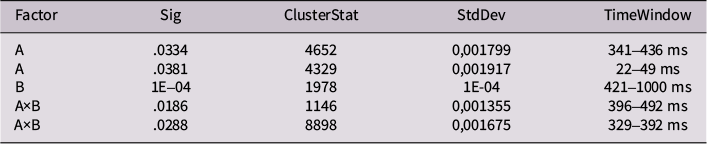
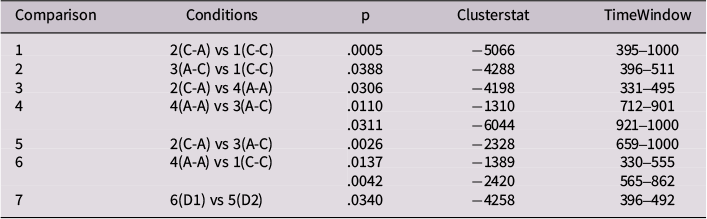
By focusing on the N400 and sustained negativity components (chosen based on the EEG scalp data), we performed non-parametric cluster-based permutation tests (Maris & Oostenveld, Reference Maris and Oostenveld2007; Oostenveld et al., Reference Oostenveld, Fries, Maris and Schoffelen2011) to assess the statistical significance of both N400 and sustained negativity across the experimental conditions. This method tests effects over broad temporal and spatial areas (accounting for multiple comparisons) without requiring a priori selection of specific time windows or regions. We implemented the cluster tests using the FieldTrip package (version 2025-5-23) for MATLAB (R2025a). For each participant and condition, we averaged ERPs within the relevant epochs and over non-ocular electrodes. Using those averages, we ran a 2 × 2 repeated-measures ANOVA with Helbling’s (Reference Helbling2025) FieldTrip extension, followed by the difference-of-differences test and conditionwise dependent t-tests. Both the ANOVA and t-tests used clustering based on time–spatial adjacency. Cluster-level statistics were computed as the sum of the dependent t- or F-values within each cluster. A Monte Carlo permutation evaluated maximal cluster statistics by randomly swapping condition labels and recomputing cluster statistics; this procedure was repeated 10,000 times. We compared the original cluster statistics to the permutation distribution. Only significant clusters are reported (p < .05). See Tables 4 and 5 for results of the cluster-based permutation ANOVAs and associated post-hoc t-tests, respectively. Figure 2a–c describe the time series of significant clusters for Factors A, B and interaction A × B, respectively. Factor A of the ANOVA produced two significant clusters. Post-hoc t-tests on the first cluster (* in the images) (centro-posterior, 341–436 ms) revealed significant negative clusters for Comparisons 2 and 3 (Table 5, centrally and posteriorly distributed, 396–511 ms and 331–495 ms, respectively), consistent with a general N400 effect concerning the first verb. The post-hoc test patterns suggest that the abstract sense in the first verb elicited a reduction in negative activation in the central area during the early N400 relative to the concrete sense. The second cluster (+ in the images) (fronto-central, 22–49 ms) for Factor A could not be confirmed by post-hoc tests. The cluster for Factor B (second predicate, 421–1000 ms) indicates a widespread sustained negativity associated with processing the second predicate. One widespread cluster was associated with post-hoc t-test comparison 1 (global, 395–1000 ms). Comparison 4 produced two closely following widespread negative clusters (both global, 712–901 ms and 921–1000 ms) in the post-hoc t-tests. The activation pattern of the post-hoc tests is consistent with sustained negativity when the abstract sense was present in the second verb compared with the concrete sense. The interaction A × B yielded two temporally adjacent centro-parietal clusters (329–392 ms and 396–492 ms), suggesting that the neural response to the second predicate depends on the semantic interpretation established by the first predicate. Post-hoc analysis of the difference-of-differences (Table 5, comparison 7, see caption for explanation on how the difference of difference was calculated) produced a negative centro-posterior cluster (396–492 ms), indicating that shift sense combinations (C-A, A-C) elicited an N400 effect relative to non-shift combinations (C-C, A-A).
Significant clusters from the cluster-based permutation ANOVA. Factor A (first predicate), Factor B (second predicate) and their interaction (A × B) across the 0–1000 ms interval

Table 4. Long description
Table showing cluster-based permutation ANOVA results with significant clusters for Factor A (first predicate), Factor B (second predicate), and their interaction (A × B). Columns include Factor, Significance (p-value), ClusterStat, StdDev, and TimeWindow. Factor A had two significant clusters (341-436 ms and 22-49 ms). Factor B had one significant cluster (421-1000 ms). The A × B interaction had two significant clusters (396-492 ms and 329-392 ms).
Significant clusters from cluster-based permutation post-hoc t-tests for the following comparisons. Polarity was always negative. Condition 7 is the difference of difference and was calculated using the following formulas D1 = ConditionC-A – ConditionC-C und D2 = ConditionA-C – ConditionA-A

Table 5. Long description
Table showing cluster-based permutation post-hoc t-test results for seven comparisons across experimental conditions. Columns include Comparison number, Conditions compared, P-value, Clusterstat, and TimeWindow. Polarity was always negative. Comparison 1: 2(C-A) vs 1(C-C), p = .0005, 395-1000 ms. Comparison 2: 3(A-C) vs 1(C-C), p = .0388, 396–511 ms. Comparison 3: 2(C-A) vs 4(A-A), p = .0306, 331-495 ms. Comparison 4: 4(A-A) vs 3(A-C), p = .0110, 712-901 ms and p = .0311, 921-1000 ms. Comparison 5: 2(C-A) vs 3(A-C), p = .0026, 659-1000 ms. Comparison 6: 4(A-A) vs 1(C-C), p = .0137, 330-555 ms and p = .0042, 565-862 ms. Comparison 7: Difference of differences, p = .0340, 396-492 ms.
Topographic maps of significant effects from the cluster-based permutation ANOVA. Symbols (+ and *) indicate electrodes belonging to statistically significant clusters identified in different time windows.

Figure 2. Long description
Figure 2 shows topographic maps of F-values across twenty 50 ms time windows (0-1000 ms post-stimulus). The figure is divided into three sections. The first section (Factor A, first predicate) shows topographic maps comparing abstract versus concrete first predicates. Significant clusters with symbols (+ and *) emerge from approximately 300 ms onwards, with strongest effects at fronto-central and central electrode sites in the 421-1000 ms window. The second section (Factor B, second predicate) shows topographic maps comparing abstract versus concrete second predicates. Significant clusters are visible from approximately 421 ms, with maximum effects at fronto-central electrodes. The third section (Factor A x B interaction) shows topographic maps of the interaction between first and second predicate type. Significant clusters appear in the 329-492 ms window at posterior and central electrode sites. Color scale ranges from 0 to 20 F-values, with darker red indicating stronger effects. Symbols (+ and *) mark electrodes belonging to statistically significant clusters.
5. Discussion
The primary objective of the present ERP study was to investigate how the meaning of the second predicate, realizing either the abstract or the concrete sense of a polysemous noun, modulates neural processing in coordinated sentence contexts. More specifically, we examined whether the target predicate in sentences such as ‘The bakery (was) rebuilt and (got) renewed/organized the workflow’ and ‘The bakery hired the chef and (got) renewed/organized the workflow’ would elicit distinct ERP responses. Our findings suggest that neural processing of the target predicate is modulated by whether it invokes the concrete or abstract sense of the polysemous noun, both when the interpretation established by the first predicate is maintained and when it is shifted. Consistent with this interpretation, the cluster-based permutation ANOVA revealed a significant interaction between the sense established by the first predicate and the semantic type of the target predicate (Table 4). To identify the source of this interaction, follow-up cluster-based permutation t-tests were performed (Table 5). These analyses revealed N400-like negativities on the target predicate, indicating differential semantic processing in shift and non-shift conditions.
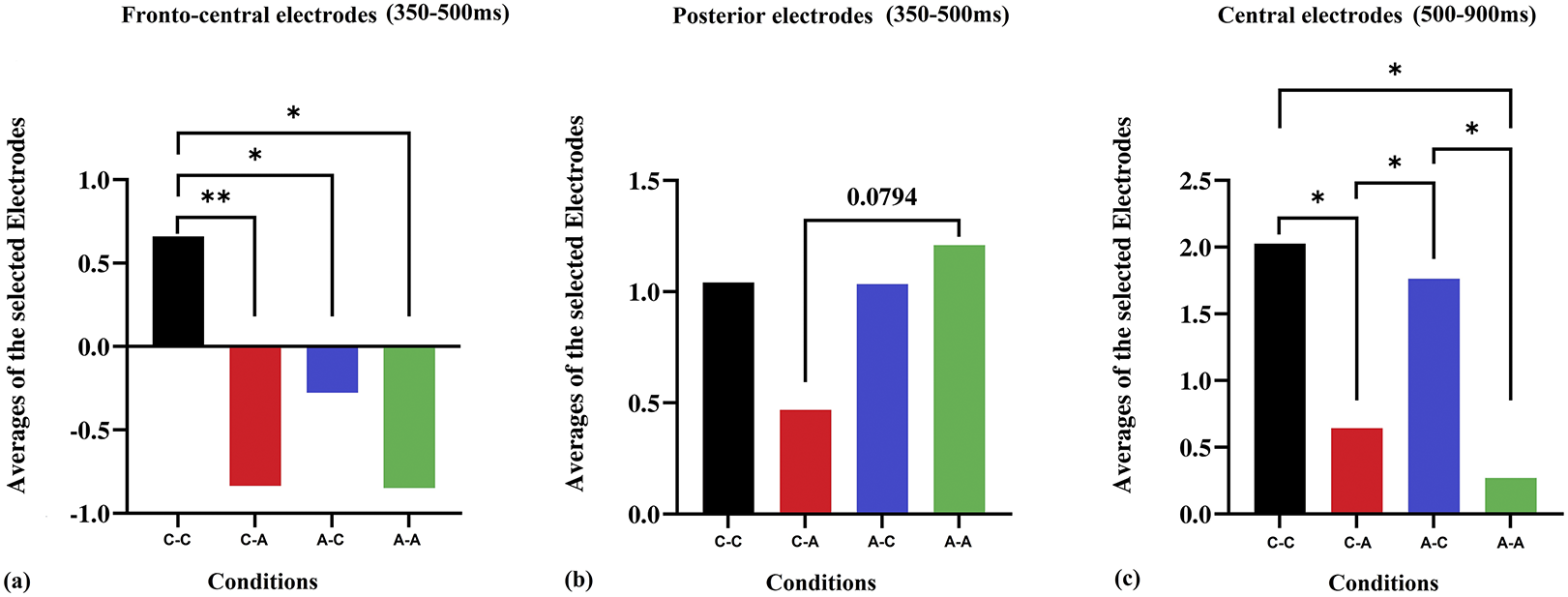
The abstractness hypothesis claims that if integrating the meaning of the second verb into the sentence meaning necessitates an abstract interpretation of the noun (institution), we anticipate a fronto-central sustained negativity in the ERP measured on the second verb, compared to when its integration requires a concrete interpretation. In order to validate this hypothesis, we took into account those two comparisons where in the target position an abstract verb is compared to a concrete verb. Firstly, in the comparison between non-shift condition 4 (A-A) and non-shift condition 1 (C-C), the results indicate a sustained negativity effect emerging approximately between 330–862 ms (see Table 5) at the fronto-central region (see Figures 3a,c and 4f). Importantly, this pattern corresponds to the significant cluster associated with Factor B (the semantic type of the second predicate) reported in Table 4, which spans approximately 421–1000 ms. This cluster indicates that the presence of an abstract predicate systematically elicited stronger sustained negativity compared with concrete predicates, regardless of the shift condition. Secondly, when comparing non-shift condition 4 (A-A) with shift condition 3 (A-C), the t-test revealed that a negativity trend was observed in the 350–500 ms time window (see Figure 3a), while a significant effect appears within the 712–1000 ms time window (see Figure 3c and Table 5). Thirdly, when comparing shift condition 2 (B-I) with non-shift condition 1 (C-C), a sustained negativity effect was observed within the 396–511 ms time window (see Table 5) at the fronto-central region (see Figure 3a,c). These findings support the abstractness effect hypothesis. The observed pattern of effects aligns with previous ERP studies, particularly those reported by Muraki et al. (Reference Muraki, Cortese, Protzner and Pexman2020). Their study investigated neural activity associated with different types of abstract verbs. Nonbodily state verbs (e.g., retire) compared to concrete verbs (e.g., build) elicited sustained negativity at the fronto-central electrodes.
The bars represent the mean amplitudes for the four experimental conditions based on pairwise t-test comparisons. Panel (a) shows the mean amplitude across electrodes FCz, CPz, Pz, Cz, C1 and C2 for the four conditions in the 350–500 ms time window following target onset. Panel (b) depicts average amplitudes across electrodes PO3, POz, PO4, O1 and Oz within the same time window. Panel (c) shows the mean amplitude across the selected electrodes C1, CPz and C2 for the four conditions in the time window between 500–900 ms after the target verb onset. *p < 0.05, **p < 0.005. Full statistical results are available at https://osf.io/mswqz/files/tfapu.

Topographic distribution of significant clusters from post-hoc cluster-based permutation t-tests. Symbols (+ and *) indicate electrodes belonging to statistically significant clusters identified in different time windows.

Figure 4. Long description
Figure 4 shows topographic maps of grand average amplitude differences across twenty 50 ms time windows (0-1000 ms post-stimulus) for six pairwise condition comparisons. The first section (2vs1: Concrete-Abstract vs Concrete-Concrete) shows significant posterior negativity in the 395-1000 ms window. The second section (3vs1: Abstract-Concrete vs Concrete-Concrete) shows significant fronto-central negativity in the 396–511 ms window. The third section (2vs4: Concrete-Abstract vs Abstract-Abstract) shows significant posterior negativity in the 331-495 ms window. The fourth section (4vs3: Abstract-Abstract vs Abstract-Concrete) shows significant negativity in the 712-901 ms and 921-1000 ms windows. The fifth section (2vs3: Concrete-Abstract vs Abstract-Concrete) shows significant central negativity in the 659-1000 ms window. The sixth section (4vs1: Abstract-Abstract vs Concrete-Concrete) shows significant fronto-central negativity in the 330-555 ms and 565-862 ms windows. Color scale ranges from −5 to 5 mV grand average difference. Symbols (+ and *) mark electrodes belonging to statistically significant clusters.
The direction of shift effect hypothesis claims that the effect should vary depending on whether the second verb causes a shift in the noun’s sense from concrete to abstract or from abstract to concrete. When measuring the ERP on the second verb, we expect a negativity effect predominantly in the posterior or nearby regions for a shift from concrete to abstract, whereas for a shift from abstract to concrete, the negativity effect should be more pronounced in the frontal or adjacent areas. Evidence for this interpretation is also consistent with the interaction between the semantic type of the first predicate and the second predicate reported in the cluster-based permutation ANOVA (Table 4). The significant A × B interaction clusters observed between approximately 329–492 ms suggest that the neural response to the second predicate depends on the interpretation of the noun established by the first predicate. In order to validate this hypothesis, we first compared the shift conditions 2 (C-A) and 3 (A-C), respectively, to their corresponding non-shift conditions 4 (A-A) and 1 (C-C), respectively. Second, we compared the two shifting conditions, namely 2 (C-A) vs 3 (A-C), which go in opposite directions: from concrete to abstract and from abstract to concrete. When comparing shift condition 2 (C-A) with non-shift condition 4 (A-A), a negativity effect is observed within the 331–495 ms time window (see Table 5 for the significant cluster in the cluster permutation test and also the marginal effect in the t-test shown in Figure 3b) localized at the posterior site (see Figures 3b and 4c). Furthermore, in the comparison between shift condition 3 (A-C) and non-shift condition 1 (C-C), a significant negativity effect is observed within the 396–511 ms time window (see Table 5), localized at the fronto-central electrodes, as illustrated in both Figures 3a and 4b. We examined the contrast between the two opposite shift directions, namely from concrete to abstract and from abstract to concrete. Firstly, in the comparison 3 (A-C) vs 2 (C-A), the t-test revealed a fronto-central negativity trend effect in the time window 350–500 ms (see Figure 3a) and a significant central negativity effect in the time window 500–900 ms (see Figure 3c and see also Table 5). Secondly, in the reverse comparison 2 (C-A) vs 3 (A-C), the t-test revealed a posterior negativity trend effect in the time window 350–500 ms (see Figure 3b). Based on this support for the direction of shift hypothesis, we suggest that during a shift from concrete to abstract interpretation, neural activity is characterized by an electric current flowing from more frontal to more posterior regions. In contrast, during a shift from an abstract to a concrete interpretation, we expect the electric current to flow from more posterior to more frontal regions.
With regard to the general sense shifting effect hypothesis, our results do not support its central prediction of a uniform ERP effect associated with sense shifting. As illustrated in Figures 3 and 4, ERP waveforms vary across conditions, showing distinct patterns in both amplitude and distribution. The cluster-based permutation ANOVA indicates a general sense shift effect; however, this effect is strongly modulated by differences between abstract and concrete senses, resulting in a markedly asymmetrical pattern. This interpretation is consistent with the statistical analyses (Tables 4 and 5), which likewise show condition-specific variations in ERP effects rather than a uniform general sense shifting effect.
It is important to highlight that the context in the current study is deliberately neutral – neither aiding in predicting the embedded target predicate nor introducing difficulty in doing so. As such, the abstractness effect appears to reflect two partially dissociable processes: an earlier, relatively context-independent component reflecting word-level lexical retrieval difficulty for abstract senses, and a later, context-dependent component reflecting the cost of integrating the second predicate’s meaning into the mental representation established by the first predicate. The earlier component is evident in both the comparisons between non-shift condition 4 (A-A) versus non-shift condition 1 (C-C), and between non-shift condition 4 (A-A) versus shift condition 3 (A-C), suggesting that abstract senses are more difficult to retrieve lexically when compared to concrete words regardless of the shift context. Consistent with this view, Taylor et al. (Reference Taylor, Francis, Borunda-Vazquez and Carbajal2019) examined how context availability affects abstract and concrete word processing using highly constrained semantic sentences. For instance, when the target was concrete ‘The new kids in town were nervous for their first day of school’ versus abstract ‘As soon as they saw each other the couple fell in love’, participants recalled concrete words more easily. This finding indicates that context availability is not always a determining factor in how abstract and concrete meanings are processed. Instead, the intrinsic characteristics of concrete and abstract words seem to play a more fundamental role in memory. Based on this logic, it appears that participants may have struggled with abstract senses due to their lack of physical attributes, which cannot be experienced directly (Montefinese, Reference Montefinese2019). In contrast, concrete senses tend to be more readily imaginable, as their meanings often involve vivid, immediate experiences (Hirshman & Arndt, Reference Hirshman and Arndt1997; Montefinese, Reference Montefinese2019). Furthermore, as illustrated in Figure 1 and Table 5, sustained negativity for abstract senses may also result from syntactic structure – specifically, when abstract predicates are followed by direct objects that clarify the action (e.g., who was hired). This suggests that participants may have experienced increased processing difficulty until reaching the sentence’s final word, producing a wrap-up effect that triggers sustained negativity (Tiffin-Richards & Schroeder, Reference Tiffin-Richards and Schroeder2018; Xiang & Kuperberg, Reference Xiang and Kuperberg2015).
It is worth noting that the sustained negativity observed for the abstract predicates in the present study extends beyond the typical N400 time window (300–500 ms), persisting into the 600–1000 ms range. Within Kuperberg’s hierarchical generative framework (Kuperberg, Reference Kuperberg2021), such late sustained effects may reflect processing at the situation model level rather than purely lexical semantic access.
To further evaluate this interpretation, we conducted an additional cluster-based permutation t-test on the first predicate, comparing verbs that instantiated the abstract and concrete senses of the polysemous noun (see Supplementary Material, Verb 1-locked analysis). This analysis revealed no significant clusters across electrodes or time windows. The absence of meaning-related effects on the first predicate is consistent with an account based on situation model construction. At the point of processing the first predicate, the discourse context may not yet provide sufficient information for a stable situation model to be established. Consequently, no sustained integration-related activity would be expected at this stage.
In contrast, by the onset of the second predicate (target verb), a situation model has already been established on the basis of the preceding context. The sustained negativity observed at the target predicate may therefore reflect the cognitive demands associated with updating or revising this representation. Under this interpretation, processing the second predicate involves both lexical semantic access, as indexed by the N400 (approximately 300–500 ms), and the subsequent integration of the predicate into the evolving situation model, as reflected by the late sustained negativity (approximately 500–1000 ms).
On the other hand, the direction of the shift effect appears to be a context-dependent phenomenon. More specifically, when participants read the first predicate, they establish a concrete sense of the polysemous noun in working memory. Subsequently, encountering the second predicate – requiring an abstract interpretation – forces an update in working memory contents. This shift, from concrete to abstract, results in a neural current flowing in the posterior direction, whereas the reverse shift (abstract to concrete) produces a current flow toward the frontal site. In addition to context dependency, another plausible factor underlying the shift effect is the degree of semantic relatedness between the two senses involved. In particular, abstract senses may produce stronger effects due to their comparatively lower semantic overlap. Even when the frequency and coherence of the predicates are balanced, abstract senses often lack strong conceptual links. For example, the first predicate might be discussed or hired, while the second is organized or sued – pairs that do not share a common semantic category. Consequently, processing these less-related abstract meanings may place greater demands on episodic memory – a complex system that relies on personal experience and contextual integration to create coherent understanding (Buchler et al., Reference Buchler, Light and Reder2008; Hawco et al., Reference Hawco, Armony and Lepage2013; Mäntylä, Reference Mäntylä1986). In contrast, concrete senses tend to exhibit higher semantic relatedness. For instance, predicates such as rebuilt or demolished followed by painted or renovated all fall within the domain of manual labor. Supporting this, Rodd et al. (Reference Rodd, Gaskell and Marslen-Wilson2002) showed that participants trained on semantically related meanings of familiar words performed better in lexical decision tasks than when trained on unrelated ones. This evidence underscores that polysemous words with related senses benefit from richer semantic representations, leading to more efficient processing (Klepousniotou et al., Reference Klepousniotou, Titone and Romero2008; Rodd et al., Reference Rodd, Gaskell and Marslen-Wilson2002, Reference Rodd, Gaskell and Marslen-Wilson2004, Reference Rodd, Berriman, Landau, Lee, Ho, Gaskell and Davis2012).
Beyond context dependency/independency and semantic relatedness, it appears that the ERP effect on the target predicate is also influenced by the interaction between the semantic content of the first predicate and its relationship to the second predicate, as mediated by the coordinating connector ‘and’. This interaction may introduce an element of surprise or disrupt participants’ expectations about the upcoming word. To illustrate, compare condition 2 (‘The bakery (was) rebuilt and organized the workflow’) with condition 1 (‘The bakery (was) rebuilt and (got) renewed’), or condition 3 (‘The bakery hired the chef and (got) renewed’) with condition 1 (‘The bakery (was) rebuilt and (got) renewed’). As shown in Figure 1 and Table 5, both target predicates – regardless of their abstract or concrete sense – elicited a negative ERP effect. This finding suggests that when participants processed the initial clause (e.g., ‘The bakery (was) rebuilt…’ or ‘The bakery hired the chef…’), they retained semantic information and formed expectations due to the connector ‘and’. A mismatch between this expectation and the actual second predicate likely led to increased processing efforts (Mak & Sanders, Reference Mak and Sanders2013; Noordman & Vonk, Reference Noordman and Vonk1992). In the light of this, the coordinating connector plays a crucial role in this study. According to Millis and Just (Reference Millis and Just1994), connectives help readers maintain coherence by encouraging them to actively integrate semantic information from both clauses. Consistent with this, Torabi Asr and Demberg (Reference Torabi Asr and Demberg2020) showed that connectives like ‘but’ and ‘although’ significantly influence how readers anticipate and build coherent mental representations, even with minimal contextual information. Moreover, Xiang and Kuperberg (Reference Xiang and Kuperberg2015) found that connectives such as ‘even so’ can generate stronger semantic predictions, as evidenced by reduced N400 amplitudes in EEG studies – demonstrating the critical role of connectives in guiding word expectation and comprehension.
6. Conclusion
This study provides the first ERP investigation into how the brain processes polysemous nouns that systematically alternate between a concrete ‘building’ and an abstract ‘institution’ sense in co-predicative constructions. By analyzing coordinated sentences containing two predicates – either by triggering the same sense or requiring a shift between senses – we examined how sense alternation influences neural processing. Two key effects emerged from our results: (1) a sustained negativity was observed for abstract interpretations compared to concrete ones, measured on the second verb, even when the sentences were designed to be coherent; (2) we identified a direction-of-shift effect, with a posterior negativity for shifts from concrete to abstract and a more frontal negativity for shifts from abstract to concrete. At the neuroanatomical level, this pattern is consistent with the engagement of posterior regions associated with lexical retrieval for shifts toward abstract meanings, and more frontal regions associated with integration and cognitive control for shifts toward concrete meanings. These findings contribute to a deeper understanding of how co-predication and polysemous nouns are processed in real time and, by providing evidence from Modern Standard Arabic, offer initial support that these processing patterns are not restricted to Indo-European languages, while highlighting the need for broader cross-linguistic investigation.
Beyond this neuroanatomical substrate, the direction-of-shift asymmetry also carries theoretical weight for how co-predication is cognitively implemented at the level of representational architecture. As discussed above, we interpret this asymmetry as reflecting an updating of the noun’s working-memory representation: the first predicate establishes an initial interpretation of the noun’s sense, and the second predicate either confirms or revises this interpretation, with the direction of revision determining whether neural activity shifts toward posterior or frontal sites. Our findings are more naturally accommodated by accounts in which sense construction unfolds sequentially as comprehenders’ expectations are updated by each successive predicate, such as the predictive processing framework proposed by Löhr and Michel (Reference Löhr and Michel2022). Our findings support the idea that understanding co-predication depends on two things working together: first, whether the combination of senses is plausible and coherent; and second, how costly it is to update expectations in real time. Crucially, our data show that it is not just whether a sense shift occurs that matters for the brain – it is the direction of the shift that determines what neural resources are needed.
Future research could extend this work along several lines. First, examining other types of logical polysemy, such as book-type nouns (physical object versus informational content) or city-type nouns (location, population, or administrative entity), would establish whether both the direction-of-shift asymmetry and the abstractness effect observed here generalize across different semantic relations, or whether they are specific to the concrete–institutional alternation tested in the present study. Finally, direct cross-linguistic comparisons between Arabic and Indo-European languages, ideally within a single harmonized experimental paradigm, would allow stronger claims about whether the neural signatures of sense construction we report reflect.
Supplementary material
The supplementary material for this article can be found at http://doi.org/10.1017/langcog.2026.10115.
Data availability statement
Due to the sensitive nature of the participant data collected for this study, the raw data are not publicly available to protect participant privacy and confidentiality, in accordance with ethical approval requirements. However, the analysis scripts necessary to reproduce the statistical analyses and figures reported in this paper are available at https://osf.io/mswqz/overview. The corresponding author may be contacted for further information regarding the analysis code.
Author contribution
Suaad Alhelou prepared the stimuli, designed and conducted the experiment, preprocessed the data, analyzed both the grand average and the t-test and wrote the manuscript. Matthias Unterhuber programmed the experiment, performed data processing and the cluster-based permutation tests and gave advice on the data processing and interpretation. Markus Werning supervised the study and contributed to the design of the experiment, data processing and data interpretation. He also provided the resources for the experiment and gave feedback for improving the manuscript.
Funding statement
The research for this paper has been funded by the Deutsche Forschungsgemeinschaft (DFG, German Research Foundation) with the grants 367110651 (PI: MW) in the Priority Program XPrag.de (SPP1727) and the grant 274877981, project LING 2.1 (PI: MW), in the RTG Situated Cognition.
Competing interests
We have no conflicts of interest to disclose.
Ethics statement
The study was conducted in compliance with the Helsinki Declaration, the ethical guidelines of the German Research Foundation (DFG) and the General Data Protection Regulation (GDPR). The study is covered by the ethics approval of the ethics commission of Deutsche Gesellschaft für Sprachwissenschaft (DGFS) with the ethics votum #2019–14-191211 as the presented material did not contain any potentially harmful content and was conducted with neurotypical subjects between 18 and 40 years of age. All subjects were volunteers and signed an informed consent of participation, which included information about protection of privacy and confidentiality, as well as the right to withdraw from participation at any point.






 Open access

