Implications
Under the rearing conditions tested in the current study, broilers ingested only modest amounts of soil. Therefore, in such conditions, soil ingestion by organic broilers should not increase the risk of food contamination, unless they are raised on yards that are located close to sources emitting pollutants or on historically contaminated soils.
Introduction
Animal welfare considerations currently tend to favor systems of outside-reared animals in European agriculture. Consumers also demand food from outside-reared poultry, especially broilers, as in the case of small individual holders or organic farming. Access to an outdoor area would allow to the birds to express their natural exploring behavior, but also to ingest plants, invertebrates or soil. According to Horsted et al. (Reference Horsted, Hermansen and Ranvig2007), such intakes can provide notable nutritional supply to the animals, such as vitamins from plants, proteins from earthworms or some minerals via soil intake (Sugimura et al., Reference Sugimura, Hori, Kurihara and Itoh1984). Nevertheless, free-range systems can also represent a risk for the safety of the food produced by these animals when the yard is situated in an area exposed to more or less recent deposition of contaminants, especially persistent organic pollutants. Indeed, several studies (Schuler et al., Reference Schuler, Schmid and Schlatter1997; De Vries et al., Reference De Vries, Kwakkel and Kijlstra2006; van Overmeire et al., Reference van Overmeire, Waegeneers, Sioen, Bilau, de Henauw, Goeyens, Poussemier and Eppe2009) have reported contamination of eggs or broiler meat in some farms using outside plots. It has been reported that soil intake can represent a potential route of entry for contaminants into the food chain, as has been shown for metals and persistent organic pollutants (Stephens et al., Reference Stephens, Petreas and Hayward1995; Bendell-Young and Bendell, Reference Bendell-Young and Bendell1999; De Vries et al., Reference De Vries, Kwakkel and Kijlstra2006; Schoeters and Hoogenboom, Reference Schoeters and Hoogenboom2006), and soil intake is generally considered as the main contributor to the exposure of outside-reared poultry to organic pollutants (van Overmeire et al., Reference van Overmeire, Waegeneers, Sioen, Bilau, de Henauw, Goeyens, Poussemier and Eppe2009; Jondreville et al., Reference Jondreville, Fournier, Travel, Feidt and Roudaut2011). Thus, the risk of soil intake needs to be controlled, whereas contaminated plants can easily be cut and removed. It is, therefore, first necessary to determine the order of magnitude of such intake in broilers. Various authors have reported that daily plant intake can reach up to 30 g of dry matter (DM) in laying hens (Hughes and Dun, Reference Hughes and Dun1983; Horsted et al., Reference Horsted, Hammershoj and Jermansen2006), and soil intake also can reach up to 23% of the ingested DM (Jondreville et al., Reference Jondreville, Travel, Besnard and Feidt2010) or even 30 g per day (Waegeneers et al., Reference Waegeneers, De Steur, De Temmerman, van Steenwinkel, Gellynck and Viaene2009). These extreme values hide huge variations, and the average intakes of outside-reared hens were estimated by De Vries et al. (Reference De Vries, Kwakkel and Kijlstra2006) at 10 g of dry soil, 7 g of plant DM and 20 g of invertebrates (insects and earthworms). Data concerning free-range broilers are scarce in the literature: Rivera-Ferre et al. (Reference Rivera-Ferre, Lantinga and Kwakkel2007) reported a daily herbage intake of 10.7 g per broiler confirmed by Almeida et al. (Reference Almeida, Hinrichsen, Horsted, Thamsborg and Hermansen2012), although the latter reported even 20 g for male broilers in the case of medium-growing genotypes. Only Almeida et al. (Reference Almeida, Hinrichsen, Horsted, Thamsborg and Hermansen2012) mentioned ‘insignificant amounts of soil particles found in crops’ without any quantification. Among factors affecting exploration activity and, therefore, soil and plants ingestion by broilers and laying hens, the presence of hiding elements such as shelters was suggested by Rivera-Ferre et al. (Reference Rivera-Ferre, Lantinga and Kwakkel2007), the genotype and sex of the birds by Almeida et al. (Reference Almeida, Hinrichsen, Horsted, Thamsborg and Hermansen2012) and feeding imbalance or coarse feeding by Horsted et al. (Reference Horsted, Hermansen and Ranvig2007) and Jondreville et al. (Reference Jondreville, Travel, Besnard and Feidt2010).
However, to our knowledge, no quantification of soil intake by broilers was published.
Estimations based on the analysis of the crop content (Horsted et al., Reference Horsted, Hermansen and Ranvig2007; Almeida et al., Reference Almeida, Hinrichsen, Horsted, Thamsborg and Hermansen2012) only provide a qualitative survey, whereas the method of sward cutting (Rivera-Ferre et al., Reference Rivera-Ferre, Lantinga and Kwakkel2007) can confound intake and trampling by the animals. Marker-based methods, especially n-alkanes for plant intake (Dove et al., Reference Dove, Mayes and Freer1996) and acid-insoluble ash (AIA) for soil intake (Beyer et al., Reference Beyer, Connor and Gerould1994), have been proposed as relevant quantitative methods in ruminants and in wild animals, including birds. The use of these markers was recently validated as a suitable method for quantitatively evaluating plants and soil intake by broilers (Jurjanz et al., Reference Jurjanz, Germain, Dziurla, Juin and Jondreville2014).
Therefore, the main aim of the current study was to implement this marker-based approach in order to quantify soil and plant ingestion of free-range broilers reared under the specifications of organic farming. In addition, the specific aim was to evaluate how this is influenced by the type of plot (on grass or under trees) considering different production periods (i.e. age of the birds). Assessing organic broilers’ production from the point of views of performance, health, behavior and environmental impact is part of a comprehensive study (Germain et al., Reference Germain, Leterrier, Meda, Jurjanz, Cabaret, Lessire, Jondreville, Bonneau and Guéméné2013).
Material and methods
Animal management
The trial was implemented as a part of the AlterAviBio project, which aimed to study broilers reared under organic farming conditions. The facilities of the experimental station ‘Le Magneraud’ in Western France (0.67°W, 46.17°N), belonging to the French Agronomic Research Institute INRA, were used to study the intake of plants and soil by broilers reared in outdoor yards. The trial was carried out according to a factorial design using the following factors: type of vegetation on the yard (n=2) and age of the birds (2 points). This was studied for five successive flocks over 2 years.
The first type of yard was located under oaks (tree-covered, TC), with a vegetation naturally composed of various dicotyledonous plants (Calluna vulgaris, Muscari cornosum, Polygonum aviculare, Primula spp., Rubus fructicosus, Urtica diodca and Viscia sativa) and some grasses (Dactylis glomerata, Festuca spp, Lolium spp. and Phleum pratense). The second type of yard was grass-covered (GC) with Festuca arundinacea, Lolium perenne, Lotus corniculatus and Trifolium repens before the first flock. At the start of the trial, the soil of both types of yards was completely covered by plants. Subsequently, the plant cover was mowed at 12-cm height before opening the pop-holes in order to standardize the conditions for the five successive flocks.
The outdoor areas were subdivided into four yards of 2500 m² and two of each type – that is, TC or GC – were used for the experiment during five successive flocks. A total of 750 broiler chickens with a sex ratio close to 50 : 50 were assigned to each plot for each flock as summarised in Table 1. Slow-growing birds adapted to organic farming of the commercial hybrids 551® (Sasso, Sabres, France) for the first flock and JA 657® (Hubbard, Quintin, France) for flocks two to five were placed at the age of 1 day in a 75 m² poultry house. At the age of 29 days, the house pop-holes were opened, allowing the birds to freely explore the outdoor area. The birds were raised up to the age of 84 days before slaughter. Over a 2-year period, five successive flocks were raised on each area, respecting a downtime of 5 weeks between each (except a downtime of 3 weeks between the two first flocks), supplementary to the 4 weeks in the house with closed pop-holes. As shown in Table 1, these five flocks covered the periods of 14 April to 7 July 2009 (flock 1 : spring 1), 28 July to 20 October (flock 2 : autumn 1), 24 November 2009 to 16 February 2010 (flock 3 : winter), 23 March to 15 June (flock 4 : spring 2) and 20 July to 12 October 2010 (flock 5 : autumn 2). Thus, flock number represented not simply a repetition, but rather reflected a seasonal effect together with the possible modification of the vegetation consecutive to the succession of flocks, which would also modulate the deterioration of the vegetation on the yard surface.
Characterization of the flocks depending on run number and yard type during the trial

1 Subjective evaluation based on the completeness of the plant cover on the surface of the plot.
2 Sasso, Sabres, France.
3 Hubbard, Quintin, France.
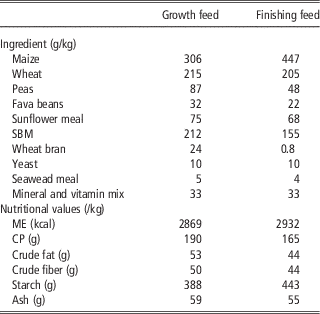
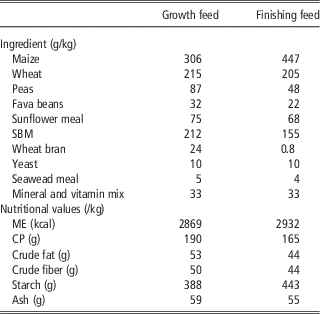
Broiler feed was purchased from a commercial mill specialized in organic farming. Birds were first fed with a starter diet (crumbles) from 0 to 28 days of age (110.09 Poussin démarrage BIO®, Aliments Mercier, La Roche-sur-Yon, France), followed by grower diet (small pellets) from 29 to 56 days of age (110.18 Poussin croissance BIO®, Aliments Mercier) and afterwards with a finisher feed (pellets; 110.03 Poulet Finition BIO®, Aliments Mercier). The detailed composition and nutritional values of the feeds used are presented in Table 2. Feeds were distributed ad libitum and consumption was recorded at the plot level. Water was provided ad libitum throughout the trial.
Composition and nutritional values of used feeds
Sampling and measurements
The birds were weighed on day 29 (opening of pop-holes), day 57 (growth) and at slaughter (day 84). The feed consumption was determined on a weekly basis by the amount of distributed feed divided by the number of birds on the plot. Feed efficiency was then calculated on average for the flock on a given yard using the recorded feed consumption per body weight gain over a given period.
Plant and soil intakes were estimated using, respectively, the odd numbered n-alkanes (ALK) and AIA markers, according to the method described by Jurjanz et al. (Reference Jurjanz, Germain, Dziurla, Juin and Jondreville2014), and is summarized in the paragraph plant and soil intake estimation here below. These intakes were estimated at two time points as follows: ‘growth’ (age of 51 days) and 2 weeks later at ‘finishing’ (age of 64 days) for each plot – that is, each flock on each yard. Both feeds (growth or finisher) were sampled at each delivery and ground to 1 mm. The plant species present on each yard were recorded and a sample of each plant was taken. These samples were rinsed twice with warm water in order to remove any adhering soil particles, dried (one day at 60°C) and ground to 1 mm.
One sample of pooled droppings was collected from each flock at each of the two sampling times. This collection was performed by placing several tarpaulins under the perches during one night. The tarpaulins were laid on the soil in such a manner as to minimize contamination from soil in order to correctly estimate fecal AIA concentrations. After removing the gravel (>2 mm) and some rare particles of feathers and straw, one sample of the collected droppings was homogenized, freeze-dried and ground to 1 mm.
In order to determine AIA contents, surface soil (0 to 5 cm) was sampled from each yard type – that is, one GC yard and one TC yard – before the first flock was granted access. Therefore, 16 sub-samples homogeneously distributed per yard were taken according to the French standard methodology (Association Française de Normalisation, 1992) by inserting 5-cm deep moulds (8 cm diameter) into the surface of the earth. In order to determine the marker contents of the soil exclusively, stones larger than 2 mm were removed, along with any plants and roots. Subsequently, soil samples were dried at room temperature and then crumbled and sieved at 2 mm before analyses.
Chemical analyses
N-alkanes in feeds, plants and feces were determined by gas chromatography coupled with mass spectrometry after accelerated solvent extraction according to Smith and Strickland (Reference Smith and Strickland2007). Paired alkanes (C24-d50 and C30-d62) were used as internal standards. AIA concentrations in feeds, plants, soil and feces were determined according to van Keulen and Young (Reference van Keulen and Young1977) by two calcinations at 550°C with an intermediate boiling step (15 min) in HCl 3N. All chemical analyses were performed in duplicate.
Plant and soil intake estimations
The intake estimation was carried out in two steps. First, the contribution of the plants to the ingested diet – that is, feed and plants – was estimated using the ALK marker. The proportion of soil in totally ingested DM – that is, feed, plants and soil – was then determined using AIA as a second marker.
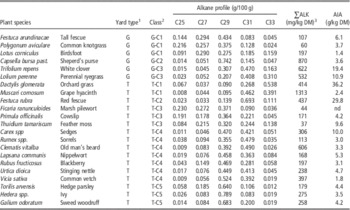
For the first step, all plants available on a yard type – that is, six species on GC yards and sixteen other species on TC yards (Table 3) – were subjected to a principal component analysis (PCA) in order to group them within a given yard type according to their ALK profile. As suggested by Olivan et al. (Reference Olivan, Ferreira, Garcia, Celaya and Osoro2007), this step of plants classification was performed in order to limit the number of independent variables in the following regression analysis. The first three axes were submitted to hierarchical cluster analysis (HCA) using squared Euclidean distance to measure similarity among clusters to a good partition and an optimal intergroup and intragroup variability. The PCA/HCA ratio was calculated to determine which plants had the same ALK profile, and each cluster was illustrated by calculating an average profile. In this manner, three clusters (plant classes) were formed within GC yards and five others within TC yards (Table 4).
Odd numbered n-alkanes and acid-insoluble ash concentration in the plant species collected on each type of yardFootnote 1 and distributionFootnote 2 between classes of the different plant species on plots

AIA=acid-insoluble ash; DM=dry matter.
1 Yard types: G=grass-covered yards, T=yards under trees.
2 Each plant species is classified into a class based on its n-alkanes profile as described in the materials and methods section.
3 Sum of the five analyzed odd-numbered n-alkanes.
Concentrations of markers in feed, soil and classes of plant species

AIA=acid-insoluble ash; DM=dry matter.
1 Classification (classes C1 to C5) of plant species within a given yard type (G=grass- covered; T=under trees).
2 Sum of the analyzed odd-numbered n-alkanes.
The fecal concentrations of ALK were then corrected for their recovery rates determined under controlled conditions: 0.29, 0.40, 0.40, 0.48 and 0.62, respectively, for the ALK C25, C27, C29, C31 and C33 (Jurjanz et al., Reference Jurjanz, Germain, Dziurla, Juin and Jondreville2014). Subsequently, the proportion of each diet ingredient – that is, feed and the plant classes available on the yard – was estimated by a multiple regression (REG procedure, SAS® version 9.3, SAS Institute, 2011) of the ALK profile of all possible ingredients on the ALK profile in feces using the following model:
 $$\eqalign{ALK_{i}\,{_{\rm feces}} = ALK_{{i\,}} _{_{\rm feed}} {\plus}ALK_{i} _{\,} _{{Pc1}} {\plus}ALK_{i} _{_{\,Pc2}} \cr {\plus}ALK_{{i\,}} _{_{Pc3}} {\plus}{\varepsilon}_{i} ,$$
corresponding to the proportion of the alkane i (C25 to C33) in the fecal matter, feed or plant classes 1, 2 and 3, as well as the residual error ε of the considered alkane.
The regressions were carried out individually for each flock, at each time point (age), integrating each of the analyzed alkanes (i=5).
The ALK profile of the feed was necessarily integrated into each regression. The iteration process was stopped only when plant classes with a partial regression coefficient of P<0.10 were integrated. At the end, the ingested amounts of plants in g/day were calculated from the recorded feed intake and the previously estimated proportions of plants and feed in the diet.
For the second step, the proportion of soil in the total DM intake was estimated using the ratio of AIA concentrations according to Beyer et al. (Reference Beyer, Connor and Gerould1994).
 $$Soil\,intake={{AIA_{D} {\minus}AIA_{F} {\plus}(AIA_{F} {\times}DMD)} \over {AIA_{D} {\minus}AIA_{S} {\plus}(AIA_{F} {\times}DMD)}},$$
where soil intake is the proportion of dry soil in the ingested DM (kg/kg), AIA D the diet (i.e. feed and plants) AIA concentration (g/kg DM), AIA F the fecal AIA concentration (g/kg DM), AIA S the soil AIA concentration (g/kg DM), and DMD the diet DM digestibility. The digestibility of the feed and plant DM was estimated, respectively, at 0.66 and 0.12 according to the results observed under controlled conditions on the plant mixture cut on these plots (Jurjanz et al., Reference Jurjanz, Germain, Dziurla, Juin and Jondreville2014). The amount of ingested dry soil was calculated using the ingested amount of the diet – that is, cumulated amount of feed and plants – as well as the proportions of the diet and soil in the total intake DM.
Statistical analyses
The amounts of ingested feed, plants and soil obtained, along with body weights and feed efficiency, were analyzed using ANOVA (procedure MIXED, SAS® version 9.3, SAS Institute, 2011) with the repeated option on the age factor within the considered yard for a given flock. The model was as follows:
 $$\eqalign{Y_{{ijkl}} =\mu {\plus}type_{i} {\plus}flock_{j} {\plus}age_{k} {\plus}[type_{i} {\times}flock_{j} ] \cr {\plus}\left[ {type_{i} {\times}age_{k} } \right]{\rm }{\plus}\left[ {type_{i} {\times}age_{k} {\times}flock_{j} } \right]{\rm }{\plus}e_{{ijkl}} ,$$
where Y ijkl , µ, type i , flock j , age k , [type i ×flock j ], [type i ×age k ], [type i ×age k ×flock j ], e ijkl represent the analyzed variables (intake in g DM/day), the overall mean, the fixed effect of the yard type (i=2 : TC or GC), the effect of the flock number (k=1 to 5), the effect of age (j=2 : 51 or 64 days), the interactions between the effects and the residual error term, respectively. Replications (n=2) correspond to the two plots of the same flock on the same type of yards. Least square means were compared by a multiple t-test according to Tukey. Statistical significance was concluded at the threshold of P<0.05.
Results
Animal performances
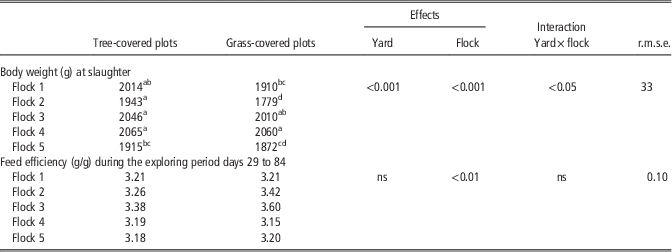
Birds weighed 499 g when pop-holes were opened on day 29, without any variations between yard types or flocks. On day 57, broilers were slightly lighter on the GC yards than on yards under trees (1118 v. 1140 g, P<0.05), and this difference increased up to slaughter on day 84: 1926 and 1997 g (P<0.01), respectively, for birds reared on GC and TC yards. At this latter time point, broilers in flock 2 raised in GC plots displayed the lowest BW.
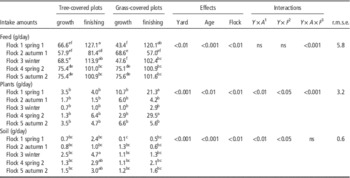
Animal feed intake increased significantly (P<0.001) along with age, with a weekly average of 65.5 g DM/day at the age of 51 days (growth) v. 100.6 g DM/day at 64 days of age (finishing). The birds ingested significantly less feed on the TC yards (on average 79.2 g DM/day) compared with GC yards (on average 86.8 g DM/day, Table 5). Finally, the flock number also significantly affected feed intake as the second flock had lower feed intakes, in accordance with their low body weight, at finishing compared with all other flock runs. Moreover, slightly higher feed intakes were recorded for flock 1, especially at 64 days of age (Table 5).
Effect of yard type, bird age, flock run and their interactions on the ingested amounts of broilers

1 Y×A, interaction between yard type and age.
2 Y×F, interaction between yard type and flock.
3 Y×A×F, interaction between yard type, age and flock.
Least square means with different letters within the same matrix block are different at P<0.05.
Feed efficiency during the period with access to the yard (day 29 to 84) was not significantly affected by the yard type (P>0.05, Table 6).
Effects of yard type and flock number on body weight and feed efficiency

Least square means with different letters within the same block of lines for a given parameter are different at P<0.05.
Characteristics of yards and ingested matter
During the exploration phase, we observed a progressive reduction of plant cover on the yards from the house to the bottom of the plot, starting with the opening of the pop-holes (Supplementary Material S1). After the end of each flock, nearly no plants were left on the surface of the yard, especially on TC plots and the surface close to the poultry house (Supplementary Material S2). The vegetation recovered more quickly on GC yards in comparison with yards under trees during the downtime between two successive flocks, before being degraded again during exploration by the birds of the following flock.
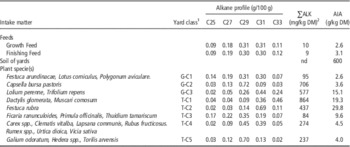
The concentrations of the markers used in the ingested feed, plant and soil matrices are shown in Table 4. Both feeds showed very low and nearly identical concentrations of both markers with ⩽10 mg ALK and ⩽3.1 g AIA/kg DM and profile composed of 0.09, 0.18, 0.30, 0.31 and 0.12, respectively, for C25, C27, C29, C31 and C33. The soil of GC yards contained 900±5 g ash/kg DM and that of TC yards 817±22 g ash/kg DM. The AIA concentration averaged at 600 g/kg dry soil, without any significant difference between both yard types, and only small variations between sampling sites of one yard were revealed (±34 g/kg DM, – that is, a coefficient of variation below 6%).
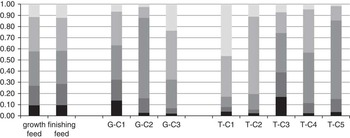
The ALK profile of the feeds and the different classes of plants on the yards are shown in Table 4 and illustrated in Figure 1. On the GC yards, the six collected species were split into three classes based on their ALK profile. Plants classified into class 1 displayed a balanced profile, whereas the profiles of plants classified into classes 2 and 3 were dominated by C29 (0.72) and by the longest ALK C29 (0.26), C31 (0.44) and C33 (0.24), respectively. Of the 16 plant species collected on the TC yards, mainly grass species were attributed to the first two classes, with a profile dominated by the longest ALK C31 and C33. Plants attributed to class 3 displayed a balanced profile and an overall low concentration of ALK. At the end, plants with a profile dominated by C29 and C31 were grouped into class 4, and those with a profile dominated by C29 (0.70) were attributed to class 5. The concentrations of AIA in plants were generally below 10 g/kg DM and only two grass samples (D. glomerata of T-C1 and Festuca rubra of T-C2) of the 22 plant species exceeded 20 g/kg DM.
Alkane profiles in feeds and in plant classes within a given yard type. Yard types: G=grass-covered, T=under trees. Plant classes C1 to C5 within a given yard type.

Intake
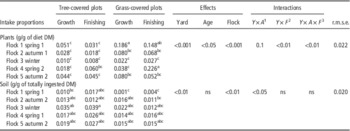
Fecal concentrations of marker compounds varied widely as expected from 14 to 76 g AIA/kg DM and finally 51 to 234 mg ALK/kg fecal DM (results not shown). The effects of the different treatments on the proportions of plant DM in the ingested diet and dry soil in the totally ingested DM are shown in Table 7, whereas the effects on ingested amounts of plants and soil are shown in Table 5.
Effect of yard type, bird age, flock run and their interactions on the proportions of plants and soil in the DM intakes of broilers

DM=dry matter.
1 Y×A, interaction between yard type and age.
2 Y×F, interaction between yard type and flock.
3 Y×A×F, interaction between yard type, age and flock.
Least square means with different letters within the same matrix block are different at P<0.05.
On average, broilers ingested significantly higher proportions of plants in the ingested diet DM on GC yards in comparison with TC yards (0.126 v. 0.031). This clear difference was mainly because of spring flocks (i.e. flocks 1 and 4, Table 7). The proportion of plants ingested by the birds varied slightly with age from 0.056 to 0.068 of the ingested diet DM (P<0.05), at 51 and 64 days of age, respectively (Table 7).
The proportion of soil ingested by the birds was significantly higher on the TC yards compared with GC yards (0.022 v. 0.013). The flock run also affected soil intake. In particular, the winter flock (i.e. run number 3) showed increased proportions of soil in the totally ingested DM. Age did not affect the amount of ingested soil directly (P>0.10), but rather in interaction with yard type (P<0.05). Indeed, no age effect on soil intake was observed on GC yards (0.013); however, the soil proportion increased on TC yards from 0.019 to 0.024 between the age points of 51 and 64 days. The amount of ingested plant DM varied widely and was affected systematically by all tested factors and interactions. Dry plant intake tended to be higher on GC plots, although this difference was not systematically significant. The highest intakes (over 20 g/day) were recorded during spring runs (i.e. flocks 1 and 4), especially on GC yards, and the lowest in winter (i.e. flock 3). Conversely, plant intakes on TC yards were lower than 7 g/day. The amount of ingested plants increased slightly but significantly with the birds’ age, as seen previously for feed intake: 3.8 and 8.1 g/day, respectively, for the ages of 51 and 64 days (Table 5). This increase between both age time points was more elevated on GC yards (+7.3 g/day) than on TC yards (+1.4 g/day), as underlined by the significant interaction between yard type and age (Table 5).
Despite a generally low daily intake of dry soil with <3 g, broilers on TC plots ingested significantly more soil than birds on GC plots, with 2.1 and 1.1 g dry soil/day, respectively. Soil intake was significantly affected by flock, with the winter flock (run number 3) on TC yards showing higher intakes, among which the highest value was 4.7 g/day. Finally, soil intake increased slightly but significantly with age as older birds ingested more soil than younger ones: 1.2 and 2.0 g dry soil/day, respectively, at the ages of 51 and 64 days (Table 5). The interactions show that birds, especially older ones, on TC plots of flock 3 ingested the highest amounts of soil. Conversely, young broilers, especially on GC yards, ingested nearly no soil (Table 5).
Discussion
Methodological considerations
The method used to estimate the proportions of ingested plants and soil has been previously validated (Jurjanz et al., Reference Jurjanz, Germain, Dziurla, Juin and Jondreville2014). However, its practical application needed some precautions. First, the plants present on the corresponding yard needed to be identified and then sampled for analyses. As the ALK profile in cuticular wax of a given plant has been reported not to vary notably over age during the vegetation cycle (Dove et al., Reference Dove, Mayes and Freer1996), in accordance with our own observations (not published), the sampling date of plants present on the plot has a certain flexibility. Nevertheless, the numerous species present on a plot, especially in natural vegetation such as on TC yards, needed grouping into classes according to their alkane profile in order to cope with this variability, as previously suggested for ruminants by Olivan et al. (Reference Olivan, Ferreira, Garcia, Celaya and Osoro2007). The next hurdle is the integration of the alkane profile of feed, very poor in n-alkanes, but at the same time the main ingredient of the intake (Jurjanz et al., Reference Jurjanz, Germain, Dziurla, Juin and Jondreville2014). Finally, possible similarity between the alkane profiles of ingredients, such as class 1 plants on GC yards and feed, could hinder the integration of this plant class in the prediction of the fecal alkane profile. Nevertheless, the quality of the relationship between the predicted and the measured proportion of a given alkane in the fecal DM may sometimes vary; however, giving a priority to the major ingredient (feed) and grouping ALK profile of plants into classes provided reliable results (R²=0.80, not shown).
The following estimation of soil intake was based on AIA concentrations, which are easy to determine and quite robust when samples are taken representatively and are correctly homogenized. The precision of each variable used in the calculation and the sensitivity of the soil intake estimation have been discussed previously (Beyer et al., Reference Beyer, Connor and Gerould1994; Jurjanz et al., Reference Jurjanz, Feidt, Pérez-Prieto, Ribeiro Filho, Rychen and Delagarde2012). Indeed, these authors showed the central role of global diet digestibility in the estimation of soil intake in ruminants and in wildlife surveys, which would be affected by the digestibility of each ingredient as well as by their proportions. This appears less true in poultry: feed digestibility is commonly well tabulated, although generally expressed in energy and rarely in DM. Very little is known about the digestibility of plants in broilers. Nevertheless, although estimates of plant digestibility reported in the literature varies greatly (0.08 to 0.35, according to Hameleers et al., Reference Hameleers, McNab and Mayes1996; Borin et al., Reference Borin, Lindberg and Ogle2006 and Jurjanz et al., Reference Jurjanz, Germain, Dziurla, Juin and Jondreville2014), the low proportions of plants in the diet would considerably limit the imprecision due to variations of their digestibility. Therefore, the proportion of plants in the diet and their DM digestibility appears to be a less sensitive variable for the estimation of soil intake in poultry compared with ruminants.
Intakes and their variation factors
The intake of plants and soil would fill a certain volume of the digestive tract. As feed intake varied in the expected order of magnitude and without any relationship to this intake, our observations seem to show that the ingested plants and soil would non-significantly affect feed intake in outside-ranged broilers. Nevertheless, a slight and non-significant tendency of lower feed intake on GC yards in comparison with yards under trees for the first three flocks could explain the slightly lower weight gain for these flocks. Jurjanz et al. (Reference Jurjanz, Germain, Dziurla, Juin and Jondreville2014) reported that broilers kept in cages and receiving diets made of up to 20% dry plants or soil were able to increase their total DM intake so that feed ingested remained constant. This is consistent with the current observations that commercial feed intake was independent of the amounts of soil and plants ingested. Rivera-Ferre et al. (Reference Rivera-Ferre, Lantinga and Kwakkel2007) estimated a daily intake of 10 g of plant DM without notable variations between two types of grass vegetation, using the methodology of sward cutting, which may cumulate ingestion and trampling. Our marker-based method revealed daily intakes of up to 7 g plant DM. Contrary to previous reports, plant intake in our trial was more variable, especially on GC yards, where some peaks of up to 30 g daily were recorded. Our approach estimates the intakes of plants and soil at two time points like snapshots of the whole rearing period. Therefore, a part of the observed variations can be due to a between-day disparity dependent on foraging offer and exploring activity. The highest intakes were obtained when plant cover was the best – that is, on GC yards during spring (flocks 1 and 4). Beside the seasonal effect on vegetation growth, plant cover on GC yards recovered more rapidly during downtime than under trees, where their shadow can slowdown the growth of plants on the ground. However, this ensured a better plant availability for the following flock. This fact would be reinforced by a higher exploration activity of the birds in spring than in winter (Germain et al., Reference Germain, Parou, Chapuis, Pouget, Juin, Guéméné and Leterrier2011) Therefore, the higher plant intake on GC yards must be viewed in relationship to a combination of favoring effects.
There can be increasing intakes, especially of plants, by an effect of age of the exploring birds as reported by Christensen et al. (Reference Christensen, Nielsen, Young and Nøddegaard2003) and Almeida et al. (Reference Almeida, Hinrichsen, Horsted, Thamsborg and Hermansen2012). In our experiment, the two measurement times were closely spaced, potentially masking increased proportions of plant intake in the event of a learning effect of exploring birds. This phenomenon can be illustrated by the fact that the plant cover disappeared progressively by the exploring activity starting from the house to the bottom of the yard after the pop-holes were opened. The proportion of soil in the intake was not affected by age. Nevertheless, the ingested amounts of plants and soil increased with increasing feed intake, thus confirming the suggestions by Rivera-Ferre et al. (Reference Rivera-Ferre, Lantinga and Kwakkel2007) that younger birds such as young broilers would ingest less herbage than adult hens.
The daily soil intake of our broilers remained low by comparison with the value of 10 g mentioned previously in hens (Stephens et al., Reference Stephens, Petreas and Hayward1995; Kijlstra Reference Kijlstra2004; De Vries et al., Reference De Vries, Kwakkel and Kijlstra2006). Jondreville et al. (Reference Jondreville, Travel, Besnard and Feidt2010) reported up to 30% of soil in the ingested DM when free-range hens received an unbalanced diet. Indeed, this dietary factor seems to favor the intake of especially soil as hens fed normal layer diets would ingest <7 g of soil (Jondreville et al., Reference Jondreville, Travel, Besnard and Feidt2010). It is not clear whether the increased soil intake in this latest study was enhanced by a protein deficit in the feed, as suggested by an increased foraging activity reported by Almeida et al. (Reference Almeida, Hinrichsen, Horsted, Thamsborg and Hermansen2012) or the presentation form of the feed – that is, wheat grains. Thus, the generally low soil intake of our broilers must be viewed in relation to the distribution of a complete feed adapted to their nutritional needs. Despite the absence of specific measurements, it is likely that a part of the ingested soil corresponded to indirect ingestion along with small animals like earthworms or deposited on plant particles as dust. Variations in soil intake between flocks illustrated the effect of plant cover, which acts as a ‘buffer’ between the birds and the soil (Supplementary Material S1 and S2), as previously suggested by Schuler et al. (Reference Schuler, Schmid and Schlatter1997) and by Waegeneers et al. (Reference Waegeneers, De Steur, De Temmerman, van Steenwinkel, Gellynck and Viaene2009) in laying hens. Indeed, flocks exploring yards with a good plant cover in spring – that is, flocks 1 or 4 – ingested very little soil; however, during winter (i.e. flock 3), the highest soil intakes were reached, especially on the bare soil of TC yards. That would mean that the quality of plant cover on yards can be an indicator of the risk of increased soil intake by exploring birds. In this way, broilers on plots under trees showed on the one hand a more homogenous distribution on the ground in comparison with grass-covered plots (Germain et al., Reference Germain, Leterrier, Meda, Jurjanz, Cabaret, Lessire, Jondreville, Bonneau and Guéméné2013); however, on the other hand, the shadow of the trees slows down the recovery of the plant cover during the downtime.
Implications for risk assessment
Various authors (De Vries et al., Reference De Vries, Kwakkel and Kijlstra2006; Schoeters and Hoogenboom, Reference Schoeters and Hoogenboom2006) have pointed out the central role of soil intake in the exposure of free-range poultry to persistent environmental pollutants. However, different tools can be proposed to limit soil intake by free-range animals. The visual ascertainment of a damaged plant cover is the first indicator of increased soil intake, as has been discussed above. Although plant cover would generally be damaged by exploration, the speed of this deterioration can be reduced. Our broilers had slightly less space on the plot (3.3 m²/bird) than required by the European regulation (4 m²/bird, 889/2008/UE). Nevertheless, the plant cover of our yards was rapidly damaged, especially close to the pop-holes. Instead of considering the average density of birds in the yard, it can be just as efficient to encourage birds to explore more homogenously the entire surface of the yard using facilities such as hedges, trees or by placing shelters in the yard (Rivera-Ferre et al., Reference Rivera-Ferre, Lantinga and Kwakkel2007). This would slowdown the damage of the plant cover. Nevertheless, if the entire surface was covered by trees, plant cover recovered more slowly during the downtime as observed on TC yards.
Other factors have been suggested to limit the risk of increased soil intake: the distribution of an adapted feed (Waegeneers et al., Reference Waegeneers, De Steur, De Temmerman, van Steenwinkel, Gellynck and Viaene2009; Jondreville et al., Reference Jondreville, Travel, Besnard and Feidt2010), provided that it is distributed in a trough and not directly onto bare soil, or a reduced access time to the outside area as shown for other species (Jurjanz et al., Reference Jurjanz, Feidt, Pérez-Prieto, Ribeiro Filho, Rychen and Delagarde2012), although this is forbidden in organic farming.
Our results seem to indicate that free-range broilers would ingest soil, but only in low proportions that would considerably limit the risk of intake of these pollutants via soil. This risk also depends on the concentrations of pollutants in the ingested soil, especially when explored surfaces have previously been exposed to a deposit of atmospheric pollutants.
A simplified simulation allows the risk for free-range broilers to be evaluated. Regulations for indicator PCBs (iPCB) in poultry meat (1259/2011/UE) set a threshold of no more than 40 ng/g fat, which would correspond in the case of our broilers (2 kg BW and 18% of lipids) to a maximum total amount of 14 mg iPCBs in body fat. As an absorption of 0.8 (Drouillard and Norstom, Reference Drouillard and Norstom2003) and a relative availability of soil-bound organic pollutants of nearly 1 (Fournier et al., Reference Fournier, Feidt, Travel, LeBizec, Venisseau, Marchand and Jondreville2012) can be assumed, an average daily intake of more than 3 g of soil during 55 exploration days would be necessary to reach this concentration when explored surfaces are contaminated at 100 ng iPCBs per g dry soil.
Such concentrations have been reported in certain soils (Viet et al., Reference Viet, Hoai, Minh, Ngoc and Hung2000; Fournier et al., Reference Fournier, Feidt, Travel, LeBizec, Venisseau, Marchand and Jondreville2012), especially when they have been amended historically with sewage sludge (Alcock et al., Reference Alcock, Bacon, Bardget, Beck, Haygarth, Lee, Parker and Jones1996). Nevertheless, soils used for agricultural purposes would generally not contain such high contaminations of organic pollutants (Lead et al., Reference Lead, Steinnes, Bacon and Jones1997; Schuhmacher et al., Reference Schuhmacher, Nadal and Domingo2004).
Conclusions
According to their natural exploring activity, free-range broilers would ingest variable amounts of soil and especially plants. According to our marker-based evaluations of plant intake via n-alkanes and of soil intake via AIA, intakes generally did not exceed 11 g of plant DM and 3 g of dry soil, although extreme points of 30 g plant DM and up to 5 g of soil were also recorded. Plant intakes can rise much higher on GC yards, especially in spring with high forage offer. Contrarily, the highest soil intakes were observed on TC yards, especially in winter. The ingested amounts, especially of plant DM, are subject of huge fluctuations, depending on the yard type, and are probably linked to seasonal yard state variations and exploring activity. Finally, the ingested amount of plants and soil would increase between both time points along the feed intake and the age of the birds. Nevertheless, soil intake was maintained at relatively low levels.
Acknowledgments
This study was funded by the French program PSDR Grand Ouest as a part of the project AlterAviBio. E. Lamothe, Ph. Rousseau, and the staff of EASM Le Magneraud are gratefully acknowledged for their care of experimental animals and assistance with measurements throughout the study, and part of the chemical analyses laboratory. Ch. Grandclaudon, P. Hartmeyer from UR Animal et Fonctionnalités des Produits Animaux (Nancy) is also acknowledged for the n-alkane and AIA assays, as well as ‘InPuzzle’ for having post-edited the English style.
Supplementary material
To view supplementary material for this article, please visit http://dx.doi.org/10.1017/S1751731114002870