


Introduction
Three-quarters of the global burden of mental disorders, including depression and anxiety, lies in low- and middle-income countries (LMICs) (WHO, 2017). However, the treatment gap for common mental disorders in LMICs is significant, with an estimated 90% of people in these settings unable to access appropriate mental health care (Vos et al., Reference Vos, Barber, Bell, Bertozzi-Villa, Biryukov, Bolliger, Charlson, Davis, Degenhardt, Dicker, Duan, Erskine, Feigin, Ferrari, Fitzmaurice, Fleming, Graetz, Guinovart, Haagsma and Murray2015) compared with a mean treatment gap of 53.2% in North America, for example (Kohn et al., Reference Kohn, Ali, Puac-Polanco, Figueroa, López-Soto, Morgan, Saldivia and Vicente2018). Several factors contribute to this huge treatment gap, including scarce resources, inadequate health care structure, limited trained health care workforce, lack of manualized and culturally appropriate psychological interventions and inability to scale up evidence-based treatments in primary care (Eaton et al., Reference Eaton, McCay, Semrau, Chatterjee, Baingana, Araya, Ntulo, Thornicroft and Saxena2011; Lancet Global Mental Health Group et al., Reference Chisholm, Flisher, Lund, Patel, Saxena, Thornicroft and Tomlinson2007).
Despite the strong evidence supporting its effectiveness in several disorders, cognitive behaviour therapy (CBT) remains under-utilized internationally due to the limited availability of comprehensive training programmes and qualified CBT professionals (Myhr and Payne, Reference Myhr and Payne2006). CBT-based self-help and guided self-help (GSH) may represent low-cost and scalable interventions that can be delivered without additional strain on the already limited resources in LMICs. However, there is a scarcity of literature to inform practice. A recent systematic review of psychotherapies for depression in LMICs identified only three GSH studies (Cuijpers et al., Reference Cuijpers, Karyotaki, Reijnders, Purgato and Barbui2018) including our multicentre randomized controlled trial (RCT) of culturally adapted guided self-help from Pakistan (Naeem et al., Reference Naeem, Sarhandi, Gul, Khalid, Aslam, Anbrin, Saeed, Noor, Fatima, Minhas, Husain and Ayub2014). There is also evidence that online CBT-based guided self-help is cost effective compared with standard CBT delivered by therapists in person (Thase et al., Reference Thase, McCrone, Barrett, Eells, Wisniewski, Balasubramani, Brown and Wright2020).
Self-help and GSH can be delivered online, and have been found to be effective and feasible for individuals with depression and anxiety (Andrews et al., Reference Andrews, Basu, Cuijpers, Craske, McEvoy, English and Newby2018). Leveraging the unprecedented increase in cell ’phone users and internet technologies, as well as the decline in prices of handheld mobile devices, may overcome barriers to care and address the huge mental health treatment gap in these settings (Lambert and Littlefield, Reference Lambert and Littlefield2009; Lewis et al., Reference Lewis, Synowiec, Lagomarsino and Schweitzer2012; UN Foundation-Vodafone Foundation Partnership, 2020; WHO, 2011). Information and communication technology is being increasingly employed in LMICs for different purposes in various health-related areas; however, there are limited evidence-based interventions that inform clinical practice (Lewis et al., Reference Lewis, Synowiec, Lagomarsino and Schweitzer2012; Naslund et al., Reference Naslund, Aschbrenner, Araya, Marsch, Unützer, Patel and Bartels2017). A recent systematic review of digital psychological interventions from LMICs highlighted that although such interventions are superior to control conditions, including usual care, there is considerable heterogeneity between studies and more studies with standardized implementation of digital psychological intervention programmes are needed to improve their reproducibility and efficiency (Fu et al., Reference Fu, Burger, Arjadi and Bockting2020). Only two interventions in the review were culturally adapted for local use (Salamanca-Sanabria et al., Reference Salamanca-Sanabria, Richards, Timulak, Connell, Perilla, Parra-Villa and Castro-Camacho2020). Cultural adaptation of an existing online itnervention involved a framework for cultural sensitivity (CSF), alongside an ecological validity framework (EVF) and principles from cross-cultural assessment research (Salamanca-Sanabria et al., Reference Salamanca-Sanabria, Richards and Timulak2019). Arjadi et al. (Reference Arjadi, Nauta, Scholte, Hollon, Chowdhary, Suryani, Uiterwaal and Bockting2018) conducted a RCT of culturally adapted behavioural activation in Indonesia and found it to be effective in reducing symptoms of depression. While the authors claim to have incorporated elements of culture sensitivity, no details were provided (Arjadi et al., Reference Arjadi, Nauta, Scholte, Hollon, Chowdhary, Suryani and Bockting2016). This work supports the need for further clinical trials of digital culturally adapted psychological interventions in the LMIC context.
Our group developed and tested ‘Khushi or Khatoon’ (‘Happy and the Lady’), a culturally adapted self-help manual delivered as therapist-guided self-help for anxiety and depression in Pakistan (Naeem et al., Reference Naeem, Sarhandi, Gul, Khalid, Aslam, Anbrin, Saeed, Noor, Fatima, Minhas, Husain and Ayub2014). This self-help manual informed the development of an interactive and responsive website for the delivery of a CBT-based GSH intervention (http://khushiorkhatoon.com/). Herein, we present the preliminary evaluation of this online culturally adapted psychological intervention.
Aims and objectives
This study aimed to assess the feasibility, acceptability, and preliminary efficacy of the online culturally adapted CBT informed GSH (CaCBT-GSH) ‘Khushi or Khatoon’ to treat anxiety and depression in primary care in Karachi, Pakistan.
Method
Design
This was a rater-blind RCT to evaluate the feasibility and acceptability of delivering culturally adapted CBT-informed guided self-help (CaCBT-GSH) in addition to treatment as usual (TAU) compared with waitlist and TAU in Karachi, Pakistan. This study employed a pre–post measure and parallel design. It was conducted from July 2018 to June 2019. Participants who met inclusion criteria were randomly allocated to one of the groups, i.e. online CaCBT-GSH plus TAU (intervention group) or waitlist plus TAU (control group) in a 1:1 ratio.
Study setting
The trial was conducted in primary care centres (family physicians and general medical out-patient clinics of hospitals) in Karachi, Pakistan. Karachi is the largest and most populous city in Pakistan. The population of Karachi is estimated to be around 23 million. It is considered as the 12th largest city in the world, with many private and government hospitals.
Inclusion and exclusion criteria
Inclusion criteria
-
(1) Individuals aged 18 to 65 years
-
(2) At least 5 years of education
-
(3) Computer literate
-
(4) Owning a smartphone or a personal computer with a reliable internet connection
-
(5) Score of 8 or higher on Hospital Anxiety and Depression Scale-Depression or Anxiety Scales
Exclusion criteria
-
(1) Substance use disorder according to DSM-5 criteria as determined by primary care clinician
-
(2) Significant cognitive impairment (for example, profound learning disability or dementia) as determined by primary care clinician
-
(3) Active psychosis as determined by their primary care clinician
Recruitment of participants and study procedures
Staff in participating family practice centres identified eligible participants. Participants were provided with detailed information about the study in writing. Those who provided written consent were invited to undertake an assessment for suitability in the trial. Assessments for eligibility were conducted by research assistants (RAs). Participants with symptoms of depression or anxiety (scoring 8 or higher on the Hospital Anxiety and Depression Scale-Depression or Anxiety Scales) and who met inclusion criteria were invited to participate in the study. Participants were randomly allocated to either the intervention or control arm of the trial. Randomization was performed using a web-based platform (www.randomization.com).
Participants were assessed at baseline and 12 weeks (end of intervention) by trained clinical RAs who were blinded to treatment allocation. RAs carried out a face-to-face interview with the participants at each time point. Participants were requested not to give any information about their treatment to the RAs.
We aimed to recruit 40 participants, 20 participants equally in each arm. This was to ensure that, even after loss to follow-up of 30–40%, we would have at least 12 participants per group for analysis. Given that the primary aim of this study was to establish feasibility, no power calculation was conducted. The sample size was informed by published guidance that suggests a sample size of at least 12 participants in individual arms of pilot/feasibility RCTs (Julious, Reference Julious2005). The results of this study may inform sample sizes of future larger, confirmatory RCTs.
Privacy and risk considerations
We recognize that there are data and privacy risks related to the use of mobile psychosocial interventions. We also acknowledge that excessive use of the internet or mobile applications can be harmful to individuals (Naeem et al., Reference Naeem, Gire, Xiang, Yang, Syed, Shokraneh, Adams and Farooq2016). In order to mitigate the security-related risks we had an information technology (IT) professional specializing in data privacy and data protection join our team. Every effort was made to ensure privacy and data safety of the participants; however, we accept that risks cannot be eliminated entirely. These risks were clearly laid out to participants in our information and consent sheets.
Interventions
CaCBT-GSH (‘Khushi or Khatoon’ online)
The self-help manual called ‘Khushi or Khatoon’ which translates to ‘Happy and the Lady’ endorses CBT techniques to address symptoms of depression and anxiety. It was culturally adapted to the Pakistan context (Naeem et al., Reference Naeem, Sarhandi, Gul, Khalid, Aslam, Anbrin, Saeed, Noor, Fatima, Minhas, Husain and Ayub2014) and has been used successfully in RCTs (Amin et al., Reference Amin, Iqbal, Naeem and Irfan2020; Naeem et al., Reference Naeem, Sarhandi, Gul, Khalid, Aslam, Anbrin, Saeed, Noor, Fatima, Minhas, Husain and Ayub2014). The manual has been further modified for stress management to reduce stigma associated with its use. The online CaCBT-GSH intervention (http://khushiorkhatoon.com/) is available in English and Urdu. The intervention consists of seven modules including cognitive restructuring, problem solving, behavioural activation and conflict management. Three additional modules focus on interpersonal relationships, mental health wellbeing and self-care. Each module is delivered over one week. The intervention uses culturally appropriate stories, drawings, examples from local folklore and religious context to describe the concepts of CBT. Given the low rates of literacy in Pakistan, this intervention was adapted to be used by individuals with at least 5 years of education. Participants received daily reminders related to the modules they were working on. Each module started with a brief introduction to the subject, used an example to interactive diaries and ended with setting a reminder. These reminders were generated and sent by the website. We used digitized versions of the original images from the paper version of the self-help manual. In addition to interactive thought diaries we also used interactive images. For example, the effects of sympathetic nervous system activity were highlighted using an interactive diagram of the human body. Trained RAs provided guidance as well as technical assistance during the intervention period. The RAs provided guidance over the 12-week intervention with 9–12 telephone contacts. This guidance mainly consisted of technical support such as login difficulties or if the person had a question related to self-help material.
Treatment as usual
In the control group, the patients screened for depression or anxiety received treatment as usual (TAU). TAU consisted of standard care under the responsible family physician. TAU in Pakistan largely consists of pharmacological treatment with anti-depressant medication and follow-up in an outpatient clinic. There is very limited availability of any psychosocial interventions in Pakistan for patients with mental illness. Follow-up data were collected at the same time for both intervention and control groups.
Outcome measures
The primary outcomes were feasibility and acceptability. Clinical outcomes included results from the Hospital Anxiety and Depression Scale (HADS) and the WHO Disability Assessment Schedule 2 (WHODAS 2). Assessments were carried out at baseline and at the end of the intervention (12 weeks).
Feasibility and acceptability measures
Feasibility and acceptability were assessed through trial procedure, recruitment, retention and informal feedback from participants. At the end of the intervention, participants were asked by RAs to describe their experience. They were also requested to name the sessions that they found the most helpful or unhelpful, and to provide suggestions to improve the intervention. Those participants who completed less than five of seven modules were considered drop-outs.
Clinical measures
Depression and anxiety
The Hospital Anxiety and Depression Scale (HADS) (Zigmond and Snaith, Reference Zigmond and Snaith1983), a validated instrument for the measurement of depression and anxiety, was used to assess symptom burden. The HADS is a rating scale consisting of 14 items, seven of which are designed to measure anxiety (HADS-A), and seven for depression (HADS-D). Each of the items is scored on a 4-point Likert scale from 0 (not present) to 3 (considerable). The sum of the individual items provides subscale scores on the HADS-D and the HADS-A, which may range between 0 and 21. A cut-off point of ≥8 for each of the constituent subscales is used to indicate probable caseness. Studies of common mental disorders in primary care settings have utilized this cut-off score, and a systematic review reported that this threshold provides an optimal balance between sensitivity and specificity for both HADS-A and HADS-D.
Functioning and disability
The WHO Disability Assessment Schedule 2.0 (WHODAS 2.0) (Üstün et al., Reference Üstün, Chatterji, Kostanjsek, Rehm, Kennedy, Epping-Jordan, Saxena, von Korff and Pull2010) was developed by the WHO to measure disability due to physical and psychological problems and has been used extensively in research settings including in Pakistan.
Statistical analysis
Analyses were carried out using SPSS (Statistical Package for the Social Sciences) version 25. SPSS frequency and descriptive commands were used to measure descriptive statistics. The SPSS explore command was used to measure normality of the data, using histograms and Kolmorogov–Smirnov tests. Baseline comparisons were made using chi-squared and t-tests. Comparisons at two time points in psychopathology and disability were measured using ANCOVA to account for differences at baseline.
Results
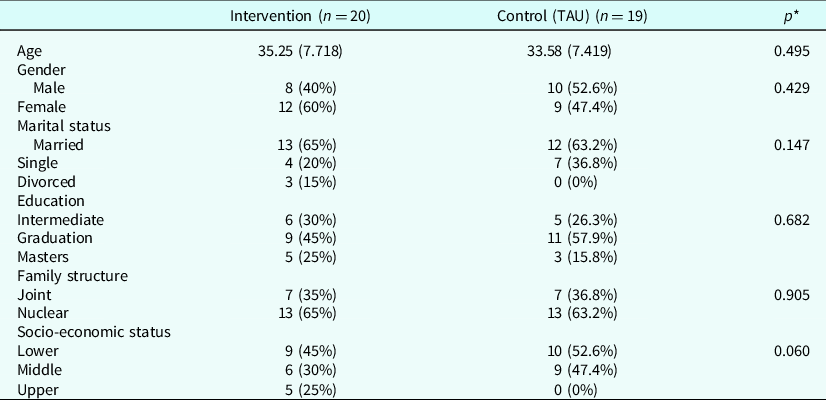
Primary care physicians initially identified 87 individuals potentially meeting inclusion criteria for the study. Research staff contacted these potential participants, and 39 met the inclusion criteria on screening. Of these, 20 were randomized to the CaCBT-GSH intervention group and 19 to the control group. Table 1 provides a summary of baseline characteristics of included participants. The two groups were similar.
Differences in demographic variables and psychopathology between the intervention and the control groups at baseline

The figures for demographic details are mean (standard deviation) for age and clinical metrics, while the rest are sample size (% within treatment group). *p-values calculated using, non-parametric Mann–Whitney U-test for continuous variables (age and clinical metrics) and Fisher’s exact test for the rest of variables which were categorical.
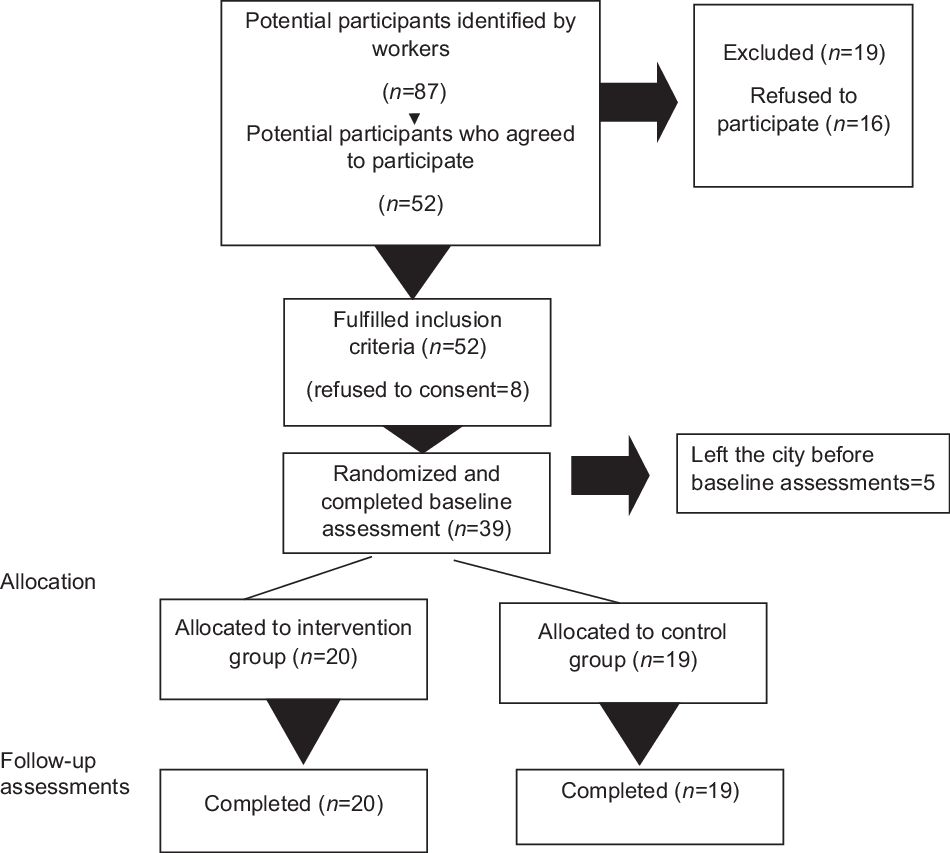
Primary care staff initially identified 87 potential participants from their case load. Of these 16 refused to participate, while 19 were excluded by the referral team based on initial screening. Therefore, 52 participants were referred to the study team for initial screening. Please refer to Fig. 1 for patient flow through the study.
CONSORT flow diagram of the trial.

Feasibility and acceptability
With regard to feasibility of the trial, recruitment was successful and occurred to time and target.
Adherence to the intervention group was excellent, with 85% (17/20) completing more than five modules. Only three participants completed five modules each. Informal feedback from the participants was positive, describing the intervention as acceptable and helpful. All those who completed the study reported the intervention to be easy to understand and the website easy to use. Informal feedback at the end of the study uses three questions: (1) which part of intervention did you like?; (2) which part you did not like?; and (3) how can we improve this intervention? Almost all the participants (18/20) described the sessions on breathing to be the most helpful. Other popular modules included dealing with thoughts (16/20), activities (14/20) and problem solving (12/20). Participants suggested that use of videos would make the intervention more appealing. There were no drop-outs from either arm of the study, indicating 100% retention in both arms.
Clinical measures
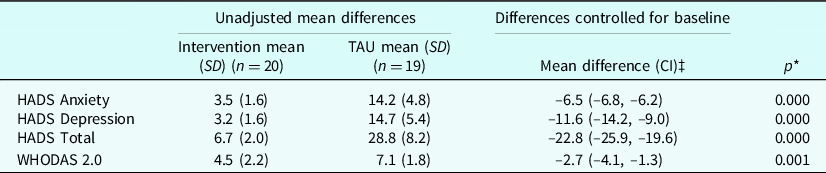
ANCOVA taking into consideration the baseline differences as covariates showed that there were statistically significant differences between the two time points in symptoms of depression, anxiety and disability. Participants in the treatment group showed significantly greater improvements in depression (HADS-Depression subscale) (p = 0.000), anxiety (HADS-Anxiety subscale) (p = 0.000), total depression and anxiety (HADS-Total) (p = 0.000) and disability (WHODAS 2.0) (p = 0.001) from baseline compared with the participants in the control group at 3 months. Table 2 describes these results.
Differences between the treatment and control groups, both uncontrolled and controlled for initial differences

Analyses were carried out using an ANCOVA. *p-values calculated using ANCOVA, controlling for baseline value of the outcome. SD, standard deviation. ‡Difference of baseline – post. Negative values mean improvement.
Discussion
To our knowledge, this is the first report of an online culturally adapted CBT-informed GSH intervention (CaCBT-GSH) for depression and anxiety from Asia. Unlike some other interventions, which were culturally adapted for the trials, we adapted an existing culturally adapted intervention for online use (http://khushiorkhatoon.com/). The study proved feasible, and the intervention was acceptable to participants. The intervention also reduced symptoms of depression, anxiety and disability.
Previously, only three papers have reported RCTs of culturally adapted online interventions that focused on the Spanish-speaking population in the USA and the local population in Colombia (Paris et al., Reference Paris, Silva, Añez-Nava, Jaramillo, Kiluk, Gordon, Nich, Frankforter, Devore, Ball and Carroll2018; Salamanca-Sanabria et al., Reference Salamanca-Sanabria, Richards, Timulak, Connell, Perilla, Parra-Villa and Castro-Camacho2020) and Indonesia (Arjadi et al., Reference Arjadi, Nauta, Scholte, Hollon, Chowdhary, Suryani and Bockting2016; Arjadi et al., Reference Arjadi, Nauta, Scholte, Hollon, Chowdhary, Suryani, Uiterwaal and Bockting2018). These inerventions provided preliminary support for online interventions in low- and middle-income countries. However, several limitations are noted. For example in the Indonesian project (Arjadi et al., Reference Arjadi, Nauta, Scholte, Hollon, Chowdhary, Suryani and Bockting2016; Arjadi et al., Reference Arjadi, Nauta, Scholte, Hollon, Chowdhary, Suryani, Uiterwaal and Bockting2018) online intervention was supported by lay therapists for up to 60 minutes per week. Similarly, the details of cultural adaptation were not available. The Colombian study provided details of cultural adaptation; however, this study also reported high drop-out rates. This study did not report extent of the guided aspect of self-help. Despite these limitations, these pioneering studies acknowledge the need for culturally adapting online interventions for mental health problems in low- and middle-income country settings. Finally, these studies did not measure feasibility and acceptability of the interventions in a systematic way. Feasibility and acceptability are important parameters in implementation and large scale system uptake.
Despite the strong evidence for its effectiveness, CBT remains under-utilized in LMICs. One key strategy to improve access to evidence-based care suggested by the World Health Organization is through task shifting or task sharing (Hoeft et al., Reference Hoeft, Fortney, Patel and Unützer2018). There is evidence to suggest that lay therapist-delivered psychosocial interventions are feasible and effective; however, due to limited resources, LMICs might not be able to afford lay therapist-delivered therapy (Chowdhary et al., Reference Chowdhary, Anand, Dimidjian, Shinde, Weobong, Balaji, Hollon, Rahman, Wilson, Verdeli, Araya, King, Jordans, Fairburn, Kirkwood and Patel2015). Therefore, there is a need to explore alternative low-cost, saleable evidence-based interventions that can be delivered with minimum resource burden in LMICs. CBT-GSH is a potential option with a strong evidence base for treating depression and anxiety disorders in high-income settings (Cuijpers et al., Reference Cuijpers, Donker, van Straten, Li and Andersson2010; Cuijpers and Schuurmans, Reference Cuijpers and Schuurmans2007; Falbe-Hansen et al., Reference Falbe-Hansen, Le Huray, Phull, Shakespeare and Wheatley2009). Online CBT as guided self-help can also be cost effective compared with in-person CBT (Thase et al., Reference Thase, McCrone, Barrett, Eells, Wisniewski, Balasubramani, Brown and Wright2020). However, only limited data are available on use of online CBT-informed GSH from LMICs.
Advancements in technology have led to successful development of digital mental health interventions. Psychosocial interventions like CBT-informed GSH can now be delivered using mobile health or web-based platforms. Cellular ’phones are widely available, affordable, and continuously decreasing in cost. In 2018 there were 106 cellular ’phone subscriptions per 100 people globally and LMICs had 102 mobile ’phone subscriptions per 100 people (World Bank, 2020). Digital platforms represent cost-effective approaches that overcome geographical and practical barriers to engagement, allowing patients to receive clinical care faster. Such platforms represent a viable resource in overcoming the significant mental health gap in LMICs. This is especially relevant during the current COVID-19 pandemic, when physical distancing, financial crises, and loss of social support threaten public mental health.
Evidence suggests that psychological interventions delivered on digital platforms are as effective as those delivered in person (Gratzer and Khalid-Khan, Reference Gratzer and Khalid-Khan2016). A recent meta-analysis suggests that digital psychological interventions are superior to usual care in LMICs (Fu et al., Reference Fu, Burger, Arjadi and Bockting2020). Thus far, we are unaware of any published trials of culturally adapted digital interventions for common mental disorders from South Asia.. The cultural relevance of the self-help material may have played a vital role in engaging patients and improving outcomes. However, this theory would need to be tested within the framework of a larger RCT comparing the intervention with the Western version of CBT-based GSH.
This feasibility study successfully achieved its required sample size, adherence was high to the intervention and drop-out rates were low, which are considerable strengths. We collected informal feedback from study participants, which was largely positive. However, as the qualitative data were not formally analysed, we cannot rely on it to confirm that the intervention was acceptable to participants. Despite this, although they had the option to refuse, most participants completed the majority of modules in the intervention. The informal feedback collected at the end of the study indicated that the treatment was highly acceptable and helpful to participants. We observed a drop in symptoms scores for anxiety and depression and a reduction in WHODAS scores in both the treatment arm and control arm. However, there was a greater reduction in the treatment arm, which was statistically significant. The control arm’s improvement may be because participants in the control arm also received some therapeutic benefit from the structured follow-up assessments with the research staff. The significant reduction in symptoms scores in the treatment group may be an indication of treatment effect.
Overall, this feasibility study’s findings are encouraging, but they require replication in a larger, confirmatory RCT. There is also a need to conduct research on cost effectiveness of self-help and guided self-help, especially in the context of low- and middle-income countries. Future research should also use formal measaures of feasibility, acceptability and user experience of online digital interventions in LAMICs.
If a larger study confirms the clinical findings of our feasibility trial, this low-cost intervention has the potential to be scaled up across LMICs like Pakistan to improve outcomes for patients with anxiety and depression. However, this is an area that requires further research, as implementation of online interventions will require improving rates of digital literacy and access to technology. Most low- and middle-income countries are low on Digital Readiness Index (DRI), i.e. business and government investment in technlogy, technology adoption and technology infrastructure as well as ease of starting digital businesses (Dagher, Reference Dagher2020). However, these efforts will not be fruitful if end users’ perspectives, perceptions and comfort with use of digital interventions are not understood, using qualitative methodology.
Future work should explore the possibility of integrating non-medical ‘digital navigators’ to enhance scalability and sustainability of the ‘Khushi or Khatoon’ intervention. Recent studies suggest that such navigators support implementation of digital health interventions and are especially relevant in LMICs, where they can customize platforms and utilize the strengths of care systems to engage patients (Rodriguez-Villa et al., Reference Rodriguez-Villa, Naslund, Keshavan, Patel and Torous2020; Wisniewski and Torous, Reference Wisniewski and Torous2020). Given the high burden of common mental disorders in these settings, such approaches may help address the significant mental health treatment gap for these conditions in LMICs and enhance public mental health.
Key practice points
-
(1) Leveraging existing virtual and digital platforms for the delivery of psychosocial interventions may be appropriate for individuals from low-resource settings.
-
(2) Using principles of CBT in a virtual self-help intervention may lead to improvement of symptoms of common mental disorders.
-
(3) Culturally adapted interventions should be considered and offered to patients with common mental disorders.
-
(4) Further research is needed on virtual and mobile delivery of culturally adapted psychosocial interventions in LMICs.
Acknowledgements
None.
Financial support
This study was funded by the Pakistan Association of Cognitive Therapists.
Conflicts of interest
The authors have no conflicts of interest to declare.
Ethics statements
The trial protocol was approved by the Pakistan Association of Cognitive Behaviour Therapy (PACBT) institutional review board. All authors have abided by the Ethical Principles of Psychologists and Code of Conduct as set out by the BABCP and BPS.
Data availability statement
The data that support the findings of this study are available from the corresponding author, O.H., upon reasonable request.
Author contributions
Madeeha Latif, Falahat Awan, Mirrat Gul, and Farooq Naeem contributed to conception of the study. Farooq Naeem and Muhammad Ayub were responsible for analysis and reporting of results. Taj Magsi was responsible for the development, maintenance and technical support for the online program. M Omair Husain, M Ishrat Husain, Kumail Sayyed, Saiqa Naz, Ozlem Aylem, Peter Phiri and Muhammad Irfan contributed to conduct of study and preparation of manuscript. All authors contributed to the design of the study, its execution and preparation of the manuscript.



Comments
No Comments have been published for this article.