The History of Joseph the Carpenter (BHO 532–533; CANT 60; clavis coptica 0037)Footnote 1 is readily accessible in many collections of New Testament Apocrypha.Footnote 2 The text is fully preserved in Arabic and Bohairic, which was the regional dialect of Lower Egypt, and fragmentarily in Sahidic (i.e., the dialect of Upper Egypt). The present paper introduces P. Duk. inv. 239, a previously unidentified Sahidic fragment of this writing, which surfaced recently among the manuscripts in the Special Collections Library of Duke University. The new textual witness supplies us with a portion of the History of Joseph the Carpenter previously unattested in Sahidic. Moreover, the Duke fragment displays at least one interesting variant reading, unrecorded in the Bohairic and Arabic versions of the text.
From a literary point of view, the History of Joseph belongs to a group of works that Joost Hagen has called the “apostolic diaries.”Footnote 3 The principal characteristic of all these texts is their claim to be apostolic books or diaries that record some of the original sayings of Jesus. They appear in the form of revelation dialoguesFootnote 4 between Christ and the apostles, usually set on the Mount of Olives. Jesus typically refers in his revelatory discourses to different topics (e.g., angelic beings; his birth, passion, and resurrection; saintly figures or places), which all happen to coincide with certain events in the Coptic calendar. The apostles record the revelation and deposit the book, most often, in the library of Jerusalem for the benefit of future generations.
As an “apostolic book,” the History of Joseph purports to be a revelation of Jesus Christ to his disciples on the Mount of Olives concerning the death of his earthly father on Epep 26 (July 20)Footnote 5 at the age of 111. The first part of the text draws heavily upon the Protevangelium of James and other apocryphal infancy narratives. Joseph is introduced as an old carpenter having children from a previous marriage (2.1–6). On the other hand, Mary is a young virgin who spent the last nine years of her life serving in the temple. When she reaches the age of twelve, the priests decide to find her a husband (3.1–2). They cast lots and Mary is given as a wife to Joseph (4.1–6). Two years later, Mary conceives by the Holy Spirit and, unaware of the miracle, Joseph wants to send her away in secret. The Archangel Gabriel appears to Joseph in a dream and reveals to him that Mary will give birth to the Savior, whose name will be Jesus (5.1–6.3). Joseph takes Mary and they go to Bethlehem in order to register for the census. On the way Jesus Christ is born, fulfilling the prophecy that the Messiah must come from Bethlehem (7.1–3). The episode of the flight to Egypt and the massacre of the innocents are mentioned at 8.1–3. The narrative concerning the childhood of Jesus ends with the return of the holy family to Nazareth (9.1). Chapters 10–29 represent a long section that focuses on the death and burial of Joseph. It is interesting to remark that the details concerning the preparations of the body for burial follow closely the funerary rituals described in the Book of the Dead, this being one of the elements that suggest an Egyptian provenance of the document.Footnote 6 The section ends with the burial of Joseph in the tomb of the patriarch Jacob. Finally, in chapters 30–32 we find out that although Jesus Christ did not grant immortality to Joseph, he protected his body from decay and transferred his soul to heaven.
Various influences have been detected in the text: from the Protevangelium of James (which had an impact on the chapters concerning the childhood of Christ) and the Testaments of Abraham, Jacob, and Isaac (CAVT 88, 98, 99), to ancient Egyptian mythology and Gnosticism. I should like to note here, however briefly, a few points of contact between the History of Joseph and the narratives regarding the death (i.e., Dormition) and assumption of the Virgin Mary. Like many texts concerning the Dormition of the Virgin, the History recounts only briefly the major moments of Joseph's life,Footnote 7 dedicating a more extensive section to the events surrounding his death. Moreover, another feature that the History of Joseph shares with the Dormition stories is an obvious tendency to see Christ as divine and human at the same time. If in the Dormition narratives Mary is portrayed as Theotokos, who gave birth to God and man in a real sense, but had kept her virginity untouched, our text calls Joseph “Christ's father according to the flesh.” As unusual as it may sound, this formula aims to defend the idea that, although Jesus is divine, he was also a descendant of David, being thus a human being. The human and divine condition of Christ is expressed by the author(s) of the text through Joseph: “You are Jesus Christ, truly Son of God and son of man at the same time” (Hist. Joseph 17.17).
According to the hypothesis of Louis-Théophile Lefort, the History of Joseph was originally composed in the Sahidic dialect of Coptic.Footnote 8 This is ascertained by the numerous biblical quotations which follow closely the Sahidic version of the Bible. As for the Bohairic version, this contains linguistic features that indicate it was translated from Sahidic. Finally, the Arabic translation of the History of Joseph was made from Bohairic. A comparison between the various manuscripts of the Arabic and Coptic recensions shows that the text suffered some redactional changes during the transmission process. It is likely that some modifications had been made already during the transmission of the Sahidic manuscripts. Indeed, those parts of the text where the Sahidic manuscripts overlap exhibit some manifest divergences, which indicate that the original writing has been revised several times.Footnote 9
The History of Joseph the Carpenter became widely known in 1722 through Georg August Wallin's Latin translation after an Arabic manuscript in the Royal Library in Paris.Footnote 10 Wallin's Arabic text and Latin translation have been reprinted, with or without emendations, on several occasions.Footnote 11 Antonio Battista and Bellarmino Bagatti published in 1975 the current standard edition of the Arabic version, based on numerous manuscripts of Egyptian provenance.Footnote 12
As early as 1808, Étienne Quatremère discovered the Bohairic version of the History of Joseph the Carpenter in the manuscript Borg. Copt. 66.Footnote 13 The army of Napoleon confiscated this manuscript together with others from the collection of Stefano Borgia, housing it between 1797 and 1815 in the Royal Library in Paris.Footnote 14 What they left in the Vatican was only a copy of the Bohairic History of Joseph, which was carelessly transcribed after the original by the Coptic Roman Catholic priest Raffaele Tuki at the end of the eighteenth century. This modern copy is to be found in the paper manuscript Borg. Copt. 25. Because of the temporary removal of the original document from Rome, Georg Zoega was able to mention in his catalogue of the Coptic manuscripts in the Borgian collection only Tuki's copy of the Bohairic History of Joseph.Footnote 15 Moreover, this faulty transcription served as a basis for Eugène Revillout's lithographed 1876 edition.Footnote 16 Forbes Robinson was the first to draw attention to two Bohairic fragments in the John Rylands Library in Manchester (Crawford no. 39), which came from a second witness of our text in this dialect.Footnote 17
In 1883, the text of Borg. Copt. 66 was finally published by Paul de Lagarde.Footnote 18 No other edition of the Bohairic text has been made ever since, but we should remark that Forbes Robinson's English translation from 1896 was based on an autoptic examination of the manuscript in the Vatican, and his notes to the translation contain useful improvements to de Lagarde's edition.Footnote 19 Similarly, Bart D. Erhman and Zlatko Pleše's publication of the History of Joseph in a more recent collection of apocryphal writings is said to be dependent on de Lagarde's text, but “with occasional changes based on the collation against the manuscript photographs.”Footnote 20
The Sahidic version, this is attested by several dismembered manuscripts scattered all over the world. Georg Zoega first reported on the existence of eight leaves in the Borgian collection (no. 121).Footnote 21 Some two decades later, Johann Karl Thilo had recognized that Zoega no. 116, which is a single leaf paginated 87–88, might also belong to the History of Joseph. Although Thilo's identification proved to be correct, the German scholar was wrong in suspecting that this fragment would belong to the same codex as Zoega no. 121:
Ejusdem codicis Sahidici, ex quo Zoega hæc partim ad verbum reddidit, partim excerptsit, suspicor esse fragmentum folii unius sub num. CXVI, p. 223, memoratum. Referente Zoega narrat ibi Jesus, quomodo cum concepit Virgo Maria et peperit in Bethlehem prope monumentum Rachelis. Conf. hist. Josephi cap. VII extr.Footnote 22
In addition to these, Forbes Robinson identified a Sahidic fragment in the British Museum (transferred later to the British Library), which belongs to yet another manuscript of the History of Joseph.Footnote 23 In a seminal article published in Le Muséon in 1953, Louis-Théophile Lefort added to the Sahidic codex first identified by Zoega five consecutive folios from the miscellaneous volume Copte 12917 of the National Library in Paris (BNF, Copte 12917, foll. 12–16).Footnote 24 Lefort was the one who organized codicologically the surviving Sahidic vestiges of the History of Joseph in four separate codices, which he designated with the letters A–D. Finally, in 2009 I edited in the same journal two small fragments in the National Library in Paris, which join together to form the bottom of a leaf (BNF, Copte 1318, fol. 148 + 1322, fol. 40).Footnote 25 They belong to Lefort's Codex A, the best preserved Sahidic copy of the text. All the fragments of the History of Joseph in this dialect are written on parchment and come from the library of the White Monastery in Upper Egypt:Footnote 26

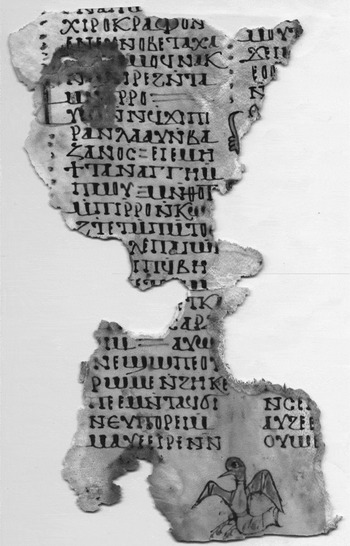
Now, to these manuscript witnesses should be added a heretofore unidentified Sahidic fragment from the Duke Coptic manuscripts available in the online catalogue.Footnote 28 P. Duk. inv. 239 (olim Coptic MS. 12) is a fragment from a parchment codex that was acquired by purchase in 1970. Nothing is known concerning the provenance of the item. A paleographical comparison with the vestiges of the other four Sahidic codices of the History of Joseph indicated that the Duke fragment had not belonged to any of them. Thus, P. Duk. inv. 239 must be attributed to a fifth Sahidic manuscript of the History of Joseph, of which it is the only witness presently known.
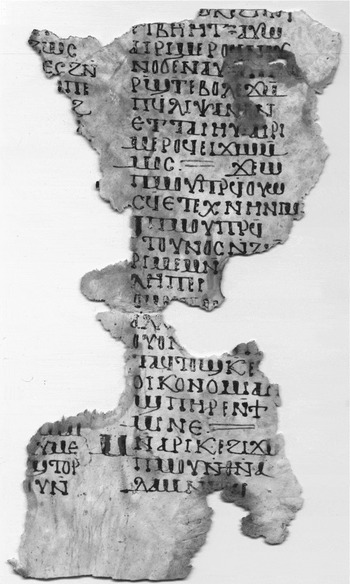
This parchment fragment measures 16 × 27 cm and was written in two columns. However, much of the second column of the recto and, consequently, the first of the verso, have disappeared, only a few letters being preserved. On the bottom of the recto, which is the hair side of the skin, there is the figure of a bird drawn with the wings stretched. There are no traces of pagination or quire signature. The fragment can be perhaps dated paleographically to the eleventh century c.e.
The text of P. Duk. inv. 239 corresponds to chapters 26.5–28.2 of the History of Joseph the Carpenter. As I already said, this portion of the text was previously unattested in Sahidic. In chapter 26, Jesus Christ blesses those who will give alms in the name of his earthly father and commemorate him. Among the blessed are also the scribes who will copy the History of Joseph. The Duke fragment starts at this point of the narrative. Its incipit says that after the death of the scribes, Christ will remove their sins from the ledger (χειρόγραφoν) and they shall escape the torments of the afterlife. For the poor persons who do not have the means to give alms to honor the saint, it is enough if they give the name of Joseph to one of their children. After the long lacuna, which encompasses most of the right-hand column on the recto and the left-hand column on the verso, the text continues on the verso with the lament of Jesus over the remnants (λείψανoν) of his father Joseph. Christ exhorts the reader not to blame death as Adam and Eve had done, because it was established by God. The text breaks off at this point, perhaps no more than three folios before the end of the text.
The new fragment in the Duke papyrus collection contains a few variant readings, most of them minor, which are not attested in any of the surviving versions of the text. One lectio is especially interesting: the reading “I will grant (χαρίζεσθαι) him to you as son in my kingdom” (recto, col. 1, lines 4–7 = 26.5) has not been recorded until now. Curiously enough, the same expression occurs in the Sahidic Testament of Isaac (CAVT 98),Footnote 29 a text with which the History of Joseph has some literary connections. The context and the argument are similar in both writings: those who honor Joseph and Isaac will gain the privilege of becoming their “sons” in the kingdom of God:

The following lines contain the editio princeps of P. Duk. inv. 239. As the new fragment offers from time to time variant readings, which are not attested in the Bohairic and Arabic versions, I tried not to fill the lacunae except in the cases where the surviving letters allowed reconstruction with some degree of probability.
P. Duk. inv. 239 recto (Hair side)

P. Duk. inv. 239 verso (Flesh side)

TRANSLATION:
(recto col. 1) [26.5.] […] I will tear the ledger (χειρόγραφoν) of their sins and I will grant (χαρίζεσθαι) him to you as son in my kingdom. And he shall not experience (πεῖρα) any torment (βάσανος) except (εἰ μήτι) the necessity (ἀνάγκη) of death and the fear of the river of fire which is in front of my Father […] his tribunal (βῆμα) […] that purifies (καθαρίζειν) all flesh (σάρξ). [6.] And again, if he is a poor man who does not have provisions (εὐπoρεῖν) to do (col. 2) [that which I have said, if he begets a son and] calls [his name] J[oseph], glorifying [your name], no [famine nor (οὐδέ) plague (λoιμός) shall be in that house]. […] (verso col. 1) [27.2.] […] just as if (ὡς) [it was entangled] with iron [nails] […] [4.] […] [he went with] me [to] Egypt [and the great] troubles [that he endured] […] (col. 2) because of me. And I wept for him for a long time. I spread over his honored remains (λείψανoν) (and) I wept for him saying: [28.1.] ‘O death, the destroyer of all craftsmanship (τέχνη), O death, the raiser of much weeping and sadness (λυπεῖν), but (ἀλλά) the one who is over everyone has appointed for you the amazing plan (oἰκoνoμία) of this sort. [2.] Do not blame death like Adam and his [wife did] […]
P. Duk. inv. 239 recto

P. Duk. imv. 239 verso