




No CrossRef data available.
Article contents
Technology assessment in dentistry: A comparison of the longevity and cost-effectiveness of inlays
Published online by Cambridge University Press: 04 August 2005
Abstract
Objectives: An example of technology assessment in dental care by evaluating the (cost-)effectiveness of types of three-surface inlays (gold, laboratory-fabricated ceramic, and chairside CAD/CAM ceramic) is provided.
Methods: MEDLINE, EMBASE, and the Cochrane Library were searched for studies published between 1966 and June 2003 that reported annual survival probabilities and annual observations. The longevity of different types of inlays was measured by the number of failure-free years. Annual survival rates from different studies were pooled by weighing the rates of each study by the inverse of the variance of the effect estimate. A cost-effectiveness analysis from the perspective of German private health insurers was performed using billing charges.
Results: Three, five, and two case series on laboratory-fabricated ceramic, chairside CAD/CAM ceramic, and gold inlays, respectively, were included. Over a 9-year observation period, the number of undiscounted failure-free years was 8.62 (95 percent confidence interval, 8.40–8.85), 8.65 (8.58–8.73), and 8.76 (8.72–8.80) for laboratory-fabricated ceramic, chairside CAD/CAM ceramic, and gold inlays, respectively. Laboratory-fabricated ceramic inlays were the most expensive.
Conclusions: While laboratory-fabricated ceramic, chairside CAD/CAM ceramic, and gold inlays had a strikingly similar failure-free survival rate, laboratory-fabricated ceramic inlays had the highest costs and, thus, were less cost-effective than chairside CAD/CAM ceramic and gold inlays.
Information
- Type
- GENERAL ESSAYS
- Information
- International Journal of Technology Assessment in Health Care , Volume 21 , Issue 3 , July 2005 , pp. 319 - 325
- Copyright
- © 2005 Cambridge University Press
Industrialized countries have recognized the importance of technology assessment in dental care for approximately a decade (2;17). However, dental technology assessment seems to be conducted less frequently than medical technology assessment, even adjusted for potential need. Dental technology assessment is needed because of the rapid increase of published research and rising dental-care expenditures due to new dental treatment options. At present, governments and health insurers are having increased difficulty in covering dental services and are under pressure to trade off treatment options based on clinical effectiveness and cost-effectiveness. One area where new options have emerged over the past 20 years are inlay restorations. In Germany, private health insurers, which cover approximately 10 percent of the population, spend approximately 6 percent of total dental expenditures on inlays (written communication by Heinrich Dreschmann on September 8, 2003). Whereas the statutory health insurers in Germany limit reimbursement to amalgam and composite fillings, private health insurers also pay for conventional laboratory-fabricated ceramic, chairside CAD/CAM ceramic, and gold inlays. The abbreviation CAD/CAM stands for computer-aided design/computer-aided manufacturing and describes a process that enables the fabrication of ceramic restorations at the patient's chairside without a dental laboratory.
Whereas there exist only a few head-to-head trials on the longevity of laboratory-fabricated ceramic, chairside CAD/CAM ceramic, or gold inlays (3;5;20), various case series on each type of inlay do exist. To the best of the authors' knowledge, no attempt has yet been made to quantitatively summarize the wealth of information available from case series on the longevity of the three-surface inlays. A recent review on case series (15) does exist that compares the longevity of laboratory-fabricated ceramic, chairside CAD/CAM ceramic, and gold inlays, but this review neither focuses on the three-surface inlays nor quantitatively summarizes results from various studies.
There is also little known about the cost-effectiveness of laboratory-fabricated ceramic, chairside CAD/CAM ceramic, and gold inlays. Although some cost-effectiveness analyses on inlays do exist (5;19), they neither consider all three treatment options, nor include more recent evidence on the inlays' longevity.
The goal of this study is to respond to the shortcomings of the existing literature by summarizing results from case series on the longevity of laboratory-fabricated ceramic, chairside CAD/CAM ceramic, and gold three-surface inlays and determining the inlays' cost-effectiveness. To this end, a systematic search for relevant studies was performed and the results were pooled in a meta-analysis, a quantitative method of combining the results of independent studies. Cost-effectiveness was assessed based on a German private insurer's billing data.
METHODS
Meta-Analysis
Selection Criteria
The meta-analysis included studies on three-surface (mesial–occlusal–distal [MOD]) laboratory-fabricated ceramic, chairside CAD/CAM ceramic, and gold inlays that reported annual survival probabilities and annual observations. Annual survival probabilities and annual observations were necessary for three reasons: (i) to detect any significant survival differences; (ii) to pool the survival data from different studies; and (iii) to determine up to which point in time the percentage of observations fell below 20 percent.
The above selection criterion represented a minimum of necessary information. Three further inclusion criteria made the selection more strict. These criteria were adopted from a systematic review by Chadwick et al. (5), who considered studies on all types of inlays until 1997. The criteria were as follows. First, studies had to be randomized and controlled. Observational studies were included only if the percentage of subjects at the first follow-up was at least 90 percent, unless the study took a random sample of subjects or explained the reasons for the subject loss. Second, studies had to evaluate the need for restoration based on appropriate criteria. And third, studies had to state or use criteria for deciding when a restoration had failed and needed to be replaced.
Literature Search and Data Abstraction
A search of MEDLINE, EMBASE, and the Cochrane Library was performed for studies on the longevity of inlays published between 1966 and June 2003. To this end, the MeSH term inlays was combined with the MeSH term life tables (EMBASE: lifetables) or the free search term Kaplan–Meier (EMBASE: KaplanMeier). In addition, studies listed in the systematic review by Chadwick et al. (5) were analyzed. Authors were contacted when the studies reported a life table, but no annual survival probabilities and numbers of observations. All annual follow-ups were included until less than 20 percent of observations remained in the study (23).
Statistical Analysis
Longevity of inlays was measured in terms of the number of failure-free years. Annual survival rates were pooled from different studies by weighing each study by the inverse of the variance (one divided by the square of the standard error) of the effect estimate (6). The Wilson score method (29) was used to determine variances of annual survival rates. This method yields an asymmetrical interval around the mean and avoids zero width intervals when p = 0 or 1. To avoid zero variances, variances were calculated based on lower confidence limits. The variance of the entire survival curve was calculated using a derivation of Greenwood's formula (12;14). Values of p<.05 were considered to be statistically significant.
Cost-Effectiveness Analysis
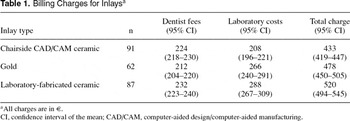
A random sample of all paid dentist bills dated from 2003 to 2004 was obtained from a private German health insurer. Given that the bills were anonymous, it was not known whether or not some of the bills came from the same dentist. Billing charges are listed in Table 1. Dentist fees cover the dentist's salary, material costs, and computer system costs (purchase and maintenance; chairside CAD/CAM ceramic inlays only), whereas laboratory costs include the salary of technicians.

A cost-effectiveness analysis from the perspective of German private health insurers was performed. Treatment beyond initial restoration was not considered because of the difficulty of modeling the consequences of restoration failure. A lost tooth, for example, can be replaced either by a bridge, denture, or implant. Failure-free years were discounted at an annual rate of 3 percent as recommended by the U.S. Panel on Cost Effectiveness in Health and Medicine (11). Costs were not discounted, because all costs considered were incurred upfront. Costs for prior examinations and follow-up appointments were not taken into account, because they were the same for all inlay restorations and, thus, canceled out.
The three inlay types were compared using the incremental cost-effectiveness ratio. This ratio was defined as the additional cost of an inlay divided by the additional failure-free survival, compared with the next less-expensive inlay. Inlays that were less effective and more costly than an alternative (dominated) and inlays with a higher cost-effectiveness ratio than a more effective alternative strategy (extended dominance) were ruled out (11).
Sensitivity Analysis
A sensitivity analysis was performed to investigate how failure-free survival would change if a 4-year instead of a 9-year follow-up period were considered. Thus, it was attempted to mitigate a potential bias from the few long-term studies on the most likely (base case) results.
RESULTS
Literature Search
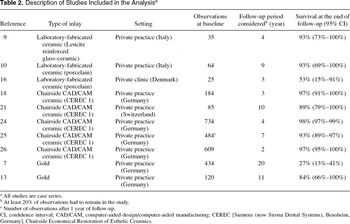
MEDLINE, EMBASE, and the Cochrane Library yielded a total of twenty-two hits using the search terms inlays, life tables (or lifetables), and Kaplan–Meier (or KaplanMeier) for publications from 1966 to June 2003. The systematic literature search did not find any trial that compared the longevity of laboratory-fabricated ceramic, chairside CAD/CAM ceramic, and gold inlays. Furthermore, it did not reveal any study that met the strict inclusion criteria. Of the twenty-two publications, eighteen did not meet the minimum selection criteria and 4 studies (7;9;10;16) did. The hand search yielded six additional studies (13;18;21;24–26) that met the minimum selection criteria. All ten studies meeting the minimum criteria were case series and are described in Table 2. There were three, five, and two studies on laboratory-fabricated ceramic, chairside CAD/CAM ceramic, and gold inlays, respectively.

Meta-analysis
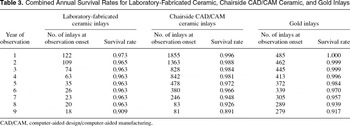
Table 3 shows the combined annual survival rates for each inlay type over a 9-year period. According to the log rank test, which tests for equality of survival functions, gold inlays had a significantly higher survival rate than chairside CAD/CAM ceramic inlays (p<.001). Chairside CAD/CAM ceramic inlays, on the other hand, had a significantly higher survival rate than laboratory-fabricated ceramic inlays (p<.05). Interestingly, the difference between gold and laboratory-fabricated ceramic inlays was not statistically different (p<.10) due to a lack of statistical power.

The sensitivity analysis using a 4-year follow-up period showed that the number of undiscounted failure-free years (95 percent confidence interval) was 3.86 (3.80–3.93), 3.95 (3.94–3.96), and 3.99 (3.98–4.01) for laboratory-fabricated ceramic, chairside CAD/CAM ceramic, and gold inlays, respectively. The log-rank test showed that the difference between gold and chairside CAD/CAM ceramic inlays in the number of failure-free years remained significant (p<.001), whereas the difference between chairside CAD/CAM ceramic and laboratory-fabricated ceramic inlays became insignificant (p<.25).
Cost(-effectiveness) Analysis
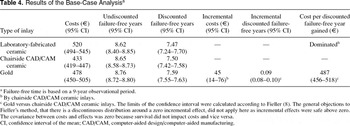
Differences in total charges between gold and chairside CAD/CAM ceramic as well as between laboratory-fabricated ceramic and gold inlays were significantly different (p <.02). In the base-case analysis, laboratory-fabricated ceramic inlays had significantly higher costs and significantly lower failure-free survival than CAD/CAM ceramic inlays (Table 4) and, thus, were dominated. Gold inlays incurred significantly higher costs and showed longer failure-free survival than chairside CAD/CAM ceramic inlays, resulting in an incremental cost-effectiveness ratio of €487 (95 percent confidence interval, 456–518) per failure-free year gained. In the sensitivity analysis, which used a 4-year follow-up period, the incremental cost-effectiveness ratio of gold versus chairside CAD/CAM ceramic inlays was €1082 (95 percent confidence interval, 287–2254) per failure-free year gained.

DISCUSSION
The goal of this study is to provide an example of technology assessment in dental care, which is increasingly being recognized as important (2;17). Although the analysis does not provide a complete technology assessment, which would include a discussion of social, ethical, legal, and implementation issues, it focuses on clinical and economical aspects of three-surface inlays. The paper stresses the importance of dental technology assessment by pointing out deficits in the quality of studies reporting the longevity of three-surface inlays. No study complied with the strict inclusion criteria used here. The meta-analysis, which was based on case series only, revealed that the three inlay types showed a strikingly similar failure-free survival rate over a 9-year observation period. This result was confirmed by a sensitivity analysis that used a 4-year follow-up period and, thus, mitigated the impact of a few long-term studies on long-term results.
Due to their higher costs and shorter survival rate, laboratory-fabricated ceramic inlays were dominated by chairside CAD/CAM ceramic inlays in the most likely scenario. Gold inlays had significantly higher costs and survival rates than chairside CAD/CAM ceramic inlays, both in the most likely scenario and in the sensitivity analysis. On the other hand, if the significant difference in the survival rates of gold and chairside CAD/CAM ceramic inlays were regarded as clinically irrelevant, chairside CAD/CAM ceramic inlays would become more cost-effective than gold inlays in the most likely scenario.
The meta-analytic approach had the advantage that it put evidence from various sources in order and increased the power to detect differences between inlays. Nonetheless, the results of this study should be interpreted with caution for the following reasons. First, the meta-analysis did not include all studies that met the inclusion criteria. Apart from a publication bias, which describes the tendency to publish studies with favorable outcomes rather than studies with unfavorable outcomes and is perhaps inherent to all systematic reviews, the analysis was particularly handicapped by insufficient reporting of annual survival probabilities and numbers of observations in publications, even after direct correspondence with authors. This failure of reporting is to some degree understandable, because most studies on the longevity of inlays did not investigate three-surface inlays in isolation and, thus, may not have had enough space to report subgroup analyses. Furthermore, it is also common to other areas of clinical care to present results of survival analyses using Kaplan–Meier plots. These plots are highly illustrative, but do not provide the opportunity to read off numbers accurately. Furthermore, the search algorithm, although containing only two search terms, might still have been too restrictive. Some studies that had investigated the longevity of inlays may not have been captured. A more inclusive literature search, however, was unlikely to be efficient, because of the above-mentioned problems with insufficient reporting. Similar efficiency considerations on searching the available literature have been proposed elsewhere for rapid health technology assessments (22) and updating clinical practice guidelines (27).
A second limitation of the analysis concerns the absence of randomized and nonrandomized comparisons of two or more inlays. Therefore, the analysis had to rely on case series without a control group. There are several limitations when no control group is present. In contrast to randomized comparisons, which ensure equal conditions for different treatments, treatment settings of case series may vary in terms of patient characteristics (e.g., age, strength of the remaining tooth substance, and level of dental care), dentist characteristics (e.g., skills), and the environment (e.g., financial incentives for re-restoration and education of dentists). This heterogeneity of the case series also limited pooling of studies on the same inlays. A further source of heterogeneity of studies on laboratory-fabricated ceramic inlays was the pooling of different materials.
Third, estimates on failure-free survival are limited by the length of follow-up in the studies included. It is not known whether or not a longer follow-up period would lead to a different ranking of inlays. Long-term survival estimates only exist for gold inlays (7;28). A longer follow-up period might also influence the cost-effectiveness ratio.
Fourth, outcome parameters other than costs and restoration failure were not considered, although some of these may be considered important; for instance, postoperative hypersensitivity and esthetic appearance. Whereas so-called quality-adjusted tooth years (QATYs) (1;4) allow to combine longevity with quality-of-life issues such as side-effects and esthetics of inlays, the absence of published data on the perception of side-effects and esthetics precluded such an analysis. Given that many patients value the esthetic appearance of laboratory-fabricated ceramic and chairside CAD/CAM ceramic inlays, the cost-effectiveness measure, costs per additional failure-free year, underestimates the cost-effectiveness of laboratory-fabricated ceramic and chairside CAD/CAM ceramic inlays compared with gold inlays.
Fifth, it was not possible to determine how much private health insurers would spend (or save) on all inlays over 1 year if the current reimbursement policy for inlays were changed. Such a calculation would have required information on the proportion of the different inlay types used.
Sixth, the cost-effectiveness of dental technology was not considered from a societal perspective, because this strategy would have required additional assumptions. To begin with, taking a societal perspective means considering opportunity costs instead of charges. To determine opportunity costs, excess profits must be subtracted from charges. The authors thought, however, that estimating excess profits was too speculative. A further reason against holding a societal perspective was the difficulty of estimating indirect costs such as productivity losses and transportation costs associated with dentist visits.
In summary, this study presents a first attempt to quantitatively summarize studies on the longevity of inlays. Despite the study's limitations and the search for scientific perfection, decision-makers may use the results from this study as the best available evidence at present. Although the cost-effectiveness ratio of gold inlays as calculated in this study cannot be compared with those of other studies, the study shows that laboratory-fabricated ceramic inlays are less cost-effective than chairside CAD/CAM ceramic inlays. Assuming that the survival difference between gold and chairside CAD/CAM ceramic inlays is clinically irrelevant, chairside CAD/CAM ceramic inlays also become more cost-effective than gold inlays in the most likely scenario. With regard to future research, investigators are encouraged to publish data on survival rates and numbers of observations at each follow-up date in a table where possible. This presentation makes data more accessible for secondary research. Furthermore, randomized trials on the longevity of inlays are recommended using the inclusion criteria proposed by Chadwick et al. (5).
POLICY IMPLICATIONS
This study shows that chairside CAD/CAM ceramic inlays are more cost-effective than laboratory-fabricated ceramic inlays and perhaps gold inlays. Given that the assessment of longevity is based on case series without a control group, it is matter of risk attitude whether or not policy-makers decide to change reimbursement policy now or await the results of future randomized trials.
CONTACT INFORMATION
Afschin Gandjour, MD, PhD, Lecturer (afschin.gandjour@medizin.uni-koeln.de), Institute of Health Economics and Clinical Epidemiology, University of Cologne, Gleueler Straße 176-178, 50935 Cologne, Germany
Thomas Kerschbaum, DDS, Dr med Dent Habil, Professor (T.Kerschbaum@uni-koeln.de), Preclinical Dentistry, Dental School, University of Cologne, Kerpener Str. 32, D-50931 Cologne, Germany
Andreas Reis, MD, MSc, Associate Professional Chair (reisa@who.int); Department of Ethics, Trade, Human Rights and Health Law; World Health Organization; 20, Avenue Appia; CH-1211 Geneva 27, Switzerland
Karl Wilhelm Lauterbach, MD, DSc, Professor and Director (LauterlGMG@t-online.de), Institute of Health Economics and Clinical Epidemiology, University of Cologne, Gleueler Straße 176-178, 50935 Cologne, Germany
The authors thank Noelle Aplevich, MA, for her very valuable comments on an earlier draft.
References
Antczak-Bouckoms AA,
Weinstein MC.
1987
Cost-effectiveness analysis of periodontal disease control.
J Dent Res.
66:
1630–
1635.Google Scholar
Axelsson S,
Dahlgren H,
Svensson Å, et al.
2000.
Need to assess dental care.
White Report. Stockholm:
The Swedish Council on Technology Assessment in Health Care;
Bergman MA.
1999
The clinical performance of ceramic inlays: A review.
Aust Dent J.
44:
157–
168.Google Scholar
Birch S.
1986
Measuring dental health: Improvements on the DMF index.
Community Dent Health.
3:
303–
311.Google Scholar
Chadwick BL,
Dummer PM,
Dunstan F, et al.
2001.
The longevity of dental restorations: A systematic review.
NHS CRD Report 19. York:
University of York;
Coplen SE,
Antman EM,
Berlin JA,
Hewitt P,
Chalmers TC.
1990
Efficacy and safety of quinidine therapy for maintenance of sinus rhythm after cardioversion. A meta-analysis of randomized control trials.
Circulation.
82:
1106–
1116.Google Scholar
Erpenstein H,
Kerschbaum T,
Halfin T.
2001
Long-term survival of cast-gold inlays in a specialized dental practice.
Clin Oral Investig.
5:
162–
166.Google Scholar
Fieller EC.
1954
Some problems in interval estimation.
J R Stat Soc (B).
16:
175–
183.Google Scholar
Fradeani M,
Aquilano A,
Bassein L.
1997
Longitudinal study of pressed glass-ceramic inlays for four and a half years.
J Prosthet Dent.
78:
346–
353.Google Scholar
Fuzzi M,
Rappelli G.
1999
Ceramic inlays: Clinical assessment and survival rate.
J Adhes Dent.
1:
71–
79.Google Scholar
Gold MR,
Siegel JE,
Russell LB,
Weinstein MC.
1996.
Cost-effectiveness in health and medicine.
New York:
Oxford University Press;
Haberkorn T.
2003.
Verweildaueranalyse von Goldgussinlays und Teilkronen
[dissertation]. Cologne:
University of Cologne;
Harris EK,
Albert A.
1991
Survivorship analysis for clinical studies.
New York:
Marcel Dekker;
29–
49.
Hickel R,
Manhart J.
2001
Longevity of restorations in posterior teeth and reasons for failure.
J Adhes Dent.
3:
45–
64.Google Scholar
Isidor F,
Brondum K.
1995
A clinical evaluation of porcelain inlays.
J Prosthet Dent.
74:
140–
144.Google Scholar
Leake JL,
Birch S,
Lewis DW.
1994
Technology assessment in dentistry.
J Can Dent Assoc.
60:
1066–
1070.Google Scholar
Lenzen JR.
1994.
Bewährung von computer-gestützt hergestellten Keramik-Inlays nach der CEREC-Methode in einer zahnärztlichen Praxis
[dissertation]. Cologne:
University of Cologne;
Mjor IA.
1992
Long term cost of restorative therapy using different materials.
Scand J Dent Res.
100:
60–
65.Google Scholar
Molin MK,
Karlsson SL.
2000
A randomized 5-year clinical evaluation of 3 ceramic inlay systems.
Int J Prosthodont.
13:
194–
200.Google Scholar
Otto T,
De Nisco S.
2002
Computer-aided direct ceramic restorations: A 10-year prospective clinical study of Cerec CAD/CAM inlays and onlays.
Int J Prosthodont.
15:
122–
128.Google Scholar
Perleth M,
Luhmann D,
Gibis B,
Droste S.
2001
‘Rapid Assessments’—schnelle Bewertung medizinischer Technologien.
Gesundheitswesen.
63
(Suppl 1):
S79–
S84.Google Scholar
Pocock SJ,
Clayton TC,
Altman DG.
2002
Survival plots of time-to-event outcomes in clinical trials: Good practice and pitfalls.
Lancet.
359:
1686–
1689.Google Scholar
Posselt A.
2003
Kerschbaum T. Longivity of 2328 chairside CEREC inlays and onlays.
Int J Computerized Dent.
6:
231–
238.Google Scholar
Reiß B.
2001
Long-term clinical performance of CEREC restorations and the variables affecting treatment success.
Compend Contin Educ Dent.
22
(Suppl):
14–
18.Google Scholar
Schauermann M.
1998.
Verweildauer von “at chairside”-hergestellten CEREC-Restaurationen in einer Kölner Zahnarztpraxis
[dissertation]. Cologne:
University of Cologne;
Shekelle PG,
Ortiz E,
Rhodes S, et al.
2001
Validity of the Agency for Healthcare Research and Quality clinical practice guidelines: How quickly do guidelines become outdated?
JAMA.
286:
1461–
1467.Google Scholar
Studer SP,
Wettstein F,
Lehner C,
Zullo TG,
Scharer P.
2000
Long-term survival estimates of cast gold inlays with their analysis of failures.
J Oral Rehabil.
27:
461–
472.Google Scholar
Wilson EB.
1927
Probable inference, the law of succession, and statistical inference.
J Am Stat Assoc.
22:
209–
212.Google Scholar
Billing Charges for Inlaysa
Description of Studies Included in the Analysisa
Combined Annual Survival Rates for Laboratory-Fabricated Ceramic, Chairside CAD/CAM Ceramic, and Gold Inlays
Results of the Base-Case Analysisa
 You have
Access
- 3
- Cited by