In the first few decades of the nineteenth century, the experience of missionaries among peoples as diverse as the ancient civilizations of India, the highly organized Zulu kingdoms, and the cannibal tribes of the South Seas had sparked a national debate concerning whether or not the “civilization of the heathen” was necessary before they could be converted, or whether Christianity would be the best means of civilizing them. Unresolved as far as public policy was concerned, this question entered discussions of the 1835 Select Committee on Aboriginal Tribes (British Settlements), a committee convened to address problems arising between British settlers and indigenous communities, including important trade sites in Australia, New Zealand, and the islands of the Pacific.Footnote 1 As with several other areas where significant British imperial pressure never took the form of direct colonial rule, the trade ports in China fell outside the committee's explicit considerations. Along with forbidding foreign settlements, Chinese culture did not fit the terms or assumptions of the committee's conversation. Since the first Jesuit mission to China in the late sixteenth century, there had been little doubt in Europe that Chinese civilization was far advanced. As a tightly controlled bureaucratic state confident of its own position as the Middle Kingdom of the world, China simply did not work within the discourse of civilization. This essay explores one attempt to adjust the terms of that British discourse in order to accommodate a civilized China.
Even as the Select Committee grappled with the relationship of civilization and Christianity, the terms of the conversation in religious sectors were likewise unstable. In these discussions, the rhetoric of light and dark slid easily from its spiritual and scriptural root in metaphor into the semantic range of civilization and barbarity. Especially after the Clapham Sect's success in achieving “the abolition of the slave trade and the reformation of manners,” many British Christians conceived of British civilization as an outworking of its dominant religious system, thereby eliding faith with laissez faire economics, social customs, and politics.Footnote 2 The more a culture held customs similar to Europeans, the less dark it was and the more easily convertible or civilizable. Even India, with its undeniably ancient civilization, was easily proven to be dark in “spiritual degradation” and in a “fallen state” not only shown by its idolatries and polytheism, but also evidenced by its fragmented linguistic groupings, caste system, lack of centralized government, low levels of education, horrific hygiene, and most stunningly, the practice of sati (Mani 109). The latter cultural and political conditions proved the former darkness.
Complicating this discussion, China proved difficult for missionaries to categorize. Evangelical missionaries to China were confounded by the inability to equate civilization with spiritual light. As I relate in the following pages, missionaries’ experiences left them simultaneously certain of China's highly developed civilization and China's deep depravity. The mission to China and the representations of the Chinese in mission narratives became sites for testing the flexibility of the light and darkness metaphor, as well as a means of reassessing the central Christian narrative against various cultural backdrops. If the terms could be usefully rearranged to include both Chinese depravity and Chinese civilization, then the metaphors and their spiritual significations need not be jettisoned when the scale of civilization, even British civilization, no longer matched previous notions of the spiritual geography. This role of Chinese mission narratives, which helped reinvigorate religious semantic flexibility, has remained unexplored.
Despite a recent flurry of interest in China by scholars of Romantic and Victorian studies, among whom “China has made its way – if not into the floodlights – at least into the well-lit recesses of literary-critical consciousness,” in the words of Shanyn Fiske, the role of religious writing about and from China has largely been neglected (215). Elizabeth Chang, Karen Fang, Fa-ti Fan, Nicholas Clifford, Lydia Liu, and Shanyn Fiske have considered both material culture and literature as media for conveying ideas about China to an imperially minded British public. Most recently, Elizabeth Chang has critically complemented her multi-volume anthology of British Travel Writing from China (Reference Chang2009) with Britain's Chinese Eyes (Reference Chang2010), which provides a broad and perceptive reading of British aesthetic interest in China from the eighteenth to the twentieth century. She has shown how things “Chinese” became the “essential opposition to British conventions” and developed what she calls the “familiar exotic,” conveying “a sense of unbridgeable cultural and aesthetic difference that is amplified, not diffused, by increased circulation and reproduction” (6). Chang, nevertheless, gives little countenance to missionaries in Britain's Chinese Eyes, despite their unique role as the linguistic and cultural experts on China from 1810–1845 and, moreover, their stated intent to bridge the unbridgeable cultural difference.Footnote 3 More surprising, but illustrative of a critical lacuna, is that Early Encounters, the first volume of British Travel Writing from China, likewise excludes mission narratives despite their wide popularity and influence on both cultural imagination and even imperial policy.Footnote 4 The gap regarding missionary influence on imperial policy is admirably addressed by Lydia Liu in The Clash of Empires: The Invention of China in Modern World Making (Reference Liu2004), whose first chapter illustrates the profound role of missionary translation between empires – of both language and custom – on the intensifying and settlement of the Opium War and the Treaty of Nanjing. Nevertheless, the hole in attention to British formational imagination of the Chinese, especially religiously coded imagination, remains.Footnote 5 Notwithstanding a broad acknowledgment among interdisciplinary scholars that nineteenth-century British people were distinctly conscious of religion, scholarly consideration of religious representation has been lacking.Footnote 6
Although Eric Reinders's Borrowed Gods and Foreign Bodies (Reference Reinders2004) gives undivided attention to missionary writing in the nineteenth century, it leaves the formational period unexplored.Footnote 7 Focusing on the period 1850–1914 and concerned with missionaries’ impressions and representations to their constituencies at home, Reinders reads a selection of late nineteenth-century works on the Chinese empire during its decline, sped along by British imperial pressure.Footnote 8 His reading of these texts concerns their negative apprehensions of the Chinese as religious quantities, which, as his title suggests, they “borrowed” for their own purposes of propaganda.Footnote 9
My argument here attempts to begin filling in the lacunae of religious representations of China. Rather than treating the period of realized imperial ambition, as in Clifford, Chang (“Converting”), Fiske, and Reinders, I am concerned with the phase that produced foundational ways of imagining the Chinese for an increasingly Evangelical British public and shaped by an Evangelical weltanschauung. The ways in which the pre-Opium War British missionaries conceived of the Chinese and their own position in relation to potential converts inevitably performed the cultural work of establishing terms and practical theology for subsequent interaction between British Christians and the Chinese.Footnote 10 And in a Victorian culture highly influenced by Evangelical publications and popular moral pressure, the terms and images derived from the early mission helped shape the standard British imagination of China for decades to come. More broadly, this discussion from the Chinese context also illustrates the flexibility of Evangelical language and how theological metaphor received both semantic loading and divestiture of meaning. With this demonstration from the Chinese context, analogous investigations of Evangelical experience at other imperial sites throughout East Asia will likely reveal similar rhetorical experimentation and adaptation.
This essay explores how mission narratives provide their own normative perspective of the Chinese. By examining the Evangelical stereotyping of the Chinese, I show how mission narratives reinforce the pre-established transhistorical narrative of world redemption through the Gospel. More particularly, my readings of key passages and visual images from these texts illustrate ways in which missionaries spiritualized their interactions with the Chinese. In doing so, the texts secured a place with their intended audience as legitimate Evangelical texts, but also spiritually coded the Chinese according to racial, national, social, and political categories within an Evangelical vision of the world. As the only speakers of the Chinese language and as the widely acknowledged authorities on Chinese customs, Evangelical missionaries served as the authoritative adjudicators of Chinese society for the British public – both Christian and secular.Footnote 11 Finally, I demonstrate that the Evangelical recognition of China's sophisticated civilization coalesced with a pressing need to rework their definition of “civilization” in order to continue justification for their wider argument that Christianity and civilization are inseparable.
I. Mission to the Chinese
When the first Protestant missionary to China, Robert Morrison, arrived in Canton (Guangzhou) in 1807, Christianity had become an unwelcome visitor. Following Kangxi's death in 1723 and continuing through the early nineteenth century, the Catholic presence in China had begun to meet with persecution from an increasingly insecure Qing government.Footnote 12 Although imperial edicts against Christianity were typically unenforced, violent persecutions occurred in 1723, 1747, 1754, 1768–69, an especially severe persecution in 1784, and a final aggressive attempt to push the religion out of the capital in 1805 (Latourette 158–75). The final general edict against Christianity in China was issued in 1811 and was enforced, piecemeal, until the Treaty of Nanjing forcibly opened China to Christianity.
In the several decades before the arrival of the London Missionary Society's (LMS’s) Robert Morrison, British representatives in Guangzhou had made a point of avoiding even the appearance of religiosity, which had been fairly simple given the exclusively commercial interests of the East India Company. When the trade was threatened several times due to the precarious position of Company representatives in Guangzhou, the Directors requested that the King send an embassy to the imperial court at Beijing, with the minimum object of establishing a better footing for Company representatives.
During the first embassy to Beijing, 1793–1794, the royal ambassador Lord Macartney aimed to convince an imperial official that the English had no interest at all in bringing Christianity to China:Footnote 13
[T]he English never attempted to dispute or disturb the worship or tenets of others, being persuaded that the Supreme Governor of the Universe was equally pleased with the homage of all His creatures when proceeding from sincere devotion. . . . That the English came to China with no such views, as was evident from their merchants at Canton and Macao having no priests or chaplains . . . and that it was such persons only who were employed as the instruments of conversion. . . . that it was true, as stated in the letter, the English had been anciently of the same religion as the Portuguese and the other missionaries, and had adopted another, but that one of the principal differences between us and them was our not having the same zeal for making proselytes which they had. (Macartney 167)
Although Macartney was likely ignorant of the new stir among Evangelicals for worldwide evangelism – a movement that took its infant steps among Non-conformists between 1792–1795 – he certainly knew that a growing group of the pejoratively named “Methodists,” not only “priests or chaplains” but common laymen, were actively “employed as the instruments of conversion” in Britain. Subtly dissembling, he sought to gain an advantage on religious grounds for the British over their Catholic Portuguese and French rivals in trade. If the English were merchants only, then they might be despised by the Chinese as the lowest class of citizen (Morrison, Miscellany 43), but at least they would not be ideologically dangerous. And, until 1807 and Morrison's arrival in Guangzhou, Macartney was honestly representing British residents in China.
Although most merchants were members of the Church of England, there was no Protestant minister in the Guangzhou merchant community. Like the exclusionary policy in India until 1813, no religious presence was allowed, forcing Morrison to reside initially among Americans in Guangzhou (Morrison, Memoirs 153). The EIC was entirely unwilling to jeopardize their ever-tenuous position in the Canton trade. One of the explicit goals of Macartney's mission was to stabilize the British position, and any assurance he might offer regarding British willingness to conform to Chinese policies was an advantage gained for the Company. By affirming Chinese religion as equally acceptable to “the Supreme Being” as European religion, he aimed to remove what the Chinese considered a barrier to cooperation with foreigners.
While Macartney's words may have assuaged Chinese concerns, his rationalist version of Christianity irritated the Evangelicals. When the account of this conversation with the Qing official appeared in John Barrow's Some Account of the Public Life of the Earl of Macartney in 1808, and was recommended by the Edinburgh Review “to the attention of certain well-disposed persons in this island, who have conceived so earnest a desire for the conversion of our Eastern subjects” ([Smith] 317), Evangelicals saw this representation of British religion as another example of the backslidden Establishment. An editorial for the Evangelical Magazine responded to the Edinburgh Review (and to Macartney), that “He who made, and those who applaud such a declaration, must certainly be ranked, not with Christians, but with infidels. . . . We lament that such an infidel character of our country should be given to a great Heathen nation, and that by a British ambassador!”Footnote 14
Even as Macartney was denying any British interest in influencing the Chinese religiously, Evangelicals in Britain were forming themselves into mission societies and making plans for the evangelization of the world. Perhaps more ironically, the very year Barrow's life of Macartney was published, in which Macartney denies British religious interest in China, the first British missionary arrived in China. Robert Morrison thus began a new role for the Evangelicals that he and others would occupy for the next twenty-five years, the role of mediating China to the British public.
II. The Evangelical Lens: National Depravity, Darkness, and the Light
According to the Evangelicals, reality primarily concerned spiritual things. The great and overarching reality, in which all lesser truths were absorbed, was considered to be God's restoration of a fallen world through the spread and acceptance of the gospel of Jesus Christ. The Christ-centered life brought about by accepting the message of forgiveness, obtained through the death of Christ on the cross, was inherently a spiritual process “that does not come from nature. For the natural man cannot attain to it” (Simeon, “Practical Christianity” 129). In giving accounts of his gospel activities, a missionary was concerned to reflect this spiritually guided process by which God is restoring the world, and as it was taking place in his own mission sphere. Evangelical writers must not only convey knowledge accurately, they must consider, refer to, and weave in the larger spiritual narrative of which their own narratives were but a part.Footnote 15
This regard for a spiritual metanarrative also required Evangelical missionaries in China to fit their representation of the Chinese into this redemption story. If they were to be consistent with Evangelical teaching on the nature of man and way of salvation, their readers would expect characterizations and instances of depravity, both on a personal and national level. As Charles Simeon, one of the patriarchs of Anglican Evangelicalism explained, conversion must be shown as the work of the Holy Spirit, “because he is the author and giver of all grace, and because it is through his agency alone that we are able to pray” (“The Means” 122). Finally, readers would expect to see the efficacy of this salvation through observable sanctification, or an obvious turn in the individual towards goodness, righteousness, and truth, which will be “the height of [their] ambition and the very end of [their] lives” (Simeon, “Practical Christianity” 128).
The few literary scholars who have considered missionary writing at any length have been quick to notice the prevalence of the doctrine of depravity, which I also consider the most marked feature of mission narratives.Footnote 16 Discussing missionary writing in Polynesia, India, and Australia, Anna Johnston has noted that “Native resistance is usually depicted as moral decay and intellectual depravity” (Missionary Writing 7), or as Christopher Herbert frames it, missionaries show “unredeemed human nature [as] a horrifying mass of lust and wickedness” (159). Likewise, Patrick Brantlinger has noted a tendency in African missionaries “to exaggerate savagery and darkness” (Rule 182). One interesting commonality in many of these readings of missionary texts is that critics seem unwilling to accept that missionaries actually believed in depravity; instead, they assign alternate reasons for their use of the concept. Brantlinger, for example, explains the trope as a means “to rationalize their presence in Africa, to explain the frustrations they experienced in making converts, and to win support from mission societies at home” (182). Johnston considers the missionaries’ depictions of “depraved native masculinity” as a foil for “vigorous but pious British manliness” (Missionary Writing 8). Herbert posits a more scientific approach and considers their depictions of depravity as “attempting to gather authenticated empirical proof of [their] proposition” – a sort of experiential scientific method (159).
These valuable examinations of missionary language and practice certainly reveal currents within missionaries’ writing, but by marginalizing Evangelical beliefs, they do not attend to how the missionaries themselves, and the culture in which they were nurtured and to which they wrote, conceived of the world. Andrew Porter's study of British religion and imperial expansion adopts the more challenging notion that “Missionaries viewed their world first of all with the eye of faith and then through theological lenses” (13). For missionaries, many of whom lost a spouse and children in their unfamiliar environments, and almost all of whom died in their adopted land, their belief in spiritual principles – that most of the world was in a perilous and desperate state in relationship to God – was actually a significant motivation and a cause worth dying for. It is not surprising, then, that their narratives are dominated by the depravity of those to whom they carried “good news”; they truly believed that the state of unbelievers was eternally perilous.
In contrast to the view of a benevolent human nature that dominated rationalist Christianity of the eighteenth and early nineteenth century, Evangelicals considered depravity to be the natural position of every living person, “the sad state we are brought into by the fall; a state as black and doleful as the former was glorious,” as explained in Thomas Boston's widely read Human Nature in its Fourfold State (59). Most simply defined, they understood depravity as “a corrupt heart,” or more fully stated, “The soul, which was made upright in all its faculties, is now wholly disordered” (61). This, “Man's Natural State,” would be the more markedly exhibited where Gospel teaching had not affected society by informing its laws and institutions.
As mission narratives of China aimed to provoke other Evangelicals to join in the work of spreading the Gospel, writers followed the Baptist William Carey's argument in the earliest text promoting British mission, An Enquiry into the Obligations of Christians to Use Means for the Conversion of the Heathen (1792). Carey argues that examples of depravity, “instead of affording an objection against preaching the gospel to them, ought to furnish an argument for it” (69). Universal alienation from God ought to motivate believers to share the gospel hope as widely and as often as possible. He went on to stress that every true Christian could not reasonably fail to act after hearing of the damnable condition of “a great part of our fellow creatures, whose souls are as immortal as ours, and who are as capable as ourselves, of adourning the gospel, and contributing by their preaching, writings, or practices to the glory of our Redeemer's name, and the good of his church” (69–70). In other words, compassion for unbelievers and their sad spiritual state, along with hope for their restoration to God, should compel Christians to do all they can to bring them into the church.
With this aim of provoking their readers, representations of Chinese depravity became both a point of doctrine and a persuasive rhetorical device. Two principal uses of depravity as rhetorical device mark these works: personal and national. As with evangelists in Britain, personal depravity was the immediate problem and pressing concern of actual missionary work. Like Robinson Crusoe's considerations of his role as Friday's evangelizer, rather than as missionary to the entire Carib people, the nations would be converted one person at a time. Understanding their Christian culture as a “religion of the heart,” Evangelical writers inserted individual instances of wicked behavior to impart a sense of empathy between the reader and subject, thereby appealing to the impulse of love in the reader. Depictions of national depravity sought to generalize from these personal depictions to produce a hastily generalized sympathy for the whole nation.
National depravity turned on moderate Calvinist eschatology, whereby Christ's atoning sacrifice was necessary for all people everywhere but available only to those who should hear the Gospel. The duty of the Church, as Carey articulated, was to be the means by which Christ's message would be conveyed and through which the messianic scripture, “I will give thee the Heathen for thine inheritance, and the ends of the earth for thy possession” (Psalm 2.8), would be realized. Since Christ would rule the nations at the end of time, the nations would need converting.Footnote 17 National depravity was simply evidence of this need. Rhetorically, national evil provided points of contrast with Evangelical culture and implied what would be changed when the “kingdom of the world [should] become the kingdom of the Lord and of his Christ!” (Burder 88). A striking instance of this rhetorical device is explored in Lata Mani's Contentious Traditions (Reference Mani1998), in which she discusses missionary representation of the Hindu practice of sati. The contrast between Evangelical faith and examples of India's national depravity shaped a “discourse that would authorize their view of the world” (109). According to Richard Fox Young, as early as 1804 sati “had become emblematic of India's civilizational inferiority and the urgency of its Christianization” (60). Depictions of national depravity and its symptoms were thus part of a larger rhetorical construct that might motivate readers to think in broad and desperate terms about the spiritual needs of a foreign people.
For the mission to China, early mission narratives articulate Chinese national depravity in terms resonant with twentieth-century anthropology. Despite humble origins as a carpenter in rural Aberdeenshire, William Milne, the second LMS missionary to China, anticipates Clifford Geertz's use of “cultural system” in framing his own perceptive cultural theory in 1820. In his Retrospect of the First Ten Years of the Protestant Mission to China, he explains, “The religious, moral, and political principles of any people, constantly and reciprocally affect each other to such a degree, that it is hardly possible to delineate one, without drawing in part of the others” (18).Footnote 18 Through a decade of interaction and conversation with Chinese, Milne and Morrison had recognized that the intertwining of customs required very careful consideration when determining how the Gospel should be presented and, if accepted, applied.
Evangelicals betrayed no doubt, however, that the Chinese cultural system was depraved. Instead of representing a well-ordered and peaceful state, like that depicted by the Jesuits Jean Du Halde, Matteo Ripa, and Jean Grosier in their travel narratives, the Protestant narratives resemble the British embassy accounts in conveying a despotic and divided empire based on the “restless ambition” of the Manchu (often called Tartars) over an insulted native population (Milne 18). Departing from the secular writers, however, the Evangelical writers do not then interpret the native Chinese as good; rather, they consider the mingling of “two national characters in the Empire, of a very opposite kind, affecting each other by a mutual re-action” (23), but turning out for the worse. Evangelicals read Chinese society as a combination and inter-reaction of the “national emanations of human depravity” present in both the Manchu and the Chinese: “the intrigue and deceit of the Chinese, and the rude courage of the Tartar” (23).
The missionaries read this combination of national characters, or perhaps the Chinese imperial system itself, as productive of its own “national evil.” With an ironic lack of self-awareness as a citizen of the British empire, Milne's criticism of Qing imperialism leads him to reflect that the rule of foreigners (the Manchu Qing dynasty) in China instead of self-rule by “her own legitimate children” is “heterogeneous and unnatural . . . like those liquid compounds (e.g. oil and water)” (Retrospect 24). Not only does foreign rule result in abuse, it brings out and exacerbates the evils inherent in both nations. China's national depravity, he concludes, is worse because Qing imperial exploitation intensifies both their own and the Chinese natural propinquities. The Manchu become more grasping, proud, and cruel while the native Chinese demonstrate their “little honorable principle as a nation – little regard to truth; but much fraud and artifice” (24). Due to their vulnerable position as minority overlords, the Manchu must overawe the population with pomp, cruelty, and insult, while the Chinese must resort to dishonesty in order to circumvent the Qing imperial system. At the same time, the Chinese view of itself as the Celestial Empire was advantageous for both Manchu and Chinese. For the Qing emperors, control of the vast and ancient empire was further enhanced by adoption of the ceremonies and terminology of Chinese custom. Though they might not prove the legitimacy of their rule, at least they could graft themselves into the Chinese tradition. Milne and Morrison understood that for the native Chinese, the centrality of China and superiority of Chinese culture provided its own form of resistance to the Manchu. No Han Chinese could for a moment believe that Qing rule would alter the Chinese place as the Middle Kingdom or the “sons of Han” as the favored race.
Missionaries were conscious that many of the insults that Westerners received were due to this imperial problem. Milne considered that “idle displays of majesty and authority [that] must satisfy those nations which seek her alliance,” were the result of an imperial anxiety to show invulnerability. “Woe to that nation,” he underscores, “which dares to presume even to think itself equal” (Retrospect 24). Restriction to the port of Guangzhou and the insulting epithets “barbarian and foreign devil” were simply results of what missionaries called “national jealousy,” deriving from China's imperial heritage. In dealing with foreigners, the anxiety for power determined policy: “She discolors narrative – she misquotes statements – she drags forth to the light whatever makes for her own advantage—and industriously seals up in oblivion whatever bears against her. She lies by system” (Milne, Retrospect 25). Missionaries argued that maintaining the empire and the place of China at the center was the modus operandi of China's foreign relations.
At the point of describing these national characteristics, writers of mission narratives make a rhetorical turn from their secular counterparts. Whereas embassy writers and later merchant lobbyists stopped at describing national characteristics that were inimical to British custom, such as infanticide, torture, and foot-binding, Evangelicals went further, interpreting the “character of a nation” as “formed by the sentiments and conduct of individuals; and that these again, are the results of principles taught in the country, or reigning in the heart” (25). Simply stated, the condition of the heart throughout “the population of the whole continent” was “spiritual blindness and ignorance” (Burder 15). Since their concern was ultimately with this completely pervasive spiritual blindness, they read national characteristics – the entire cultural system – through a spiritual lens.
Morrison and Milne operated under the assumption that every society had “native emanations of human depravity.” Man's nature was the same everywhere; it merely altered its social appearance “according to times, and circumstances” (Burder 20). As an editor for the Evangelical Magazine explained it, “England, Wales, and Ireland” had their own “dark and neglected corners” full of “irreligion, false religion, immorality, dissipation, luxury, and infidelity” (Burder 433). To every nation, with its own special emanations of depravity, the Gospel had to be taken. With the Gospel conceived as “the true Light, which lighteth every man that cometh into the world” (John 1.9), the central metaphor for both domestic depravity and the depravity of China was darkness. Part of the Evangelical task was to show how the “Light shineth in darkness, and the darkness comprehended it not” (John 1.4). As Milne phrases it, “The CONVERSION of the heathen, is the great end of all Missionary exertions. By the conversion of the heathen, I mean, the making of them ‘wise unto salvation’ – ‘the turning of them from darkness to light, and from the power of Satan unto God’” (Retrospect 330).
As Evangelicals framed the light and darkness metaphor, light was characterized by the dissemination of scriptural ideas throughout the customs and laws of a land, while spiritual darkness – where a people were without the Gospel – had the effect of corrupting the nation, almost always reflected in tyranny, cruelty, and idolatry.Footnote 19 In China, the missionaries agreed that every social, political, and ideological problem of “the Emperors of China, her statesmen, her merchants, her people, and her PHILOSOPHERS” derived from their false worship, the most notable emanation of China's national depravity. Milne explains the condition:
She has gods celestial, terrestrial, and subterraneous – gods of hills, of the vallies, of the woods, of the districts, of the family, of the shop, and of the kitchen! She adores the gods who are supposed to preside over the thunder, the rain, the fire . . . she worships “the host of heaven, the sun, the moon, and the stars.” She also worships the genii of the mountains, rivers, lakes, and seas; together with birds, beasts, and fishes. She addresses prayers and offers sacrifices, to the spirits of departed kings, sages, heroes; and parents whether good or bad. Her idols are silver and gold, wood and stone, and clay; carved, or molten, the work of men's hands. . . . Astrology, divination, geomancy, and necromancy, every where prevail. Spells and charms, every one possesses. (Milne, Retrospect 30)
Like the Baptist missionaries in India and the earlier LMS missionaries in the South Seas, those in China immediately became aware that the worship of localized deities permeated all levels of society. From their first time on a Chinese boat or in the market, they noted a multitude of religious practices intertwined with everyday life, including music to frighten or invite deities, spiritualized theatrical exhibitions, roadside offerings on small altars, prostrations, mantras, etc. For these spiritually conscious Evangelicals, China was clearly a land of pervasive non-Christian worship, “in which scarcely any thing but darkness, confusion, or absurdity is palpable” (Milne, Retrospect 37).
Visual images within their narratives are calculated to underscore the written imagery of false worship. In 1838, the third missionary to China, a London printer and typesetter named Walter H. Medhurst, published an account of his experiences in China titled China: Its State and Prospects (Reference Medhurst1838), which includes more than a dozen images. These Evangelical engravings underscore their notion of human nature without Christ as depraved and falling inevitably into idolatry.
In the first image, titled “Buddhist priests on a stage” (Figure 12), the attention of the Evangelical reader is arrested by the prominence of the idol, both in size and decorative splendor. Highlighted by their seats on a stage, which would be understood as self-promotion, the reader is directed to Medhurst's text: “the priests of this sect actually swarm” (205), leading “indolent lives” and “looked upon as drones in society” (216). The image is intended to gesture at once towards several aspects of China's national depravity. Biblically focused Evangelical readers would understand this as a depiction of Psalm 115, from which missionary writers frequently quote:
“Buddhist Priests on a Stage.” Engraving from W. H. Medhurst, China: Its State and Prospects (Crocker & Brewster, 1838), 180.

And like the Psalm further states – “They that make them are like unto them; / So is everyone that trusteth in them” – the image also suggests that the Chinese are confused by the “sly deceit and cringing meanness” of an idle priesthood (Medhurst 216).
In addition to showing the blinded abjection of the common people, Evangelical depictions also visually underscore how thick on the ground was Chinese darkness. Mission narratives typically mention the plethora of Buddhist temples and ancestral shrines, the emblems of the darkened people. The “Cluster of Temples” (Figure 13) from Medhurst's work shows the variety of temple architecture from a small shrine in the right-hand corner, to a residential temple complex in the center, to an ancient and imposing pagoda on the hill in the background. The cross-legged Buddha in the central tower draws the viewer's eye, and the Evangelical audience is certainly intended to feel a pang of sadness for the darkened (visually as well as metaphorically) worshipper kneeling before it.
“Cluster of Temples.” Engraving from W. H. Medhurst, China: Its State and Prospects (Crocker & Brewster, 1838), 396.

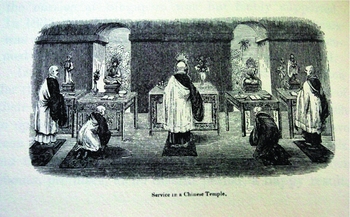
Perhaps most evocative of Evangelical representation of the Chinese is the final figure, “Service in a Chinese Temple” (Figure 14). As Milne put forward, “the idolatry of ancient Canaan, of Egypt, of Greece, of Rome, of Chaldea, and of India; are all to be found here” – there was nothing which marked the Chinese so clearly as their devotion to darkness. In a litany of China's dark idolatry, Milne provides a Scriptural catalogue of descriptors for the ungodly:
“Service in a Chinese Temple.” Engraving from W. H. Medhurst, China: Its State and Prospects (Crocker & Brewster, 1838), 180.

For they are ‘sitting in darkness, and dwelling in the land of the shadow of death’ – ‘Have changed the glory of the incorruptible God, into images made like to corruptible man, and to birds, and four-footed beasts, and creeping things;’ ‘worship and serve the creature more than the creator’ – ‘are led away to dumb idols’ – ‘do service to them who by nature are not gods – serve ‘idols of gold, and silver, and wood, and stone, which can neither see, nor hear, nor walk;’ – . . . ‘having the understanding darkened, alienated from the life of God through the ignorance that is in them’ – ‘without hope – without God in the world!’ (Retrospect 44)
As an exhibit of this bondage to darkness, Figure 14 is literally a dark image. Heavy shading indicates the dark interior of the temple, a suggestion of its corresponding spiritual darkness. Like Milne's description, the image shows worshipers “sitting in darkness” as they kneel before various objects of veneration. In addition to a Buddha on the left, sacred books, and incense, several other images appear to lurk in the darkened recesses. The worshiper on the right kneels in front of what appears to be Mazu, the Chinese goddess of the sea. Mentioned widely by both missionaries and secular writers, the placation of Mazu was particularly common among the coastal Chinese with whom the British had the most contact. In the engraving, the palm tree just above the shrine's head suggests a coastal location for this image of Chinese depravity.
These few images of China are a small sample of those in the corpus of mission narratives, all of which, without any obvious exception, are understood to depict some manifestation of national depravity. These engravings include cruel executions, temples and holy sites, and the machinery of war and oppression, all included with reference to their religious implications. In the same way that mission narratives’ written representations of the Chinese provide a narrow lens for viewing the culture, the visual representations also provide a specific way of imagining the Chinese based on the Evangelical worldview. This alternate way of thinking about China as part of a worldwide spiritual geography was not without conceptual obstacles.
III. Redefining “Civilization”
Despite the Evangelicals’ conviction that China was a land “in the thick darkness of midnight” (37), China's national depravity presented a problem for the general conception and ideological use of the light and dark metaphor among Evangelicals, and later among popular writers who adopted the metaphor. The experience of the mission among the Chinese complicated this simple equation. By any measure, China was civilized. Since the Macartney embassy of 1793–94, China was “universally admitted to be more civilized than any Asiatic nation,” with “the most unequivocal proofs of their civilization” having been established by eyewitness reports (“Journal of the Proceedings” 433). Not only was “The superiority which the Chinese possess over the other nations of Asia” a matter of fact (Davis, Chinese 6), some went so far as to state that “we may perhaps be induced to concede to the Chinese not only that superiority which we have claimed for them over the rest of the Asiatics; but even to doubt whether they do not possess certain advantages, which some even of the more enlightened European nations cannot boast” (“Narrative of the Chinese Embassy” 414).
Notwithstanding their spiritual concerns, missionaries were also quick to affirm the attainments of Chinese civilization and its supremacy “with regard to the antiquity of its origins, the extent of its territory, the amount of its population, and the advance of its civilization” (Medhurst 2). In his China: Its State and Prospects, Medhurst spends almost a hundred pages praising the attainments of the Chinese in manners, genius of invention, skill in the arts, and justice of law. In 1825, when Robert Morrison spent a year on furlough in Britain trying to encourage new missionaries to China, he presented a message to the Missionary Society in which he asked, “What, then, do the Chinese require from Europe?” He stressed that they needed nothing of “the arts of reading and printing,” nor “education,” and nothing of “what is so much harped on by some philanthropists – civilization” (“Knowledge of Christ” 13). What they needed, he stated, was “only [that] which St. Paul deemed supremely excellent, and which it is the sole object of the Missionary Society to communicate – they require the knowledge of Christ” (272). The problem with the question of Christianity and civilization as it had been framed, then, was that Christianity could not civilize China since it was already clearly civilized.
With China possessing an apparently high degree of civilization, the Evangelicals had a rhetorical problem. The bearing of light into a dark nation – conceived with both spiritual and cultural semantic fields – could not work in reference to China. Working among opium smugglers and profit-driven merchants, Morrison, Milne, and Medhurst agreed that the light of British civilization was a bankrupt idea in China. In both private letters and public statements, all three remark about their difficulties living among the British merchant community.Footnote 21 With missionaries seeing a British iteration of depravity among the merchants and another among the surrounding Chinese, and both thoroughly civilized, they realized that “a good deal will depend upon what is meant by civilization” (Coates 99).
This situation in China crystallized what some Evangelicals felt to be a pressure to maintain a cohesive identity as a leavening or transformative force in society. Prior to the abolition and reform movements of the 1820s and early 1830s, Evangelicals had taken a prophetic and countercultural stance, as suggested even in the title of William Wilberforce's Practical View of the Prevailing Religious Conceptions of Professed Christians in the Higher and Middle Classes in this Country Contrasted with Real Christianity. By reforming British society, they would make it brighter and a better vehicle for bringing the light of the gospel to all nations. But with civilization proven to be possible without the gospel, and with serious questions raised about the suitability of the imperial vehicle for opening the way for the gospel, Evangelicals needed a reassessment of their place within a British empire that connected with nations all over the “scale of civilization.”
Their somewhat ingenious solution was to redefine civilization as a function of Evangelical faith. Similar to how Wilberforce had redefined “true Christianity” or “real Christianity” as against the “prevailing religious system of professed Christians,” leaders of the Evangelical mission societies began changing the terms for talking about civilization in order to fit the Evangelical weltanschauung. In testimony before the Select Committee on Aboriginal Tribes, John Beecham, secretary of the Wesleyan Mission, stated,
I regard Christianity as the parent of civilization, and am persuaded that true civilization cannot be produced without it; I say true civilization, because I am aware that a certain kind of civilization may exist unconnected with Christianity . . . [and] the only kind of civilization that the Christian philanthropist can be supposed anxious to promote, cannot be originated but by means of Christianity. (Coates 123)
As Beecham's comments indicate, there had been growing concern about the impact of “a certain kind of civilization” being conveyed by unprincipled and immoral British subjects on the frontiers of empire. While mission societies preferred more official imperial control to “uncontrolled conquest and colonization” (Brantlinger, Victorian 20), they were “anxious to promote” a civilization in which Christians took the lead in primary contact. This mission-focused interaction would be most likely to produce “true civilization.” Adopting the terminology of true civilization versus a limited counterfeit, William Ellis of the London Missionary Society agreed.Footnote 22
True civilization and Christianity are inseparable; the former has never been found but as a fruit of the latter. An inferior kind of civilization may precede Christianity and prevail without it to a limited extent. . . . This kind of civilization is only superficial. . . . (Qtd. in Coates 172)
With this redefinition, that “[t]he more nearly that a nation approaches to that standard [of Christianity], in the highest degree does it enjoy civilization,” they were pressed to consider the place of Britain on a scale of civilization. Replying to the question, “Do you think that there exists any nation on the face of the globe thoroughly civilized?” Beecham replied, “Not in the highest sense of the expression” (qtd. in Coates 171). Just as Wilberforce had redefined “real Christianity” to mean the evangelical faith, and “practical Christianity” to mean Evangelical culture, missionary representatives redefined “true civilization” according to their view of God's kingdom on earth: an Evangelical hegemony both at home and abroad.Footnote 23
Conclusion
Employing this redefinition of true civilization as a nation of committed Christians, or shy of that, the hegemony of Evangelical culture, missionaries to China (and elsewhere) made good use of the newly flexible language. Since their mission narratives performed ideological work that was crucial to the overall cultural mission of Evangelicals both in England and China, redefinition enabled Evangelical writers to map a spiritual geography over top of widely accepted assessments of social development. In this way, the understanding of light as the presence and practice of the Gospel, and darkness as resistance to the Gospel, could still fit their notion of total human depravity regardless, or in spite of, the achievements of an ancient and highly developed culture. They were able to rearticulate what Boston had written in 1720, “Every natural man's heart and life is a mass of darkness, disorder, and confusion, how refined soever he may appear in the sight of men” (84). They could allow for higher degrees of light in so-called civilized places such as Britain, where they yet maintained very active “home missions” to the “dark corners” of the land because it was not truly civilized. Less developed regions like Africa and India could become truly civilized as long as they let go of their own native darkness and did not absorb any of Western civilization's darkness. Finally, the Empire of China, civilized according to secular standards, could at the same time be startlingly dark. As Morrison expresses,
For with all their antiquity, and their literature, and their arts and refinement, they are still infatuated idolators; they are still given up to what Heaven regards as abominable idolatries and to vile affections, working that which is unseemly. . . . With all their civilization, still envy and malice, deceit and falsehood to a boundless extent, pride and boasting; a selfish ungenerous, scarcely honest prudence, and a cold metaphysical inhumanity, are the prevalent characteristics of the people of China. (“Knowledge of Christ” 13)
The reinvigorated flexibility of the light and darkness metaphor gave these early missionaries a way at once to affirm and celebrate the impressive attainments of Chinese culture and to maintain the spiritual geography of their worldview, including their own sense of alienation within British culture. British society as a whole was not good – it was, in fact, dark and full of depravity – yet it possessed a greater measure of light than China. Morrison, Milne, and Medhurst were able to explain the people of China, who were completely without the Gospel, as fitting “exactly the portrait of the Gentile world, drawn by the inspired writers” (Milne 40). Since depravity on this national scale was understood to lead a people away from God, making them averse to truth and spiritual pursuit, it was obviously “the source of all that stupidity, blindness, perverseness, and secularity of soul” described above (Milne 340). China endured national depravity because it did not have the light of the Gospel, and the only remedy would be to bear that “spark of the sacred flame . . . kindled by a living coal from between the cherubim” (Burder 385), into every dark corner of the Chinese empire.
The writings of missionaries to China powerfully demonstrate this shifting of categories from material and cultural terms over to the spiritualized rhetoric of true civilization. The missionary emphasis – from the 1790s through the late 1830s – on the national depravity of every people, regardless of race, complicates the critical commonplace expressed recently by Brantlinger in Victorian Literature and Postcolonial Studies (Reference Brantlinger2009) that missionary texts “are the religious equivalent of secular jingoism” (24). Despite his recognition that “the relations between missionaries, non-Western societies, and non-missionary colonizers were frequently antagonistic,” – a point also demonstrated by Anna Johnston and Catherine Hall – Brantlinger's summary assessment indicates that there has been little critical awareness of how Evangelical rhetoric works.
The shifting semantic range of terms like light and darkness, civilization, and depravity during the early missionary movement was an expression of Evangelicals’ active commitment to using Scriptural language and theology, even to the point of realigning their self-understanding in order to keep the terms intact. By reading back to the early decades of the nineteenth century with the cultural positioning of the mid to late century – after the majority of British society had accepted Evangelical Christianity – the rhetorical and even doctrinal flexibility of the Evangelical movement is easily missed. Although most scholars of this period must share Hall's disclaimer that “My focus is on the social, cultural and political world of nonconformists; I do not pretend to be a theologian” (444 n29), there is a great deal overlooked or confused when, in assessing missionaries’ thinking and action, one does not attend to the theology that missionaries themselves took very seriously. Because mid- to late-century use of light and darkness again realigned light with Western civilization and ejected theological content – the alignment that has dominated the scholarly literature – many critics have missed an interesting element in the first half of the nineteenth century. In an era where the relationship between religion and formal empire was far from settled and cooperative, the uncertainty in theological and cultural categories demonstrates the constant reassessment by which British subjects felt their way into other cultures.
The particular emphases of Evangelical theology and the fluidity of their definitions discussed above demonstrate the necessity of reconsidering later-century British and Evangelical rhetoric in light of pre-Opium War representation. Since most critical work on the British presence in China has focused on the period during and after the “unequal treaties” – following the Opium Wars of 1842 and 1856 – there is a need to reconsider the wide use of Chinese tropes and stereotyping as products of an earlier rhetorical project, a primarily spiritual project. Likewise, critical readings of mid- to late-century writing from China, both missionary and secular, must take into account the results of the Opium Wars and the overt pressure of the British empire – and thus a strongly anti-foreign Chinese population. Texts from 1807–1840, then, require a particularized reading that incorporates the Evangelicals’ sense of their own identity at this cultural moment, both at home and abroad. This particularized reading reveals a surprising contention among the Evangelicals that in China, as in Britain, a nation could live in a highly cultured, civilized depravity.
Finally, as Asia and the Pacific Rim come into increasing focus within the wider discourse on British imperialism, this study of the shifting Evangelical representation of China suggests that scholars considering the other imperial sites represented in this volume would do well to note the influence of religious activity in the region under investigation. Quite simply, wherever there was imperial pressure, there was also an Evangelical presence. But as this study demonstrates, students of cultural interaction ought likewise to avoid making easy but hasty generalizations about the self-positioning of these Evangelical missions based on a narrow chronological selection or drawn exclusively from moments of conflict. While they frequently benefited and periodically cooperated with imperial policy, missionaries could also be the most vociferous critics of political and economic imperialism. Understanding themselves as, in a spiritual sense, participants in transnationality and separate from their own nation's depravity, Evangelical critique has the potential to reveal levels of conflict and contestation in British imperialism that have previously been left unexplored.