The overthrow of a troublesome regime by force presents very real attractions to potential attackers. Such action promises to neuter decisively a lingering interstate military threat by replacing a rogue leader with a more docile successor. Twentieth-century history seems to offer strong support for the promise of foreign-imposed regime change (FIRC) as a means of reducing international threat. The replacement of militarist regimes in Japan, Germany and Italy after the Second World War transformed those states from war-prone aggressors into peaceful democracies. The lure of FIRC attracted the American invasions of Afghanistan and Iraq in 2001 and 2003 as the means of safeguarding American national security.
However, the effects of FIRCs on interstate relations constitute only part of the story. What effects do FIRCs have on intrastate violence? Scholars have yet to explore the possible relationship between FIRC, the most shattering domestic political event a country can experience, and the onset of civil war. Exploring this relationship is critical, as FIRC is closely associated with political factors scholars have connected to civil war onset. On the policy side, it is critical to know whether removing a rogue regime carries the cost of substantially increasing internal turmoil.
This article proposes that FIRCs may make civil war more likely, through their effects on state infrastructural power and political institutions. Some FIRCs, such as those following interstate wars, will be accompanied by the destruction of a state’s physical and human infrastructure, including its road networks, utilities, national capital, armed forces and bureaucracy. Such assets help prevent insurgency by facilitating the mobilization of armed force to deter insurgents, and by delivering goods and services to the population to drain popular support for an insurgency. State power aside, FIRCs may make civil war more likely if a target state’s political institutions as well as its leadership are changed. The civil war literature has long proposed and found evidence supporting the idea that change in political institutions makes civil war more likely. This proposition would predict that FIRCs which change political institutions increase the risks of civil war.
We test the state infrastructural power and institutional change theories on a dataset of civil war onset among all states from 1920 to 2004. We use rare event logit, and include an array of control variables. The empirical analysis provides strong evidence that in general FIRCs make civil wars more likely. The analysis provides strong support for the conjecture that FIRCs incite civil wars when they wreck state infrastructural power, as FIRCs following interstate wars increase the likelihood of civil war onset, but FIRCs which do not follow interstate wars do not. The effect of post-war FIRC on civil war onset is quite large, increasing the likelihood of civil war onset eightfold, far more than any other independent variable. The analysis cannot confirm that FIRCs with foreign occupation forces may have a significantly higher likelihood of civil war onset than FIRCs without occupation forces. The analysis also indicates that FIRCs make civil wars more likely when they change political institutions. Indeed, the analysis reveals that interstate war and changed political institutions are virtually necessary if not sufficient conditions for an FIRC to make civil war onset more likely.
This article makes several contributions to scholarship on FIRC and scholarship on civil war. It demonstrates that a full understanding of the causes of civil war onset must account for FIRC in particular and state infrastructural power more generally. It sheds light on FIRC more generally, and describes conditions which make FIRCs more likely to cause civil war. The finding that FIRCs make civil war more likely because they wreck state power dovetails nicely with extant research which finds that FIRCs make interstate war less likely because they wreck state power. Lastly, it casts doubt on the attractiveness of FIRC as a policy tool. Policy makers may be less willing to use FIRC knowing that it substantially increases the chances of civil war.
Foreign imposed regime change, state infrastructural power and civil war onset
The term ‘regime’ has been used by scholars sometimes to refer to a leaderFootnote 1 and sometimes to refer to political institutions.Footnote 2 Foreign-imposed regime change, therefore, can mean an externally imposed change in either leaders or political institutions, though in practice it is often both. In our theoretical discussion and empirical analyses, we distinguish between foreign-imposed leadership change and foreign-imposed institutional change.
States sometimes use FIRC as a foreign policy tool. By one count, some forty foreign-imposed leadership changes have occurred between 1920 and 2004,Footnote 3 and by another count over the 1816–1980 period there were twenty-six foreign-imposed leadership changes which occurred as parts of interstate war outcomes.Footnote 4 Sometimes, the outcome of an interstate war culminates in FIRC for the losers, as it did for Germany and Japan in 1945. In other instances, violence or international pressure short of interstate war, including a gentler use of force or covert action, such as the 1989 American invasion of Panama, can result in an FIRC.
In all contexts, two conditions are necessary for an FIRC. First, an outside actor must wish to impose regime change on a target state. Regime change is often imposed to remove an interstate threat, especially when an adversary is seen as implacably hostile and untrustworthy. Regime change is seen as one brutal solution to this problem, replacing the dangerous older regime with a puppet regime or democratically elected leaders.Footnote 5 In addition to removing interstate threats, FIRC can also be a means to advance foreign economic interests or spread ideology. Secondly, a potential imposer must be capable of imposing regime change. Some states simply do not have the military or covert intelligence capability to impose regime change on a target, regardless of how noxious they find the politics of the target’s leadership.Footnote 6
The evidence strongly indicates that FIRC greatly reduces interstate threats and the chances of interstate conflict.Footnote 7 However, what are the domestic political consequences for FIRC? Though FIRC may tame a war-mongering state, does it also allow for the establishment of domestic liberty and/or stability? As to the former goal of liberty, although earlier work was hopeful that intervention could spread democracy,Footnote 8 more recent studies have been more sceptical.Footnote 9
This article examines the relatively unexplored question of what the consequences of FIRCs are for internal stability. Do FIRCs make the outbreak of civil war more likely? The article develops two theories to answer these questions, the first concerning state infrastructural power and the second institutional change.Footnote 10
State Infrastructural Power
The first theory emphasizes state infrastructural power. State power is the state’s ability to exercise autonomous control over its society and territory. This includes what Michael Mann has referred to as infrastructural power, the ‘capacity of the state to actually penetrate civil society, and implement logistically political decisions throughout’ the country.Footnote 11
An FIRC may destroy a state’s physical and human infrastructure such as transport networks, public utilities like water and electricity, an adequately sized and competent bureaucracy to implement policies, and police and paramilitary forces to maintain internal order. These facilities enable the state to deter insurgents, through the ability to deploy rapidly armed agents of the government throughout the national territory, to show force or to damp down the beginnings of rebellion. Indeed, scholars since Thomas Hobbes have recognized that the raison d’être of the state is to maintain order within society and prevent violence.Footnote 12 More powerful states have greater abilities to use force to crush extra-legal or violent protests through the use of police forces, internal security services, militia or regular armed forces, and to compel the population to comply with anti-insurgency campaigns.Footnote 13 In Latin America, Chile’s greater state power under Augusto Pinochet enabled it to maintain a firm grip on society and prevent the emergence of any violent insurgency. Conversely, the weaker state in Peru left it vulnerable to the Shining Path Marxist insurgency.Footnote 14
Physical and human infrastructure also enables the state to deliver goods and services to the population, such as adequate nutrition, health care, education and public utilities, which have the effect of sapping public support for insurgencies. Some have speculated that civil wars are driven by greed and grievance, and if the ability to crush armed insurgents makes greed-driven rebellions less likely, then distributing basic needs to the population helps prevent grievance-driven rebellions.Footnote 15
FIRCs, especially those following interstate wars, can heavily damage a target state’s physical and human infrastructure. An FIRC may come on the heels of the destruction of the FIRC target’s military in war, and states sometimes use their (regular) militaries to deter or combat insurgents.Footnote 16 Certainly, scholars have long recognized that fighting and especially losing an exhausting war can make a state vulnerable to internal upheaval. This was perhaps the central argument of Theda Skocpol’s seminal work – that defeat in war is one of the critical events which can undermine state power and spark revolution.Footnote 17
Combat aside, after an FIRC, the imposer may dismantle the target’s internal security forces to prevent it from posing a threat to the puppet regime or to the occupation forces. Though such actions may reduce threats posed by remnants of the former state to the imposer, they also weaken the ability of the target state to combat insurgents. For example, America’s decision to disband the Iraqi regular army in 2003 after capturing Baghdad undermined the Iraqi state’s ability to maintain order and fight insurgents.Footnote 18
FIRC can also undermine a state’s bureaucratic and administrative power. An FIRC following the end of interstate war is usually accompanied by the substantial destruction of the target state’s physical infrastructure, either through collateral damage inflicted by conventional combat, because installations such as bridges and power plants were directly targeted by the attacker, or because a retreating defender adopted a scorched earth policy. More specifically, total military loss usually accompanying a post-war FIRC often means heavy damage to and occupation of the national capital. Heavy destruction in the capital city can be especially devastating to infrastructural power, given the central importance of the capital for the administration of national government, including policing and distributing goods and services to the population.Footnote 19 Relatedly, a foreign imposer of regime change may purge members of the target state’s bureaucracy who are politically suspect. This may undermine infrastructural power, as those bureaucrats may have expert knowledge in implementing critical functions of the state. For example, in May 2003, the United States banned former Baath party members from holding public sector positions in the Iraqi government. This had the effect of removing from administrative power various ministry employees with experience in carrying out critical governing functions such as providing electricity and water to the population. The inability to provide basic services to the people incubated widespread grievance.Footnote 20 Conversely, when victors have imposed regime change but have left much of the bureaucracy intact, the chances for peace have been higher. American forces left much of the Japanese bureaucracy intact following Japan’s 1945 surrender, and enjoyed a surprisingly peaceful and successful occupation and political transition.Footnote 21
Some might posit that the victorious imposers of regime change can fill the state power void left by a post-war FIRC, policing and providing goods and services sufficiently to prevent internal conflict. However, occupiers are often ill-equipped to fulfil these functions.Footnote 22 This was the unfortunate American experience in Iraq after 2003, as American forces and personnel were unable to fill the gaps created by the dismissal of the Baath party and the disbanding of the Iraqi army.Footnote 23 Brutal conquerors can sometimes maintain order with a threat that citizens either work or starve.Footnote 24 However, not all conquerors are morally prepared to adopt such grim measures, and sometimes even ruthless conquerors cannot prevent an uprising. Nazi Germany, for example, was unable to prevent violence on a civil war scale in occupied Yugoslavia during the Second World War.Footnote 25
Conversely, an FIRC which occurs outside the context of an interstate war may be less physically destructive of a country’s physical and human infrastructure, and hence less likely to cause civil war. Bombing is one common means of destroying state infrastructural power, but there were no instances of a non-war FIRC being accompanied by a coercive bombing campaign between 1917 and 1999.Footnote 26 Furthermore, the absence of war and its attendant destruction may indicate that FIRC imposers were able to negotiate the peaceful exit of a leader, replacing him or her with a more legitimate leader waiting in exile.
Interestingly, some have made essentially the opposite of the above argument, that greater state infrastructural power can increase civil violence.Footnote 27 Instead of deterring insurgents and satisfying the population, the extension of state power might inspire resistance to state-directed actions such as taxation, policing, regulation and conscription. This is Charles Tilly’s explanation of the Vendée counterrevolution in Western France in 1793. Michael Hechter, in his study of nationalism, argued that as a state embraces more centralized approaches to the control of subsidiary political units in its territory, sub-national groups become more prone to violent, nationalist resistance. Robert Pape argued that perceived occupation by democracies increases terrorist attacks by those willing to commit suicide, though the empirical evidence on this claim is mixed.Footnote 28
It may be difficult to know when state infrastructural power will avert violence, and when it will inflame it.Footnote 29 However, many FIRCs, especially those following wars, introduce the element of state infrastructural power perhaps most likely to inspire violent insurgency: foreign occupation troops. Occupation troops are often seen as unwelcome invaders, operating outside the rule of law and in support of a hated puppet regime. Certainly, a major factor inciting insurgent violence in Iraq and Afghanistan has been the presence of American and other foreign troops.Footnote 30
Institutional Change
Scholars of comparative politics have long recognized that weak political institutions and particularly institutional change make internal violence more likely.Footnote 31 New political institutions suffer from a related set of problems which make internal violence more likely. Since recently changed institutions are new, they are regarded as less legitimate. Håvard Hegre and his colleagues remarked, ‘Political change, whether in the form of democratization or autocratization, can create instability. The loss of legitimacy by the regime induces dissatisfied groups to struggle against it’.Footnote 32 A second problem is that the decision to forge new political institutions creates an opportunity to reallocate power within society. Conflict may emerge as groups within society seek to shape political institutions to maximize their own power and advance their own interests. Certainly, this has been the case in post-2003 Iraq, in which conflict between Sunnis, Shi’ites and Kurds has been driven by diverging preferences over the form of Iraq’s new political institutions. Oil wealth is distributed asymmetrically across the territory controlled by the three groups. This has, in turn, generated conflict among the three groups as to what Iraq’s political institutions should look like, as institutions determine the distribution of oil wealth.Footnote 33
Among all instances of institutional change, those caused by FIRC may be especially likely to spark civil war. Institutional change which emerges internally, especially changes which are pacted transitions, are more likely to enjoy higher legitimacy and to solve through peaceful negotiations the thorny problems of how changing institutions will redistribute power and resources among different groups.Footnote 34 In contrast, foreign-imposed institutional change is more likely to be seen as illegitimate, and there is less of a guarantee that sub-state groups will have agreed to accept the new order peacefully.Footnote 35
What are the areas of overlap between the state infrastructural power and institutional change theories? Changes in political institutions may increase the likelihood of bureaucratic purges (and therefore the degradation of state infrastructural power), though not necessarily, as in the process of institutional changes state ‘legality may ensure the continuity of the state’s normal administrative functions – such as keeping order, collecting taxes, running the courts, and so on’.Footnote 36 In addition, the two are tied by the notion of legitimacy. Some have argued that legitimacy boosts state infrastructural power. Legitimacy makes it easier for a state to use physical and human infrastructures to exert its presence throughout and upon society, for tax collectors to enter villages, for individuals to co-operate with police and let them walk the streets, for families to send their children to state-run schools, and for individuals to use state-sanctioned means of political participation rather than engage in political violence.Footnote 37 If imposed institutional change undermines legitimacy, this may then make the exercise of state infrastructural power more difficult.
Past scholarship and new hypotheses
The existing quantitative research on whether various measures of state power affect internal violence is thin and mixed. James Fearon and David Laitin have proposed that economic development prevents civil war because it strengthens state power. They have also argued that countries with fewer mountains are more easily controlled by the state, and hence less likely to experience the onset of civil war. However, development may be associated with grievance as well as with state power, and the evidence on the link between terrain and civil war is mixed.Footnote 38 Hanne Fjelde and Indra de Soysa have found mixed evidence that their fiscal and legal measures of state power correlate with the onset of civil war.Footnote 39 Using the development measure, Brian Lai found that state power is inversely correlated with terrorism. Lai and Daniel Slater found that military regimes are more likely to initiate military disputes, proposing that this is because military regimes have less infrastructural power and hence need to initiate external conflict to stave off internal political threats.Footnote 40 A number of empirical studies have demonstrated that changes in political institutions make civil war more likely.Footnote 41
Little empirical work exists on the connection between FIRC and civil war. Andrew Enterline and Michael Greig have found that when political institutions were externally imposed, several factors made internal political challenges more likely, such as regime type, ethno-religious divisions and the geographic characteristics of the neighborhood.Footnote 42 This article builds on the Enterline and Grieg work in several ways. First, by including cases of non-FIRC as well as FIRC, it provides a better understanding of whether and by how much FIRC makes internal violence more likely than it would be in the absence of FIRC. Secondly, our empirical domain reaches up to 2004, allowing for the inclusion of the 2001 Afghan and 2003 Iraq FIRCs, whereas the Enterline and Grieg study stops in 1994. Thirdly, we build on the theory presented in Enterline and Greig, generating some new hypotheses. Fourthly, we look at different measures of FIRC, exploring leadership as well as institutional changes. Fifthly, we use a different dependent variable, ‘civil war onset’ instead of ‘political challenges’.
This article aims to discover whether FIRC makes civil war more likely, and if so, under what conditions. The state power theory recommends separating FIRCs following interstate wars from FIRCs which do not follow interstate wars. FIRCs that follow interstate wars are more likely to be characterized by greater levels of destruction of the FIRC target’s physical and human infrastructure, including the destruction of the transport infrastructure and national capital, the defeat and possible disbanding of the target’s military and paramilitary forces, and the devastation of the bureaucracy through political purges. Conversely, non-war FIRCs generally are not accompanied by extensive combat on the target’s soil, and the bureaucracy is less likely to be purged. Hence, if the destruction of the physical and human infrastructure is an important component of why FIRCs cause civil wars, then FIRCs following interstate wars should be more likely to cause civil wars than FIRCs that do not follow interstate wars.
HYPOTHESIS 1: States experiencing foreign imposed regime change following interstate wars are more likely to experience civil war onset than states experiencing foreign imposed regime change in other contexts, and states not experiencing foreign imposed regime change.
The institutional change theory predicts that imposed institutional change makes civil war more likely by undermining state legitimacy and creating conflicts among groups as new institutions get formed. Hence, among FIRCs, those which impose new political institutions may be especially likely to experience civil war onset.
HYPOTHESIS 2: States experiencing foreign imposed regime changes which cause changes in their domestic political institutions are more likely to experience civil war onset than are states which experience foreign imposed regime changes but not domestic political institutional change, and other states.
Research design
We test these hypotheses using a cross-sectional panel research design with the country–year as the unit of observation. We build on the Fearon and Laitin data, extending their 1945–99 temporal range forwards as well as backwards, covering all Correlates of War (COW) members of the interstate system from 1920 to 2004.
The dependent variable is binary, coded 1 if civil war erupts in a particular country–year. Our list of civil wars uses the Fearon and Laitin operational definition that an armed conflict must meet the following three criteria to be included:
(1) [it] involved fighting between agents of (or claimants to) a state and organized, non-state groups who sought either to take control of the government, to take power in a region, or to use violence to change government policies. (2) The conflict killed at least 1,000 over its course, with a yearly average of at least 100. (3) At least 100 were killed on both sides (including civilians attacked by rebels).Footnote 43
Central Explanatory Variables
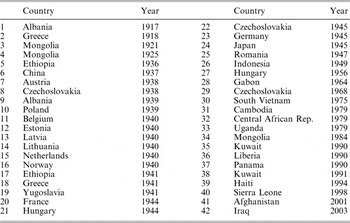
The main explanatory variable indicates whether an FIRC has occurred in the past five years. FIRC occurs whenever a leader is directly removed from power by another state. A leader can be removed by means varying from kidnapping to invasion, but cases in which a state indirectly arranges the removal of a leader, such as when a state supports a coup d’état executed by domestic groups, are not coded as FIRCs. The leadership change data are taken from the Archigos dataset. Specifically, we are interested in Exit codings signifying ‘deposed by another state’. From 1920 to 2004, there were forty episodes of a leader being deposed by another state.Footnote 44 They are listed in Table 1.Footnote 45
Foreign Imposed Leadership Changes, 1915–2004

Note: Drawn from Archigos dataset. Even though the dataset runs from 1920 to 2004, the above list includes FIRCs back to 1915, because the FIRC variable change is coded 1 for the five years following the FIRC, meaning that we need to include pre-1920 cases.
To test Hypothesis 1, we divide FIRCs into those following interstate wars, and those which did not follow interstate wars. We use three dichotomous variables to test Hypothesis 1. The first is coded 1 if a state experienced FIRC after losing an interstate war, 0 otherwise. The second is coded 1 if a state experienced FIRC though not after losing an interstate war, 0 otherwise. The third is coded 1 if a state lost a war but not did experience an FIRC, 0 otherwise. The excluded category is no FIRC, no lost war. Each of the FIRC independent variables is lagged by a year to reduce endogeneity. The FIRC independent variables cover a five-year period following the FIRC. So, if a state experienced an FIRC in 1920, the FIRC dummy variable would be coded 1 for the years 1921–25. We used the data produced by Nigel Lo and his colleagues on interstate war participation, which contains very slight refinements of the COW data.Footnote 46
We test Hypothesis 2 by creating a measure of post-FIRC institutional change. We create a variable which is the absolute difference of the (lagged) Polity score in the year in question minus the Polity score in the year just before the FIRC. Therefore, if an FIRC moved a country from a Polity score of 3 to a Polity score of 8, this Polity difference variable would be coded as 5. We then created a dummy variable for this Polity difference variable, coded as 1 if there was a change of 4 or more points on the Polity score, indicating a non-trivial change in political institutions, and 0 if there was a change of 3 or less, indicating no or only a minor change in political institutions. The choice of 4 as a cutpoint reflects the distribution of the Polity difference variable, as the distribution of the Polity difference variable is unimodal, and there is a very large mode for a change of 4 points.
Another possible measure of change in political institutions is to use the Polity IIId ORIG variables, originally created for Polity II, and modified by Enterline and Greig.Footnote 47 Those variables measure the external imposition of a new polity, either at or after a state’s birth. ORIG codes a polity change if there was change in any of a state’s codings along the six dimensions of political institutions. We prefer the Archigos/Polity difference variables described above to the ORIG variable, for three reasons. First, the ORIG variable only goes up to 1994, meaning that it excludes the critical FIRCs of Afghanistan and Iraq. Secondly, the ORIG variable includes a broader category of episodes than those commonly thought of as FIRCs. For example, it includes instances in which an external power helped guide the creation of a state’s initial political institutions, such as Canada and Ireland at independence. Thirdly, ORIG has some odd decisions about the timing of the imposed institutional change. For example, it codes Japan as experiencing imposed institutional change in 1952, when the new Japanese polity began functioning, as opposed to 1945, when the imperial regime was overthrown. Chile is coded as experiencing imposed institutional change in 1974, though Salvador Allende was overthrown in 1973. Notably, the period of greatest risk for civil war is probably the years just after the old regime had been overthrown, as that is when destruction to physical and human infrastructure is greatest and there is the greatest blow to legitimacy. As a result, the ORIG data are likely to be biased against finding that imposed changes in political institutions are correlated with the onset of civil war. Perhaps because of these last two points, the correlation between the Archigos data on FIRC and the ORIG data on imposed institutional changes is very low. Archigos lists forty FIRCs and ORIG lists sixty-three instances of FIRC for the years 1920–94, and there are only two instances of overlap, that is, cases in which both datasets agree that a target state suffered an FIRC in a particular year.
Control Variables
We include other variables, both because they are standard controls included in other studies of civil war onset, and because many of these variables fit under the theoretical aegis of the state power or institutional change theories. Fearon and Laitin have examined per capita income, population size, previous war, oil, mountainous terrain, new state, instability, non-contiguity, anocracy, democracy and ethnic fractionalization as possible causes of civil war onset.Footnote 48 We include all these variables in our statistical model, except for oil, which lacks data before 1945.
GDP per capita and population size
Higher development may make civil war less likely because it both increases state power and reduces popular grievances.Footnote 49 Data on per capita income are taken from the World Bank’s World Development Indicators (WDI), Conference Board’s Total Economy Database, OECD data,Footnote 50 Penn World Tables (version 6.2) and COW energy consumption data.Footnote 51 Country population size is obtained from WDI and the Penn World Tables.
Regime type and new state
Following Fearon and Laitin, to distinguish between regime types we refer to the Polity IVd – 10 to 10 coding of a country’s democracy.Footnote 52 We code states as being autocracies, anocracies or democracies. To avoid falsifiability problems, we follow James Vreeland by correcting the Polity measure of regime type, taking out elements of Polity which themselves measure internal violence.Footnote 53
Polity does not have data for the crucial cases of Afghanistan and Iraq following their 2001 and 2003 FIRCs. We fill these gaps with Freedom House data. We designate ‘Not Free’ as equal to autocracy, ‘Partially Free’ as anocracy and ‘Free’ as democracy.
The new state variable is coded 1 if the country appears for the first time in a given year according to the COW system membership data, 0 otherwise.
Instability
This is a dichotomous variable coded 1 if a state has moved from one of the three regime type categories into another of the categories within the last five years.
Mountainous terrain, non-contiguity and ethnic fractionalization
The geographer A. J. Gerard codes the percentage of total territory which has mountainous terrain, and more mountainous terrain is hypothesized to make insurgency easier. A country is coded as non-contiguous when it possesses territory ‘holding at least 10,000 people and separated from the land area containing the capital city either by land or 100 km of water’.Footnote 54 Non-contiguity may make it easier for insurgents to build power out of the reach of the state. Ethno-linguistic fractionalization (ELF) scores indicate the probability that two randomly drawn individuals in a society belong to different ethnic groups.Footnote 55
Statistical Method
Since the dependent variable is dichotomous, we use logit regression. We use rare event logit because the dependent variable is skewed, with more than 98 per cent zeroes.Footnote 56 Note that robust standard errors are not employed in rare event logit, because this technique calculates its own standard errors. Following Fearon and Laitin and Vreeland, we use a lagged war variable on the right-hand side.Footnote 57
Results
There were six civil wars which followed within five years of an FIRC: Greece 1945, Uganda 1981, Afghanistan 2003, Iraq 2004 and two Indonesian civil wars following its 1949 FIRC. Of these, all but the Indonesian conflicts occurred following an interstate war. A first cut reveals that FIRCs following interstate wars seem to be highly correlated with civil war onset. Across the 8,920 country–years in the dataset, there is civil war onset in 146 cases, about 1.7 per cent. In comparison, across the fifty-six country–years in which the FIRC interstate war variable is coded 1 (a country–year is coded 1 for the FIRC interstate war variable for five years following an interstate war FIRC), there are four civil war onsets, about 7.1 per cent. Civil war onset, then, is nearly four times more frequent during these five-year windows following an interstate war FIRC than they are across the entire dataset.
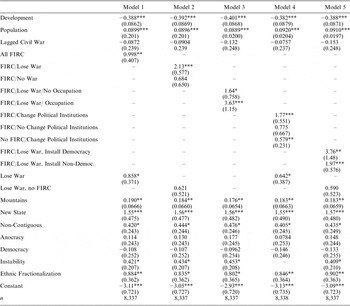
Table 2 presents our multivariate regression results.Footnote 58 Model 1 includes a simple dummy variable coded 1 if there was an FIRC, 0 otherwise. A control variable for losing an interstate war is included. As a first cut, FIRCs make civil war onset significantly more likely.
Rare Events Logit Analysis of Civil War Onset, 1920–2004

Note: *Significant at the 0.05 level; **significant at the 0.01 level; *** significant at the 0.001 level. All significance tests are one-tailed.
Hypothesis 1 speculates that among all FIRCs, those which follow interstate wars are especially likely to cause civil war onset. Model 2 tests Hypothesis 1, including three dichotomous variables described in the previous section. The results provide strong support for Hypothesis 1. FIRCs following interstate wars make civil war onset significantly more likely, whereas FIRCs which do not follow interstate wars do not make civil war onset significantly more likely. This is important evidence that the destruction of physical and human infrastructure which accompanies a FIRC following an interstate war explains why FIRCs can make civil war more likely. Note also that losing an interstate war, FIRC aside, does not by itself make civil war onset more likely. Among the control variables, development, population, mountains, contiguity, instability and ethnic fractionalization are significant and in the predicted direction, whereas regime type is not significant.
Foreign occupation forces are the element of state infrastructural power most likely to engender popular backlash. Hence, if this provocative element of state infrastructural power explains why FIRCs cause civil wars, then those FIRCs which are followed by foreign occupation forces are more likely to cause civil war. We test this possibility using David Edelstein’s data on foreign occupations.Footnote 59 We create a dummy variable coded 1 if a state was the subject of foreign occupation during the year in question. We then create two interaction variables, the first coded 1 if there was an FIRC war and occupation, the second coded 1 if there was an FIRC war and no occupation. There are no cases in which there was a non-war FIRC and occupation. The dummy variable for lose war has been dropped to reduce multicollinearity. The results indicate that both kinds of FIRC are significantly correlated with civil war onset, and that FIRC–war–occupation has a larger coefficient. However, a χ 2 test reveals that we cannot reject the hypothesis at the 0.10 level that the two FIRC variables are significantly different from each other (p = 0.2728), indicating that though the results suggest that occupation forces may make FIRCs more destabilizing, we cannot reject the null hypothesis that war-FIRCs with occupation have equal effects on civil war onset as do war-FIRCs without occupation.
Hypothesis 2 proposes that foreign-imposed changes in political institutions make civil war onset more likely. We divided all FIRCs into those in which the FIRC target experienced changes in political institutions, and those which did not. We include three dummy variables, a variable coded 1 if there is FIRC and political change, another coded 1 if there is FIRC and no political change, and a third coded 1 if there is no FIRC and political change (to reduce multicollinearity, we dropped the Instability control variable). That analysis is presented in Model 4. Note that the FIRC-change political institutions variable is significantly correlated with civil war onset, but FIRC-no change political institutions is not.Footnote 60 Political change without FIRC also raises the risk of civil war onset, but not as much as FIRC-change political institutions. This provides support for Hypothesis 2.
Models 2 and 4 test separately the effects of war and institutional change on the onset of civil war. We next attempt to test the effects of these two factors in a single empirical model. The most straightforward approach would be to divide FIRCs into four groups: war/change political institutions, war/no change political institutions, no war/change political institutions, and no war/no change political institutions. Drawing inferences with this approach becomes difficult, because the relatively small numbers of FIRCs (and civil wars) make the size of ever-divided cells smaller and smaller. Not surprisingly, multivariate analysis of a model which includes all four of these variables is impossible (STATA cannot produce coefficient estimates), because there are no cases in which a war/no institutional change FIRC causes civil war, and no cases in which a non-war/institutional change FIRC causes civil war.
We examine the data more closely. Most of the civil wars that follow FIRCs (four out of six) occur after interstate war and are accompanied by institutional change. This indicates that perhaps interstate war and institutional change are both necessary though not sufficient conditions for an FIRC to cause civil war. However, there are two civil wars following FIRCs that, by the coding rules, did not follow interstate wars and were not followed by changes in political institutions. Those two are the 1951 and 1953 civil wars in Indonesia, which followed the 1949 FIRC there. But these are exceptions which prove the rule. It is true that the Indonesia FIRC did not follow an interstate war, but the FIRC could have not have followed an interstate war in this case because an interstate war requires two independent states, and Indonesia became independent in 1949. However, the FIRC (and independence) did follow what COW calls an extra-systemic war between the colonial metropole Netherlands and Indonesian rebels, the Indonesian War of Independence. This war was of the scale of an interstate war as 25,000 were killed, meaning that we ought to expect that there was the kind of damage to human and physical infrastructure associated with interstate wars, which in turn make civil war more likely.Footnote 61 Furthermore, the ‘change in political institutions’ variable was measured using Polity scores from before and after FIRC, but there were no pre-FIRC polity scores because Indonesia was not yet independent. However, the theory predicts that change in political institutions makes civil war onset more likely because changed institutions lack legitimacy, and certainly new political institutions lack legitimacy as well. Note that in all models the control variable for ‘new state’ is significant, indicating that for all new states the new, low legitimacy political institutions make civil war more likely. In sum, Indonesia after 1949 is a country which experienced an FIRC, suffered interstate war-level combat on its territory, had new, low legitimacy political institutions, and suffered civil wars.
Pushing Hypothesis 2 further, perhaps an FIRC which installs democracy is less likely to cause a civil war than an FIRC which installs a non-democracy, because installed democracies may enjoy higher levels of legitimacy than installed non-democracies. Model 5 tests this proposition, including two variables, war-FIRC-install democracy and war-FIRC-install non-democracy.Footnote 62 Both variables are statistically significant and in the predicted direction, and surprisingly the war-FIRC-install democracy coefficient is larger than the war-FIRC-install non-democracy coefficient. However, a χ 2 test reveals that we cannot reject the null hypothesis that the two variables are not significantly different from each other (p = 0.2599). That is, we cannot reject the null hypothesis that among war-FIRCs which change political institutions, imposing democracy and imposing non-democracy have similar effects on the likelihood of civil war onset.
These results make two important points regarding the FIRC-civil war relationship. First, they provide strong evidence that FIRCs make civil war onset more likely. Secondly, they provide evidence that FIRCs make civil war more likely when they undermine state infrastructural power and when they effect institutional change. The evidence does not indicate that FIRCs make civil war more likely because they provoke the population by introducing occupation forces. Note that many of the results on the control variables support the thesis that state power matters in understanding civil war onset. Lower economic development means a weaker physical and human infrastructure, and makes civil war more likely. New states have weaker physical and human infrastructures and lower legitimacy, and are more likely to experience civil war. Political instability lowers government legitimacy and creates opportunities for conflict among sub-state groups, and makes civil war more likely.
Some might speculate that it is fighting war rather than losing war which makes civil war onset more likely. To explore this possibility, we re-ran the analysis with an additional control variable for war participation, coded as 1 if the state participated in an interstate war in the previous year, and 0 otherwise. This variable was not significant and did not change the other findings (results not shown). Hence, it is the experience of losing a war and suffering an FIRC, not just fighting a war, which is critical. Note that no states won or drew a war and then also suffered an FIRC.
FIRC makes civil war more likely. But, under what conditions do FIRCs make civil war more likely? The results provide important clues. They indicate that for an FIRC to cause a civil war, it is virtually necessary for the FIRC to follow an interstate war, and for the FIRC to impose changes in political institutions. The results indicate that imposing democracy is not more or less likely to cause civil war than imposing non-democracy. Also, they do not indicate that the presence of occupation forces generates different effects.
We explored other possible factors which might make an FIRC more likely to cause civil war. One possibility is that FIRCs against ethnically diverse targets are more dangerous, as perhaps rival ethnic groups will move to fight each other when their ruling government is overthrown. However, interaction variables of FIRC times Ethnic Fractionalization and FIRC/Lose War times Ethnic Fractionalization were insignificant and did not change the other results.Footnote 63
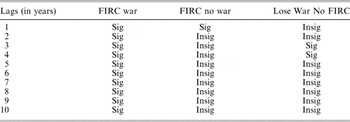
We also considered whether our results were robust to different lag structures. The results in Table 2 were produced with a research design which allowed for the effects of FIRC on civil war onset for five years past the occurrence of the FIRC. We explored a variety of different lag structures, testing models which coded the FIRC and related war variables for effects of only one year up to ten years. The results of these robustness tests are provided in Table 3. Each row indicates a different lag structure specification. For example, in the first row, the relevant independent variables are coded as one only for one year after the FIRC and/or war. The three columns are for coefficient estimates of FIRC/Lose War, FIRC/No Lose War, and No FIRC/Lose War using Model 2. Each cell indicates whether the relevant independent variable is significant and in the predicted direction for that lag structure.
Statistical Significance of Key Independent Variables with Different Lags

Note: FIRC War, FIRC No War and Lose War No FIRC results were all produced with the research design of Model 2 in Table 2. ‘Sig’ indicates significant at the 0.05 level, one-tailed test, in the predicted direction. ‘Insig’ indicates not significant at the 0.05 level, one-tailed test.
Table 3 demonstrates that the results are robust to lag structure specification. The results are also robust when some of Archigos’s debatable codings of FIRC are changed. For example, Archigos codes France as suffering an FIRC in 1944 but not in 1940. If the results are changed such that there is no FIRC in 1944, the results do not change. The results do not change if we code FIRCs as occurring in France in 1940 and 1944. The results do not change if we code Germany as suffering an FIRC in 1918, or Afghanistan suffering an FIRC in 1979.
Relatedly, Archigos tends to exclude some FIRCs which may have been caused by covert action, such as Iran 1953, Guatemala 1954, Brazil 1964 and Chile 1973. We are reluctant to alter Archigos and add in covert FIRCs, as there is no comprehensive list of covert actions which could help build such a variable. However, none of the four cases above occurred in the context of interstate war and none were followed by civil war. Their inclusion in the data would therefore likely strengthen our finding that non-interstate FIRCs do not make civil war more likely.
The results might be sensitive to how we used the Archigos data. Archigos provides two means of coding FIRC, the means by which a leader is deposed, and the means by which a leader enters power. In practice, in most cases when a leader is deposed by foreign pressure or force, his or her successor is installed by foreign pressure or force. However, there are three cases in the data set of regime changes in which the exiting leader does not leave because of foreign pressure, but the entering leader is brought into power because of external pressure, Czechoslovakia 1938, Liberia 1990 and Gabon 1964. None of these cases occurred following an interstate war, and civil war did not follow any of them. Hence, these cases support our general findings that civil war is more likely after interstate war FIRCs, but not after non-interstate war FIRCs.
One possible concern is selection bias concerning ‘state death’.Footnote 64 A state might suffer an FIRC following an interstate war, cease to exist as a nation-state, and then get dropped from our dataset because it is no longer a COW member of the nation-state system. Belgium after the 1940 German conquest is an example. However, one could argue that these dead states should still be accounted for, because a theoretically and politically consequential civil war might still occur in these ‘dead’ states, and if civil war has not occurred in these cases, then the exclusion of dead states would bias our results in favour of finding that interstate war FIRCs make civil war more likely. We tested for this possibility by adding ‘dead’ states back in, that is, states which were members of the COW nation-state system, suffered an FIRC and then got dropped from the COW dataset.Footnote 65 The results are highly consistent with the Model 1 results, with FIRC/Lose War significant, FIRC/No Lose War and No FIRC/Lose War insignificant.
An issue that may be related is that, in this dataset, FIRCs include episodes which are arguably quite different, namely FIRCs used as a bid for empire (notably, many of the FIRCs that occurred during the Second World War) and FIRCs used to install democracy (Afghanistan 2001 and Iraq 2003). Some might propose that these two sets of events ought not to be combined because the civil war risks might differ.
A few points are in order. First, the theories argue for the inclusion of both sets of cases. No matter the goals of the imposer, wrecking the physical/human infrastructure of the target and changing the target’s political institutions should make civil war onset more likely, according to the theories. Secondly, in practice, the inclusion of so-called ‘imperial FIRCs’ has relatively little effect on the results, because many of those country-years get dropped from the analysis because the target experiences state death (see above). Thirdly, the difference between imperial FIRCs and other FIRCs may be debatable. Some, especially leftists outside the United States, view the American overthrow of Saddam Hussein as essentially an imperial venture, motivated by an appetite for oil.
Another issue is a possible endogeneity bias in our inference about interstate war FIRCs. States might be more likely to implement FIRCs on targets where civil war onset is more likely; hence, a high probability of civil war might be causing FIRC, rather than FIRC causing a high probability of civil war. The observed correlation between war FIRCs and civil war might be spurious, as war FIRCs are not causing civil wars, but rather structural factors are causing both civil wars and war FIRCs.
There are three problems with this speculation. First, the models in Table 2 include several control variables for common causes of civil war onset. The war FIRC variable is significant despite the inclusion of these variables, providing confidence that the war FIRC-civil war onset relationship is not spurious. Secondly, the endogeneity critique makes little theoretical sense. If anything, there might be a disincentive for an attacker to impose FIRC on a state prone to civil war, as for a victorious power the outbreak of civil war after interstate war creates severe problems, as the United States discovered in Iraq and Afghanistan. If an attacking state defeated the target’s military and feared possible civil war in the event of an FIRC, it might then have an incentive not to implement an FIRC in order to avoid civil war. One reason Britain did not impose regime change on Turkey in 1918 was British fear of a violent reaction.Footnote 66 Fear of intrastate violence was one reason George H. W. Bush did not overthrow Saddam Hussein after liberating Kuwait in 1991.Footnote 67 Thirdly, there is little evidence of the endogeneity conjecture that attackers seek out targets prone to civil war. We performed rare event logit analysis of the determinants of interstate war FIRC, using as independent variables several of the factors which make civil war onset more likely. Population, mountains, contiguity, ethnic fractionalization and political instability were all not significantly related. Only economic development was significantly and negatively related to the chances of a war FIRC.
There is another possible endogeneity critique. Consider an environment in which an illegitimate leader has a loose grip on power, and there exists a popular regime in waiting. The imposer might negotiate the illegitimate leader’s exit, and the legitimacy of the new regime might lead to a smoother, less violent transition. This would mean that non-war FIRCs are safer not because their physical and human infrastructures were untouched, but rather because in at least some cases an attacker imposed regime in a relatively welcoming domestic political environment. It is difficult to assess this speculation, as not all such leaders in waiting will be welcomed with open arms (certainly, Ahmed Chalabi of the expatriate Iraqi National Congress was not embraced by the Iraqi population when Saddam Hussein was overthrown), and we have no good measures of the popularity of such leaders. It does appear that this scenario is infrequent, however. In the fifteen non-war FIRCs in our dataset, there are perhaps two cases in which an imposer overthrew a leader in large part because the imposer perceived the targeted leader to be unpopular, Haiti 1994 and Central African Republic 1979.
The lagged civil war variable is statistically insignificant. The results do not change if we instead drop all cases where this variable is coded 1, that is, cases of ongoing civil war. We tried replacing the lagged variable with different temporal controls.Footnote 68 The new controls were not significant, and their inclusion did not change the other results. We also tried other statistical models, including random effects and fixed effects logit models. The results did not change.
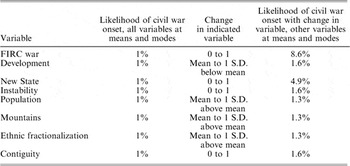
The magnitude of the effects of interstate war FIRC on civil war onset is quite substantial, as may be seen in Table 4. When we set all other variables at their means or modes, the chances of civil war onset jump from 1 per cent, if there is no interstate war FIRC, to 8.6 per cent if there is an interstate war FIRC, an eightfold increase. The magnitude of this effect is much greater than the effects of all the other statistically significant independent variables. The chances of civil war increase only from 1 per cent to 1.6 per cent if the measurement of development decreases from the mean value to one standard deviation below the mean. It increases from 1 per cent to 4.9 per cent if one compares non-new states to new states. It increases from 1 per cent to 1.3 per cent if the population variable moves from the mean to one standard deviation above the mean. It increases from 1 per cent to 1.3 per cent if the mountains variable moves from the mean to one standard deviation above the mean. It increases from 1 per cent to 1.3 per cent if the ethnic fractionalization variable moves from the mean to one standard deviation above the mean. It increases from 1 per cent to 1.6 per cent when the contiguity variable moves from 0 to 1.
Substantive Effects on Likelihood of Civil War Onset

Note: All predicted values for civil war onset produced with coefficient estimates from Model 1 of Table 2. All non-dichotomous variables were set at their means. All dichotomous variables were set at their modes, which in all cases were zero.
Conclusions
FIRCs make civil wars more likely because they wreck state infrastructural power or change political institutions. The central empirical result of this article is that virtually necessary (though not sufficient) conditions for an FIRC to cause a civil war are that the FIRC follows an interstate war and imposes changes in the target state’s political institutions. The magnitudes of these effects are considerable, as imposing an FIRC following an interstate war increases the risk of civil war onset more than eightfold. Yet the results cannot confirm that the presence of foreign occupation troops makes an FIRC more likely to spark a civil war.
Other findings also indicate that state infrastructural power and institutional change are key factors making civil war more likely. Higher levels of development, which increase state power, decrease the likelihood of civil war. More mountainous terrain makes civil war more likely, as mountains reduce the ability of the state to project its power within the country. New states, likely to have lesser legitimacy and weaker physical and human infrastructures, are more likely to experience civil war. Political change, likely to lower legitimacy, makes civil war more likely.
The results from this and other studies indicate that FIRCs following interstate wars both significantly decrease the odds of interstate conflict, and significantly increase the odds of intrastate conflict. These two findings are linked by the devastating effect of FIRC on a state’s physical and human infrastructure. If a state’s infrastructural power is undercut, this reduces its power both to launch interstate wars and to maintain order internally. At a broader level, these results emphasize the importance of using state infrastructural power to understand conflict behaviour.
On the policy side, these results warn against launching interstate war FIRCs. Going to war to impose regime change is tempting, promising to remove a source of militarism and instability, and eliminate a regime likely to repress or massacre its own population. However, doing so significantly increases the risk of civil war. Such an outcome can undermine policy goals, by creating a humanitarian disaster through mass civilian death, the breakdown of social order and the creation of refugees. Though a former rogue regime wracked by civil war may be less likely to instigate interstate war, it may also become a host for terrorist groups. Such a threat may in turn require the imposer to deploy troops in the target state for several years, in the hopes of creating stability and re-establishing order. In the context of the ongoing conflicts in Iraq and Afghanistan, the results here demonstrate that damage to the physical and human infrastructure of these two countries is the taproot of civil violence there. To minimize conflict, policy efforts should in the future focus on reconstruction, such as repairing roads, retaining and training bureaucrats, and bolstering energy production and distribution.
Though the findings indicate the importance of state infrastructural power for civil war onset, more work needs to be done on the determinants of state infrastructural power, and the elements of state infrastructural power critical for maintaining internal order. At the most general level, there is the question of whether state power matters because it facilitates policing, because it alleviates grievances, or some combination. More specifically, there is the question of what national attributes are most important for the state power–civil war relationship. Some focus on geography as critical to state power. Policing effectiveness may be determined by the size and composition of internal security forces. The ability to deliver goods and services is determined by economic development, the extractive capacity of the state and the distributive capacity of the state. In turn, all three of these factors affecting the ability to deliver goods to the population may be affected by factors such as the transport infrastructure, the extent of roads, rail, and air and maritime transport.
Answering these state power questions will in turn provide purchase on a related question, what conditions make it especially likely that an FIRC will cause civil war? FIRC does not always cause civil war, Japan after the Second World War and Germany being perhaps the most prominent examples of war-FIRCs which were not followed by civil war. This article has shed some light on this question. These results accompany scholarship which has found that internal violence ought to be less likely when the target state faces high levels of external threat and when local elites co-operate with occupying forces.Footnote 69 Future research on the FIRC–civil war relationship should examine more closely state power elements, such as whether after an FIRC the imposer purged the target’s bureaucracy, whether the target’s physical infrastructure (including the capital) was heavily damaged, whether the target’s internal security apparatus and/or conventional military had been disbanded, and others. Relatedly, future research could take a closer look at the size and nature of post-FIRC occupation forces. The occupation data used here are simple, just a dichotomous variable for the presence of foreign occupation forces. Better data might explore whether the size of occupation forces matters. Future research should endogenize the presence and size of foreign occupation forces, as imposers may be more likely to deploy (more) occupation forces when the threat of civil war is greater.
Lastly, work needs to be done on the decision to impose an FIRC. What factors make FIRC more likely? Do these factors differ for war environments in comparison to non-war environments? Answering these questions with more extensive data and sophisticated theories and research designs will, among other things, provide a conclusive answer as to whether accounting for the decision to impose FIRC affects our understanding of the FIRC–civil war relationship.