Legislatures that more fully reflect the composition of their citizenry better achieve the promises of democracy. All democracies, however, fail to provide full political equality. For example, although women have significantly progressed in political representation over the last couple of decades, elected representatives are mainly male, upper class, and from the dominant ethnic/cultural group in that nation (Hughes Reference Hughes2011; Paxton and Hughes Reference Paxton and Hughes2007). Parties and selectorates play important roles in explaining inequalities in political representation, but one important factor on the voters’ side, which has received little attention, is the extent to which voters want the composition of the legislature to change. Previous research has highlighted the importance of public support as a causal force for policy outcomes (Brooks and Manza Reference Brooks and Manza2007; Burstein Reference Burstein2003). More specifically, increasing the number of women and MPs from other politically marginalized groups in parliament may not be seen as politically legitimate if it occurs without substantial public support (Barnes and Córdova Reference Barnes and Córdova2016; Clayton Reference Clayton2014). Therefore, we investigated the extent to which citizens support increasing the number of women and members of other marginalized groups in the legislature, whether they support measures (e.g., quotas and reserved seats) to increase the representation of women and other marginalized groups in legislature, and what motivates this support.
Much research has focused on a straightforward explanation of descriptive representation: voters engage in identity politics and want a candidate who looks like them. For example, research in the United States and Canada suggests a baseline preference among voters for those of the voter's same gender and race (Dolan Reference Dolan2004; Huddy and Carey Reference Huddy and Carey2009; Sanbonmatsu Reference Sanbonmatsu2002), confirming that sociodemographic similarities are “the simplest shortcut of all” when it comes to electoral choice (Cutler Reference Cutler2002). However, citizens’ support for increasing the representation of certain groups may also reflect a desire for symbolic and/or substantive representation. Voters can use gender or ethnic background as a cue for an overall sense that the candidate stands for issues associated with that gender/ethnic group or to develop expectations that a candidate will be better suited to accomplish certain political goals (DiMaggio Reference DiMaggio1997). These latter processes usually involve the deployment of a variety of stereotypes (Dolan Reference Dolan2010, Reference Dolan2014; Dolan and Lynch Reference Dolan and Lynch2014), but they nevertheless show the importance of substantive and symbolic alignment of interests between voters and candidates (Campbell and Heath Reference Campbell and Heath2017; Huddy and Carey Reference Huddy and Carey2009). For these reasons, we argue for the importance of expanding our understanding of public support for the political representation of groups that have been traditionally marginalized and include substantive and symbolic concerns as possible explanations for support for an increased political representation of marginalized groups.
Using the 2014 New Zealand Election Study data, we compared support for increasing the numbers of women and indigenous Māori MPs.Footnote 1 We moved beyond the typical focus on only women and included another politically marginalized group (see also Gidengil Reference Gidengil1996). Specifically, in the current study, (a) we directly compared generic support for increasing the number of women and indigenous Māori MPs and (b) we examined support for particular measures to increase the representation of both groups, through informal measures, gender quotas, and reserved seats for Māori. New Zealand is a particularly compelling setting for comparing support for the representation of women and Māori in the lower house because women are descriptively underrepresented (31.4%) and Māori are, thanks to reserved seats, well represented (20.7% MPs vs. 15% in the population) (Barker and Coffé Reference Barker and Coffé2018).
CRAFTING SUPPORT FOR GREATER FORMAL AND INFORMAL EQUALITY IN REPRESENTATION
Despite the importance of demographically representative parliamentary bodies (Phillips Reference Phillips1995), all democracies tend to have elected members more heavily drawn from the male ethnic/religious elite of society (Htun Reference Htun2004; Hughes Reference Hughes2011). Moving toward equality takes multidimensional change, and one important factor is public opinion, especially support for increasing equality in representation for minorityFootnote 2 and marginalized groups. Much of the research in this vein has focused on support for increasing women's representation through various types of quotas. Despite the growing use of gender quotas around the world and evidence of their effectiveness for increasing women's representation (Krook Reference Krook2006; Paxton, Hughes, and Painter Reference Paxton, Hughes and Painter2010; Xydias Reference Xydias2007), public support for gender quotas is quite mixed across nations (Barnes and Córdova Reference Barnes and Córdova2016; Gidengil Reference Gidengil1996; Keenan and McElroy Reference Keenan and McElroy2017; Vowles, Coffé, and Curtain Reference Vowles, Coffé and Curtain2017; Zetterberg Reference Zetterberg2009). A lack of enthusiasm for formal measures, may, however, not mean an overall lack of support for increasing diversity. Indeed, people may support an increase in the number of MPs of marginalized groups and/or groups that have been traditionally underrepresented, but simultaneously, they may not support the introduction of any formal measures (e.g., in the form of quotas or reserved seats) to achieve that goal.
The most thoroughly investigated mechanism for explaining support for increasing some group of MPs (mainly women) is identity congruence; that is, people want MPs who look like them (Cutler Reference Cutler2002). Thus, voters belonging to a certain group will be supportive of increasing the number of MPs belonging to the same group. Based on theories of political representation, voters may, however, have a number of ways to assess the importance and value of increased women and minorities in parliament, in particular, based on factors derived from descriptive, substantive, and symbolic representation (Pitkin Reference Pitkin1967; Schwindt-Bayer and Mishler Reference Schwindt-Bayer and Mishler2005).Footnote 3 Applied to public opinion, each of these may reflect reasons why voters do or do not think changes are needed in the de jure or de facto representation of a particular group. These factors can also be used as a foundation for understanding how citizens may differentially assess the importance of electing more women or minorities.
Identities Matter
The evidence supports the importance of descriptive representation in shaping voters’ opinions. Voters prefer representatives who ‘look like them’ (Cutler Reference Cutler2002), indicating that voters engage in identity politics or “political allegiances formed on the basis of some demographic similarity” (Plutzer and Zipp Reference Plutzer and Zipp1996, 31). Considering race, US researchers conclude that voters strongly favor racial in-group candidates and disfavor racial out-group candidates (Dawson Reference Dawson1995; Huddy and Carey Reference Huddy and Carey2009; Hutchings and Valentino Reference Hutchings and Valentino2004; McDermott Reference McDermott1998). Women are much more likely to support the increased representation of women in general and through quotas (Allen and Cutts Reference Allen and Cutts2016; Barnes and Córdova Reference Barnes and Córdova2016; Cowley Reference Cowley2013; Espírito-Santo Reference Espírito-Santo2016; Gidengil Reference Gidengil1996; Rosenthal Reference Rosenthal1995; Sanbonmatsu Reference Sanbonmatsu2003), though the evidence for the women-centered effect is overall much less consistent than that for race (Huddy and Carey Reference Huddy and Carey2009). Thus, descriptive representation should support increased representation of each group. Our first hypothesis is that, net of all other controls, the following holds true:
H 1:
Respondents belonging to a group will be more supportive of an increased representation of that same group in parliament.
Substance Matters
Alternatively, or in addition to the preceding discussion, some issues are seen as ‘belonging’ to a group, for example, abortion as a women's issue or minority economic programs as a racial/ethnic minority issue (Brown Reference Brown2014; Gwiazda Reference Gwiazda2019; Swers Reference Swers2002). In this case, regardless of the voters’ own identity, voters may be supportive of an increased number of representatives who they believe will substantively represent their concerns with that issue because of the assumed congruence between the MP's identity and the issue type (i.e., women MPs and abortion rights as a women's issue).
Electing more women can lead to greater government investment in issues seen as particularly relevant to gender equality (Bolzendahl Reference Bolzendahl2011; Celis Reference Celis2006; Cowell-Meyers and Langbein Reference Cowell-Meyers and Langbein2009; Schwindt-Bayer and Mishler Reference Schwindt-Bayer and Mishler2005; Wängnerud Reference Wängnerud2009), suggesting that substantive representation is at play. Public opinion research in Northern Ireland also found support for the belief that increasing women's descriptive representation would improve the representation of women's interests, and this effect was particularly strong for women (Allen and Cutts Reference Allen and Cutts2016). A British public opinion study revealed that respondents tended to disagree that women can better represent ‘women's interests’ than men, though women, more than men, were more inclined to believe that women could (Campbell and Heath Reference Campbell and Heath2017). Some US findings have linked supporting a female candidate to a respondent's sense that the candidate will be a better representative on abortion views; they also show that stereotypes about women's substantive representation matter in shaping support for female candidates (Dolan Reference Dolan2010, Reference Dolan2014; Dolan and Lynch Reference Dolan and Lynch2014).
Similar results based on racial and ethnic minority candidates have been reported (Hutchings and Valentino Reference Hutchings and Valentino2004), and in the United States, there is a strong link between legislators that are black and Latino and their intervention on policies favorable to black and Latino constituents (Broockman Reference Broockman2013; Griffin Reference Griffin2014; Minta Reference Minta2009; Preuhs Reference Preuhs2007). In a study of 47 nations, Hänni (Reference Hänni2017) found that minority groups can effectively influence policy outcomes when power and size are in their favor (see also Lončar Reference Lončar2016). This relationship between representatives’ ethnic or racial background and their policy focus and opinions is echoed in public opinion research. In US surveys, respondents are more likely to see black candidates as dealing more centrally with issues affecting minorities (Huddy and Carey Reference Huddy and Carey2009; McDermott Reference McDermott1998; Preuhs Reference Preuhs2006; Tate Reference Tate1994, Reference Tate2003), as are respondents in Great Britain (Saalfeld and Bischof Reference Saalfeld and Bischof2013). Given that citizens seem to see specific policy issues and opinions as belonging to a marginalized group, we hypothesize the following:
H 2:
Respondents who are more supportive of issues associated with the interests of a marginalized group will be more supportive of an increased representation of that group in parliament.
Symbols Matter
Although women or ethnic minorities may be seen as better able to represent constituents on issues substantively associated with that group, respondents can also see the increased election of women or minorities as symbolic of their overall views of government and social issues. To the extent that symbolic representation is “concerned not with who the representatives are or what they do, but how they are perceived and evaluated by those they represent” (Schwindt-Bayer and Mishler Reference Schwindt-Bayer and Mishler2005, 409), women or minority candidates may reflect stereotypes about governance, inequality, and social inclusion (Krysan Reference Krysan2000; Lefkofridi, Giger, and Holli Reference Lefkofridi, Giger and Holli2018; McDermott Reference McDermott1998; Sigelman et al. Reference Sigelman, Sigelman, Walkosz and Nitz1995). This finding contrasts with the substantive representation described in the preceding text, in which we expect public opinion to be based on a view of representatives as uniquely qualified to deal with group-specific policy issues (Gwiazda Reference Gwiazda2019). In symbolic representation, the respondent may associate a representative with larger (and vaguer) social concepts (Barnes and Córdova Reference Barnes and Córdova2016; Krysan Reference Krysan2000). In particular, given that representatives of marginalized groups are often seen as social and/or political outsiders, citizens may believe that these representatives will be more supportive of addressing economic inequality and of increasing social investment (McDermott Reference McDermott1998). For example, in their study of support for gender quotas in Latin America, Barnes and Córdova (Reference Barnes and Córdova2016) found that support for greater government involvement was a strong predictor of overall support for quotas.
Hence, public support for increasing representation of marginalized groups may be linked to overall concerns with economic equality, social inclusion, and democratic performance. Public opinion studies have shown that women are perceived as better suited to make social policies handling issues of equality and equity (Huddy and Terkildsen Reference Huddy and Terkildsen1993), as being less corrupt (Goetz Reference Goetz2007), and as helping to strengthen the government (McDermott Reference McDermott1998; Sanbonmatsu Reference Sanbonmatsu2002). In part, this opinion is built from stereotypes about gender traits (e.g., women as expressive or emotional) (Bauer Reference Bauer2018; Lefkofridi, Giger, and Holli Reference Lefkofridi, Giger and Holli2018), but these can also be interpreted as perceptions of women and minorities as symbolic tokens of equity. This process is further supported by US research suggesting that voters are much more likely to see Black politicians as more competent with general equality-related issues such as civil rights, health care, welfare programs, poverty, and unemployment than white politicians (Enders and Scott Reference Enders and Scott2019; Schneider and Bos Reference Schneider and Bos2011; Tesler Reference Tesler2012, Reference Tesler2015). Based on these findings, we further expect that the following hypothesis is true:
H 3:
Support for issues tied to socioeconomic and political inclusion will increase the support for greater representation of marginalized groups.
THE NEW ZEALAND CASE
In 1996, New Zealand replaced its First Past the Post (FPP) electoral system by a mixed-member proportional (MMP) system. In this system, each elector has two votes: one for a specific candidate in the constituency (electorate vote) and one for a party list (list vote). The overall distribution of seats in parliament reflects each party's share of the nationwide party list vote. Party groups in parliament comprise all those elected as electorate MPs, plus MPs taken from the party list to bring that party up to its overall seat entitlement in parliament (Miller Reference Miller2015). Having been the first country granting women the right to vote in 1893, the representation of women in the New Zealand parliament has stabilized around 30% since the introduction of MMP in 1996, but it reached its highest level after the 2014 elections with 31.4% women.Footnote 4
The issue of gender quotas and women's political equality was hotly debated in 2013, when the Labour Party initially proposed and then rejected the adoption of an all-women shortlist option for candidate selection in electorate seats (Vowles, Coffé, and Curtain Reference Vowles, Coffé and Curtain2017). Following the 2011 election defeat, the party established a selection working group to provide recommendations about reforming its processes to increasing women's representation as electorate candidates. A constitutional remit on the issue was planned for the annual conference in November, but it leaked to a right-wing blog site called “Whale Oil” in early July. A media frenzy followed, with the proposed policy labelled a “man ban” and commentators accusing Labour of discrimination, failing to select on the basis of merit, and looking “out of touch” with its rank and file. Within a week of the leak, then leader David Shearer said the Party was dumping the quotas but would retain its target of 45% women MPs in 2014, a goal that was confirmed after the leadership moved in September 2013. The other major party, National, has not adopted formal gender quotas, but it does apply the principle of balance in its nomination process. The Green Party is the only party with gender quotas, stipulating that women and men alternate up and down the order of their party list, and therefore, exactly half of the MPs are women.
Seven of the 71 New Zealand electorates are dedicated seats for indigenous Māori. These seats overlay the general electorates, and candidates of any political party and any race or ethnicity may stand for election in a Māori electorate (Electoral Commission 2014a). Since 1993, the number of Māori seats has been allowed to vary depending on how many voters of Māori descent choose to enroll on the Māori roll rather than the general roll.Footnote 5 Based on this provision, the number of Māori seats has grown from five in 1996 to the current seven. Thanks to these seats, Māori are well represented in parliament. With 20.7% of the MPs identifying as Māori after the 2014 elections, the representation of Māori is higher in parliament than in NZ society where, according to the 2013 census, one in seven people (14.9%) belong to the Māori ethnic group (Barker and Coffé Reference Barker and Coffé2018).Footnote 6
DATA
To investigate our research questions, we relied on the 2014 New Zealand Election Study (www.nzes.org). This study was conducted via post among a representative sample of registered electors immediately after the elections held on September 20, 2014, and respondents had the opportunity to complete the survey online. Data were weighted to correct for oversampling by gender, age, and Māori electorates on a cell-by-cell basis; by education, reported vote, and validated turnout; and on the basis of iterative weighting on the marginal frequencies. Missing data were addressed through multiple approaches depending on the variable, and these are discussed in the following section. The final sample size for our study was 2,423.
MEASURES AND METHODS
Dependent Variables: Support for Increased Representation of Women and Māori
We assessed support for increased representation of women and Māori in two ways: general support and opinions on efforts to increase their representation. Although we anticipated that the hypotheses would be similarly applicable to both types of measures, we included both measures to gain a more comprehensive empirical perspective on support for equality in representation.
General support for an increase of women and Māori MPs was measured by considering the following question: “Looking at the types of people who are MPs, do you think that there should be more, fewer, or about the same number as now who are [women/Māori]?” Three answer categories were provided in the survey: (1) more, (2) same as now, and (3) fewer and depends on candidate.Footnote 7 Given that initial tests indicated that the main differences for both women and Māori were between those who want (1) more women or Māori MPs versus (0) other responses, we used the latter operationalization in the analyses reported in the following section.
Support for specific efforts and measures to increase women's representation was measured using three different categories: (0) no efforts (i.e., no need to increase the number of women MPs or it will happen naturally), (1) informal efforts (i.e., political parties make their own voluntary commitments to increase the number of women MPs or to encourage more women to participate in politics), or (2) formal efforts (i.e., legally requiring all political parties to select more women candidates by means of ‘quotas’). The middle category is the reference category. Support for the introduction of measures to increase the representation of Māori distinguishes those who support (0) abolishing the seats, (1) keeping the seven currently in place, or (2) increasing the number of reserved Māori seats.Footnote 8 The middle category is the reference category in the analyses that follow.
Explanatory Variables: Expectations of Representation
Gender and ethnic identity were the main measures of descriptive, or identity-based, representation. Gender was a dichotomous variable: (1) women and (0) men. Māori group membership was coded as (1) Māori versus (0) European and other ethnicities.
Policy issues seen as “belonging” to women and Māori, regarded as substantive concerns, include abortion rights and the Treaty of Waitangi. Debates over women's access to safe and legal abortion in New Zealand are ongoing and have highlighted sexism inherent in the current wording of the law.Footnote 9 Currently, abortion is legal only in cases of a danger to the mother or if the fetus has developmental problems. We measured support for abortion rights as ranging from (0) strongly agree (i.e., abortion is not always wrong) to (4) strongly disagree (i.e., abortion is always wrong). Our supplementary analysis confirmed that women were significantly more favorable to abortion rights than men.Footnote 10 An issue highly relevant to the Māori population concerns the Treaty of Waitangi, the founding document of the nation and the cooperation between the British and Māori.Footnote 11 Although differing uses and interpretations of the treaty have led to conflict, it forms the basis for the protection of Māori rights. The survey asked respondents whether “reference to the Treaty of Waitangi should be removed from the law.” Responses ranged from (0) strongly agree to (4) strongly disagree. Higher values thus indicated support for keeping reference to the Treaty of Waitangi in the law, and Māori were significantly more opposed to removing the Treaty from law.Footnote 12
The effect of symbolic concerns on respondents’ likelihood of supporting an increase of women and Māori MPs was examined by considering the extent to which respondents support broader ideals and/or interests in equity and social investment and concerns about the maintaining a high-functioning democracy. First, for socioeconomic equality, respondents were asked if the government should spend (0) much less to (4) much more on health, education, unemployment, superannuation (pension), and welfare benefits. Responses were summed into an index (Cronbach's α = .66), and respondents who did not answer any of these questions were dropped. Second, for inequality, respondents were asked whether they (0) strongly disagree to (4) strongly agree that “government should take measures to reduce differences in income levels.” Third, for government function, respondents were coded as to whether they were (1) not very or not at all satisfied versus (0) very or fairly satisfied with “how democracy works in New Zealand.”Footnote 13 Additional analyses revealed that on each of these three topics, women were not significantly different from men in their views. Māori tended to be more supportive of social investment and ameliorating income inequality and were more dissatisfied with democracy than non-Māori. As detailed in the preceding section, however, symbolic associations mean that regardless of the link between respondents’ gender and ethnic background on attitudes toward these issues, these issues may still stereotypically associate such interests with women or Māori elected representatives (Bauer Reference Bauer2018; Enders and Scott Reference Enders and Scott2019).
Control Variables
Our analyses also included various political and socioeconomic control variables: political ideology (left, center, right, don't know), education (low, middle, of high (university)), political interest (very interested vs. others),Footnote 14 age, born in New Zealand, having a partner, having children, religious attendance, religion, employment status, occupation, and urban residence. Descriptive statistics for all explanatory and control variables included in our analyses are available in Appendix Table A1 online.
Statistical Analysis
Our analysis included a variety of descriptive statistics to provide a foundational understanding of the patterns in opinions, which we analyzed inferentially. Our inferential binary and multinomial logistic models allowed us to simultaneously test the relationships between our key dependent and explanatory variables. In the tables, logit coefficient effects were confounded with variance of the errors and thus could not be directly compared. Therefore, we have illustrated the substantive relationships in marginal predicted probability for key values of interest.
RESULTS
Descriptive Patterns of Support
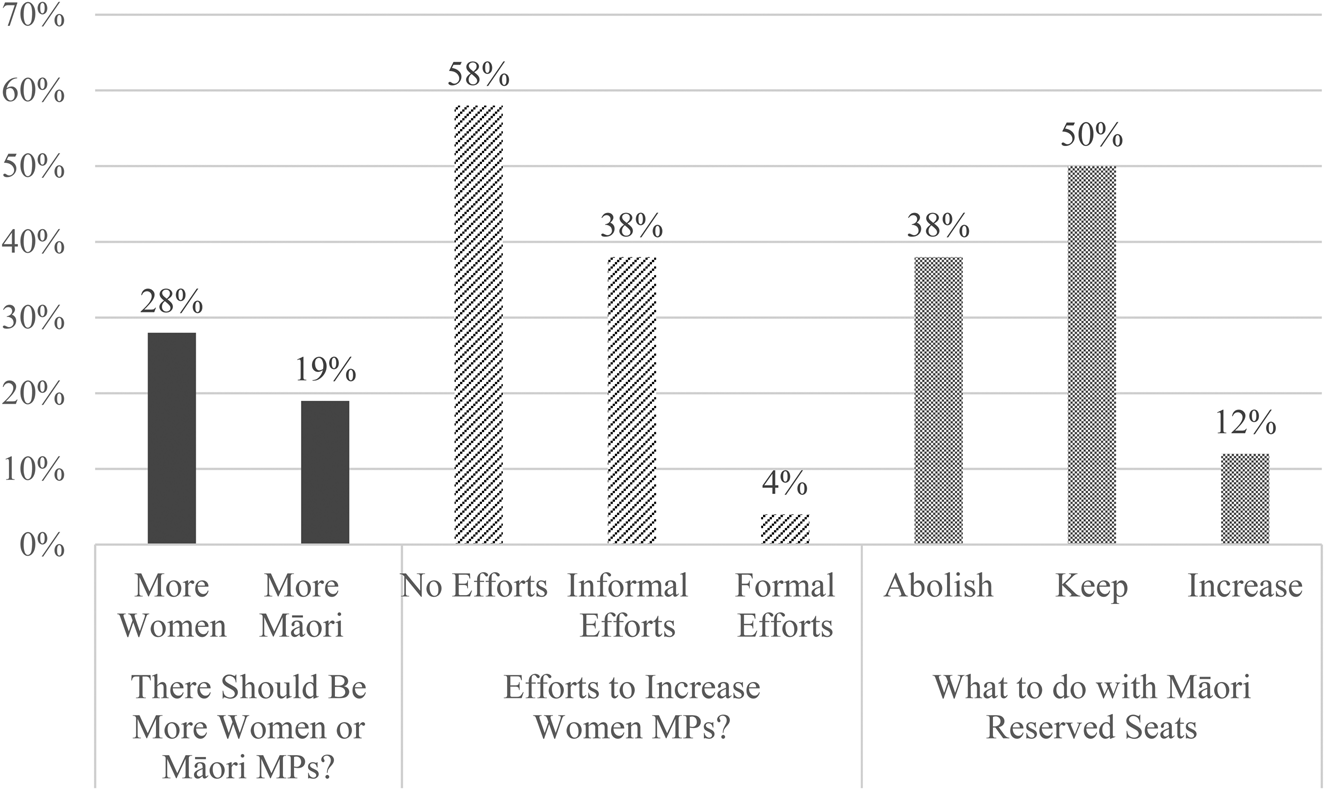
Figure 1 presents the descriptive information regarding support for increasing the numbers of women and Māori MPs in parliament. The left panel of Figure 1 presents overall support for an increase in the number of women and Māori MPs. The middle and right panels show the results for support for the introduction of measures to increase the number of women and Māori MPs. The results presented in the left panel indicate that most respondents do not support increasing the number of women in parliament overall. Only 28% of the respondents believe that the number of women in parliament should be increased. Support for increasing the number of Māori MPs is even lower: 19%. This may reflect an awareness of women's greater underrepresentation in the NZ parliament.
Descriptive patterns of support for increasing women's and Māori representation in Parliament.

The middle panel of Figure 1 shows that most respondents (58%) believe that no efforts should be undertaken to increase the number of women MPs. When efforts are supported to increase the representation of women MPs, they should be mainly informal; only 4% of respondents favored quotas. As shown in the right panel of Figure 1, respondents were willing to accept the continued use of the reserved seats for Māori representation. This finding may suggest that respondents are more comfortable with the formal efforts in place for this group than such efforts for women. The greater support for reserved seats for Māori compared with formal efforts to increase women's representation may relate to the fact that while reserved seats for Māori exist, only one party has formal gender quotas in the NZ parliament. Although 50% of the respondents wanted to keep the reserved seats for Māori, a sizable group (38%) wanted to abolish these seats.
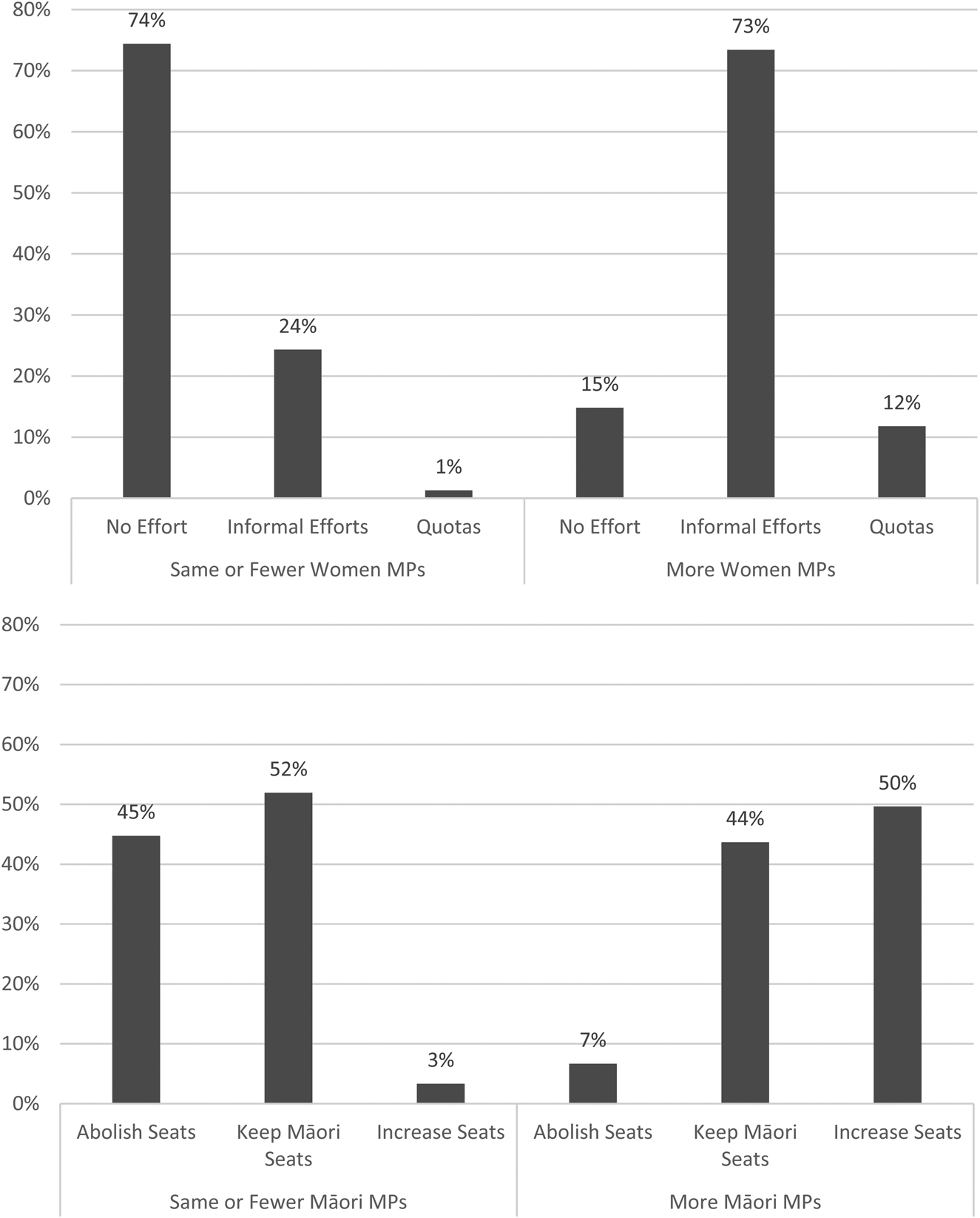
To better understand the relationship between general support for more women and Māori MPs and the introduction of measures to increase their representation, Figure 2 illustrates patterns in overlapping support. Overall, those who generally wanted more women elected strongly preferred informal efforts over formal efforts. However, among this group, support for quotas was much higher than among those who wished to keep or reduce the number of women MPs (12% vs. 1%). The pattern is quite different for those who support increasing the number of Māori MPs; most of those respondents (50%) favored increasing the formal efforts by adding more reserved seats. Those who wanted to see the number of Māori MPs stay the same or decrease generally favored retaining the formal reserved seats rather than abolishing them (52% vs. 45%).
Relationship between general support for increasing the number of women MPs and support for the introduction of measures to increase their representation (top panel) and between general support for increasing the number of Māori mps and support for the introduction of measures to increase their representation (bottom panel).

Inferential Tests of General Support for Increasing Women and Māori MPs
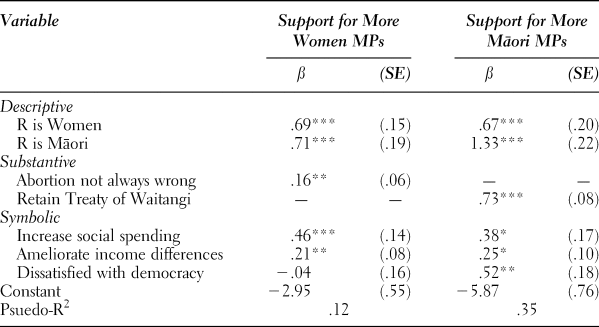
Next, we tested our hypotheses using a binary logit regression model for general support for an increase in the number of women and Māori MPs and a multinomial logit regression model for support for the introduction of measures to increase the number of women and Māori MPs.Footnote 15 Starting with the explanations for general support for an increase of the number of women and Māori MPs in Parliament, the results presented in Table 1 indicate a strong effect of identity: women were significantly more likely to support increasing the number of women MPs and Māori were significantly more likely to support increasing the number of Māori MPs. However, support also overlaps for a group who wish to see increases in both types of MPs. Favoring substantive policies linked to women or Māori MPs is also positively associated with greater support for increasing the representation of these groups. The evidence supports Hypothesis 2 and Hypothesis 3 regarding expected links between symbolic issues and support for more women or Māori MPs. The only exception is dissatisfaction with democracy, which is unrelated to support for more women MPs but is positively related to support for more Māori MPs.
Logistic regression models of support for increasing the number of women and Māori MPs

*P < .05; **P < .01; ***P < .001. MP, member of parliament; SE, standard error. All models include all control variables (see text).
Source: 2014 New Zealand Election Study.
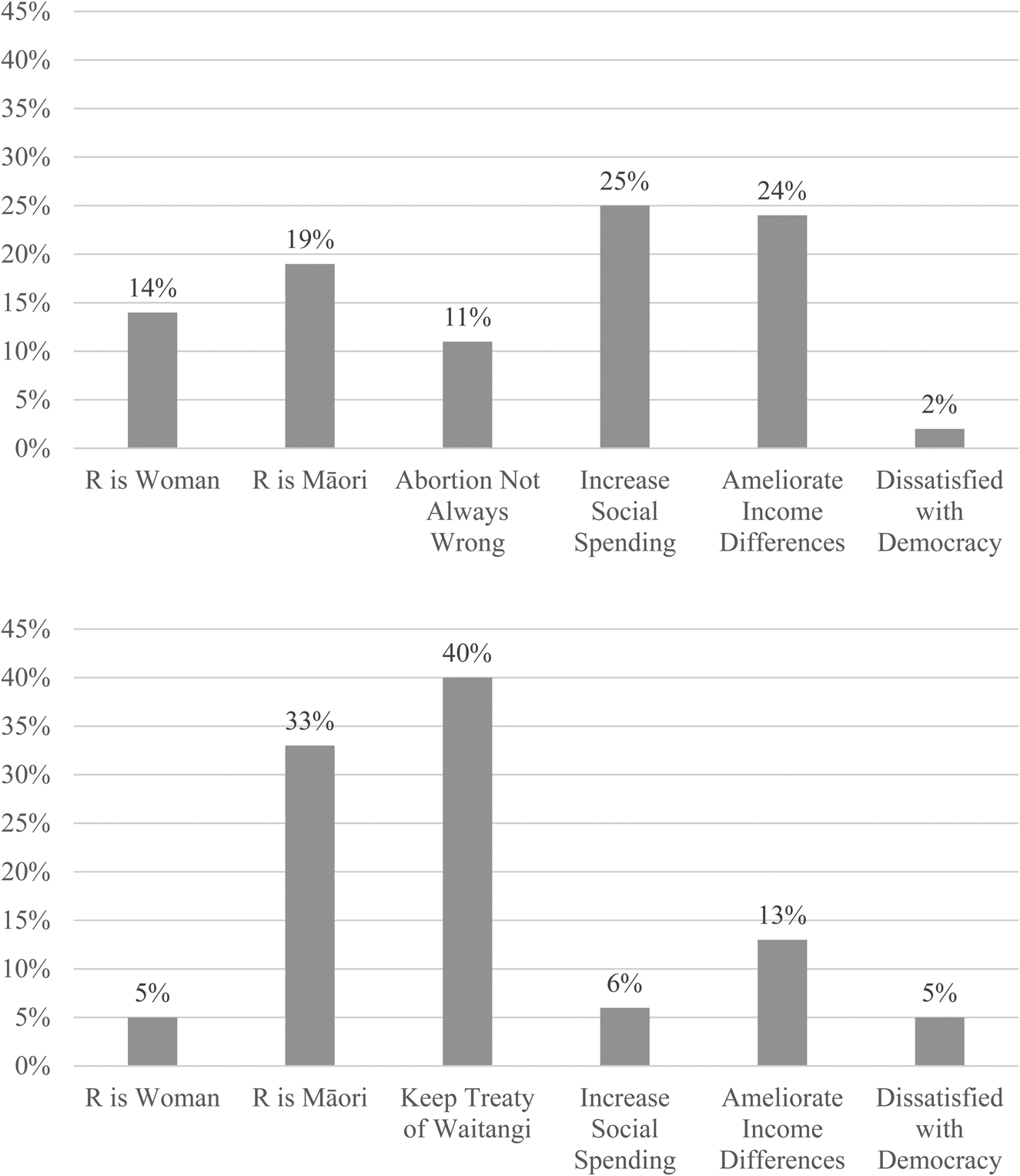
Figure 3 presents marginal predicted probabilities for key explanatory variables, with all other variables held at their means. Percentages in these figures are the percent change in support between the two groups or levels being discussed. For example, in the case of “R is woman,” the percentages reflect the difference between women and men respondents in their support for increasing the number of women and Māori MPs. Marginal predicted values for all key findings are discussed in the text and are available in Appendix Table A2 online. Women have a 30% predicted probability of wanting more women MPs, and men have a 16% predicted probability; thus, women are 14% more supportive of increasing the number of women MPs compared with men in our sample. The illustrations show that Māori respondents are 19% more likely to support electing more women MPs than non-Māori; thus, the cleavage in support for increasing women MPs is wider by ethnic status than by gender. Māori respondents had a 39% predicted probability of wanting more women MPs, versus 20% for non-Māori. Māori respondents had an overall greater predicted probability to support an increase in the number of women MPs than women.
Change in predicted marginal probabilities of support for increasing women MPs (top panel) and Māori MPs (bottom panel) across values of key variables.

Respondents who believe that abortion is not always wrong were 11% more likely to support increasing the number of women MPs than those who think it is always wrong. Opinions about social spending and income differences were strongly linked to support for increasing the number of women MPs. Those who supported “much more” social spending were 25% more likely to support more women MPs than those who supported (on average) “less” social spending.Footnote 16 Those who “strongly agree” that the government should work to ameliorate income differences were 24% more likely to than those who “strongly disagree” with that policy. Overall, the three largest predicted probabilities of support for more women MPs were being Māori (39%), wanting much more social spending (39%), and wanting the government to ameliorate income inequalities (35%). A desire for greater government involvement in economic social policy is thus strongly tied to support for increased representation of women.
Examining similar changes in probabilities of support for increasing the number of Māori MPs, Figure 3 shows that identity politics and substantive concerns are the major factors at play. Respondents who are Māori were 33% more likely than non-Māori to call for increasing the number of Māori MPs. Māori had a 37% probability of wanting more Māori MPs, compared with a probability of only 4% among non-Māori. Although women were statistically significantly more supportive than men to support an increase of Māori MPs (see Table 1), women's support amounted to only an 8% probability (vs. 3% among men). The largest gap in support for an increase in the number of Māori MPs was between those who wish to keep the Treaty of Waitangi in the law versus those who which to remove it: a 40% difference. The strongest supporters of the treaty had a 41% probability of wanting more Māori MPs, and those least supportive had only a 1% probability of wanting more Māori MPs. Further analysis (available upon request) shows that this cleavage increased when we also considered ethnic group membership. Namely, Māori who wished to keep the treaty had a 61% probability of wanting more Māori MPs. In comparison, non-Māori who strongly supported keeping the treaty in law had only a 28% probability of wanting more Māori MPs. Clearly, Māori respondents who wanted to protect the treaty's place in law strongly linked it to their support for Māori legislative representation. Despite findings for significant relationships in Table 1, few other cleavages had a strong substantive effect on support for more Māori MPs. The strongest gap is between those who strongly agreed that the government should work to ameliorate income differences compared with those who strongly disagreed with that policy. Those who supported this platform were 13% more likely to support increasing the number of Māori MPs.
Inferential Tests of Support for Formal Efforts to Increase Women and Māori MPs
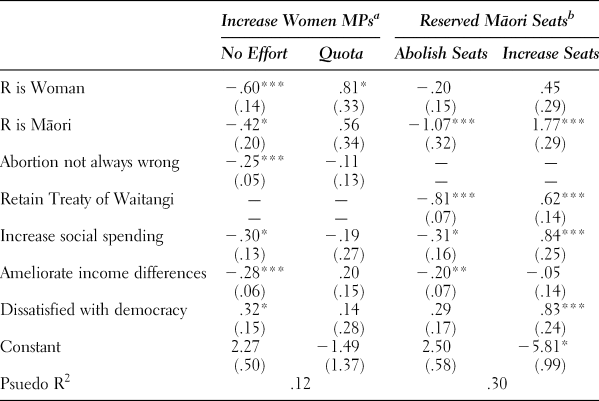
Next, we used multinomial logit analyses to investigate support for efforts to increase the representation of women and Māori. As mentioned in the preceding section, the “informal efforts” category is the comparison or base category in the analysis for support for efforts to increase women's representation. With regard to formal efforts toward the representation of Māori, the current reserved seats provide numerical equity. Thus, retaining the status quo was the base category for that dependent variable.
Multinomial logit models of support for measures to increase women and Māori MPs

N = 2,423. Standard error is shown in parentheses.
*P < .05; **P < .01; ***P < .001. All models include all control variables (see text).
a Base category: “informal efforts.”
bBase category “retain current 7 seats.”
Source: 2014 New Zealand Election Study.
The results of this measure of support show the importance of identity politics in an effort to increase the number of women and Māori MPs. Women are significantly more likely to support both informal and formal efforts to increase the number of women MPs. Māori significantly support an increase the existing number of reserved Māori seats and are opposed to the abolishing these seats. Contrary to general support for an increase of Māori MPs (see Table 1 and Figure 3), being a woman does not distinguish opinions on reserved seats for Māori MPs.Footnote 17 Although Māori respondents were slightly more likely to support informal efforts rather than no efforts to increase women MPs than non-Māori respondents, Māori respondents did not differ from non-Māori in support for quotas (compared with informal measures). Although there were overlapping sources of general support for an increase in the number of women and Māori MPs. Women were significantly more likely to support an increase in Māori MPs than men, and Māori were significantly more likely to support an increase in women MPs compared with non-Māori. This trend does not hold for the introduction of specific measures to increase their representation.
Considering the effect of substantive concerns, those who say that abortion is not always wrong were more likely to support the introduction of informal efforts to increase the number of women MPs than those who say that abortion is always wrong. Support for keeping the Treaty of Waitangi in law strongly relates to a desire to maintain or expand the number of reserved Māori seats.
Symbolically, the results for efforts to increase the number of women MPs echo those in Table 1. Those who want more government socioeconomic policy involvement are more likely to want informal efforts to increase the number of women MPs (compared with no effort) than those who do not want governmental involvement. However, dissatisfaction with democracy slightly undermined support for any efforts to increase the number of women MPs. The desire to keep or increase the Māori reserved seats was also linked to a desire for greater government socioeconomic policy involvement. However, those dissatisfied with democracy wanted more reserved seats for Māori MPs (compared with keeping the same number of seats) than those who were satisfied with the way democracy is working. This effect is conditional on controlling for opinions on the Treaty of Waitangi; without controlling for opinions on the Treaty, dissatisfaction with democracy was positively linked to both abolishing and increasing seats. This finding illustrates the wide cleavage in opinions on the Treaty.
Overall, the only significant source of support for quotas to increase the number of women in parliament was among women themselves. In contrast, Māori respondents supported the Treaty of Waitangi, supported increased social spending, and/or were dissatisfied with democracy, and they were all advocates of increasing the number of Māori seats.
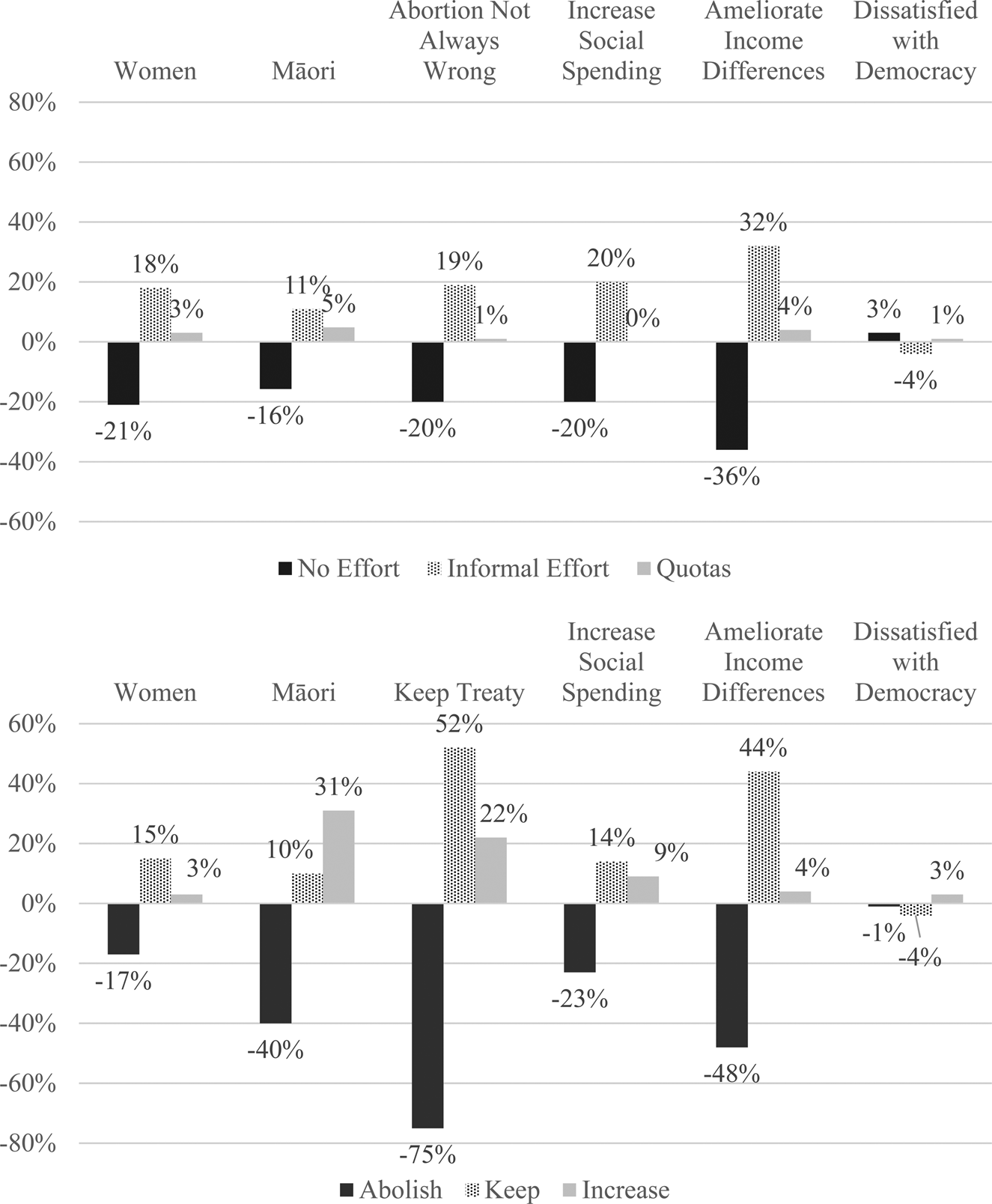
To put these effects in context, we identified cleavages in marginal predicted probabilities for the key variables in our analysis in Figure 4. As in Figure 3, these numbers represent the difference in the effects (e.g., probability for women − probability for men). Marginal predicted values for all key findings are discussed in text and are available in Appendix Table A2 online. Looking at the top panel, Figure 4 shows consistently little to no support for quotas. Where variables mattered, they were linked to a preference for informal efforts or a rejection of a “no efforts” model. Women were 18% more likely to support the introduction of informal measures to increase women's representation than were men, and they were more than 20% less likely to believe that no effort should be undertaken than men were. In general, the models predict that women have a 45% probability of wanting informal efforts to elect women (compared with 27% among men).
Change in predicted marginal probabilities of support for efforts to increase women MPs (top panel) and to maintain Māori reserved seats (bottom panel) across values of key variables.

Support for abortion rights also demonstrated a cleavage for the categories of no effort and introducing informal efforts. The overall gap between these two extremes was 19% for the support of introducing informal efforts. Abortion right supporters had a 45% probability of wanting more informal efforts to elect women. However, as seen for overall support for increasing the number of women MPs (Figure 3), the largest cleavages were between those who wanted greater government involvement in socioeconomic policy (in particular to decrease income differences) and those who wanted less or none. More specifically, 48% of those who wanted much more social spending, and 49% of those who strongly supported the government's involvement in ameliorating income inequality, wanted more informal efforts to elect women. These percentages were respectively 20% and 32% higher than for those who did not want more social spending or more involvement of the government in ameliorating income inequality. Dissatisfaction with democracy had little substantive connection to views on efforts to increase the number of women MPs, but the effect was polarized. Those who were dissatisfied were more likely to both want no efforts or quotas, rather than informal efforts.
Regarding respondents’ opinions about maintaining, increasing, or abolishing the reserved seats for Māori, the bottom panel of Figure 4 indicates (similar to the general support for increasing the number of Māori MPs shown in Figure 3) that support for keeping and increasing the number of reserved seats was largely shaped by being Māori and by support for maintaining the Treaty of Waitangi. Māori respondents were 31% more likely to prefer increasing the number of seats and 10% more likely to want to keep the current number of seats than were non-Māori respondents. Being Māori was associated with a 32% probability of wanting the number of seats expanded and a 64% probability of wanting to keep the current seats. Those supporting keeping the Treaty of Waitangi in the law were 75% more likely to reject abolishing any seats and were more in favor of keeping (52%) or increasing (22%) the number of seats than were those who did not believe that the Treaty should be kept in the law. If a respondent opposed keeping the treaty in law, they had a 79% probability of wanting to abolish the reserved seats (compared with 4% among those supporting keeping the treaty in the law). Those who supported keeping the treaty in the law had an approximately 76% probability of wanting to keep the current number of reserved seats. Support for expanding the seats among treaty backers was 23% (compared with 1% among those not supporting to keeping the treaty in the law). The main symbolic policy issue tied to support for keeping the current reserved seats was the desire to have the government work to ameliorate income differences. Those who wanted government intervention in income inequality had a 76% probability of wanting to keep the current reserved seats. This difference in predicted probability was 44% compared with those who did not want such intervention by the government.
CONCLUSIONS
Political power has long been dominated by men and members of majority ethnic groups. This is slowly changing, and support for more equitable representation—and actual equality in representation—has increased for women and many other marginalized and/or minority groups (Hughes Reference Hughes2011; Paxton, Hughes, and Green Reference Paxton, Hughes and Green2006). The question of why the public believes more representatives from minority groups are needed, however, is complex. As Pitkin (Reference Pitkin1967) and those building off her work have noted, representation is multidimensional. Regarding popular support for the principle of increasing the number of representatives from marginalized groups, we cannot assume that all persons are motivated by the same reasoning or that the reasons matter equally for all groups or in all nations. In this article, we have addressed these concerns by evaluating a set of competing explanations (descriptive, substantive, and symbolic) for support for increasing the number of women and Māori MPs and for the introduction of efforts to increase their numbers in New Zealand. Our findings suggest that the different dimensions of representation matter for understanding support for an increase in the representation of both groups of MPs and for both general support and support for the introduction of measures to increase their representation, but they also highlight crucial differences in explanatory patterns.
Our first hypothesis (H 1) focused on descriptive representation and argued that identities matter. Our results suggest that identities do indeed matter. Women were significantly more likely than men to want more women MPs and to support formal and informal efforts to achieve this. Māori were more likely to want more Māori MPs and to support efforts to maintain or increase their representation than non-Māori. Women were also more likely to want more Māori MPs than were men, and Māori were more supportive of increasing the number of women MPs than were non-Māori. The predicted probabilities even suggest that support for increasing the number of women MPs is greater among Māori than among women. Being from an underrepresented group seems to have increased support not only for additional representation of one's own group but also for an increase of the representation of other social groups who had traditionally been underrepresented. In general, the identity cleavage was larger between Māori/non-Māori than between women and men. Although Māori were significantly more likely to support increasing the number of reserved seats, women had quite weak support for the introduction of quotas. However, women were substantially more likely than men so support the introduction of informal efforts to increase women's representation.
Hypothesis 2 examined concerns over substantive representation, choosing two political issues, and positions seen as characteristic of women and Māori MPs. First, viewing abortion as not always wrong meant significantly more support for women MPs in general and with regard to support for informal efforts to increase the number of women MPs. This finding seems to suggest that, for many voters, increasing the number of women elected is tied to substantive concerns over women's reproductive rights. Second, support for increasing Māori representation in general and keeping or expanding reserved Māori seats was strongly tied to substantive concerns over keeping the Treaty of Waitangi in the law. Voters clearly viewed Māori presence in government as a key correlate of this policy issue, and the correlation was particularly strong for Māori respondents. In general, then, we can conclude that substantive issues are linked to support for more equitable gender and ethnic representation, although the connection is strongest for models of Māori MP support.
Our third and final hypothesis (H3) suggested that measures of symbolic representation—defined as overall concerns with socioeconomic equity and democratic performance—play a significant role in support for an increase of the political representation of traditionally underrepresented and marginalized groups. This hypothesis was largely confirmed by our findings. We did not find that dissatisfaction with democracy is important in supporting increased representation of women or Māori and measures to increase their support, but we found overwhelming evidence in favor of a link between support for an increase in social spending and governmental efforts to ameliorate income difference and generally wanting more women or—to a lesser extent—Māori MPs. The interest in government-backed efforts to address socioeconomic equality, and efforts to decrease income differences in particular, were also strongly tied to positive support for informal efforts to increase women's representation and for maintaining the Māori seats. Voters thus seemed to view minority MPs as symbolically linked to concerns about social investment and economic inequality, and those who were concerned about these issues were more likely to support an increased representation of minority MPs than those who were not concerned about these issues.
DISCUSSION
Our findings have important implications for theories on representation and public opinion. People do seem to want representatives that “look like them” (Plutzer and Zipp Reference Plutzer and Zipp1996), and sociodemographic similarities provide an easy cognitive shortcut for voters (Cutler Reference Cutler2002). Nevertheless, in a competitive model, controlling for a wide array of individual characteristics, including political ideology, identities are not the largest driver of support for candidates from these marginalized groups. Cleavages among respondents in terms of support for substantive policies and concerns about general socioeconomic equality have the largest effects. These results suggest that well beyond descriptive representation, voters use political candidates or the marginalized status of an MP (i.e., woman or Māori) as a shorthand for major policy concerns, regardless of whether the voter is a woman or man, Māori or not. These findings provide an important reminder that gender and race exist far beyond individual identities and that voters use cultural shortcuts voters to assess candidates on a much broader scale (Hutchings and Valentino Reference Hutchings and Valentino2004; McDermott Reference McDermott1998; Preuhs Reference Preuhs2006; Ridgeway Reference Ridgeway2011).
Although general patterns occurred for support to increase the representation of women and Māori MPs, support for increasing their representation was not equal in general or with regard to efforts to achieve or maintain representation. Respondents were more supportive of increasing women's presence than Māori presence, perhaps reflecting women's underrepresentation relative to the parity of Māori representation. This support did not carry over to formal efforts, however. Most respondents wanted no effort to increase women or, if any, only informal measures. By contrast, support for continuing reserved seats for Māori was robust, and a sizeable group would like to see this legal mandate increased. We did not find any substantively meaningful support for gender quotas. Indeed, although our findings complement those of Barnes and Córdova (Reference Barnes and Córdova2016) for Latin America and suggest that support for an increase in women MPs is related to a demand for greater government involvement (Hypothesis 3), even among those demanding greater governmental involvement in reducing income differences and an increase of social spending, support for gender quotas remains small.
General support for Māori MPs and for keeping or increasing the number of reserved Māori seats is more strongly linked to issues specific to this racial/ethnic group (see also Huddy and Carey Reference Huddy and Carey2009)—retaining the Treaty of Waitangi in law—and descriptive representation than is support for a greater number of women MPs and for the introduction of measures to increase their representation. Support for women MPs (at least informal efforts) are tied to issues of symbolic representation.
We conclude that support for the increased presence of women and/or minority politicians is motivated by similar concerns over descriptive, substantive, and/or symbolic representation. However, the level of importance respondents assign to these issues when assessing an increase in women or Māori MPs are not the same. Our findings suggest that symbolic explanations matter most for women, whereas descriptive and substantive explanations have the greatest impact on support for increasing the number of Māori MPs. One explanation for this difference in effects may be linked to the diversity inherent in the social group of “women” and in the understanding of issues relevant to women MPs. By contrast, a longer shared history of group marginalization may have strengthened solidarity among Māori in New Zealand, similarly to processes documented in the United States with regard to Native Americans and blacks (James and Redding Reference James, Redding, Janoski, Alford, Hicks and Schwartz2005), resulting in a strong effect of identity.
Despite the paucity of support for gender quotas, the robust support for keeping the number of Māori reserved seats raises the possibility that institutionalizing quotas could lead to acceptance of these measures to increase women's legislative presence in the future (Kittilson Reference Kittilson2006). At the same time, however, support for reserved seats may differ from support for quotas. To that end, and given that the quotas for Māori are not referred to as “quotas,” future research could productively explore how the term “quota” may prejudice voters against such formal efforts. For example, survey experiments could manipulate the type of suggested formal effort (e.g., reserved seats vs. quotas) to assess whether support for formal efforts to increase the representation of underrepresented groups differs depending on the type of formal effort suggested. Future studies could investigate the extent to which this support may interact with the underrepresented group the efforts are aimed toward.
Finally, in the current study, we mainly investigated the extent to which descriptive, substantive, and symbolic concerns help explain overall support for increasing women's and Māori's representation in parliament. Future research could investigate in greater detail why Māori and women are particularly supportive of increasing the representation of respectively Māori and women MPs as substantive or symbolic issues. Such analysis could involve structural equation modeling and mediation analysis, facilitating the evaluation of group members’ likelihood of supporting increased representation of members of their own group in greater depth.
SUPPLEMENTARY MATERIAL
To view supplementary material for this article, please visit https://doi.org/10.1017/S1743923X19000217