Implications
This paper aimed to investigate the behavioural responses of piglets to different music conditions (four music types plus a condition with no music) to reveal whether piglets had a preference for certain music characteristics. The study demonstrated that the piglets were more sensitive to tempo than to the type of musical instrument and were more active with music than without, where slow-tempo string music generally led to a relaxed state while fast-tempo music activated the piglets.
Introduction
Listening to music has been shown to reduce anxiety, stress and patient tolerance of procedures and to have beneficial effects on inflammatory biomarkers (Khan et al., Reference Khan, Kitsis, Golovyan, Wang, Chlan, Boustani and Khan2018). Music acts as auditory environmental enrichment not only for humans but also for animals, with exposure to classical music reducing abnormal behaviour and endocrine stress responses in humans, non-human primates and rodents (Barcellos et al., Reference Barcellos, Koakoski, Chaulet, Kirsten, Kreutz, Kalueff and Barcellos2018). The literature shows that music acts through the mediating factors of mood and emotion (Landay and Harms, Reference Landay and Harms2018). Listening to music has great potential to rehabilitate mood and is believed to be a powerful therapeutic tool for that purpose, with music chosen by the listener being most effective for short-term mood enhancement (Lynar et al., Reference Lynar, Cvejic, Schubert and Vollmer-Conna2017).
Studies on changes in physiology, cognition and brain chemistry and morphology induced by music provide evidence that music may affect animals and humans in a similar manner (Alworth and Buerkle, Reference Alworth and Buerkle2013). Music preference has been reported to be the most important factor in reducing stress (Cheung et al., Reference Cheung, Yee, Chan, Saravelos, Chung, Cheung, Kong and Li2018). Thus, music can be used as environmental enrichment to improve the adaptability of animals to their environments or to mitigate the stress response of the animals and reduce their responsiveness to negative events (Cloutier et al., Reference Cloutier, Weary and Fraser2000). The impact of music on different animal species may vary. As reported, zoo-housed psittacines (Aves: Psittaciformes) exposed to different types of auditory stimulation showed differences in behaviour (Williams et al., Reference Williams, Hoppitt and Grant2017). Cats responded more to species-appropriate sounds than to human music; the average pitch (tessitura) of both cat compositions (1.34 kHz) was approximately 2 octaves higher than that of the human control pieces (335 Hz) and was an octave above the upper range of the fundamental frequency of cat vocalisations (Snowdon et al., Reference Snowdon, Teie and Savage2015). Exposure to classical music can mitigate anxiety in chimpanzees (Howell et al., 2003). Classical music has also been shown to reduce stress in kennelled dogs (Bowman et al., Reference Bowman, Scottish, Dowell and Evans2017). Only a few studies on music exposure have been carried out in farm animals. Broilers kept in an environment with classical music increased their feed intake and the amount of time they spent in contact with food (Gvaryahu et al., Reference Gvaryahu, Cunningham and Van Tienhoven1989). Exposing newly weaned piglets to classical music increased their play behaviour (de Jonge et al. Reference de Jonge, Boleij, Baars, Dudink and Spruijt2008). Clear evidence suggests that music can stimulate the immune system, and it may be possible to enhance animal welfare by providing relevant music conditions (Fancourt et al., Reference Fancourt, Ockelford and Belai2014). Although some studies have shown that animals respond differently to music and other sounds, in no case can the melodic content of the music be identified as the effective feature (Patterson-Kane and Farnworth, Reference Patterson-Kane and Farnworth2006). Different sounds, frequencies and loudness of sounds may be the key factors that affect the response of animals (Patterson-Kane and Farnworth, Reference Patterson-Kane and Farnworth2006). For example, white noise has a calming effect on monkeys (Kawakami et al., Reference Kawakami, Tomonaga and Suzuki2002). A voice at 70 to 80 dB increased salivary cortisol levels in marmosets (Pines et al., Reference Pines, Kaplan and Rogers2004), and a voice at 80 dB also increased blood glucose in dogs (Treptow et al., Reference Treptow, Hecht and Baumann1966). Do pigs have the ability to identify musical types? In this study, we exposed piglets to different music conditions featuring two different instruments and two different tempos to investigate whether the piglets preferred certain music types, in which case those types would have the potential to be used as environmental enrichment.
Material and methods
Animal care and treatment were in compliance with the standards described in the Northeast Agricultural University (China) guidelines for the care and use of laboratory animals (NEAU-[2011]-9).
Animals and management
The experiment was conducted in a commercial operation with 500 sows in the A-Cheng animal experiment farm of Northeast Agricultural University in China from June to August 2016. Before the experiment was conducted, all piglets (hybrids of Yorkshire × Duroc × Minpig (a local native breed)) were housed in farrowing pens with their own dams in a nursery barn that contained 24 farrowing pens, each measuring 4.2 m (L)×2.4 m (W), providing an average area of 1.44 m2 per piglet. The floors of the farrowing pens were concrete and covered with straw bedding during the lactation period. The bedding was 2.0-cm thick, and straw was added at the end of each week. There was a low barrier (20 cm high) in each pen to prevent the piglets from leaving the rest area. All piglets had undocked tails and received iron supplements on the 3rd day, selenium supplements on the 7th day and starter diet from the 7th day onward. The temperature and humidity of the barn were controlled by automatic fans, and the room temperature and humidity were maintained at 20°C to 25°C and 65% to 75%, respectively. All piglets had free access to feed and water during the testing period. The feed supplied to the piglets was 11.87 MJ/kg in energy, and the CP was 15.5%, with 4% crude fibre and 1.3% lysine. The piglets were routinely inspected every day. All group-housing pens were cleaned twice a day between 0700 and 0730 h in the morning and between 1730 and 1800 h in the afternoon.
Within 3 days of weaning at 4 weeks of age, 35 male piglets were selected from 14 litters and housed in five groups (seven piglets per pen) with similar mean BWs (8.2±0.3 kg). After being assigned to groups, the 35 piglets were moved into an adjacent room (test room) with the same environmental condition as the farrowing barn, and they remained in the same groups throughout the testing period.
Experimental design
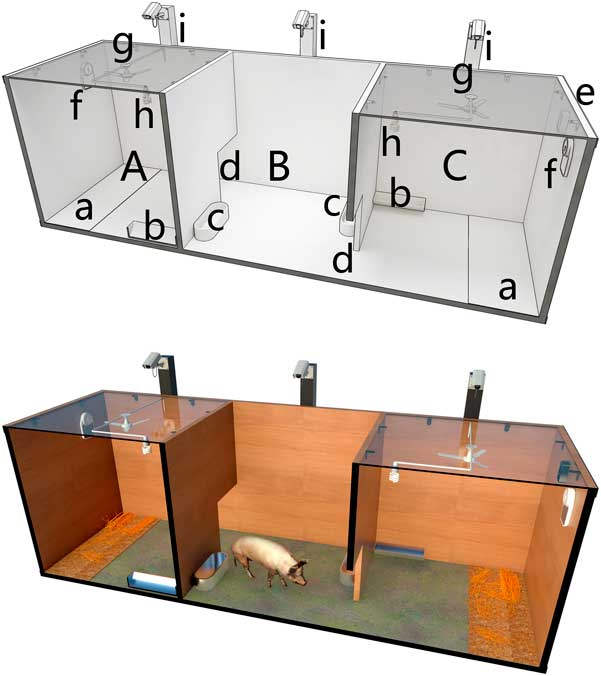
The test room contained five chambers built specifically for music preference testing in. The structure of the music testing chambers (SITCs) is given in Figure 1. Each SITC measured 3.60 m (l)×1.20 m (w)×1.20 m (h) and consisted of a sound-filtering box made of planks (1.20×1.20×1.20 m) with a music speaker fixed above the middle of the resting area at 1.15 m in height in the music box. There was an entrance door (0.40×0.40 m) at one corner of each music box, giving the piglets free access to the music chamber and the no-music chamber. The music chamber was made of highly densified boards with high-quality soundproof material. The top of the SITC was covered with a transparent glass for observing behaviour. The resting area (1.20×0.40 m) was covered with straw. A feed trough (0.40×0.15×0.10 m) was located inside the SITC, and a water drinker (0.40×0.15×0.10 m) was located outside the SITC. The locations of a hygrometer, electric fan and light in each SITC are shown in Figure 1. Three surveillance cameras were placed 0.50 m above the SITC, allowing panoramic viewing. All 35 piglets, once removed into the test room, remained in the room until the test was finished and returned to the original shed for production.
The three-dimensional structure of the music test chamber (SITC). Each SITC (3.60×1.20×1.20 m) was made of wooden boards, which composed two sound-filtering boxes (1.20×1.20×1.20 m) connected by an aisle. A represents the chamber with no music; B is the aisle area; C is the music chamber. The music speaker (e) was fixed above the middle of the resting area (a) in the music chamber, C (1.15 m interior height); doors (d: 0.40×0.40 m) were located along the bottoms of the board walls that boxes A and C shared with box B, ensuring that the piglets could freely enter either the music chamber or the no-music chamber. The music chamber was made of high-density boards with high-quality soundproof material attached to the interior surfaces, and all joints were sealed with cotton. The top of the SITC was covered with transparent glass, excluding the passage area (for ventilation), so that the pigs’ behaviour could be observed. The resting area (a: 1.20×0.40 m) was covered with straw. A feed trough (b: 0.40×0.15 ×0.10 m) was located inside the SITC, and a waterer (c: 0.40×0.15×0.10 m) was located outside the SITC. The locations of the hygrometer (f), electric fans (g) and lights (h) in each SITC are shown in Figure 1 (1.05, 1.10, 1.05m interior height, respectively). Three surveillance cameras (i) were placed 0.50m above the SITC, allowing panoramic viewing.

In this experiment, the music conditions were designed to include two musical instruments of different families (wind instrument v. string instrument) and two music rhythms (slow tempo v. fast tempo); therefore, the experiment included four types of music (Supplementary Table S1), as follows: (1) string instrument combined with slow tempo (SS group, Canon, strings, 65 beats/min (bpm)); (2) string instrument with fast tempo (SF group, The Sound of Spring, strings, 200 bpm); (3) wind instrument with slow tempo (WS group, Jasmine Flower, wind, 65 bpm); and (4) wind instrument combined with fast tempo (WF group, The Runaround, wind, 200 bpm); (5) a group with no music was designated as control group (C group, no music). All four musical selections were formulated in the required rhythm with Cubase (version 7; Steinberg Media Technologies GmbH, Hamburg, Germany).
In the testing room, there were five independent music chambers, each consisting of a music-playing chamber and a blank chamber (no music). Each chamber had a different music type, either one of four music types or no music at all. The music sound intensity was set at 75 dB (Li, Reference Li2011), and it was adjusted before each test. The structure and layout of the SITC are given in Figure 1. The room noise level (mostly from the fans) was measured to be below 45 dB, which was much lower than the 75 dB of the testing sound.
Measurements
For individual identification, all 35 individuals wore ear tags and were divided into five groups (seven piglets per group), of which six piglets were used for testing and one was kept as a reserve. For testing, one piglet was randomly selected from each group; thus, there were six rounds of trials (five treatment groups of six individuals and five individuals per round). In each round of the trial, a piglet selected from each group was placed in the chamber for 2 days. On day 1, no observation was made, and the piglet could adapt to its sudden isolation and new indoor environment, including music stimulation; on day 2, behavioural activity was measured from 0800 to 1800 h for a total of 10 h. Once a test round was over, the next round of testing followed. During the test, the music began at 0800 h and played until the end of the observation.
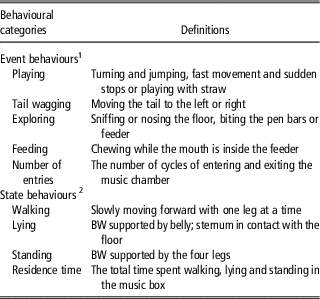
For behaviour observation, IR network cameras (Hangzhou Hikvision Digital Technology Co. Ltd., Hangzhou, China) were placed 50 cm above the music boxes for panoramic viewing. During observation, the piglet was recorded continuously for up to 10 h. Instantaneous sampling was carried out at 20-s intervals to observe lying, standing and walking; thus, a total of 1800 samples were collected during each observation period (10 h). These data were considered state behaviours and were recorded as percentages (%). Exploring, feeding, playing and tail wagging were observed by instantaneous observation at 20-s intervals and sampled with the one-zero sampling method, and all the occurrences of the above behaviours during observation were recorded. These data were regarded as event behaviours and recorded as frequency (n). In this study, we also observed the number of entries, that is, the number of times that the piglet entered the music chamber. If the piglet was in the process of entering the music chamber at the time of sampling, or if the piglet was outside the box in one observation (20 s) and inside the box in the next observation (20 s), the event was recorded as one entry. The definitions of the behavioural parameters observed in this study are given in Table 1.
Behavioural categories and the definitions of the growing pigs’ behavioural parameters

1 Based on Reimert et al. (Reference Reimert, Bolhuis, Kemp and Rodenburg2013).
2 Based on Hay et al. (Reference Hay, Vulin, Génin, Sales and Prunier2003).
Statistical analysis
The experimental data were statistically analysed using the software Statistical Product and Service Solutions (SPSS 23.0; IBM Institute Inc., Chicago, IL, USA). Before statistical analysis, all data were tested for normal distribution with the one-sample Kolmogorov–Smirnov test, and none of the data showed a non-normal distribution. The effects of music instrument (two levels) and music tempo (two levels) on behaviour were analysed by a two-way ANOVA model, and the influence of music conditions (five levels) on behaviour was analysed by a one-way ANOVA model. The following formulas were used: Y ij =u+a i +β j +a i β j +e, where Y ij is the total observation value, μ the population mean, α i the effect of music instruments, β j the effect of music rhythm, a i β j the effect of the interaction of music instruments and music rhythm and e the random error; Y i = μ+α i +e, where Y i is the total individual observation value, μ is the population mean, α i is the effect of different music categories and e is the random error. Differences with P⩽0.05 were considered significant, and those with P⩽0.01 were considered extremely significant. The values are expressed in the text as the mean±SD.
Results
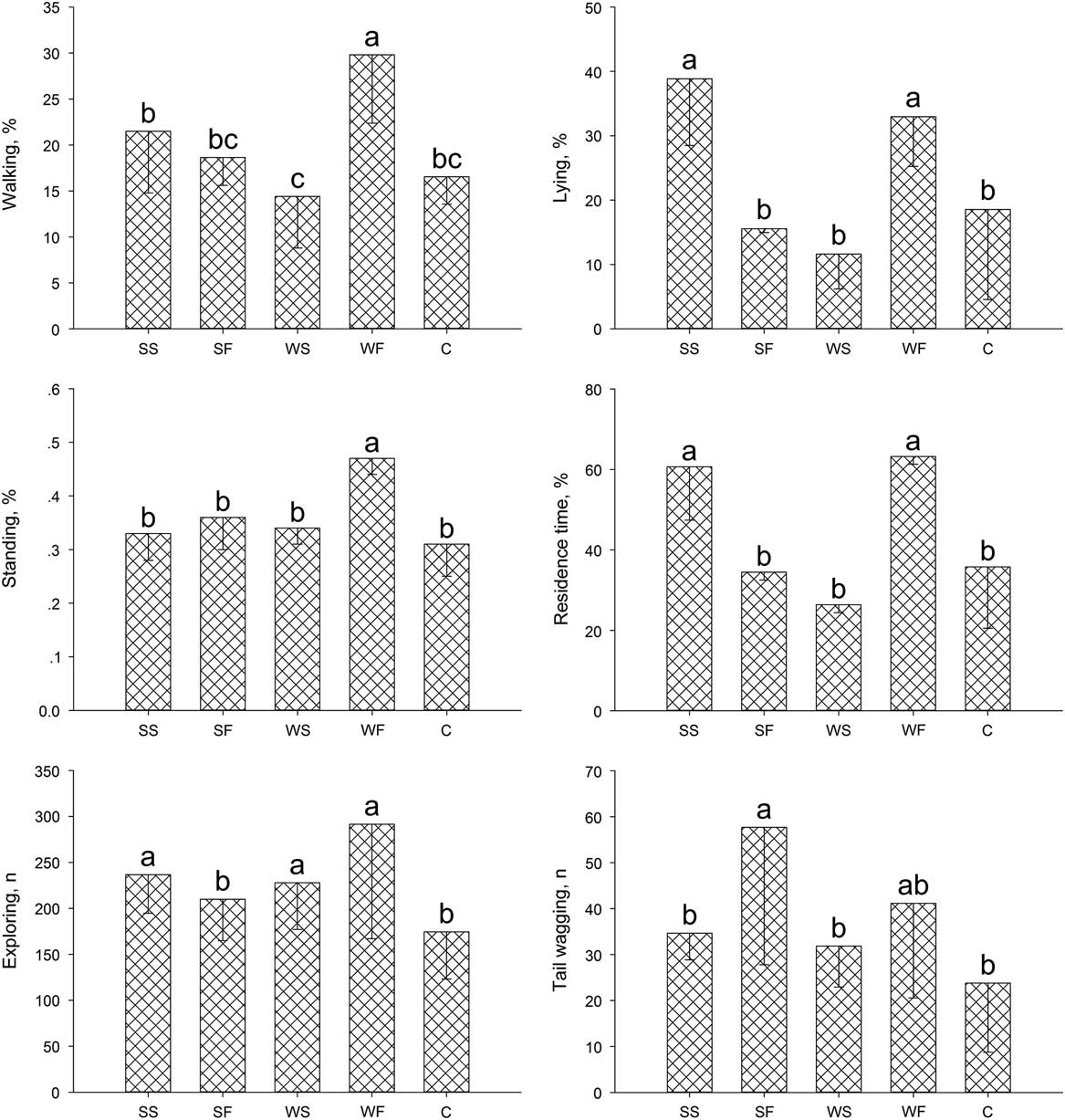
In this study, the behavioural activity of piglets under the different music conditions was compared, and the results (Figure 2) showed that the residence times (RTs) of the SS group and WF group were significantly higher than those of the control group and the two other music groups (F(4, 25)=42.01, P<0.01), with the lowest RT for the WS group. However, there was no difference in the number of entries between the music group and the control group (F(4, 25)=0.70, P=0.60).
Behavioural responses to different music types by growing pigs. The experiment treatment groups included: (1) string instrument combined with slow tempo (SS group); (2) string instrument with fast tempo (SF group); (3) wind instrument with slow tempo (WS group); (4) wind instrument combined with fast tempo (WF group); and (5) a group with no music was designated as control group (C group). a,b,cDifferent superscripts indicate a significant difference at P<0.05.

Compared with the control treatment, SS music significantly increased lying (F(4, 25)=20.49, P<0.01) and exploring behaviour (F(4, 25)=2.41, P<0.01), but did not affect walking, standing, feeding, playing or tail wagging (P>0.05). String-fast music significantly increased tail-wagging behaviour alone (F(4, 25)=3.35, P=0.03), having no impact on any of the other behaviours. Wind-slow music significantly increased exploration (F(4, 25)=2.41, P<0.01) without affecting other behaviours (P>0.05). Wind-fast music significantly increased walking (F(4, 25)= 7.52, P<0.01), lying (F(4, 25)=20.49, P<0.01), standing (F(4, 25)=10.74, P<0.01) and exploration (F(4, 25)=2.41, P<0.01) without affecting any of the other behaviours (P>0.05).
Among the four music conditions, walking behaviour was significantly more common in the WF group than in the three other music groups (P<0.01), while the walking behaviour of the SS group was more frequent than that of the WS group (F(4, 25)=7.52, P<0.01). The lying behaviour of the SS and WF groups was significantly more common than that of the SF and WS groups (F(4, 25)=20.49, P<0.01). The standing behaviour of the WF group was significantly more frequent than that of the other music groups (F(4, 25)=10.74, P<0.01). Exploration behaviour was significantly rarer in the SF group than in the other three music groups (F(4, 25)=2.41, P<0.01). Feeding, playing and number of entries were not found to be different among the music groups (P>0.05). Tail wagging was more frequent in the SF group than in the SS group or the WS group (F(4, 25)=3.35, P<0.05).
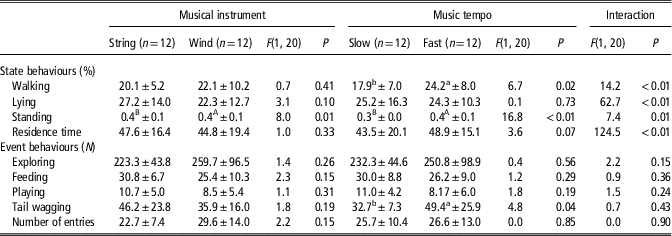
The behavioural responses to music instruments and music tempo are given in Table 2. The results showed that the type of musical instrument and the tempo of the music had no significant effect on most of the measured behaviours (P>0.05), with the exception of standing behaviour, which was significantly more common with the wind instrument than with the string instrument (F(1, 20)=8.02, P=0.01). Walking (F(1, 20)=6.71, P=0.02), standing (F(1, 20)=16.83, P<0.01) and tail wagging (F(1, 20)=4.81, P=0.04) were significantly more frequent under the fast-tempo condition than under the slow-tempo conditions. The interaction of musical instrument with rhythm had a significant effect on state behaviours such as walking (F(1, 20)=14.21, P<0.01), lying (F(1, 20)=62.65, P<0.01), standing (F(1, 20)=7.35, P=0.01) and RT (F(1, 20)=124.51, P<0.01) but did not affect event behaviours (exploring, feeding, playing, tail wagging and number of entries, P>0.05).
The effects of musical instruments and tempo on the behaviour of growing pigs

a,bDifferent superscripts indicate a significant difference at P<0.05.
A,BDifferent superscripts indicate a significant difference at P<0.01.
Discussion
The length of the RT observed in this experiment may mean that, in a sense, the piglet tends to choose to stay in a particular music condition, which indicates the pig’s ‘preference’. The results of the test suggest that piglets seem to show such preferences, having relatively longer RTs in the SS and WF groups than in the SF and WS groups. In animal welfare experiments, the use of operant conditioning allows an investigator to ask the animal questions about its own preferences (Bailey et al., Reference Bailey, Stephens, Ingram and Sharman1983). We would like to argue that if an animal is found in a specific location, a longer RT should be seen as ‘preference’ for the location, as the more time an animal spends at a given location or condition, the more the individual prefers it. Thus, the pigs tended to prefer the SS and WF music type to the SF and WS types. Admittedly, whether the RT can be used as an effective index for identifying the piglet’s preference cannot be determined from the results of this experiment. Thus, further investigation is needed.
In addition, we compared the behavioural responses of the piglets under four types of music conditions (SS, SF, WS and WF) and found that piglets seemed to prefer the fast tempo to the slow tempo, walking and standing more in the former condition than in the latter. This result may also indicate that SS and WF music conditions excite the pigs. Judging by the tendency of piglets in choosing music conditions, it suggests the piglets seem to prefer the majority of music conditions over no music and disliked only slow-paced songs with wind instruments (WS).
Some studies on other animals show that when animals are relaxed and resting, they spend increased amounts of time recumbent or sitting, as has been shown in a gorilla (Velarde et al., Reference Velarde2007) and dairy cows (Haley et al., Reference Haley, Rushen and Passillé2000). Velarde et al. (Reference Velarde2007) suggested that the lying time of the animals was an important indicator of comfort and well-being. Music can make animals more relaxed. When exposed to the classical music album ‘The Very of Best of the Classic Experience’ (EMI Virgin Records), the gorilla showed a more relaxed state (Velarde et al., Reference Velarde2007). Li (Reference Li2011) also reported that music (silent mountain forest, 65 to 75 dB) made piglets quieter, less excited, more lying and less active. Compared with other music conditions, we found that the piglets in the slow-tempo string instrument (SS) and the fast-tempo wind instrument (WF) conditions increased lying along with the RT. This may demonstrate that the piglets under these music conditions feel more relaxed and comfort than the other two types of music conditions.
In short, the music conditions can induce piglets to show excitement by increasing their walking and standing behaviour and decreasing their lying, and certain music types such as SS and WF types can also make piglets feel comfort, as shown by increased lying. However, these results came from only a day of observation; therefore, in this study, this selective effects of these music conditions on the piglets may not hold. It can be inferred that, with long-term musical stimulation, the excitement of the piglets would decrease (Zhao et al., unpublished) and their activity might change to some extent. Therefore, given the results of this study, we suggest observing the effects of music on animals for a longer period of time. Overall, all the music conditions in this study elicited better behavioural responses than the control treatment, such as exploring, lying, tail wagging and RT, and the results further demonstrated that the music conditions benefit the growing pigs. It has been reported that musical stimuli can also be used as environmental enrichment (Bowman et al., Reference Bowman, Scottish, Dowell and Evans2015), and an enriched environment can increase exploratory behaviour in pigs (Beattie et al., Reference Beattie, O’Connell and Moss2000; Casal-Plana et al., Reference Casal-Plana, Manteca, Dalmau and Fàbrega2017). Our study supports the above conclusion: all music conditions either increase the pigs’ exploration or increase tail wagging compared to the absence of music.
Based solely on these behaviours, we cannot judge the emotional state of piglets in the musical environment, although some activities can reflect porcine emotional states that may be caused by environmental impacts (Wells et al., Reference Wells, Hepper, Coleman and Challis2007), as Leliveld et al. (Reference Leliveld, Düpjan, Tuchscherer and Puppe2016) reported that pigs affected by the environment were less active and had higher standing behaviour. Similarly, Reimert et al. (Reference Reimert, Bolhuis, Kemp and Rodenburg2013) also reported that a negative emotional state in pigs was accompanied by reduced activity and reduced exploration but increased lying. Therefore, it is not easy to judge the emotional state of piglets through behavioural analysis alone, and other physiological indicators are needed to assist. Tail wagging is another indicator of a pig’s positive emotional states (Blackshaw et al., Reference Blackshaw, Blackshaw and McGlone1998), and an increase in tail wagging reflects the positive emotional state of the individual. However, the pigs under the SF condition were found to perform more frequent tail wagging than other groups, although the SF piglets performed less in exploration. This pattern may indicate that behaviours that show positive emotional states, such as exploring and tail wagging, do not always go hand in hand, such that the presence of any of these behaviours could have the potential to indicate the state of the animals’ positive emotion.
In our study, in addition to SF, SS, WS and WF, music conditions can increase the exploring behaviour of the pigs compared with Group C, which is in line with the above report. Therefore, the appropriate music type can be used as an enriched environmental condition. Exploratory behaviour is an instinctive behaviour of pigs (Donald et al., Reference Donald, Healy, Lawrence and Rutherford2011), and the increase in exploration by pigs is a sign of positive emotions (Studnitz et al., Reference Studnitz, Jensen and Pedersen2007).
However, the lack of preference for a particular musical instrument does not mean that music instrument types do not affect the piglets, because their standing behaviour was affected by music instrument type. In contrast to musical instrument type, the piglets tended to be affected by music tempo. Further analysis suggested that the piglets had an increased probability of staying in place under the fast-tempo music condition. Although this tendency is insufficient to prove that piglets can recognise music features (rhythm), the results did not rule out the possibility that piglets can distinguish musical features.
At the same time, we also observed the piglets’ response to the musical rhythm; we found that the fast-tempo music increased exploration and tail wagging, which showed the positive mood of the piglets in the fast-tempo musical conditions. This result is consistent with the report of de Jonge et al. (Reference de Jonge, Boleij, Baars, Dudink and Spruijt2008). Through the observation of the piglets under different music types, we found that almost all types of music, with the exception of the SF music, increased the exploratory behaviour of piglets, indicating that the music intensity used in this study was acceptable to piglets.
Human studies have shown that music can lead to positive physiological responses and positive psychological effects (Bowman et al., Reference Bowman, Scottish, Dowell and Evans2015). However, the results of animal studies do not fully confirm this phenomenon (Alworth and Buerkle, Reference Alworth and Buerkle2013). Ladd et al. (Reference Ladd, Albright, Beck and Ladd1992) found that playing music (country music or classical music) to layers for 8 h reduced immunity (neutral lymphocyte ratio) and grooming behaviour. Similarly, Campo et al. (Reference Campo, Gil and Davila2005) found that the stress levels of layers exposed to music for a long period were higher than those of the control group. Clearly, the impact of music on animals needs further investigation, especially the need to verify what environmental conditions can lead to a positive or negative emotional state.
In conclusion, this study provides no evidence that piglets had the ability to discriminate between musical instruments, but they tended to show a preference for some music types, such as the SS and WF music types. Fast-tempo music was more effective than slow-tempo music in influencing pig behaviour. The slow-tempo string music condition (SS) usually led to a more relaxed state than other music types.
Supplementary material
To view supplementary material for this article, please visit https://doi.org/10.1017/S1751731119000260
Acknowledgements
The study was supported by National Natural Science Foundation of China (31472131 and 31501989/C170109), the Young Talents Project of Northeast Agricultural University (16QC22) and the Earmarked Fund for China Agriculture Research System (No. CARS 35).
Declaration of interest
The authors confirm that there are no known conflicts of interest associated with this publication and that there has been no significant financial support for this work that could have influenced its outcome. The article is original and has not been published previously, and it has not been submitted to any other publications.
Ethics statement
Animal care and treatment were in compliance with the standards described in the Northeast Agricultural University (China) Guidelines for the Care and Use of Laboratory Animals (NEAU-[2011]-9). At NEAU, all experimental protocols must be approved by the Office of Research Projects Management, which is in charge of reviewing and approving all research projects to determine whether the research animals were treated in compliance with the specifications of No. [2011]-9.
Software and data repository resources
All data are available upon request.