Significant obstacles impinge on the ability to perform research in developing countries, which include lack of resources and indifferent governmental concerns, as well as cultural, religious, and moral diversity. These issues are compounded by researchers from developed countries who wish to introduce diagnostic and therapeutic modalities in developing countries that do not typically have access to the same standard treatment. The ethical implications require careful consideration. The purpose of this paper is to review the current status of paediatric cardiac programmes performing research in developing countries.
Research paradigms
Clinical research is vital to further understand human health and to advance prevention, diagnosis, and treatment of disease. 1 Research paradigms consist of
-
• basic science research,
-
• translational or bench-to-bedside research, and
-
• clinical research.
Basic science discoveries can lead to trials that involve partnerships and collaboration in academia, government, and industry. 2 Translational research often utilises animals as subjects for preclinical assessment to translate basic scientific discoveries into clinical therapies. Clinical research consists of 3
-
• phase I, II, III, and IV trials;
-
• management and analyses of local, national, and international databases;
-
• case reports and reviews of literature; and
-
• multi-institutional studies.
Sustainable paediatric cardiac programmes
To improve paediatric cardiac surgical care worldwide, Dearani et alReference Dearani, Neirotti and Kohnke 4 call for physicians to be actively involved in political, economic, and social aspects of society, with the ultimate goal of improving care for the majority of children born with congenital heart disease. A self-sustained paediatric cardiac surgical centre is best administered by the local population of the developing country and mentored by an established paediatric cardiac surgical centre from a developed country. Paediatric cardiac surgical centres in developing countries will succeed and will be sustainable only if supported legislatively and financially by their local governments.Reference Jonas 5 The treatment facility must haveReference Dearani, Neirotti and Kohnke 4
-
• up-to-date diagnostic capabilities managed by paediatric cardiologists and related specialists;
-
• fully trained nurses and physicians in an intensive care unit that specialises in neonates, infants, and children post-operatively; and
-
• education and training incorporated into the process at all levels via academia, research, and quality reporting.
Developing countries
Kofi Annan, former Secretary General of the United Nations, defined a developed country as follows. “A developed country is one that allows all its citizens to enjoy a free and healthy life in a safe environment”. 6 But according to the United Nations Statistics Division, there is no established convention for the term “developing” countries in the United Nations system. 7 The designation is generally used to portray a nation with a low level of material well-being. Because there is no single internationally recognised definition of the term developing country, 7 , Reference Sullivan and Sheffrin 8 for our purposes a developing country is a country without the resources to provide adequate healthcare to its people, whether the lack of resources involves manpower, equipment, or financial support.
Importance of research in developing countries
Research is an essential component to a viable paediatric cardiac centre in developing countries and provides the means to define the size of local problems and the incidence of neglected diseases, and to generate specific solutions thereto related.Reference Yacoub 9 Research can lead toReference Yacoub 9
-
• the development of local expertise and eventually improved technology,
-
• opportunities for talented people,
-
• the generation of additional financial resources, and
-
• the enhancement of the dignity of the people and morale of researchers resulting from global participation.
Increasing demands are being placed on researchers to provide opportunities to resolve current health problems making research indispensable. 10 Currently, the research community is focused on solving the health problems of the poor and disadvantaged, which will inevitably stimulate the development of vaccines, drugs, and diagnostic capabilities where they are currently insufficient. Owing to changes across the world in public health and research, there is a need for a thorough and widespread approach to management of research. 10
The International Children's Heart Foundation, 11 a non-governmental organisation that supports the establishment of paediatric cardiac surgical programmes in developing countries, calls for research in those countries because the non-governmental organisation has found that a healthcare facility that performs research is interested in advancing itself and improving care. In addition, engaging medical colleagues in research projects stimulates further education and self-evaluation, thus promoting growth and quality improvement.
Incorporating research into the infrastructure while initially establishing a paediatric cardiac centre ultimately improves quality of care while efficiently utilising resources that can be employed for both patient care and research: buildings, equipment, and human resources such as physicians, nurses, and administrators who can serve as principle investigators, research assistants, and study coordinators.Reference Yacoub 9 Some type of management needs to be in place with the purpose of overseeing and educating the team. Optimally, recruiting and training local individuals identified as appropriate to provide healthcare and perform research will thereby improve understanding of congenital heart disease and increase quality of care locally. Continuing education programmes and audits of individual performances, as well as audits of laboratories, technology, and epidemiology, are crucial.Reference Yacoub 9
Globalisation and the maldistribution of healthcare
Global considerations are an inescapable factor of healthcare. Globalisation refers to the interconnection of the world's markets, businesses, cultures, and ideas, and can link local happenings to events occurring across the world. Because “over 6.8 billion people live on the 4.5 billion-year-old planet earth … [and] Politically it is composed of 244 entities (192 countries in and 9 countries not in the United Nations, the Vatican, 38 inhabited dependent territories, and 4 special entities)…the social, political, economic, environmental, and demographic imbalances are real and factual”.Reference Pezzella 12
In most of North America and Western Europe, medical treatment is readily available and has good outcomes.Reference Fenton, Castillo, Claro and Novick 13 In much of the rest of the world, treatment of children with congenital heart disease is limited to a small proportion of those who need it. “There are 1222 open heart operations per million population in North America and 18 per million in Africa, which translates into 1 centre per 120,000 people in the United States and 1 centre per 33 million people in Africa”.Reference Pezzella 12 , Reference Cox 14 , 15 These data highlight the maldistribution of access to paediatric cardiac care throughout the world and the need for sustainable paediatric cardiac programmes in developing countries.
Financial aspects
Establishing a congenital heart surgery programme in a developing country, or anywhere for that matter, is costly. In many developing countries, the facilities and funds necessary for basic research are simply not available. Resources are scarce, and countries are competing for the limited resources that exist.Reference Fenton, Castillo, Claro and Novick 13 In a developing country, the healthcare system as a whole may be lacking, and scarcity of financial resources makes it problematic to purchase and maintain up-to-date medical equipment and supplies, as well as to pay and retain adequately trained and experienced personnel.Reference Fenton, Castillo, Claro and Novick 13
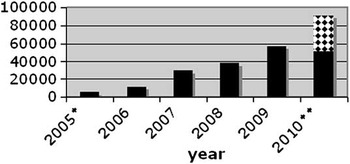
While trying to establish a paediatric open heart surgery programme in Nicaragua, Fenton et alReference Fenton, Castillo, Claro and Novick 13 report that the programme was jointly financed by two non-governmental organisations. Each non-governmental organisation was responsible for different specific expenses. Recognising that a programme in a developing country may never have the resources that a developed country has, there were times when the medical team had to search out and receive further donations for specific necessities to provide optimal patient care, such as milrinone, fine vascular clamps, and a cerebral oximetry monitor. The programme grew and surgical volume increased. For various organisational, financial, manpower, and logistic reasons, the programme later moved to the only hospital in the country that performed adult cardiac surgery. Case volume is currently financially limited as the vast majority of patients are low income, and surgery is paid mostly by donations. Recently, the government approved social security insurance for a few specific congenital cardiac diseases.Reference Fenton, Castillo, Claro and Novick 13 This case in point demonstrates that depending on philanthropy (Fig 1)Reference Fenton, Castillo, Claro and Novick 13 for sustainability of a paediatric cardiac surgery centre in a developing country is not a long-term solution for self-reliant programmes. Complete programme development requires establishing a self-sustaining local system with local resources such as
Annual donations received by Programa Corazon Abierto (local Nicaraguan organisation involved in a Twinning program). *Estimated data. **Through June 30 only. Reproduced with permission from Fenton et al.Reference Fenton, Castillo, Claro and Novick 13

-
• governmental funding and insurance or social security,
-
• staff,
-
• equipment, and
-
• infrastructure.
Medical students who train abroad should be given incentives to return to their home countries.
International non-government organisations
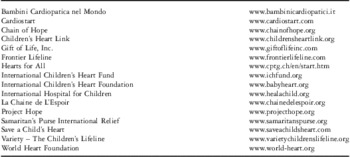
Non-governmental organisations date back to the mid-1800s and were active in the anti-slavery movement and women's suffrage.Reference Davies 16 Non-governmental organisations play an important role in the collaboration with governmental agencies to improve congenital cardiac disease care throughout the world. Fenton et alReference Fenton, Castillo, Claro and Novick 13 believe that it is crucial for an established local non-governmental organisation to provide necessary complementary financial support, public awareness, and fund-raising for the paediatric cardiac surgery centre being established in a developing country. A prominent example (Table 1)Reference Pezzella 12 is the International Children's Heart Foundation, whose mission that every child has the right to be born into a world where he or she can thrive is being met by sending medications, surgical supplies, and diagnostic equipment that helps train surgeons and medical staff in developing countries so they ultimately may care for their own. 11 , Reference Pezzella 12
Sample of international voluntary/humanitarian non-governmental organisations.

Reproduced with permission from Pezzella.12
World Health Organization
The World Health Organization, the directing and coordinating authority for health within the United Nations system, in 1948 signed its constitution allowing them to 10 , 15
-
• provide leadership on global health matters,
-
• shape the health research agenda,
-
• set norms and standards, and
-
• articulate evidence-based policy.
Two core functions of the World Health Organization are 10 , 15
-
• to achieve the highest possible level of health for all people and,
-
• by shaping the research agenda, stimulate the generation, translation, and propagation of valuable knowledge.
According to the World Health Organization, high-quality research is essential for improving global health and economic development and provides the greatest potential to improve global health security, accelerate health-related development, and right health inequities. 10 , 15
Elements of a successful twinning partnership
According to the World Health Organization 10 , 15 , a paediatric cardiac centre in a developed country optimally should be able to perform 300 to 500 operations annually per 2 million people. Yacoub estimates the number to be closer to 1 centre per 1 million people in the population.Reference Yacoub 9 Regrettably, many countries with 15–70 million people do not have a single paediatric cardiac centre able to perform modern therapies.Reference Yacoub 9
In the past, strategies to deal with the maldistribution of care for children with congenital heart disease primarily involved transporting children to developed countries for surgical care and organising surgical medical missions to developing countries.Reference Dearani, Neirotti and Kohnke 4 , Reference Larrazabal, Jenkins and Gauvreau 17 , Reference Liu 18 More recently, a new paradigm has brought about the creation of local paediatric cardiac centres partnered with established centres from developed countries, aptly named twinning.Reference Dearani, Neirotti and Kohnke 4 , Reference Larrazabal, Jenkins and Gauvreau 17 , Reference Liu 18
The first basic requirement in establishing a successful paediatric cardiac surgical twinning programme involves the active participation of an established healthcare institution to create a mutually beneficial partnership, and in so doing establish an association with an already successful paediatric cardiac programme.Reference Dearani, Neirotti and Kohnke 4 Dearani et alReference Dearani, Neirotti and Kohnke 4 have instituted a systematic approach to the design, support, and implementation of paediatric cardiac surgery programmes in developing countries, which includes
-
• forming the vision and then generating incentives and resources,
-
• comprehensive education,
-
• local governmental support,
-
• consistent leadership from the medical staff, and
-
• a committed faculty.
A clinical database should be initiated in order to critique and optimise quality of care. Ideally, a minimal volume of 100 surgical cases per year is available, with the potential population to increase to 300 to 500 surgical cases per year over a 5-year period.Reference Dearani, Neirotti and Kohnke 4 Finally, Dearani et alReference Dearani, Neirotti and Kohnke 4 feel it is essential to perform risk assessment and track and measure results by reporting data and ultimately using aggregate clinical data to contribute to professional societies and national and international journals.
One critical component for a twinning programme to succeed is a financial plan.Reference Dearani, Neirotti and Kohnke 4 , Reference Jonas 5 , Reference Fenton, Castillo, Claro and Novick 13 It is important to have a philanthropic partner with long-range plans to stay involved, but using only the philanthropic model is the least effective method to provide care in the developing world.Reference Jonas 5 It is imperative that the local government take financial responsibility for patient care, salaries, and infrastructure, thereby solidifying a self-supporting paediatric cardiac surgery centre.Reference Jonas 5
The Guatemala experience
The primary goal of the programme in Guatemala is to improve outcomes of children with congenital heart disease in Guatemala by training local staff to eventually become self-sufficient.Reference Larrazabal, Jenkins and Gauvreau 17 A foundation was created in the United States to support the programme, and the local government was successfully urged to assign a defined portion of their budget to pay for surgeries, salaries, and infrastructure.Reference Larrazabal, Jenkins and Gauvreau 17 Efforts are in place to secure a continued partnership with this foundation in the United States, which will ultimately allow for the continued success of this programme.Reference Larrazabal, Jenkins and Gauvreau 17
The Guatemalan program, implemented in 1997, was evaluated in 2007 using a risk-adjusted analysis of outcomes.Reference Larrazabal, Jenkins and Gauvreau 17 Overall mortality was consistently reduced across all Risk Adjustment for Congenital Heart Surgery-1 Categories (RACHS-1 Categories), even as the founding and senior surgeon, Dr Aldo Castaneda, performed fewer cases over time, implying that performance of the trainees improves with more experience. As trainees acclimate and achieve better results, the exodus of children to foreign developed centres decreases as long as appropriations from local and international sources continue.Reference Larrazabal, Jenkins and Gauvreau 17
Shanghai Second Medical Center
The government in China allocates only 5.4% of the gross domestic product for healthcare each year (same as Mexico and Zambia; 13.9% in the United States), and congenital cardiac disease is the number one birth defect in that country.Reference Liu 18 In the 1970s, paediatric cardiac care was performed at state-owned tertiary hospitals of the major cities of China. In 1975, when international professional exchange of information started in China, the most effective model to promote the development of paediatric cardiac care in the country was implemented: a joint collaboration with Project HOPE, Xin Hua Hospital, Shanghai Second Medical Center, and Shanghai Second Medical University. Dr Richard Jonas led the collaboration from Children's Hospital Boston. Under the leadership of Dr Jonas and the team from Boston, this collaboration ultimately involved different medical centres from across the United States of America. This team has come annually to China to train and educate while performing more than 20 complex congenital heart surgeries each year, including the first arterial switch operation successfully performed in China. Several young and talented local surgeons have developed into skilful paediatric cardiac surgeons. Governmental leaders and the Ministry of Public Health allowed for the opening of Shanghai's Children's Medical Center, including a successful Cardiovascular Surgery Department. In the early years, the annual surgical volume was 100; in 2007, the volume had increased to 2850 cases per year, including complex procedures – 257 operations for of tetralogy of Fallot and 80 operations for transposition of the great arteries. Research projects increased from 5 in the early 1980s to 31 funded research studies in 2008. Scientific publications increased from 20 to 447 articles in major Chinese and international journals. Recently, the team organised several domestic training programmes and meetings about congenital cardiac disease, as well as four international conferences with more than 300 participants from 31 provinces within China.Reference Liu 18
Database participation
Society of Thoracic Surgeons Congenital Heart Surgery Database
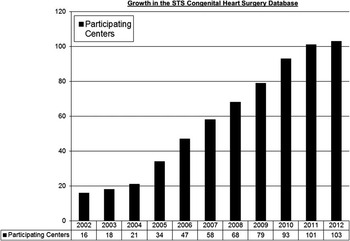
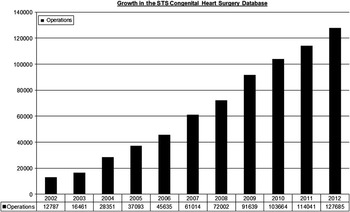
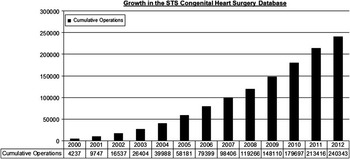
Of the ∼125 congenital heart surgery centres in the United States, 100 centres participate in the Society of Thoracic Surgeons Congenital Heart Surgery Database (Figs 2, 3, and 4).Reference Jacobs, Jacobs, Mavroudis, Lacour-Gayet and Tchervenkov 19 , Reference Jacobs, Maruszewski and Kurosawa 20 Participation in the database and biannual harvesting of data allows for an accurate account of local congenital cardiac surgery, including volume, and outcomes, while providing an opportunity to compare with other programmes and thus improve quality.Reference Jacobs, Jacobs, Mavroudis, Lacour-Gayet and Tchervenkov 19 – Reference Mavroudis and Jacobs 21 Furthermore, it generates annual reporting to hospital administrators, payors, and governmental agencies, all supporters in the care of children with congenital cardiac disease.
The graph documents the annual growth of the STS Congenital Heart Surgery Database by number of participating centres submitting data. The aggregate report from Spring 2012 Harvest of the STS Congenital Heart Surgery Database includes data from 103 Congenital Heart Surgery Centres in North America, 100 in the United States of America, and 3 in Canada. Reproduced with permission from Jacobs et al.Reference Jacobs, Jacobs, Mavroudis, Lacour-Gayet and Tchervenkov 19 STS = Society of Thoracic Surgeons.

The graph documents the annual growth of the STS Congenital Heart Surgery Database by the number of operations per averaged 4-year data collection cycle. The aggregate report from the Spring 2012 Harvest of the STS Congenital Heart Surgery Database includes 127,685 operations performed in the 4-year period of January, 1, 2008–December, 31, 2011, inclusive, submitted from 103 centres in North America, 100 in the United States of America, and 3 in Canada. Reproduced with permission from Jacobs et al.Reference Jacobs, Jacobs, Mavroudis, Lacour-Gayet and Tchervenkov 19 STS = Society of Thoracic Surgeons.

The graph documents the annual growth of the STS Congenital Heart Surgery Database by the cumulative number of operations over time. The current number of cumulative total operations in the STS Congenital Heart Surgery Database is 240,343. The aggregate report from the Spring 2012 Harvest of the STS Congenital Heart Surgery Database includes 127,685 operations performed in the 4-year period of January, 1, 2008–December, 31, 2011, inclusive, submitted from 103 centres in North America, 100 in the United States of America, and 3 in Canada. Reproduced with permission from Jacobs et al.Reference Jacobs, Jacobs, Mavroudis, Lacour-Gayet and Tchervenkov 19 STS = Society of Thoracic Surgeons.

European Association for Cardio-Thoracic Surgery Congenital Heart Surgery Database
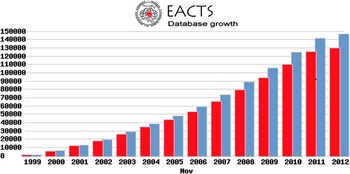
In Europe, the European Association for Cardio-Thoracic Surgery Congenital Heart Surgery Database is an international registry that serves similar function to the Society of Thoracic Surgeons Congenital Heart Surgery Database, using identical nomenclature and database standards (Fig 5).Reference Jacobs, Maruszewski and Kurosawa 20 The European Association for Cardio-Thoracic Surgery Congenital Heart Surgery Database and the Society of Thoracic Surgeons Congenital Heart Surgery Database are truly “sister databases” that allow for collaborative benchmarking and quality improvement.
The graph documents the annual growth of the EACTS Congenital Heart Surgery Database by the cumulative number of operations over time. This figure was provided by Professor Bohdan Maruszewski, Chair of the EACTS Congenital Heart Surgery Database. EACTS = European Association for Cardio-Thoracic Surgery.

Outcome measurements
Participating in the European Association for Cardio-Thoracic Surgery Congenital Heart Surgery Database or the Society of Thoracic Surgeons Congenital Heart Surgery Database provides blinded centre-specific patient and procedural volume and outcomes for comparison with peers. This reporting uses standardised nomenclature, The International Paediatric and Congenital Cardiac Code, and includes diagnosis, procedure, procedural complexity, and discharge mortality.
Risk analysis and reporting
Application of methods for meaningful comparisons of procedural complexity and potential for mortality and morbidity allows for the use of clinical data for benchmarking and contributions to professional societies and national and international journals.Reference Jacobs, O'Brien and Jacobs 22 Commonly used complexity stratification tools include:
-
• The Society of Thoracic Surgeons – European Association for Cardio-Thoracic Surgery Congenital Heart Surgery Mortality Categories (STAT Mortality Categories)
-
• The Society of Thoracic Surgeons Congenital Heart Surgery Morbidity Categories (STAT Morbidity Categories)
-
• Aristotle Basic Complexity Levels (ABC Levels)
-
• Risk Adjustment for Congenital Heart Surgery-1 Categories (RACHS-1 Categories)
The Society of Thoracic Surgeons – European Association for Cardio-Thoracic Surgery Congenital Heart Surgery Mortality Score and Categories (STAT Mortality Score and Categories) is an empirically developed mortality risk score that has largely replaced the early scores (RACHS-1 and Aristotle).Reference Jacobs, O'Brien and Jacobs 22 Using similar statistical methods, Jacobs et alReference Jacobs, O'Brien and Jacobs 22 reported, “An empirically based tool for analysing morbidity associated with operations for congenital heart disease”. Use of these two tools will allow any cardiac programme to participate in meaningful global collaboration and comparison of data, which will
-
• enhance teaching at all levels,
-
• provide programmatic sustainability,
-
• allow data-driven clinical research, and
-
• raise the reputation of the paediatric cardiac surgery centre within the country and beyond.
Building global coalition
Change can be effected in the world by improving paediatric cardiac care. Upgrading the paediatric cardiac programme in a developing country can lead to upgrades in other domains of medicine in that country. Unnecessary competition between providers/sponsoring organisations and duplication of efforts wastes time and resources, diminishes credibility with potential donors, and inevitably impacts negatively on the lives of the children who were the noble focus of beneficence.Reference Fenton, Castillo, Claro and Novick 13
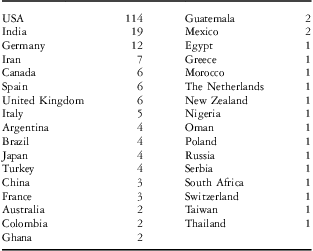
The World Journal for Pediatric and Congenital Heart Surgery was established to provide a platform for congenital heart surgeons to present findings, to introduce important developments to peers, and to highlight efforts of surgeons from across the world (Table 2; Marshall L. Jacobs, MD, personal communication). Both Cardiology in the Young and The World Journal for Pediatric and Congenital Heart Surgery strive to have a global audience and a global authorship. These complementary journals share in this mission. In fact, Cardiology in the Young, The World Journal for Pediatric and Congenital Heart Surgery, and the World Society for Pediatric and Congenital Heart Surgery can and should serve as facilitators to help improve communication and fellowship among paediatric and congenital cardiac surgeons, paediatric and congenital cardiologists, and all other professionals interested in the care of patients with paediatric and congenital cardiac disease throughout the world.Reference Fenton, Castillo, Claro and Novick 13
Country of origin of manuscripts submitted in World Journal for Pediatric Congenital Heart Surgery Volumes 1 and 2.

Marshall L. Jacobs, MD, personal communication
Ethics of research in developing countries
Clinical trials conducted in developing countries should meet the same ethical standards as trials based in developed countries. 1 , 10 , 15 , Reference Shapiro and Meslin 23 Mandatory requirements that are consistent with all international regulatory commissions include: 1 , 10 , 15 , Reference Shapiro and Meslin 23
-
• prior review by an independent ethics committee that will ensure minimisation of risk to participants,
-
• favourable risk–benefit ratio for the participant, and
-
• completion of informed consent by all participants.
Furthermore, clinical trials performed in developing countries and sponsored by groups from developed countries should be restricted to those trials that respond to the needs of the developing country.Reference Shapiro and Meslin 23 If the participants will ultimately not be able to afford the treatment being studied, it is unethical to ask them to participate. In the past, research participants in developing countries have been less likely to have continued access to the intervention than participants in developed countries. Shapiro and Meslin believe that any experimental intervention should be compared with an established effective treatment in that particular country. 1 , 10 , 15 , Reference Shapiro and Meslin 23 It is of great ethical concern that participants in developing countries not be exploited because the population is less fortunate, less powerful, and therefore more vulnerable. It is controversial whether the control group in a developing country must receive the same intervention as that which would be provided in a developed country, specifically owing to whether the intervention is available or is standard of care in the developing country before or after the trial. 1 , 10 , 15 , Reference Shapiro and Meslin 23
The European Group on Ethics in Science and New Technologies supports the implementation of funded research activities in economically challenged countries only when such research is consist with the fundamental ethical rules of justice, beneficence, and non-maleficence. 1 Researchers have a moral duty to help participants overcome inequities. In countries where the standard treatment is too costly for participants, it falls to the research sponsor to continue to provide the treatment for free or at a low cost after the end of the trial, even for a lifetime. Clinical trials should benefit the community where the study is taking place. 1
Conclusion
Owing to the inequities and competing needs of paediatric cardiac healthcare in the world, resolving priority health problems should be based on the most informed and best evidence available. 10 , 15 With research being a viable mechanism to define the size of local health problems, solve neglected diseases of the poor and disadvantaged, and improve quality of care, all clinical trials must meet the same ethical standards worldwide:
-
• prior review by an independent ethics committee,
-
• minimisation of participant risk, and
-
• informed consent.
It is essential that research in developing countries be monitored to ensure the rights and dignity of research participants. Researchers are obliged to be responsive to the health needs of the population participating in the study. 1 , 10 , 15 , Reference Shapiro and Meslin 23 , Reference Macklin 24 It is unacceptable to exploit participants in research or accept a lower ethical standard for research performed in developing countries.
What can a surgeon do?
Physicians should put aside competition and duplication of efforts and be actively involved in political, economic, and social aspects of society with the sole purpose of improving care for children born with congenital heart disease around the world. Having an established paediatric cardiac surgery centre provide long-term mentorship to a new local centre in a developing country builds an infrastructure based on knowledge, education, training, research, and measurement of outcomes.
Give a man a fish and feed him for a day; teach a man to fish and you feed him for a lifetime. (The origin and author of this quote is unknown, although it is generally cited as being Chinese. Over the years, the quote has been misattributed to Confucius, Lao Tzu, Laozi, and Guan Zhong).