Ethno-regionalist parties have gained increasing visibility over the last 30 years, and in many cases they have achieved significant electoral success (De Winter and Türsan Reference De Winter and Türsan1998; De Winter et al. Reference De Winter, Gómez-Reino Cachafeiro and Lynch2006; Elias and Tronconi Reference Elias and Tronconi2011a). This has presented not only new challenges to the members of this family of parties, but also new opportunities to reach the ‘threshold of government’ at both regional and (more sporadically) state level (Elias and Tronconi Reference Elias and Tronconi2011b; Jeffery Reference Jeffery2009). In fact, an increasing number of ethno-regionalist parties have become leading players in regional party systems, and their governmental presence, once sporadic, is now quite common.
The aim of this article is to explore the reasons for the ethno-regionalist parties’ acceptance of government responsibilities. Government participation cannot be taken for granted for this party family, even when representation in legislative assemblies reaches such a proportion that the aforesaid parties can play a key role in negotiations on coalition formation. On the contrary, the decision to be party to a government coalition is a matter of strategic choice (Strøm Reference Strøm1990).
On the one hand, remaining as part of the opposition may be perceived as the most remunerative strategy from an electoral point of view, given that it is as opposition parties that they normally achieve their initial electoral success. On the other hand, there may be a strong temptation to invest the newly acquired electoral ‘capital’ in a place at the government table, by trying to influence policy outcomes from that position or just by using the distributive power that governmental participation often entails. In other words, a typical trade-off between votes, policy and in-office goals is easily predictable when a party moves from a position of non-representation in the parliamentary arena, or of parliamentary irrelevance, to being an important player in the government coalition game. Government participation follows the prevalence of an office-seeking strategy over others.
The dilemma of government participation in the case of those parties that have experienced electoral success in recent years has been examined with regard to a number of different parties or party families.Footnote 1 The ethno-regionalist parties have rarely been included in such studies. While there may well be a reason for this if our analysis is limited to the state level – as only a few ethno-regionalist parties can be considered relevant in national parliaments, and even fewer of them have actually gained positions in the executive – at the regional level the number of ethno-regionalist parties with sufficient bargaining power is considerably higher and represents an interesting new field for empirical research.
Focusing on the ethno-regional party family offers an interesting and original perspective on the study of government coalitions that goes beyond the substantial importance of its members in an increasing number of regions and countries. From the theoretical point of view, these parties face challenges similar to those of other ‘niche’ parties, namely the undertaking of the risks associated with bargaining with stronger counterparts, and, once in government, being forced to take sides on non-core issues which can easily be avoided when in opposition. Unlike other party families, however, ethno-regionalist parties diverge considerably in terms of their ideological orientations, the assertiveness of their autonomist demands, their levels of electoral support, their history and their degree of socialization to parliamentary and governmental institutional settings. This party family is a peculiar one also in terms of its territorial ‘anti-systemness’ (Massetti and Schakel Reference Massetti and Schakel2013). By definition, ethno-regionalist parties pose a challenge to the integrity of the state. This more or less intensively expressed anti-systemness – depending on the autonomist or secessionist stance of the party – can be an obstacle (that is, an additional risk in terms of electoral consequences) to cooperation with state-legitimizing institutions such as state-wide parties.
Furthermore, the focus on the sub-national level of government, despite having received little attention until recently (but see Deschouwer Reference Deschouwer2003; Downs Reference Downs1998; Ştefuriuc Reference Ştefuriuc2009a, Reference Ştefuriuc2009b), offers the advantage of a rapidly growing number of cases, and of increasing powers in several regionalized or federalized states (Hooghe et al. 2010b). The two countries I will be focusing on in the empirical part of this work, namely Italy and Spain, have in fact expanded the number of policy areas under the control of regional institutions in recent years, as well as increasing the discretionary powers by which such policies are handled.
Regional institutions do not operate in a vacuum, however. Focusing on the sub-national level calls for specific attention to be paid to possible interactions with the dynamics of competition at the state level. Indeed, I shall show how party competition at the state level has a clear effect on strategies at the regional level. I will be specifically building on the notion of vertical congruence (that is, the correspondence of governmental alliances across territorial levels) in order to offer a realistic understanding of government formation even in those cases that single-level accounts – normally adopted in coalition theories when referring to the state level alone – would fail to explain.
In the following sections, I shall be presenting the hypotheses underlying my empirical analysis, and then describing in some detail my case selections and choice of variable operationalizations. Subsequently, I shall be offering statistical figures for the ethno-regionalist parties’ participation in regional governments and testing relevant explanatory factors through a multivariate logit model. The following section, before the conclusion, features a specific focus on multilevel dynamics and their implications.
THEORY AND HYPOTHESES
For the sake of expositive clarity, I shall refer to three clusters of hypotheses. The first cluster concerns features of the party itself, the second concerns the position of the party within the policy space in relation to the main coalition party, and the third cluster regards interaction between regional and national levels of competition.
The first and most obvious hypothesis concerns the size of the party as a proxy for its importance in the party system. Broadly speaking, a large party should have easier access to government than a small party does. From the point of view of the party itself, in fact, a larger share of seats is normally translated (ceteris paribus) into stronger bargaining power in coalition negotiations. On the other hand, from the point of view of coalition partners, the inclusion of a larger party permits the creation of simpler coalitions (that is, coalitions made of a limited number of partners), whereas the inclusion of smaller parties is possibly associated with fragmented coalitions, and thus more complex decision-making processes.Footnote 2
One could also argue that the electoral outcome of the most recent election is even more important than size per se. Following this line of reasoning, a party might be rewarded with a place in government for its increased electoral support. Similarly, incumbent parties might be interested in seeing a fast-growing competitor given a place in the cabinet, in order to curtail any potential future damage by having that competitor associated with the responsibilities of government. On the other hand, Raunio and Mattila (Reference Raunio and Mattila2004) suggest some caution should be taken in accepting such a hypothesis. Their analysis of 15 West European countries since 1945 shows that electoral gains are not a predictor of government participation. Indeed, in several countries (Austria, Germany, Spain and Italy) a loss of seats increases the probabilities of entering government.
A third hypothesis focuses on the relevance of the party in public office vis-à-vis the other two organizational ‘faces’: the party in central office and the party on the ground. It has been convincingly argued (Katz and Mair Reference Katz and Mair2002) that in recent stages of party organizational development, the party in public office has increased its power to the detriment of the other two faces, at least in Western European countries. If we accept this claim, we can expect parties to shift from vote- and policy-seeking strategies to an office-seeking strategy, as elected representatives will be the most likely beneficiaries of government openings. In the first place, members of regional parliaments (MRPs) will probably constitute the group from which regional cabinet officials are to be selected. Secondly, even if not directly involved in the executive, they will benefit from the additional resources that majority status guarantees within the assembly (for instance, in terms of committee chairs). I propose to operationalize the prevalence of the party in public office by referring to the length of parliamentary experience of each party. While it is true, in fact, that the ascendancy of the party in public office (Katz and Mair Reference Katz and Mair2002) is described as a general characteristic of political parties in recent decades, we can expect this to be more important for parties with a longer history of parliamentary representation. On the contrary, in the case of recently established parties, or parties that have only recently managed to gain access to parliament (whether at regional or other levels), the other two organizational faces are more likely to retain stricter control over elected officials.
The last hypothesis within the first cluster refers to the external shock generated by electoral downturns. Here I am not going to consider the outcome of the latest regional election, as discussed above, but the mere fact that the party has experienced at least one electoral defeat in its history.Footnote 3 As Panebianco (Reference Panebianco1988: 243) and Harmel and Janda (Reference Harmel and Janda1994: 265) contend, electoral defeats are among the most common, and the most powerful, external shocks forcing parties to make organizational changes and to modify their purported goals. As far as the probability of government participation is concerned, a fall in electoral support might induce the party dominant in the coalition to reconsider a vote- or policy-seeking strategy. A similar claim has been made for other outsider party families, such as the Greens (Dumont and Bäck Reference Dumont and Bäck2006: 41). As long as they remain in opposition, electoral gains are expected not only as a result of their own attractiveness, but also as a consequence of the accountability burden upon governing parties. Once the party has experienced a vote loss, however, this strategy may be questioned and the possible benefits of government participation reassessed. Factions demanding a closer involvement in government may emerge or become stronger within the party, to the point of challenging the existing dominant coalition and eventually requiring a move towards an office-seeking strategy.
The above discussion may be summarized using the following hypotheses:
Hypothesis 1: The larger the share of seats, the more likely the ethno-regionalist party is to participate in government.
Hypothesis 2: An increase in electoral support in the latest regional elections makes it more likely that ethno-regionalist parties will enter government.
Hypothesis 3: The longer their experience of parliamentary representation, the more likely ethno-regionalist parties are to participate in government coalitions.
Hypothesis 4: Government participation is more likely in the case of those parties that have suffered at least one electoral downturn over the preceding 10 years.
The second cluster of hypotheses is based on the positioning of ethno-regionalist parties within the regional party system, particularly vis-à-vis the main coalition partner. It is broadly agreed that a realistic view of party behaviour in the coalition bargaining process cannot be limited to office-seeking strategies, but should also include a consideration of the proximity of potential coalition partners’ policy positions (Warwick Reference Warwick1998; see De Winter and Dumont Reference De Winter and Dumont2006 for an overview of theories). In some cases this can simply be translated into a positioning of parties along the left–right axis, assuming this dimension of policy competition to be the only (or, at least, the most) relevant one. In other cases, an operationalization of this kind would certainly prove to be problematic. Ştefuriuc (Reference Ştefuriuc2009a: 102) notes that in multilevel systems the territorial dimension is sometimes – but not always – a divisive issue among parties. In Spain, for instance, this is the most salient dimension of competition in some autonomous communities, but is virtually absent from political debate in others. Variations may also be observed over time, as the cases of Italy (Mazzoleni Reference Mazzoleni2009; Roux Reference Roux2010) and Belgium (Deschouwer Reference Deschouwer2013; Hooghe Reference Hooghe2004) show. In other words, this question can only be settled on empirical grounds. Given that this work focuses on parties whose raison d’être is the centre–periphery cleavage, however, we can safely assume that this dimension of political conflict is a crucial one. Assuming that the largest coalition partner will, formally or informally, head the negotiation process leading to the formation of government, the above analysis leads to the following two hypotheses:
Hypothesis 5: Ethno-regionalist parties are more likely to participate in government coalitions the closer they are to the main coalition partner along the left–right policy axis.
Hypothesis 6: Ethno-regionalist parties are more likely to participate in government coalitions the closer they are to the main coalition partner along the centralization–decentralization policy axis.
Finally, an additional hypothesis needs to be formulated in order to take account of the multilevel aspects of political competition. In countries where a regional level of government exists, parties compete at two separate levels at the very least, without considering any possible sub-national or supra-national arenas. A recent series of studies have focused on the interaction between the two levels and the possible consequences of such for party organizations (van Biezen and Hopkin Reference van Biezen and Hopkins2006; Bolleyer Reference Bolleyer2012; Carty Reference Carty2004; van Houten Reference van Houten2009) and for coalition strategies (Deschouwer Reference Deschouwer2003; Field Reference Field2009; Ştefuriuc Reference Ştefuriuc2009a, Reference Ştefuriuc2009b). The basic idea behind coalition theory in multilevel institutional arenas is that coalition formation can be conceptualized as a multilevel game where parties trade coalition support at one level, for (policy or office) benefits at another level. This implies that parties should be perceived as non-unitary actors simultaneously pursuing different goals – votes, office, policy – at different levels (Downs Reference Downs1998; Ştefuriuc Reference Ştefuriuc2009a). One of the most theoretically and empirically important consequences of multilevel negotiations for coalition formation is the notion of vertical congruence, defined as ‘the situation in which the party composition of a sub-national government coincides with that of the national government’ (Ştefuriuc Reference Ştefuriuc2009b: 94). The extent to which vertical congruence across levels is pursued by political parties is not expected to be uniform across countries and parties. On the contrary, it has been suggested that it varies according to: (1) the degree to which regional and state executives need to cooperate with one another in order to implement their respective policies, and (2) the degree of autonomy enjoyed by regional branches of parties vis-à-vis their respective head offices.
When looking at the notion of vertical congruence from the point of view of ethno-regionalist parties, certain specifications are called for. Firstly, many ethno-regionalist parties do not enjoy any representation at state level, or if they do then their national parliamentary weight is irrelevant in terms of coalition potential. Secondly, complete cross-level congruence is unlikely in party systems characterized by high fragmentation and frequent oversized coalitions. In Italian regional elections, for instance, we find ad hoc personal lists supporting the candidate for the regional presidency, which in some cases obtain a significant share of votes (Tronconi Reference Tronconi2010). Obviously, such lists do not contest state-wide elections. In other cases, ad hoc coalitions of minor parties are created in order to overcome electoral thresholds. Once again, these region-specific or election-specific arrangements make it difficult to compare electoral results and coalition governments across regions, and even more so across governmental levels. For these reasons, I suggest that the above-mentioned definition of vertical congruence be relaxed, and that the focus be placed exclusively on the relationship between the ethno-regionalist party and the main coalition partner, without taking into account the composition of the entire governing coalition. This leaves the notion of congruence substantially unaltered when applied to ‘simple’ systems, such as the Spanish one, characterized by a limited number of significant parties. At the same time, it allows it to be extended to ‘complex’ systems such as the Italian one.
This can be summarized by the following hypothesis:
Hypothesis 7: Ethno-regionalist parties are more likely to participate in regional government if both the ethno-regionalist party and the main regional government partner are included in the government coalition at state level.
CASE SELECTION
As stated at the start of the article, the main research topic of this study concerns the reasons for ethno-regionalist parties deciding to participate in coalition governments. This implies that political parties, rather than governments, constitute the unit of analysis. Existing studies of coalition governments have tended to focus on government itself, or on government formation opportunities.Footnote 4
From a practical point of view, this means that all Italian and Spanish ethno-regionalist parties gaining representation at regional level during the post-1945 democratic histories of the two countries have been included in the data set, for each legislative term in which such ethno-regionalist parties have been represented. Thus, each party has been included as many times as it had the opportunity to participate in forming the government.Footnote 5 On the other hand, there are regions in which more than one ethno-regionalist party is represented. Consequently, government formation opportunities where two or more ethno-regionalist parties are involved are entered n times, with n equal to the number of parties in question.
In order to identify formation opportunities, I have followed the standard rules: a new cabinet is formed if (1) elections are held, (2) the party composition of the cabinet changes, (3) the head of the cabinet changes, (4) the head of the cabinet resigns and a new government is formed with the same head and party composition (see, among others, Laver Reference Laver2003: 26; Woldendorp et al. Reference Woldendorp, Keman and Budge2000: 10).
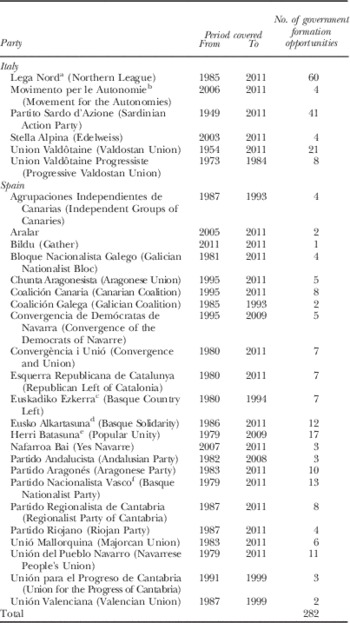
Data have been gathered for the 1949–2011 period for Italian special statute regions and 1970–2011 for ordinary statute regions; as regards Spain’s autonomous communities, the 1979–2011 period has been covered. As Table 1 shows, 29 parties are included in this study. The table also displays the number of government formation opportunities that each one of them has had.
Cases Included (with English translations in parentheses)

Notes:
a The Northern League is present in the Veneto (since 1985), Lombardy, Piedmont, Liguria, Emilia-Romagna (since 1990), Valle d’Aosta (1993–98), Friuli Venezia-Giulia (since 1993), Tuscany, Umbria and Marche (since 2010).
b The Movement for the Autonomies is present in Sicily (since 2006), Abruzzo (since 2008) and Basilicata (since 2010).
c The Basque Country Left is present in Navarre (1980–91) and the Basque Country (1980–94).
d Basque Solidarity is present in Navarre (1986–2007) and the Basque Country (since 1986).
e Popular Unity has had various name changes (Euskal Herritarrok, Batasuna, Euskal Herrialdeetako Alderdi Komunista) and is present in Navarre (1979–2003) and the Basque Country (1980–2009).
f The Basque Nationalist Party is present in Navarre (1979–87) and the Basque Country (since 1980).
As is normally the practice in studies of coalition governments, Table 1 and all subsequent analyses do not include those cases where a party gained an absolute majority of seats and consequently formed a single-party majority government. Thus, for instance, the Galician Nationalist Bloc had nine government formation opportunities, but five of these (1989, 1993, 1997, 2001 and 2011) have not been considered here as during the legislative terms in question the People’s Party enjoyed an absolute majority of seats and formed a single-party government. With one important exception, all cases of this kind have been located in Spain.Footnote 6 In Italy, single-party governments are extremely rare, regardless of the level of government. Even in the (few) cases in which a party wins a majority of seats, oversized coalition governments are often formed. The aforementioned exception is the South Tyrolean People's Party, the party of the German-speaking minority of the South Tyrol. In this case all the South Tyrolean provincial elections resulted in an absolute majority of votes and seats for the South Tyrolean People's Party, which in fact will not be considered in this work.
These rules lead to the selection of 282 observations (parties per government formation opportunities), perfectly balanced between the two countries.Footnote 7
THE OPERATIONALIZATION OF VARIABLES
The dependent variable in this study is governmental participation. All government formation opportunities resulting in the direct involvement of the party in question in the cabinet, have been coded 1, while the remaining cases have been coded 0. I do not consider as government participation the involvement in parliamentary coalitions, where a party supports the government, on the basis of a formal or informal agreement, without being part of that government (Müller and Strøm Reference Müller and Strøm2003: 3). While I realize that this approach may be questionable, nonetheless it allows me to focus on the form of participation that represents the core dilemma of governmental inclusion; that is, the possible trade-off between office and votes. Indeed, it is precisely in order to avoid this dilemma that most parliamentary coalitions are formed, allowing minor partners to reach ad hoc agreements while maintaining sufficient room for manoeuvre vis-à-vis militants and supporters. A ‘pragmatic’ reason must also be taken into consideration: reliable information on parliamentary coalitions is not always available at the regional level, especially in the case of informal agreements. Direct participation, on the other hand, is easily observed and leaves little margin for error.
The first four hypotheses refer to the electoral results of ethno-regionalist parties and how they are reflected in the number of seats in the assembly. In the case of the first independent variable (seat percentage), the operational definition is straightforward and requires no further specification. The second variable (votes gained/lost) is given by subtracting the percentage of votes at regional election t from the percentage of votes at the preceding regional election. The fourth variable (ever lost) considers a similar aspect, but from a long-term perspective: it assumes a value of 1 if the party has lost at least 1 per cent of electoral support in at least one previous election over the preceding 10 years, and 0 otherwise. Thus a party experiencing an electoral defeat at a given point in time in the previous 10 years will be given a score of 1 for this variable for the following government participation opportunities, regardless of the electoral results in subsequent elections. The third variable (parliamentary experience) counts the number of electoral terms during which a party has been represented at regional level.
The fifth and sixth hypotheses refer to the policy position of ethno-regionalist parties along two dimensions (left–right and centre–periphery). More precisely, they refer to the distance between the policy position of the ethno-regionalist party and the policy position of the main coalition partner. In this case we have no universally accepted coding scheme or unit of measurement. A substantial share of recent literature refers to the Comparative Party Manifestos data set (Budge et al. Reference Budge, Klingemann, Volkens, Bara and Tanenbaum2001; Klingemann et al. Reference Klingemann, Volkens, Bara, Budge and McDonald2006; Volkens et al. Reference Volkens, Lacewell, Lehmann, Regel, Schultze and Werner2011) in order to locate parties in the political space along a number of policy dimensions, including the centralization–decentralization dimension, using a detailed analysis of the contents of parties’ official documents since 1945. Unfortunately, only a minority of the ethno-regionalist parties observed here are covered by this monumental data collection, the main focus of which is given by national elections and legislatures. A second well-established source of information is the growing number of expert surveys (see, for instance, Hooghe et al. 2010a), which suffer from the same shortcoming. Mass surveys have also sometimes been used to classify parties on the left–right or other dimensions of competition (see, for example, Dalton Reference Dalton2008), but once again the number of respondents identifying with, or declaring their vote for, ethno-regionalist parties is normally insufficient for any serious analysis.
As the usual paths are precluded, I have turned to the most accurate and systematic classification of ethno-regionalist parties along the two aforementioned dimensions (Massetti Reference Massetti2009),Footnote 8 which is based on an extensive review of the literature, and on the author’s own analysis of parties’ web pages. The two dimensions are categorized into five cells each: the traditional ideological continuum goes from extreme left to extreme right, passing through mainstream left, centre and mainstream right. On the centre–periphery axis, however, it is assumed that ethno-regionalist parties are, by definition, peripheral. The question is how far they push their demands for self-rule of the peripheral region. Here the main line of division lies between autonomist and secessionist parties. Autonomists are in turn divided into moderate and assertive; while secessionists are divided into strongly committed and extremists (that is, those adopting violent means), the latter being defined on the basis of their links with terrorist organizations. Finally, there is an intermediate space situated between the autonomist and secessionist camps, taken up by parties that ‘either use ambiguous formulae, as in the case of the Welsh Plaid Cymru until 2003 and the Basque Nationalist Party since 2002, or leave their explicit objective of independence in the background for some time, as in the case of the Republican Left of Catalonia and the Galician Nationalist Bloc during the 2000s (Massetti Reference Massetti2009: 505). Massetti’s work covers almost all of the parties included in my analysis, with the exception of Bildu (‘Gather’) and Nafarroa Bai (‘Yes Navarre’) in Navarre, and the Union for the Progress of Cantabria, which I have codified by analysing their public statements available on the internet.
In order to compute the distance between the ethno-regionalist party and the main coalition partner with regard to their respective policy positions, we need to place the latter on the same scale. This can be easily done for the left–right dimension. For the centre–periphery dimension, however, we do not find only pro-decentralization parties: some support the partial devolution of power to regional government, and can be placed on the same footing as moderately autonomist parties; others do not have any strong preference, or adopt somewhat ambiguous positions, and others still – most notably the Spanish People’s Party among those considered here – have a clear centralist standpoint. Thus, two categories have been added, reflecting the non-saliency of the regionalist issue and the pro-centralization stance.
Finally, the last variable refers to the interaction between regional and state levels of government. Very simply, a dummy variable has been created, signalling the simultaneous presence of the ethno-regionalist party and the main coalition partner in government both at regional and state levels (vertical congruence). Following the operationalization of Ştefuriuc (Reference Ştefuriuc2009a: 108), those parties making up parliamentary coalitions at the national level are also considered as part of the government.Footnote 9
DESCRIPTIVE STATISTICS
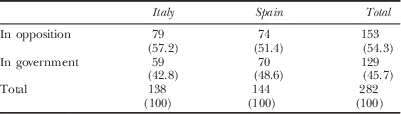
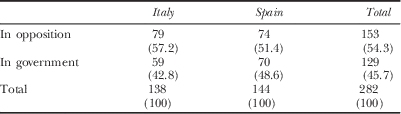
Before turning to the multilevel analysis (see the next section), it is useful to have a general view of the numbers and types of government participation of ethno-regionalist parties in the two countries in question. Slightly less than half of government formation opportunities (129 out of 282) resulted in one ethno-regionalist party being included in the coalition, with no substantial differences between the two countries (see Table 2).
Ethno-regionalist Parties in Government, by Country (column percentages in parentheses)
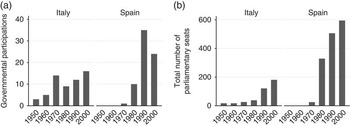
Differences are more evident if one looks at the presence of ethno-regionalist parties in regional governments from a chronological perspective (Figure 1). The most trivial difference is the shorter democratic period of Spain, for which data on regional elections and governments are only available for the second half of the 1970s onwards. Beyond this, the two countries display a similar tendency towards an increase in both the parliamentary strength and the presence in regional governments of the ethno-regionalist parties, which would suggest that an increase in the number of parliamentary seats is normally associated with an increase in participation in government. It should be pointed out, however, that this relation is not a linear one. In the case of Italy, an increase in government participation during the 1970s is not linked to any analogous increase in seats; in Spain, an increase in parliamentary weight very recently is reflected in a reduction in the number of parties involved in government. All this reinforces the idea that the relationship between ethno-regionalist parties’ electoral strength and their governmental participation is an indirect one, and must be studied in conjunction with other explanatory factors.
Government Participation and Number of Seats of Ethno-regionalist Parties at the Regional Level in Italy and Spain, by decade
Note: The first decade includes 1949, the last decade includes 2011.

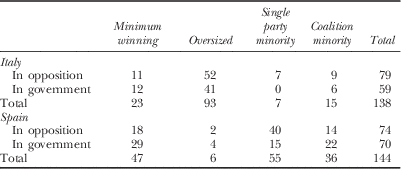
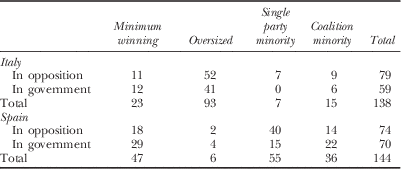
The coalitional format is observed in Table 3. In this case, the divergence between the two countries could not be clearer. About two-thirds of the regional governments in question have an oversized format in the Italian case, while this kind of format is virtually unknown in Spain. On the contrary, minority governments are a very common feature of Spain’s autonomous communities, whereas they are a rare occurrence in Italy. The type of coalition does not have any apparent impact on the ethno-regionalist parties’ governmental participation.
Ethno-regionalist Parties’ Governmental Participation, by Type of Coalition
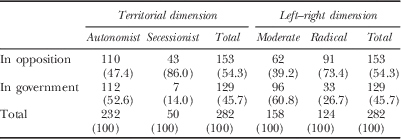
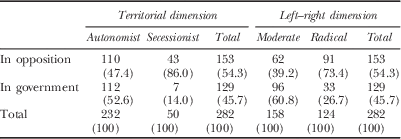
One could also question if the ‘anti-systemness’ of ethno-regionalist parties (Massetti and Schakel Reference Massetti and Schakel2013) along the territorial dimension (that is, aiming to a secession of the peripheral region from the state) or along the traditional left–right dimension affects their propensity to be involved in regional government. We look here at the positioning of ethno-regionalist parties along the two dimensions in absolute terms – not relative to their potential coalition partners. The implicit hypothesis would be that radical or secessionist parties have fewer chances to join government coalitions, as a consequence of their anti-systemness. This is plausible and in fact confirmed by the data (Table 4): only 14 per cent of secessionist parties are included in coalitions, while the figure is equal to 52.6 per cent for autonomist parties; only 26.6 per cent of extreme leftist or rightist parties are included in coalitions, against 60.7 per cent of moderate parties. However, since the focus of this article is on the willingness or ability of ethno-regionalist parties to reach an agreement with other potential coalition partners, it seems correct to look at this variable in relational terms in the explanatory model (see the next section). Including absolute, instead of relational, positions in the multivariate models would not alter any of the coefficients, nor would it substantially change the explanatory power of the models (data available upon request).
Ethno-regionalist Parties’ Governmental Participation, by Position on Territorial and Left–Right Dimensions (column percentages in parentheses)
THE MULTIVARIATE MODEL: RESULTS AND DISCUSSION
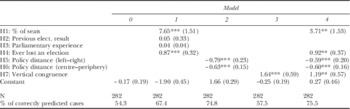
So far I have divided my hypotheses concerning the ethno-regionalist parties’ governmental participation into three groups: the first group focuses on the party itself, the second on the party’s relational features (its policy positions compared with those of the main coalition party), and the third on the interaction between regional and national arenas. In this section, I am going to present the results of a multivariate analysis of data, first looking at the three clusters of variables in isolation, and then combining them to form an integrated model. Given the binary nature of the dependent variable (presence or absence from the government coalition at each government formation opportunity), a logit model is the most appropriate statistical tool to use here. As government formation opportunities are clustered within the considered regions, standard errors have consequently been adjusted in each of the following models (Table 5).
The Explanation of Ethno-regionalist Parties’ Governmental Participation: Logit Models

Note: Standard errors (in parentheses) have been adjusted for 25 clusters in regions. *significant at the 0.10 level; **significant at the 0.05 level; ***significant at the 0.01 level.
As a reference for the following model specifications, the first column presents an ‘empty’ model, with no independent variables entered. This blind model correctly predicts the outcome variable (whether the party participated in government or not) about 54 per cent of the time, which corresponds to the share of government formation opportunities resulting in the ethno-regionalist party being in opposition. The first group of variables is tested in the second column. Only two of them are statistically significant: the percentage of seats and the fact that the party has suffered at least one electoral defeat in its history. Both these variables affect the probability of government inclusion positively, as expected. On the contrary, the other two variables are not statistically significant, and their coefficients are very close to 0. On the basis of the data analysed here, we can safely conclude that neither parliamentary experience nor the fact of having gained votes in the most recent election have an impact on the likelihood of participating in government.
In the following model, the two ‘relational’ variables are introduced. Policy distances between ethno-regionalist parties and the main coalition partner are statistically significant in terms of both policy dimensions (left–right and centre–periphery) and display the expected sign: the greater the distance between the two parties, the less likely is the ethno-regionalist party to be included in the coalition.
The hypothesis concerning the multilevel setting is included in the third model. The coefficient is statistically significant and displays the expected positive effect on government participation. Finally, the fourth model introduces all the significant variables from the previous analyses. All variables keep their sign and significance, thus confirming their stability and significance.
The overall predicting power of the integrated model is considerably higher than the ‘empty’ one, as indicated by the percentage of correctly classified cases (75.5 against 54.3).
The statistical models presented here confirm most of my initial hypotheses. Parliamentary strength and one electoral defeat over the previous 10 years make it more likely that an ethno-regionalist party will be included in a government coalition, as suggested in Hypothesis 1 and Hypothesis 4, respectively. Adopting similar positions to those of the leading governmental player on two crucial policy dimensions also makes it more likely that ethno-regionalist parties will enter the cabinet (Hypothesis 5 and Hypothesis 6). Finally, and perhaps most interestingly, vertical congruence matters (Hypothesis 7). Cooperating with a party at national level – which means, roughly speaking, exercising ‘blackmail’ power over state government – makes ethno-regionalist parties stronger in their core constituency (the region) and thus more likely to be involved in the executive. Moreover, for policy-seeking parties – and several ethno-regionalist parties undoubtedly possess a clear policy-seeking profile – a strong link with the party in government at the national level represents a credible guarantee that coalition agreements will be fulfilled and the interests of the region adequately represented at national level. The next section will look at a few more specific aspects of this issue.
DOES VERTICAL CONGRUENCE MAKE ANY DIFFERENCE? IF SO, HOW?
A number of researchers have focused on coalitional strategies of parties in multilevel settings, implicitly or explicitly recalling the concept of vertical congruence (for example, Elias and Tronconi Reference Elias and Tronconi2011b; Keating and Wilson Reference Keating and Wilson2009; Ştefuriuc Reference Ştefuriuc2009a, Reference Ştefuriuc2009b). In particular, Spain seems to be an appropriate case for such studies, given the role played by non state-wide parties in the negotiation for the formation of minority governments at state level. One well-known case of intersection between sub-national and national strategies of coalition building is Catalonia. Since 1993, Catalan ethno-regionalist parties have played a pivotal role in the negotiations with the two main Spanish parties. In 1993 the Socialist government led by Felipe Gonzalez was supported by the deputies of Convergence and Union (and the Basque Nationalist Party), while since 1995 a minority government led by Convergence and Union in Barcelona was externally supported by the People’s Party. This ‘incongruent’ situation was corrected a few months later when the People’s Party won the general elections in 1996, establishing a new minority government led by José Maria Aznar. In 2000 the relationship between the two levels of government changed again, with the birth of a new Aznar government in Madrid, this time self-sufficient. As a consequence, Convergence and Union found itself in the difficult situation of being dependent on People’s Party support in Catalonia, without any possibility of influencing the policies of the national government.
The equilibrium between the national and regional level of government continued to change in the following years, due to the successive elections at the two levels, with an alternation in power of the main political forces, and an alternation between majority and minority governments both in Madrid and Barcelona (Barrio and Barberá Reference Barrio and Barberá2011: 78–83). This had relevant consequences also in policy terms. For instance, the complex negotiations regarding the drafting of a new Statute of Autonomy for Catalonia took off only after 2004, with the formation of congruent coalitions including the Socialists and the Republican Left of Catalonia at both levels of government. When a new stalemate was reached in 2006, the statute could only pass in the national parliament thanks to an agreement between Convergence and Union and the Socialist Party, which made the Catalan coalition (Socialist Party of Catalonia, Republican Left of Catalonia and Initiative for Catalonia Greens) de facto incongruent with the national one (Ştefuriuc Reference Ştefuriuc2009b: 104). This led to the exclusion of the Republican Left from the Catalan government and the calling of early elections in autumn 2006.
In Italy, only one party, the Northern League, normally reaches the ‘threshold of relevance’ in the national arena. Here the multilevel game concerns the mutual convenience of the Northern League and Silvio Berlusconi’s Forza Italia to coordinate in order to keep a predominant position on the electoral market in the northern regions.Footnote 10 This lesson became clear in 1996, and has informed the strategic decisions of the two parties ever since. After a short-lived coalition with Berlusconi’s Forza Italia in 1994 the Northern League got its highest electoral score ever in the general elections of 1996 (10.1 per cent nationwide), running alone against the two main centre-left and centre-right coalitions. In spite of this result, the party was excluded from the government and became irrelevant at national level, after having already lost influence also in the governments of northern regions after the 1995 regional elections. The new strategy of alliance with Forza Italia inaugurated in 1999 brought the Northern League back in government in Lombardy and Veneto in 2000, and at the national level in 2001. As a key point of the agreement, a constitutional reform was passed in 2006 including an expanded redefinition of regional autonomy, though this was later rejected in a popular referendum (Mazzoleni Reference Mazzoleni2009). In the 2010 regional elections, the Northern League was even more successful in the negotiations. Its candidates, Roberto Cota and Luca Zaia, led the centre-right coalitions in Piedmont and Veneto, respectively, and eventually were elected as the presidents of these regions (Tronconi Reference Tronconi2010).
Both in the Italian and in the Catalan cases (and one could bring in, a contrario, the failure of the Ibarretxe Plan in the Basque Country),Footnote 11 major shifts in the balance of powers between the centre and the periphery of the state were approved thanks to the cooperation between state-wide and ethno-regionalist parties across levels of government.
In this article I have tried to broaden the use of the vertical congruence concept beyond the narrative of single cases, by applying it to a new country (Italy, whereas most of the cited works focus on Spain) and to a specific party family. In fact, the ethno-regionalist party family could prove a particularly interesting testing ground for the vertical congruence hypothesis for two related, albeit contradictory, reasons. First, the ‘core business’ of ethno-regionalist parties is their promotion of the devolution of powers to the peripheral regions in which they are active. There are certainly enormous differences in the assertiveness of such demands for regional autonomy, and other issues may well be salient with regard to the political proposal of such parties, but no ethno-regionalist party can afford to abandon the quest for self-rule without losing its own identity. The point is that changes in the balance of power between central and regional levels of government necessarily require amendments to national legislation – whether ordinary or constitutional. This forces ethno-regionalist parties to stay at the negotiating table with nationwide political actors, and especially with those in government, who thus exercise veto power on such issues. Yet, and here we come to the second reason, reaching an agreement with state-wide parties means for ethno-regionalist parties running a considerable risk of electoral losses, if the agreement is judged to be a low-profile one by militants and supporters, or if the party is not able to implement it fully while in power. In essence, it is the typical office vs. vote dilemma (Elias and Tronconi Reference Elias and Tronconi2011c: 360–5), which makes governmental participation desirable and unsafe at one and the same time.
What I contend here, and what has been confirmed by the above empirical analysis, is that cooperation between one (or more) state-wide party and an ethno-regionalist party is more likely if some form of ‘safeguard’ is available for the latter. The first, and most obvious, example is represented by its parliamentary weight. A party that is of vital importance for the survival of the executive, or even better, one that leads the coalition, is, ceteris paribus, better equipped to force coalition partners to implement the most important pledges contained in the coalition agreement. In second place, a coalition where the most important party has policy positions similar to those of the ethno-regionalist parties (on the relevant policy dimensions) may represent another reason why an agreement can be easily reached within the coalition, and adequate policy results can be achieved.
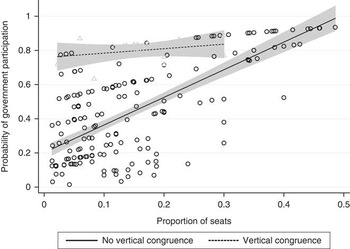
Vertical congruence may be another possible form of safeguard for ethno-regionalist parties: the fact of being an important, or even indispensable, coalition partner at national level makes an ethno-regionalist party’s negotiating power at regional level greater than one would imagine by only looking at its weight in terms of seats in the legislative assembly. Figure 2 offers clear empirical support for this intuition. While the percentage of seats strongly affects the estimated probability of being part of government in the case of those parties that cannot rely on vertical congruence (as seen from the steep continuous line in the graph), parties included in congruent coalitions are very likely to enter regional government even when they enjoy limited representation in legislative assemblies (dashed line).
Estimated Probabilities of Being in Government by Percentage of Seats, Conditional to Vertical Congruence
Note: The grey areas represent 95% confidence intervals of fitted values.

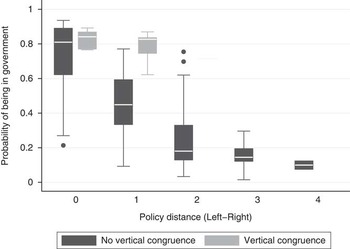
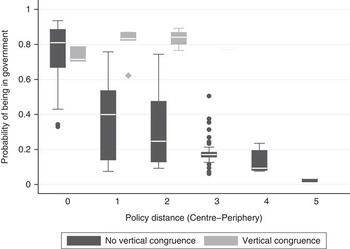
Figures 3 and 4 present similar findings regarding policy proximity between ethno-regionalist parties and the main coalition party in respect of the two dimensions considered in the previous analyses. Once again, for those ethno-regionalist parties that are not members of congruent coalitions, the likelihood of government participation rapidly decreases when policy positions diverge; on the other hand, this does not happen in the case of those parties included in congruent coalitions, for which the likelihood of government participation is stable even when there is a greater divergence between policy positions.
Estimated Probabilities of Being in Government by Distance on the Left–Right Policy Position, Conditional to Vertical Congruence

Estimated Probabilities of Being in Government by Distance on the Centre–Periphery Policy Position, Conditional to Vertical Congruence

The three graphs tell basically the same story: vertical congruence can be an alternative to parliamentary strength and to policy proximity to the leading actor in the governing coalition. In other words, if the ethno-regionalist party is sufficiently strong, or sufficiently close to the main coalition partner, then vertical congruence does not make a great difference. In Figure 2, the lines of fitted values get rather close when the ethno-regionalist party obtains around 30 per cent of the seats in the regional assembly; in Figures 3 and 4 the boxes are close when policy divergence is limited. On the contrary, vertical congruence assumes more importance for low levels of parliamentary representation, or for considerable policy divergence. That is to say, ethno-regionalist parties may still be willing to run the risk of trading office for votes, provided that their cooperation with state-wide parties also extends to the national level.
CONCLUSION
In this article, I have developed and tested several hypotheses regarding the regional governmental participation of ethno-regionalist parties. In part, these are drawn from similar studies of ‘outsider’ party families, such as the Greens; in part they are meant to grasp specific multilevel dynamics, on the basis of the idea that a relationship exists between party strategies at regional and state levels, and specifically that parties are willing to adopt compatible alliance strategies at the said two levels.
Both kinds of hypothesis (the single-level and multilevel types) have been seen to be plausible when empirically tested in the cases of Italy and Spain. Specific attention has been given to the potential interaction between different levels of government, and to the conditions under which vertical congruence across levels is used by ethno-regionalist parties as an effective strategy in order to minimize the risks associated with governmental participation at the regional level. In particular, vertical congruence is used by ethno-regionalist parties as a safeguard in case of agreements with parties that are much stronger in terms of seats, or have remarkably different policy positions.
The limited number of ethno-regionalist parties participating in national governments suggests that a certain caution is required when interpreting the results of such analyses. Further studies are needed to confirm the insights that have been sketched here on the basis of the available data. Nonetheless, congruence has been seen to constitute an important factor in shaping parties’ strategies for governmental participation within multilevel contexts. Future studies, possibly covering a wider range of cases, should continue considering this as a crucial variable.
ACKNOWLEDGEMENTS
A preliminary version of this paper was presented at the ECPR Joint Sessions of Workshop, Antwerp, 10–15 April 2012, and at the Tuesday Seminar of the Centre for the Study of Political Change, University of Siena, 6 November 2012. I would like to thank all the participants, as well as the two anonymous referees of this journal, for their helpful comments.