Substance use during adolescence has been identified as a significant public health concern (US Department of Health and Human Services, 2001), as it is linked with multiple behavioral and mental health problems. Given the numerous adverse outcomes associated with substance use, it is important to identify the mechanisms that underlie problematic developmental trajectories of substance use during adolescence. Transactional developmental theories suggest a progression from early family risk factors, an early onset of aggressive and disruptive behavior, and adjustment problems within the school and peer contexts, which have a cascading effect on the onset and growth in substance use in adolescence and subsequent adjustment problems in young adulthood (Patterson, Reference Patterson1982; Patterson, DeBaryshe, & Ramsey, Reference Patterson, DeBaryshe and Ramsey1989). Yet there has been little longitudinal research empirically testing the specific developmental pathways by which these early risk factors increase the likelihood that youth will develop risky trajectories of substance use, and in turn, experience psychopathology and failures in the social and academic domains in young adulthood.
The current paper tests a developmental cascade model that describes a sequence of risk factors within the family, child, and peer ecological domains that contribute to the onset and progression of cigarette, alcohol, and marijuana use during adolescence, and to subsequent mental and behavioral health problems in young adulthood (Bronfenbrenner, Reference Bronfenbrenner1979). Informed by the conceptual and methodical work on developmental cascade models (e.g., Burt, Obradović, Long, & Masten, Reference Burt, Obradović, Long and Masten2008; Dodge et al., Reference Dodge, Malone, Lansford, Miller, Pettit and Bates2009; Masten et al., Reference Masten, Long, Roisman, Burt, Obradović and Roberts2005), this developmental progression is examined within a sample of urban, predominantly African American youth who were followed from first grade into young adulthood. Applying the latest generation of growth mixture modeling procedures to model trajectories of substance use, we examine the indirect effects of early risk factors on substance use trajectories in high school and on subsequent adjustment problems in adulthood. This study aims to enhance our understanding of the risk process and elucidate potential targets for preventive interventions that are developmentally and contextually sensitive. Focusing prevention efforts on these factors may alter trajectories of substance use during adolescence, thereby reducing the risk for co-occurring and subsequent psychopathology.
Developmental Theories of Substance Use
Both life course (Elder, Reference Elder1994) and developmental psychopathology (Cicchetti, Reference Cicchetti, Cicchetti and Cohen2006) theories suggest that early negative experiences, like an early onset of aggressive behavior or problems adjusting to the school environment, can alter a child's developmental trajectory (Kellam & Rebok, Reference Kellam, Rebok, McCord and Tremblay1992) and interfere with the accomplishment of normative developmental milestones, like the formation of prosocial peer relationships (Ialongo et al., Reference Ialongo, Rogosch, Cicchetti, Toth, Buckley, Petras, Cicchetti and Cohen2006; Rutter, Reference Rutter1989). Work by Moffitt (Reference Moffitt1993, Reference Moffitt, Cicchetti and Cohen2006) on the early onset of aggressive behavior suggests that aggressive behavior during childhood may be indicative of psychosocial problems and constitutional abnormalities (e.g., poor executive functioning, impulse control problems), which pose further developmental risks (Moffitt, Reference Moffitt1993). Patterson's transactional model of the development of antisocial behavior suggests that the effects of early aggressive behavior on subsequent delinquent and problem behavior are mediated by achievement problems, peer rejection, and deviant peer affiliations (Patterson et al., Reference Patterson, DeBaryshe and Ramsey1989). Other similar models have been proposed that highlight the interaction between risks within the child, peer, and academic domains as a developmental pathway by which aggressive and problem behavior during childhood increase the risk for psychopathology (Dodge & Pettit, Reference Dodge and Pettit2003; Kellam & Rebok, Reference Kellam, Rebok, McCord and Tremblay1992).
Although developmental theories are commonly utilized to describe aggressive behavior in youth, they may also inform our understanding of the process by which youth engage in risky substance use (Ialongo et al., Reference Ialongo, Rogosch, Cicchetti, Toth, Buckley, Petras, Cicchetti and Cohen2006). The social transactional perspective has particular relevance for the development of substance use, as it emphasizes the importance of parent–child interactions in the development of antisocial behavior from childhood through adolescence (Patterson et al., Reference Patterson, DeBaryshe and Ramsey1989). In this model, antisocial behavior encompasses a number of different behaviors, including aggression, delinquency, and substance use. We build on these developmental theories in the current study, in order to better understand the cascading process by which early aggressive behavior, academic readiness, and deviant peer affiliation contribute to substance use, subsequently increasing the risk for psychopathology and other untoward outcomes in young adulthood (Bradshaw, Schaeffer, Petras, & Ialongo, in press). Below, we consider each of these risk factors in greater detail, and how the developmental cascade framework (e.g., Masten et al., Reference Masten, Long, Roisman, Burt, Obradović and Roberts2005) is particularly instructive for conceptualizing the association among these factors and the process by which they translate into substance abuse problems in adolescence and adjustment problems in young adulthood.
Risk Factors for Adolescent Substance Use
According to Patterson and colleagues (Reference Capaldi and Patterson1989), the risk for behavioral and mental health problems has its roots in the toddler years, when parents' success in teaching their child to interact within a normal range of compliance and aversive behavior is a prerequisite for the child's subsequent development of social survival skills (Patterson, Reference Patterson1986). Parents' failure to effectively punish aggressive and coercive behavior during these formative years and to teach reasonable levels of compliance comprises the first step in a process which serves to “train” the child to become progressively more coercive and antisocial. In the classroom setting, such children are difficult for teachers or peers to “teach” appropriate forms of social interaction and problem solving. Moreover, their coercive style may be further reinforced in the presence of inconsistent and coercive teacher disciplinary practices. Ultimately, the coercive child is rejected by parents, teachers, and well-adjusted peers, which results in the child's failure to develop the necessary academic, social, and occupational “survival” skills that presage successful adaptation in the educational, work, peer group, romantic relationships, and family social fields in early adulthood and beyond (Kellam & Rebok, Reference Kellam, Rebok, McCord and Tremblay1992). Consequently, they have limited opportunities to learn these social survival skills thorough interactions with teachers, parents, and mainstream peers.
The drift into a deviant peer group further increases the risk for antisocial behavior, as antisocial behavior and substance use are both modeled and reinforced (Thornberry & Krohn, Reference Thornberry, Krohn, Stoff, Breiling and Maser1997). The lack of adequate monitoring by parents in early adolescence (Beyers, Bates, Pettit, & Dodge, Reference Beyers, Bates, Pettit and Dodge2003), coupled with rejection by teachers and mainstream peers (Dodge, Coie, & Lynam, Reference Dodge, Coie, Lynam, Eisenberg, Damon and Lerner2006; Dodge et al., Reference Dodge, Lansford, Burks, Bates, Pettit and Fontaine2003), precipitates “drift” into a deviant peer group, wherein a wide array of antisocial and delinquent behavior, including alcohol and drug use, may be reinforced, along with rejection of mainstream norms and mores (Brook, Nomura, & Cohen, Reference Brook, Nomura and Cohen1989; Hirschi, Reference Hirschi1969; Jessor, Reference Jessor and Fishman1978; Patterson, Reid, & Dishion, Reference Patterson, Reid and Dishion1992). Substance-using friends, specifically, may serve as a further training ground for drug and alcohol use, resulting in not only its maintenance, but also its escalation (Dishion, Capaldi, Spracklen, & Li, Reference Dishion, Capaldi, Spracklen and Li1995; Thornberry & Krohn, Reference Thornberry, Krohn, Stoff, Breiling and Maser1997; Vitaro, Brendgen, & Tremblay, Reference Vitaro, Brendgen and Tremblay2000). The rejection of mainstream norms and mores that occurs within the substance-using peer group may further exacerbate aggressive behavior and other conduct problems. These experiences may also lead to other off-time developmental events, such as early and unprotected sex, teen pregnancy, child bearing, parenthood, and the sexually transmitted diseases that may come along with early and unprotected sex (Capaldi, Crosby, & Stoolmiller, Reference Capaldi, Crosby and Stoolmiller1996; Elder, Reference Elder1994). In a cascading fashion, these childhood and early adolescent experiences may lead to increased substance use in later adolescence, and subsequently increase the risk for psychopathology and related adjustment problems across multiple domains in adulthood (Kellam & Rebok, Reference Kellam, Rebok, McCord and Tremblay1992; Rutter, Reference Rutter1989).
Race/ethnic and gender differences
It is particularly important to examine the development of substance use among African American adolescents because prior research indicates that these youth are at reduced risk for substance initiation compared to Caucasian adolescents (Johnston, O'Malley, Bachman, & Schulenberg, Reference Johnston, O'Malley, Bachman and Schulenberg2006), but they tend to be at greater risk for substance use and other adjustment problems in adulthood (Mayes & Suchman, Reference Mayes, Suchman, Cicchetti and Cohen2006). Furthermore, African American youth, especially those in urban contexts, are at greater risk for engaging in aggressive behavior (Tolan, Gorman-Smith, & Henry, Reference Tolan, Gorman-Smith and Henry2003), which is a potential factor contributing to a risky trajectory of substance use in adolescence.
With regard to gender differences, previous research has indicated that males tend to engage in higher rates of physical aggression and conduct problems (Archer, Reference Archer2004; Dodge et al., Reference Dodge, Coie, Lynam, Eisenberg, Damon and Lerner2006; Tolan et al., Reference Tolan, Gorman-Smith and Henry2003). However, there are mixed findings regarding potential gender differences in the use of specific substances (Andrews, Reference Andrews, Bell, Foster and Mash2005; Mayes & Suchman, Reference Mayes, Suchman, Cicchetti and Cohen2006). For example, whereas some studies have found that male adolescents tend to engage in higher rates of illicit drug use (e.g., marijuana), and are at higher risk for substance dependence in young adulthood (Andrews, Reference Andrews, Bell, Foster and Mash2005; Mayes & Suchman, Reference Mayes, Suchman, Cicchetti and Cohen2006), others have found that girls report either higher or comparable rates of substance use (e.g., cigarettes, alcohol, marijuana use) by mid- to late adolescence (Westling, Andrews, Hampson, & Peterson, Reference Westling, Andrews, Hampson and Peterson2008). Yet data from the Youth Risk Behavior Surveillance System indicated no gender difference for current alcohol use among high school students, although male adolescents had higher rates of current cigarette use (Centers for Disease Control and Prevention, 2008). Given the previous findings regarding gender differences in aggressive/conduct problems (Archer, Reference Archer2004; Dodge et al., Reference Dodge, Coie, Lynam, Eisenberg, Damon and Lerner2006) and possibly substance use (Mayes & Suchman, Reference Mayes, Suchman, Cicchetti and Cohen2006), additional research is needed to contrast the risk processes for male and female adolescents.
A Developmental Cascade Model of Substance Use
The current study focused on the link between early risk factors and trajectories of substance use during adolescence, and their concomitant effects on mental and behavioral health problems in young adulthood. As described above, Patterson and colleagues' (Reference Patterson, DeBaryshe and Ramsey1989, Reference Patterson, Reid and Dishion1992) transactional model outlines a developmental progression whereby maladaptive parenting practices lead to antisocial behavior. This process is consistent with the emerging interest in developmental cascade models (e.g., Burt et al., Reference Burt, Obradović, Long and Masten2008; Dodge et al., Reference Dodge, Malone, Lansford, Miller, Pettit and Bates2009; Dodge, Greenberg, Malone, & The Conduct Problems Prevention Research Group, Reference Dodge, Greenberg and Malone2008; Masten et al., Reference Masten, Long, Roisman, Burt, Obradović and Roberts2005). Specifically, the transactional model describes the process by which early family risks have a cascading effect on the onset of conduct problems and aggressive behavior in childhood, which can lead to peer rejection, academic failure, and association with substance-using peers. These challenges reinforce antisocial behavior, thereby leading to more serious aggression and delinquency, and contribute to the onset and growth of substance use in high school and a greater risk for adjustment problems in young adulthood.
Although the transactional model is widely cited in the research on aggression, delinquency, and substance use, few studies have tested this model using multi-informant longitudinal data collected from early childhood through adulthood. A series of studies by Dodge and colleagues (Reference Dodge, Greenberg and Malone2008, Reference Dodge, Malone, Lansford, Miller, Pettit and Bates2009) examined a dynamic cascade model of substance use in adolescence and are a notable exception to the extant research. Using data collected from kindergarten through age 18, Dodge et al. (Reference Dodge, Greenberg and Malone2008) fit a dynamic cascade model of serious violence among a relatively diverse sample (43% African American). Their model provided evidence of the indirect effects of early family risk (e.g., harsh and inconsistent parenting) on an early onset of aggressive and disruptive behavior, academic problems, deviant peer affiliations, and violence in high school. The second study of primarily Caucasian youth (81%), followed longitudinally from kindergarten through 12th grade, examined a related dynamic cascade model of illicit substance use (e.g., marijuana, inhalants; Dodge et al., Reference Dodge, Malone, Lansford, Miller, Pettit and Bates2009). This latter study provided evidence of the interrelated and indirect effects of risk factors across different domains (e.g., biological factors, parenting, peer relations) at multiple time points (early childhood, early adolescence) on the onset of illicit substance use by the high school years.
These and other studies (e.g., Burt et al., Reference Burt, Obradović, Long and Masten2008) are impressive in both scale and scope, and have greatly informed our understanding of the cascading processes by which early risk factors influence violence and substance use onset during adolescence. However, further work is needed to enhance our understanding of the extent to which a cascading process occurs for substance use among urban, primarily African American youth, for whom the risk for involvement in aggression is typically increased (Tolan et al., Reference Tolan, Gorman-Smith and Henry2003), but the process by which those risks translate to substance use in adolescence may differ (Mayes & Suchman, Reference Mayes, Suchman, Cicchetti and Cohen2006). Additional work is also needed to understand how these early risk factors influence trajectories of substance use, which characterize both its onset and developmental progression (Muthén, Reference Muthén and Kaplan2004; Nagin, Reference Nagin1999), and the extent to which the cascade model varies by the specific type of substance used. For example, the effects of early risk on initiation and growth in use of illegal substances, like marijuana, may differ from these effects in other substances, such as cigarettes and alcohol, which are more accessible to teenagers (Mayes & Suchman, Reference Mayes, Suchman, Cicchetti and Cohen2006). Finally, although life course theory suggests there will be developmental impacts into adulthood (Elder, Reference Elder1994; Ialongo et al., Reference Ialongo, Rogosch, Cicchetti, Toth, Buckley, Petras, Cicchetti and Cohen2006; Kellam & Rebok, Reference Kellam, Rebok, McCord and Tremblay1992), few studies have examined the effect of these cascading risk processes on adult outcomes, like psychopathology, educational attainment, and related adjustment problems (see Burt et al., Reference Burt, Obradović, Long and Masten2008).
Overview of the Current Study
The extant theoretical research on the development of aggressive behavior, together with the empirical research on risk factors for substance use, directs our attention to early-onset aggression, academic readiness, and deviant peer affiliations as a set of cascading factors that contribute to the onset and growth in substance use during adolescence and subsequent adjustment problems. Whereas much of the extant research linking these risk factors with substance use has examined them cross-sectionally and in isolation, transactional developmental theories (e.g., Patterson et al., Reference Patterson, DeBaryshe and Ramsey1989) suggest they are interrelated and should be examined longitudinally in a cascading sequence (Burt et al., Reference Burt, Obradović, Long and Masten2008; Dodge et al., Reference Dodge, Malone, Lansford, Miller, Pettit and Bates2009; Masten et al., Reference Masten, Long, Roisman, Burt, Obradović and Roberts2005). Building on the transactional theory and previous developmental cascade models of illicit drug use (e.g., Dodge et al., Reference Dodge, Malone, Lansford, Miller, Pettit and Bates2009), the current study advances prior work by evaluating a cascading developmental progression of risk for cigarette, alcohol, and marijuana use in high school (see Figure 1). In addition, we examine the implications of this cascading process for young adult adjustment outcomes among a high risk, predominantly African American, urban sample.
The hypothesized developmental cascade model of high school substance use trajectories. Cross-time correlations not illustrated.

The current paper uses data from an epidemiologically defined sample of urban, primarily African American youth followed from first grade through age 21 to examine the process by which early-onset aggressive behavior problems and academic readiness influence risk for substance use. A significant feature of this study is the ability to examine the risk process, both longitudinally and across multiple domains (individual, peer, school). The prospective longitudinal design offers several advantages that will enhance our understanding of the risk process, including the examination of exposure to different risk factors at different developmental time points, which, as suggested by life course theory (Elder, Reference Elder1994; Kellam & Rebok, Reference Kellam, Rebok, McCord and Tremblay1992; Moffitt, Reference Moffitt1993), has important effects on both development and psychopathology. This research will also identify specific processes at different developmental time points that may be targeted through preventive interventions aimed at reducing risk for substance use during adolescence and other adjustment problems (e.g., risky sex, mental health problems) during young adulthood.
Growth mixture modeling analyses (Muthén, Reference Muthén and Kaplan2004) were conducted to determine if there were distinct classes of individuals who followed different trajectories of cigarette, alcohol, and marijuana use across high school. We hypothesized that for all three substances, there would be at least two classes or trajectories of substance use, including an “abstaining” class and a “using” class. We expected that the using class would report higher rates of problematic outcomes (e.g., mental health problems, risky sex) in young adulthood. We used these growth trajectories to examine our primary aim, which was to evaluate a dynamic cascade model of substance use from first grade through young adulthood (see Figure 1). Consistent with prior research on cascade models (e.g., Dodge et al., Reference Dodge, Greenberg and Malone2008, Reference Dodge, Malone, Lansford, Miller, Pettit and Bates2009; Masten et al., Reference Masten, Long, Roisman, Burt, Obradović and Roberts2005), we hypothesized that each predictor variable at time t would be significantly associated with the subsequent predictor variable at time t + 1. Furthermore, it was hypothesized that there would be a significant indirect effect between the predictor at time t and high school substance use class via the predictor at time t + 1.
Method
Participants
In the fall of 1993, 678 urban first-graders were recruited from 27 classrooms in nine elementary schools primarily located in Baltimore. Approximately half (53.2%) were male, 86.8% were African American, and 13.2% were Caucasian. At entrance into first grade, the children had a mean age of 6.2 (range = 5.3–7.7, SD = 0.34) and 63.4% received free or reduced priced lunch.
Consent and participation rates
In 1st grade, written parental consent was obtained for 97% of the children. Consent to participate ranged from 79.6% to 84.7% in Grade 6 through the age 21 assessment. Barriers to consent included active refusal, failure to respond, inability to be located, and death. Through 12th grade, nearly 75% of participants have teacher-report data at 8 of 11 possible time points, including the pretest or baseline assessment in the fall of 1st grade. Similarly, nearly 75% of the participants have participant self-report data for at least 7 out of the 9 possible assessments from 6th grade through age 21. School record data for at least 8 of 12 possible time points were available for over 80% of the sample.
Design
The children participated in a longitudinal randomized trial of two school-based universal preventive interventions whose immediate targets were aggressive/disruptive behavior and academic achievement in first grade (Ialongo et al., Reference Ialongo, Werthamer, Kellam, Brown, Wang and Lin1999; Ialongo, Poduska, Werthamer, & Kellam, Reference Ialongo, Poduska, Werthamer and Kellam2001). The interventions were provided over the first grade year, and participants were followed through high school. All analyses controlled for intervention status. There were no significant differences in terms of sociodemographic characteristics or intervention condition between consenting and nonconsenting children. Additional information about the study design as well as the intervention effects can be found in Bradshaw, Zmuda, Kellam, and Ialongo (Reference Bradshaw, Zmuda, Kellam and Ialongo2009) as well as Ialongo et al. (Reference Ialongo, Werthamer, Kellam, Brown, Wang and Lin1999).
Measures
Data were collected from multiple reporters, including teachers, parents, and the participating youth, as well as school and court records through age 21.
Parental discipline and parent rejection, first grade
The Structured Interview of Parent Management Skills and Practices, Parent Version (Capaldi & Patterson, Reference Capaldi and Patterson1989) was designed to assess the major constructs included in Patterson et al.'s (Reference Patterson, Reid and Dishion1992) model of the development of antisocial behavior in children. That is, the parent disciplinary practices and processes associated with the development of antisocial behavior. The subscales utilized in the present study include inconsistent discipline (e.g., “How often can child talk you out of punishing him/her?”) and rejection of the child (“How difficult is it to be patient with child?”). Parents are asked to respond to questions regarding their disciplinary practices on a 1 (almost always) to 5 (never) frequency scale. A 1 to 5 response format was also used with the rejection scale; however, the response anchors reflected severity rather than frequency, with 1 representing the lowest level and 5 the highest level of rejection. Capaldi and Patterson (Reference Capaldi and Patterson1989) report adequate internal consistency and test–retest reliability for each of the above subscales. The coefficient alphas for these subscales in our study were 0.77 for inconsistent discipline and 0.69 for rejection.
Oppositional defiant behavior and peer rejection, first and third grades
The Teacher Observation of Classroom Adaptation—Revised (Werthamer-Larsson, Kellam, & Wheeler, Reference Werthamer-Larsson, Kellam and Wheeler1991) is a brief measure of each child's adequacy of performance on core tasks in the classroom as defined by the teacher. It was administered to teachers in Grades 1–3 by a trained member of the assessment staff using a structured interview. The interviewer recorded the teacher's ratings of the adequacy of each child's performance on six basic tasks including accepting authority (oppositional defiant behavior, e.g., “Disobeyed teachers and other adults,” “Talked back to teachers and other adults,” and “Broke rules”) and peer rejection (e.g., “Children seek him/her out to play,” “Lots of friends,” and “Rejected by classmates”). Response options ranged from almost never (1) to always (6). The scores used in our analyses represent the average of the items making up the subscales, with higher scores reflecting greater levels of oppositional defiant behavior and peer rejection. Coefficient alphas for the oppositional defiant behavior and peer rejection subscales were 0.94 and 0.78, respectively.
Academic achievement, first, third, and eighth grades
Teachers reported on the child's overall grade performance on a 6-point scale, ranging from excellent to failing in first and third grade. Academic achievement in eighth grade was measured via the Kaufman Test of Educational Achievement (Kaufman & Kaufman, Reference Kaufman and Kaufman1998). This test is an individually administered diagnostic battery that provided a global standardized assessment of mathematics computation skills.
Substance-using friend affiliation, seventh grade
The friends drug use subscale from the Monitoring the Future National Survey (Johnston, O'Malley, & Bachman, Reference Johnston, O'Malley and Bachman1995) was used in Grades 6–12 to assess the youth's perception of how many of his/her friends (1 = none to 5 = all) used tobacco, alcohol, marijuana, crack, cocaine, heroin, inhalants, and ecstasy.
Conduct problems, eighth grade
Teachers provided data on adolescent conduct problems (α = 0.91) via the Teacher Report of the Classroom Behavior Checklist, which was a checklist format of the original Teacher Observation of Classroom Adaptation structured interview.
Substance use in high school
Frequency of substance use in the last year (cigarettes, alcohol, and marijuana) was measured using questions from the Monitoring the Future National Survey (Johnston et al., Reference Johnston, O'Malley and Bachman1995). The drug and alcohol component of the youth interview was self-administered in Grades 9–12 via a computer with audio as well as visual presentation of the questions. Response options included none (0), once (1), twice (2), 3–4 times (3), 5–9 times (4), 10–19 times (5), 20–39 times (6), and 40 or more times (7).
Indicators of adjustment in young adulthood
We assessed adjustment across five broad domains in young adulthood: educational attainment (e.g., graduating high school on time), mental health problems, drug problems, risky sexual behaviors, and involvement in the criminal justice system. All indicators of adjustment were dichotomous variables, indicating either the presence or absence of the indictor. To assess educational attainment, data were obtained from the school district to determine whether the participant had graduated from high school or passed the General Educational Development test (~4% of the sample). In some cases (<5% of the sample), data from the school records were missing on this variable, in which cases the self-report data from the students' age 19 interview were used (Bradshaw et al., Reference Bradshaw, Zmuda, Kellam and Ialongo2009). Mental health problems were assessed at age 21, using a structured interview that indicated lifetime major depressive disorder (Diagnostic Interview Schedule for Children, Fourth Edition; Shaffer, Fisher, Lucas, Dulcan, & Schwab-Stone, Reference Shaffer, Fisher, Lucas, Dulcan and Schwab-Stone2000) and antisocial personality disorder (Diagnostic Interview Schedule, Fourth Edition; Robins et al., Reference Robins, Cottler, Bucholz, Compton, North and Rourke2000). The drug abuse and dependence subscales from the National Survey on Drug Use and Health (Substance Abuse Mental Health Services Administration, 2004) were designed to allow generation of DSM-IV diagnoses of abuse and drug dependence; they were also administered via a computerized interview. Participants reported on previous risky sexual behaviors at the age 21 assessment. Unsafe sexual behavior was operationalized as having unprotected sex with an unknown partner, a one-time partner, an acquaintance, or friend. In addition, females reported if they had ever been pregnant, and males reported if they had ever impregnated someone, including current pregnancies, abortions, miscarriages, still births, and live births. Finally, court records provided information on involvement in the juvenile and adult criminal justice systems. This included the existence of either a juvenile or adult criminal record, as well as involvement in both violent and nonviolent offences as a juvenile or an adult.
Covariates
Intervention status, gender, parental education, and eligibility for free or reduced priced lunch (as a proxy for income) were included as covariates in all analyses. We did not include race/ethnicity as a covariate because the sample was largely African American. All analyses were also run separately by gender to further evaluate potential gender differences in the models.
Analytic plan
We followed a three-stage process for testing the hypothesized developmental cascade model (see Figure 1). We first fit the trajectories of cigarette, alcohol, and marijuana use in high school using growth mixture modeling. We then examined the association between latent class membership and early risk factors and subsequent adjustment outcomes. The final set of analyses focused on fitting the full hypothesized cascade model depicting the indirect effects of the early childhood risk factors on young adult adjustment outcomes (e.g., educational, mental health), as mediated by childhood and adolescent risk factors and the substance use trajectories. All analyses were conducted in Mplus 5.21 (Muthén & Muthén, Reference Muthén and Muthén1998–2008) and are described in greater detail below.
Growth mixture modeling analyses
We first conducted a series of growth mixture modeling analyses to model trajectories of cigarette, alcohol, and marijuana use across high school (9th–12th grades). Growth mixture modeling is an advanced analytic technique that allows for the estimation of subgroups of individuals within the population who differ in terms of their initial levels and rates of change for a specific outcome over time (Muthén, Reference Muthén and Kaplan2004; see also Bradshaw et al., in press; Petras et al., Reference Petras, Schaeffer, Ialongo, Muthén, Lambert and Poduska2004; Schaeffer et al., Reference Schaeffer, Petras, Ialongo, Masyn, Hubbard and Poduska2006; Schaeffer, Petras, Ialongo, Poduska, & Kellam, Reference Schaeffer, Petras, Ialongo, Poduska and Kellam2003). This modeling procedure is ideal for evaluations of substance use across high school, as the method is capable of identifying theorized subgroups based on the data, rather than arbitrarily creating subgroups using cut-points (e.g., median split, quartiles). We identified trajectories of the three substances separately because of differences in social acceptability, legality, and potential long-term adjustment problems associated with each substance. Furthermore, understanding substance-specific pathways to use, as well as substance-specific associations with young adult adjustment outcomes, has important implications for prevention.
We examined the distributions of the past year substance use variables and found them to be slightly skewed across Grades 9–12 (cigarettes, skewness = 1.57–2.69, kurtosis = 0.67–6.00; alcohol use, skewness = 1.32–2.35, kurtosis = 0.53–4.90; marijuana use, skewness = 1.84–3.13, kurtosis = 1.86–8.60). As such, maximum likelihood estimation with robust standard errors was employed for all analyses using full information maximum likelihood (FIML) estimation. A benefit of using FIML with maximum likelihood estimation with robust standard errors is that reliable effect estimates are obtained despite deviations from normality and missing data, assuming data are missing at random (Muthén & Muthén, Reference Muthén and Muthén1998–2008). Given that FIML uses all individuals who provide data for at least one time point, the growth mixture model is based on the full sample, as opposed to only individuals with complete data over time.
The number of classes that best fit the data for each outcome was selected based on a number of diagnostic criteria, including the log likelihood values, Bayesian information criterion, Akaike information criterion, the likelihood ratio test, the Lo–Mendell–Rubin adjusted likelihood ratio test, and the bootstrapped likelihood ratio test (Muthén & Muthén, Reference Muthén and Muthén1998–2008; Nylund, Asparouhov, & Muthén, Reference Nylund, Asparouhov and Muthén2007). An entropy score was also calculated to determine the percentage of participants correctly classified.
Predictors and outcomes associated with substance use trajectories
After the appropriate growth mixture models were identified for each of the high school substance use variables, associations between class membership and covariates, as well as the distal outcomes of adjustment in young adulthood, were estimated. Class membership was regressed on the covariates, and significant covariates were maintained in all subsequent analyses involving the growth mixture models of high school substance use. Evaluations of class membership as a predictor of subsequent young adult adjustment outcomes, using the auxiliary function in Mplus, provided information regarding the implications of high school trajectories of substance use for the transition into young adulthood. As discussed above, each substance was evaluated separately to provide information on substance-specific pathways and associations with young adult adjustment. A simple cross-tabulation of overlap in substance use class membership was evaluated to determine the degree of overlap between the classes of cigarette, alcohol, and marijuana use.
Fit of the developmental cascade model
The primary aim of this study was to evaluate the hypothesized developmental cascade model of high school substance use (see Figure 1). We utilized path analysis within Mplus, which allowed for the simultaneous evaluation of multiple pathways to the (latent) high school substance use classes. The hypothesized cascade model included a series of mediated associations between the early childhood and adolescence variables, which in turn predicted the high school substance use trajectories. In a path-analysis framework, mediation requires a significant path (α) between the independent variable and the mediating variable, as well as a significant path (β) between the mediating variable and the dependent variable (MacKinnon, Reference MacKinnon2008). The indirect effect is estimated as the product of these two pathways (αβ) which, if statistically significant, indicates that the association between the independent variable and the dependent variable is significantly mediated via the mediating variable.
We evaluated all of the direct and indirect associations hypothesized by the developmental cascade model of substance use in three stages. First, direct associations between the childhood and adolescent predictor variables were evaluated using path analysis in Mplus, controlling for concurrent cross-domain effects as well as continuity across time within domain when possible. Cross-domain effects were estimated by regressing the independent variable and mediator on the concurrent covariates. Cross-time effects were estimated by correlating the mediators and dependent variables at time t with their corresponding variables at time t – 1. Based on the developmental cascade model, it was expected that each variable along the cascading pathway from childhood and adolescence would be directly associated with the subsequent variable in the developmental progression, as illustrated in Figure 1. Simultaneously estimating the direct and indirect effects specified in Figure 1 as well as cross-domain/cross-time covariation allowed for a more rigorous test of the developmental cascade model. All of the childhood and adolescence variables, with the exception of oppositional defiant behavior in first grade, serve as independent variables, mediating variables, and dependent variables at different points in the analyses. Therefore, the evaluation of the direct effects between each variable and the subsequent predictor provides a statistical evaluation of the pathways required to establish meditational processes (α and β).
The second hypothesis put forth by the developmental cascade model was that there would be significant indirect effects between the predictor variables along the cascading pathway. To test this, predictor variables at time t were evaluated as mediators of the association between variables at time t – 1 and variables at time t + 1. For example, peer rejection in third grade was expected to be indirectly associated with conduct problems in eighth grade via substance-using peer affiliation in seventh grade. The indirect effect was estimated by simultaneously evaluating the pathways between the independent variables and the mediators (α), as well as the pathways between the mediators and the dependent variables (β). The product of these two pathways was also simultaneously estimated, to produce evidence of statistical mediation among the predictors along the cascade model.
The final stage of the evaluation of the developmental cascade model determined if the effect of each childhood/adolescent predictor on substance use class membership was mediated by the subsequent predictors along the cascade. As such, variables at time t were evaluated as mediators of the association between variables at time t – 1 and substance use class membership. These mediation analyses simultaneously estimated pathways between variables at time t – 1 and variables at time t (α) as well as pathways between variables at time t and substance use trajectory class membership (β) separately for each substance use outcome (e.g., cigarettes, alcohol, and marijuana). The product of these two pathways was simultaneously estimated to determine if there were significant indirect effects of a variable at time t – 1 on substance use class membership, via a variable at time t. All associations in which substance use class membership was the outcome were evaluated via logistic regression. This three-staged approach for testing the complex developmental cascade model of substance use allowed for a thorough evaluation of all of the hypothesized pathways in the model. The results of the cascading associations between childhood and adolescent variables for high school substance use were interpreted in light of substance-specific associations with young adult adjustment outcomes.
Missing data
The estimates of parameters in the models were adjusted for attrition. As noted above, Mplus uses FIML estimation, which is a widely accepted as an appropriate way of handling missing data (Muthén & Shedden, Reference Muthén and Shedden1999; Schafer & Graham, Reference Schafer and Graham2002). FIML estimation assumes that data are missing at random, meaning that the reason for the missing data is either initially random or random after incorporating other variables measured in the study (Arbuckle, Reference Arbuckle, Marcoulides and Schumacker1996; Little, Reference Little1995). Mplus bases its estimates on all available time points for a given case. To assess the extent of missing data in the data set, Mplus provides a bivariate covariance “coverage” matrix that gives the proportion of available observations for each endogenous variable and pairs of variables, respectively. The minimum coverage necessary for models to converge is 0.10 (Muthén & Muthén, Reference Muthén and Muthén1998–2008). In the present study, coverage ranged from 68% to 100%, more than adequate for unbiased estimation.
Results
Descriptive statistics
There were no significant gender differences in the demographic variables (e.g., parental education, eligibility for free or reduced lunch, race/ethnicity); however, there were gender differences in average levels of childhood and adolescence predictors, as well as in high school substance use. Specifically, parents reported greater inconsistent discipline for females (M = 2.12, SD = 0.76) compared to males (M = 1.99, SD = 0.71) t (574) = −2.16, p = .031. Comparing males and females, the males had significantly higher parental rejection (M = 1.99, SD = 0.59 and M = 1.83, SD = 0.53, respectively) t (535) = 3.20, p = .001, higher oppositional defiant behavior (M = 2.62, SD = 1.39 and M = 2.00, SD = 1.10, respectively) t (558) = 5.94, p < .001, higher peer rejection (M = 2.47, SD = 1.19 and M = 2.19, SD = 1.13, respectively) t (507) = 2.70, p = .007, poorer academic achievement (M = 2.82, SD = 1.22 and M = 2.42, SD = 1.16, respectively) t (506) = 3.73, p < .001, and higher conduct problems (M = 1.68, SD = 0.64 and M = 1.39, SD = 0.48, respectively) t (517) = 5.93, p < .001. However, there were no differences between males and females regarding substance-using friend affiliation.
Significant increases in cigarette use, F (3, 1341) = 17.16, p < .001, η2 = 0.037, alcohol use, F (3, 1341) = 24.36, p < .001, η2 = 0.052, and marijuana use, F (3, 1341) = 19.43, p < .001, η2 = 0.042, were observed across high school. There were no gender differences in reports of cigarette or alcohol use; however, males reported higher levels of marijuana use in high school compared to females (M = 0.97, SE = 0.10 and M = 0.67, SE = 0.10, respectively) F (1, 447) = 4.39, p = .037, η2 = 0.010. See Table 1 for correlations between childhood/adolescent risk factors and high school substance use.
Correlations between childhood/adolescent risk factors and high school substance use

*p < .05. **p < .01. ***p < .001.
Growth mixture modeling analyses
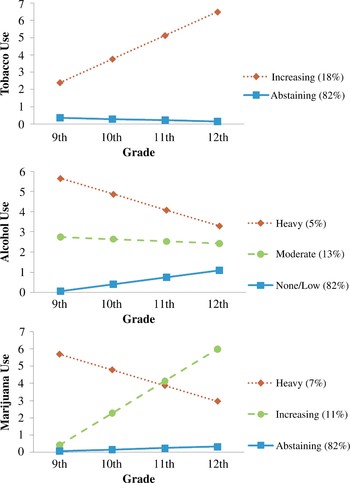
The first aim of this study was to determine if there were subgroups of individuals within the population who differed in both initial levels of substance use as well as change in substance use across high school. Growth mixture modeling was used to evaluate classes of linear growth separately for high school cigarette, alcohol, and marijuana use. Figure 2 illustrates the final models of high school cigarette, alcohol, and marijuana use. Gender,Footnote 1 parental education, eligibility for free or reduced lunch, and intervention statusFootnote 2 were evaluated as covariate predictors of substance use class membership, with significant associations maintained in all subsequent analyses involving the latent classes. Furthermore, associations between latent classes of high school substance use and subsequent young adult adjustment outcomes were also evaluated.
Growth mixture models of high school substance use. [A color version of this figure can be viewed online at journals.cambridge.org/dpp]

Cigarette use
A two-class model fit the frequency of cigarette use data. The majority of the sample abstained from the use of cigarettes (n = 437, 82% of the sample). We labeled this group “abstainers,” as they reported levels of cigarette use near zero throughout high school. A smaller group of individuals who reported “increasing” cigarette use across high school was identified (n = 96, 18% of the sample). In 9th grade, the increasing group reported having used cigarettes an average of 2 times in the past year. By 12th grade, they reported having smoked cigarettes an average of 20 and 39 times in the past year.
Alcohol use
A three-class model best fit the alcohol use data. The majority of the sample followed a trajectory of “none/low” alcohol use (n = 583, 83% of the sample). This class reported no alcohol use in ninth grade. By the end of high school, the none/low alcohol class reported drinking alcohol just once in the past year, on average. Despite this small increase, this group of adolescents largely abstained from the consumption of alcohol during high school. A “moderate” class of alcohol use was also identified (n = 88, 13% of the sample). The moderate class reported drinking alcohol between 2 and 4 times in the past year, on average, throughout high school. Finally, a small group of “heavy” alcohol consumers was identified (n = 28, 4% of the sample). In 9th grade, the heavy alcohol users reported drinking alcohol between 10 and 39 times in the past year, on average. By 12th grade, this class had decreased their reports of alcohol consumption to between 3 and 9 times in the past year, on average. Despite this observed decrease in drinking across high school, the heavy drinking group still reported higher levels of alcohol consumption compared to the moderate and abstaining groups.
Marijuana use
Marijuana use was also best represented by a three-class model. Similar to cigarette and alcohol use, the majority of the sample abstained from marijuana use throughout high school (n = 437, 82% of the sample). “Abstainers” reported rates of marijuana use near zero from 9th to 12th grades. An “increasing” class of marijuana users was also identified (n = 58, 11% of the sample). Increasing marijuana users reported levels of marijuana use comparable to the abstainers in 9th grade; however, by 12th grade, this class reported having used marijuana between 20 and 39 times in the past year, on average. Finally, a small group of “heavy” marijuana users was identified (n = 36, 7% of the sample). In 9th grade, the heavy marijuana users reported having used marijuana between 10 and 39 times in the past year, on average. By 12th grade, this class reported decreased marijuana consumption to between 3 or 4 times in the past year, on average. Despite this decrease, the heavy group still represented a high risk trajectory, as they had heavy marijuana use early in adolescence that had not fully diminished by the end of high school.
Overlap in substance use class membership
To evaluate overlap among the trajectory groups of cigarettes, alcohol, and marijuana use, we conducted a simple cross-tabulation of the overlap in trajectory class membership. As expected, the greatest degree of overlap occurred among individuals who abstained from all three substances (66% of the sample). Given the small percentage of individuals who followed trajectories of heavy alcohol use or heavy marijuana use, the following percentages combine these classes with their moderate use and increasing counterparts, and are discussed as trajectories of use (as opposed to abstention). Small percentages of the sample engaged in use of only one substance: cigarettes (7%), alcohol (8%), and marijuana (4%). Only 5% of the sample followed trajectories of use for all three substances. Among individuals who followed trajectories of use for only two substances, the most common combination was co-occurrence of marijuana and tobacco use (6%), followed by marijuana and alcohol use (3%), with only 1% of the sample following trajectories of alcohol and tobacco use during high school. These findings suggested that although there was overlap among individuals who followed similar trajectories of cigarette, alcohol, and marijuana use during high school, the majority of individuals displaying a risky substance use trajectory did so for individual substances, rather than for all three simultaneously.
Predictors and outcomes associated with substance use trajectories
Cigarette use
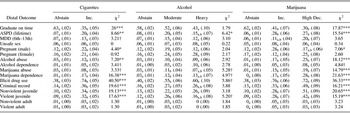
There were some demographic differences between the two cigarette use classes. A one unit increase in parental education was associated with a 22% increase in the odds of being in the abstaining, compared to those in the increasing class (b = 0.20, SE = 0.08, est./SE = 2.33, p = .020). Females had 61% higher odds of being in the abstaining cigarette class than males (b = 0.48, SE = 0.24, est./SE = 2.03, p = .042). In addition, the cigarette trajectory classes were differentially associated with adjustment outcomes in young adulthood (see Table 2). The increasing class had significantly fewer individuals who graduated on time compared to the abstaining class. The increasing class also reported more mental health and drug problems in young adulthood compared to those adolescents who abstained from using cigarettes during high school. Specifically, individuals in the increasing cigarette use trajectory during high school were more likely to meet the criteria for antisocial personality disorder, alcohol abuse and dependence, and marijuana abuse and dependence, and to have ever used an illicit drug. Regarding sexual behaviors, the increasing cigarette use class contained significantly more males who reported having gotten someone pregnant compared to the abstaining class. Furthermore, individuals in the increasing cigarette use class also reported more involvement in the criminal justice system compared to those in the abstaining class. Individuals in the increasing cigarette use class were more likely to have committed a juvenile nonviolent or violent crime, and were more likely to have a criminal record.
Associations between high school substance use trajectories and young adult adjustment outcomes
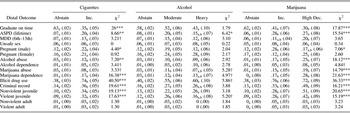
Note: Estimates represent the within class percentage of outcome. Values with different subscript letters are significantly different. Inc., increasing; Dec., decreasing; ASPD, antisocial personality disorder; MDD, major depressive disorder.
†p < .10. *p < .05. **p < .01. ***p < .001.
Alcohol use
Although there were no demographic differences between the alcohol trajectory classes, the classes did differentially predict mental health and drug problems, as well as involvement in the criminal justice system by young adulthood (see Table 2). Individuals who followed a trajectory of moderate alcohol use across high school were significantly more likely to meet the criteria for antisocial personality disorder and marijuana abuse and dependence, and to have ever used an illicit drug by young adulthood, compared to those who followed a trajectory of none/low alcohol use during high school. Moderate alcohol users were also more likely to have committed a juvenile violent crime and to have a criminal record compared to the none/low class. The heavy alcohol user class reported rates of negative adjustment outcomes similar to the moderate class; however, the relatively high variability within the heavy user class resulted in fewer of these effects reaching statistical significance. One exception was that those in the heavy alcohol use class were significantly more likely to have used an illicit drug by young adulthood compared to those in the none/low class.
Marijuana use
There were some significant associations between the covariates and the marijuana use classes. Parental education differentiated the heavy class from both the increasing class (b = 0.32, SE = 0.14, est./SE = 2.28, p = .023) and the abstaining class (b = 0.31, SE = 0.11, est./SE = 2.96, p = .003). A one unit increase in parental education was associated with a 37% increase in the odds of abstaining from marijuana, as well as 37% increase in the odds of being in a trajectory of increasing marijuana use, compared to those in the heavy marijuana use trajectory. Females had a 216% increase in the odds of being in the abstaining marijuana class than in the increasing class (b = 0.77, SE = 0.31, est./SE = 2.47, p = .014).
Marijuana class membership was also associated with different indicators of adjustment in young adulthood (see Table 2). Most of these associations differentiated the abstainers from either the increasing class or the heavy class. The increasing marijuana use class and the heavy class had significantly fewer individuals who reported graduating high school on time compared to abstainers. In addition, individuals who followed a trajectory of either increasing or heavy marijuana use during high school had higher rates of both mental health and drug problems in young adulthood. Individuals from these classes were more likely to meet the criteria for antisocial personality disorder, alcohol abuse, and marijuana abuse and dependence and more likely to have ever used an illicit drug compared to those who abstained from marijuana use during high school. Furthermore, those in the heavy class were significantly more likely to have met the criteria for major depressive disorder than those in the abstaining class.
The increasing and heavy marijuana classes also reported more involvement in the criminal justice system by young adulthood compared to the abstaining class. Individuals who followed trajectories of either increasing or heavy marijuana use were more likely to have committed a nonviolent or violent juvenile crime and to have a criminal record compared to those in the abstaining class. Regarding sexual behaviors, males in the increasing marijuana use class were significantly more likely to report that they had gotten someone pregnant compared to those in the abstaining class. Finally, there were two outcomes in young adulthood that further distinguished between the increasing and the heavy marijuana use latent classes. The females in the heavy class were significantly more likely to report having been pregnant and significantly more likely to report having committed a nonviolent crime in adulthood compared to those in the increasing class.
Fit of the developmental cascade model
The primary aim of this study was to evaluate a hypothesized developmental cascade model depicting the link between early risk factors, trajectory of high school cigarette, alcohol, and marijuana use, and adult adjustment (see Figure 1). The statistical evaluation of the mediated model involved another three-stage process. First, associations between variables at time t with subsequent variables at time t + 1 were evaluated. Second, variables at time t were evaluated as mediators of the association between variables at time t – 1 and variables at time t + 1. Finally, variables at time t were evaluated as mediators of the association between variables at time t – 1 and substance use class membership.
Prediction of childhood and early adolescent variables
The first stage of analyses for testing the developmental cascade model evaluated the direct associations between each of the predictor variables. According to the developmental cascade model (see Figure 1), it was expected that each variable from childhood and adolescence would be directly associated with the subsequent variable in the developmental progression. Pathways through peer rejection and academic achievement were evaluated separately. Model fit statistics indicated that both the peer rejection pathway (comparative fit index = 0.95, root mean square error of approximation = 0.04, standarized root mean square residual = 0.03) and the academic achievement pathway (comparative fit index = 0.92, root mean square error of approximation = 0.06, standarized root mean square residual = 0.04) fit the data. All associations between variables at time t with subsequent variables at time t + 1 were statistically significant, with one exception. Oppositional defiant behavior in first grade did not statistically predict poor academic achievement in third grade. However, first grade oppositional defiant behavior was associated with greater peer rejection in third grade (b = 0.12, SE = 0.05, est./SE = 2.17, p = .030). Peer rejection and poor academic performance in third grade were significantly associated with substance-using friend affiliation in seventh grade (b = 0.08, SE = 0.04, est./SE = 2.11, p = .035 and b = 0.09, SE = 0.04, est./SE = 2.60, p = .009, respectively). Affiliation with substance-using friends in seventh grade predicted conduct problems in eighth grade (b = 0.18, SE = 0.04, est./SE = 4.35, p < .001). The significant associations observed between these predictor variables provided statistical evidence in support of the pathways required (α and β) to establish the meditating processes evaluated in the last two stages of the analyses (MacKinnon, Reference MacKinnon2008).
Mediation analyses testing the link between childhood and early adolescence variables
The second stage of analyses tested the hypothesis that there would be significant indirect effects among the predictor variables along the cascading pathway in the developmental cascade model. Predictor variables at time t were evaluated as mediators of the association between variables at time t – 1 and variables at time t + 1. Previously reported results indicated that each predictor at time t was either significantly or marginally associated with the subsequent predictor at time t + 1, providing evidence of the significant pathways necessary for the estimation of the indirect effect via path analysis. The indirect effect was simultaneously estimated along with the pathways from the independent variable to the mediator (α) and the mediator to the dependent variable (β) via the product of these two pathways (αβ).
The association between oppositional defiant behavior in first grade and seventh grade substance-using friend affiliation was not significantly mediated by either peer rejection or academic achievement in third grade. However, the indirect effect of peer rejection in third grade on conduct problems in eighth grade via substance-using friend affiliation in seventh grade was marginally significant (αβ = 0.02, SE = 0.01, est./SE = 1.77, p = .078). Last, the indirect effect of academic achievement in third grade on conduct problems in eighth grade via substance-using friend affiliation in seventh grade was statistically significant (αβ = 0.02, SE = 0.01, est./SE = 2.19, p = .029).
Mediation analyses testing the link between childhood and early adolescence variables and substance use class membership
The final stage of the evaluation of the developmental cascade model determined if the effect of each childhood/adolescent predictor on substance use class membership was mediated by the subsequent predictors along the cascade. Pathways from each predictor at time t to the subsequent predictor at time t + 1 (α) as well as pathways from each predictor to substance use class membership (β) were simultaneously estimated along with the indirect effects via the product of the two pathways (αβ).
Cigarette use
The indirect effect of oppositional defiant behavior in first grade on high school cigarette class membership via peer rejection in third grade was marginally significant (αβ = 0.04, SE = 0.02, est./SE = 1.93, p = .053), whereas the indirect effect of oppositional defiant behavior in first grade via academic achievement in third grade was not significant. Substance-using friend affiliation in seventh grade significantly mediated the association between high school cigarette class membership and both peer rejection in third grade (αβ = 0.05, SE = 0.02, est./SE = 2.02, p = .043) and academic achievement in third grade (αβ = 0.05, SE = 0.03, est./SE = 2.07, p = .038). Last, the indirect effect of substance-using friend affiliation in seventh grade via conduct problems in eighth grade on subsequent cigarette trajectory class membership in high school was significant (αβ = 0.11, SE = 0.04, est./SE = 3.09, p = .002).
Alcohol use
Oppositional defiant behavior in first grade was not indirectly associated with high school alcohol class membership via peer rejection or academic achievement in third grade. However, substance-using friend affiliation in seventh grade significantly mediated the association between high school alcohol class membership and both peer rejection in third grade (αβ = 0.06, SE = 0.03, est./SE = 2.26, p = .024) and academic achievement in third grade (αβ = 0.06, SE = 0.03, est./SE = 2.39, p = .017). The indirect effect of substance-using friend affiliation in seventh grade via conduct problems in eighth grade on subsequent alcohol trajectory class membership in high school was also significant (αβ = 0.13, SE = 0.04, est./SE = 3.27, p = .001).
Marijuana use
The indirect effect of oppositional defiant behavior in first grade on high school marijuana class membership via peer rejection in third grade was marginally significant (αβ = 0.05, SE = 0.03, est./SE = 1.87, p = .061), whereas the indirect effect of oppositional defiant behavior in first grade via academic achievement in third grade was not significant. Substance-using friend affiliation in seventh grade significantly mediated the association between high school marijuana class membership and both peer rejection in third grade (αβ = 0.07, SE = 0.03, est./SE = 2.01, p = .044) and academic achievement in third grade (αβ = 0.07, SE = 0.03, est./SE = 2.25, p = .025). Last, there was a significant indirect effect of substance-using friend affiliation in seventh grade via conduct problems in eighth grade on subsequent marijuana trajectory class membership in high school (αβ = 0.13, SE = 0.04, est./SE = 3.11, p = .002).
Discussion
The current study aimed to test a developmental cascade model of adolescent substance use trajectories and young adult adjustment in urban, predominantly African American youth followed from first grade through young adulthood. Our first set of analyses, which used growth mixture modeling, provided support for the hypothesized trajectories of substance use in high school. Specifically, an “abstaining” class was identified for all three substance use outcomes. In addition, “increasing” classes were identified for both cigarettes and marijuana use during high school. The cigarette and marijuana increasing classes were similar, in that rates of use were near zero in ninth grade, but subsequently increased to very high levels by the end of high school.
The trajectories of alcohol use were slightly different, in that the class that evinced statistical increases in use over high school was the abstaining/low use class; however, there was a class of alcohol users who reported fairly stable moderate use across high school. Finally, for both marijuana and alcohol, small classes of heavy users were identified that were composed of individuals who began reporting very high levels of substance use in high school, but then subsequently decreased in substance use. Despite the decreases, both the heavy alcohol and marijuana classes reported high levels of use throughout high school. Moreover, an evaluation of the co-occurrence of substance use in high school revealed that although there is co-occurrence among some individuals, a larger percentage of users follow a trajectory of use for a single substance.
No demographic differences were found for the trajectories of alcohol use; however, parental education and gender were associated with cigarette and marijuana class membership. Lower parental education was associated with membership in the increasing cigarette class as well as the increasing and heavy marijuana classes. A higher proportion of males followed trajectories of increasing cigarette and marijuana use. We also found support for the hypothesis that the “increasing use” classes would experience higher rates of problematic outcomes in young adulthood. For all three substances, individuals from the abstaining classes reported significantly better young adult adjustment outcomes across a variety of domains. These associations are important for understanding the implications for adjustment of maladaptive trajectories of specific substance use during high school and emerging adulthood.
In our second set of analyses, we evaluated a developmental cascade model of high school substance use trajectories based upon Patterson and colleagues' (Reference Patterson, DeBaryshe and Ramsey1989) developmental model of antisocial behavior. The strongest support for the Patterson model was in regard to trajectories of high school cigarette and marijuana use via the peer rejection pathway. Oppositional defiant behavior in first grade was statistically associated with peer rejection in third grade, accounting for both cross-domain and cross-time covariance. Furthermore, significant indirect effects were observed beginning in early childhood with peer rejection, subsequently leading to affiliation with a deviant substance-using peer group and adolescent conduct problems, and ultimately higher odds of following a trajectory of cigarette or marijuana use rather than abstention. The hypothesized pathway through academic achievement was not as strongly supported; however, this could be because of limitations in measurement of this construct. Future studies of the Patterson model would benefit from further evaluation of other indicators for each of the domains in the model. However, trajectories of use of both cigarettes and marijuana were associated with a myriad of negative adjustment outcomes, including educational attainment, mental health and substance abuse problems, risky sexual behavior, and involvement in the criminal justice system.
The results for trajectories of alcohol use were somewhat different than those for cigarettes and marijuana, in that only the middle school variables proved to be significant mediators. Specifically, substance-using peer affiliation in seventh grade mediated the associations between the third grade predictors (e.g., peer rejection and academic performance) and trajectory of alcohol use. Conduct problems in eighth grade mediated associations between substance-using friend affiliation in seventh grade and high school alcohol class membership.
Although there were commonalities in pathways to cigarette and marijuana use, as well as commonalities in associated young adulthood adjustment outcomes, it is important to highlight that cigarette use and marijuana use did not perfectly correspond with one another. Individuals who used marijuana also were likely to smoke cigarettes; however, most individuals who followed a trajectory of increasing cigarette use did not also use marijuana. Pathways to alcohol use were slightly different than cigarettes and marijuana use. This may be because alcohol use is viewed socially as a normative and acceptable behavior in adulthood, whereas attitudes toward cigarette use have become more negative, and marijuana use is not considered socially acceptable or legal.
Observed gender differences in average reports of substance use across high school can be accounted for by the greater proportion of males who follow trajectories of increasing cigarette and marijuana use. Notably, a substantial percentage of females followed trajectories of increasing or high cigarette and marijuana use, and there were no observed gender differences in alcohol class membership. Furthermore, cascading developmental pathways to trajectories of high school substance use were not substantially different for males and females. Taken together, these findings suggest that both males and females should be targeted for prevention of substance use, and that gender-specific interventions may not be necessary.
Strengths and Limitations
A major strength of this study was the longitudinal assessment from early childhood (first grade) through young adulthood (age 21). Furthermore, the statistical analyses employed in this study allowed for the inclusion of the entire sample in analyses, despite missing data, via the use of FIML parameter estimation. Growth mixture modeling allowed for the identification of subgroups of individuals who followed distinct trajectories of substance use during high school based on the patterns observed in the data, rather than relying on arbitrary cut points (e.g., mean split, upper and lower quartiles). In addition, by evaluating each substance separately, we were able to examine substance-specific pathways to use, as well as substance-specific associations with young adult adjustment outcomes. Another strength of this study was the utilization of multiple reporters to assess the constructs of interest, including parents, teachers, participants, school records, and court records. The availability of data from multiple respondents on a range of variables over the course of 16 years enabled us to fit a relatively comprehensive cascade model, while accounting for cross-domain and cross-time covariation; this suggests that the observed mediated associations are not simply because of unaccounted for covariance. Finally, the sample can also be considered a strength, given the relative dearth of information regarding developmental processes among urban, minority youth.
In terms of limitations, we decided to model a single variable to represent each of the childhood and adolescent constructs, whereas some researchers have examined indexes of multiple indicators at each time point (e.g., see Dodge et al., Reference Dodge, Greenberg and Malone2008). Nevertheless, the use of single indicators provided clear evidence that these specific individual and interpersonal characteristics are important to the onset of trajectories of high school substance use. Although having 16-year longitudinal data on a well-characterized sample is unusual, the relatively modest sample size may have limited our ability to detect more substance use classes and/or evidence of mediation. A third limitation is the sole reliance on self-reports of the parenting constructs, youth drug use, and substance-using friends. An additional limitation was the use of teacher report of peer rejection and youth conduct problems. Further research is needed to replicate these findings and determine the extent to which they generalize to other samples and in different ecological contexts.
Conclusions and Implications
This study identified factors along the continuum from childhood through adolescence that created a cascade of associations across time that propelled individuals toward negative adjustment outcomes in young adulthood. The results confirm and extend previous findings (e.g., Moffitt, Reference Moffitt, Cicchetti and Cohen2006; Patterson et al., Reference Patterson, DeBaryshe and Ramsey1989; Rutter, Reference Rutter1989) by indicating that the risk for adolescent substance use, young adult mental health problems, and criminal behavior begins in early childhood. The implementation of developmentally appropriate interventions across childhood and adolescence has the potential for offsetting negative developmental trajectories and promoting a healthy transition into adulthood. These finding also have implications for public health as well as prevention science. For example, there appear to be multiple opportunities along the developmental continuum for intervening in the hopes of offsetting negative developmental trajectories. This cascade of influence toward high school substance use provided clear evidence that substance use prevention programming needs to target both the childhood and adolescent years (Ialongo et al., Reference Ialongo, Rogosch, Cicchetti, Toth, Buckley, Petras, Cicchetti and Cohen2006).
From a public health perspective, this study highlighted the link between cigarette use in high school and young adult mental health problems, drug problems, and involvement in the criminal justice system. This is important, as cigarettes are known for their connection to physical health in adulthood, but not necessarily for links to mental health problems and criminal involvement. The significant associations between cigarette use and young adult adjustment found in this study do not establish a causal link, especially in light of associations between cigarette and marijuana use during high school. However, cigarette use is frequently more visible to parents, peers, and teachers compared to marijuana use and can perhaps serve as a useful indicator of risk, not only for physical health problems but also for later mental health problems, substance abuse, and criminal behavior.