Working memory (WM) is the theoretical construct that has been described as “perhaps the most significant achievement of human mental evolution” (Goldman-Rakic, Reference Goldman-Rakic1992, p. 111). It is considered a central construct in cognitive psychology and, more recently, in cognitive neuroscience. Over the last years, cognitive psychologists have claimed that WM plays an important role in learning during childhood, and corroborate their view on studies demonstrating close links between WM skills and learning measures (Baddeley & Hitch, Reference Baddeley, Hitch and Bower1974; Bull & Scherif, Reference Bull and Scerif2001; Gathercole & Pickering, Reference Gathercole and Pickering2000; Jarvis & Gathercole, Reference Jarvis and Gathercole2003; Siegel & Ryan, Reference Siegal and Ryan1989; Swanson, Reference Swanson1994).
The issue of whether WM is a unitary or a non-unitary construct has been a source of controversy in the WM literature. Some researchers have emphasized the unitary nature of WM (e.g., Anderson, Reder, & Lebiere, Reference Anderson, Reder and Lebiere1996; Engle, Cantor, & Carullo, Reference Engle, Cantor and Carullo1992; Kyllonen & Christal, Reference Kyllonen and Christal1990), whereas others have emphasized its non-unitary nature (e.g., Baddeley & Hitch, Reference Baddeley, Hitch and Bower1974; Daneman & Tardif, Reference Daneman, Tardif and Coltheart1987; Ferreira, Almeida, & Prieto, Reference Ferreira, Almeida and Prieto2011; Shah & Miyake, Reference Shah and Miyake1996).
Regarding the functioning of WM, researchers also clearly distinguish between children and adults processes. In accordance with this differentiation, we thus present a theoretical framework of both WM functioning in adults and WM functioning in children. Then, we present an overview and the hypotheses of the present study.
WM functioning in adults
The multicomponent WM model developed originally by Baddeley and Hitch (Reference Baddeley, Hitch and Bower1974) belongs to the tradition which considers WM as a “memory system”, meaning that it is comprised of distinct structural components. According to this model, a dynamic WM system allows us simply to store information for short periods of time (by using the two slave systems of the model: the Phonological Loop and the Visuospatial Sketchpad) and also manipulate that information while it is being stored (by using the Central Executive, probably acting in conjunction with one or more of the slave systems). The model also proposes that the activities of three components of WM have been demonstrated to be largely separable, although related in the sense of being a coherent system of immediate memory functioning.
Several investigations into WM models have conducted factor-analytic studies to assess the validity of the construct. In general, results have been supportive of Baddeley’s multicomponent WM model, with two or three typically identified factors. Some studies (e.g., Engle, Tuholski, Laughlin, & Conway, Reference Engle, Tuholski, Laughlin and Conway1999) have discovered two broad factors that divide tasks into short-term memory and WM, whereas other factor analyses have pointed to three factors that are similar to Baddeley and Hitch (Reference Baddeley, Hitch and Bower1974) original three components. Other factor-analytic studies (Ferreira et al., Reference Ferreira, Almeida and Prieto2011; Swanson & Berninger, Reference Swanson and Berninger1996) have reported verbal and visuospatial WM load on two different factors. For example, Oberauer, Wilhelm, and Wittmann (Reference Oberauer, Süß, Wilhelm and Wittmann2003) also found evidence for a distinction between verbal-numeric and visuospatial WM systems, although their content was highly correlated. Indeed, adults’ measures of verbal and visuospatial WM share approximately 40% of their variance (Kane et al., Reference Kane, Hambrick, Tuholski, Wilhelm, Payne and Engle2004). From a neuropsychological perspective, there is evidence that supports a differential processing of verbal-numeric content in the posterior left cortex and non-verbal content in the posterior right cortex (Kiss, Watter, Heisz, & Shedden, Reference Kiss, Watter, Heisz and Shedden2007).
Regarding the task characteristics, prior research pointed out that some contents demand higher levels of executive processing. Thus, additional studies revealed that Visuospatial Sketchpad implicates more executive functions than does Phonological Loop (Baddeley, Reference Baddeley1996; Hegarty, Shah, & Miyake, Reference Hegarty, Shah and Miyake2000). For example, Philips and Christie (Reference Phillips and Christie1977) argued that it might not be necessary to postulate a visuospatial subsystem separate from the Central Executive. Accordingly, other studies (Miyake, Friedman, Retinger, Shah, & Hegarty, Reference Miyake, Friedman, Rettinger, Shah and Hegarty2001) found evidence that the visuospatial domain and the Central Executive can be considered as a single construct. The authors also found that a restricted model with the Visuospatial Sketchpad and the Central Executive, which constrained to be equal, resulted in a model that fit the data. This study revealed a common variance among visuospatial short-term memory and WM, which reflects substantial Central Executive involvements. This is important because executive functions and visuospatial short-term memory and WM variables together fully explain the intercorrelations between different ability factors (Miyake et al., Reference Miyake, Friedman, Rettinger, Shah and Hegarty2001).
WM functioning in children
Over the course of development, the strength of the relationships among components varies, the functioning and interaction of the components evolve, and individuals learn to utilize components in different ways. In early childhood, the three Baddeley and Hitch (Reference Baddeley, Hitch and Bower1974) components are relatively independent, but as executive functions of WM mature, there is a greater degree of interdependence between the functioning of the executive and short-term components. For example, in the Gathercole, Pickering, Ambridge, and Wearing (Reference Gathercole, Pickering, Ambridge and Wearing2004) study, the correlation between the Central Executive and phonological short-term memory increased from .73 at age 6, to .90 or greater for 10-to 15-year-olds. The growing interdependence is probably a function of more executive coordination, as well as increased strategy use. Moreover, growth processes and skill acquisition change the nature of WM functioning. In general, young children seem to depend more heavily on phonological short-term memory than adults. In particular, the phonological features of words are more influential in children’s processing, whereas adults rely more on semantic associations, as indicated by the finding that phonological similarity and non-words are less disruptive to adult functioning (Colin & Gathercole, Reference Colin and Gathercole2006).
Visuospatial recoding emerges between the ages of 6 to 8 years, at about the same time children learn to read. Prior to recoding, children must remember nonverbal information in visuospatial form. By the age of 10, individuals consistently recode visuospatial material into verbal information. The ability to use retained material in visuospatial form also increases during childhood. Moreover, tasks that involve retention of complex visuospatial information place heavy demands on the Central Executive (Gathercole & Baddeley, Reference Gathercole and Baddeley1993). Neuropsychological studies have documented that growth in the Central Executive, and in general WM capacity, is related to prefrontal cortex maturation (Kane & Engle, Reference Kane and Engle2002). The development of the Central Executive occurs later than that of the phonological and visuospatial components. With increasing age, the Central Executive becomes more strongly associated with verbal WM and less connected with visuospatial functioning (Pickering, Gathercole, Hall, & Lloyd, Reference Pickering, Gathercole, Hall and Lloyd2001).
With the publication of a WM test battery based on Baddeley’s model, traditional psychometric validity evidence is now available. Exploratory and confirmatory factor analyses of the Working Memory Test Battery for Children resulted in a factor structure supportive of Baddeley and Hitch tripartite model (Pickering & Gathercole, Reference Pickering and Gathercole2001). Recently, Alloway, Gathercole, and Pickering (2006) completed a confirmatory factor analysis study that produced a three-factor model, with related but separable verbal and visuospatial storage factors, along with an executive factor representing shared variance between short-term verbal and visuospatial processing. The WMTB-C subtests are based mainly on established experimental paradigms known to yield relatively pure assessments of particular aspects of WM. Three of the four Phonological Loop subtests use a serial recall method in which the examinee must repeat spoken items in the original order, whereas the fourth subtest consists of a matching activity. These widely used measurement paradigms appear to call upon the components of the Phonological Loop, storage and sub-vocal rehearsal. All of the three Central Executive subtests require simultaneous storage and processing. Each of the executive measures consists of a complex-span procedure, including the classic Listening Span task, originally developed by Daneman and Carpenter (Reference Daneman and Carpenter1980). The predominantly verbal nature of the executive subtests indicates that performance on all three of the executive tasks is likely to be verbally mediated. Thus, the Central Executive score may be heavily influenced by the Phonological Loop and verbal abilities. For its part, the visuospatial composite may be mediated by executive processes, as research has established that the Visuospatial Sketchpad places significant demands on Central Executive resources (Pickering, Reference Pickering and Pickering2006; Pickering et al., Reference Pickering, Gathercole, Hall and Lloyd2001).
Present study overview and hypotheses
In our research, we intend to analyze the functional organization of WM in a sample of children aged 8–9 years old. Considering that at this age memory performance increases steeply up (Gathercole, Reference Gathercole1999), and that a great amount of studies were conducted with experimental and highly controlled tasks, we intend to test the fractionation of WM with the use of a standardized WM battery (Gathercole, Reference Gathercole1999). Accordingly, we posit that it is also imperative to understand memory structure in children aged 8–9 years old, as most of memory studies have been usually conducted with undergraduate students. Thus, it is vital to test different hypothesis and try to replicate the findings in order to clarify how human memory behaves and to help professionals in the diagnosis and intervention in those early ages. We also aim to explore whether verbal and visuospatial memory is supported by a common resource pool or whether they are maintained by separable cognitive resources in children. According to research on the area, the structure of WM is already in place in children of this age (Gathercole et al., Reference Gathercole, Pickering, Ambridge and Wearing2004). In this sense, we tested participants with a WM battery for children – the WMTB-C by Pickering & Gathercole (Reference Pickering and Gathercole2001) –, that assesses the three WM components (the Central Executive, the Phonological Loop and the Visuospatial Sketchpad). Contrary to the great majority of studies that adopted experimental tasks, we will take advantages of the psychometric tests to assess a set of hypotheses. First, we will examine if memory in children of this age is represented as a three factor structure of Visuospatial Sketchpad, Phonological Loop and Central Executive (cf. Baddeley & Hitch, Reference Baddeley, Hitch and Bower1974; Pickering & Gathercole, Reference Pickering and Gathercole2001). Second, we will address the question regarding memory being a unitary construct (cf. Anderson et al., Reference Anderson, Reder and Lebiere1996; Engle et al., Reference Engle, Cantor and Carullo1992; Kyllonen & Christal, Reference Kyllonen and Christal1990). Third, we will check if there is a differentiation for verbal and visuospatial content (cf. Ferreira et al., Reference Ferreira, Almeida and Prieto2011; Jarvis & Gathercole, Reference Jarvis and Gathercole2003; Oberauer et al., Reference Oberauer, Süß, Wilhelm and Wittmann2003; Kiss et al., Reference Kiss, Watter, Heisz and Shedden2007). Finally, we will investigate if the Central Executive works as a single factor independent from Phonological Loop (cf. Baddeley, Reference Baddeley1996; Hegarty et al., Reference Hegarty, Shah and Miyake2000; Miyake et al., Reference Miyake, Friedman, Rettinger, Shah and Hegarty2001; Pickering et al., Reference Pickering, Gathercole, Hall and Lloyd2001; Philips & Christie, Reference Phillips and Christie1977).
Method
Participants
The participants in this study were 103 third-grade Portuguese students of two public primary (basic) schools from the South of Portugal. The participants’ mean age is 8.45 years old (SD = .50; 51.5% male). All children come from urban areas and diverge in social background. None of these children had any physical, sensory, or behavioral impairment. Also, parental consent was obtained for each child participating in the study.
Measures
The WMTB-C (Pickering & Gathercole, Reference Pickering and Gathercole2001) is the only norm-referenced battery specifically designed to measure Baddeley’s triarchic theory of WM. The WMTB-C measures the Central Executive, the Visuospatial Sketchpad, and the Phonological Loop, but excludes the Episodic Component.
We used three subtests to assess the Central Executive: (a) Listening Recall (LR), where children have to listen to a series of spoken sentences and judge whether or not the sentence made sense, by responding “yes” or “no” while remembering the last word of each sentence (test trials begin with one sentence, and continue with additional sentences in each level until the child is unable to recall three correct trials at a level); (a) Counting Recall (CR): where children have to look at a booklet that is placed in front of them containing a rectangle with three, four, five, or six red dots on each page. Then, they must count the number of dots presented in a series of arrays (saying the total number aloud) and subsequently, recall the total dots in the order that the arrays were presented (the test trial begins with one page of a dot array, and increases by one page in each level, until the child is unable to recall four trials correctly); lastly, (c) Backward Digit Recall (BDR), involves a task where children must maintain the forward sequence of digits while recalling them in reverse order (test trials begin with two numbers, and increase by one number in each level, until the child is unable to recall four correct trials at a level).
To assess the Phonological Loop, we used four tasks. Digit Recall (DR involves the presentation of spoken sequences of digits for immediate serial recall. Children must complete four or six trials per span in order to continue to a higher span. Word List Matching (WLM), Word List Recall (WLR) and Non-word List Recall (NWLR) are subtests composed of one-syllable stimuli. In the first subtest children have to listen to a group of words twice and say “yes” or “no”, depending on whether the words were told in the same order. Determination of the start point, the presentation rate and the continuation rule are the same as the Digit Recall subtest. Only in the two last subtests do children have to recall the list in the original sequence. No item was repeated more than once across trials. Finally, to evaluate the Visuospatial Sketchpad we used two measures. Block Recall (BR) is a task in which a board is placed on a table and the administrator of the test and the child sit opposite one another, with the board between them. On one side of each block, a number (from 1 to 9) is printed. The administrator taps a sequence on the blocks on this side of the board, while the child is required to repeat the sequence by touching the same blocks in the same order they have been shown. The general procedures are the same as for the Digit Recall subtest, beginning with the tapping of a single block. Mazes Memory (MM) is a task in which a red route is shown through a maze and the administrators of the test traces the route with their finger. Following this, the children are asked to draw the exact route that they have seen into an identical, but empty, maze. Maze complexity is increased by adding more walls to the maze. Each stimulus maze is shown to the child for approximately 3 seconds. The same scoring procedure was used for all subtests: one point for each correct answer and zero points for incorrect answers.
This battery showed a good internal consistency (Kuder-Richardson 20 -KR20) for all the subtests of the Phonological Loop: (Digit Recall with KR20 = .82; Word List Recall and Word List Matching, each of them with KR20 = .86 and Nonword List Recall with KR20 = .78). For Visuospatial Sketchpad subtests, that include Mazes Memory and Block Recall, the coefficients were (KR20 = .75 and .78, respectively). Finally the two Central Executive subtests, the Listening Recall and Backward Digit Recall revealed good internal consistency (KR20 = .80 and KR20 = .85). Only the Counting Recall subtest had lower internal consistency with KR20 = .70.
The search of short (one-syllable) words for the Portuguese version of the WMTB-C measure was identical to the English version. Some WMTB-C subtests were translated into Portuguese by experts in the field, such as listening recall, word list recall, and word list matching and non-word list recall. Specific points were considered, such as including simple and common words to be familiar for young children, and guaranteeing that no one-syllable stimuli was repeated more than once across trials within a test. The nonsense words from non-word list recall were created using the same pool of sounds (phonemes) as the words used in the word list recall subtest.
Procedure
All tasks were applied individually to all participants in the same sequence (Digit Recall, Word List Matching, Word List Recall, Non-word List Recall, Block Recall, Mazes Memory, Listening Recall, Counting Recall and Backward Digits Recall) in only one individual session that lasted about 40 minutes and included a short pause. In each task, there was at least one practice trial before the testing phase so as to ensure that the children understood what was required. All instructions regarding each task were presented orally. The order of the administration of the subtests was held constant. The data were analyzed with SPSS 17.0 and AMOS 6.0.
Results
Descriptive statistics and correlational analyses
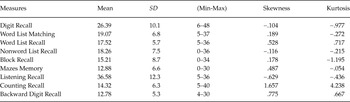
Descriptive statistics for each subtest of the Children’s Working Memory Test Battery are provided in Table 1. Looking at the raw scores, children’s performance mean ranges from 12.78 (SD = 5.3) in Backward Digit Recall to 36.58 (SD = 12.3) in Listening Recall. The skewness and kurtosis values of all measures indicated that all values are close to zero (except for counting recall), meaning that all of the distribution of the measures are close to the normality. According to the literature (West, Finch, & Curran, Reference West, Finch, Curran and Hoyle1995), a value of kurtosis below 7.0 does not deteriorate the measures.
Descriptive statistics of raw scores of WMTB-C measures (n = 103)

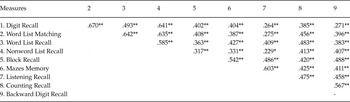
Table 2 shows correlations between composite scores for the WMTB-C measures. All measures correlated significantly with each other.
Correlations among all the variables of WMTB-C (n = 103)

* Correlation is significant at the .05 level (2-tailed).
** Correlation is significant at the .01 level (2-tailed).
Confirmatory factor analyses
The analysis of the internal structure was based on a confirmatory factor analysis (CFA). In order to analyze the adjustment level between the substantive model and the data, the variance-covariance matrix and the parameters were estimated with the Maximum Likelihood estimation procedure of the AMOS 6.0 computer software (Arbuckle, Reference Arbuckle2005). As suggested by Macmann and Barnett (Reference Macmann and Barnett1994), the adequacy of the model was based on various indexes. We used absolute and incremental indexes in this study, such as: the Chi-Square statistic value, the Root Mean Square Error of Approximation (RMSEA), the Akaike Information Criterion (AIC), the Comparative Fit Index (CFI) and the Tucker Lewis Index (TLI).
In accordance with Macmann and Barnett (Reference Macmann and Barnett1994), the Chi-Square allows us to test the adjustment between the model and the matrix of the observed covariance, considering that the lower the value, the better the fit. In this case, there should be a greater approximation to the degrees of freedom and consequent acceptance of the null hypothesis (p > .05). Values closer to 1 for the TLI and CFI indicate a good fit. As for the RMSEA, values of .08 or less also indicate a good fit (Hancock & Freeman, Reference Hancock and Freeman2001). As AIC values are a composite of badness of fit and complexity, simpler models will show lower scores, while higher values will result in complex and poorer models.
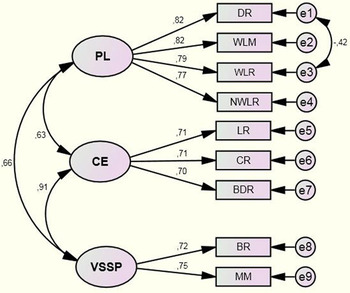
In order to understand WM structure in children, our first analysis tried to replicate the WMTB-C’s (Pickering & Gathercole, Reference Pickering and Gathercole2001) original structure. This model replica of Baddeley and Hitch’s initial tripartite model consisted of Phonological Loop (PL), Visuospatial Sketchpad (VSSP) and Central Executive (CE) factors. First, we conducted a preliminary analysis and then progressed with a post-hoc procedure, thus correlating errors from two tasks that measure the same Phonological Loop factor (Digits Recall and Word List Recall). Accordingly, the model obtained a significant Chi-Square value, as well as other adequate fit indexes [χ2(23, N = 103) = 25.150, p = .343; TLI = .945, CFI = .965, RMSEA = .030, AIC = 69.15], indicating a fit between the hypothetical model and the results obtained. The three latent factors obtained consisted of the three components (two domain-specific and one domain-general) proposed by Baddeley and Hitch’s (Reference Baddeley, Hitch and Bower1974) original model. All factors had significant correlations and adequate factorial loads. However, it should be noted that the correlation between the Central Executive and the Visuospatial Sketchpad was very high (.91), sharing 82.8% of their variance. Our results suggest that the visuospatial memory tasks required greater involvement of the Central Executive component than the verbal memory tasks (sharing 39.7% of their variance).
The high correlations between Central Executive and Visuospatial Sketchpad suggest that in the Visuospatial Sketchpad domain, WM tasks may have been highly implicated in executive functioning. According to the Baddeley and Hitch model, the Central Executive deals with both the Visuospatial Sketchpad and the Phonological Loop. In this sense, we constructed a model (M2) that constrained to 1 the correlations between the latent variables (Visuospatial Sketchpad, Central Executive, and Phonological Loop), which resulted in a decrease in the model’s fit (see M2 in Table 3 for details). Accordingly, the fit of this new model was not good, suggesting that memory is far from being a unitary construct, contrarily to some authors point of view (Anderson et al., Reference Anderson, Reder and Lebiere1996; Engle et al., Reference Engle, Cantor and Carullo1992; Kyllonen & Christal, Reference Kyllonen and Christal1990).
Fit indexes of the full Confirmatory Factorial Analysis and reduced models of the different memory factors

Model with a three factor structure similar to the Multi-component Working Memory Baddeley and Hitch’s Model.

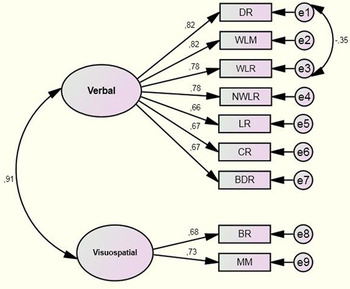
Because all the Central Executive and Phonological Loop tasks represent verbal content, we developed a two factor model (see Figure 2) in which the verbal content tasks are associated to the verbal factor, while the second (visuospatial) is associated to the remaining visuospatial tasks. Considering that there is evidence in the psychometric (Jarvis & Gathercole, Reference Jarvis and Gathercole2003), experimental (Oberauer et al., Reference Oberauer, Süß, Wilhelm and Wittmann2003) and neuropsychological (Kiss et al., Reference Kiss, Watter, Heisz and Shedden2007) studies for a differentiation between verbal-numeric and visuospatial working memory systems we tested model 3 on Figure 2. The model does not provide a good fit of the data [χ2(25, N = 103) = 46.634, p = .005; TLI = .487, CFI = .644, RMSEA = .092, AIC = 86.634].
Model with two-factor structures of the covarying verbal and visuospatial subtests.

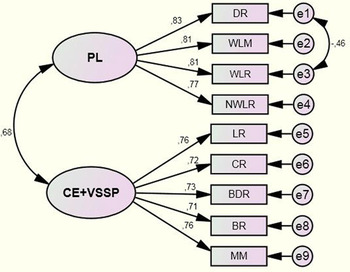
In contrast with the verbal domain, WM tasks may implicate central execution functioning or controlled attention strongly correlated with the visuospatial domain (Baddeley, Reference Baddeley1996; Hegarty et al., Reference Hegarty, Shah and Miyake2000; Miyake et al., Reference Miyake, Friedman, Rettinger, Shah and Hegarty2001; Pickering et al., Reference Pickering, Gathercole, Hall and Lloyd2001; Philips & Christie, Reference Phillips and Christie1977). Following the suggestion of Philips and Christie (Reference Phillips and Christie1977) that it might not be necessary to postulate a visuospatial subsystem separate from the Central Executive, we tested the hypothesis that the involvement of the Central Executive in the Visuospatial Sketchpad may make these constructs indistinguishable. Also, Miyake et al. (Reference Miyake, Friedman, Rettinger, Shah and Hegarty2001) revealed a common variance among visuospatial short-term memory and WM tasks, which reflects substantial Central Executive involvements. In order to replicate this hypothesis, we tested a model consisting of a Central Executive and a Visuospatial Sketchpad factor that co-varied with a second factor with loadings of all Phonological Loop tasks (Figure 3). This model provided better fit indexes than the initial model shown in Figure 1 [χ2(25, N = 103) = 27.280, p = .342; TLI = .946, CFI = .962, RMSEA = .030, AIC = 67.280]. The interfactor correlates were high (.68), with 46.2% of shared explained variance between constructs.
Model including two-factor structures with the Central Executive and the Visuospatial subtests covarying with the Phonological Loop subtests.

Primary results suggest that two models provide good fit measures: (a) a model with the Central Executive and the Visuospatial Sketchpad as separate factors (Figure 1); and (b) a model with executive functioning and visuospatial tasks as the same factor (Figure 3). In order to compare which model provides better fit indexes, we restricted the model in Figure 1 by fixing the correlation between Central Executive and the Visuospatial Sketchpad to equal 1.0. This procedure resulted in nested models, which allowed us to make comparisons by using the chi-square difference. Considering the statistically non-significance (Δχ2 = 2.13, ns), we found that the restricted model with Central Executive and the Visuospatial Sketchpad as the same factor is the most parsimonious (Kline, Reference Kline2005).
Discussion and conclusion
The purpose of this research was to analyze the functional organization of WM in a sample of children. Students were tested with a WM battery for children – the WMTB-C (Pickering & Gathercole, Reference Pickering and Gathercole2001) which assesses the three WM components (the Central Executive, the Phonological Loop and the Visuospatial Sketchpad). Next, we will briefly summarize our key findings.
First, we found evidence that supported the presence of three independent WM subsystems: the Phonological Loop, the Visuospatial Sketchpad and the Central Executive. Our results were consistent with the Baddeley and Hitch’s (Reference Baddeley, Hitch and Bower1974) initial tripartite model, thus supporting our first hypothesis. In this sense, we were able to replicate the WMTB-C’s (Pickering & Gathercole, Reference Pickering and Gathercole2001) original three-factor structure with a sample of Portuguese 8 to 9 year-old students. Second, our results were consistent with the view that the WM system is a multicomponent structure responsible for storage and processing information. Hence, our second hypothesis was not supported, as memory consists of independent subsystems rather than being a unitary construct. Our data also suggest a good fit model with the Central Executive and the Visuospatial Sketchpad as the same factor, co-varying with the Phonological Loop factor. However, since the initial introduction of the model in 1974 (Baddeley & Hitch, Reference Baddeley, Hitch and Bower1974), other important research has provided evidence of separate components, and of their roles in information processing (Gathercole et al., Reference Gathercole, Pickering, Ambridge and Wearing2004; Gathercole & Pickering, Reference Gathercole and Pickering2000; Pickering et al., Reference Pickering, Gathercole, Hall and Lloyd2001). Other authors such as Shah and Miyake (Reference Shah and Miyake1996) disagreed with the idea of a single Central Executive component serving various functions, and proposed separate verbal and spatial WM systems. Thus, evidence supported our third hypothesis, as we found no significant correlation between reading span and spatial span, which suggests that verbal and spatial WM are indeed separate constructs. Finally, we also corroborated our fourth hypothesis and found indication that Central Executive works as a single factor independent from Phonological Loop. This is in line with research that involves central execution functioning or controlled attention strongly correlated with the visuospatial domain (Baddeley, Reference Baddeley1996; Hegarty et al., Reference Hegarty, Shah and Miyake2000; Miyake et al., Reference Miyake, Friedman, Rettinger, Shah and Hegarty2001; Pickering et al., Reference Pickering, Gathercole, Hall and Lloyd2001; Philips & Christie, Reference Phillips and Christie1977).
We will now discuss some implications of our findings. The close link found between the Central Executive and the Visuospatial Sketchpad is consistent with research outcomes regarding both children and adults (Baddeley, Reference Baddeley1996; Hegarty et al., Reference Hegarty, Shah and Miyake2000; Miyake et al., Reference Miyake, Friedman, Rettinger, Shah and Hegarty2001; Pickering, Reference Pickering and Pickering2006; Pickering et al., Reference Pickering, Gathercole, Hall and Lloyd2001; Philips & Christie, Reference Phillips and Christie1977; Vergauwe, Barrouillet, & Camos, Reference Vergauwe, Barrouillet and Camos2009). For example, Baddeley (Reference Baddeley1996) argues that the use of imagery is less practiced than the verbal code processing. This results in more demands on the Central Executive. Otherwise, there is growing evidence to suggest that executive functions support the more dynamic aspects of visuospatial tasks, including tracking visual sequences and transforming visuospatial images (e.g., Duff & Logie, Reference Duff and Logie1999; Kane et al., Reference Kane, Hambrick, Tuholski, Wilhelm, Payne and Engle2004; Logie, Reference Logie1995). There is also evidence in the literature (Szmalec, Vandierendonck, & Kemps, Reference Szmalec, Vandierendonck and Kemps2005; Vandierendonck, Kemps, Fastame, & Szmalec, Reference Vandierendonck, Kemps, Fastame and Szmalec2004) that the Corsi blocks task was affected by a secondary task involving the central executive component, which may explain high correlations between constructs. In the present study, the visuospatial short-term memory tasks included dynamic formats, such as the Block Recall tasks. It is possible that the high association between visuospatial short-term memory tasks and the Central Executive fits in well with the idea that dynamic formats of visuospatial tasks involve executive functions as well. The strength of this association may reflect in part, the architectural limitation of the visuospatial system.
Regarding the role of the Central Executive in WM, some researchers (Reisberg, Rappaport, & O’Shaughnessy, Reference Reisberg, Rappaport and O’Shaughnessy1984) have proposed that it should be able to activate the appropriate slave systems based on the complexity of the task. Morris (Reference Morris1989) tested this hypothesis by using a task that required the contribution of both slave systems. A series of studies required the recall of consonants that were presented (i.e., either fixed or random) at multiple locations, while participants had to perform a secondary task. In general, the results suggest that a decrease in performance only occurred when the consonants were presented randomly and the participants completed a secondary visual tracking task. Based on his findings, this author proposed that the Visuospatial Sketchpad was activated when the consonants were presented randomly, but not when they were presented in a fixed location. Thus, it would seem that the Central Executive activated the Visuospatial Sketchpad when it was needed. To this point, the secondary tracking task decreased the efficiency of the interaction between the Central Executive and the Visuospatial Sketchpad. On the other hand, according to Miyake and colleagues (2001), the close relationship between the Visuospatial Sketchpad and the Central Executive tasks should be associated to the fact that all visuospatial tasks of the WMTB-C would be less automatic and highly dependent on the Central Executive when little information is provided. In general, visuospatial tasks overload the memory system and require the Central Executive to function even when they involve less information. Despite all the research carried out, this association is not yet completely understood.
Let us now point out some limitations of our research and suggestions for future studies. First, the results provided by this study should be cautiously interpreted, as our sample was quite limited in terms of size. Moreover, the Central Executive measures were verbal and none were visuospatial. The WMTB-C was used as the design of the present study which was developed on the basis of the multicomponent WM model of Baddeley & Hitch (Reference Baddeley, Hitch and Bower1974). Starting from tests measuring these three components, we recognize that it would be unlikely to find a distinct WM structure. Also, our results could not be generalized to different samples (i.e., adults, or older children). As previously mentioned, memory performance generally increases steeply up to 8 or 9 years of age, and shows more gradual improvement thereafter to asymptotic levels at 11 or 12 years (Gathercole, Reference Gathercole1999). Considering this, we suggest further analysis that include more significant and representative samples, as well as additional measures with visuospatial content, namely from the Central Executive factor. Finally, future studies should seek to counterbalance the order of the memory tasks across participants, instead of performing all tasks in the same order for all participants.
As a conclusion, we consider that two key findings emerged in this present study, thus contributing to the WM literature. First, we identified a multicomponent WM model with two domain-specific and one domain-general WM, identical to Baddeley and Hitch’s model. Second, our data revealed that a model with the Central Executive and the Visuospatial Sketchpad as a same factor, co-varying with the Phonological Loop, provides a more parsimonious model than the initial Baddeley and Hitch tripartite structure. Considering the visuospatial tasks of the WMTB-C, we suggest a new approach to the construct validity of the WMTB-C battery. The two-factor structure appears to be an alternative to the classic three factors provided by Pickering et al. (Reference Pickering, Gathercole, Hall and Lloyd2001) study. According to our study we can conclude that visuospatial WM performance, but also verbal WM performance of children aged 8-9 years old largely depends on the Central Executive. In sum, this research tried to shed some light into the literature of WM functioning in children.