Introduction
All US states have an approved scope of practice for emergency medical service (EMS) practitioners. These scopes of practice dictate the types and extent of interventions that may be performed by EMS personnel at various levels of EMS licensure. Each state has the statutory authority and responsibility to regulate EMS within its borders, and to determine the scope of practice of state-licensed EMS personnel. 1 In New Mexico, EMS scope of practice is defined in regulation. Like many states, New Mexico exceeds the National EMS Scope of Practice Model, and permits licensed EMS personnel to perform skills and roles beyond the national skill set. Historically, these changes were implemented to respond to the unique needs of New Mexico's rural and frontier geography. 2
Like much EMS care nationally, few EMS interventions in New Mexico have been assessed for efficacy, potential harm, or potential benefit. There is concern that many interventions added over the years may no longer be supported by evidence and may be outdated, harmful, or ineffective in the EMS setting. While many of these interventions were appropriate when originally proposed, newer technologies have made many earlier additions obsolete. For example, the scope permits the use of laryngeal mask airways (LMAs) and other recently introduced supraglottic airways such as the King airway, while still making provisions for the now much less commonly used pharyngeal-tracheal lumen airway (PTLA) and Combi-tube airways which have been associated with lower airway success rates in patients.Reference Hunt, Sheets and Whitley 3 , Reference Hubble, Wilfong, Brown, Hertelendy and Benner 4
The scope also includes interventions that lack supporting evidence while concurrently endorsing better-proven therapies for the same condition. For example, the scope permits acupressure to be used for nausea, while also permitting the use of certain antiemetic drugs.Reference Lee and Frazier 5 Aminophylline for acute asthma remains in the scope despite well-conducted reviews suggesting that inhaled Beta agonists and steroids are more effective, evidence-based therapies.Reference Parameswaran, Belda and Rowe 6
Finally, the scope permits EMS interventions that are in widespread use across the US, but which rapidly emerging research suggests may be harmful. Prehospital pediatric intubation by paramedics is such an example.Reference Youngquist, Gausche-Hill, Squire and Koenig 7 , Reference Gausche, Lewis and Stratton 8
In light of these problems, a group of investigators from the University of New Mexico and the New Mexico Department of Health, EMS Bureau, formed a working group in 2011 to develop and implement a formal process for reviewing the New Mexico EMS practice. This process initially evaluates the current scope of practice to identify interventions that should be removed, but will ultimately be used to evaluate all existing and proposed new interventions. The investigators’ work will provide guidance to the State Department of Health's EMS Medical Direction Committee, which is empowered to review the state scope of practice.
There are many ways to judge a scope of practice; investigators felt that a harm/benefit metric, while utilitarian, offered a reasonable approach. To determine an intervention's potential benefit, several questions were addressed: First, does an intervention possess demonstrated benefit in the emergency department (ED) or other medical setting? If so, does it display utility in the EMS setting? A medical intervention may be shown to be beneficial in the ED or hospital environment, but there is no assurance of the generalizability of these results to the EMS environment.
A second question involves an intervention's potential for harm. What is the risk to patients? Is the intervention appropriate for use in the field, and by technicians at specific levels of EMS licensure? For example, administration of manually drawn and administered intramuscular epinephrine in cases of anaphylaxis may be medically helpful, but fraught with significant risks, particularly when performed by technicians at lower levels of licensure.
Questions regarding benefit and risk are best answered through formal analysis of the literature using a process similar to evidence-based clinical guideline development. In this process, an expert panel systematically assesses interventions to determine which interventions are of proven benefit, and to document the quality of the supporting data. These reviews alert practitioners to interventions unsupported by medical evidence and draw attention to ineffective and dangerous practices.Reference Feder, Eccles, Grol, Griffiths and Grimshaw 9 - Reference Shekelle, Woolf, Eccles and Grimshaw 11
Devising a scope of practice review program is complex owing to the widely acknowledged paucity of EMS-specific research. Despite a search of the available literature, no suitable existing model for scope of practice evaluation could be found, although less formalized initiatives for describing and developing scopes of practice have been attempted in EMS and in other health professions.Reference Bissell, Seaman and Bass 12 - Reference Fox-Young and Ashley 14 Scopes of practice evaluations are inherently more complex than clinical guidelines, because scope of practice decisions, unlike clinical guidelines, need to account for not only the advisability of a particular intervention but also the clinical level of the provider, location and circumstances under which the intervention is performed.
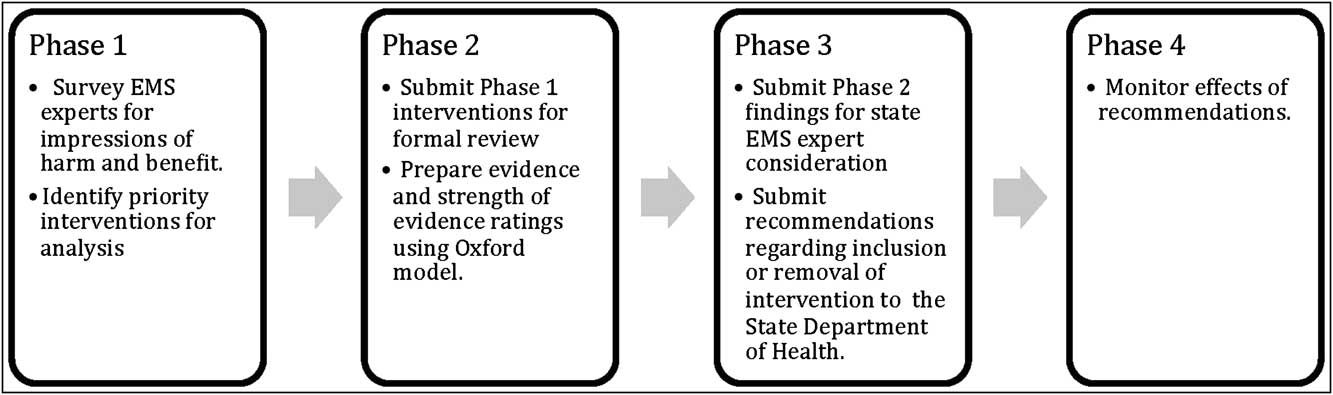
The New Mexico EMS Interventions Assessment Project will systematically review the scope using a formalized process including literature review, strength of evidence determinations and expert panel assessment. This process is outlined in Figure 1. This first report describes the evaluative process and reports results from Phase One of the project, which identified interventions in the New Mexico EMS scope of practice that are the highest priority for further review.
The New Mexico EMS Interventions Assessment Project Formalized Process

Methods
Statement of Purpose
Phase One of the project, described in this report, involved identifying priority interventions for review. New Mexico's EMS scope of practice includes >300 specific interventions at four levels of licensure (First Responder, Emergency Medical Technician (EMT), EMT-Intermediate, Paramedic). Basic interventions such as wound dressing and patient packaging were felt to be simple enough to not merit further assessment. The goal of this preliminary study was to arrive at a list of 20-30 high priority interventions that will be the first interventions to undergo evidence-based analysis. High priority interventions were identified as those in which the potential harm exceeded their potential benefit (a ratio of harm/benefit greater than one) and interventions with high levels of potential harm. The authors relied on a national panel of EMS experts to rate the potential harm and benefit of New Mexico's EMS interventions.
Study Design and Population
A Web-based survey based on the 2010 New Mexico EMS Scope of Practice statute was administered from March through June, 2011. Individuals eligible to participate in this study were either State EMS medical directors (identified from a list supplied by The National Association of State EMS Officials, NASEMSO) or EMS Fellowship Directors (identified by the Society for Academic Emergency Medicine). 15 Based upon these criteria, 104 respondents were identified as potential participants. These experts were invited to respond to two surveys randomly selected from the five online surveys; four surveys corresponded to each level of EMS licensure and a fifth corresponded to the paramedic inter-facility transfer scope of practice. Individual invitation emails were generated with links to the two electronic surveys. Participants were asked to respond to two surveys to increase the diversity of responses.
Survey Content and Administration
One investigator (MDM) abstracted all interventions into a spreadsheet format, and assigned an individual code to each intervention by licensure level. The surveys included 19 First Responder, 39 EMT-Basic, 59 EMT-Intermediate, 67 EMT-Paramedic and 28 Inter-facility EMT-Paramedic interventions. Of the over 300 interventions in the state scope of practice, 212 were included in the surveys. The remaining interventions were felt to be sufficiently simple or noninvasive to be excluded. These included simple interventions such as bandaging and oral suctioning. After one week, all EMS experts received a follow-up email encouraging their participation. Data were collected anonymously. The University of New Mexico Human Research Protections Office ruled the study exempt from review.
Survey Items
The survey included demographic questions regarding respondent experience. Respondents were asked to rate the potential harm and the potential benefit of specific EMS interventions on a 5-point ordinal scale. Respondents were asked to consider the EMS skill level to which the skills pertain and to assume an EMS practitioner of average ability and competence. Respondents were asked to assume non-perfect/typical EMS use of an intervention when considering risk and benefit. Questions regarding potential benefit were coded such that a 0 represented “not at all beneficial” and a 4 represented “extremely beneficial.” Similarly, questions regarding potential harm were coded such that 0 represented “not harmful” and 4 represented “extremely harmful.” Questions about harm and benefit were presented on separate pages of the instrument to avoid possible confusion.
Data Collection and Statistical Processing
Data analysis consisted of descriptive analyses of each individual question, and matrix analysis to identify interventions rated as both high in potential harm and low in potential benefit. Descriptive data included median (and quartile) and mode for each question, response counts, and graphs of frequency distributions. Subsets of interventions were generated where (1) the harm to benefit ratio was >1.0; and (2) the harm median score was ≥ 3.
Results
Eighty-eight (88) completed surveys were received following 208 emailed invitations to 104 respondents (42% response rate). Two respondents communicated that they were no longer in their roles, and forwarded the invitations to incumbent colleagues.
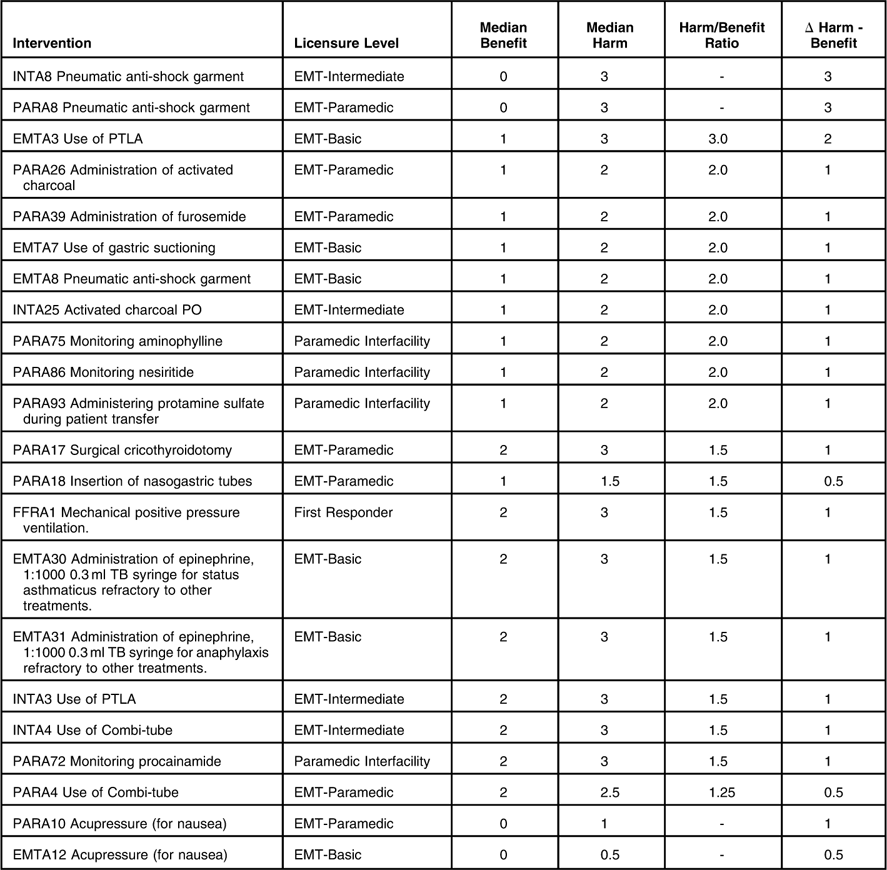
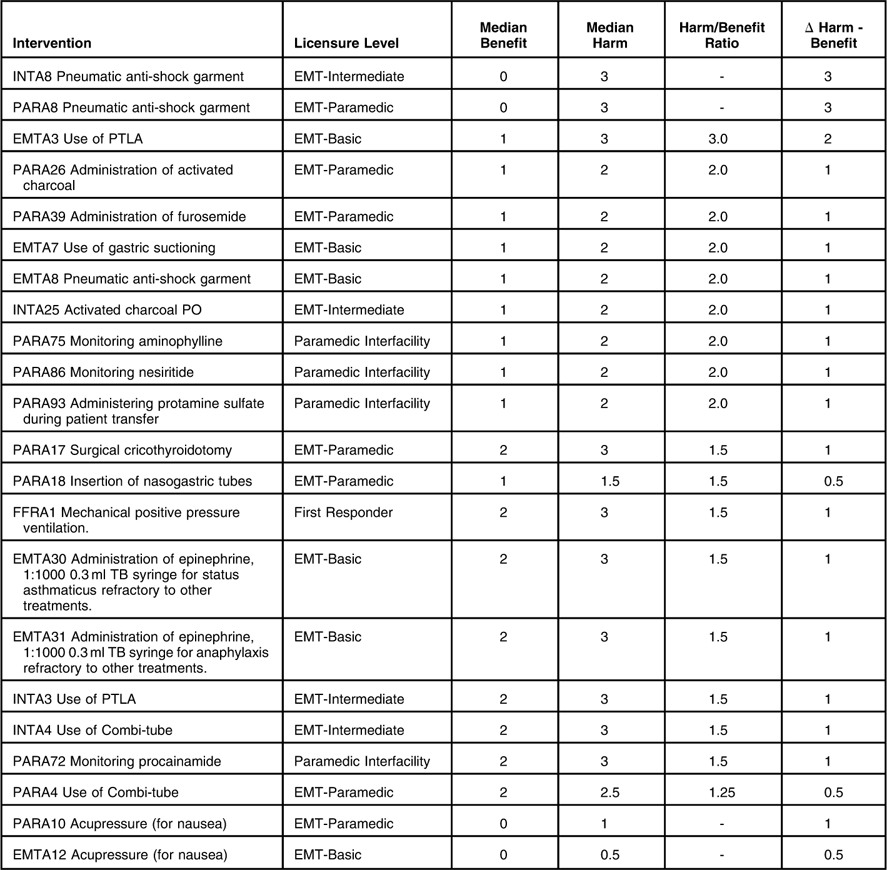
Data were non-parametrically distributed and described using medians. Median benefit and median harm scores were calculated, and harm/benefit ratios were calculated. Interventions where median harm scores exceeded median benefit scores (a harm to benefit ratio of >1) were considered first priority interventions for review. Twenty-two (22) highest-priority interventions were identified. The top five interventions with the most concerning harm/benefit ratios included the use of pneumatic anti-shock trousers at the EMT-Basic and EMT-Intermediate levels, the use of the PTLA airway, administration of activated charcoal and furosemide. These interventions are referenced in Table 1.
Subset of Interventions Where Harm/Benefit Ratio ≥ 1, Sorted by Decreasing Harm/Benefit Ratio
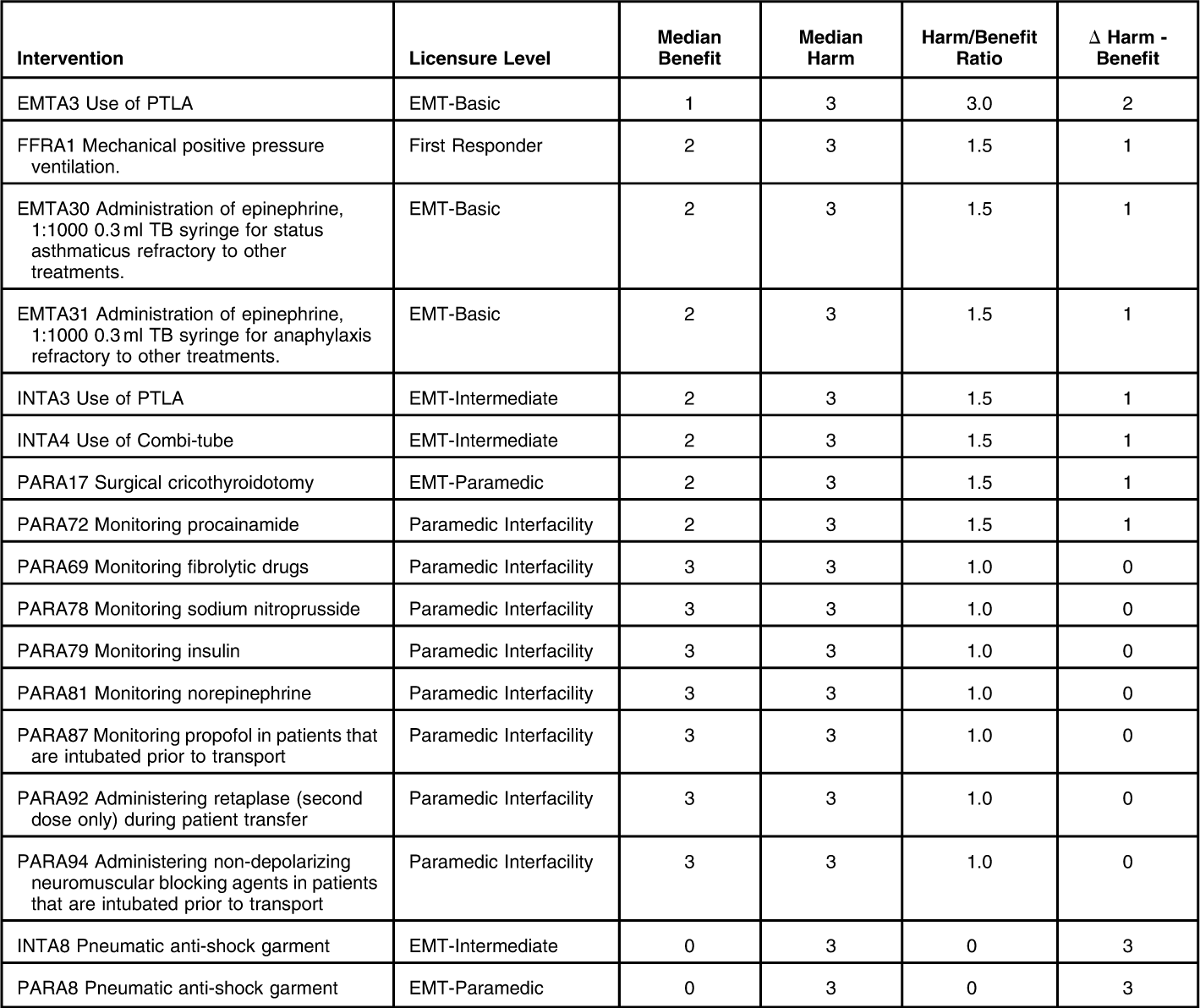
Interventions with a median potential harm rating of 3, where median benefit ratings were 3 or less were considered second-priority for review. Seventeen (17) interventions were in the subset, but only seven were interventions not also identified on the list of primary interventions based on harm/benefit ratio. These interventions are referenced on Table 2.
Subset of Interventions Where Median Harm = 3, Sorted by Decreasing Harm/Benefit Ratio

Discussion
Survey results identified 29 interventions that will be systematically assessed in a subsequent formal evidence-based review. There were a few interesting patterns to the responses. First, the list is primarily comprised of skills that are unique to New Mexico and not contained in the National EMS Scope of Practice. For example, gastric suctioning at the EMT-Basic level and acupressure are state skills with unfavorable perceived harm/benefit ratios. Other controversial therapies, such as pneumatic anti-shock trousers, the pharyngeotracheal lumen airway (PTLA) and activated charcoal administration were also identified. Respondents flagged interventions that are typically more aggressive than national standards (e.g., the manual drawing up and injection of epinephrine at an EMT-Basic level). Interestingly, prehospital intubation, a nationally contentious intervention, was not identified as a concerning intervention by survey respondents despite the introduction of newer and probably safer airway devices to EMS practice.
The New Mexico EMS Interventions Project offers a novel model for assessing a prehospital scope of practice using the literature review and expert consensus commonly used to develop clinical practice guidelines. A scope of practice generally represents the legal limits placed upon a non-physician licensed individual's performance of medical skills. Usually, the appropriate licensing body determines this scope, and in the United States, this regulation occurs primarily at the state level. This effort represents one of the first efforts to use clinical evidence to guide a scope of practice: evidence-based analysis does not appear to have been used in the development of the National EMS Scope of Practice or its predecessors, the National Highway Traffic Safety Administration (NHTSA)-sponsored National EMS Core Content and the American Board of Emergency Medicine's Model of Clinical Practice of Emergency Medicine. 16 - Reference Thomas, Beeson and Binder 17 In the next steps of this assessment project, the research team will formally assess the high-priority interventions identified in Phase One of the study. Published criteria traditionally applied to clinical guideline development will help develop these clinical questions.Reference Guyatt, Oxman and Vist 18 , Reference Guyatt, Oxman and Kunz 19
Limitations
There are several limitations to this novel process for assessing and reducing a state's EMS scope of practice. First, attempts to synthesize relevant evidence involving EMS practice is challenging owing to the fact that relatively little EMS research is available. It is likely that despite best efforts to collect evidence to support the use of interventions, many decisions will rely on expert consensus.
Another concern is that this project will initially address only 29 of the over 300 interventions in the state scope of practice. Over time, the process will be used to systematically review the remaining interventions, but this may take years. The project will initially serve as a “weeding out” of existing interventions, and will not capture best practices absent from the state's scope; informally, the authors believe that there are few well-supported EMS interventions not yet in the scope of practice. Going forward, should this method of scope of practice validation prove to be successful, it would be applied to promising interventions prior to their inclusion in upcoming revisions of the scope of practice.
Finally, a 42% response to the survey is suboptimal. Despite reminders, the response was limited due to the large time commitment needed to respond regarding multiple interventions. It is reassuring that those interventions identified by the respondents as potentially concerning generally corresponded with internal opinion among the study authors. In addition, survey ratings of most interventions were consistent among respondents.
Conclusions
The New Mexico EMS Interventions Assessment Project offers a novel, utilitarian model for reviewing one state's EMS scope of practice. This model assesses interventions by quantifying their potential benefit and potential harm, followed by formal review similar to a clinical guideline development process. Phase One of this project identified 29 EMS interventions that will be advanced to the second phase of the project for formal literature review.
This project can guide other states wishing to perform formal reviews of their own EMS scopes of practice. As medical knowledge increases at a rapid pace, periodic review of health worker scopes of practice are necessary and well-advised.
Abbreviations
- ED:
-
emergency department
- EMS:
-
emergency medical services
- EMT:
-
emergency medical technician
- LMA:
-
laryngeal mask airway
- PTLA:
-
pharyngeal-tracheal lumen airway
Acknowledgements
The authors wish to thank the EMS experts who donated their time to complete the online scope of practice survey.