Multidrug-resistant organisms (MDROs) are increasingly common in healthcare settings; they are associated with considerable morbidity, mortality, and costs. This growing crisis in antimicrobial resistance has prompted increased attention on infection control efforts to reduce transmission in healthcare settings. Infection control measures are typically implemented as bundles of enhanced surveillance, education, hand hygiene, personal protective equipment, and environmental controls (eg, single-patient rooms and room disinfection). One such method of reducing transmission is cohorting, which is often employed when routine measures fail to control an outbreak.
Cohorting is the practice of grouping together patients who are colonized or infected with the same organism to confine their care to 1 area to prevent contact with other susceptible patients.Reference Siegel, Rhinehart, Jackson and Chiarello1 It has been used extensively for managing outbreaks of multidrug-resistant organisms (MDRO) including methicillin-resistant Staphylococcus aureus (MRSA),Reference Haley, Cushion and Tenover2,Reference Murray-Leisure, Geib and Graceley3 vancomycin-resistant Enterococcus (VRE),Reference Jochimsen, Fish and Manning4,Reference Sample, Gravel, Oxley, Toye, Garber and Ramotar5 Clostridioides difficile infection (CDI),Reference Garcia-Lecona, Garza-Gonzalez and Padilla-Orozco6 extended-spectrum β-lactamase (ESBL)–producing organisms,Reference Podnos, Cinat, Wilson, Cooke, Gornick and Thrupp7 and carbapenem-resistant Enterobacteriaceae (CRE).Reference Rosenberger, Hranjec and Politano8–Reference Viale, Tumietto and Giannella10 Cohorting has also been used to contain viral outbreaks such as respiratory syncytial virus among childrenReference Doherty, Brookfield, Gray and McEwan11,Reference Hall, Geiman, Douglas and Meagher12 and severe acute respiratory syndrome (SARS).Reference Tan, Chow and Tan13 Staff cohorting, or assigning healthcare personnel to care only for patients infected or colonized with a single target pathogen, limits further transmission of the target pathogen to uninfected patients.14,Reference Austin, Bonten, Weinstein, Slaughter and Anderson15 However, cohorting, particularly of staff, is usually costly and difficult to maintain due to staff shortages in hospitals.Reference Needleman, Buerhaus, Mattke, Stewart and Zelevinsky16
A comprehensive evaluation of patient and staff cohorting as a prevention approach is lacking. We performed a systematic review to determine its effectiveness as an infection control strategy.
Methods
This systematic review was conducted and is reported according to the Preferred Reporting Items for Systematic Reviews and Meta-Analyses (PRISMA) guidelines.Reference Shamseer, Moher and Clarke17
Study criteria
We included studies published between 1966 and November 30, 2019, on adult populations hospitalized in acute-care hospitals. We only included studies that reported use of patient and/or staff cohorting as part of an infection control intervention and that included outcome data reported either as absolute number of colonizations and/or infections or rate of colonizations and/or infection. Studies involving the pediatric population and studies performed in long-term acute-care facilities or nursing homes were excluded.
Search methods
With the help of a professional librarian, we searched MEDLINE, EMBASE (OvidSP), from inception through November 30, 2019. We used medical subject headings (MeSH) and terms for cohorting and multidrug-resistant organisms (eg, VRE, MRSA, ESBL, CRE) or C. difficile. Reference lists of included studies and studies cited in previous reviews were screened. Furthermore, 2 independent reviewers (C.L.A. and N.S.) performed abstract screenings and full-text reviews. Reviewers were not blinded for author, institution, or journal names. Language was restricted to English.
Data abstraction and management
The following data were abstracted: study design, country, study year(s), type of hospital and/or setting, type of infection, description of infection control interventions and outcomes. We defined cohorting as a grouping together or segregation of patients colonized or infected with the same organism in 1 area of a unit (eg, geographic) or in a specially built or separate unit entirely. Cohorting could involve patients or both patients and staff. Data were extracted by author C.L.A., and discrepancies were resolved by consensus between 2 authors (C.L.A. and N.S.).
Quality and bias assessment
We used the Downs and Black Checklist for Measuring Quality,Reference Downs and Black18 which has 27 items for evaluating the following parameters: reporting, internal and external validity, confounding, and power. The maximum score is 28. The risk of bias was independently assessed by 2 reviewers (A.B. and C.L.A.) without blinding to the journal or study authorship. Discrepancies were resolved by discussion or involvement of a third review author (N.S.) when needed.
Outcomes
The primary outcome was rate of colonization or hospital-acquired infection (HAI). Acceptable definitions were incidence rates or incidence density (eg, number of colonizations or HAIs per 1,000 patient days), absolute number of colonizations per infections, or risk ratio. Secondary outcomes included compliance with infection control intervention(s) and adverse events.
Data synthesis
We considered a formal meta-analysis inappropriate because of heterogeneity in outcome measures and patient populations.
Results
We searched the PUBMED and EMBASE databases, yielding a total of 2,356 articles. Title and abstracts were screened, and 159 articles were retrieved for review. The references of these 159 articles were evaluated, which yielded 19 additional papers. After careful review, 87 studies met inclusion criteria (Fig. 1).Reference Murray-Leisure, Geib and Graceley3–Reference Rosenberger, Hranjec and Politano8,Reference Viale, Tumietto and Giannella10,Reference Alfandari, Gois and Delannoy19–Reference Gregory, Llata and Stine98 The full search strategy is provided in Supplementary Appendix 1 (online).
Cohorting diagram.

Characteristics of included studies
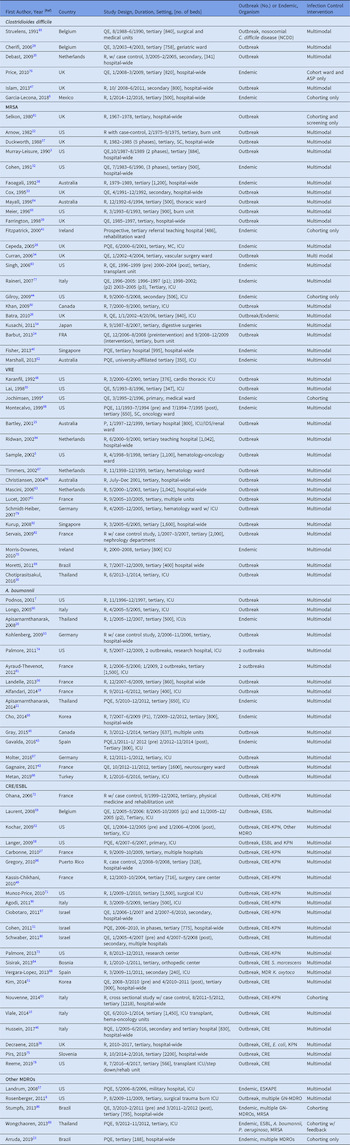
Among the 87 included studies, there were no randomized controlled trials. Most were retrospective studies (n = 49) or quasi-experimental “before and after” studies (n = 35).Reference Murray-Leisure, Geib and Graceley3,Reference Jochimsen, Fish and Manning4,Reference Viale, Tumietto and Giannella10,Reference Apisarnthanarak, Pinitchai, Thongphubeth, Yuekyen, Warren and Fraser20,Reference Apisarnthanarak, Pinitchai, Warachan, Warren, Khawcharoenporn and Hayden21,Reference Arruda, de Aguiar and Jardim23,Reference Barbut, Yezli, Mimoun, Pham, Chaouat and Otter24,Reference Batra, Cooper, Whiteley, Patel, Wyncoll and Edgeworth26,Reference Cepeda, Whitehouse and Cooper28,Reference Cherifi, Delmee, Van Broeck, Beyer, Byl and Mascart29,Reference Cohen, Block and Levin31–Reference Curran, Hamilton, Monaghan, McGinlay and Thakker34,Reference Faoagali, Thong and Grant38,Reference Fisher, Tambyah and Lin40,Reference Gagnaire, Gagneux-Brunon and Pouvaret42,Reference Gavalda, Soriano and Camara43,Reference Hussein, Rabino and Eluk46,Reference Kim, Han and Song51,Reference Kochar, Sheard and Sharma52,Reference Lai, Kelley, Melvin, Belliveau and Fontecchio55,Reference Landrum and Murray57–Reference Laurent, Rodriguez-Villalobos and Rost59,Reference Marshall, Richards and McBryde62,Reference Montecalvo, Jarvis and Uman68,Reference Price, Cheek and Lippett76,Reference Raineri, Crema and De Silvestri77,Reference Schwaber, Lev and Israeli80,Reference Singh, Squier, Wannstedt, Keyes, Wagener and Cacciarelli83,Reference Struelens, Maas and Nonhoff85,Reference Stumpfs, de Souza and Konkewicz86,Reference Wongcharoen, Luxamesathaporn, Khawcharoenporn, Rujanavech, Warren and Apisarnthanarak89,Reference Ciobotaro, Oved, Nadir, Bardenstein and Zimhony97 The remaining 3 were prospective studies.Reference Rosenberger, Hranjec and Politano8,Reference Bartley, Schooneveldt, Looke, Morton, Johnson and Nimmo25,Reference Fitzpatrick, Murphy, Brady, Prout and Fenelon41 Case-control analysis was done in 7 studies.Reference Arnow, Allyn, Nichols, Hill, Pezzlo and Bartlett22,Reference Debast, Vaessen, Choudry, Wiegers-Ligtvoet, van den Berg and Kuijper35,Reference Kohlenberg, Brummer and Higgins53,Reference Ohana, Denys and Guillemot72,Reference Servais, Mercadal and Brossier82,Reference Nouvenne, Ticinesi and Lauretani93,Reference Gregory, Llata and Stine98 Most were performed in tertiary-care hospitals (n = 75), followed by secondary (n = 7),Reference Cox, Conquest, Mallaghan and Marples33,Reference Debast, Vaessen, Choudry, Wiegers-Ligtvoet, van den Berg and Kuijper35,Reference Gilroy, Miller Stahl and Noonan44,Reference Islam, Cheek, Navani, Rajkumar, Cohen and Llewelyn47,Reference Schwaber, Lev and Israeli80,Reference Vergara-Lopez, Dominguez, Conejo, Pascual and Rodriguez-Bano88,Reference Ciobotaro, Oved, Nadir, Bardenstein and Zimhony97 primary (n = 2),Reference Jochimsen, Fish and Manning4,Reference Langer, Lafaro, Genese, McDonough, Nahass and Robertson58 and specialty hospitals (n = 3; eg, military hospital or research institute).Reference Landrum and Murray57,Reference Palmore and Henderson73,Reference Palmore, Michelin and Bordner74 Furthermore, 29 studies were carried out in the ICUReference Podnos, Cinat, Wilson, Cooke, Gornick and Thrupp7,Reference Rosenberger, Hranjec and Politano8,Reference Alfandari, Gois and Delannoy19–Reference Apisarnthanarak, Pinitchai, Warachan, Warren, Khawcharoenporn and Hayden21,Reference Batra, Cooper, Whiteley, Patel, Wyncoll and Edgeworth26,Reference Cepeda, Whitehouse and Cooper28,Reference Chotiprasitsakul, Santanirand and Thitichai30,Reference Gavalda, Soriano and Camara43,Reference Gilroy, Miller Stahl and Noonan44,Reference Karanfil, Murphy and Josephson48,Reference Khan, Lampitoc, Salaripour, McKernan, Devlin and Muller50,Reference Kochar, Sheard and Sharma52,Reference Lai, Kelley, Melvin, Belliveau and Fontecchio55,Reference Landrum and Murray57–Reference Longo, Pantosti and Luzzi60,Reference Marshall, Richards and McBryde62,Reference Metan, Zarakolu and Otlu66,Reference Molter, Seifert and Mandraka67,Reference Morris-Downes, Smyth and Moore70,Reference Munoz-Price, De La Cuesta and Adams71,Reference Palmore, Michelin and Bordner74,Reference Raineri, Crema and De Silvestri77,Reference Vergara-Lopez, Dominguez, Conejo, Pascual and Rodriguez-Bano88–Reference Ayraud-Thevenot, Huart and Mimoz91 ; 19 studies were conducted in wardsReference Jochimsen, Fish and Manning4,Reference Sample, Gravel, Oxley, Toye, Garber and Ramotar5,Reference Cherifi, Delmee, Van Broeck, Beyer, Byl and Mascart29,Reference Curran, Hamilton, Monaghan, McGinlay and Thakker34,Reference Fitzpatrick, Murphy, Brady, Prout and Fenelon41,Reference Gagnaire, Gagneux-Brunon and Pouvaret42,Reference Mayall, Martin, Keenan, Irving, Leeson and Lamb64,Reference Montecalvo, Jarvis and Uman68,Reference Ohana, Denys and Guillemot72,Reference Servais, Mercadal and Brossier82,Reference Struelens, Maas and Nonhoff85,Reference Timmers, van der Zwet and Simoons-Smit87 or specialty areasReference Arnow, Allyn, Nichols, Hill, Pezzlo and Bartlett22,Reference Barbut, Yezli, Mimoun, Pham, Chaouat and Otter24,Reference Kassis-Chikhani, Saliba and Carbonne49,Reference Kusachi, Nagao and Saida54,Reference Meier, Carter, Wallace, Hollis, Pfaller and Herwaldt65,Reference Singh, Squier, Wannstedt, Keyes, Wagener and Cacciarelli83,Reference Sisirak and Hukic84 ; and 39 studies involved multiple units or were conducted hospital-wide.Reference Murray-Leisure, Geib and Graceley3,Reference Garcia-Lecona, Garza-Gonzalez and Padilla-Orozco6,Reference Viale, Tumietto and Giannella10,Reference Arruda, de Aguiar and Jardim23,Reference Bartley, Schooneveldt, Looke, Morton, Johnson and Nimmo25,Reference Carbonne, Thiolet and Fournier27,Reference Cohen, Block and Levin31–Reference Cox, Conquest, Mallaghan and Marples33,Reference Debast, Vaessen, Choudry, Wiegers-Ligtvoet, van den Berg and Kuijper35–Reference Fisher, Tambyah and Lin40,Reference Gray, Allard and Pare45–Reference Islam, Cheek, Navani, Rajkumar, Cohen and Llewelyn47,Reference Kim, Han and Song51,Reference Kohlenberg, Brummer and Higgins53,Reference Landelle, Legrand and Lesprit56,Reference Lucet, Armand-Lefevre and Laurichesse61,Reference Mascini, Troelstra and Beitsma63,Reference Moretti, de Oliveira Cardoso and Levy69,Reference Palmore and Henderson73,Reference Pirs, Cerar Kisek and Krizan Hergouth75,Reference Price, Cheek and Lippett76,Reference Reeme, Bowler and Buchan78–Reference Selkon, Stokes and Ingham81,Reference Stumpfs, de Souza and Konkewicz86,Reference Kurup, Chlebicki and Ling92–Reference Gregory, Llata and Stine98 Most studies (65 of 87, 74.7%) were performed in the setting of an outbreak,Reference Jochimsen, Fish and Manning4,Reference Garcia-Lecona, Garza-Gonzalez and Padilla-Orozco6,Reference Viale, Tumietto and Giannella10,Reference Apisarnthanarak, Pinitchai, Thongphubeth, Yuekyen, Warren and Fraser20,Reference Apisarnthanarak, Pinitchai, Warachan, Warren, Khawcharoenporn and Hayden21,Reference Arruda, de Aguiar and Jardim23,Reference Cepeda, Whitehouse and Cooper28,Reference Cohen, Morita and Bradford32,Reference Faoagali, Thong and Grant38,Reference Fisher, Tambyah and Lin40,Reference Fitzpatrick, Murphy, Brady, Prout and Fenelon41,Reference Gavalda, Soriano and Camara43,Reference Gilroy, Miller Stahl and Noonan44,Reference Kusachi, Nagao and Saida54,Reference Landrum and Murray57,Reference Marshall, Richards and McBryde62,Reference Montecalvo, Jarvis and Uman68,Reference Morris-Downes, Smyth and Moore70,Reference Palmore and Henderson73,Reference Pirs, Cerar Kisek and Krizan Hergouth75–Reference Selkon, Stokes and Ingham81,Reference Singh, Squier, Wannstedt, Keyes, Wagener and Cacciarelli83,Reference Stumpfs, de Souza and Konkewicz86,Reference Wongcharoen, Luxamesathaporn, Khawcharoenporn, Rujanavech, Warren and Apisarnthanarak89,Reference Nouvenne, Ticinesi and Lauretani93–Reference Cho, Bak, Baek, Park, Kim and Bae95 and the rest were not. Most focused on specific pathogens, including MRSA (n = 22),Reference Murray-Leisure, Geib and Graceley3,Reference Arnow, Allyn, Nichols, Hill, Pezzlo and Bartlett22,Reference Barbut, Yezli, Mimoun, Pham, Chaouat and Otter24,Reference Batra, Cooper, Whiteley, Patel, Wyncoll and Edgeworth26,Reference Cepeda, Whitehouse and Cooper28,Reference Cohen, Morita and Bradford32–Reference Curran, Hamilton, Monaghan, McGinlay and Thakker34,Reference Duckworth, Lothian and Williams37–Reference Fitzpatrick, Murphy, Brady, Prout and Fenelon41,Reference Gilroy, Miller Stahl and Noonan44,Reference Khan, Lampitoc, Salaripour, McKernan, Devlin and Muller50,Reference Kusachi, Nagao and Saida54,Reference Marshall, Richards and McBryde62,Reference Mayall, Martin, Keenan, Irving, Leeson and Lamb64,Reference Meier, Carter, Wallace, Hollis, Pfaller and Herwaldt65,Reference Raineri, Crema and De Silvestri77,Reference Selkon, Stokes and Ingham81,Reference Singh, Squier, Wannstedt, Keyes, Wagener and Cacciarelli83 VRE (n = 17),Reference Jochimsen, Fish and Manning4,Reference Sample, Gravel, Oxley, Toye, Garber and Ramotar5,Reference Bartley, Schooneveldt, Looke, Morton, Johnson and Nimmo25,Reference Chotiprasitsakul, Santanirand and Thitichai30,Reference Karanfil, Murphy and Josephson48,Reference Lai, Kelley, Melvin, Belliveau and Fontecchio55,Reference Lucet, Armand-Lefevre and Laurichesse61,Reference Mascini, Troelstra and Beitsma63,Reference Montecalvo, Jarvis and Uman68–Reference Morris-Downes, Smyth and Moore70,Reference Schmidt-Hieber, Blau and Schwartz79,Reference Servais, Mercadal and Brossier82,Reference Timmers, van der Zwet and Simoons-Smit87,Reference Kurup, Chlebicki and Ling92,Reference Ridwan, Mascini, van Der Reijden, Verhoef and Bonten94,Reference Christiansen, Tibbett and Beresford96 Clostridioides difficile (n = 6),Reference Garcia-Lecona, Garza-Gonzalez and Padilla-Orozco6,Reference Cherifi, Delmee, Van Broeck, Beyer, Byl and Mascart29,Reference Debast, Vaessen, Choudry, Wiegers-Ligtvoet, van den Berg and Kuijper35,Reference Islam, Cheek, Navani, Rajkumar, Cohen and Llewelyn47,Reference Price, Cheek and Lippett76,Reference Struelens, Maas and Nonhoff85 extended-spectrum β-lactamase–producing organisms (ESBLs) or carbapenem-resistant Enterobacteriaceae (CRE) (n = 22),Reference Viale, Tumietto and Giannella10,Reference Carbonne, Thiolet and Fournier27,Reference Cohen, Block and Levin31,Reference Decraene, Phan and George36,Reference Hussein, Rabino and Eluk46,Reference Kassis-Chikhani, Saliba and Carbonne49,Reference Kim, Han and Song51,Reference Kochar, Sheard and Sharma52,Reference Langer, Lafaro, Genese, McDonough, Nahass and Robertson58,Reference Laurent, Rodriguez-Villalobos and Rost59,Reference Munoz-Price, De La Cuesta and Adams71–Reference Palmore and Henderson73,Reference Pirs, Cerar Kisek and Krizan Hergouth75,Reference Reeme, Bowler and Buchan78,Reference Schwaber, Lev and Israeli80,Reference Sisirak and Hukic84,Reference Vergara-Lopez, Dominguez, Conejo, Pascual and Rodriguez-Bano88,Reference Agodi, Voulgari and Barchitta90,Reference Nouvenne, Ticinesi and Lauretani93,Reference Ciobotaro, Oved, Nadir, Bardenstein and Zimhony97,Reference Gregory, Llata and Stine98 and multidrug-resistant Acinetobacter baumanni (MDR-Abau; n = 15).Reference Podnos, Cinat, Wilson, Cooke, Gornick and Thrupp7,Reference Alfandari, Gois and Delannoy19–Reference Apisarnthanarak, Pinitchai, Warachan, Warren, Khawcharoenporn and Hayden21,Reference Gagnaire, Gagneux-Brunon and Pouvaret42,Reference Gavalda, Soriano and Camara43,Reference Gray, Allard and Pare45,Reference Kohlenberg, Brummer and Higgins53,Reference Landelle, Legrand and Lesprit56,Reference Longo, Pantosti and Luzzi60,Reference Metan, Zarakolu and Otlu66,Reference Molter, Seifert and Mandraka67,Reference Palmore, Michelin and Bordner74,Reference Ayraud-Thevenot, Huart and Mimoz91,Reference Cho, Bak, Baek, Park, Kim and Bae95 A few studies (n = 5)Reference Rosenberger, Hranjec and Politano8,Reference Arruda, de Aguiar and Jardim23,Reference Landrum and Murray57,Reference Wongcharoen, Luxamesathaporn, Khawcharoenporn, Rujanavech, Warren and Apisarnthanarak89,Reference Landelle, Pagani and Harbarth99 investigated multiple MDR organisms (MDROs). A summary of study findings is provided in Table 1, and the characteristics of included studies are listed in Table 2.
Summary of Study Findings

Note. MRSA, methicillin-resistant Staphylococcus aureus; CRE, carbapenem-resistant Enterobacteriaceae; ESBL, extended-spectrum β-lactamase; VRE, vancomycin-resistant Enterococcus.
a For example, multiple gram-negative organisms.
b Total not 87, as 2 studies did both.
c Colonization or infection.
Summary of Included Studies

Note. QE, quasi-experimental; R, retrospective; PQE, prospective quasi-experimental; CC, case-control; MC, multicenter; ICU, intensive care unit; CDI, C. difficile infection; CRE, carbapenem-resistant Enterobacteriaceae; CR-KPN, carbapenem-resistant Klebsiella pneumoniae; MRSA, methicillin-resistant Staphylococcus aureus, Abau, A. baumannii,; ESBL, extended-spectrum β-lactamase; GN, gram-negative; MDRO, multidrug-resistant organism; ESKAP, E. coli/Staphylococcus/KPN/Abau/Pseudomonas aeruginosa; VRE, vancomycin-resistant Enterococcus.
Study quality and bias assessment
Our average study score was 14.9 (range, 12–22) points. Studies scored highly on external validity but poorly on power (Supplementary Appendix 2 online).
Description of cohorting
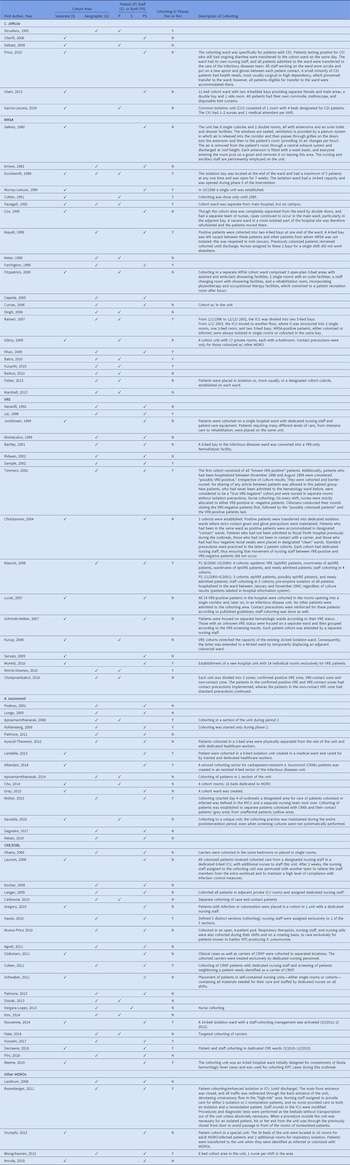
Cohorting was performed in the setting of other infection control interventions, either maintained throughout the duration of the interventions (56 of 87, 64.4 %) or limited to certain phases (31 of 87, 35.6%).Reference Murray-Leisure, Geib and Graceley3,Reference Sample, Gravel, Oxley, Toye, Garber and Ramotar5,Reference Rosenberger, Hranjec and Politano8,Reference Alfandari, Gois and Delannoy19,Reference Apisarnthanarak, Pinitchai, Thongphubeth, Yuekyen, Warren and Fraser20,Reference Batra, Cooper, Whiteley, Patel, Wyncoll and Edgeworth26,Reference Cepeda, Whitehouse and Cooper28,Reference Cohen, Block and Levin31,Reference Cohen, Morita and Bradford32,Reference Decraene, Phan and George36–Reference Farrington, Redpath, Trundle, Coomber and Brown39,Reference Hussein, Rabino and Eluk46,Reference Kassis-Chikhani, Saliba and Carbonne49,Reference Khan, Lampitoc, Salaripour, McKernan, Devlin and Muller50,Reference Kohlenberg, Brummer and Higgins53–Reference Landelle, Legrand and Lesprit56,Reference Mascini, Troelstra and Beitsma63,Reference Mayall, Martin, Keenan, Irving, Leeson and Lamb64,Reference Molter, Seifert and Mandraka67,Reference Moretti, de Oliveira Cardoso and Levy69,Reference Morris-Downes, Smyth and Moore70,Reference Raineri, Crema and De Silvestri77,Reference Reeme, Bowler and Buchan78,Reference Struelens, Maas and Nonhoff85,Reference Timmers, van der Zwet and Simoons-Smit87,Reference Wongcharoen, Luxamesathaporn, Khawcharoenporn, Rujanavech, Warren and Apisarnthanarak89,Reference Nouvenne, Ticinesi and Lauretani93 In 55 of the 87 included studies (63%), cohorting was described as the physical separation of patients within a section of a unit. In 34 studies (39%), a dedicated area or ward was created for patients,Reference Murray-Leisure, Geib and Graceley3,Reference Jochimsen, Fish and Manning4,Reference Garcia-Lecona, Garza-Gonzalez and Padilla-Orozco6,Reference Alfandari, Gois and Delannoy19,Reference Arruda, de Aguiar and Jardim23,Reference Cherifi, Delmee, Van Broeck, Beyer, Byl and Mascart29,Reference Cohen, Morita and Bradford32,Reference Cox, Conquest, Mallaghan and Marples33,Reference Debast, Vaessen, Choudry, Wiegers-Ligtvoet, van den Berg and Kuijper35–Reference Faoagali, Thong and Grant38,Reference Fitzpatrick, Murphy, Brady, Prout and Fenelon41,Reference Gavalda, Soriano and Camara43–Reference Gray, Allard and Pare45,Reference Islam, Cheek, Navani, Rajkumar, Cohen and Llewelyn47,Reference Laurent, Rodriguez-Villalobos and Rost59,Reference Lucet, Armand-Lefevre and Laurichesse61,Reference Moretti, de Oliveira Cardoso and Levy69,Reference Price, Cheek and Lippett76,Reference Reeme, Bowler and Buchan78–Reference Servais, Mercadal and Brossier82,Reference Stumpfs, de Souza and Konkewicz86,Reference Kurup, Chlebicki and Ling92,Reference Nouvenne, Ticinesi and Lauretani93,Reference Cho, Bak, Baek, Park, Kim and Bae95–Reference Landelle, Pagani and Harbarth99 and 2 studies did both.Reference Duckworth, Lothian and Williams37,Reference Faoagali, Thong and Grant38 In 60 studies (68.9%), both patients and staff were cohorted, while in the remaining 27 studies (31.0%), patients were cohorted alone.Reference Garcia-Lecona, Garza-Gonzalez and Padilla-Orozco6,Reference Viale, Tumietto and Giannella10,Reference Apisarnthanarak, Pinitchai, Thongphubeth, Yuekyen, Warren and Fraser20,Reference Apisarnthanarak, Pinitchai, Warachan, Warren, Khawcharoenporn and Hayden21,Reference Barbut, Yezli, Mimoun, Pham, Chaouat and Otter24,Reference Batra, Cooper, Whiteley, Patel, Wyncoll and Edgeworth26,Reference Chotiprasitsakul, Santanirand and Thitichai30,Reference Cohen, Morita and Bradford32,Reference Debast, Vaessen, Choudry, Wiegers-Ligtvoet, van den Berg and Kuijper35,Reference Duckworth, Lothian and Williams37,Reference Faoagali, Thong and Grant38,Reference Fisher, Tambyah and Lin40,Reference Fitzpatrick, Murphy, Brady, Prout and Fenelon41,Reference Gavalda, Soriano and Camara43,Reference Gilroy, Miller Stahl and Noonan44,Reference Kim, Han and Song51,Reference Kusachi, Nagao and Saida54,Reference Marshall, Richards and McBryde62,Reference Meier, Carter, Wallace, Hollis, Pfaller and Herwaldt65,Reference Morris-Downes, Smyth and Moore70,Reference Raineri, Crema and De Silvestri77,Reference Singh, Squier, Wannstedt, Keyes, Wagener and Cacciarelli83–Reference Struelens, Maas and Nonhoff85,Reference Wongcharoen, Luxamesathaporn, Khawcharoenporn, Rujanavech, Warren and Apisarnthanarak89,Reference Kurup, Chlebicki and Ling92,Reference Cho, Bak, Baek, Park, Kim and Bae95 Potential adverse effects from cohorting were discussed in 12 studies.Reference Rosenberger, Hranjec and Politano8,Reference Alfandari, Gois and Delannoy19,Reference Bartley, Schooneveldt, Looke, Morton, Johnson and Nimmo25,Reference Cepeda, Whitehouse and Cooper28,Reference Cox, Conquest, Mallaghan and Marples33,Reference Curran, Hamilton, Monaghan, McGinlay and Thakker34,Reference Gilroy, Miller Stahl and Noonan44,Reference Laurent, Rodriguez-Villalobos and Rost59,Reference Lucet, Armand-Lefevre and Laurichesse61,Reference Reeme, Bowler and Buchan78,Reference Stumpfs, de Souza and Konkewicz86,Reference Wongcharoen, Luxamesathaporn, Khawcharoenporn, Rujanavech, Warren and Apisarnthanarak89 These adverse effects included increased anxiety or feeling of isolation,Reference Cepeda, Whitehouse and Cooper28,Reference Curran, Hamilton, Monaghan, McGinlay and Thakker34 increased workload for the healthcare team,Reference Lucet, Armand-Lefevre and Laurichesse61,Reference Reeme, Bowler and Buchan78 higher cost,Reference Alfandari, Gois and Delannoy19,Reference Cox, Conquest, Mallaghan and Marples33 disruption of patient care,Reference Laurent, Rodriguez-Villalobos and Rost59,Reference Lucet, Armand-Lefevre and Laurichesse61 potentially less time spent with the healthcare team,Reference Cepeda, Whitehouse and Cooper28 increase in other MDROs,Reference Bartley, Schooneveldt, Looke, Morton, Johnson and Nimmo25 or no adverse effects.Reference Rosenberger, Hranjec and Politano8 In 1 study,Reference Stumpfs, de Souza and Konkewicz86 the researchers used surrogate markers, such as falls and pressure ulcers, to evaluate adverse events from contact precautions, and none was observed. In contrast, in 2 studies,Reference Gilroy, Miller Stahl and Noonan44,Reference Wongcharoen, Luxamesathaporn, Khawcharoenporn, Rujanavech, Warren and Apisarnthanarak89 cohorting led to increased time spent with patientsReference Wongcharoen, Luxamesathaporn, Khawcharoenporn, Rujanavech, Warren and Apisarnthanarak89 and decreased cost.Reference Gilroy, Miller Stahl and Noonan44 Descriptions of cohorting and the other interventions are provided in Table 3 and in Supplementary Appendix 3 (online), respectively.
Description of Cohorting Strategy by Pathogen

Effect of cohorting: Outcome
Clostridioides difficile infection (CDI)
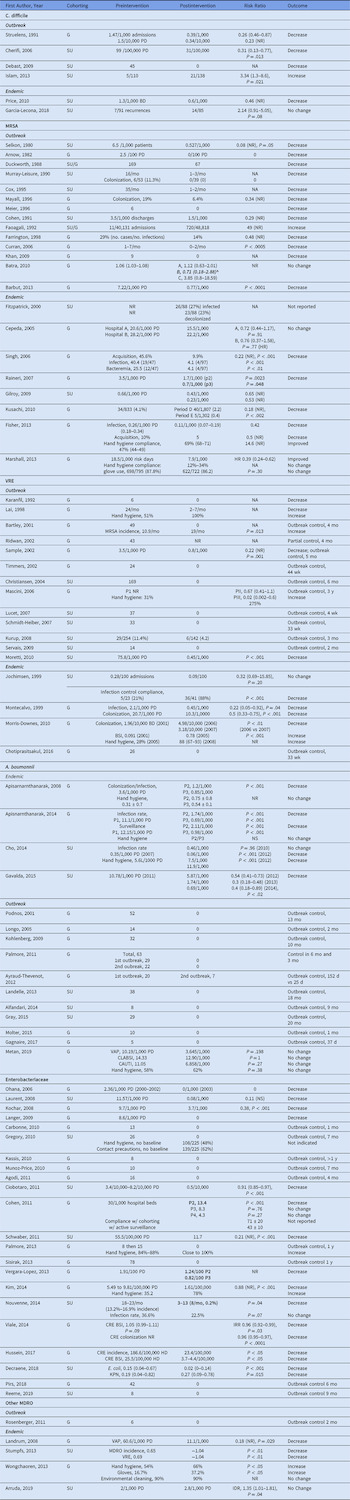
Six studies evaluated the effect of cohorting on CDI.Reference Garcia-Lecona, Garza-Gonzalez and Padilla-Orozco6,Reference Cherifi, Delmee, Van Broeck, Beyer, Byl and Mascart29,Reference Decraene, Phan and George36,Reference Islam, Cheek, Navani, Rajkumar, Cohen and Llewelyn47,Reference Price, Cheek and Lippett76,Reference Struelens, Maas and Nonhoff85 In all but 1 study,Reference Struelens, Maas and Nonhoff85 patients were cohorted in separate units from patients without CDI. Two studies were performed in hospitals where C. difficile was endemic.Reference Garcia-Lecona, Garza-Gonzalez and Padilla-Orozco6,Reference Price, Cheek and Lippett76 CDI rates or numbers decreased in 4 of 6 studies.Reference Cherifi, Delmee, Van Broeck, Beyer, Byl and Mascart29,Reference Debast, Vaessen, Choudry, Wiegers-Ligtvoet, van den Berg and Kuijper35,Reference Price, Cheek and Lippett76,Reference Struelens, Maas and Nonhoff85 In one studyReference Garcia-Lecona, Garza-Gonzalez and Padilla-Orozco6, there was no change in the number of CDI recurrences despite cohorting, while in another,Reference Islam, Cheek, Navani, Rajkumar, Cohen and Llewelyn47 cohorted patients had a higher risk of CDI recurrence, with an OR of 3.94 (IQR, 1.23–12.65; P = .021) (Table 4).
Summary of Study Outcomes by Pathogen and Endemicity

Note. PD, patient days; BD, bed days; G- geographic, SU- special or dedicated unit; NR, not reported, RR, risk ratio; IDR, incidence density ratio. P1/2/3, phase1/2/3; NR, not reported; CRE, Carbapenem-resistant Enterobacteriaceae; CLABSI, Central line associated bloodstream infection; CAUTI, Catheter associated Urinary tract infection; MRSA, Methicillin Resistant Staphylococcus Aureus; MDRO, multi drug resistant organism; VAP, ventilator associated pneumonia.
Bold data indicates cohorting intervention.
Methicillin-resistant Staphylococcus aureus (MRSA)
Overall, 22 studies included the use of cohorting to control MRSA infection.Reference Murray-Leisure, Geib and Graceley3,Reference Arnow, Allyn, Nichols, Hill, Pezzlo and Bartlett22,Reference Barbut, Yezli, Mimoun, Pham, Chaouat and Otter24,Reference Batra, Cooper, Whiteley, Patel, Wyncoll and Edgeworth26,Reference Cepeda, Whitehouse and Cooper28,Reference Cohen, Morita and Bradford32–Reference Curran, Hamilton, Monaghan, McGinlay and Thakker34,Reference Duckworth, Lothian and Williams37–Reference Fitzpatrick, Murphy, Brady, Prout and Fenelon41,Reference Gilroy, Miller Stahl and Noonan44,Reference Khan, Lampitoc, Salaripour, McKernan, Devlin and Muller50,Reference Kusachi, Nagao and Saida54,Reference Marshall, Richards and McBryde62,Reference Mayall, Martin, Keenan, Irving, Leeson and Lamb64,Reference Meier, Carter, Wallace, Hollis, Pfaller and Herwaldt65,Reference Raineri, Crema and De Silvestri77,Reference Selkon, Stokes and Ingham81,Reference Singh, Squier, Wannstedt, Keyes, Wagener and Cacciarelli83 MRSA was endemic in 10 studies.Reference Cepeda, Whitehouse and Cooper28,Reference Cohen, Morita and Bradford32,Reference Faoagali, Thong and Grant38,Reference Fisher, Tambyah and Lin40,Reference Fitzpatrick, Murphy, Brady, Prout and Fenelon41,Reference Gilroy, Miller Stahl and Noonan44,Reference Kusachi, Nagao and Saida54,Reference Marshall, Richards and McBryde62,Reference Raineri, Crema and De Silvestri77,Reference Singh, Squier, Wannstedt, Keyes, Wagener and Cacciarelli83 Cohorting was used as the major intervention in only 3 studiesReference Fitzpatrick, Murphy, Brady, Prout and Fenelon41,Reference Gilroy, Miller Stahl and Noonan44,Reference Selkon, Stokes and Ingham81 ; all other studies used multiple other interventions. Most studies showed a decrease in MRSA colonization or infection after initiation of a multifaceted strategy, although rates remained unchanged in 3 studiesReference Batra, Cooper, Whiteley, Patel, Wyncoll and Edgeworth26,Reference Cepeda, Whitehouse and Cooper28,Reference Gilroy, Miller Stahl and Noonan44 and increased in 1 study.Reference Faoagali, Thong and Grant38 In 3 studies,Reference Arnow, Allyn, Nichols, Hill, Pezzlo and Bartlett22,Reference Cox, Conquest, Mallaghan and Marples33,Reference Curran, Hamilton, Monaghan, McGinlay and Thakker34 rates of MRSA infection specifically declined after initiation of cohorting. Two studies looked at compliance with hand hygieneReference Fisher, Tambyah and Lin40,Reference Marshall, Richards and McBryde62 or the use of gloves, which did not change during the intervention period. A summary of outcomes is provided in Table 4.
Vancomycin-resistant Enterococcus (VRE)
We identified 17 that included cohorting as part of a strategy to help control VRE infection.Reference Jochimsen, Fish and Manning4,Reference Sample, Gravel, Oxley, Toye, Garber and Ramotar5,Reference Bartley, Schooneveldt, Looke, Morton, Johnson and Nimmo25,Reference Chotiprasitsakul, Santanirand and Thitichai30,Reference Karanfil, Murphy and Josephson48,Reference Lai, Kelley, Melvin, Belliveau and Fontecchio55,Reference Lucet, Armand-Lefevre and Laurichesse61,Reference Mascini, Troelstra and Beitsma63,Reference Montecalvo, Jarvis and Uman68–Reference Morris-Downes, Smyth and Moore70,Reference Schmidt-Hieber, Blau and Schwartz79,Reference Servais, Mercadal and Brossier82,Reference Timmers, van der Zwet and Simoons-Smit87,Reference Kurup, Chlebicki and Ling92,Reference Ridwan, Mascini, van Der Reijden, Verhoef and Bonten94,Reference Christiansen, Tibbett and Beresford96 All but 3 studiesReference Jochimsen, Fish and Manning4,Reference Montecalvo, Jarvis and Uman68,Reference Morris-Downes, Smyth and Moore70 were performed in the setting of a VRE outbreak. There was a significant decline in VRE numbers or incidence after enhanced infection control measures, with the exception of 1 study.Reference Jochimsen, Fish and Manning4 In that study,Reference Jochimsen, Fish and Manning4 there was a noted decrease from 0.28 per 100 admissions versus 0.09 per 100 admissions specifically during the cohort ward intervention (RR, 0.32; 95% CI, 0.69–15.85; P = .20), but this was not statistically significant. However, in this study, staff compliance with infection control measures improved during the cohort intervention from 5 of 23 (21%) to 36 of 41 (88%) (P < .001). In another study, only partial control of the outbreak was achieved despite multiple interventions.Reference Ridwan, Mascini, van Der Reijden, Verhoef and Bonten94 Time to outbreak control varied from 2 monthsReference Servais, Mercadal and Brossier82 to 3 years.Reference Mascini, Troelstra and Beitsma63 Hand hygiene compliance, which was reported in 3 studies,Reference Jochimsen, Fish and Manning4,Reference Mascini, Troelstra and Beitsma63,Reference Morris-Downes, Smyth and Moore70 improved during the intervention phase.
Carbapenem-resistant Enterobacteriaceae (CRE) and extended-spectrum β-lactamase (ESBL)–producing organisms
Among the studies we evaluated, 22 investigated cohorting as part of an intervention to control drug-resistant Enterobacteriaceae, all in the setting of an outbreak.Reference Schwaber and Carmeli9,Reference Viale, Tumietto and Giannella10,Reference Carbonne, Thiolet and Fournier27,Reference Cohen, Block and Levin31,Reference Decraene, Phan and George36,Reference Hussein, Rabino and Eluk46,Reference Kassis-Chikhani, Saliba and Carbonne49,Reference Kim, Han and Song51,Reference Kochar, Sheard and Sharma52,Reference Langer, Lafaro, Genese, McDonough, Nahass and Robertson58,Reference Laurent, Rodriguez-Villalobos and Rost59,Reference Munoz-Price, De La Cuesta and Adams71–Reference Palmore and Henderson73,Reference Pirs, Cerar Kisek and Krizan Hergouth75,Reference Reeme, Bowler and Buchan78,Reference Sisirak and Hukic84,Reference Vergara-Lopez, Dominguez, Conejo, Pascual and Rodriguez-Bano88,Reference Agodi, Voulgari and Barchitta90,Reference Nouvenne, Ticinesi and Lauretani93,Reference Ciobotaro, Oved, Nadir, Bardenstein and Zimhony97,Reference Gregory, Llata and Stine98 Most involved CRE, with the exception of 2 studies with ESBL-producing Klebsiella spp.Reference Langer, Lafaro, Genese, McDonough, Nahass and Robertson58,Reference Laurent, Rodriguez-Villalobos and Rost59 In both, rates of ESBL decreased; from 11.57 per 1,000 patient days to 0.08 per 1,000 patient days (RR, 0.11) in one study and from 8.6 per 1,000 patient days to 0 after intervention, in the other.
In all studies, the outbreak was controlled after multiple infection control interventions. In the study by Nouvenne et al,Reference Nouvenne, Ticinesi and Lauretani93 there was a statistically significant decrease in the incidence of new cases from 18 to 23 cases per month to 8 cases per month (range, 3–13), specifically after the cohorting intervention (P = .04). The length of time to outbreak control varied widely, from as short as 1 monthReference Carbonne, Thiolet and Fournier27 to as long as 1 year.Reference Kassis-Chikhani, Saliba and Carbonne49,Reference Palmore and Henderson73,Reference Sisirak and Hukic84 Among the 4 studies that reported hand hygiene compliance,Reference Cohen, Block and Levin31,Reference Kim, Han and Song51,Reference Palmore and Henderson73,Reference Gregory, Llata and Stine98 there was an increase in compliance rates in 2 studiesReference Kim, Han and Song51,Reference Palmore and Henderson73 ; the other 2 studies did not provide baseline data.
Acinetobacter baumannii
We identified 15 studies that explored the use of enhanced infection control measures including cohorting in the setting of MDRO-A. baumannii infection.Reference Podnos, Cinat, Wilson, Cooke, Gornick and Thrupp7,Reference Alfandari, Gois and Delannoy19–Reference Apisarnthanarak, Pinitchai, Warachan, Warren, Khawcharoenporn and Hayden21,Reference Gagnaire, Gagneux-Brunon and Pouvaret42,Reference Gavalda, Soriano and Camara43,Reference Gray, Allard and Pare45,Reference Kohlenberg, Brummer and Higgins53,Reference Landelle, Legrand and Lesprit56,Reference Longo, Pantosti and Luzzi60,Reference Metan, Zarakolu and Otlu66,Reference Molter, Seifert and Mandraka67,Reference Palmore, Michelin and Bordner74,Reference Ayraud-Thevenot, Huart and Mimoz91,Reference Cho, Bak, Baek, Park, Kim and Bae95 In 4 studies,Reference Apisarnthanarak, Pinitchai, Thongphubeth, Yuekyen, Warren and Fraser20,Reference Apisarnthanarak, Pinitchai, Warachan, Warren, Khawcharoenporn and Hayden21,Reference Gavalda, Soriano and Camara43,Reference Cho, Bak, Baek, Park, Kim and Bae95 A. baumannii was endemic in the institution. In all instances, MDR-A. baumannii was controlled. However, time to outbreak control took 1–2 monthsReference Gagnaire, Gagneux-Brunon and Pouvaret42,Reference Longo, Pantosti and Luzzi60,Reference Molter, Seifert and Mandraka67 to >1 year in others.Reference Podnos, Cinat, Wilson, Cooke, Gornick and Thrupp7,Reference Gray, Allard and Pare45,Reference Landelle, Legrand and Lesprit56 In 2 studies that observed >1 outbreak,Reference Palmore, Michelin and Bordner74,Reference Ayraud-Thevenot, Huart and Mimoz91 time to outbreak control was shorter for subsequent outbreaks: from 6 months to 3 monthsReference Palmore, Michelin and Bordner74 and from 152 days to 37 days.Reference Ayraud-Thevenot, Huart and Mimoz91 In 4 studiesReference Apisarnthanarak, Pinitchai, Thongphubeth, Yuekyen, Warren and Fraser20,Reference Apisarnthanarak, Pinitchai, Warachan, Warren, Khawcharoenporn and Hayden21,Reference Metan, Zarakolu and Otlu66,Reference Cho, Bak, Baek, Park, Kim and Bae95 that reported hand hygiene compliance rates, improvement was noted in only 1 study.Reference Cho, Bak, Baek, Park, Kim and Bae95
Other MDROs
Finally, 5 studiesReference Rosenberger, Hranjec and Politano8,Reference Arruda, de Aguiar and Jardim23,Reference Landrum and Murray57,Reference Stumpfs, de Souza and Konkewicz86,Reference Wongcharoen, Luxamesathaporn, Khawcharoenporn, Rujanavech, Warren and Apisarnthanarak89 evaluated MDRO-related infections. Most studies were conducted in institutions where the MDRO was endemic, except for one.Reference Rosenberger, Hranjec and Politano8 In this study, the absolute number of multiple nonclonal gram-negative MDROs decreased from 6 to 0 after the intervention.Reference Rosenberger, Hranjec and Politano8 A decrease in MDRO rates was observed in 2 other studies.Reference Landrum and Murray57,Reference Stumpfs, de Souza and Konkewicz86 The study that evaluated ventilator-associated pneumonia (VAP)–ESKAPE pathogen rates in a military hospitalReference Landrum and Murray57 reported a decrease in VAP rates from 60.6 to 11.1 per 1,000 patient days (P = .029). In the other study,Reference Stumpfs, de Souza and Konkewicz86 a significant decrease in the trend of MDROs occurred after an isolation unit was created (trend change from 0.65 to 1.04; P = .01). Most of the observed reduction was related to the reduction of infections due to VRE (trend change from 0.69 to 1.04; P = .01) and carbapenem-resistant P. aeruginosa (trend change from 1.35 to 1.45; P = .01). There was no significant change for ESBL-producing organisms, MRSA, or carbapenem-resistant A. baumannii. In the remaining 2 studies that also used cohorting as the main intervention,Reference Arruda, de Aguiar and Jardim23,Reference Wongcharoen, Luxamesathaporn, Khawcharoenporn, Rujanavech, Warren and Apisarnthanarak89 there was no change in colonization or incidence rates. In the study by Arruda et alReference Arruda, de Aguiar and Jardim23 in particular, there was no immediate effect of cohorting on the incidence density of MDR bacteria acquisition (β2, −1.32; 95% CI, 3.81–1.16; P = .28). In the only study that reported hand hygiene compliance, there was a significant increase in MDR bacteria acquisition from 54% to 66% before and after the intervention.Reference Wongcharoen, Luxamesathaporn, Khawcharoenporn, Rujanavech, Warren and Apisarnthanarak89
Discussion
In this systematic review, we found that cohorting was used in conjunction with other infection control measures, generally in the setting of an outbreak. Most studies in this review (77 of 87, 88.5%) showed a decline in colonization or infection rates after the implementation of a multifaceted approach that included cohorting as part of the intervention bundle; thus, it was not possible to determine the independent effect of cohorting in these studies. Once pathogens (MRSA or gram-negative MDROs) are endemic, control is challenging, even with cohorting.
The studies we reviewed were heterogeneous, and our analysis of bias and risk assessment fell in the fair category (mean, 14.9). Notably, the process of cohorting varied across all studies. Cohorting involved the creation of a dedicated ward or separate unit or just sectioning off a part of the unit. Cohorting was performed throughout the duration of the outbreak or was maintained only in certain phases. Finally, cohorting involved either patients alone or both staff and patients. All of these differences made it difficult to assess the process of cohorting itself, but the outcomes were consistent across studies regardless of the variations among cohorting practices.
In most studies, both patients and healthcare staff were cohorted (n = 60) as opposed to patients alone (n = 27). In these 60 studies, staff provided care for only those patients already infected or colonized with the resistant pathogen. Staff did not cross over between infected and colonized and noncolonized patients. Intuitively, cohorting staff to care for infected and colonized patients should have a substantial impact on nosocomial transmission, and keeping infected and colonized patients separate from noninfected and noncolonized patients is a powerful tool for preventing transmission. Assigning staff to cover only patients who are infected may be a key mechanism for preventing transmission in the healthcare setting.Reference Henderson100 Proving this theory is difficult, however, given the concomitant use of other interventions. Staff cohorting can also be very costly and can lead to increased burden to the provider and the healthcare system,Reference Cox, Conquest, Mallaghan and Marples33 which may explain why in some studies in this review (31 vs 56 studies), cohorting was done only in discrete phases, and was not continuous. Given the heterogeneity in the studies, we were not able to compare the relative benefit of staff versus patient cohorting.
In a few studies in which MRSA was evaluated,Reference Cepeda, Whitehouse and Cooper28,Reference Faoagali, Thong and Grant38,Reference Farrington, Redpath, Trundle, Coomber and Brown39,Reference Raineri, Crema and De Silvestri77 rates of infection remained unchanged or even increased despite the use of cohorting and other concomitant infection control strategies. In these studies, the failure to reduce infection was likely multifactorial and included an increase in numbers of colonized patients on admission, possibly related to a change in strainReference Farrington, Redpath, Trundle, Coomber and Brown39 or because of delayed identification of unknown cases.Reference Faoagali, Thong and Grant38 In a systematic review of infection control isolation measures in the management of MRSA, which included 46 studies,Reference Cooper, Stone and Kibbler101 4 studies (1 of which is included hereReference Duckworth, Lothian and Williams37) provided strong evidence that intensive control measures including patient isolation were effective in controlling MRSA. In the 2 other studies included in this review,Reference Faoagali, Thong and Grant38,Reference Farrington, Redpath, Trundle, Coomber and Brown39 isolation wards failed to prevent endemic MRSA.
The risk of recurrent C. difficile infection seemed higher with cohorting compared with the use of single rooms, at least in 2 studies. These researchers attributed this higher risk to the possibility that patients admitted to a cohort unit are at greater risk of C. difficile reinfection because of persistent exposure to environmental spores. However, no molecular typing or molecular analysis of the C. difficile strains was conducted. Such a test would have helped differentiate between recrudescent infection versus re-infection from another source.
Interestingly, reduction of CRE or ESBL-producing Enterobacteriaceae occurred in all 22 studies that used multimodal interventions during an outbreak. Thus, cohorting as an intervention for outbreak control is considered a reasonable as part of enhanced infection control precautions, often in conjunction with stewardship measures. However, the possibility of regression to the mean during an outbreak is often a confounding factor and must also be considered. Given the heterogeneity in organisms that comprise CRE, further study is also needed to determine whether there is a differential risk of transmission among the CRE, in the context of the close proximity related to cohorting patients.
Our systematic review has several limitations and strengths. The studies were too heterogeneous and did not allow for a formal meta-analysis. Given the multifaceted approach to outbreak control, we could not isolate the role or quantify the importance of cohorting among intervention bundles. Despite these limitations, we used a comprehensive search strategy, data extraction, and documentation of threats to validity to evaluate the shortcomings of existing research. Although we cannot determine the effect of cohorting as a separate strategy for infection control, the evidence suggests that cohorting may be a reasonable strategy as part of a multimodal approach to curtailing MDRO outbreaks. Whether it is an effective strategy in endemic situations remains unknown, and future studies should examine the effect of cohorting, particularly for institutions where MDRO or C. difficile are endemic.
Supplementary material
To view supplementary material for this article, please visit https://doi.org/10.1017/ice.2020.45
Acknowledgments
We would like to thank Ellen M. Aaronson, AHIP, Mayo Clinic Libraries, for help with the search strategy.
Financial support
No financial support was provided relevant to this article.
Conflicts of interest
All authors report no conflicts of interest relevant to this article.