Central venous catheters (CVCs) continue to be the lifeline for the critically ill and for cancer patients. However, such intravascular devices continue to be associated with infectious as well as mechanical complications such as arrhythmias, artery punctures, hematomas, and pneumothoraces.Reference Fratino, Molinari and Parodi 1 – Reference Hodzic, Golic, Smajic, Sijercic, Umihanic and Umihanic 5 Diagnosing catheter-related bloodstream infection (CRBSI) is imperative because it may guide the management of the patient. When the CVC is the likely source of BSI, the guidelines recommend removing of the CVC for most pathogens when possible, or alternatively using an antibiotic lock in an attempt to salvage the CVC.Reference Mermel, Allon and Bouza 6 However, if the CVC is not the source of the BSI, CVC may be retained.
In the current study, we compared the rate of CVC removal in patients with central-line–associated bloodstream infections (CLABSIs) versus non-CLABSIs.
METHODS
BSI and CVC Removal
From January 2013 to March 2014, we searched the infection control surveillance database and the microbiology laboratory database at our institution to identify all patients who had a CVC and presented with a bloodstream infection (BSI). The BSIs were classified as CLABSIs according to the Centers for Disease Control and Prevention (CDC) criteria or non-CLABSIs. 7 We only focused on patients who had 2 positive simultaneous blood cultures drawn from the CVC and peripheral site or a blood culture and a catheter-tip culture to be able to further categorize them into CRBSIs according to the Infectious Diseases Society of America (IDSA) definition.Reference Mermel, Allon and Bouza 6 Approval to conduct this retrospective study was obtained from our institutional review board and a waiver of informed consent was obtained.
Statistical Analysis
Descriptive statistics were used to summarize patients’ demographics and clinical characteristics.
The χ2 or Fisher exact tests were used to compare categorical variables, as appropriate. Continuous variables were compared using Wilcoxon rank-sum tests because of the data’s deviation from normal distribution. All tests were 2-sided, and statistical significance was set at P-value of .05. The statistical analyses were performed using R statistical software (version 3.2.1; R Foundation for Statistical Computing, Vienna, Austria).
RESULTS
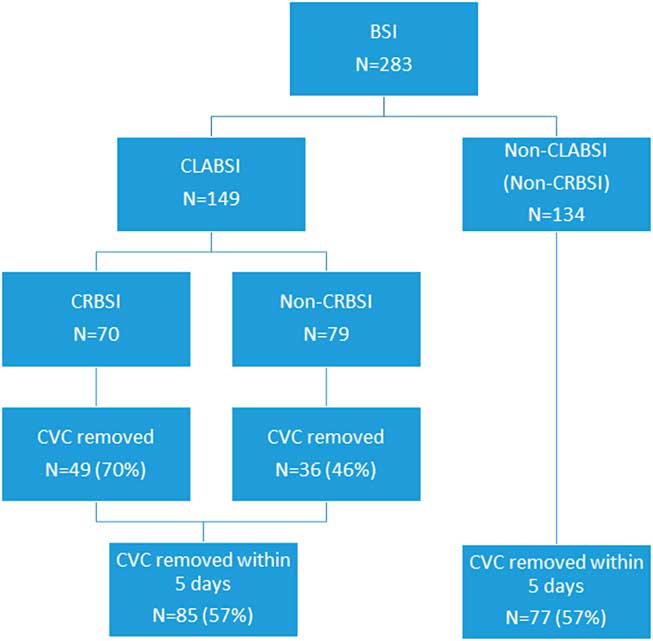
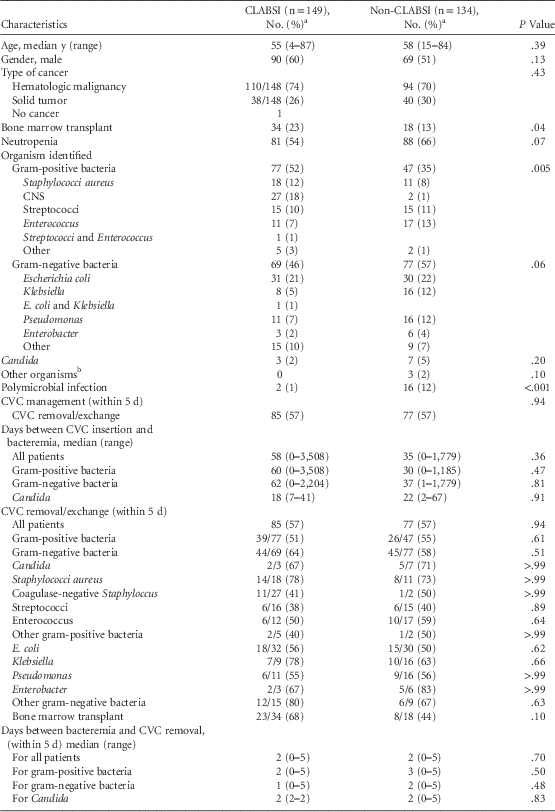
We identified 283 patients who had a CVC and had simultaneous blood cultures drawn from the CVC and the peripheral site (Figure 1). Of those, 149 patients met the CDC criteria for CLABSI, while 134 patients did not (ie, the bacteremia was likely considered secondary to another source). Different data from a subset of patients with CLABSI were previously published.Reference Chaftari, Jordan and Hachem 8 Gram-positive organisms contributed to 52% of CLABSIs, followed by gram-negative (46%) and Candida (2%). Gram-negative organisms were the main etiologic pathogens for 57% of the non-CLABSIs, followed by gram-positive (35%), Candida (5%), and other rare organisms (2%) (Table 1). Infection occurred after a median of 58 days from CVC insertion in the CLABSI group and earlier, after 35 days, in the non-CLABSI group (Table 1). Candida pathogens caused the BSIs that occurred earlier, followed by gram-positive then gram-negative organisms (Table 1).
Patients with central venous catheters (CVCs) and bloodstream infections who had simultaneous blood cultures drawn from CVCs and peripheral sites. Abbreviations: BSI, bloodstream infection; CLABSI, central line-associated bloodstream infection; CRBSI, catheter-related bloodstream infection; CVC, central venous catheter.

Characteristics of Patients With CLABSIs and Non-CLABSIs

NOTE. CVC, central venous catheter.
a Unless otherwise specified.
b Other organisms included 2 non-Candida fungal infections and 1 polymicrobial infection, which included both gram-positive and gram-negative bacteria.
The CVC was removed within 5 days in a similar proportion of patients in both CLABSI and non-CLABSI groups (57% and 57%, respectively; P=.94) after a median of 2 days (range, 0–5 days). In 70% of patients with CRBSI, CVCs were removed within 5 days. In addition, CVCs were removed in 51% of patients with gram-positive CLABSIs and 55% of patients with gram-positive non-CLABSIs (P=.61); in 64% of patients with gram-negative CLABSIs and 58% of patients with gram-negative non-CLABSIs (P=.51); and in 67% of patients with Candida CLABSIs and 71% of patients with Candida non-CLABSIs (P>.99) (Table 1). The rate of CVC removal for each specific pathogen was also similar in both groups (Table 1).
DISCUSSION
Our findings indicate that CVCs are removed similarly and often unnecessarily in patients with CLABSIs and with non-CLABSIs (57% vs 57%; P=.94). The management of the catheters in patients with BSIs can be challenging. Currently, the IDSA guidelines recommend the removal of the CVC and reinsertion of a catheter at a different vascular site in patients with CRBSI.Reference Mermel, Allon and Bouza 6 Because multiple studies have demonstrated the successful salvage of the indwelling CVC through effective antimicrobial catheter lock, even in the setting of documented CRBSI,Reference Raad, Chaftari and Zakhour 4 the IDSA guidelines have supported such a practice for some organisms (eg, coagulase negative staphylococci, gram-negative organisms, etc).Reference Mermel, Allon and Bouza 6 However, the current practice in critically ill and/or immunocompromised cancer patients often goes to the other extreme of removing the CVC and reinserting it, even in the setting of suspected CLABSI or even any BSI in a patient with indwelling CVC rather than documented CLABSI or CRBSI.
The CVC is often removed with the assumption that it is the source of the BSI (ie, suspected CLABSI) simply because the BSI occurred in a patient with an indwelling CVC. The high rate of CVC removal (57%) in patients who neither had CLABSI nor CRBSI is surprising (Figure 1). Frequently, these patients require the insertion of a new CVC to continue their chemotherapy course. This practice may result in a substantial number of unnecessary removals and reinsertions of CVCs in this high-risk patient population with limited vascular access despite the fact that clinical and microbiologic data could be obtained and easily used to determine whether the CVC is the source of the bacteremia.
Despite the guidelines and the availability of microbiological data that could help determine whether the CVC is the source of the BSI, physicians taking care of cancer patients continue to disregard these meaningful data and decide to remove the CVC irrespective of the source of the BSI. Although we observed that the CVC removal rate in patients with CLABSIs who met the CRBSI definition was higher than in those who did not meet the CRBSI definition, which emphasizes the benefit of available resources such as quantitative blood cultures in the management of CLABSI, the rate of CVC removal in patients with non-CLABSIs remains considerable. Hence, there is a universal need for intense, targeted physician education. It is possible that many healthcare providers think that any BSI in a patient with an indwelling CVC is a CLABSI or has the potential of becoming a CLABSI or CRBSI. This assumption is based on the perception that any pathogen causing the BSI could potentially seed the CVC. Electron microscopy studies at our center have shown that the risk of hematogenous seeding of the CVC by organisms causing the BSI is very low.Reference Anaissie, Samonis and Kontoyiannis 9 Therefore, the CVC could be retained in non-CLABSI cases and in many documented non-MBI-CLABSI/CRBSI cases, an effective antimicrobial lock could help salvage and retain the indwelling CVC.
A potential limitation of the study is the retrospective, nonrandomized design of the study, with a relatively small number of patients whose CVC management was left at the discretion of the treating physician. Another limitation is that we did not collect information on the infectious outcome of the BSIs. However, previous small studies that evaluated different modalities of CVC management have been published.Reference Raad, Chaftari and Zakhour 4 , Reference Chaftari, Kassis and El Issa 10
In conclusion, this study shows that CVCs are unnecessarily removed in 57% of cancer patients with non-CLABSIs. Intense physician education is necessary to instruct healthcare providers to avoid unnecessary removal of the CVC, particularly in patients with secondary BSIs. Further development of catheter salvage strategies (that would include an effective antimicrobial catheter lock) even in the setting of documented CLABSI are warranted.
ACKNOWLEDGMENTS
We would like to thank the infection control and the infusion therapy teams at the MD Anderson Cancer Center and Ms Jeanette Lahoud (a student) for their contributions in conducting the study.
Financial support: No financial support was provided relevant to this article.
Potential conflicts of interest: Dr I. I. Raad is coinventor of technology related to minocycline and rifampin-coated catheters. This technology is licensed to Cook, Inc. Dr Raad receives royalties related to this technology, which is owned by The University of Texas MD Anderson Cancer Center (UTMDACC). Dr Raad is a coinventor of the minocycline-EDTA-ethanol lock solution technology, which is owned by UTMDACC and has been licensed to Novel Anti-Infective Technologies, LLC, of which UTMDACC, I. Raad, and J. Rosenblatt are shareholders. Drs I. I. Raad and J. Rosenblatt, UTMDACC, are inventors of the nitroglycerin-based catheter lock solution technology also licensed to Novel Anti-Infective Technologies, LLC.