Introduction
Potato (Solanum tuberosum L.) breeding has been undertaken in Latvia since the start of the 20th century, and locally developed cultivars have been available since the 1930's (Skrabule and Bebre, Reference Skrabule and Bebre2013). In the 1970's, the Latvian potato breeding programme was expanded, and additional germplasm was introduced from the Vavilov Plant Production Institute, Russia. In the Latvian potato breeding programme, increasing emphasis has been placed on quality traits (Murniece et al., Reference Murniece, Karklina, Galoburda, Santare, Skrabule and Costa2011) and organic farming conditions (Skrabule, Reference Skrabule2010). Potato variety trials and breeding have been undertaken at the State Priekuli Plant Breeding Institute (SPPBI) since its establishment in 1913; however, varieties have been developed in other agricultural institutions, as well as by the breeder A. Saulitis, who has utilized mutagenesis breeding (Skrabule and Bebre Reference Skrabule and Bebre2013). The Latvian potato genetic resources collection consists of 83 accessions of Latvian origin, including landraces, cultivars and breeding material. These are maintained in field and in vitro collections by the SPPBI.
Cultivated potato is a clonally propagated autotetraploid species, and has been characterized by using various DNA marker techniques (Milbourne et al., Reference Milbourne, Meyer, Bradshaw, Baird, Bonar, Provan, Powell and Waugh1997; McGregor et al., Reference McGregor, Lambert, Greyling, Louw and Warnich2000). Owing to the tetraploid genome, genotyping data are often analysed in a binary manner, which negates the advantages of using co-dominant marker systems such as simple sequence repeat (SSR) markers (Provan et al., Reference Provan, Powell and Waugh1996; Milbourne et al., Reference Milbourne, Meyer, Bradshaw, Baird, Bonar, Provan, Powell and Waugh1997; Braun and Wenzel, Reference Braun and Wenzel2005).
The DNA diversity array technology (DArT) is a microarray-based molecular marker system (Jaccoud et al., Reference Jaccoud, Peng, Feinstein and Kilian2001) that has been successfully applied for genetic diversity studies, linkage and association mapping in many different plant species (Wenzl et al., Reference Wenzl, Carling, Kudrna, Jaccoud, Huttner, Kleinhofs and Kilian2004; Comadran et al., Reference Comadran, Thomas, van Eeuwijk, Ceccarelli, Grando, Stanca, Pecchioni, Akar, Al-Yassin, Benbelkacem, Ouabboh, Bort, Romagoas, Hackeyy and Russell2009; Tyrka et al., Reference Tyrka, Bednarek, Kilian, Wedzony, Hura and Bauer2011; Alheit et al., Reference Alheit, Maurer, Reif, Tucker, Hahn, Weissmann and Wurschum2012; He and Bjørnstad, Reference He and Bjørnstad2012). The DArT marker technique yields dominant marker genotypes, with a high multiplex ratio. This marker technique has been utilized for genetic mapping of resistance traits in potato (Śliwka et al., Reference Śliwka, Jakuczun, Chmielarz, Hara-Skrzypiec, Tomczyńska, Kilian and Zimnoch-Guzowska2012), as well as assessment of genetic diversity in wild potato accessions (Traini et al., Reference Traini, Iorizzo, Mann, Bradeen, Carputo, Frusciante and Chiusano2013).
The aim of this study was to investigate the genetic diversity and relatedness of Latvian potato genetic resources, by comparing old and modern cultivars, breeding material and foreign accessions that were utilized within the Latvian potato breeding programme.
Materials and methods
All potato accessions were obtained from the SPPBI collection. The majority were Latvian bred cultivars and foreign cultivars or breeding clones, but only one landrace was analysed (‘Jelgavas Baltie’) (Table S1, available online). The release dates of the cultivars were ranged from 1931 to 2010. The Latvian cultivars were predominantly developed in breeding programmes at the SPPBI or other breeding institutions and by the private breeder A. Saulitis (Table S1, available online). Genomic DNA was extracted from fresh leaves or sprout material using the Qiagen Plant DNA Minikit (Qiagen, Germany).
DArT marker genotyping was carried out by Diversity Arrays Technology Pty. Ltd., Canberra, Australia (http://www.diversityarrays.com/). Ninety-four potato accessions were genotyped with the potato DArT array producing 2762 loci. In total, 1482 DArT markers with two or less missing data points were retained after the quality control accounting for 139,308 genotypes including 0.8% of missing data points.
Inter primer binding site (iPBS) genotyping on the cultivars ‘Spidola’, ‘SPO-11’, ‘Laima’ and ‘Priekulu Baltie’ was performed as described previously by Kalendar et al. (Reference Kalendar, Antonius, Smýkal and Schulman2010), using 20 iPBS primers (2075, 2076, 2077, 2078, 2079, 2080, 2081, 2083, 2094, 2097, 2098, 2270, 2271, 2272, 2273, 2274, 2276, 2277, 2278 and 2279).
Analysis of the DArT genotypes was carried out by using dominant binary data. Polymorphism information content (PIC) values were calculated as PIC = 1 − (p 2− q 2), where p= fragment frequency and q= no fragment frequency (Nei, Reference Nei1973). Genetic diversity analyses were performed with GenAlEx 6 version (Peakall and Smouse, Reference Peakall and Smouse2006) and DARwin (Perrier and Jacquemoud-Collet, Reference Perrier and Jacquemoud-Collet2006). Pair-wise genetic distances among cultivars were calculated from the binary data using Jaccard's coefficient, and dendrograms were constructed using the weighted Neighbour joining method. The robustness of the dendrograms was examined by bootstrapping analysis (1000 bootstraps). The dendrogram was visualized by using the FigTree 1.4.2. program. Differences in pair-wise genetic distances and PIC values were compared by using Welch's t-test for unequal variances between groups.
DNA sequences of DArT clones polymorphic between cultivars ‘Laima’ and ‘Priekulu Baltie’ were obtained from Dr. A. Kilian (Diversity Arrays Technology Pty. Ltd., Canberra, Australia). BLASTN and BLASTX analyses against National Centre for Biotechnology Information GenBank nucleotide and non-redundant protein databases, respectively, were carried out on the NCBI website (http://blast.ncbi.nlm.nih.gov/Blast.cgi) on 28 December 2014.
The potato cultivars were characterized according to the Latvian potato descriptor list (http://www.genres.lv/en/kulturaugi/deskriptori/) at the SPPBI in the years 2007–2009.
Results
Ninety-four Latvian potato varieties and breeding clones, and some commonly used foreign accessions were genotyped with the potato DArT array (Śliwka et al., Reference Śliwka, Jakuczun, Chmielarz, Hara-Skrzypiec, Tomczyńska, Kilian and Zimnoch-Guzowska2012), obtaining genotypes from 2762 DArT loci. After the quality control, 1482 DArT loci with two or less missing data points were retained for further analysis. All of the 1482 DArT loci were polymorphic in the full set of 94 analysed potato accessions, although 62 markers had a minor allele frequency less than 0.05. The PIC values ranged from 0.02 to 0.50, the maximum PIC value for dominant marker data (average 0.335, SD 0.138). Jaccard's genetic distances ranged from 0.001 to 0.632, average 0.510, SD 0.051. The DArT marker technique was able to distinguish all the analysed cultivars. Previously, a subset of the Latvian potato genetic resources collection was genotyped with eight SSR markers, and two pairs of cultivars could not be distinguished: ‘Spidola’ – ‘SPO-11’ and ‘Laima’ – ‘Priekulu Baltie’ (Zhuk et al., Reference Zhuk, Veinberga, Skrabule and Rungis2008). Using the smaller 1482 locus set, and excluding missing data points in one or both pairs, the cultivars ‘Spidola’ and ‘SPO-11’ were differentiated at 24 DArT loci (from a total of 1448 loci – 1.66%), while the cultivars ‘Laima’ and ‘Priekulu Baltie’ were differentiated at only one DArT locus (from 1457 loci – 0.06%). When the full set of 2762 DArT loci was used to compare these two pairs of cultivars (again excluding missing data points in one or both pairs), there were 88 differences between ‘Spidola’ and ‘SPO-11’ (from a total of 2544 loci – 3.46%) and 9 differences between ‘Laima’ and ‘Priekulu Baltie’(from 2602 loci – 0.35%). As clear phenotypic differences are observed between ‘Laima’ and ‘Priekulu Baltie’, the sequence homology-based annotation of polymorphic DArT marker clones was done between them by using the BLASTN and BLASTX analyses to identify potential candidate genes (Table S2, available online). The DArT marker sequences were homologous to a range of genes/proteins, including a cytochrome P450 protein, an RGA-3-like resistance protein, starch synthase, a CMP-sialic acid transporter 4-like protein, a pentatricopeptide repeat-containing protein, a transcriptional regulatory protein and three uncharacterized sequences.
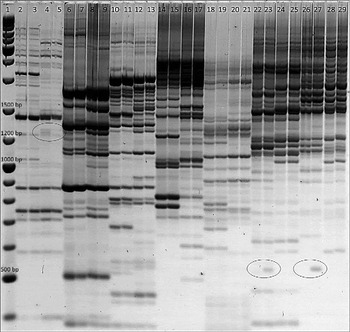
To confirm the polymorphism between both these pairs of cultivars, they were fingerprinted using an alternative marker method – iPBS, a retrotransposon based marker technique (Kalendar et al., Reference Kalendar, Antonius, Smýkal and Schulman2010). A total of 20 iPBS primers were utilized, and the primer 2075 detected a polymorphic fragment approximately 1300 bp in size between the cultivars ‘SPO-11’ and ‘Spidola’, while the primers 2080 and 2081 detected polymorphic fragments approximately 520 bp in size between the cultivars ‘Laima’ and ‘Priekulu Baltie’, confirming the genetic differentiation of these pairs of cultivars (Fig. 1).
iPBS marker genotyping of the cultivars ‘Laima’ (lanes 2, 6, 10, 14, 18, 22 and 26), ‘Priekulu Baltie’ (lanes 3, 7, 11, 15, 19, 23 and 27), ‘Spidola’ (lanes 4, 8, 12, 16, 20, 24 and 28) and ‘SPO-11’ (lanes 5, 9, 13, 17, 21, 25 and 29). iPBS markers: 2075 (lanes 2–5), 2076 (lanes 6–9), 2077 (lanes 10–13), 2078 (lanes 14–17), 2079 (lanes 18–21), 2080 (lanes 22–25) and 2081 (lanes 26–29). Differentially amplified fragments between cultivar pairs are circled. Lane 1 – size standard (GeneRuler DNA ladder mix (Thermo Fisher Scientific, Lithuania)).

From the cultivar characterization and evaluation trial results (2007–2008), tuber eye depth was assessed as very deep to deep for the cultivar ‘Laima’, but was assessed deep to shallow for the cultivar ‘Priekulu Baltie’. A difference between tuber shape indexes for both cultivars was observed, but the difference was not significant (P>0.05). The eye depth was deeper for the cultivar ‘Laima’ with round oval tubers than for the cultivar ‘Priekulu Baltie’ with oval tubers. Tubers of the cultivar ‘Laima’ were more resistant to internal bruising than ‘Priekulu Baltie’ tubers. The tuber flesh enzymatic darkening in the cultivar ‘Laima’ was very weak, but was more pronounced in the cultivar ‘Priekulu Baltie’. Internal bruising and tuber flesh discoloration is less pronounced for round tubers than for oval or long oval tubers (Molema et al., Reference Molema, Klooster, Verwijs, Hendriks and Breteler1997a, Reference Molema, Verwijs, Van der Berg and Bretelerb), which was noted in this case with the cultivar ‘Laima’. The tuber flesh enzymatic darkening is caused by oxidation of phenols. This trait appears to be a dominant character governed by small number of genetic factors (Dale and Mackay, Reference Dale, Mackay, Bradshaw and Mackay1994). Less enzymatic activity was observed in the cultivar ‘Laima’ than in ‘Priekulu Baltie’ as tuber flesh darkening was very weak in this cultivar.
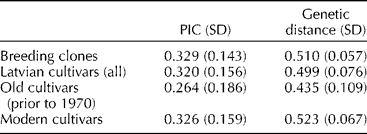
The potato accessions were divided into four groups – Latvian cultivars (32 accessions), Latvian breeding materials (39 accessions), Western European cultivars (15 accessions) and Eastern cultivars (8 accessions). AMOVA indicated that only 2% of the genetic diversity was found between these groups (P< 0.01). The level of genetic diversity within the Latvian potato accessions was further examined, comparing the PIC values and pair-wise genetic distances within the cultivars and breeding material (Table 1). In the cultivars, 68 of the 1482 DArT markers were fixed (F= 0 or 1), and 59 markers were low frequency alleles (F< 0.05), while in the breeding material 20 DArT markers were fixed, and 61 markers were low frequency alleles (F< 0.05) The average PIC value in the cultivars was 0.320 (SD 0.156), and 0.329 (SD 0.143) in the breeding material, which was not significantly different. The pair-wise genetic distances were marginally lower between the cultivars (average 0.499, SD 0.076) than in the breeding material (average 0.510, SD 0.057); however, this difference was significantly different (P= 0.003).
Genetic diversity parameters of breeding lines and Latvian cultivars, old and modern Latvian cultivars

The genetic diversity of old ( < 1970) and modern Latvian cultivars was compared. A total of 16 modern cultivars and 14 old cultivars could be unambiguously identified from the Latvian potato collection. In the modern cultivars, 131 of the 1482 DArT markers were fixed (F= 0 or 1), while in the old cultivar group 303 DArT markers were fixed. There were 143 unique DArT markers found only in the modern cultivars, and 29 markers found only in the old cultivars. The average PIC value of the 1482 DArT marker set was significantly lower in the old cultivars (0.264, SD 0.186) than in the modern cultivars (0.326, SD 0.159) (P< 0.001). The average pair-wise Jaccard's genetic distances were also significantly lower between the old cultivars (0.435, SD 0.109) compared with the modern cultivars (0.523, SD 0.067) (P< 0.001) (Table 1).
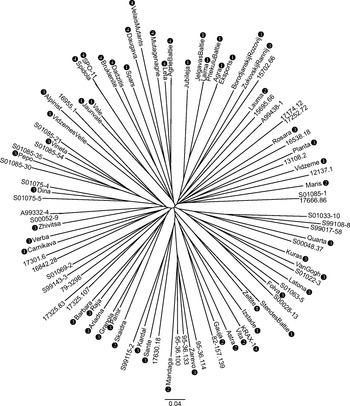
The dendrogram constructed using all accessions genotyped using the DArT markers was mostly consistent with the known pedigrees of the accessions (Fig. 2). All varieties developed by the breeder A. Saulitis (except for KPAX-11) clustered separately from the other accessions (the majority of which were developed by SPPBI). There was one well-supported cluster that contained the old varieties ‘Laima’, Priekulu Baltie', ‘Agra’, ‘Eksports’, ‘Jubileja’ and the landrace ‘Jelgavas Baltie’. Otherwise, there was no separation of the Latvian varieties, breeding material and foreign cultivars. Breeding clones derived from the same cross clustered together, sometimes with one or both the parental cultivars (e.g. 95-36.100, 95-36.114, 95-36.133, ‘Mandaga’ and the parent cultivar ‘Zarevo’; S01075-4, S01075-5, and the parent cultivar ‘Dina’). Occasionally, some clones from the same cross clustered together with the parental cultivars, e.g. S01085-21, S01085-30, S01085-35, S01085-54 clustered with the parent cultivars ‘Pepo’ and ‘Vineta’. In other cases, the breeding clone was clustered separately from both parental cultivars, e.g. (S00028-13, ‘Zhukovskiy ranniy’ and ‘Dina’).
Dendrogram of potato accessions based on 1482 DArT marker genotypes was visualized in FigTree 1.4.2. Old Latvian cultivars (1931–1970), new cultivars (1971–2010), foreign cultivars and A. Saulitis' cultivars are numbered from one to four, respectively. The unnumbered accessions are Latvian breeding lines.

Discussion
The DArT marker technique was an efficient method for genotyping the Latvian potato collection. The average PIC value in the analysed accessions was 0.335, which was similar to the average DArT marker PIC values found in other cultivated species, e.g. carrot 0.301 (Grzebelus et al., Reference Grzebelus, Iorizzo, Senalik, Ellison, Cavagnaro, Macko-Podgorni, Heller-Uszynska, Kilian, Nothnagel, Allender, Simon and Baranski2014), rye 0.34 (Bolibok-Brągoszewska et al., Reference Bolibok-Brągoszewska, Targońska, Bolibok, Kilian and Rakoczy-Trojanowska2014), sorghum 0.410 (Mace et al., Reference Mace, Xia, Jordan, Halloran, Parh, Huttner, Wenzl and Kilian2008), barley 0.38 (Wenzl et al., Reference Wenzl, Carling, Kudrna, Jaccoud, Huttner, Kleinhofs and Kilian2004), wheat and triticale 0.36 (Badea et al., Reference Badea, Salmon, Tuvesson, Vrolijk, Larsson, Caig, Huttner, Kilian and Laroche2011) and hop 0.335 (Howard et al., Reference Howard, Whittock, Jakše, Carling, Matthews, Probasco, Henning, Darby, Cerenak, Javornik, Kilian and Koutoulis2011). The DArT markers were able to distinguish the two pairs of accessions that could not be uniquely fingerprinted with the SSR markers. The cultivars ‘Spidola’ and ‘SPO-11’ were differentiated at 1.66–3.46% of the DArT marker loci. This rate is much higher than the previously reported maximum gamma ray induced mutation rate of less than one mutation per 1810 bp (0.05%) in tetraploid potato (Elias et al., Reference Elias, Till B, Mba and Al-Safadi2009), which indicating that the cultivar ‘SPO-11’ is most probably not an induced mutant derived from the cultivar ‘Spidola’. More surprising was the low differentiation of the cultivars ‘Laima’ and ‘Priekulu Baltie’ (0.06–0.35%). According to pedigree data, ‘Laima’ is derived from a cross between ‘Irish Cobbler’ and ‘Jubel’, while ‘Priekulu Baltie’ is derived from a cross between ‘Kameraz 18-368’ and ‘Agra’, which itself is derived from ‘Irish Cobbler’. The genetic differentiation of these two pairs of cultivars was verified by fingerprinting with an alternative marker technique – iPBS, which revealed a low level of overall genetic polymorphism between these pairs of cultivars, but identified differentially amplified iPBS fragments. In addition, these two pairs of cultivars also differ in several characterization and evaluation descriptors, particularly with regard to tuber and plant characteristics (Skrabule, unpublished).
The nine DArT markers that differentiate ‘Laima’ and ‘Priekulu Baltie’ were annotated by BLASTN and BLASTX analyses, which identifying candidate genes for the observed phenotypic differences (Table S2, available online). Further analyses of these candidate genes will enable the elucidation of the genetic basis of the observed phenotypic differences between these two cultivars.
There was a little genetic differentiation between the Latvian cultivars, breeding material and foreign (mostly European) cultivars, which reflecting the common provenance of the Latvian and European potato cultivars. The breeding programme accessions include advanced clones, which were derived from the crosses between foreign cultivars with the aim of combining useful traits from parent cultivars. The assessment and selection of advanced breeding clones within the region of expected future deployment ensure that the clones containing unique combinations of genes from the cultivated potato gene pool, which are most adapted to local growing conditions, are advanced to cultivars. Thus, the local adaptive diversity of the potato germplasm pool is increased, and allows for the development of new cultivars adapted to local conditions.
Potato breeding has been carried out in Latvia since the start of the 20th century. Old Latvian potato cultivars were defined as those released prior to the 1970's, and genetic diversity between old and modern cultivars was examined. The genetic diversity parameters were lower in the old cultivars than in the modern cultivars. This could be due to the influx of new breeding germplasm into the Latvian breeding programme that occurred in the 1970's. This in turn is a reflection of the increasing genetic diversity in potato breeding programmes resulting from the use of wild Solanum germplasm (Gebhardt et al., Reference Gebhardt, Ballvora, Walkemeier, Oberhagemann and Schuler2004; Hajjar and Hodgkin, Reference Hajjar and Hodgkin2007), with the aim of introgressing resistance to pests or specific quality traits. This maintenance or even increase of genetic diversity in cultivars since the 1960's and 1970's has been reported for other crop species as well (van de Wouw et al., Reference van de Wouw, van Hintum, Kik, van Treuren and Visser2010). All of the old cultivars did not cluster separately from the modern cultivars, suggesting that the combination of locally adapted cultivars with donors of specific resistance and other traits has been successful, and has increased the amount of genetic diversity within Latvian potato cultivars without causing a shift in the population away from locally adapted germplasm.
Analysis of the Latvian potato genetic resources collection has revealed that the amount of genetic diversity has increased in the modern cultivars in comparison with the old cultivars released prior to 1970, indicating that the Latvian potato breeding programme has successfully expanded the genetic base of Latvian potatoes, integrating this with locally adapted older varieties.
Supplementary material
To view supplementary material for this article, please visit http://dx.doi.org/10.1017/S14792621150003988
Acknowledgements
The authors thank Ruslan Kalendar and Alan Schulman from the MTT/BI Plant Genomics Laboratory, Institute of Biotechnology, Viikki Biocenter, University of Helsinki, for performing the iPBS genotyping of the cultivars ‘Spidola’, ‘SPO-11’, ‘Laima’ and ‘Priekulu Baltie’, and to Andrzej Kilian from the Diversity Array Technology Pty. Ltd, Canberra, Australia for DArT genotyping and for providing sequences of DArT clones. This research was supported by the State Research Programme in Agrobiotechnology (2006–2009) and the Programme for research, maintenance, reproduction and documentation of Latvia crop genetic resources financed by the Ministry of Agriculture.