




No CrossRef data available.
2003–2004 Congressional Fellows Off With a Bang
Published online by Cambridge University Press: 26 February 2004
Abstract
An abstract is not available for this content. As you have access to this content, full HTML content is provided on this page. A PDF of this content is also available in through the ‘Save PDF’ action button.
Information
- Type
- Association News
- Information
- Copyright
- © 2004 by the American Political Science Association
Orientation a Success with the Help of Friends
This year's class of Congressional Fellows emerged from their fall orientation with a clearer understanding of Congress, thanks to more than 60 guest lecturers who spoke on topics ranging from policy and politics to procedure. In a town where honoraria can range from hundreds to thousands of dollars, speakers were tickled to receive the modest but coveted CFP coffee mug. Many were former Fellows, and all are great friends of the program.
The month-long seminar, held at the Johns Hopkins University School of Advanced International Relations (SAIS), featured four speciallytailored sessions hosted by the Congressional Research Service (CRS) on advanced legislative procedure. Included among the almost legendary faculty was former Fellow Colton Campbell (1998–1999) who lectured on the topic “Considering Measures on the House Floor.” Other speakers included Walter Oleszek, Judy Schneider, Paul Rundquist, and Rick Beth, who serve as vital research contacts for the Fellows for the rest of the year.
As an aside, we are happy to announce that Colton Campbell and Paul Herrnson (1989–1990) of the Center for American Politics and Citizenship recently edited a book now available in stores (see inset). War Stories from Capitol Hill, published by Prentice Hall, features chapters authored by fellowship alumni and is dedicated: “To the Congressional Fellowship Program, which for more than fifty years has provided academics with the opportunity to leave the ‘ivory tower’ for ten months.”
The Fellows also attended an eight-hour conference on the changing nature of the House Speakership through special invitation of the CRS. For most it was their first time in the Cannon House Caucus Room, and certainly their first time in the presence of three House Speakers, past and present. CFP Director Jeff Biggs moderated the panel on Thomas Foley, with remarks by former Reps. Vic Fazio (D-CA), Bill Frenzel (R-WI), and Foley himself. Just two days into their orientation, many of the Fellows could already be seen on C-SPAN, which filmed the event.
As usual, Walter Beach of the Helen Dwight Reid Educational Foundation kicked off the orientation discussions with an entertaining account of the fellowship's history. He offered the tongue-in-cheek suggestion that beyond a practical knowledge of Congress, Fellows might pick up a little extra from the experience. Like Ben and Mavis Reeves, who married at the end of their fellowship year in 1953–1954, they might find true love. Or like Korean Fellow Ock-Jin Kim, who worked for then-Congressman Gerald Ford, they might find themselves returning to play golf with a former president.

The 2003–2004 Fellows listen to a health care briefing at the Institute of Medicine: (L to R) RWJ Fellows Susan Scavo Gallagher and Vipol Mankad, Political Science Fellows Vincent Moscardelli, Paul Martin, and RWJ Fellow Pamela Bataillon.
Fellows were captivated by Beach's anecdotes about former Vice President Hubert Humphrey, former Secretary of State Dean Acheson, D. B. Hardeman, and other prominent figures from the fellowship's past. Chris Johnson, who worked at APSA for more than three decades, fondly remembered when Vice President Dick Cheney first arrived as a young political scientist from “someplace in Wyoming.” He and his 1968–1969 cohorts seemed “afraid” at the prospect of finding a congressional assignment.
Fellows Break New Ground with Office Assignments
While the program has seen many changes over the past 30 years, this initial anxiety remains a constant. Nonetheless, this year's Fellows have made impressive headway in securing their assignments. At the time of writing, nearly half of the Fellows had offers, making them somewhat precocious when compared with previous classes. More importantly, many have secured interviews in offices that had not hosted a Fellow in years, if at all. Among the offices are Rep. Martin Frost (D-TX), ranking on the Rules Committee; Rep. David Obey (D-WI), ranking on the House Appropriations Committee; Rep. Javier Becerra (D-CA); Rep. Jim Leach (R-IA), Chair of the House Subcommittee on Asia and the Pacific; Rep. Ileana Ros-Lehtinen (RFL), Chair of the House Subcommittee on the Middle East and Central Africa; and House Speaker J. Dennis Hastert (R-IL).
There are also offices that have consistently offered past Fellows such solid legislative experiences that their name connotes the standard by which the fellowship is measured. Heeding the injunction to “make new friends but keep the old,” Fellows have sought interviews with traditional program supporters like Sen. Richard Lugar (R-IN) and Sen. Thomas Daschle (D-SD), both members of the CFP Advisory Committee, as well as with Sen. Joseph Lieberman (D-CT), Sen. Olympia Snowe (R-ME), Sen. Jack Reed (D-RI), and Sen. Ron Wyden (DOR). On the House side, Fellows have interviewed in the offices of Rep. Jim Cooper (D-TN), Rep. David Price (DNC), Rep. Henry Hyde (R-IL), Rep. Charlie Rangel (D-NY), Rep. Frank Wolf (R-VA), Rep. Christopher Shays (R-CT), and Rep. Louise Slaughter (D-NY).
While only a partial listing, these names reflect a growing number of offices that recognize the value of APSA Fellows and welcome them year after year. A good number expressed their appreciation by putting statements in the July 22nd Congressional Record commemorating the fellowship's 50th anniversary. The Fellows in turn tend to leave glowing assessments of their experiences which help guide future Fellows. Recent examples of this pattern can be found in the offices of Rep. Jim McDermott (D-WA) and Rep. Juanita Millender-McDonald (D-CA), which have become an especially nurturing environment for the international Fellows.
To assist the Fellows in their search, the CFP staff sent letters announcing their arrival to more than 700 House and Senate Chiefs of Staffs as well as to all Committee Majority and Minority Staff Directors. The Fellows also helped each other by sharing tips, reviewing each other's resumes and cover letters, and communicating which offices wanted a Fellow and which did not. A visitor to the APSA offices in Dupont Circle would find several Fellows on any given day reading the evaluations of their predecessors, poring over CQ's Politics in America, and setting up interviews on the phone.
CFP Broadens Its Base with Alumni Projects
We are happy to report that due to the recent decision to emphasize online advertising the past year saw a surge in the number of journalist applicants. Contrary to expectations, this strategy has resulted in more “traditional” applicants instead of more electronic journalists. We are also in the midst of bolstering alumni networks through updated directories, an improved web site, and creation of email listservs sorted by fellowship year. In particular, we would like to capitalize upon alumni representatives who attend regional journalism conferences and job fairs. We have already received word from several worthy volunteers who will help with recruitment at those venues.
The updated Alumni Directory, originally intended for distribution at the 2003 Annual Meeting, has been put on hold as the CFP staff expands it into an online database modeled on the APSA members' directory and made available to alumni on CDROM. In addition to updated contact information, the new directory will feature a complete list of congressional office assignments that alumni could search by Fellow, year, or Member of Congress.
In the meanwhile, we very much need updates from Fellows who suspect their contact information may be out of date. You may update your profile on the web site, http://www.apsanet.org/about/cfp/update.cfm. Alternately, you may send your name, fellowship year, work and home addresses, phone number(s), e-mail address(es), and office assignments to either cfp@apsanet.org or to APSA Congressional Fellowship Program, 1527 New Hampshire Avenue NW, Washington, DC 20036.
As in the past, contributions of $50 or more will land you a 50th Anniversary mug, which orientation speakers have commented on as being very handsome. In addition, you will also receive a complimentary copy of A Congress of Fellows: Fifty Years of the American Political Science Association Congressional Fellowship Program. The 200-page chronicle, written by Jeff Biggs, draws heavily on little-known anecdotes provided by long-time supporters including Walter Beach, Fred Holborn of Johns Hopkins SAIS, Tom Mann of the Brookings Institution (1969–1970), and Advisory Committee Members Norm Ornstein (1969–1970) and Cathy Rudder (1974–1975). Since printing was rushed for distribution at the Annual Meeting, the history should be considered a “work in progress” and will be edited for a later edition.

LA Times Washington D.C. Bureau Chief Doyle McManus briefing the 2003–2004 Fellows on the domestic and foreign affairs issues facing the 2nd session of Congress.
The Congressional Fellowship Program continues to benefit from the generosity of MCI, Congressional Quarterly, Inc., the John S. and James L. Knight Foundation, the William E. Steiger trust, and the annual contributions of program alumni.
—Sarah Mi Ra Dougherty
American Political Science Association
To keep current on the latest happenings of the Congressional Fellowship Program visit www.apsanet.org/about/cfp/index.cfm.
Former Fellows Give Inside Account of Congress in War Stories from Capitol Hill
The Center for American Politics and Citizenship recently released a new book in its Real Politics in America Series, War Stories from Capitol Hill, edited by Colton Campbell of the Congressional Research Service and Paul Herrnson of the University of Maryland. Published by Prentice Hall, War Stories is an inside account of Congress written by former APSA fellows who served as congressional staff.
The essays outline the historical and conceptual framework surrounding former Speaker Tom Foley's fight against term limits, the Republicans' race for Senate majority leader, the House Democrats' attempts to set a partisan political agenda, the juvenile justice bill and the universal tobacco settlement act, the taking of the 2000 census, and the reapportionment of House seats.
Each chapter provides a dynamic view of how Members balance the demands of constituents, lobbyists, congressional leaders, and their own consciences when making national policy. The book also covers a wide range of congressional processes, including private constituent meetings, speeches, committee hearings and markups, leadership strategy sessions, and the complex rules that govern floor procedures.
War Stories, with its unique insider's perspective, emphasizes “real” politics and examines the legislative process in a balanced, informed manner. For more information, please visit http://vig.prenhall.com/catalog/academic/product/0,4096,0130280887,00.html.

The 2003–2004 Fellows listen to a health care briefing at the Institute of Medicine: (L to R) RWJ Fellows Susan Scavo Gallagher and Vipol Mankad, Political Science Fellows Vincent Moscardelli, Paul Martin, and RWJ Fellow Pamela Bataillon.
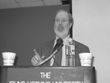
LA Times Washington D.C. Bureau Chief Doyle McManus briefing the 2003–2004 Fellows on the domestic and foreign affairs issues facing the 2nd session of Congress.
 You have Access