Introduction: ‘a Victorian community overseas’
One of the world's great nineteenth-century ‘instant cities’, Melbourne, Australia, is the only non-British city included by urban historian Asa Briggs in his classic 1963 study, Victorian Cities.Footnote 1 Described by Briggs as ‘a Victorian community overseas’, Melbourne was founded in 1835 just before Queen Victoria came to the throne, and had a population of nearly half a million by the time she died in 1901. Arguably never really a city in the traditional urban density sense, Melbourne's ‘very British’ ‘rapid suburbanization’ meant that it was a sprawling low-density metropolis from almost the very outset.Footnote 2 Today, with a metropolitan population exceeding four million and a physical area that covers nearly 10,000 square kilometres, the city retains much of that sprawling, low-density, suburban character. But while it is true that more than 70 per cent of its dwellings remaining detached single-family houses, this macro figure conceals as much as it illuminates. Most of Melbourne is still dominated by detached houses, but many of its older suburbs now feature substantial pockets of higher-density dwellings, including townhouses, flats and apartments. In some older suburbs, these higher-density dwellings now constitute the majority housing-type.
The biggest difference between Victorian-era Melbourne and today is, however, demographic. Whereas in the nineteenth century and through to the end of World War II the city was essentially a monoculture with a population that was more than 90 per cent Australian-, British- or Irish-born, today Melbourne is one of the most ethnically diverse metropolitan regions in the world. The most recent national census, taken in 2011, shows that almost 40 per cent of the population are immigrants and another 20 per cent have at least one foreign-born parent.Footnote 3 Home to more than 200 separate ethnic groups, the contemporary city is one of the world's great immigrant metropolises, recognized by the Migration Policy Institute as one of only 20 cities worldwide with more than one million foreign-born residents.Footnote 4
These two recent changes – morphological and demographic – are linked, but little discussed. While the history of Victorian-era Melbourne and the stories of many of its nineteenth- and early twentieth-century suburbs has been well-told, that of the emergence of the contemporary multicultural metropolis and the genesis of these pockets of higher-density dwellings is less well documented.Footnote 5 This absence of the contemporary and the ‘other’ is not that unusual in either urban or suburban historiography, either in Australia or internationally, however. In an important article published in Urban History in 2007 Ruth McManus and Philip Ethington noted that most suburban histories tend to be static, about beginnings rather than about processes of change across time. In calling for more histories of ‘what happens to a suburban seedbed after it has been planted: after it ceases to occupy the leading edge of a metropolis, once it no longer stands as the historically typical suburban form’, they asked us as historians to investigate suburban chronology and to document the ways in which suburbs evolve over time as a function of demographic, economic, social and cultural change. Noting that different ethnic groups have differing impacts on the urban landscape, they also suggested that there needs to be more investigation into how new immigrant groups adapt existing suburban houses to suit their immediate post-arrival accommodation needs, but also how the building stock of such older suburbs are rebuilt as the demography and economic profile of the suburb changes over time. More obliquely, they hinted at how suburban morphology and social change are intertwined, and suggested that an examination of the links between these processes might be a fruitful area of research for historians of suburbia.Footnote 6
Inspired by these ideas and challenges, this article seeks to redress the imbalance in our knowledge of Melbourne's history by bringing a twentieth-century and immigrant-oriented focus to the existing historiography of the British-inspired suburban Victorian city. In doing so, it embeds Melbourne's story into an emerging international historiography of the mid- to late twentieth-century demographic and morphological experiences of the low-density suburban cities of the English-speaking New World, evocatively characterized by historian Lionel Frost as the ‘New Urban Frontier’.Footnote 7 Mostly established in the second half of the nineteenth century, and essentially monocultures until the post-war years, in recent decades New Urban Frontier cities such as Melbourne, Los Angeles and Vancouver have emerged as some of the most ethnically diverse cities in the world.Footnote 8 Each has also seen its housing stock move beyond the traditional detached single-family dwelling norm to reflect the economic, social and cultural impacts and needs of these new residents.Footnote 9
By charting demographic and morphological change across the broad metropolitan area in the post-war years, and in two particular suburbs in the 1950s, 1960s and 1970s, this article brings a Melbourne and Australian aspect to this emerging literature. The first part of the article documents the genesis of the contemporary multicultural city by charting macro changes in the demographic profile of metropolitan Melbourne in these years, while the second presents detailed case-studies of two streets in two classic nineteenth-century suburbs – middle-class East St Kilda and working-class Footscray – that not only became home to large numbers of immigrants in the post-war period, but were also rebuilt with low-rise apartment buildings by mostly overseas-born developers in the 1960s and 1970s. Drawing on a range of sources, including census material, municipal rate and valuation books, immigration and company records as well as building industry publications, the article shows that what began as locations on the metropolitan fringe in the nineteenth century had by the 1960s taken on new roles and become suburban ‘zones of transition’, each home to large immigrant communities who had begun to have an impact on the local culture, economy and built form of these previously archetypal, low-density monocultural suburban neighbourhoods.
Before we begin the main tasks of the article, however, it is necessary to define what we mean when we use the terms ‘city’ and ‘suburb’ in the Australian context. Unlike in most of Europe, the United States and elsewhere in the world, in Australia there is no definitional or political difference between these two entities. Rather, entire metropolitan areas are referred to officially and colloquially as ‘cities’, and all regions bar the downtown Central Business District (‘CBD’ or sometimes simply ‘the City’) are referred to as ‘suburbs’. Australians also use the term ‘inner suburb’ to refer to the mostly nineteenth century-era residential districts that surround the CBD, which elsewhere in the world are usually called ‘neighbourhoods’. This is a term that is seldom used in Australia, other than to refer to the immediate vicinity of one's home. To add further to the confusion Australian metropolitan areas are comprised of municipal regions (usually called ‘Cities’) that, while having their own local political representatives, are rarely entrusted with overseeing major instruments of policy or governance. More akin to boroughs than metropolitan-level city governments, these municipalities do have some planning and other powers, but these are limited. In Melbourne, and much of Australia generally then, cities and metropolitan areas are functions of the states rather than independent self-governing entities and many of the tasks normally undertaken by city governments elsewhere in the world, such as major planning decisions and the provision of services such as education, water and sanitation are the responsibility of state governments and are delivered and controlled at that level. For the rest of this article, then, when I use the term ‘city’ I am referring to metropolitan Melbourne, while the use of the term ‘suburb’ refers to a municipal region within the metropolitan area. Smaller more localized areas within those municipal regions (again akin to the North American ‘neighbourhood’) are also sometimes called ‘suburbs’, and will thus be referred to as such.Footnote 10
The making of modern multicultural Melbourne
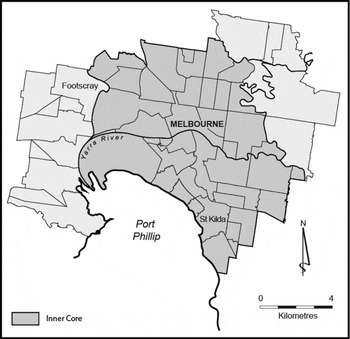
In 1947, at the first census taken after the conclusion of World War II, Melbourne had a metropolitan population of just over 1.2 million people.Footnote 11 Nearly 90 per cent of these were Australian-born, and of those born overseas 85 per cent were from the British Isles. Less than 3 per cent (36,378 people) were born in non-English-speaking countries and less than 1 per cent were deemed ‘foreigners’, that is people born outside Australia who had not become British subjects.Footnote 12 Other than the British, the largest of the overseas-born groups were the Italians (4,195), Poles (3,903), Germans (3,345) and Greeks (1,750). Over 80 per cent of the population lived in detached, single-family dwellings or terrace houses, although as a result of a severe housing shortage these were often shared by more than one family.Footnote 13 Less than 7 per cent of Melbourne's dwellings were self-contained flats, while another 4 per cent were tenements, that is private multi-unit dwellings in which either a bathroom or a kitchen was shared by other tenants.Footnote 14 Almost all of the flats and most of the tenements were in the inner area, with more than half in the two inner south-eastern municipalities of Prahran and St Kilda (Figure 1).
Map of inner Melbourne, showing Melbourne City (‘CBD’), ‘inner core’, Footscray and St Kilda/East St Kilda (courtesy Kara Rasmanis, Monash University)

Thirty-four years later, the census of 1981 documented just how profound was the demographic transformation of Melbourne in the post-war period.Footnote 15 While the metropolitan population more than doubled to 2.7 million in those years, the number of overseas-born increased sevenfold to nearly 800,000 or nearly 30 per cent of the population.Footnote 16 These numbers do include the Australian-born children of immigrants, who according to calculations by demographer Ian Burnley add a further 533,320 people to this immigrant total. What this means is that whereas in 1947 less than 10 per cent of Melburnians were foreign-born, by 1981 nearly half were immigrants or their children. And whereas in 1947 less than 40,000 residents of Melbourne were from a non-English-speaking background, by 1981 that figure was more than 600,000 (or 22 per cent of the population).Footnote 17 Metropolitan Melbourne thus went from essentially being a monoculture to an ethnically and linguistically diverse city in little more than one generation.
As historians Tony Dingle and Graeme Davison have shown, most of the accommodation pressures brought about by the rapid increase in the post-war population were absorbed by the expansion of the physical size of the metropolis, which underwent extensive outward growth at the fringe and infill development between the existing suburban railway lines, as the car replaced public transport as the main mode of urban transit.Footnote 18 But while the Australian-born moved to new outer-ring suburbs, many of the immigrants replaced them in the older inner-ring suburbs where they bought up and renovated old terrace houses and cottages. In doing so, they had important local impacts on the demography and culture of the city by creating a variety of ethnic enclaves, such as ‘Little Italy’ in Carlton, ‘Little Athens’ in Richmond and ‘Little Sarajevo’ in Fitzroy.Footnote 19
This movement of immigrants to inner-city regions temporarily slowed the numerical and proportional population loss that had been a feature of these areas since the 1890s, but this phenomenon was short-lived. Whereas in 1947 the population of inner Melbourne was just under 700,000 and represented 52 per cent of the metropolitan total, by 1981 these figures were down to 485,000 and 18 per cent respectively. Gentrification, smaller household sizes and a rapid exodus of older more-established European immigrant communities to the suburbs accelerated these inner-urban depopulation trends in the 1970s, at the same time as economic restructuring and deindustrialization began to have a major detrimental impact on the socio-economic profile of these areas.Footnote 20 Two major morphological changes put something of a temporary brake on this population decline in the 1960s and early 1970s, however. The first was a major urban renewal programme undertaken by the Housing Commission of Victoria (HCV) which demolished and redeveloped a number of inner-city ‘slum’ regions with high-rise, high-density public housing estates, while the second was the redevelopment of older suburbs with privately built low-rise blocks of flats.Footnote 21 Unlike the HCV, which focused its efforts mainly on the oldest inner-city neighbourhoods (the ‘inner core’), private developers looked to the next ring where larger suburban lots laid out in the late nineteenth and early twentieth centuries, and capable of accommodating multiple dwellings, were located.
Whereas in 1961 there were only 47,000 flats in the Melbourne metropolitan area, 20 years later that figure had grown to more than 150,000.Footnote 22 The largest concentrations of these were in these ‘outer-inner-ring’ suburbs, such as St Kilda, Malvern, Caulfield and Footscray which experienced rapid flat development in the 1960s and as a result bucked the trend of inner-urban population loss.Footnote 23 The stories of the transformations of two of these suburbs form the basis of the rest of this article.
Villas, bungalows and flats: transforming Westbury Street, East St Kilda
St Kilda has long been one of Melbourne's most unusual suburbs. Founded in 1840 as a wealthy suburban retreat, it is located by the seaside approximately five kilometres from the city centre, to which it was connected by rail in 1857. A municipality as well as a suburb, St Kilda fell into genteel decline from the 1890s, and was then subject to major flat development in the inter-war years.Footnote 24 By 1947, the municipal population numbered 58,318, just over 8 per cent (4,737) of whom were overseas-born. Almost half (2,200) of the immigrants were from Austria, Germany and Poland, and thus likely members of the small community of European-born Jews who settled in Melbourne in the inter-war years. A generation later, the Census of 1981 showed that St Kilda's population had declined to 49,366 and of these 41 per cent were overseas-born, with the largest groups coming from the UK and Ireland (4,484 people or 9 per cent of the population), the USSR (1,872), Poland (1,733), Greece (1,052) and Hungary (874). Population decline came late to St Kilda, however, and unlike most of the rest of Melbourne's inner areas, its population actually grew during most of the post-war years, largely because the number of dwellings in the suburb increased by over 50 per cent from under 17,500 in 1947 to nearly 27,000 in 1981. Most of these new dwellings were flats, which grew from just under 6,000 (35 per cent of the dwelling stock), to 17,400 (72 per cent) in this period.Footnote 25 Most of these flats were built in the 1960s – more than 2,500 in the five years to 1971 alone – and in a short time whole streets went from being dominated by single-family dwellings to being dominated by blocks of low-rise flats.
One such transformed street was Westbury Street in East St Kilda, a neighbourhood two kilometres inland from the bay, yet still within the municipality of St Kilda. Traditionally more overtly suburban than the central beachfront area, in the mid-nineteenth century East St Kilda was sparsely populated with the mansions of an urban elite, but by the early twentieth century most of its housing stock consisted of villas and bungalows, most of which were built in the period between the 1880s and the 1930s.Footnote 26 Once solidly Anglo-Australian and middle class, from the mid-1950s onwards East St Kilda became the heartland of Melbourne's rapidly growing European Jewish community. Having grown from under 10,000 people before World War II to approximately 30,000 by the 1970s, mostly as a result of migration by Holocaust Survivors and their families, this community brought a strongly central and eastern European feel to the neighbourhood in the post-war years.Footnote 27 As early as the 1950s, its major commercial thoroughfare, Carlisle Street, was characterized by businesses catering to this Jewish community, and by the 1960s the area was home to a number of community facilities, including synagogues and Jewish day schools.
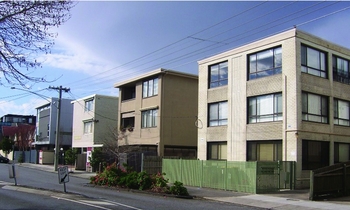
Running perpendicular to Carlisle Street, Westbury Street has always been solidly residential, rather than commercial, although it does feature a Catholic Church and school at its northern end. Once lined with detached brick houses, most of which were built in the period between the 1880s and the 1920s, today it is dominated by two- and three-storey blocks of flats (colloquially known as ‘six-packs’ in Australia) (Figure 2). Some of these were built before World War II, but most date from the 1960s and early 1970s. A study of municipal rate books over the 25 years from 1955 to the early 1980s allows us to document a street and a suburb undergoing a process of profound change as Jewish immigrant residents and entrepreneurs began to make their mark on the economy and culture of the neighbourhood. In 1955, there were 104 separate lots in the section of Westbury Street that lies within St Kilda's North Ward, most (82) of which featured a single-family houses of 3 to 12 rooms. The majority were detached bungalows and villas of 4 to 6 rooms. Some of the larger ones appear to have been boarding houses, although in the absence of detailed resident records of tenants and sub-tenants this is almost impossible to verify.Footnote 28 Westbury Street's other 22 lots housed 140 flats in 22 mostly small purpose-built blocks of 4 to 8 flats, with Westbury Heights at number 38, with its 24 individual units, by far the largest single block. The majority of the residents of the houses were owner-occupiers – 48 out of 82 – while almost all flat-dwellers were tenants. In both the flats and the houses the majority of residents were of British or Irish background, but it is impossible to tell whether these were local-born or immigrants. Already, however, there was a sizable minority of Europeans, mostly Jews, most of whom, as we have seen, were likely recent pre- or early post-war immigrants.
General view, Westbury Street, East St Kilda, 2013 (courtesy of author)

Even before the full impact of post-war Jewish migration was felt in Melbourne in the later 1950s and 1960s, Jews were heavily over-represented as owners and landlords of Westbury Streets flats. Rate book records show that in 1955, 13 of the 22 identified owners of flat blocks had what can be described as obviously Jewish names, while a number of other blocks were owned by individuals with names that are ambiguous, but also possibly Jewish.Footnote 29 One block, Wessex Manor, was owned by a company, Centre Court Pty Ltd of Collins Street in the CBD. Most of the Jewish owners were individuals or husband and wife couples, but at least one block of 12 flats – Seaton at number 66 – was jointly owned by three sisters Frances, Maud and Leah Slonim. Tenants of the Jewish landlords were from mixed backgrounds, but many were Jewish. Some were possibly relatives or acquaintances of the owners, although without access to detailed family history records this is almost impossible to verify accurately. We do know, however, that more established Jewish Australians acted as guarantors of jobs and accommodation for families and others fleeing persecution before the Holocaust and seeking a safe haven after it. It is possible that some of Westbury Street's flats were used for these purposes. The flats at number 64 were, for example, owned by a member of the Fink family, whose patriarch Leo was a founding member and active champion of the United Jewish Overseas Relief Fund, which sponsored and housed refugees before the war and survivors after it.Footnote 30 In 1955, at least six of the eight tenants of this block were Jewish.
Over the following 20 years, Westbury Street's dwelling stock almost tripled in size, until by the mid-1970s it consisted of nearly 600 individual dwellings, the vast majority of which were now flats rather than houses.Footnote 31 By the late 1970s only 30 houses of 82 houses recorded in 1955 remained intact, meaning that 95 per cent of Westbury Street's dwellings, and more than 70 per cent of its individual lots, were now flats. Most of these were in two- and more commonly three-storey blocks, and most were very new, with the majority having been built in the 1960s and early 1970s. At least 30 separate blocks of flats were built in Westbury Street between 1960 and 1975, 17 in the five years to 1970 alone. Westbury Heights was overtaken as the largest single block by 27 flats built at number 82 in 1965, but these large blocks remained rare, with most new developments ranging from 10 to18 flats each, and by 1975 only 4 of the 74 blocks of flats in Westbury Street contained more than 20 individual flats.
Tenants’ names were not rigorously compiled in the 1960s and 1970s, but from those that we do have we know that residents of Westbury Street's flats were a mix of the local-born, European immigrants and a very small number of Asian immigrants. Most blocks had a mix of residents, but on extremely rare occasions some smaller blocks housed either a majority or an entirety of Jewish tenants. One such example was the block of six flats at number 108, which was developed by a Jewish woman in 1958, and which appears to have had an almost exclusively Jewish tenant profile for most of the next 20 years. But such exclusivity was extremely unusual, and unlike some individual apartment blocks and larger high-density developments in cities in the United States for example, few of Westbury Street's flats ever developed an entirely Jewish resident profile.Footnote 32
As in the case of number 108, Jewish individuals and businesses came to exert an important influence on the development and ownership of Westbury Street's flats in the post-war period. This became especially true in later years as the community became both more economically established and entrepreneurial in its behaviour. Some of these people invested profits from other businesses − most notably the clothing textile and footwear industries which had a strong Jewish connection at this time − into flats, while for others the development and on-selling of flats was their primary source of income. Peter Kaufman, owner of Sunray Lingerie and four flats at number 49 from at least the mid-1950s through to the mid-1970s was an example of the first group, as was Mendel Fetter of Fetter Mills, who owned five flats at number 43 from at least the mid-1950s though to 1968. Similarly, the six flats next door at 45 which were owned from the mid-1950s until 1976 by a couple described as ‘merchants’ might also follow this trend. As I have argued elsewhere, this recycling of profits from other business interests into the ownership of flats was to become a common feature of the Melbourne property market in the 1960s.Footnote 33
One response to such investor demand was the emergence within the Jewish community of a second entrepreneurial group, developers who would build blocks of flats before subdividing them and selling them off as individual units, or more commonly on-selling whole completed blocks to investors who would then let them out as rental units. These processes and individuals became a major feature of Westbury Street's flat market, especially in the 1970s. While at the beginning of that decade single flats in only 10 of Westbury Street's 70 blocks were held in individual ownership (‘own your own’ (OYO) or ‘strata title’ in Australian parlance), rate valuation cards for the latter 1970s suggest that this process became very common later in the decade. By the 1980s, single ownership of an entire block had become more the exception than the norm, and almost all of Westbury Streets flats were by then held in individual ownership. Those that were strata-titled earlier (in the 1960s and early 1970s) were usually built specifically for owner-occupiers by developers and development companies that specialized in this field.
Again, as we have seen a number of these developers and their clients were Jewish, significant numbers of them Holocaust Survivors who turned their hand to building and development 10 to 15 years after arriving in Australia in the early post-war years. Two such people were the owners of Henley Constructions, which was founded in 1963 by Schlomo Itzan a Polish-born glazier who had arrived in Australia as a ‘stateless person’ aged 32 in 1950 and Isaac Hatz, an electrician who was similarly a stateless Polish-born refugee who had arrived in Melbourne in 1948. In the mid- to late 1960s, Henley became a major developer of low-rise OYO flats, including two blocks of nine units each at numbers 44 and 46 Westbury Street built in 1967/68, which were immediately sold off individually to what appear to be entirely Jewish investors (Figure 3).Footnote 34 The company was also involved more broadly in the St Kilda flat market in this era, although available records do not allow us to gauge the full extent of its activities in this field. We do know from published contract reports listed in the trade journal Cazaly's Contract Reporter that besides the 18 flats at 44–46 Westbury Street Henley built at least another 27 flats in three blocks in streets around St Kilda in the period from 1962 to 1970, before Hatz’s untimely death aged 48 in 1971.Footnote 35
44 and 46 Westbury St, East St Kilda, 2013 (courtesy of author)

In Westbury Street and in St Kilda and East St Kilda more generally in the post-war period, then, high rates of immigration and residential succession saw the transformation of the demographic profile of what had been a classic Victorian-era and early twentieth-century middle-class Australian suburb into an enclave conspicuous for both its large numbers of central and eastern European immigrants and for its predominantly high-density urban form. What had until the 1950s been a mostly low-density suburban street saw its dwelling numbers almost triple in the space of a generation as entrepreneurial members of that new population reacted to increased demand for dwellings by replacing the area's original detached suburban houses with low-rise apartment buildings, many of which they then rented out or on-sold to investors, including other immigrants. In Westbury Street's case, most of the people who facilitated this transformation were Jewish, but as we shall see this process of suburban transformation in Melbourne was less a Jewish story and more an immigrant one. Across Melbourne in the more working-class suburb of Footscray, similar changes occurred and were also driven by European immigrants, albeit there mostly by recent arrivals from Italy and other parts of southern Europe.
‘An industrial suburban community’ transformed: Empire Street, Footscray
Footscray, in Melbourne's inner western suburbs, was similarly transformed with flat development in the post-war period, albeit as we shall see slightly later than was East St Kilda. Like St Kilda, Footscray is both a suburb and a municipality, but unlike more middle-class St Kilda it has always been what its official historian John Lack calls an ‘industrial suburban community’.Footnote 36 Separated from the CBD by two rivers and a major swamp, Footscray has long been Melbourne's back door. Known as ‘Worst Smelbourne’ in the nineteenth century when it was home to meat processing and associated livestock and other noxious industries, it became a major centre of manufacturing and light industry in the twentieth. Its central area, adjacent to an important railway junction, has also always been a vibrant shopping and business district featuring department stores and a variety of local and regional business premises. From the mid-twentieth century, these shops and businesses increasingly began to reflect the demands and needs of a new and emerging ethnic clientele. In contrast to similar working-class neighbourhoods in Europe and the American north-east, however, Footscray's nineteenth-century housing stock was neither high-density nor overcrowded. Instead, it overwhelmingly consisted of detached single family dwellings – mostly three- and four-roomed single- and double-fronted timber houses. The majority were owner-occupied, with Lack noting that in the late nineteenth century approximately 60 per cent of Footscray's houses were owned or being purchased by their occupiers.Footnote 37
In 1947, Footscray's population totalled 53,459 people who lived in 13,454 dwellings, almost all of which were separate houses. As was the case across Melbourne, however, the post-war housing shortage meant that more than 10 per cent of these (1,368) were shared by more than one family. Unlike in St Kilda, where flats had already become common in the inter-war years, in Footscray they were almost non-existent; only 64 purpose-built flats and 116 tenements were recorded across the entire municipality in 1947. At that time, more than 90 per cent of the population was Australian-born, with less than 300 from non-English-speaking countries. The largest of these groups were the 54 Germans, 32 Italians and 28 Greeks.Footnote 38 But as with St Kilda, Footscray's population profile was rapidly transformed in the post-war years as it became home to large numbers of European immigrants. In contrast to St Kilda, however, the majority of these new residents came from south and south-eastern Europe rather than the centre or north. Between 1947 and 1981, Footscray's population declined by just over 4,000 to 49,756, but the overseas-born expanded rapidly to number 19,364 or nearly 40 per cent of the population. The largest single group were what were then called Yugoslavs (5,307 or 11 per cent of the population), followed by Greeks (2,495) and Italians (2,422). Residential morphology similarly dramatically changed in the post-war period, so while by1981 there was a slight fall in the numbers of detached dwellings to 12,963 (72 per cent of the total) there was a huge increase in the number of flats to 3,856 (22 per cent).
As was the case with Westbury Street, the post-war history of Empire Street, to the west of Footscray's main shopping precinct, reflects many of the demographic and morphological changes that swept across Melbourne's suburbs during these decades. While today Empire Street is almost totally dominated by flats, it was originally one of those Footscray streets described by Lack as featuring ‘detached cottages standing on plots relatively generous by inner suburban standards’.Footnote 39 Empire Street was thus fairly nondescript and a typical late nineteenth-/early twentieth-century suburban Footscray street. It rates a mention in the official history of the suburb, however, because of its unusual gestation as one of several streets that formed a ‘bold experiment in State-financed worker housing – the Footscray Workmen's Home Settlement Scheme, or “The Settlement” as it simply came to be called’. This early twentieth-century scheme saw the state government make ‘allotments available to 100 families at £3 10s per year for thirty years, and provided loans for housing on a pound for pound basis up to £50’.Footnote 40
By 1907, ‘The Settlement’ was home to about 250 people who lived in 80 or so separate houses, mostly three- and four-roomed detached weatherboard cottages. More were constructed in what Australians call the ‘Californian Bungalow’-style in the inter-war years. The last publicly available rate assessment study undertaken in 1935 before the impact of mass immigration shows that of the 35 houses in the street in that year, 33 were constructed of timber, one was built of brick and the other made of stone. One house included stables, while the Footscray Settlers Progress Association Hall could be found at number 8. Only six of the houses were tenanted, the rest owner-occupied by mostly working-class men and their families. There were no flats, and based on resident numbers in each of the houses, no boarding houses, although some families may have informally taken in boarders to supplement meagre incomes. As would be expected in the days before mass immigration, all residents of Empire Street had what could be described as British, Irish or ‘Australian’ names.Footnote 41
Empire Street changed dramatically in the post-war years.Footnote 42 Until the 1970s, its dwelling structure remained largely intact, but its ethnic profile changed fundamentally. Of the 32 separate houses that remained in 1972, 21 (i.e. more than two-thirds) were owned by Continental European immigrants, including Italians, Greeks, Yugoslavs and Ukrainians. The houses had been joined by three blocks of flats – at numbers 18, 22 and 32, the largest of which, 14 one- and two-bedroom flats built in 1967 at number 22, were owned by Italian-born Giovanni Colossimo of Newport, a neighbouring suburb (Figure 4). In 1967, 12 two-bedroom flats had similarly replaced a six-roomed house at number 32. These flats were owned by Luigi D’Andrea of nearby Smith Street, Footscray. In both cases, tenants of the flats were a mix of the local-born (or possibly immigrants from English-speaking countries) and Continental Europeans whose ethnic profile mostly mirrored that of the home-owners. The third block was what are called ‘units’ (or villa units) in Australia – attached single-storey dwellings built lengthways down or clustered around a traditional suburban block. Number 18 was a block of five of these units built in 1971 and owned by Saverio and Monica Sabatella, a brother and sister who had arrived in Melbourne from Sicily in 1955 aged 13 and 6 respectively. By 1972, he was a labourer and she a hairdresser and they lived at 11 Empire Street with Roberta and Angelo Sabatella, a labourer and his wife who were no doubt related in some way. By 1972, Saverio was 30 and Monica was 23, so the flats may have legitimately belonged to them, but more likely they were acting as nominees for Angelo or Roberta, who for whatever reason may have wanted to keep secret from the authorities knowledge of their ownership of these flats.Footnote 43
22 Empire St, Footscray, 2013 (courtesy of author)

Valuation and rate books for Empire Street in the 1970s are missing, but those from the 1980s tell us that its morphology was entirely transformed in that decade, until by the early 1980s there were only nine of the original 35 pre-war houses left. Four of these were new houses recently built to replace older ones on the same lot, while the rest of the street was now flats and units. The same was true of much of The Settlement, which was now largely made up of two-storey blocks of flats. As had been the case in Westbury Street, most of these flat blocks were strata-titled in the 1970s, but in the mid-1980s at least nine blocks remained in single ownership. Immigrants, especially Italians for whom property ownership became an important symbol of prosperity and belonging in post-war Australia, remained important among this group, with five of the blocks in single ownership having identifiably Italian owners.Footnote 44 One Italian Gianni Camparo built nine flats and a corner shop at number 2 in 1982, and appears to have lived and worked on site, while Saverio Sabatella had become the sole owner of the five flats at number 18. He retained that ownership until at least the late 1980s, but like a lot of Italians in this period he had moved out of Footscray to Melbourne's north-western suburban frontier, which was increasingly becoming a centre of secondary immigrant residence at this time. The new owner of Luigi D’Andrea's flats at 32 Empire Street – another Italian – similarly lived in this north-western corridor. And in what is perhaps indicative of ethnic succession in business as well as residence, Giovanni Colossimo's 14 flats at number 22 were now owned by a Chinese-Australian who resided in the outer south-western suburbs, which was also rapidly developing at that time.
Conclusion: suburbs in transition
The demographic and morphological changes experienced in these two streets and these two suburbs are possibly extreme, but they are emblematic of similar changes that transformed the inner and middle regions of suburban Melbourne in the three decades after World War II. What had been low-density, largely monocultural suburbs were reinvented and rebuilt to reflect their new status as zones of transition for newly arrived and later economically successful immigrant groups. As the old British-dominated suburban city underwent a programme of mass immigration and cultural transformation, so too were older suburban streetscapes reimagined and remade by new immigrant groups who altered the built fabric of the city and its suburbs to reflect their dwelling requirements and desire for economic security.
The changes experienced in East St Kilda and Footscray, and documented here, are representative of an international phenomenon that saw higher-density redevelopment transform a number of suburbs in immigrant cities across the English-speaking world in the second third of the twentieth century. As Matthew Lasner has recently documented, urban and suburban flat/apartment development became ubiquitous in cities across the United States in the post-war years.Footnote 45 Similar changes were seen in other formerly low-density suburban cities across the world, including Sydney, Toronto and Johannesburg, which all saw higher-density residential development (often undertaken by immigrants) in these decades.Footnote 46 In undertaking these redevelopments, the new residents transformed the traditional British-inspired low-density form of these streets and neighbourhoods, and in doing so also transformed the dwelling culture of these once suburban cities into localized versions of an emerging hybrid-form of international (sub)urbanism that combined the street layout of the individual suburban lot with the higher residential and population densities of traditional urbanism.
There is an argument that the changes documented here reflect the use and re-use of urban rather than suburban spaces, and that both East St Kilda and Footscray are city neighbourhoods rather than suburbs in the classic sense of the term. But in a city such as Melbourne, where there has never been an accepted definition of the difference between the urban sphere and the suburban, this argument makes little sense. These same arbitrary definitional divisions may also be true elsewhere. As McManus and Ethington note, suburbia is as much a concept as a place. Our definitions of what constitutes suburbia change over time, and what were once sparsely populated locations on the fringe become core regions as populations grow and technology evaporates time and distance. Footscray and East St Kilda were once far-flung suburbs, whereas both are now considered inner-city neighbourhoods (or ‘inner suburbs’ in the Australian vernacular). Their geographic locations obviously did not change, but their residents, dwellings and economic and social profiles did. That is the nature of space, including suburban space. Land uses and morphology change over time to reflect new realities and the impacts of wider historical forces, including demographic change. As McManus and Ethington suggest, our understandings of the history of these suburban places, and indeed of the history of the wider metropolis, needs to be constantly updated to reflect these ongoing processes of change and succession.