Introduction
Most dementias are irreversible and progressive. At different stages of their disease, dementia patients develop various problems that usually do not have a single solution and require multidisciplinary approaches (Richards and Hendric, Reference Richards and Hendric1999). The special needs of these patients have led to the development of focus care teams, such as those within memory or psychogeriatric clinics, where comprehensive and holistic case management is applied to dementia. The prevalence of dementia in Hong Kong, reported to be 6.1% in people aged 70 and above, is similar to that in the West (Chiu et al., Reference Chiu1998). However, at the population level, recognizing dementia as a disease involves the understanding of norms, values, attitudes towards care-giving and dependency, which are strongly culturally bounded. The impact of dementia on individual patients and their families is shaped by premorbid lifestyle, traditional values toward aging, and expectations or beliefs (Dilworth-Anderson and Gibson, Reference Dilworth-Anderson and Gibson2002). In different ethnic populations, memory clinics could be targeting different subsets of patients and operating in different dimensions of dementia care. In this study we review our own experience of local dementia patients in Hong Kong, paying particular attention to patient demography, referral patterns and social backgrounds upon referral, and diagnostic profiles after evaluation. We hypothesize that in modern Chinese cities like Hong Kong, where traditional values and Chinese culture are still largely preserved especially among the older population, the presentation of dementia could be quite different from that in Western countries at similar levels of socioeconomic development.
Methods
This study comprises a retrospective case notes review of consecutive patients referred to the memory clinic at Princess Margaret Hospital, Hong Kong from 1 January 1999 to 30 June 2004. The clinic was established in early 1998 as a geriatric-based multidisciplinary clinic with expertise from a neurologist (B.S) and geriatricians (C.B.L and K.M.Y) in a tertiary hospital. It operated two half-day sessions per week and accepted one new patient per session. The clinic service was temporally suspended for about 3 months in 2003 because of an epidemic of human corona virus respiratory infection (severe acute respiratory syndrome, SARS) in the region, during which period the government designated this as a receiving hospital for SARS patients in Hong Kong. We received a diverse source of referrals. About half of the patients were referred from other specialties of the same hospital, most of them were from other internal medicine subspecialties, and it was likely that these patients would have a high prevalence of comorbidities. The rest were referred by general practitioners (GPs), general outpatient clinics (GOPC, the primary health care clinic run by the government), nursing homes and even community elder centers. The average waiting time for a new referral was six weeks. The study period was chosen from the beginning of 1999 because from that time point onwards a complete electronic patient record database was available for use.
We followed the published practice guide in the diagnostic workup for dementia (Knopman et al., Reference Knopman2001). Patients seen in the memory clinic had a battery of blood tests, including complete blood count, renal and liver function tests, glucose, cholesterol, calcium and phosphate levels, serum vitamin B12, thyroid function tests and syphilic serology. We used computerized tomography (CT) of the brain as the standard imaging modality for diagnostic evaluation, and magnetic resonance imaging (MRI) in selected patients. Other investigations, like electroencephalograph and cerebrospinal fluid examinations, were performed when indicated.
Neuropsychological assessment
We used standard neuropsychological and functional assessment instruments during initial assessment and at regular intervals. During the first consultation, a Mini-mental State Examination (MMSE) and/or a clock-drawing test were used as screening tests for cognitive impairment (Folstein et al., Reference Folstein, Folstein and McHugh1975; Royall et al., Reference Royall, Cordes and Polk1998). Patients with mild symptoms or those with diagnostic ambiguity that required more detailed neuropsychological evaluation were assessed by ADAS-Cog in a subsequent clinic visit (Rosen et al., Reference Rosen, Mohs and Davis1984). We used the clinical dementia rating (CDR) to rate the severity of dementia (Morris, Reference Morris1993), and for patients under regular follow up, MMSE was repeated on a yearly basis.
Diagnosis of dementia
The diagnosis was jointly reached by the core members of the clinic after reviewing the investigation and cognitive assessment results. We used the Diagnostic and Statistical Manual IV (DSM-IV) criteria for the diagnosis of dementia (American Psychiatric Association, 1994), and followed the guidelines set in NINCDS-ADRDA and NINDS-AIREN for Dementia of Alzheimer's disease (AD) (McKhann et al., Reference McKhann, Drachman, Folstein, Katzman, Price and Stadlan1984) and vascular dementia (VaD) (Román et al., Reference Román1993), respectively. Patients who we believed to have both AD and cerebral ischamic components were classified as AD with cerebral infarction if the cognitive profile was not that of a full-bloom VaD. We avoided the term “mixed dementia” (MD) since a good consensus in describing this condition is still lacking.
Subjects and statistics
We identified 454 patients from the electronic patient record database by searching the memory clinic coding within the period of interest. We then reviewed the outpatient records of each individual patient and retrieved the important information regarding patient demography, investigations and cognitive assessment results, residence and community supports and the final diagnosis after evaluation. Most of the statistics applied were descriptive only. The numerical data were presented as mean ± SD for continuous variables, and median (25, 75 percentile) for categorical and non-normal distributed variables.
Results
Overview of diagnostic patterns in the memory clinic
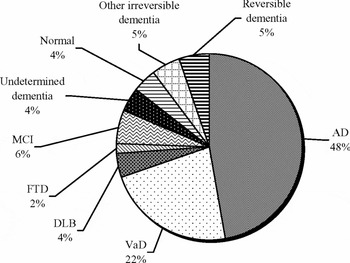
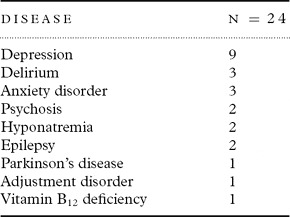
We recruited 454 patients with a mean age of 76.1 ± 9.4, 60.4% of whom were female. The median duration of follow-up was 13.8 (4.1–29.0) months. Three hundred and eighty-five (84.8%) had dementia, and 27 patients had mild cognitive impairment (MCI) (Figure 1). Twenty-four patients were found to have reversible dementia; their cognitive impairment either resolved or improved significantly after treatment of the primary etiology (Table 1). Normal cognitive function was confirmed in the remaining 18 patients with their forgetfulness being deemed to be age-related.
Diagnostic profile of the 454 memory clinic attendees. AD = Alzheimer's disease; VaD = vascular dementia; DLB = dementia with Lewy bodies; FTD = frontotemporal dementia; MCI = mild cognitive impairment.

Individual diagnoses in reversible dementia

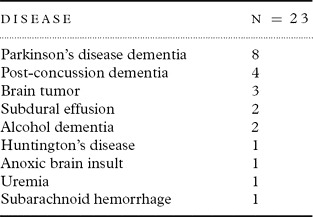
Of the patients with dementia, 215 (55.8%) had AD, the most common form of dementia in the cohort. Other dementia patients had VaD (26.2%), other irreversible dementia (6.0%), dementia with Lewy bodies (DLB) (5.2%), undetermined dementia (4.9%) and frontotemporal dementia (FTD) (1.8%). Most of the undetermined dementia patients were at an advanced stage of the illness and could not provide information on their disease progression; others had undergone an incomplete medical evaluation. Other irreversible dementias included patients with dementia developing from Parkinson's disease, trauma, etc (see details listed in Table 2).
Individual diagnoses in other irreversible dementias.

Characteristics of dementia patients in the memory clinic
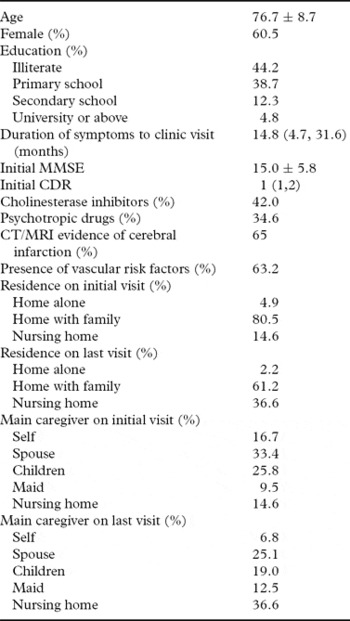
We diagnosed 385 dementia patients. The median duration from symptom onset to clinic attendance was two years (range: four months to ten years). Forty-four percent were illiterate, and up to 83% had not received education beyond the primary level. Their mean initial MMSE was 15.1, and the median CDR was 1. A majority (66.5%) had moderate to severe dementia with initial MMSE ≤ 17 (Table 3).
Clinical and demographic factors of 385 dementia patients.

MMSE = Mini-mental State Examination; CDR = Clinical Depression Rating; CT = computerized tomography; MRI = magnetic resonance imaging.
Imaging and laboratory investigations in dementia patients
Brain CT or MRI was performed in 326 out of 385 dementia patients; 65% had different degrees of ischemic lesions. If only AD patients were selected, 54.1% (106 out of 196) had ischemic lesions. Most of the patients who did not have imaging investigations were those with advanced dementia and severely disabled to the extent that we considered a comprehensive work-up would be futile. Laboratory tests for syphilic serology, vitamin B12 level and thyroid function tests were available for 79%, 80% and 82.1% of the patients respectively. Twenty patients had abnormal syphilis serology, but none had neurosyphilis after further investigations. Low vitamin B12 levels were found in 44 patients, but the dementia was only reversible in one patient after vitamin B12 replacement. Three patients had abnormal thyroid function tests (one with hyperthyroidism and two with hypothyroidism); their cognitive function did not improve with correction of thyroid function.
Social circumstances of dementia patients
Eighty-five percent were community-dwelling upon their first visit and the rest were nursing home residents. Over a median duration of two years, the proportion of nursing home residents more than doubled (37%), and a shift of responsibility on patient care from spouse and children to external resources such as maid and institution was observed (see Table 3). A quarter of patients had received various community support services on their first visit, with centers for the elderly being most frequently utilized (75%); other services such as home help and meal delivery were also popular.
Discussion
Presentation of dementia at an advanced stage
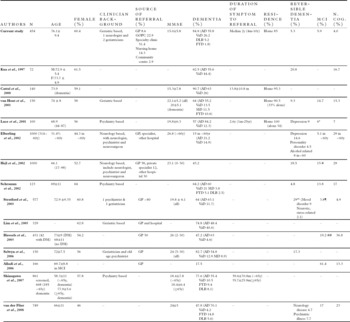
Eighty-five percent of patients referred to us with dementia symptoms were confirmed as having dementia, while reversible attributable causes such as anxiety and depression were only diagnosed in a few. In the literature, disease patterns varied quite remarkably among different clinic settings and referral channels, where dementia prevalence could range from 50% at the lower end to 90% at the higher end (Kua et al., Reference Kua, Tan, Lee, Ko and Tan1997; Cattel et al., Reference Cattel, Gambassi, Sgadari, Zuccala, Carbonin and Bernabei2000; van Hout et al., Reference van Hout2001; Luce et al., Reference Luce, McKeith, Swann, Daniel and O'Brien2001; Elberling et al., Reference Elberling, Stokholm, Høgh and Waldemar2002; Hejl et al., Reference Hejl, Hogh and Waldemar2002; Schramm et al., Reference Schramm, Berger, Műller, Kratzsch, Peters and Frölich2002; Stratford et al., Reference Stratford, Logiudice, Flicker, Cook, Waltrowicz and Ames2003; Lim et al., Reference Lim, Chin, Lam, Lim and Sahadevan2005; Biessels et al., 2005; Selwyn et al., Reference Selwyn, Findlay and McMurdo2006; Alladi et al., Reference Alladi, Arnold, Mitchell, Nestor and Hodges2006; Shinagawa et al., Reference Shinagawa2007; van der Flier et al., Reference van der Flier, Pijnenburg, Schoonenboom, Dik, Blankenstein and Scheltens2008). It appeared that the geriatric-based memory clinic consistently reported higher prevalence compared to neurology- or psychiatry based services. We not only had a prevalence close to the higher end, but also a high prevalence of advanced stage dementia. Our initial MMSE of 15 is among the lowest, but the reported duration of symptoms before the clinic visit was relatively short, which implied that our Chinese dementia patients had a longer period of “asymptomatic” or “subclinical” dementia.(Table 4) One possible reason is the low education of this cohort, which may invite a lower cut-off of MMSE scores. However, judging from the high nursing home transition rate and the need for psychotropic drugs, our overall impression on an advanced stage of dementia cohort still stands. We attempt to explain this phenomenon with reference to the local culture and socioeconomic structures. The local Chinese culture, which places high value on harmony, interdependence and reciprocity, might have a higher tolerance for cognitive decline in the aged. Many may accept it as a normal aging process, and even when individuals are affected with profound dementia, families may not seek external help, as they perceive providing care for the aged and sick as their natural responsibility – so called filial piety (Gallagher-Thompson et al., Reference Gallagher-Thompson2003). In addition to this cultural influence, the simple lifestyle adopted by the elders could also serve to mask cognitive impairment. In the West, people usually live in a highly dynamic and mentally demanding environment throughout their lives, and will be particularly aware of any change in their mental capacity that might endanger their independence and autonomy; by contrast, in Oriental societies many of the local elders still live a very simple lifestyle, and many of them live with – or very close to – their younger relatives in the same district for decades. They receive pocket money from their children and seldom worry about banking services or financial management issues. Jogging and going for morning tea in a nearby restaurant become a routine such that, even with a decline in mental competency, they will still be able to carry on this simple lifestyle without much difficulty. Cognitive impairments therefore do not bring an individual to medical attention until they have progressed to a stage such that he or she fails to meet the demands of daily living or develops behavioral symptoms that are disturbing to the family. This is reflected in the high utilization of psychotropic drugs in our clinic, and a high nursing home transition rate within short period of time. Nevertheless, we do not expect this pattern of late presentation to persist in the future generations. The middle aged – those who were born after World War II – have generally received a better education and have benefited from a stronger economy. They tend to be more financially independent and more concerned about their health. Since more and more middle-aged people in Hong Kong participate in annual health screenings for such medical problems as diabetes, hypertension and obesity, they are more likely to seek medical help at the very early stage of any subjective memory problems. Our current practice could therefore see a revolutionary change over the next two or three decades.
A comparison of the current study and other published dementia cohorts from different kinds of memory clinics.

AD = Alzheimer's disease; DLB = dementia with Lewy bodies; DM = diabetes mellitus; FTD = frontotemporal dementia; GOPC =; general outpatient clinic; GP = general practitioner; MCI = mild cognitive impairment; VaD = vascular dementia.
*Age associated cognitive decline; #Isolated amnesia; ¶Mild organic cognitive syndrome not associated with systemic disease; **Reversible etiology; ## Cognitive impairment with no dementia.
High prevalence of cerebral infarction in dementia
The proportions of different subtypes of dementia reflected the local disease pattern, with AD being the most common form of dementia, followed by VaD. More than half of our AD patients had cerebral infarctions, which is higher than the reported prevalence of 30–40% in pathology-proven AD (Snowdon et al., Reference Snowdon, Greiner, Mortimer, Riley, Greiner and Markesbery1997; Heyman et al., Reference Heyman1998). Cerebral infarction is known to accelerate the clinical expression of dementia in AD at its early stage (Snowdon et al., Reference Snowdon, Greiner, Mortimer, Riley, Greiner and Markesbery1997), and its presence suggested that vascular etiology could play an important role in the manifestation of dementia in local AD patients. However, since half our cohort is from other specialties of the same hospital, the comorbidities we found could be predictably higher than other community dementia cohorts.
Vitamin B12 deficiency and dementia
Hyperhomocystinemia is a well-established risk factor for AD and stroke, and vitamin B12 deficiency is an important factor for hyperhomocystinemia (Seshadri et al., Reference Seshadri2002). Ten percent of our dementia patients had vitamin B12 deficiency. There was no information available on whether correction of hyperhomocystinemia would modify the course of AD. In our sample, only one out of 44 patients with a vitamin B12 deficiency improved after replacement treatment.
Community support in dementia patients
We found that despite advanced stages of dementia, the majority of patients were still community-dwelling. Of these, 80% required caregivers, and spouses accounted for half of these. Filial piety strengthens the family bonding and may delay the transition to nursing home care, but spouse caregivers are elders themselves, often poorly educated and lacking access to new information. These deficiencies deprive them of community services and resources, and they are vulnerable to physical and mental stresses due to caring for their partners with dementia. In our case notes review, we could not specify the trigger event that brought patients to the clinic in a systematic way, but from the indirect clue of psychotropic drug prescription and transition of care responsibilities from family members to external resources it is reasonable to presume that many of the trigger events are related to escalating behavioral disturbances or psychotic symptoms that will cause a break-down in sustainable community care. From our experience, late intervention in these scenarios inevitably carried a high failure rate, as the caregivers are already over-exhausted and looking for nursing home transition as a final way out. We believe the gate-keepers of the various social services could help here by encouraging medical assessments and treatments and making referrals if necessary, as these patients may not be aware of their medical needs.
To summarize, dementia patients in Hong Kong seek medical attention at advanced stages and apparently enjoy a long asymptomatic period. We postulate that the underlying reasons for this can be found in differences in culture and socioeconomic structures.
Conflict of interest
None.
Description of authors' roles
B. Sheng designed the study, collected the data, performed the statistical analysis and wrote the paper. C. B. Law collected the data, amended the paper and supervised the study. K. M. Yeung collected the data, amended the paper and assisted in the statistical analysis.