


1 Introduction
The past decades witnessed a wave of market-oriented health care reforms throughout the world, particularly in Europe and North America (Stabile and Thomson, Reference Song, Du, Zhou, Shen and Xue2014; Maarse et al., Reference Ma2015). These market-oriented reforms are prompted by a combination of rising demand for health care services, increasing expectation for health care quality and significant pressure to curb the growth in health care spending. Often, at the core of these reforms are efforts to expand patient choices and to promote competition among health care providers.
To a large extent, China’s health care reforms reflect the same pattern. A new round of health system reforms first implemented in April 2009 helped to transform China’s health care delivery and financing systems by establishing a national basic medical insurance system and deregulating the hospital market with the welcomed entry of private investment. These reforms have made significant achievements in relieving the problem of ‘difficult and expensive health care (kan bing nan, kan bing gui)’ in that the new health insurance programs ensure the urban and rural residents to have better (although not universal or uniform) access to basic health care and more choices in selecting the providers (Yip et al., Reference Yip, Hsiao, Chen, Hu, Ma and Maynard2012). Moreover, the newly established private hospitals help to satisfy the unmet medical need due to the overcrowding in public hospitals (Liu et al., Reference Li2013).
Despite their initial success, China’s health care reforms may not be sustainable in the long run, due in part, to their heavy reliance on subsidies from the central and local governments (Yip et al., Reference Yip, Hsiao, Chen, Hu, Ma and Maynard2012). Perhaps more importantly, the reforms do not directly involve the core player in the health care delivery system, namely the public hospitals, who serve the largest number of patients in China, yet suffer from low efficiency in health care provision (World Bank, 2010; Ng, Reference Newhouse2011). It is clear that unless the operational efficiency among public hospitals is improved, the health system reform in China is not likely to achieve its desired results even with continued investments from the government. To this end, the public hospital reform has been identified by the current central government as the core of the next stage health reform agenda (Li, Reference Li2011).
The urgent need to reform public hospitals has drawn recent attention at all levels of the society. Recent academic studies have proposed different approaches to the public hospital reform. Some call for building the market environment for hospital competition (Liu et al., Reference Li2013; Pan et al., Reference Ng2013), while others propose more government involvement to correct market failures within the health care sector (Li, Reference Li2006). The above debate on the viability of market-based reforms centers on a fundamental question: whether the health care market is different from other markets. That is, will introducing the market mechanism improve the hospital sector’s long-run performance? Undoubtedly, the health care market is unique in various aspects (Arrow, Reference Arrow1963), but it also shares common features with other markets (Porter and Teisberg, Reference Pierson2004). The combination of individuality and generality of the health care market can easily lead to misunderstanding of the role that competition plays in this market (Dranove, Reference Dranove2011; Gaynor and Town, Reference Gaynor2011).
Indeed, when discussing the possible impacts of introducing market mechanism into the hospital sector, much of the domestic debate in China has been misled in that it equates ‘market competition’ to ‘competition between public and private hospitals’. This is because given China’s successful experience in marketizing its economic sectors, the market mechanism has always been closely connected with privatization, deregulation and encouragement of competition between different ownership forms. As such, the academic discussion concerning competition in health care market often drifts to the discussion over hospital ownership and the reforms of property rights. Off-the-point debates subsequently arise such as whether public hospitals should pursue profit or whether private hospitals should be allowed to ‘cherry pick’ the profitable medical services. In contrast, scant attention has been paid to the issue of competition between public hospitals, thereby limiting the public view on how competition can function in diverse contexts, and may in turn generate an underestimation of the value of competition as an instrument for hospital reforms.
This paper aims to expand the scope of the current discussion on China’s health care reforms by assessing the potential impacts of adopting pro-competition policies among the public hospitals on the efficiency of the health care market. Specifically, we adopt a two-stage approach to address the following questions: whether the pro-competition policy is a viable option for China, and if so, how to reap the positive outcomes of hospital competition. In the first stage, Section 2 introduces the conceptual framework on how the internal competition among public hospitals can influence the hospital market and improve health care delivery. In the second stage, Section 3 examines the key institutional features in China’s hospital system, and preliminarily assesses the incentive environment and the outcomes of the public hospital competition in China. In Section 4, we propose policy suggestions based on the findings for China’s future hospital reforms.
2 Conceptual framework
2.1 Competition vs privatization and deregulation
Market-oriented reforms in health care are traditionally implemented through a general movement toward privatization and deregulation in the hospital industry. This practice is motivated and reinforced by the academic research that often links market-based health care resource allocation with the privatization of public hospitals and the relaxed entry barriers of private hospitals (Maier-Rigaud, Reference Maarse, Jeurissen and Ruwaard2012). Some recent policy discussions in China even proposed a total abdication of government regulation and responsibility in the health care market (Li, Reference Li and Huang2012), leading to the ‘laissez-faire’ view on the hospital reforms.
This ‘laissez-faire’ reform approach also has a series of repercussions in China (Communist Party of China (CPC) Central Committee and State Council, 2009; National Development and Reform Commission et al., Reference Maier-Rigaud2014), leading to debates in social media over the effectiveness of promoting private ownership in the hospital market. In the recent health care reform agenda, for-profit and not-for-profit private hospitals are both allowed to set their own prices for medical services. Many of these private institutions become Medical Insurance Designated Hospitals and are put on equal footing with the public hospitals in terms of obtaining reimbursement from the public health insurance payers.
Despite the above academic and practical undertaking, it is often ignored, however, that the essence of the market-oriented reforms is to promote competition rather than privatization and deregulation. Equating the two concepts can greatly limit the scope of how competition influences the development of the health care market. Admittedly, the market allocates resources through competition, and competition is the essence of the market mechanism. Besides efficient resource allocation, competition is also believed to be the most important means of promoting social welfare (Pierson, Reference Pan, Qin, Li, Messina and Delamater2001). However, conceptually it must be made clear that though privatization is a way to promote competition, it apparently is not competition.
Considering the limited health care resources and patient volumes in the medical market, hospitals can be motivated by economic or social benefits to compete. The extent to which such competitive behavior is observed lies in whether the hospitals or their managers are given the incentives to compete, instead of whether the hospitals are public or private. Once the incentives are aligned for competition, public hospitals can engage in the ‘internal competition’ against each other, as opposed to the ‘external competition’ between public and private ownership forms. Although the traditional health care reforms have emphasized on the importance of external competition, we argue that internal competition plays a more important role in China. This is because public and private hospitals have significant differences in size and service mix.
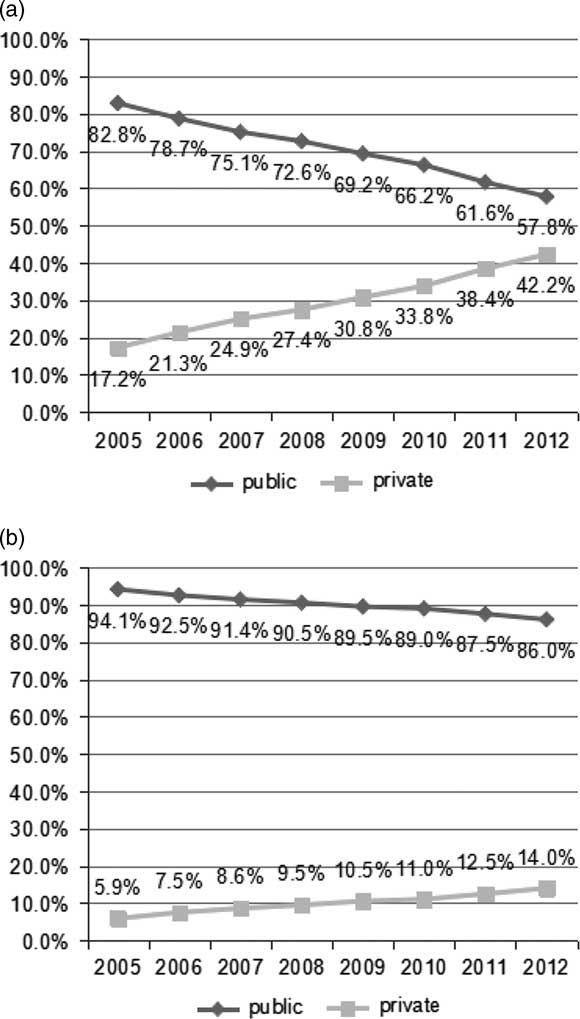
Figure 1 shows that the number of private hospitals increased rapidly in recent years, from 17% of total number of hospitals in 2005 to 42% in 2012. However, the market share of private hospitals (measured by hospital beds) is still relatively low, increasing from 6 to 14% during the same period. This indicates that the mean size of private hospitals is far smaller than that of public hospitals. Second, most public hospitals are general hospitals, while the majority of the private hospitals are specialty hospitals (Tang et al., Reference Tam2013). These descriptive statistics show that the private and public hospitals may operate in segmented markets, implying that (external) competition between them may not have a strong impact on the overall efficiency of the hospital market. As a result, this study focuses on the viability and potential impacts of internal competition on health care efficiency.
Ownership structure of hospitals (a) and hospital beds (b) in China, 2005–2012 (%). Source: Health Statistical Yearbook of China (2006–2013). Note: Public hospitals include the hospitals registered as state owned or collectively owned. Private hospitals are the non-public hospitals.

2.2 Internal competition and hospital market efficiency: a review
Whether the pro-competition policies can be used to promote health care efficiency hinges on whether and how competition may affect the quality and cost of the hospital services. In this section, we provide a review of the relevant literature to assess the possible answers to this question, with a special focus on the internal competition.
The organization of health care systems varies around the world, which in turn shapes the institutional features that affect how hospitals compete and the outcomes associated with their competitive behaviors. In general, the existing empirical studies on the effects of hospital competition are mainly based on data from United States and United Kingdom (Gaynor and Town, Reference Gaynor2011). Our review focuses on the UK-based studies because the institutional features of the British health care system are more relevant to China in two dimensions: (1) the vast majority of hospital care in United Kingdom is provided by public hospitals; and (2) the health care prices are regulated by the government and hence hospitals can only compete on a non-price basis.
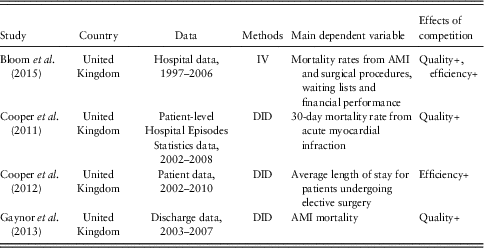
Cooper et al. (Reference Cooper, Gibbons, Jones and McGuire2011), for instance, find that the hospital quality in United Kingdom improved after the post-2006 reforms by National Health Service (NHS) to expand the patient choices over hospitals within a market under fixed-price regulation. Using discharge data from 162 hospitals in United Kingdom, Gaynor et al. (Reference Gaynor, Moreno-Serra and Propper2013) conclude that providing patients with more health care choices such as locations and timeliness can improve their clinical outcomes without raising the costs. The above research jointly demonstrates that hospital competition effectively improves health care quality in the British NHS system (see Table 1 for a summary).
Summary of the selected studies on public hospital competition

AMI=acute myocardial infarction; IV=instrumental variable; DID=difference in differences.
In addition to the discussion on whether hospital competition has a definitive effect toward health care productivity, many recent studies are also concerned with how such effects take place, that is, the influencing mechanisms of competition on hospital performance. On the positive side, some studies hypothesize that competition improves hospital productivity through its promotional effect on hospital operational efficiency. For example, Cooper et al. (Reference Cooper, Gibbons, Jones and McGuire2012) find that the post-2006 NHS reforms in United Kingdom effectively created a more competitive environment for hospitals, which in turn helps them to reach a higher level of operational efficiency. Similarly, Bloom et al. (Reference Bloom, Propper, Seiler and Van Reenen2015) argue that competition puts pressure on hospitals to improve their management quality, which in turn is beneficial to the overall hospital performance.
On the other hand, competition may give rise to a medical arms race (MAR) and cream skimming (CS) (patients selecting) behaviors, which may lead to lower hospital efficiency. MAR refers to the case where hospitals compete in purchasing expensive medical equipment in an effort to attract patients. Due to the information asymmetry between the consumers and providers of medical care, hospitals may engage in MAR, buying large amounts of expensive medical equipment and transferring the incurred costs to patients through the physician-induced demand (i.e. over-prescription of diagnostic tests for the recovery of equipment costs).
CS behavior refers to the case where hospitals engage in patient screening with the goal of reducing treatment costs or gaining reputation (Friesner and Rosenman, Reference Friesner and Rosenman2009). For example, when the government adopted the prospective payment system and started to reimburse inpatient cases on a flat-rate basis according to diagnosis-related group (DRG) categories, hospitals began to admit patients who were relatively easier to treat, turning away the severely ill who are more likely to generate financial loss for the hospitals (Cooper et al., Reference Cooper, Gibbons, Jones and McGuire2011; Gaynor, Reference Gaynor and Town2012).
In addition to MAR and CS, some studies also find that hospitals may either reduce their costs when confronted with competition by lowering the quality of health care services when the patient demand elasticity of price is high, or increase prices for better quality when the patient demand elasticity of quality is high (Cutler et al., Reference Cutler, Huckman and Kolstad2010). The validity of this prediction, of course, depends on the assumption that hospitals are able to segment the market according to the customer demand.
2.3 Prerequisites for the positive outcomes of hospital competition
The review in the above section suggests that competition among hospitals may lead to either improvement or deterioration of health care efficiency. Thus, it is important to further assess the conditions under which the positive effects of competition may be elicited. According to Cooper (Reference Cooper2012) and Gaynor (Reference Gaynor and Town2012), there are four main prerequisites or necessary conditions, which include enough hospitals, incentives for hospitals to attract patients, demand responsiveness to differences across hospitals and enough information.
For hospitals to compete, patients must have alternative providers to choose from, that is the hospital market cannot be a monopolistic market. However, a competitive market does not necessarily involve a large number of hospitals either. Due to the economy of scale in health care, the number of hospitals in a region is often small, but studies have shown that even a small number of hospitals can generate fierce competition (Bresnahan and Reiss, Reference Bresnahan and Reiss1991; Abraham et al., Reference Abraham, Gaynor and Vogt2007).
In the face of competition, hospitals will have the incentives to attract patients only if they receive financial or social benefits from serving more patients. For-profit hospitals naturally have such incentives due to financial payoffs. But the government-sponsored public hospitals are often charged with social responsibilities (e.g. epidemic disease control, unemployment relief, etc.) and may not be primarily driven by financial concerns. In particular, if the hospital revenue is unrelated to the quantity of patients they serve, it is expected that such hospitals would have no incentives to attract patients. Thus, the incentives for competition usually depends on how hospitals receive their revenues. For example, the major source of hospital revenues in United Kingdom are from the prospective payment that is related to the number of patients treated (Bloom et al., Reference Bloom, Propper, Seiler and Van Reenen2015), which gives hospitals the incentive to attract patients.
The third prerequisite is that patients must have explicit preferences in making health care choices, that is they show ‘revealed preference’ over the differences across hospitals. Such preferences can be measured in multiple dimensions of hospital services such as cost, reputation, facility, physician attitude, etc., and they can be heterogeneous among patients. The preferences are usually ‘revealed’ by the patients’ responsiveness to the differences in these dimensions, and they form an important foundation for hospitals to compete and specialize in.
The last necessary condition is that there is enough information disclosure to help the patients make informed health care choices. This means that patients should be equipped with sufficient knowledge to understand the differences among hospitals – particularly the differences on health care quality and prices. This does not necessarily imply that all consumers in a market are well informed. Rather, it is sufficient that enough buyers are well informed such that sellers cannot discriminate between the well informed and the poorly informed customers (Gaynor, Reference Gaynor and Town2012). Such information can come from multiple sources, such as the government authorities or independent third-party agencies, who help provide impartial information that reduces search costs for the patients.
3 A preliminary assessment of the current public hospital competition in China
3.1 Assessing the four main prerequisites for effective hospital competition
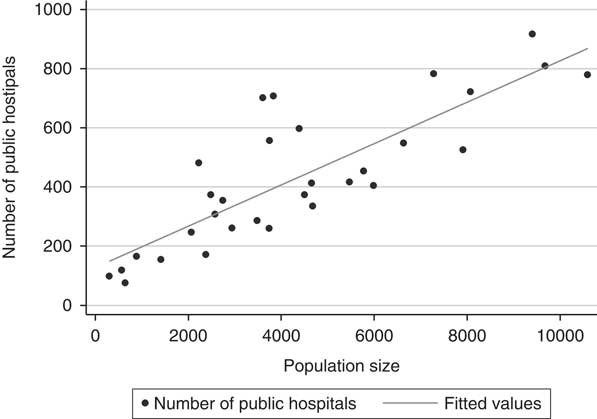
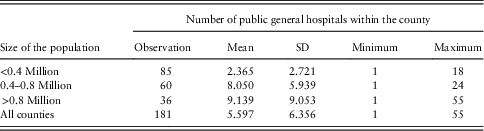
Does China have enough hospitals to promote internal competition in local health care markets? China has a large number of public hospitals. According to the 2014 Health Statistical Yearbook of China, there are 13,396 public hospitals in the 31 provincial-level administrative regions. With the planning oversight by the central Ministry of Health and local health bureaus, public hospitals are widely distributed throughout the whole country, albeit more densely concentrated in the more populous areas (see Figure 2). Table 2 shows the distribution of public hospitals in Sichuan province, a large inland province in western China: among the 181 counties in Sichuan, the average number of general public hospitals is 5.6 per county, and about half of the counties contain four or more general public hospitals. Given the fact that Sichuan belongs to China’s economically less-developed region with relatively low density of health care resources, the above evidence suggests that most counties in China should have at least two public hospitals, an indication that China satisfies the first prerequisite for internal competition in local health care markets.
Population size and number of public hospitals in China’s provinces, 2012. Source: Health Statistical Yearbook of China (2013) and Statistical Yearbook of China (2013). Note: The unit of measurement for provincial population size is 10,000 people.

Population size and the number of public general hospitals at county level in Sichuan Province, China, 2012

Source: Statistical Yearbook of Sichuan (2013).
Note: County hospital numbers are obtained using the Sichuan Provincial Health Statistics Support System Database, which is administrated by the Health and Planning Commission of Sichuan Province.
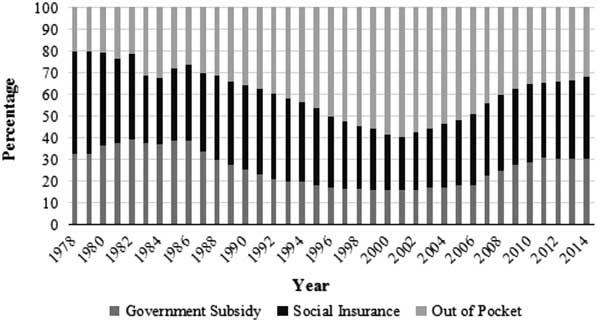
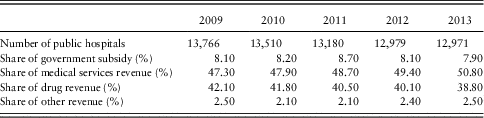
Are China’s public hospitals sufficiently motivated to increase their patient volumes? We believe the answer is yes due to the following institutional factors. First, as shown in Table 3, the public hospitals in China receive only about 8% of their total revenue from the government subsidy between 2009 and 2013, and have to rely on their own day-to-day operation for the remaining 92% of revenues to pay for staff salaries and other overhead. This phenomenon arises from the marketization reforms enacted in early 1980s that reduced government subsidies to public hospitals in order to allow them to take on a market-driven approach to meet their budget needs (Figure 3 shows the declining share of government funds in China’s total health care expenditure since early 1980s). In addition, the medical price regulation in China adopts a two-tier pricing system: low prices (often below marginal costs) for the basic services and high prices (often well above average costs) for prescription drugs and high-tech diagnostic procedures such as magnetic resonance imaging (Eggleston and Yip, Reference Eggleston and Yip2004). Under the two-tier price regulation, the public hospitals in China typically rely on the sales mark-up of prescription drugs and market-priced items to cross-subsidize the underpriced items such as the low salaries of hospital-employed doctors and nurses. As a result, prescription drugs typically contribute >40% of total revenues in China’s public hospitals (Table 3). This institutional feature gives sufficient incentives for the public hospitals to attract patients, as a larger patient volume ensures more revenues for employee welfare and long-run development.
Health care expenditure by payment sources in China, 1978–2014. Source: Health Statistics Yearbook of China (2014).

The composition structure of public hospital revenues in China, 2009–2013

Source: Health Statistical Yearbook of China (2014).
Another source of motivation is the hospital payment and insurance reimbursement systems, which mainly follow the fee-for-service model. Other payment mechanisms, such as capitation, DRG-based prospective payment and pay-for-performance, are all currently being experimented with and promoted in pilot cities such as Beijing and Changde. These innovative payment methods intend to mitigate the incentives of hospitals to prolong inpatient stays, but may also boost their incentive to increase the bed turn-over rates and patient loads when risks are not properly assessed and adjusted for each patient. A recent study by Jian et al. (Reference Jian, Lu, Chan, Poon, Han, Hu and Yip2015), for instance, show that the pilot plan of DRG payment in Beijing led to reductions in total health expenditure and out-of-pocket payment per inpatient admission by 6.2 and 10.5%, respectively. Although the new payment system shows the potential to save health care costs, it still preserves incentives for public hospitals to attract more patients in order to obtain revenues (Bloom et al., Reference Bloom, Propper, Seiler and Van Reenen2015).
Lastly, even for the public hospitals that do not concern themselves with maximizing revenues, a large patient volume is also essential for developing good reputation and high-quality research and training programs. A unique feature of China’s public hospital system is that the presidents and managers in these hospitals carry government cadre ranks and are thus directly affiliated with the ministry of health or local health bureaus. Their performance is periodically evaluated by the government administrators, and the number of outpatient visits and the overall performance of the hospitals are usually the primary measures for the evaluation. In such a context, hospital managers usually have strong incentives to maintain good hospital practice and attract talented and experienced doctors and staffs. This career motivation gives China’s public hospitals yet another major incentive to compete for patients.
Is there enough demand responsiveness to differences across hospitals in China? We believe the patient demand is generally responsive enough to promote hospital competition because of the less strict referral system in China’s health financing policies. Although hospitals are categorized into three tiers and patients are encouraged to follow the physician referral procedure when seeking medical care, the insurance administration in China does not enforce a strict ‘gate keeper’ model. That is, patients in China are allowed to choose hospitals and specialist even without the referral recommendation from the primary care doctors. In addition, the public payers in China do not impose substantially different copayment rates across the three levels of hospitals. Therefore, self-referral to higher levels of hospitals usually does not incur significant monetary costs to patients, although they need to pay the non-monetary cost such as the long waiting time in higher level hospitals. As a result of the above policies, the vast majority of Chinese patients have strong incentives to survey their options and actively search for the hospitals that best suit their needs.
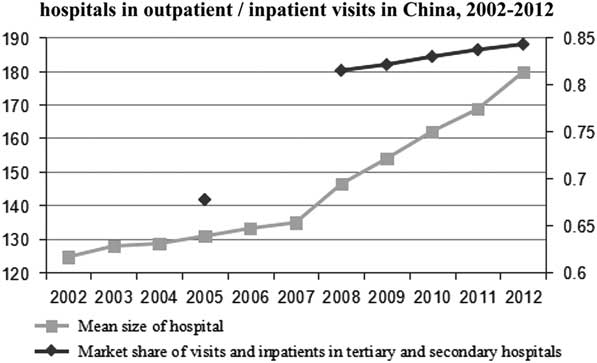
Figure 4 provides supporting evidence that the Chinese patients often use the size of hospitals as a signal of quality and hence tend to self-refer to larger hospitals. Between 2002 and 2012, the mean size of hospitals in China increases from 125 beds to 180 beds. Meanwhile, we observe that the market share of large (secondary and tertiary) hospitals increases over time, from 67% in 2005 to 85% in 2012. Given that the patient preferences are revealed by the hefty share of large hospitals in both outpatient and inpatient services, it indicates that the pro-competition policies may benefit the Chinese patients in making informed choices when seeking health care. As an example, a recent study conducted in Ningxia province during 2009–2012 examines the roles of provider quality and health care prices in patients’ selection of health care facilities (Hafez, Reference Hafez2014). It finds that both quality and price serve as significant determinants for the patients’ choices of outpatient care providers, while the inpatient care is more influenced by cost concerns. These results confirm our hypothesis that the health care demand in China is very responsive (elastic) to hospital differences, and thus the third precondition for effective competition is likely to hold in China’s public hospital sector.
Average size of hospitals and the market share of tertiary and secondary hospitals in outpatient/inpatient visits in China, 2002–2012. Source: Health Statistical Yearbook of China (2013). Note: ‘Mean size of hospital’ denotes the number of hospital beds on average. ‘Market share of visit and inpatients in tertiary and secondary hospitals’ denotes the proportion of visits and inpatients in tertiary and secondary hospitals.

Is there sufficient information provision to promote internal hospital competition in China? We believe the evidence in support of this prerequisite is less strong than the other necessary conditions. In China, the new round of health care reforms that started in 2009 made building the information system a priority in order to modernize the health care delivery system. During the central government’s 12th Five-Year Plan published in 2011, a three-level health information platform – national, provincial and municipal – was proposed and will be constructed on a national scale by 2018.
Already, aggregated health care-related data are readily accessible to the public that provide information such as the distribution and classification of local hospitals, the local average personal health care expenditure, the patient utilization patterns and hospital bed turn-over rates, etc., which can be helpful for some patients. However, a significant gap still exists for providing comprehensive, unbiased and detailed public information regarding the quality and prices of specific hospitals. For example, Song et al. (Reference Smith, Preker, Ligght and Richard2015) investigate the quality of public hospital websites in China by selecting about 70% of public hospitals from Shanghai, Hubei and Gansu provinces (a sample of 878 hospitals), and show that only one-third of the hospitals use websites to provide useful information (such as service items and prices) to the public. The limited availability and low quality of information through the internet drives the majority of patients in China to rely on private or informal information channels when selecting hospitals, such as the word-of-mouth from their families, friends and online posting websites. The reputational effect often leads to striking popularity differences between the good and the bad hospitals, which may in turn, intensify hospital competition and make hospitals more alert to patient demand (Ma, Reference Lu2001).
3.2 Is the internal competition performing well among China’s public hospitals?
The analyses in the above section show that three out of the four necessary conditions are satisfied for favorable hospital competition in China. In terms of the fourth necessary condition, however, the current system lacks the formal provision of public information on the quality of hospital services. Consequently, we observed in recent years various adverse outcomes arising from the ‘vicious competition’ among public hospitals, which can be summarized in the following three dimensions.
First, there is strong evidence of MAR among public hospitals in China. An important driver of public hospitals’ MAR behavior arises from China’s hospital accreditation system, which classifies hospitals into three accreditation levels: (1) level 1 (primary or community hospital); (2) level 2 (secondary or metropolitan hospital); and (3) level 3 (tertiary hospital or medical center). Conducted every four years by the accreditation agency, the size of hospitals and the number and types of medical equipment within the hospitals are used as major classification criteria. Although the initial purpose of the accreditation system is to guide patient referrals, it leads to unintended consequences such as MAR as the lower-level hospitals have strong incentives to expand its size and to purchase new medical equipment in the hope to upgrade themselves to higher levels. Similarly, the existing tertiary hospitals also have incentives to keep investing in new medical equipment and hospital beds in order to maintain their accreditation status. Consequently, public hospitals in China expand in size and medical equipment purchases increase rapidly (Figure 4; He et al., 2013).
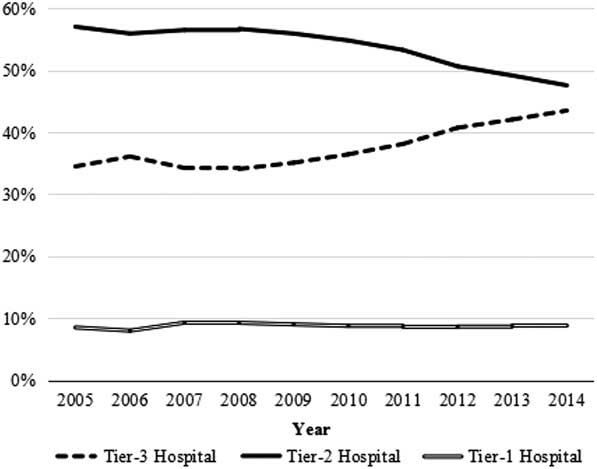
Figure 5 shows that the market share of tertiary hospitals (in terms of hospital beds) increased rapidly in recent years from 34% in 2005 to 43% in 2014. As the share of primary hospitals remained mostly constant, the increasing share of tertiary hospitals is associated with a decreasing share of secondary hospitals, suggesting that the secondary hospitals have strong incentives to become tertiary hospitals. In fact, the race for being tier-3 hospitals forced the regulatory agency to invalidate the approval of 240 new tier-3 hospitals in order to slow down the leap forward process (Xinhua News, 2012).
Share of hospital beds by three accreditation levels in China, 2005–2014. Source: Health Statistics Yearbook of China (2005–2014). Note: The non-accredited hospitals are excluded from the analysis.

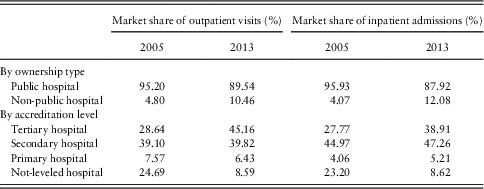
To provide additional evidence of MAR, Table 4 shows the distribution of health care utilization by three accreditation levels. The results show that tertiary hospitals gained a large market share in both outpatient visits and inpatient admissions in the recent decade, which can be explained by two reasons: first, the capacity of tertiary hospitals increased considerably in recent years (Figure 5); second, the tertiary hospitals have invested heavily in new medical technology and equipment that in turn attract more patients. Based on a survey from 71 hospitals selected from four sites (Shanghai, Zhejiang, Shaanxi and Hunan), He et al. (2013) find that the growth in the number of high-tech medical equipment between 2006 and 2009 was higher than most of the Organisation for Economic Co-Operation and Development countries. Shanghai experienced the highest growth rate, indicating that hospitals in larger cities are more likely to engage in MAR.
Hospital outpatient and inpatient market shares by ownership types and accreditation levels in China

Source: Health Statistical Yearbook of China (2014).
Note: Most non-accredited hospitals in China are non-public that newly entered the hospital market, thus the available information on the health care utilization by three accreditation levels mainly reflect the patterns in public hospitals.
The second widely recognized negative outcome from hospital competition is drug over-prescription. As mentioned, the hospital income in China is directly linked to the sales of pharmaceutical products under the current two-tier pricing system. In this case, physicians may serve as imperfect agents for patients as their self-interest plays an important role in the prescription decision. At the hospital level, as the drug revenue always accounts for a major share of hospital revenues, over-prescription becomes a rampant behavior in most public hospitals, which translates to added financial burden on the patients (Table 3).
Currie et al. (Reference Currie, Lin and Zhang2011) find micro evidence that physicians are likely to prescribe more drugs to patients if they can receive direct income from prescriptions. Based on a field experiment, Lu (Reference Liu, Guan and Gao2014) also shows that physicians prescribe 43% more expensive drugs to the insured patients compared with uninsured patients, suggesting that the agency problem is even stronger if patients have health insurance coverage. At the national level, drug expenditure persistently accounts for over 40% of total health expenditure in China, which is significantly higher than the normal levels in other countries. This has long been criticized as a major source of inefficiency in China’s health care system, as drugs that are prescribed solely for hospitals’ profit margins often produce low or even negative health benefits for the patients (due to the potential side effects and adverse drug interactions), reducing the overall cost-effectiveness of China’s health care system.
The third negative outcome of hospital competition in China is the attenuation of the trust relationship between patients and physicians, observed by the increasing number of medical malpractice litigations in recent years (Pan et al., Reference Pan, Liu and Ali2015a). Tam (Reference Stabile and Thomson2012) surveys 434 patients from 26 public hospitals in Beijing, and shows that patients’ trust in physicians is relatively low, especially in physician agency and information provision (as opposed to physician’s technical and interpersonal competence). There are two plausible explanations: first, as noted above, the hospitals’ pursuit of profit from drug sales has resulted in agency problems and damaged the patient trust in physicians; second, as public hospitals in China expand, the health care utilizations are heavily concentrated in large hospitals, making it difficult for patients to keep a long-standing relationship with their doctors. In such a hospital-centered system, most patients are ‘one-time buyers’ instead of ‘repeat customers’, making it difficult for patients to acquire sufficient information about their doctors’ treatment decisions. In fact, patients’ choice in China is limited to the extensive margin in the sense that patients can typically choose between hospitals, but once at the hospitals, patients have very limited choices in the treatment decisions (Eggleston and Yip, Reference Eggleston and Yip2004). Although direct evidence is lacking, we speculate that the ‘one-time buyer’ phenomenon is an important reason why many medical malpractice disputes in China result in violence against doctors (The Lancet, Reference Tang, Zhang, Chen and Lin2014).
Although the above negative outcomes of hospital competition are pervasive, there is preliminary evidence to show that public hospital competition has also produced positive outcomes in improving health care delivery in China. Specifically, Pan et al. (Reference Pan, Liu and Gao2015b) use both provincial- and individual-level data to investigate the relationship between hospital competition and the outcomes of health care delivery in China. The study finds that greater competition is associated with shorter outpatient waiting time, lower outpatient costs and reduced mortality rate in outpatient observation rooms. Overall, the results suggest that positive outcomes of hospital competition are more likely to be achieved in the outpatient setting than inpatient setting. A plausible explanation is that inpatient services are more differentiated and thus the providers are more likely to gain monopolistic market power, which in turn may weaken the competition effects. In addition, patients are less likely to become ‘repeat customers’ for inpatient services as compared with outpatient services. Thus, the learning opportunity is low in the inpatient sector.
4 Policy options for enhancing the public hospital competition in China
A major conclusion drawn from the above analyses is that China’s public hospitals have been involved in internal competition for a long time, and both positive and negative outcomes are observed from this competition. Thus, the key policy challenge in China is not whether or not to introduce competition into the hospital sector, but on how to fix the public hospital system so that internal competition can reap positive outcomes in term of increasing quality or lowering costs. In the public hospital market, the policy instruments to improve competition are quite diversified (Smith, Reference Porter and Teisberg2009). Countries adopt different policies based on their historical, socio-economic or cultural backgrounds (Smith et al., Reference Smith2005). In regard to China’s ongoing public hospital reform, we provide the following policy suggestions.
4.1 More information disclosure
Given the lack of public information in the current hospital market, we argue that information provision is the first priority for enhancing the pro-competition policies in China. As information is usually a public good with high private costs (the fixed costs of producing hospital data) and high social benefits (the positive externality due to information spillover), private sectors or individual hospitals often do not have strong incentives to invest in this area. Thus, the public sector needs to play an active role in the production and dissemination of health care information. To provide appropriate guidance for public hospital competition, the government should invest in the technology infrastructure and information platforms to release timely and unbiased data on the quality of medical care to encourage patients to ‘vote with their feet’ (Hibbard et al., Reference Hibbard, Stockard and Tusler2005), which in turn may force the public hospitals to strive for higher efficiency and treatment quality.
4.2 Pricing and payment system reforms
As noted, several unintended consequences of hospital competition arise from the price distortion and the traditional fee-for-service payment system. Thus, an important task for mitigating the negative outcomes is to remove the price distortion in health care. As the fee-for-service system involves thousands of health care items and procedures, the direct regulation of item prices can be difficult due to the political challenges from health care providers and the incapability of the government to ‘set’ the reasonable prices for all kinds of health care services. Thus, a more efficient solution for the price distortion problem is to use the indirect price regulation through payment system reforms toward the prospective payment schemes (Eggleston and Yip, Reference Eggleston and Yip2004). In China, the DRG-based payment that reimburses hospitals based on the severity-adjusted disease categories is being promoted as a way to control costs. Other payment strategies such as pay-for-performance and capitation is also being experimented with and shows promises.
4.3 Higher degree of autonomy for lower-level medical institutions
Given that the majority of large hospitals in China are owned and operated by the government, the improvement of the pro-competition policy requires the government to refrain from micro-managing the hospitals and to promote the ‘good corporate governance’ among public hospitals. This separation of operational management and regulatory oversight is instrumental for building a competitive environment and provide more flexibility and incentives for hospitals to improve their performance in the marketplace (Pan et al., Reference Ng2013). Local reforms such as ‘hospital president responsibility system’, in which the president of a lower-level hospital is given full authority for staff hiring, wage setting and development planning, are good practices along this direction (Li and Huang, 2010), and their initial success provides much support for the expansion of such models. This view is consistent with the observation of a World Health Organization group who proposed that the core players in China’s future hospital market are those operating at the county level (Barber et al., Reference Barber, Borowitz, Bekedam and Ma2014). Under such policy guidance, hospitals are more likely to capitalize on their own comparative advantage (such as competency in certain specialties), to find the market niche in the competition and to increase the overall efficiency in allocating the medical resources.
4.4 Stronger regulation
The above three policy options focus on the demand and supply sides of the market, respectively. On the system (market) level, the government can improve their regulations over the quality and prices of the hospital services. In the face of competition, hospitals are likely to adopt a strategy that maximizes their ‘output–input ratio’ or increases their market share, which may or may not lead to the improvement of health care productivity. In particular, given the information asymmetry between patients and providers, it is difficult for patients to assess the real quality of health care, but they are often quite sensitive to health care prices. Thus, when confronted with a trade-off between costs and quality, hospitals are more likely to compete over prices at the expense of quality (Newhouse and RHIE Group, 1993). Therefore, it is necessary for the government to strengthen the regulation and set the guidelines of service quality in the hospital market to prevent this ‘race to the bottom’ pattern.
5 Conclusions
After more than three decades of market-oriented reforms that have benefited the economic sectors in China, it is important to explore whether the same market mechanism (in general) and the pro-competition policy (in particular) can also be applied to the health sector. Given that public hospitals account for nearly 90% of market share in China’s health sector, this paper addresses an important question on whether the pro-competition policy can be an effective solution for China’s public hospital reform. Our analyses yield three important findings.
First, we point out that there are two types of competition in China’s hospital market: external competition, which refers to the competition between the incumbent public hospitals and the newly entered private hospitals; and internal competition, which refers to the competition among the existing public hospitals. Our analyses indicate that the private and public hospitals are in two segmented markets due to their systematic differences in size and service mix. As a result, the internal competition may play a more significant role in China.
Second, given that prior studies find mixed evidence on the impact of pro-competition policies on the quality of hospital care, we further investigate whether the current institutional features of China’s public hospital sector satisfy the prerequisites for positive outcomes of competition. The results show that three out of the four pre-conditions are satisfied in the current context, with the only exception being that the current system lacks the effective provision of public information on the quality of hospital care.
Third, given the lack of public information available in China’s hospital market, our analyses further identify several unintended consequences of hospital competition, including MAR, drug over-prescription and the high level of distrust between patients and doctors. However, we also find evidence of positive outcomes of hospital competition in China, including the effect of reducing outpatient waiting time and outpatient costs. We offer the following recommendations to guide hospital internal competition: improve public investment on information provision (strengthening the information infrastructure and dissemination agencies), enact pricing and payment reforms, increase autonomy for lower-level hospitals and strengthen the regulation on the hospital market.
An important implication of our study is that the pro-competition policy is a viable option for China to increase the efficiency in the hospital sector as long as the public sector takes the responsibility of removing the price distortion in the health care market and provides timely, detailed and unbiased information on hospital care. Given that China has shown a strong comparative advantage in using IT investments to increase the productivity in many industrial sectors (such as e-commerce), we are optimistic that China can readily apply this know-how to increase the productivity and efficiency in the hospital sector. Compared to the government subsidies on expanding the coverage of health insurance, the cost of public investment in health information technology and information disclosure networks for hospital quality is relatively low. Thus, neither the financial cost nor the technical know-how is likely to become a barrier for the realization of healthy competition in China’s hospital sector.
Acknowledgments
The authors thank National Natural Science Foundation of China (71303165 and 71573003), Ministry of Education of China (12JZD036), Sichuan University (skqx201401), China Postdoctoral Science Foundation (2013M540706 and 2014T70863) the startup funds of Duke Global Health Institute and China Medical Board (13–167) for their financial support. They also thank Niying Li for her excellent research assistance in collecting the data and offering helpful comments on the earlier version of this paper. The authors are responsible for all remaining errors.