Introduction
Since the late nineteenth century, England, along with most Western liberal democracies, has developed policy and practice in child welfare with the intent to ensure that the state is able to intervene in the privacy of the family in order to protect children, while at the same time supporting the family as the key institution for rearing children. It is our argument that in recent years we have witnessed a shift in the way this fine balance is managed. In particular, there is an increasing emphasis on the importance of policy and practice being underpinned by and organised in ways that are explicitly ‘child-centred’. These developments are particularly evident in England, with the recent creation of local authority Departments of Children's Services. Beyond this, we will argue that these new organisational and administrative arrangements pose particular challenges where practitioners and managers struggle to locate individual children in their familial and social contexts, and where their histories and relationships are important. These challenges are particularly evident in the growing reliance upon a range of new Information Communication Technologies (ICTs) in day-to-day professional practice, where the primary data unit is the ‘atomised’ child. This is a major issue currently. For while government is keen, following the high-profile death of ‘Baby Peter’ (Laming, Reference Laming2009), to ensure that children are kept safe (HM Government, Reference Government2009), it is also keen to emphasise the importance of children's services working closely with adult services and, in particular, that they Think Family (Cabinet Office, Social Exclusion Task Force, 2008).
A community-based family service
It is important to remember that these developments differ from the philosophy and organisation of services previously established in England. The reorganisation of local authority personal social services in 1971 was based on the recommendations of the Seebohm Report (Seebohm, Reference Seebohm1968). The central recommendation of the Report was the establishment of a new local authority department that would be:
a community-based and family-oriented service which would be available to all. The new department will, we believe, reach far beyond the discovery and rescue of social casualties; it will enable the greatest possible number of individuals to act reciprocally giving and receiving service for the well-being of the whole community. (Ibid.: para. 2)
The new department would be universal in nature, focusing on the family and community, and provide a range of personalised, generic services. An explicit attempt was made in establishing this new family service to ensure that all age ranges would be included, and different needs and problems addressed in order to overcome previous concerns about fragmentation. Importantly, the family was both the focus of attention and the key organisational unit on which the service would be based. In many ways, the Seebohm Report and the reorganisation of the personal social services were premised on a traditional notion of the nuclear family, in which the male was the breadwinner, the female took prime responsibility for the domestic sphere and the rearing of children took place in a context of lifelong marriage (Rustin, Reference Rustin, Parry, Rustin and Satyamurti1979).
The subsequent 40 years have seen enormous changes in the nature and structure of ‘family’ life. The number of first marriages more than halved from 390,000 in 1975 to 175,000 in 1997, while remarriages made up two-thirds of the total. The number of divorces more than doubled between 1961 and 1997, when the total was 175,000, only slightly fewer than the number of first marriages (ONS, 1998). Crucially, for our purposes, the proportion of children born outside marriage quadrupled, and by the end of the 1980s fewer than 50 per cent of 18–24 year-olds thought it necessary to marry before having children (Kiernan and Estaugh, Reference Kiernan and Estaugh1993). Two-thirds of first partnerships in the early 1990s were cohabitations, compared with one-third 20 years earlier, and 22 per cent of children were born into cohabiting unions, compared with 2 per cent 20 years earlier (Ermisch and Francesconi, Reference Ermisch and Francesconi1998).
The rate of cohabitation among couples with children reached 13 per cent in 1998, and among those in the lowest third of the income distribution scale the rate was almost 26 per cent. Among couples with children who were drawing benefits, it was more than two and a half times as high (Marsh et al., Reference Marsh, McKay, Smith and Stephenson2001). Lone-parent households with dependent children increased from 2 per cent of the total of all households in 1961, to 7 per cent by 1979. The notion of lifelong marriage as the only sanctioned framework for sexual partnerships and parenthood had come to be seen as increasingly outmoded by the end of the twentieth century. However, the failure of one relationship appears not to be a deterrent to repartnering, and another increasingly common feature of ‘family’ life is that of ‘social parenting’, in which children are being raised in homes in which one adult, usually the father figure, is not the biological parent. Ferri et al. have argued that what underlies such trends in family and personal relationships ‘is the extent to which they are rooted in the changing position of women’ (Reference Ferri, Bynner and Wadsworth2003: 302).
A number of commentators (Beck and Beck-Gernsheim, Reference Beck and Beck-Gernsheim2002; Smart and Neale, Reference Smart and Neale1999) have argued that these changes have shifted the basis of interpersonal relationships from the nuclei to networks, so that what is increasingly left are ‘partnerships’. In the process, sexuality has been decoupled from marriage, and increasingly becomes something to be discovered, moulded and altered. No longer are marriage and parenthood seen as being tied together, for having a child is increasingly separate from decisions about marriage for increasing numbers of people. In addition, and for the first time, fertility rates are now often below the threshold for generational replacement, and the number of children in the population has been reducing in both absolute and relative terms as people live longer. Consequently, the value of each child, both emotionally and economically, is much greater than previously.
The model of the ‘normal’ nuclear family, based on the institution of lifelong marriage and premised on the male-breadwinner model, by the late 1990s seemed outmoded, and the changes have increasingly been taken into account in the way policy and practice in child welfare have been thought about and organised. Rather than the focus of attention being primarily on ‘the family’, as previously, children have increasingly been seen as important in their own right. In addition, the period since the early 1970s has also seen increasing anxieties about children and childhood.
This has been most evident in relation to a series of high-profile child abuse inquiries, where children have died at the hands of their parents and carers. A major concern has been that professionals were too concerned with the views and interests of the parents and not sufficiently cognisant of the needs and wishes of the children (Parton, Reference Parton2006). In particular, children were seen as ‘objects of concern’ rather than ‘subjects’ in their own right (Secretary of State for Social Services, 1988). These concerns were addressed in the Children Act 1989, where there was a focus on the ‘welfare of the child’, particularly where a ‘child was in need’ (Parton, Reference Parton1991). Guidance to professionals has increasingly stressed the importance of seeing and talking with children separately, and recognising that their ‘needs’ and ‘interests’, while related to those of their parents, need to be identified and assessed separately.
Individualising ‘children in need’
Initially, in the early 1990s, the children ‘in need’ who were considered especially vulnerable were children ‘looked after’ away from home and for whom the local authority assumed a degree of parental responsibility. The development of the ‘Looking After Children’ (LAC) project proved key in developing a whole range of new assessment technologies in which individual children are the focus. The project (Parker et al., Reference Parker, Ward, Jackson, Aldgate and Wedge1991) was prompted by growing political concerns about residential care for children and scandals that received wide media coverage in the late 1980s and early 1990s (Corby et al., Reference Corby, Doig and Roberts2001). It was seen as vital that local authorities fulfilled their responsibilities as ‘corporate parents’ to the children and young people they looked after (Jackson and Kilroe, Reference Jackson and Kilroe1996).
Seven ‘developmental dimensions’ were identified as key to achieving long-term ‘well-being’ for children: health, education, identity, family and peer relationships, emotional and behavioural development, self-care and competence and social presentation.
The components of the LAC system were a series of six age-related assessment and action records (AARs), and within the seven developmental dimensions the AARs set specific age-related objectives for children's progress. The AARs were set within a system for gathering information and reviewing children's cases that would provide baseline information about the specific needs of individual children. While the AARs were initially implemented as a practice tool, this was secondary to their original purpose, which was to provide local authorities with a systematic means of gathering information that would enable them to assess the outcomes of ‘looked-after’ children. Information on individual children could be aggregated to provide management with a means of assessing the effectiveness of the service as a whole. The LAC system was based on a very particular approach to child development. As Winter argues, ‘the framework and its associated materials are based upon a particular model of child development that emphasises universal and invariant age-related developmental stages’ (Reference Winter2006: 56).
While originally introduced specifically for use with children ‘looked after’ by a local authority, by the late 1990s local authority managers, researchers and senior civil servants began to examine how far the LAC system could be adapted to develop similar tools for assessing outcomes for other children who, while not ‘looked after’, were using local authority children's services. They could be developed for audit purposes rather than merely case recording (Gatehouse et al., Reference Gatehouse, Statham and Ward2004). The development of the LAC system in the 1990s provided the crucial foundation for the development of subsequent systems designed to assess a potentially much wider range of children and their parents and also provide mechanisms for integrating services and sharing information among professionals. It was foundational in the development of the Assessment Framework for Children in Need and their Families (DH, 2000), the Integrated Children's System (Cleaver et al., Reference Cleaver, Walker, Scott, Cleaver, Rose, Ward and Pithouse2008), and the Common Assessment Framework (CAF) (CWDC, 2007).
The Assessment Framework was represented by a triangle made up of three dimensions: the child's developmental needs, parental capacity and family and environmental factors. At the centre of the triangle, and the focus of the assessment, was the individual child. Only through an assessment of the interrelationships between the three dimensions was it possible to assess and identify the ‘needs’ of any particular child.
Governing childhood under New Labour
The New Labour government in May 1997 took these developments to a new level. From the beginning, New Labour focused on modernising welfare policy, and placed policies related to children and young people at the heart of its programme. As a number of commentators have argued, the New Labour government has pursued a more ‘active’ approach to social entitlements for adults by drawing a tighter link between employment and social provision, and a stricter ‘social investment’ approach to social spending in general (Powell, Reference Powell2008). In this context, considerable attention has focused on children as future citizens and maximising their educational and employment potential (Lister, Reference Lister and Lewis2006) together with ensuring they do not engage in criminal or anti-social behaviour (James and James, Reference James and James2004).
In many respects, a major development with New Labour was its decision to accept and work with the grain and direction of social change evident within the ‘family’ and the growing individualisation in social and community life (Lewis, Reference Lewis, Hills, Le Grand and Piachaud2007). Rather than seeing its prime focus as attempting to strengthen marriage and the family, the government has prioritised policies primarily concerned with improving the life chances and well-being of children, particularly providing them with secure and stable parental relationships and attachments (Lewis, Reference Lewis2001). Policy has, therefore, subtly but significantly shifted from a focus on the family to one which is concerned directly with childhood vulnerability and well-being, and upholding parental responsibility. Childhood has moved to the centre of policy priorities, seen as lying at the fulcrum of attempts to tackle social exclusion and the investment in a positive, creative and wealth-creating future, and many of the challenges posed by the social and economic changes related to globalisation.
Previously the family was seen as the central building block of society and a key instrument of government, but this has now changed in important ways. Because the family has been both deconstructed and disaggregated, children and parents (both men and women) are seen to inhabit separate worlds with separate interests. However, they are locked together both legally and emotionally. Under New Labour, parents have responsibilities to their children, which they must carry out on behalf of the wider community, and it is the child's overall welfare and development that is the overriding concern. In order to fulfil these responsibilities, parents do not need to be married or even live together. In recognising the reality of changing family life, a much greater emphasis has therefore been placed on the importance of parental responsibility. While ‘partnering’ is seen as primarily a private matter, subject to individual freedom of action and choice, ‘parenting’ is very much a public concern and therefore a legitimate site for state intervention. These processes of increased individualisation have helped to create the social conditions that have made it possible for children to gain more protection, initially within the family and subsequently in other institutions. The process of individualisation not only disaggregates the family, but also recognises that children have a right to a life, a biography and autonomy; hence there is an increased emphasis on the views and rights of children.
In organisational child welfare terms, we see an important shift away from services which are framed primarily in terms of ‘the family’, to ones which are explicitly ‘child-centred’. Not only is this represented by the change from social service departments to departments of children's services, but also in the way the technologies and administrative systems are themselves organised and articulated. This was perhaps made most explicit by the green paper Every Child Matters (Chief Secretary to the Treasury, 2003), which states the government's intention ‘to put children at the heart of our policies, and to organise services around their needs’ (p. 9). As noted in the previous section, it was also evident in the Looking After Children (LAC) documentation and the Assessment Framework, where it is the ‘child in need’ who is placed at the centre of the systems. A key unit of organisation becomes the individual child, and it is children as opposed to ‘the family’ that is the primary focus of government.
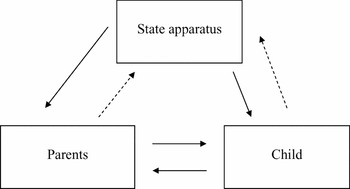
While the focus of this article is changes in child welfare policy and practice, we suggest that it provides an interesting exemplar of some of the more wide-ranging recent changes in the relationships between children, parents and the state. Lars Dencik (Reference Dencik1989) has argued that when sociologists of the family have talked about the family's function in society, it has usually been analysed as a two-sided relationship, and children were seen as part of the family with parents acting as their spokesperson. However, this has gradually been superseded by a new development that he has called an ‘eternal triangle’, in which the state on one base has a triangular relationship with the parents on another base of the pyramid and children on the third, as well as parents and children having their own separate set of relationships. The implication of this important shift becomes even more evident with the introduction of a whole variety of new information technology (ICT) systems, which are designed to store information and aid communication in relation to individual children.
The triangular relationship of state-child-parents (adapted from Dencik, Reference Dencik1989).

ICTs in child welfare in England
We will examine two systems which draw on concepts of child need introduced in the LAC, namely the Common Assessment Framework (CAF) and the Integrated Children's System (ICS). By early 2010, the ICS and CAF had been widely implemented, although some local authorities still used paper versions of the forms rather than the electronic versions. The authors have carried out research into these systems: the e-Assessment project looked at the CAF, and the Error project investigated the ICS.Footnote 1 Details of these studies can be found on the ESRC Society Today website, and in various publications (for example, Broadhurst et al., Reference Broadhurst, Wastell, White, Hall, Peckover, Thompson, Pithouse and Davey2009; Peckover et al., Reference Peckover, White and Hall2008, Reference Peckover, Hall and White2009; Pithouse et al., Reference Pithouse, Hall, Peckover and White2009; White et al., Reference White, Hall and Peckover2009). We will draw on data from this research, together with government-sponsored evaluations (Cleaver et al., Reference Cleaver, Barnes, Bliss and Cleaver2004; Brandon et al., Reference Brandon, Howe, Dagley, Salter, Warren and Black2006; Bell et al., Reference Bell, Shaw, Sinclair, Sloper and Rafferty2007), to examine the ways in which the technologies have been developed. We will pay particular attention to how versions of children, child need and families are structured in the software, and the dilemmas posed for managers and practitioners.
The Common Assessment Framework (CAF)
The CAF is a standard assessment form used by all child welfare professionals. It can be completed as a Word template, but is increasingly being held on local databases to enable electronic transfer between professionals. Following the format established by the Assessment Framework of Children in Need and their Families, it encourages the assessment of three aspects of the child – their personal development, parenting and their family and environment – under 19 topics, with guidance as to what information should be included. A CAF is to be completed for each child and focuses on their ‘needs’ and ‘strengths’. Children's and parents’ comments and their consent to share the assessment can be recorded.
The CAF is seen as an early assessment of a child's needs and concerns, to be completed particularly by schools, GPs and health and early years’ professionals. Practitioners are encouraged to consider whether the child's needs can be met from within their own resources and, if not, the CAF can be used as a referral to another service. It was piloted in 12 local authorities (Brandon et al., Reference Brandon, Howe, Dagley, Salter, Warren and Black2006).
The structure of the assessment section provides topics mainly about the child. Twelve of the 19 boxes are about the child's health, education and development. Three are concerned with ‘Parenting’: ‘Basic care, ensuring safety and protection’, ‘Emotional warmth and stability’ and ‘Guidance, boundaries and stimulation’. In the final section, ‘Family and environmental’, there are four headings, one labelled ‘Family history, functioning and well-being’ with the longest list of prompts: ‘illness, bereavement, violence, parental substance misuse, criminality, anti-social behaviour, culture, etc.’. It appears as a residual section, enabling the CAF writer to add whatever aspects had not been included in other sections. There is nowhere to record information about relations between siblings. There is a section at the beginning labelled ‘Current family and home situation’ to identify siblings and ‘significant adults’ for setting the scene, but it is not part of the assessment.
The CAF is ‘child-focused’, with opportunities to write about the family problems and interactions restricted. As government guidance makes clear: ‘The CAF is a standardised approach to conducting an assessment of a child's additional needs and deciding how those needs should be met’ (CWDC, 2007: 6).
The central aim is to support the sharing of information about children between professional groups, what is sometimes referred as a ‘common language’ (Axford et al., Reference Axford, Berry, Little and Morpeth2006), so that practitioners can understand how others are reporting about children. The concept of ‘child need’ is identified as the way to achieve this, since all appropriate practitioners are considered, with training, to be able to identify and write about ‘needs’ in a similar way.
Integrated Children's System (ICS)
The ICS is the client record system of children's social care. It is described on the DCSF website (2008a):
It provides a conceptual framework, a method of practice and a business process to support practitioners and managers in undertaking the key tasks of assessment, planning, intervention and review.
It is completed by social workers and managers and has a series of electronic forms and case records for assessments, planning and reviews of children at referral, in ‘child protection’, for ‘children in need’ and for those ‘looked after’. As with the CAF, there is a no family file, but a separate file for each child, although there are electronic links to family members. Underpinning the ICS are particular approaches to child development and how children are to be written about. As the DCSF website notes, it is based on ‘an understanding of children's developmental needs in the context of parental capacity and wider family and environmental factors’, linking the ICS to the genealogy of LAC, the Framework for the Assessment of Children and their Families, and CAF. This is a complex IT system which incorporates several tasks. First, it is an electronic case file with a running record, reports, meeting minutes, letters and so on, as expected of social work case files. Paper items can be scanned in. Second, it is an assessment system with ‘exemplars’ that share features of the earlier LAC and Assessment Framework forms. Third, it is a decision-making system, with functions to request decisions from managers: for example, to ‘sign off’ assessments. Fourth, it includes functions to produce statistics of completed tasks for audit and performance management. The case file is no longer located in filing cabinets but available to all personnel with authorisation to access, clearly delineating a change from the personal ownership of practitioners to institutional-wide scrutiny (Hall et al., Reference Hall, Slembrouck and Sarangi2006: 90).
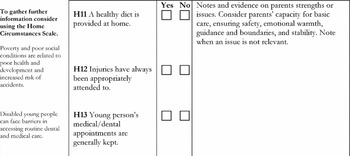
The Core Assessment exemplar in the ICS is a major assessment of a child to be completed in 35 days. Examples are provided in Figures 2 and 3 from the DCSF website (2008b). Each local authority's version may vary in format, but the topics and prompts are similar. Like the LAC forms, there are prompt questions for each topic and different forms for different age groups. It is much longer than the CAF (28 pages compared with eight for the CAF). While built around the now familiar topics of the ‘child's developmental needs’ and ‘parenting capacity’, each of the child's needs has associated questions about the ‘parental capacity to meet needs’, as seen in Figure 2. In contrast to the CAF, parenting is to be written about in terms of specified needs of the child.
Health: parental capacity.

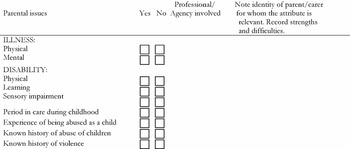
Parents’/carers’ attributes and the impact on their capacity to ensure the child's safety from harm and to respond appropriately to his/her needs.

The next major section is headed ‘Parents/Carers Attributes and the Impact on their capacity to ensure the child's safety from harm and to respond appropriately to his/her needs’. There follows a series of topics which suggest possible deficits or disabilities of the parent (see Figure 3), but the writer is encouraged to assess how they affect the child. The writer is asked to record ‘strengths and difficulties’ of each adult, but this is a section organised around problems. It is not clear how strengths are to be associated with, for example, ‘known history of violence’.
Similarly, with the ‘Family and environmental factors’ section, the writer is asked to assess the impact on the child's needs and parenting capacity. As with the CAF, there is a series of topics related to the family's circumstances: housing, income, social integration, access to community resources and support of wider family. The question about ‘family functioning’ again relates to potential risks to the child.
What becomes apparent is that the structure of the Core Assessment encourages a fragmented view of ‘the family’. The child is constructed through a series of boxes which list ‘needs’. Parents or carers are constructed in terms of how they address those needs, and parental attributes are seen in terms of deficits and difficulties. There is nowhere to write about relations with siblings or friends, except in negative terms under ‘family functioning’, where ‘The young person's impairment/behaviour has a negative impact on siblings.’ The child is viewed as having a set of attributes and problems, but these are to be reported in isolation from issues concerning their families or communities.
In summary, the CAF and ICS are ‘child-centric’ in that writers are required to assess the needs of individual children expressed in terms of their health, education and personal development. They are restricted in the ways they can comment on the parents’/carers’ problems or family relations. We are suggesting that such formulations are new and based on new ways of viewing the state's and parents’ responsibilities for the upbringing and well-being of children.
Using the ICTs
In the final section, we will examine the problems practitioners face when using child-centric ICTs. Overall, the development of ICTs in everyday work is reported by child welfare practitioners to be cumbersome, deskilling and challenging professional judgement. In contrast to the relational work with children and parents, which they see as ‘the real work’, time at the computer is seen as an unnecessary distraction (see Bell et al., Reference Bell, Shaw, Sinclair, Sloper and Rafferty2007: 8).
Concerns versus needs
While ‘child need’ appears in policy and guidance as unproblematic, when applied in everyday practice it is not straightforward. A clear statement about the centrality of ‘needs’ is made in a government-sponsored evaluation, making a distinction between ‘needs’ and ‘concerns’ as the basis for sharing information:
there are important practical and philosophical differences between recording a child's needs and recording practitioner's concerns. Practitioner's concerns are probably an extremely sensitive way of highlighting children who may need closer scrutiny. However, they are also likely to be intangible, transient and not directly evidence based. As such, they may be harder to justify or back up and are more open to misrepresentation. Child's needs are necessarily evidence based. A practitioner has to assess and analyse concerns/evidence before needs can be identified. Recording needs is therefore more robust and objective but at the risk of being less sensitive. (Cleaver et al., Reference Cleaver, Barnes, Bliss and Cleaver2004: 54)
Identifying a ‘child's needs’, it is suggested, is more ‘robust and objective’, having been subjected to an assessment of available evidence.
However, many respondents did not consider ‘child need’ a straightforward or appropriate concept. In contradiction to Cleaver et al.'s recommendations, in our e-Assessment research professionals were more likely to write about children in terms of ‘concerns’. We analysed 280 CAFs and found that writers used the language of ‘need’ in 54 per cent of the sample, whereas they described ‘concerns’ in 84 per cent. For example, in Table 1, the section on ‘Needs’ in terms of ‘Emotional and Behavioural Development’, a youth worker describes concerns about a young person by describing his behaviour.
CAF form

A number of respondents noted the difficulty of delineating the child's ‘need’. It was seen as not really telling the ‘reader’ what the issues were.
Teacher: So I don't think the needs bit is terribly useful; I think it needs to be a different type of word.
Interviewer: So what . . .
Teacher: I don't know [laughter] what I have put there, I have described the teacher being worried about something I mean that isn't a need but if I put the need in, I am not really stating what the issue is, do you see what I mean. It's kind of got this concern that if you just put in what the need is, which I have put in later on is that he needs to feel safe and he needs you know, so if I stick that there it's not really telling the person who is reading it what the issue is. Maybe it needs to be strengths and issues rather than strengths and needs. Or maybe it needs to be strengths, issues and needs because people are having difficulty with that because you need to write in what the concerns are.
Also, ‘need’ was seen as not enabling the writer to provide appropriate contextual information:
Teacher: We are being specific about what this child needs and the worry is if you only home in on the needs without contextual information you are not going to appreciate the gravity of why all those things are important.
Even social workers, who have been familiar with the concept of ‘child need’ for some time, do not always find it easy to fit the assessments into ICTs (Bell et al., Reference Bell, Shaw, Sinclair, Sloper and Rafferty2007: 42).
Splitting up families
Our central argument is, in being ‘child-centred’, ICTs disaggregate and fragment the family. There is no longer a ‘family file’ but, moreover, the assessments restrict the descriptions of family or parental issues.
As has been the case for many years, practitioners approach children's problems as being linked to their family contexts, responses to which have been a core element of their work (Rustin, Reference Rustin, Parry, Rustin and Satyamurti1979; Parsloe and Stevenson, Reference Parsloe and Stevenson1978; Satyamurti, Reference Satyamurti1981). A Sure Start worker highlighted the problem of writing a CAF for a mother who was struggling but whose care of her child was not in question.
Sure Start worker: The issues were really around her depression. She was struggling with her own emotions most of the time, was very emotional and weepy, but I have no concerns for the children and the school had no concerns for the boy, but her health visitor was concerned about mum herself.
By only describing the child's needs, the CAF writer considers she was unable to describe crucial problems faced by the mother. Similarly, for one ICS writer, the boxes restrict how parents are written about:
Social worker: With the Core Assessment right at the end you have a summary box where you can really make a distinction, I find, with the child's needs and the parenting. I think right at the very end there's a parenting summary, yes, so you have a whole section here where you can define any specifics about parenting capacity, like with that case for example I would say here that the parent has depression, I suppose this is where I would probably talk about it, and your observations of that, ‘yes mum is really coping with parenting even though she's got depression’. So I find in this part here you can sort out and tease out things especially with the observation and you can put your own views here. But within the Form itself sometimes it's hard to differentiate and separate out because you have to repeat yourself a number of times, the same information over and over again.
As with the CAF, the ICS requires a description of the child's needs. It was shown in Figure 3 that the parents’ problems can be completed in a separate section, but the writer is again restricted to predetermined boxes. In this quote, we can see the social worker interpreting the question about family issues in terms of ‘parenting capacity’, but then describes the mother's depression. She then complains about the restrictive nature of the boxes, an issue raised by Bell et al. (Reference Bell, Shaw, Sinclair, Sloper and Rafferty2007: 6).
The loss of the family perspective is also emphasised in the government-sponsored ICS evaluation (ibid.: 12). Two thirds of social work respondents to a questionnaire agreed with the statement the ‘ICS loses the family perspective’ (ibid., 2007: 78) and in focus groups a typical comment was the loss of a ‘holistic view of the family’ (ibid., 2007: 59). The evaluation recommends changes to the ICS that includes a ‘pen picture of the family’ (ibid.: 12). Our view, however, is this is not just an omission but related to the child-centric policies that underpin the systems.
Telling stories
Much has been written about the way that professionals use narrative to talk and write about children and families (Hall, Reference Hall1997; White et al., Reference White, Hall and Peckover2009; Pithouse and Atkinson, Reference Pithouse, Atkinson and Coupland1988). Indeed, many writers have suggested that storytelling is a central method of making sense of the world (see Gubrium and Holstein, Reference Gubrium and Holstein1998: 163). A narrative provides an overall formulation within which to locate observations, information and hunches. Hurwitz (Reference Hurwitz2000: 2086) describes how a GP pieces together bits of information to create an understanding of patients’ descriptions of their complaints. ICTs, however, undermine narrative (Lash, Reference Lash2001; Aas, Reference Aas2005; Parton, Reference Parton2008), splitting the story into bits of information without an integrating structure. In a database, information is ‘stacked’, combining ‘various items according to whim, without any sense of internal development or progression and direction’ (Aas, Reference Aas2005: 85). The reader locates bits of the child and family which are made available, but there will always be gaps, as the database does not have a sense of completeness. In the CAF, the structure of the boxes with headings is seen as fragmenting the child and family:
Health visitor: And a CAF doesn't tell a story. It feels to me a bit like school exams. Multiple choice. You can tick the boxes with the right answer, but it really doesn't give you . . . the story. It is about narrative, isn't it. It's about people's lives. It ISN'T about dividing a life up into a lot of small boxes and when you put all those boxes together it will be equal to the narrative.
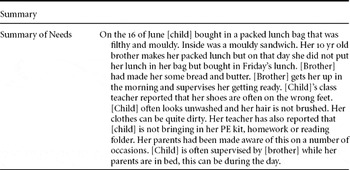
However, professionals often ignore the structures of the ICT and insert the narrative. In our e-Assessment project, nearly half of the CAFs structured some of the information in narrative form and over a third related a story to illustrate their point (White et al., Reference White, Hall and Peckover2009). For example, in Table 2 a teacher completes the Summary of a CAF entirely in the form of a story.
CAF form

Writing a CAF in this way uses an incident of a lunch bag to depict what is suggested as evidence of a pattern of neglect. It is not a statement of the child's ‘needs’, but illustrates in story form a set of behaviours by the parents and their effect on the child. It produces a picture of family interaction, between the child and her brother and children and parents, in ways that the structure of the CAF resists.
The ICS also undermines the story. As respondents to the ICS evaluation noted, ‘the business of assessment was one of collecting unrelated pieces of information’ (Bell et al., Reference Bell, Shaw, Sinclair, Sloper and Rafferty2007: 61), echoing the ‘stacking’ of the database mentioned earlier. The loss of the narrative was bemoaned by nearly three quarters of respondents (ibid., 2007: 78) and the evaluators considered that ‘telling the story is an essential part of the social work process’ (ibid., 2007: 99). We see this loss of narrative as a significant impact of the introduction of current ICT systems into child welfare practice.
Writing for audiences
In a paper entitled ‘Good Organisational Reasons for “Bad” Clinic Records’, Garfinkel (Reference Garfinkel1967) describes how records from a psychiatric clinic are frequently incomplete in terms of basic information (age, ethnic original, occupation and so on). He suggests this is because such records are concerned to describe and justify a therapeutic encounter for later readers:
In our view, the contents of clinic folders are assembled with regard for the possibility that the relationship may have to be portrayed as having been in accord with expectations of sanctionable performances by clinicians and patients. (1967: 199)
Organisational records are constructed for particular audiences rather than as ends in themselves. There are potentially several audiences of children's ICTs – managers, auditors, parents, children, other professionals, politicians – and increasingly these diverse audiences have access to organisational records or the resulting performance tables. However, following Garfinkel, we suggest that any organisational record addresses ‘entitled’ readers (Reference Garfinkel1967: 201). The writer attunes how they report their assessments to the sensibilities of particular audiences, and as such they are negotiated documents.
In some cases, the audience is the parent. Government guidance on the CAF instructs the writer to complete the CAF with the child and parents (CWDC, 2007: 19). Writing the document describes a child and family, but also engages with them. For example, a teacher describes the sensitivity of the negotiation process:
Teacher: It does not include information about our real concerns about the parenting capacity, which perhaps the next time around we'll amend it. I felt that my decision on this occasion was that I needed as much backing from the parents as possible to get a statement from [parent] and that I would only aggravate things if I put in information that would upset them.
To gain the cooperation of the parents in subsequent interventions, the teacher avoided spelling out her ‘real concerns’.
It has also been noted the extent to which the CAF is written as a referral for other professionals rather than as an assessment (Brandon et al., Reference Brandon, Howe, Dagley, Salter, Warren and Black2006). In our e-Assessment research (White et al., Reference White, Hall and Peckover2009), two thirds of the 280 CAFs were used for referral and inevitably were written with the concerns of the receiver in mind.
Education worker: And sometimes the [name] team they are not always that happy to work with families if there are loads of other agencies involved. So you know you might concentrate more on the child's problems and their behaviour than you might on mum's problems with the house because you don't want them to think ‘well actually you need a family support worker first’ . . . so that makes it a less objective form really, doesn't it, if we are filling it in with different kinds of ends in mind.
The ICS, on the other, hand was seen by social workers as having an uncertain audience. It is too ‘lengthy and overwhelming’ to share with parents and children (Bell et al., Reference Bell, Shaw, Sinclair, Sloper and Rafferty2007: 62). In fact, in our Error research, social workers were not sure if anyone read them:
Social worker: I've not yet met a family who's gone through my Core Assessment and read it.
Interviewer: So who are they for?
Social worker: Exactly, that's something I struggle with, I don't know. I think when I've picked up a case that's already had a Core Assessment on it done, I read the Analysis and the Summary boxes and most other managers and people at different levels when they do auditing that's what they look at.
The Core Assessment is seen as too long to be read by parents, and other informed readers only look at key sections. Similarly, for reports to child protection conferences, the chair of conference does not read everything, particularly as separate reports have to be prepared on all the children involved:
Social worker: I have certainly heard people say: ‘ok, give me the youngest child's and the oldest child's and I will just read them. But because largely the issues are going to be the same and if there is anything for the individual child on the other children in that instant then you know tell me about it but otherwise I am only going to read two of the reports’. And again that is quite disheartening because again I'm compelled to write 7 conference reports for quality assurance . . . But you just think, ‘well, why are we compelled to write this way; why can't we write one report for the family and then just have individual sections for the children, you know.’ I mean, everybody tears their hair out with it, I think.
What is particularly interesting about these comments is that the social worker sees the ICS forms primarily for ‘audit’ or ‘quality assurance’ purposes. The reader is not those actively involved in the day-to-day decision-making but, as Garfinkel says, ‘later readers’. A respondent to Bell et al. (Reference Axford, Berry, Little and Morpeth2007: 63) saw the information as required for ‘some statistician somewhere’. The current changes are part of much greater emphasis upon the accountability and surveillance of practitioners and children, young people and parents with whom they work (Parton, Reference Parton2006, Reference Parton2008).
Conclusion
We have argued in this article that we can identify a significant shift in the relationships between the state and family in recent years, which is exemplified in the emergence of a ‘child-centric’ focus in child welfare policy and practice. Such changes have become far more embedded in day-to-day organisational practices via the introduction of a range of new ICT systems in recent years. At one level, such changes can increase the potential surveillance capacities of statutory child welfare agencies in relation to the children, young people and parents with whom they come into contact and the frontline professionals who are responsible for implementing the policies.
At the same time, and this has been the prime focus of this article, the introduction of child-centric ICTs into child welfare has posed a number of fundamental challenges, particularly for practitioners. Evidence from research suggests that the new systems make it very difficult to locate children in their familial, social and relational contexts, and that the work has become increasingly fragmented as a result. Far from supporting a practice which is centred on the contexts in which children live and the concerns which professionals might have about them, the new ICT systems are having the effect of distancing professionals from the lived day-to-day experiences of the people with whom they work. Since the research discussed here has been completed, these issues have become a major focus for political and professional debate. Prompted by a request from the Secretary of State and critical comments by Lord Laming in his report on child protection in England (Laming, Reference Laming2009), the newly established Social Work Task Force has identified the need for a major reform of the Integrated Children's System (ICS) (Social Work Task Force, 2009). In particular, social workers reported to the Task Force that the new ICT systems were not supporting them in their work. The bureaucratic demands arising from the new systems had increased to such an extent that they were failing to support their professional judgement and were having the effect of removing them from direct contact with children and young people. The atomised and fragmented nature of the information required and the mechanisms for both inputting and accessing it were such that it had become very difficult to identify the key relational and social nature of the work.
In addition, the voices and experiences of children and young people themselves are in great danger of being marginalised: a development which is particularly ironic for a system that aims to place children at the centre of policy and practice. However, the way in which the ‘child-centric’ systems have been developed and operationalised is based, almost exclusively, on an administratively determined psychologised view of children with little room for other voices and perspectives and little space for debate and negotiation, by children and young people as well as professionals. In many ways the thinking behind the development sees children in very instrumental ways: as the objects of a variety of concerns which need to be acted upon rather than agents of their own lives. In this respect, it is not just the ‘family’ and professional practice which has become fragmented, but children themselves. Increasingly, it seems we are attempting to create ‘electronic children’ (Peckover et al., Reference Peckover, White and Hall2008) which then stand as the key markers for access to resources, services and power and which may well be unknown to the children and young people for which they act as referents.
If we are serious about wanting to recognise the needs and views of children, it is important that we conceive of them as agents with rights to fully participate in the decisions made about them and also as holding citizenship claims over the resources which are available to them. As one of us has argued previously, recent developments in England have not been sufficiently concerned with developing children's rights as citizens:
The challenge is to ensure that the systems being introduced do not become inherently complex and unstable, and are subject to human control, so that they become the vehicles for the increased safety and emancipation of children and young people, rather than their opposite. (Parton, Reference Parton2006: 187).
It is not the purpose of this article to deny that ICTs can support and enhance professional practice in child welfare. However, this requires systems to be designed in such a way that they are attuned to the working environment of the users (practitioners, children and families), and not seen primarily as trying to re-engineer that environment. There is considerable work in user-centred design and human–computer interaction, which seems to be missing from current practices in child welfare (White et al., forthcoming). Systems can be designed which support professional reflection and promote user involvement by, for example, enabling some of the literary practices of professionals described in our research: telling stories, expressing concerns about children, addressing specific audiences. The purpose of assessing and sharing information about children and their families is to facilitate the mutual understanding of professionals and support decision-making. It is for them to judge whether ICTs have enhanced such processes and, as we have described, their assessments of current systems are highly critical.