Introduction
Women carry the primary responsibility for family planning in most parts of the world. However, they are often afforded little authority in decision-making and control over fertility desires. It is widely recognized that in developing countries women are often not the sole decision-makers regarding childbearing, contraceptive use and abortion. This is especially true in societies that are based on patriarchal family systems, where women's decision-making power is restricted by social norms governing gender roles, household power dynamics and communication patterns (Edmeades et al., Reference Edmeades, Macquarrie, Malhotra and Nyblade2009).
Derose & Ezeh (Reference Derose and Ezeh2010) demonstrated that in Uganda men are the principal decision-makers, not only at home but also in terms of fertility and contraception. Patriarchal tendencies have given men sole control over sexual relations and inclined them to have more children. In Honduras, Speizer et al. (Reference Speizer, Whittle and Carter2005) studied the gender differences in the decisions they make about reproductive health. They found that males dominated reproductive decision-making, and concluded that family planning programmes should recognize the unequal power relations within the household, which affect women's ability to achieve their reproductive desires. They suggested that men should be educated to communicate with their wives about reproductive issues. The findings of Omeje et al. (Reference Omeje, Oshi and Oshi2011) suggest that reproductive decision-making by married couples is unequal and that the husband dominates. Unequal gender relations may result in women suffering from unfavourable outcomes because they have to obey their husbands. Women's lack of bargaining power is a threat to their health, and may carry negative social and economical consequences. Creel et al. (Reference Creel, Sass and Yinger2002) also maintains that in many countries women do not enjoy adequate decision-making control over sexual relations and their choices of contraceptive methods, and that fertility control is markedly influenced by the preferences of their spouse and family. In a study conducted by Badar et al. (Reference Badar, Manzoor and Chaudhary2007), it was found that most women prefer to bear fewer children, but are not allowed to make independent decisions about the number. Their study also indicated that women are culturally pressured to have an ‘adequate’ number of children and that having a son is an imperative. Islam et al. (Reference Islam, Padmadas and Smith2006) demonstrated that only 18% of women make independent family planning decisions, and that a couple's education level, length of marriage and the husband's approval influence the decision to use family planning. In Oman, men were found to be the only decision-makers on matters of contraception in nearly half of families (Al Riyami et al., Reference Al Riyami, Afifi and Mabry2004).
Iran, the target country of this study, had a successful family planning programme, which decreased the total fertility rate from 7.1 in 1986 to 2.9 in 1996 (Statistical Center of Iran, 1998), reaching 1.9 in 2005 (UNFPA, 2005). However, a study conducted by Mazloumi et al. (Reference Mazloumi, Shahidi, Abbasi Shavazi and Shahrizadeh2007) in central Iran showed that only 28% of women have sufficient autonomy in making decisions about their contraceptive choices. According to Nabavi et al. (Reference Nabavi and Ershad Farhang2009), while Iranian men are the principal decision-makers in fertility, women shoulder the largest responsibility for family planning; they noted that with increasing women's decision-making power on household and social and economic matters, couples tend to share more family planning responsibilities and decisions. Abbasi & Askari (Reference Abbasi Shavazi and Askari Nadoushan2005), in their study entitled ‘Family changes and fertility decline in Iran’, concluded that the family is the most fundamental decision-making unit in terms of fertility. They also found that woman's status in the family and society is crucial in influencing fertility behaviours and attitudes. Hence, women should be empowered in fertility-related decisions and enabled to develop the required decision-making skills (Pandey & Singh, Reference Pandey and Singh2008). Empowered women are aware of their value and seek equal access to health services, insist on asserting their rights, marry later, delay childbirth, bear fewer and suitably spaced children, and get access to health services at the appropriate time; all of these lead to the promotion of family planning and improvement of women's reproductive health (World Health Organization, 2008). Various studies have demonstrated the effect of women's empowerment on population processes and fertility outcomes. Women's empowerment influences contraceptive practice, abortion, child spacing, gender composition and the family size (Macquarrie, Reference Macquarrie2009). Thus, empowerment should be duly considered in family planning. It is also imperative to assess and evaluate the decision-making process on fertility desires and contraceptive practice.
Women's empowerment is a key component of national development, population stability and global welfare (Pandey & Singh, Reference Pandey and Singh2008). According to Kabeer (Reference Kabeer2005) empowerment is the development of abilities in individuals that enable them to make their basic life choices; these abilities have previously been neglected. However, Lee-Rife (Reference Lee-Rife2010) points to women's empowerment as the process of developing women's ability and freedom to make basic life choices and to enable them to formulate opportunities, gain control over resources and make decisions that fundamentally influence their life outcomes. The International Conference on Population and Development in Cairo 1994 concluded that empowerment of couples is essential to fulfillment of family planning objectives. Empowerment, especially of women, should afford them the authority of decision-making and control over fertility, enabling them to meet their family planning responsibilities. In other words, success in family planning hinges upon empowerment of women, in both families and the community (Eguavoen et al., Reference Eguavoen, Odiagbe and Obetoh2007).
One element that is missing from the above studies is how women perceive empowerment when making family planning decisions. Thus, the present study seeks to investigate the perception of empowerment meaning in terms of family planning and contraception in the view of Iranian women of reproductive age using a qualitative content analysis approach.
Methods
The study used a qualitative approach and naturalism paradigm in order to explore and discover the views of the participating women on empowerment in family planning.
Participants and data collection
The study was conducted in 2010 on a sample of 35 married women between the ages of 20 and 46 who were eligible for contraception. Purposeful sampling was used to select women from a group of volunteers. Subsequently, maximum variation sampling (reflecting variations in age, education, employment, number of children and contraceptive methods) was used to select women of different backgrounds.
Women were invited to participate in the study after a telephone conversation during which they were told of the study's objectives. The discussions and interviews were arranged at health centres or any other places according to the participant's preference. Seven focus group discussions were conducted, each with five to six participants. The participants in each group were adjusted for age, education and employment. To maintain consistency within the groups, an interview guide with the following questions was used: ‘Tell me about your fertility desires, please?’, ‘Could you describe your role in implementing your desirable fertility plan?’, ‘Could you describe your decision-making process in family planning?’ The discussions lasted 45–90 minutes and were recorded using a digital voice recorder. Notes were also taken from the participants' non-verbal reactions. Five semi-structured individual interviews similar to the focus group discussions were also conducted. Women who were not willing to discuss their experiences in a group, and those who could not attend the group discussions, were interviewed individually. Data collection continued until no new concept emerged from the data.
Data analysis
The data obtained were simultaneously processed using conventional content analysis, in which themes and categories were explored to reveal the women's experiences of empowerment in family planning. The advantage of using the conventional qualitative content analysis approach is that codes and categories are derived from the raw data directly, without being imposed to preconceived categories or previous theoretical perspectives (Hsieh & Shannon, Reference Hsieh and Shannon2005). The researcher listened to records and transcribed them word-for-word after developing a general idea. An analysis unit was established where the transcripts were read line-by-line, the important sentences and phrases were underlined and the main ideas derived from them and labelled as codes. Overlapping codes were assimilated and primary categorization of data was performed. Data reduction continued in all analysis units until main categories emerged. Credibility was enhanced through member checking, peer checking and maximum variation of sampling. To establish inter-transcript reliability, three qualitative researchers carried out a second review. Approximately 60% of the transcript, codes and categories were re-checked and there was 90% agreement among them.
The study was approved by the ethics committee of Isfahan University of Medical Sciences. Written informed consent was obtained from the participants and they were given the option to withdraw from the study at any time.
Results
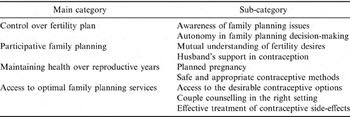
Most of the participants had high school education, were housewives and had two children. Analysis of the participants' descriptions of empowerment in family planning yielded four main categories, namely: ‘Control over fertility plan’, ‘Participative family planning’, ‘Maintaining health over reproductive years’ and ‘Access to optimal family planning services’. Each category has a number of sub-categories (see Table 1).
Main categories and sub-categories derived from focus group discussions and individual interviews for understanding Iranian women's perception of empowerment in family planning

Control over fertility plan
For the majority of the participants, empowerment in family planning is translated as wielding control over one's fertility plan. Subjects who enjoyed access to adequate family planning information and who could make related decisions with autonomy thought of themselves as ‘empowered’.
Awareness of family planning issues
The participants said being informed of their reproductive rights, enjoying access to reliable sources of practical information on contraception and being aware of their husband's expectations in relation to family planning made them feel enabled to draw up a general fertility plan. A 46-year-old working woman said: ‘I had good knowledge of family planning and good understanding of my own and my husband's fertility expectations … this made me determined to form the plan.’
Autonomy in family planning decision-making
According to the participants, women use their information resources to draw up a general fertility plan, but the plan cannot be realized unless they have autonomy in family planning decision-making. They mentioned that this autonomy is formed by acquiring personal decision-making skills during childhood and adolescence, as well as by gaining decision-making authority in their marriage life. A 42-year-old working woman said: ‘In the marriage life I was free to make my own decisions about family planning issues.’
Participative family planning
Participants acknowledged that the nature of family planning is such that neither partner can independently make decisions and suppose that their reproductive expectations can be fulfilled. They emphasized that the sense of empowerment is achieved when all fertility-related decisions are made in a participative atmosphere with the couple's mutual contribution, not only in making family planning decisions, but also in implementing contraception methods.
Mutual understanding of fertility desires
According to the majority of participants, since marriage partners may come from families of different social/cultural backgrounds with varying attitudes to childbearing, the mutual understanding of fertility preferences, which is the basis of participative family planning, should be achieved by negotiation about fertility decisions. Women in particular need to win the agreement of their husbands in matters of contraception. A 34-year-old housewife said: ‘I did my own research and chose condoms … it took a lot of effort to persuade my husband.’ A few women stated that their cultural and religious beliefs encouraged them to follow their husbands' decisions about family planning. They thought that accepting their husband's decision is an important factor for family stability. A housewife said: ‘In spite the authority to decide about fertility issues on my own, I prefer to attend to my husband's will, due to family stability.’
Husband's support in contraception
According to all of the participants, once the partners have reached an understanding and agreement on their fertility plan, the next essential element for success in participative family planning is the husband's support in choosing and the use of the selected method of contraception. Women especially emphasized the importance of their husband's support in contraception, saying that despite approving the family planning, men often accept little responsibility in implementing contraception. A 37-year-old housewife said: ‘In my family, my husband and I were equally willing to use contraception after having two children, I had tubal ligation. My husband stood by my side the whole time.’
Maintaining health over reproductive years
Half of the participants considered health as an essential element of empowerment in family planning, mentioning that after giving birth to several children and using contraceptive methods, women's health often deteriorates. Nonetheless, planned pregnancies and use of safe and appropriate contraceptive methods can help to promote women's health.
Planned pregnancy
The participants' description of planned pregnancy revolved around reducing the number of pregnancies and spacing them appropriately. They noted that both fewer and planned pregnancies would reduce the risks to mothers' health. A 37-year-old employed woman said: ‘I had a negotiation with my husband about the best time to have a child, so we could prepare for it mentally, and contribute to my health and that of our family.’
Safe and appropriate contraceptive methods
All of the participants had experienced different methods of contraception and some complained of side-effects, saying that contraception methods had endangered their health by their side-effects. Most of the participants said easy access to a variety of free and safe contraceptive methods could ensure women's health and empower them in family planning. A 30-year-old housewife said: ‘When I have to use contraception for 20 years, there should be several methods with few side-effects that suit my body … so I can both avoid pregnancy and ensure I'll stay healthy.’
Access to optimal family planning services
Although all participants said they had easy access to health centres, they said that these services did not empower them in family planning. In their view, optimal family planning services were those that would allow them to choose their desirable contraceptive method with the help of skilled personnel through couple counselling and ensure treatment of any side-effects.
Access to desirable contraceptive options
According to half of the participants, empowerment in family planning meant choosing the right contraceptive method through interaction with skilled health providers. The participants said that currently methods were limited, mainly focusing on the female and ignoring women's right to choose. A 34-year-old housewife said: ‘The health centre should offer us counselling and our desirable range of contraceptive methods … then we can bring our decisions into practice.’
Couple counselling in the right setting
The participants said that empowerment in family planning hinged on the couple's agreement on a fertility plan. Hence, they expected counselling sessions to be held in the presence of their husbands. However, health centres offer their services in the mornings and usually have no male family planning providers. They also lack suitable physical space where services could be offered to men. Therefore, family planning is assumed a predominantly female ‘business’, with women shouldering the responsibility for contraception. A 26-year-old working women said: ‘I think if my husband can accompany me to the counselling session at the health centre, he will be more supportive in the contraception use.’
Effective treatment of contraceptive side-effects
All participants stated that if the health centres were attentive to the treatments of contraceptive side-effects, and assisted in covering related costs, women would become more empowered in family planning. Furthermore, they mentioned that although contraceptive methods were offered free of charge, they incurred considerable costs when they were referred to physicians for treatment of side-effects; this had occasionally led to switching contraceptive methods, or even using traditional methods. A 42-year-old working woman said: ‘Although health centres offer free contraceptive methods, they're incapable of treating the side-effects. They keep referring us to physicians, and that's expensive.’
Discussion
This study investigated, for the first time, Iranian women's perception of empowerment in family planning. Participants mentioned four main categories of how they perceive the meaning of empowerment in family planning: ‘Control over fertility plan’, ‘Participative family planning’, ‘Maintaining health over reproductive years’ and ‘Access to optimal family planning services’. These categories are influenced by socio-cultural norms about gender roles in family and society.
The study's findings suggest that most participants consider control over their fertility plan as a key component of empowerment. To achieve this control there are two basic requisites: adequate knowledge of family planning issues, and autonomy in decision-making. This finding is entirely consistent with the goals of the Cairo International Conference on Population and Development 1994 in relation to women's empowerment in family planning, and the literature indicates that several studies have shown the same results. Eguavoen et al. (Reference Eguavoen, Odiagbe and Obetoh2007) maintain that reproductive decisions are an outcome of the couple's negotiation and that the nature of relations in the family greatly impacts the fertility decisions. Hence, contraception decisions are influenced by the woman's power and independence within both the family and the community. Casterline et al. (Reference Casterline, Sathar and Haque2001) also demonstrated that adequate knowledge of contraceptive methods and independent decision-making ability are two essential factors for fulfillment of fertility preferences and reduction of unmet needs of contraception. Al Riyami et al. (Reference Al Riyami, Afifi and Mabry2004) concluded that decision-making autonomy is fundamental to fertility control, and defines it as the mental and social ability to obtain information and use it at times of decision-making on important personal matters, including reproductive issues. Lee-Rife (Reference Lee-Rife2010) points to ‘women's empowerment for gaining autonomy in decision-making on family planning issues’, and ‘greater control over fertility’ as key factors for reducing unwanted pregnancies. Pandey & Singh (Reference Pandey and Singh2008) also found that women who feel empowered exercise greater control over their family planning behaviours, and that higher awareness of their reproductive rights and health services promotes their reproductive health. Couples' decision-making patterns at the family and community level influence the rate of use of modern contraceptive methods, and the use of contraception declines significantly when a patriarchic decision-making model governs domestic and reproductive issues (DeRose & Ezeh, Reference Derose and Ezeh2010).
The participants of the current study felt more empowered in family planning when the associated responsibilities were shouldered by both wife and husband in an atmosphere of agreement and mutual participation, in which the husband offers support not only in fertility decision-making, but also in the use of contraception. Other studies have found the same. The 1995 Beijing Conference greatly emphasized the role of men's participation in contraceptive efforts for the promotion of reproductive health (Silva et al., Reference Silva, Araújo, Bastos and Moura2011). Rostamian et al. (Reference Rostamian, Heydari, Zafarmand, Asaadi, Barbgandan, Dianat and Bahtouei2002) point to men's support and participation in family planning. They cite men's acquisition of correct knowledge of contraceptive methods and joint decision-making about having children as examples of their participation in family planning. Participative decision-making should govern all aspects of family planning and fertility so that both partners feel in control of their fertility desires (Mutambirwa et al., Reference Mutambirwa, Utete, Mutambirwa and Maramba1998). Here it is worth mentioning that Iran has the highest prevalence of male contraceptive use such as condoms (6.0%), compared with other countries in the region such as Jordan (5.3%), Pakistan (5.3%), Afghanistan (2.2%), Egypt (0.7%) and Iraq (0.7%). Other male contraceptive use such as male sterilization (2.3%) and withdrawal (11.4%) are also higher compared with other countries. These differences may be arisen from socio-cultural and religious differences as well as different health and economic conditions (United Nations, 2007).
The results of this study show that women view maintenance of health over the reproductive years as a key element of empowerment in family planning. They consider planned pregnancies as being vital to reproductive health, emphasizing that pregnancies should occur at a time of optimal physical and mental preparedness. Fewer and properly spaced pregnancies, they believe, are conducive to women's health. The participants also thought that safe and proper contraceptive methods were essential to maintain women's health during the reproductive years. Kaddour et al. (Reference Kaddour, Hafez and Zurayk2005) found that women view reproductive health as a central concept that encompasses all aspects of health, not only in pregnancy, but also during the period in which contraceptive methods are used. A mutual relationship exists between empowerment and women's health. Maintenance of women's health is conducive to their empowerment because healthy women can make their basic life decisions more effectively and act to develop their capabilities. Women who can make decisions about the time of childbearing, number of children and spacing of births, in an atmosphere that is free from violence and intimidation, can participate in society and contribute to national development on a par with men (UNFPA, 2004).
Access to optimal family planning services was another concept emphasized by the participants, especially housewives. They viewed easy and free access to current family planning services as being insufficient to meet their fertility desires. It seems imperative that health centres adopt a new approach to the provision of family planning services that would help women feel empowered. This could be accomplished by making available a wide range of contraceptive methods desired by women in health centres, and employing the services of skilled providers for couple counselling in private situations to help them make their own choices and overcome the side-effects of contraceptive methods. Silva et al. (Reference Silva, Araújo, Bastos and Moura2011) observed in Brazil that a lack of variety in contraceptive methods and their disorderly provision gave rise to gaps in Brazil's population policies in the family planning behaviours pervading the Brazilian community. Also, they suggested that health centres should provide more complete and accurate counselling tailored to their clients' needs. Creel et al. (Reference Creel, Sass and Yinger2002) concluded that health systems should be designed to cater for the specific requirements of clients. This could be achieved by providing counselling services to clients in confidence by skilled providers. This modified approach to provision of family planning services could lead to women's empowerment, fulfillment of their fertility desires and broadening of contraceptive options.
Some studies have emphasized the influence of culture and religions on family planning. It has been shown that Christianity, Judaism, Islam, Hinduism and Buddhism and cultural factors have the potential to influence the acceptance and use of contraception by couples, and within religions different sects may interpret religious teachings on this subject in varying ways. Cultural factors are equally important in couples' decisions about family size and contraception (Srikanthan, Reference Srikanthan2008). It has been shown in countries with a majority Sunni Muslim population in the region that religious leaders have played a significant role in the increase in contraception use among Muslim women (Sueyoshi et al., Reference Sueyoshi and Ohtsuka2006; Sueyoshi & Ohtsuka, Reference Sueyoshi and Ohtsuka2010). Also, husbands' and families' opinions influence women's contraceptive behaviour (Libbus & Kridli, Reference Libbus and Kridli1997).
Iran, with its majority Muslim, mainly Shiite, population (98%), intertwined with its culture and special economic and health conditions, appears to be different from other countries in terms of family planning. Its rate of contraceptive use is 73.9% (58.9% modern contraceptive use and 14.3% traditional methods), the highest rate among eastern Mediterranean countries such as Morocco (63.0%), Egypt (60.3%), Tunisia (60.2%), Jordan (59.3%), Syrian Arab Republic (58.3%), Lebanon (58.0%), Iraq (49.8%), Pakistan (27.0%), Saudi Arabia (23.8%) and Afghanistan (22.8%) (World Health Organization, 2011). Iran had a successful family planning programme, mainly because of the support of religious community leaders and a supportive environment (Simbar, Reference Simbar2010). A decreasing fertility rate and increasing contraceptive prevalence rate were the success criteria for family planning programmes in the past when population control was the ultimate goal. However, one of the most important parts of the Third Millennium Development Goal is women's empowerment, so the criterion for success of family planning programmes should be women's power to make decisions about their fertility plans through childbearing and contraceptive use, male participation, women's health through the reproductive years and access to optimal family planning services.
Conclusion
It can be concluded that the participants in this study view knowledge of family planning, as well as autonomy in decision-making on family planning matters, as essential elements to fulfillment of their fertility desires. Therefore interventions are needed to improve women's decision-making autonomy and strengthen their negotiating capacity on family planning. The current strategies for provision of family planning services through Iran's health system have failed to address fully women's fertility desires. So family planning policymakers need to be providing services with a new approach that focus on women's health and empowerment.
Acknowledgments
The study was supported by grants from Isfahan University of Medical Sciences, which is greatly appreciated. In addition, the authors would like to thank the participants in this study.