Introduction
This study focuses on the ageing population in an area of northern Sweden occupied by indigenous groups and colonisers. Previous research shows that the demographical pattern for indigenous people follows a different path compared to non-indigenous groups living in the same area with higher mortality, shortened life expectancy at birth, poverty, and increased vulnerability to diseases (Gracey and King Reference Gracey and King2009; Stephens et al. Reference Stephens, Porter, Nettleton and Willis2006; Trovato Reference Trovato2001). The Sami living in Sweden today have an equally good life expectancy compared to the rest of the Swedish population (Hassler Reference Hassler2005). Life expectancy at birth was 74.9 years for the Sami men compared to 74.6 for non-Sami men, and 80.0 years for Sami women compared to 80.3 for non-Sami women (Hassler et al. Reference Hassler, Johansson, Sjölander, Grönberg and Damber2005). This was not the case during the 18th and 19th centuries when the Sami experienced higher death rates, especially among infants (Brändström Reference Brändström2007; Sköld and Axelsson Reference Sköld and Axelsson2008). While we know that the general mortality and infant mortality were high, we do not know much about the elderly population or which members of the Sami population lived to old age during the era of colonisation. During the beginning of the 17th century and before the Swedish state established population statistics, a common belief was that Sami either died very young or very old (von Düben Reference von Düben1873).
This study aims to compare population trends among older people (60 years and above), age-specific mortality rates and causes of death between the Sami and the non-Sami population. The main source material for this study is a set of data files from The Sápmi Population Database. The results are discussed in relation to the colonisation process, epidemiological and demographic transitions as well as in relation to the source material.
The epidemiological transition
The theory of epidemiological transition by Omran (Reference Omran1971) implies that over time societies experience three stages of development regarding the pattern of health and disease dominance. The first stage is the ‘age of pestilence and famine’, and the second stage is the ‘age of receding pandemics’. Western society reached the third stage by the turn of the 20th century. The third stage, ‘man-made and degenerative diseases’, is characterised by diseases associated with demographic ageing, longevity and lifestyle habits (e.g. cancer and heart disease) (Omran Reference Omran1971). In Omran's study, Sweden was among the countries that had reached this final stage, whereas the health development for countries in Latin America, Asia and Africa were delayed. Indigenous people were not explicitly addressed in Omran's article; however, their health development is seen as delayed compared to non-indigenous groups (Kunitz Reference Kunitz1990). In 1998, Omran revised his theory of the epidemiologic transition by adding one and possibly two stages (Omran Reference Omran1998).
The demographic transition
The demographic transition entails declining death rates from the 19th century to the beginning of the 20th century (Willner Reference Willner, Sundin, Hogstedt, Lindberg and Moberg2005). The decline of fertility and mortality rates resulted in a demographic transition in Sweden towards a growing proportion of elderly. In 1751, 44 per cent of the Swedish population lived to be 50 years of age or older and 100 years later this proportion was 51 per cent (Dribe and Stanfors Reference Dribe and Stanfors2005). In the mid-18th century, the proportion of the Swedish population above 65 years of age was 6 per cent and 150 years later it was approximately 8 per cent (Statistiska Centralbyrån (SCB) 1969; Willner Reference Willner, Sundin, Hogstedt, Lindberg and Moberg2005). During the second half of the 18th century, life expectancy at birth was 33.7 years for men and 36.6 years old for women; these low ages were a result of high infant mortality rates. The mortality rates were highest among infants and the elderly; and when infant mortality rates started to decline, life expectancy apparently increased.
There is a lack of studies concerning life expectancy at birth among the Swedish Sami during the 18th and 19th centuries. From previous studies we know that infant mortality among the Sami population was high during the 18th and 19th centuries (Brändström Reference Brändström, Åkerman and Lundholm1990; Sköld and Axelsson Reference Sköld and Axelsson2008). The few studies involving fertility patterns display a constant fertility, regardless of the age of the mother, for Sami and non-Sami women which resulted in a relatively high average age for child bearing (Sköld Reference Sköld, Lantto and Sköld2004; von Düben Reference von Düben1873; Wahlund Reference Wahlund1932). The Sami women were seen as giving birth to fewer children than the non-Sami women, explained by a higher abortion level among the Sami women (Wahlund Reference Wahlund1932).
The colonisation and assimilation process
The health disadvantages of contemporary indigenous people can be explained by their trajectory of colonisation and assimilation (Fur Reference Fur2006). Colonisation is a process shared by all indigenous people. The way colonisation is expressed differs, but whenever it occurs indigenous people and newcomers experience complex and very difficult relations (Loomba Reference Loomba2005). Acculturation is a process that takes place over a period of time and entails changing the culture and the individual (Berry Reference Berry1990). The word ‘changing’ does not necessarily imply leaving a culture or adopting another, it can also be a mutual process whereby something new is created (Berry Reference Berry and Grusec2006). How this process affects indigenous groups depends on the cultures involved and the quality of the relationships between the groups (Kvernmo Reference Kvernmo, Sam and Berry2006). Acculturation of indigenous groups can give rise to positive effects, although negative effects have been more commonly observed throughout history.
During the mid-16th century, the Swedish king Gustav Vasa started to intensify the tax levy in Sweden. This resulted in individual taxes for those living in the Sápmi area, for farmers as well as the Sami. The Swedish state used different ways to contribute to the colonisation and development of Sápmi. According to the Settlement Act of 1673, settlers were promised 15 years of freedom from taxes (Lundmark Reference Lundmark1998). The settlers arrived in Sápmi at the end of the 17th century, but it was not until the mid-18th century that in-migration really started. At this time, the colonisation process began and during the forthcoming 150 years the Sami shifted from the majority to the minority in the area. During the colonisation process taxes, rights to land, school systems, practice of religion and living arrangements were all factors that strongly affected the living conditions of the Sami population.
Colonisation caused many conflicts between the Sami and non-Sami population including damage caused by reindeer and questions about fishing rights, but there was also an interchange of services. Some of the elderly Sami population lodged with settlers since they were too old to follow the reindeer to the winter settlement. In exchange, the Sami gave the settlers meat and skins (Kjellström Reference Kjellström2000/2003). In the aftermath of colonisation, the assimilation process of the Sami population began. The assimilation policy included reduced opportunities for reindeer herding and restrictions on the use of their native language (Alex et al. Reference Alex, Hammarström, Norberg and Lundman2006).
Data and method
The source material for this study is a set of data files from the Demographic Data Base (DDB) at Umeå University. DDB is the largest historical database in Europe and since 2002 parish records from the Sápmi area have been digitised from the 18th and 19th centuries. The Sápmi Population Database is the first indigenous database of its kind in the world and spans approximately 150 years (1750–1900). The results of this combination of sources: records of births, deaths, marriages, migration, and catechetical examination register means that every individual in the parishes is included and can be followed from cradle to grave (Sköld and Axelsson Reference Sköld and Axelsson2008).
The parishes and their population developments
This study includes the northern parishes of Jokkmokk and Jukkasjärvi and the southern parishes of Föllinge and Föllinge Sami parish. From 1607, the parish of Jokkmokk included the four Sami villages of Sjokksjokk, Jokkmokk, Tourpon and Sirkas.Footnote 1 According to the data, the Sami were in the majority in Jokkmokk until 1872 at which time the non-Sami population started to increase rapidly. During the end of the 19th century, the non-Sami population in Jokkmokk was almost two and a half times as large as the Sami population.
Jukkasjärvi, the northernmost of the parishes, was established in 1673 (Nordin Reference Nordin2009). In 1763, the Sami population in Jukkasjärvi was four times as large as the non-Sami population. A high proportion of the Sami population out-migrated into Norway at the end of the 18th century as an effect of difficulties in the reindeer herding (Lundmark Reference Lundmark2008). In 1845 the non-Sami population started to increase and at the end of the colonisation era the difference between the two populations had diminished. A significant proportion of Norwegian Sami moved into the parish of Jukkasjärvi in 1860 since the border with Finland was closed. In the parish of Jukkasjärvi, the Sami population remained as the majority during the period 1763–1900.
In the South, Föllinge Sami parish was established in 1746 as the first Sami parish and included the Sami from Jämtland and Härjedalen (Nordin Reference Nordin2009). Föllinge Sami parish was a non-territorial, administrative parish exclusively for the Sami, whereas the parish of Föllinge included settlers. The Sami population changed from around 550 individuals in the year 1776 to 150 individuals in the year 1866. Because the Föllinge Sami parish was divided into two parishes and later into four Sami parishes, the Sami population size changed during the period. The settler population of Föllinge increased from around 500 individuals in the beginning of 1805 to 2,500 individuals in 1885. The catechetical examination ends the year 1866 in Föllinge Sami parish.
This dataset allows for making comparisons between Sami and non-Sami, and the North and South. There are some differences between the parishes when their catechetical examination starts and ends. In order to make the parishes comparable some analysis has 1780 as its starting point, otherwise the data begin from 1750. For Föllinge Sami parish some analysis ends in the year of 1866. The reader is informed in the results section when this happens. Another approach would have been to study the parishes together, which would give a more stable dataset. Since a previous study has shown that geographical and cultural mortality differed in the Sami area the parishes are studied separately (Sköld and Axelsson Reference Sköld and Axelsson2008).
The sample and variables
Age
The ageing process varies considerably between different time-space contexts and older people are defined and positioned differently in different cultures (Brändström Reference Brändström2007). It is a challenge to analyse the concept of ageing because it is difficult to decide when a person has reached ‘old age’ (Högman Reference Högman1999). Furthermore, it becomes even more difficult to identify the start of ‘old age’ for indigenous populations because age is more than a chronological etiquette and becoming elderly is not necessarily related to a certain chronological age (Coates Reference Coates2004; Hetzel Reference Hetzel2000; Pollitt Reference Pollitt1997). For the purpose of this study, we use 60 years of age as the starting point for examining the ageing population; however some analyses will also include younger cohorts (see the section ‘Mortality pattern’). When studying the proportion of the ageing population (aged 60 and older) the data focuses on the years 1780, 1810, 1840, 1870 and 1890. The proportion of elderly in Sápmi is compared to the same proportion in the Swedish population.
Ethnicity
Ethnicity was not registered in the church records; however, the database provides opportunities to find information about a person's ethnicity. Ethnic information can be found in several ways: occupation; mortality records; geographical information; name; and family relations. The material separates the indigenous Sami population from the settler population through a system of ethnic indicators designed and implemented by the historian Gabriella Nordin (Reference Nordin2009). Even if the transformation of the ethnic variable is well suited to capture the Sami, it is possible that some Sami are included in the non-Sami group, especially the Sami who settled at an early stage (Sköld and Axelsson Reference Sköld and Axelsson2008).
Mortality pattern
In order to compare the mortality between the Sami and the non-Sami population age-specific mortality rates are calculated as the total number of deaths per 1,000 people of a given age. To construct more stable rates, which are not sensitive to small populations and fluctuations between years, the data are summarised in two broad time periods: 1780–1840 and 1841–1900. For the Föllinge population, the selected time period is 1780–1866, as registration in Föllinge Sami parish ended in 1866. The total population in each parish is included in the analyses. There are two reasons for this approach. First, it allows for a broader picture of the mortality pattern, and second, we were able to relate the age mortality rate for elderly people to other age cohorts. For infants (under one year old), the infant mortality rate is calculated.Footnote 2
Causes of death
In this study, the basis for coding is the ICD-10 system.Footnote 3 It is important to note that some problems occurred during the classification phase. First, some of the reported causes are incomplete and difficult to interpret. Second, there could have been several causes of death for one individual.Footnote 4 Third, the same cause could have been reported in different ways in the three parishes, due to local terminology. In order to classify different terms for the same disease, we used the Lagerkranz dictionary on Swedish diseases in previous times (Lagerkranz Reference Lagerkranz1988). The causes of death are classified as: tuberculosis; infectious diseases; cancer; circulatory diseases; respiratory diseases; accidents/external causes; ageing; unknown diseases; and others.Footnote 5
Missing cases
Unreported out-migration is a general problem when analysing historical data (Gley, Lundström and Wilmoth Reference Gley, Lundström and Wilmoth2008). As a result of difficulties related to reindeer herding (diseases and extreme weather conditions), the Sami had a high proportion of out-migration but they often returned when conditions improved (Kvist Reference Kvist1989). There is no significant difference between the parishes, except for the parish of Föllinge where the proportion of out-migration was higher.Footnote 6 Compared to the elderly Sami in Föllinge (aged 60 and above), the proportion of non-Sami with reported causes of death is notably higher, 79 per cent compared to 58 per cent. This difference in proportion of reported causes of death is not seen between ethnic groups for the parish of Jokkmokk and Jukkasjärvi.Footnote 7 Gender is a key variable when examining ageing and age at death. In the dataset, the majority of the individuals can be distinguished by gender. A small proportion is registered as ‘unknown’ or ‘indefinite’.Footnote 8 When comparing gender, these are treated as missing cases.
Results
The ageing population
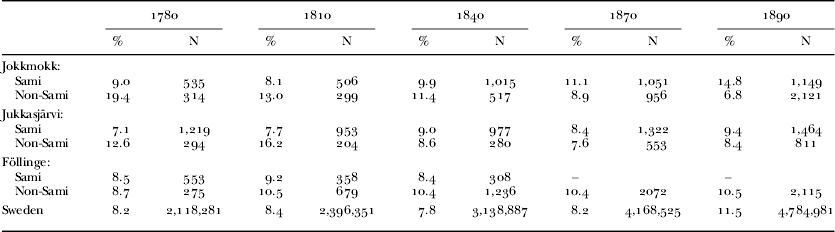
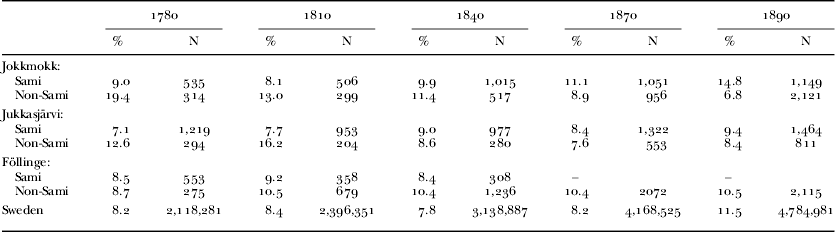
In all three parishes at 1780 and 1810, the Sami population aged 60 and above was considerably lower than the non-Sami population living in the same area. In 1780, the proportion of elderly Sami (⩾60 years old), to non-Sami in Jokkmokk was 9.0 to 19.4, respectively; as compared to 8.2 for Sweden in general. Table 1 shows that the Sami had a higher proportion of elderly (⩾60 years old), from the year 1870 and onward, as compared with the non-Sami living in the same area and with the total population of Sweden. Among the Sami in Jokkmokk parish, the proportion of elderly (⩾60 years old) increased to 14.8 at the end of the 19th century, causing a laterally reversed situation compared to 1780. As is evident from Table 1, there was a shift in the proportion of elderly (⩾60 years old) among the Sami and non-Sami around 1840. The question arises whether this increased proportion of elderly people is distributed across all age groups.
Proportion of elderly (⩾60 years old) in Jokkmokk, Jukkasjärvi (1780–1890), Föllinge (1780–1866) and Sweden (1780–1890)
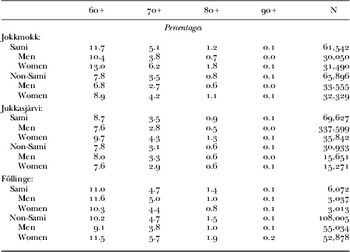
In all three parishes, the proportion of the Sami population over the age of 60 is higher than for the settler population, especially in the parish of Jokkmokk. When the population reaches 70 years of age, the difference between the Sami and the settlers decreased, and once the population is above 90 years of age there is no difference between the two groups. The Sami showed greater difference between the sexes with a surplus of older women, whereas the opposite was found in the settler population. The Sami seem to be more likely to reach ages above 60 years old, especially in the case of women and those living in Jokkmokk or Föllinge. Table 2 shows that there is no evidence that the Sami reached extremely high ages.
Proportion of elderly (⩾60 years old) in Jokkmokk, Jukkasjärvi (1840–1895) and Föllinge Sami parish (1840–1866)

Mortality patterns
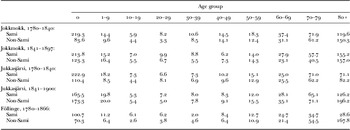
During the period 1780–1840, the largest difference between Sami and settlers in Jokkmokk is found in infant mortality rate, almost three times higher for the Sami (Table 3). The age-specific mortality shows generally higher rates for the Sami in Jokkmokk, compared to the non-Sami population. The only exceptions were people older than 80, where the Sami had a small advantage. During the period 1841–1897, the infant mortality rate was still higher for the Jokkmokk Sami; it was twice as high because the infant mortality rate for the settlers also increased. During the second half of the 19th century, the differences in mortality rate diminished between the two populations in Jokkmokk. Concerning the elderly population (⩾60 years old), the mortality rate is still higher for the Sami, except in the oldest age category (⩾80 years old).
Age-specific death rate and infant mortality in Jokkmokk (1780–1897), Jukkasjärvi (1780–1900) and Föllinge (1780–1866), by age groups and ethnicity

Age-specific mortality during the period 1780–1840 reveals generally higher rates for the Sami in Jukkasjärvi. The largest difference between Sami and settlers in Jukkasjärvi is found in the infant mortality rate, twice as high for the Sami. The age-specific mortality shows higher rates for the elderly Jukkasjärvi Sami aged 70–79 years old. This does not hold true for the oldest members of the population (⩾80 years old). For the Sami living in Jukkasjärvi the mortality pattern changed during the period 1841–1900. The death rates of elderly Sami (aged 70–79 years old) decreased compared to the non-Sami. The infant mortality rate for the settlers increased at the same time as it decreased for the Sami, leading to a higher rate of infant mortality amongst the settlers. For the period of 1841–1900, the differences in the mortality rates of Jukkasjärvi Sami and their non-Sami counterparts generally diminished. At the same time, the mortality rate for the oldest individuals (aged 80 and above) largely increased.
The Sami in Föllinge have higher mortality rates than the settlers, especially among infants and children (aged 1–19 years old). Lower rates are seen among the elderly Föllinge Sami aged 70 and above. The parish of Föllinge shows considerably lower rates (age-specific death rates and infant mortality rate) than Jokkmokk and Jukkasjärvi. According to contemporary observers and official statistics, the county of Jämtland (including the parish of Föllinge) shows extremely low mortality rates during the mid-19th century (BiSOS A 1892).
The age-specific mortality rate for Sami in Sápmi reveals that the Sami generally have higher mortality rates among the elderly (aged 60–70 years old) during the period 1780–1840, compared to the non-Sami population. During the period 1841–1900, the mortality rate among the Sami in Jokkmokk (aged 60–70 years old) was still higher than for the non-Sami population, whereas the pattern changed among the two populations in Jukkasjärvi. During the entire period 1780–1900, the Sami in Sápmi had lower mortality rates among the oldest members of the population (aged 80 and above) compared to the non-Sami population. Age-specific mortality for the Sami older than 80 in Jukkasjärvi was considerably lower during the entire period 1780–1900, than that of the Sami in Jokkmokk.
Causes of death
There is a lot of research on causes of death during historical periods in Sweden. However, we know less about the differences in causes of death as it pertains to indigenous groups and the Sami. It is believed that the Sami lived a healthy life in a favourable climate with good eating habits (von Düben Reference von Düben1873). As a nomadic group, the Sami differed from settled populations in their access to the medical system, as well as in how they viewed different diseases and illness. Some of the mortality during these periods can be attributed to a lack of immunity against diseases and certain epidemics brought to the population from missionaries travelling to the area (Whitehead Reference Whitehead, Salomon and Schwartz1999). In the case of smallpox, the Sami showed a lower mortality rate than in the rest of Sweden at the same time as the epidemics reached a similar size in the Sami area as in Sweden in general. Sköld describes the phenomenon in terms of the Sami's cultural perception of the smallpox; avoidance of exposure to the disease, both in a physical and cultural way (Sköld Reference Sköld1997). The Sami distinguished between natural and supernatural diseases, and when their own cures did not work they attempted to escape the disease, as was their method with smallpox (Sköld Reference Sköld, Lantto and Sköld2004). Among causes of death, the Sami had higher mortality rates for diseases such as pneumonia, nerve fever, influenza and diarrhoea; whereas, the settlers had higher mortality rates for dysentery, laryngitis and typhus (Sköld Reference Sköld, Lantto and Sköld2004). To a higher degree, the Sami suffered from eye diseases due to the extreme weather conditions associated with snow and sunshine, and as a result of smoke in their huts (von Düben Reference von Düben1873). The smoke was also said to cause respiratory diseases. Other factors assumed to cause health problems were alcohol and coffee consumption, especially among women.
Based on previous research about causes of death among the Sami population, the views about the health status among the Sami, and the general causes of death during this era, we make the following hypotheses: the Sami had more respiratory-related causes of death, less infection-related causes of death, and to a higher degree, the Sami died from ‘ageing’.
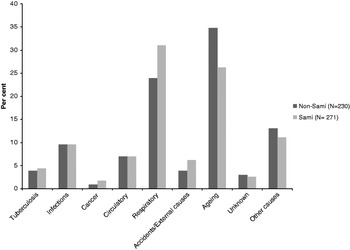
During the period 1750–1900, the two most common causes of death recorded for the Sami and settlers living in Jokkmokk were respiratory illness (31 and 35%, respectively) and age-related causes (26 and 35%, respectively) (Figure 1). As previously shown, the proportion of elderly settlers was extremely high in Jokkmokk, especially during the first period 1750–1840. The Sami had a small surplus of individuals dying from cancer, accidents and tuberculosis, compared to the non-Sami population.
Leading causes of death for elderly (⩾60 years old) in Jokkmokk, by ethnicity, 1750–1900.

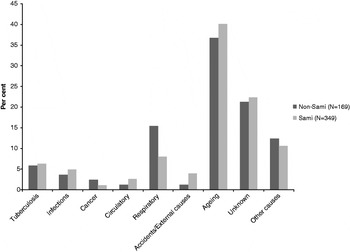
For the Sami and settlers living in Jukkasjärvi the two most common causes of death were age-related causes (40 and 37%, respectively) and unknown diseases/death (22 and 21%, respectively) (Figure 2). The Sami population had a surplus of deaths due to accidents and/or external causes, infections and circulatory diseases, whereas respiratory illness was more common among the settlers.
Leading causes of death for elderly (⩾60 years old) in Jukkasjärvi, by ethnicity, 1750–1900.

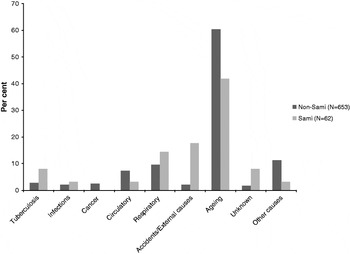
For the Sami and settlers living in Föllinge, by far most common causes of death were age-related causes (42 and 60%, respectively) (Figure 3). The Sami population had a surplus of deaths due to accidents and/or external causes, tuberculosis, infections and respiratory diseases, whereas circulatory illness was more common among the settlers.
Leading causes of death for elderly (⩾60 years old) in Föllinge, by ethnicity, 1750–1866.

In all three parishes, deaths due to accidents and external causes were more common among the Sami population. The analysis showed that respiratory diseases were hardly more common among the Sami population in Jokkmokk and Föllinge than among the non-Sami population. In contrast to what was expected, deaths due to infections were more common among the Sami population, at least in Jokkmokk and Föllinge. Only in Jukkasjärvi did the Sami population show a greater proportion of deaths due to old age. Figures 1–3 show that the differences in causes of death are larger between the three parishes than between the Sami and the non-Sami (note that the Sami population in the parish of Föllinge was small). In Jokkmokk, the Sami population had a higher proportion of elderly (aged 60 and above) dying as a result of respiratory illnesses (31%). The same proportion for the Sami populations in Jukkasjärvi and Föllinge were 8 and 15 per cent, respectively. In Jukkasjärvi and Föllinge around 40 per cent of the Sami population aged 60 and above died because of old age, whereas the same proportion among the Sami in Jokkmokk was 26 per cent. It is worth noting that the second greatest proportion of deaths in the category, ‘unknown’ in Jukkasjärvi, accounts for a very small part of the causes of death in Jokkmokk. Does this indicate that the people living in Jukkasjärvi died from unknown diseases to a higher degree? Or is it attributable to the clergy's inability or oversight in classifying the causes of death? Or did the clergy in Jokkmokk refuse to classify a death as ‘unknown’? These questions are difficult to answer, but there is continuity over time in reporting causes such as ‘unknown’ in Jukkasjärvi, indicating that there could have been some cultural differences in the way the causes were reported in the parishes.
Long-term development
During the period 1750–1849, the most common cause of death for the Sami living in Jokkmokk was respiratory illness and the most common for the settlers were age-related causes. From 1850 onwards, the pattern is the same but the differences between the causes diminished somewhat, and causes like cancer made their debut as the fifth most regular cause of death amongst the Sami. In Jukkasjärvi between 1750 and 1849, almost half of the Sami and non-Sami deaths are classified as age-related; this changes during the period of 1850–1900 when ‘unknown’ diseases constituted around 40 per cent of the classified causes. In Föllinge, old age-related deaths remained the leading cause throughout the 18th and 20th centuries.
Discussion
The analysis has shown that earlier in the colonisation period (1780–1840), the Sami had a lower proportion of elderly people (over 60 years old) as compared to the non-Sami population, and the Swedish population in general. During the mid-19th century, the proportion of elderly Sami (⩾60 years old) significantly increased and at the end of the colonisation era (1841–1900), the proportion of elderly Sami was well above the proportion of elderly non-Sami and more similar to the rest of Sweden. The data did not show that the Sami had a high proportion of the oldest age group (⩾80 years old) or that they reached extremely old ages.
Differences existed between Sami and non-Sami, but differences within the Sami area were also shown among mortality rates and causes of death. Accidents and external causes of death were more common among the Sami population. ‘External causes’ such as drowning among the Sami population may be explained by the importance of fishing and transportation on water. During the colonisation process and structural transformation, the most vulnerable groups were small children and older people, and this is reflected in higher rates of infant and elderly mortality. During the early era of colonisation (1780–1840) the oldest segment of the Sami population (above 80 years of age) were in a better position compared to the non-Sami population, but this changed during the second era (1841–1900). One of the causes of the apparent increase in the mortality rate amongst older people was probably because the information about age at the time of death after 1840 was more accurate.
The most dangerous period was apparently the first year of life, and this is most obvious among the Sami population during the early era of colonisation. During the second era (from 1840), the rate of infant mortality increased among the settlers, whereas it decreased for the Sami in the parish of Jukkasjärvi. The result of this change meant that the infant mortality rate among the settlers was more pronounced than among the Sami. The major change in the population profile started in 1830 when the non-Sami population began to increase at a more rapid rate than the Sami population. This rapid increase in population left its mark in higher infant mortality rates, especially among the non-Sami living in Jukkasjärvi. The lower mortality rates before 1840 can be explained by the fact that the first settlers who moved into the Sami area were mostly adults and older individuals and family formation was delayed. Increased levels of family formation and fertility among the non-Sami population can explain the dramatic decrease in the proportion of older people (aged 60 and above).
According to Omran's study, Sweden entered the third phase of epidemiologic transition in the beginning of the 20th century, a time when this study ends. The results project a complex picture of the epidemiologic transition in the Sápmi area. By using decrease in age-specific mortality rates as indicators of a positive shift in the epidemiological transition, we can draw some conclusions. Firstly, and compared to the rest of Sweden, the Sami as well as the non-Sami population seem to have met this third phase with a delay. The negative consequences of colonisation left their mark in an increase of the mortality rate among the indigenous population, but also among the settlers.
Secondly, we can conclude that the Sami population advanced more rapidly in the model of epidemiologic transition. Mortality rates were generally higher for the Sami population throughout the first period (1780–1840). However, during the second period (1841–1900) the differences between the Sami and non-Sami became more equal, not because of the decrease in mortality rates among Sami, but because of the increased infant mortality rates among the non-Sami.
Finally, the demographic transition was different between the three parishes, especially between the two parishes in the north. The Sami who were living in the parish of Jukkasjärvi had a lower mortality rate than the Sami living in Jokkmokk, whereas the opposite was true for the non-Sami population. Can this difference be explained by the way the population developed in the two parishes? The Sami population in the parish of Jukkasjärvi remained in the majority during the entire period, whereas the Sami population in Jokkmokk lost their majority position. These differences within the Sami population need further analyses to be explained. As previous studies have shown, the parish of Föllinge in the county of Jämtland showed extremely low mortality rates (BiSOS A 1892). What makes the rates in Föllinge significantly lower than those in the two northern parishes? Is there a geographical and/or a cultural explanation for this phenomenon? Or, does the difference have more to do with the way the data are handled? First, we need to remember that the population size differs considerably between the three parishes, especially among the Sami population. The Sami population is small in Föllinge Sami parish, which means that the mortality rate is subject to fluctuations. Second, the Föllinge parish and Föllinge Sami parish have a higher proportion of out-migration. These two factors can make the mortality rates for the southern parishes more ambiguous. Forthcoming research will continue to focus on the differences in mortality rates in the Sápmi region, such as comparing the long-term life expectancy at birth between the Sami and non-Sami population.
Acknowledgements
The research project is part of the activities at the Centre for Sami Research and the interdisciplinary research programme Ageing and Living Conditions at Umeå University. Thanks to the Demographic Data Base for the preparation of data files; to colleagues at the Centre for Sami Research for helpful comments and to Dr Gabriella Nordin at the Centre for Sami Research for the transformation of the ethnic variable.